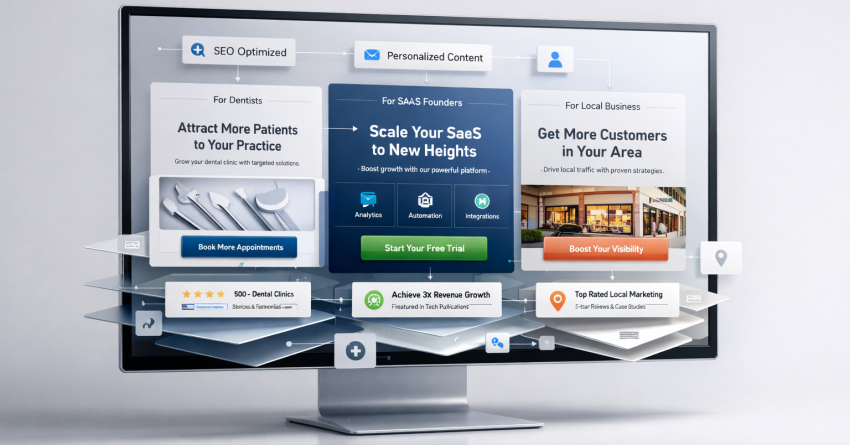
Most websites still say the same thing to everyone.
In 2026, that’s a problem.
People expect pages to speak to their industry, stage, and intent. Smart content (also called dynamic content or personalized experiences) changes what visitors see based on who they are and what they’ve done.
At the same time, search engines still need stable, crawlable, semantic pages to rank well.
This guide shows you how to balance both and how White Label SEO Service helps agencies build smart, adaptive pages as a white-label solution.
Want smart, dynamic pages under your agency brand?
Book a free “Smart Content & SEO Strategy Call” with White Label SEO Service and get a 90-day personalization roadmap for your site or your clients.
What Is Smart Content (in Plain English)?
Smart content is content that changes based on the visitor:
- Their location or device
- Their past visits or downloads
- Their industry or role
- Their position in the funnel
Tools like HubSpot Smart Content, personalization tokens, and similar platforms let you swap headlines, CTAs, case studies, or offers per segment.
Think of it like:
- A billboard = same message to everyone
- A good salesperson = asks questions, then adapts their pitch
Smart content turns your website into the second one.
Studies show that personalization:
- Increases satisfaction and engagemen
- Boosts click-through and conversion rates
- Makes businesses more profitable, according to a big share of marketers
How Top White Label SEO Competitors Work Today
Recent comparisons of white label SEO agencies and tools (DashClicks, The HOTH, SEOReseller, FatJoe, Softtrix, Boostability, more) show clear patterns:
Most of them focus on:
- Technical SEO (audits, fixes, Core Web Vitals)
- On-page SEO (keywords, meta tags, content optimization)
- Link building & digital PR
- Reporting & white-label dashboards
- Content strategy (blogs, landing pages, local SEO)
These are important but here’s the gap.
The Big Gap: Personalization as a Productized Service
From the research, very few white label SEO providers:
- Offer packaged “smart content” or dynamic page services
- Show clear frameworks for segment-based messaging on web pages
- Connect personalization to E-E-A-T and semantic SEO in a structured way
- Include smart content setups (e.g., HubSpot, WordPress personalization) as a visible line item
Most agencies are left to figure out:
- When to personalize
- What to personalize
- How to keep SEO safe while doing
This is where White Label SEO Service can stand out: by offering a white-labeled, “Smart Content + SEO” package that blends personalization, UX, and search best practices.
Smart Content vs SEO: Friends, Not Enemies
Some marketers worry that dynamic content will hurt rankings.
That only happens when it’s used carelessly.
Modern guides on dynamic personalization say: use personalization on top of a stable SEO foundation.
How Smart Content Can Help SEO
- Better engagement: people stay longer and click more when content fits them.
- Lower bounce rates: visitors don’t leave instantly if the page “gets” them.
- More conversions: personalized CTAs and offers convert far better (dynamic CTAs in one study converted over 2x better).
Engagement and relevance are huge indirect ranking signals.
SEO-Friendly Smart Content Principles
- Keep a solid, crawlable base (main HTML, headings, semantic structure).
- Layer personalization inside modules, not as the whole page.
- Avoid “cloaking” (showing engines and humans totally different content).
- Make sure key semantic terms (topics, entities) are present in every variation.
Smart Content Use Cases That Actually Move the Needle
Here’s where dynamic pages shine especially for agencies reselling SEO and CRO.
1. Industry-Specific Messaging on Core Pages
Scenario: Same service, different verticals.
- Visitor A: Dentist
- Visitor B: SaaS founder
Both land on your “SEO Services” page, but they care about different things.
Smart content ideas:
- Change the headline based on industry:
- “SEO that fills your chairs with new patients” (dentists)
- “SEO that fills your pipeline with demo requests” (SaaS)
- Swap case studies and testimonials relevant to each industry.
2. Stage-Based CTAs and Offers
Not everyone is ready to “Book a Call”.
Smart content ideas:
- First-time visitor → offer: checklist or guide
- Returning visitor → offer: audit or strategy session
- Existing lead → offer: proposal or upgrade
Dynamic CTAs and offers are strongly tied to higher conversion rates.
3. Personal Proof and Social Evidence
People trust proof that feels close to them.
Smart content ideas:
- Show logos and case studies based on visitor industry or region
- Rotate testimonials by business size (startup vs enterprise)
- Highlight review snippets that match their goals (more traffic, more leads, better retention)
Want done-for-you smart content frameworks for your agency site?
White Label SEO Service designs and implements dynamic headlines, CTAs, and proof blocks so every visitor feels like your best-fit client.
How White Label SEO Service Builds Smart, Dynamic Pages
Here’s how this becomes a repeatable, white-label service for your agency.
Step 1 Research, Data, and Experience (E-E-A-T)
We start with Experience, Expertise, Authoritativeness, Trustworthiness:
- Study your ideal clients, offers, and current funnel
- Review analytics and CRM data (if available) to see segments and behavior
- Audit your existing pages for semantic coverage (topics, entities, synonyms)
We use trusted benchmarks on personalization, dynamic content, and SEO to shape the strategy.
This shows:
- Real-world experience with SEO and personalization
- Expertise in technical implementation and UX
- Authority through use of industry best practices
- Trust via clear reasoning, transparent recommendations, and safe SEO methods
Step 2 Segmentation and Rules
We help you define smart rules like:
- New vs returning visitors
- Known leads vs unknown visitors
- Industry, size, or location
- Funnel stage (top, middle, bottom)
We then map:
- Which blocks change (hero headlines, CTAs, case studies, FAQs, benefit lists)
- Which stay stable (core value prop, main H1, core semantic key terms)
Tools like HubSpot’s Smart Content and similar CMS features let us implement these rules with clear targeting.
Step 3 Semantic, Personalized Copy & Design
Here’s where we blend smart content with semantic SEO.
Semantic & Topic Coverage
We make sure each page variation still:
- Covers the main topic clearly
- Uses related phrases and synonyms (semantic words)
- Reflects relevant entities: industries, locations, problems, solutions
For example, a smart content block for “SEO for Dentists” might include semantic terms like:
- dental SEO, local dental marketing, new patient bookings, dental website rankings
While a SaaS version might mention:
- SaaS SEO, ARR growth, demo bookings, MQLs, user acquisition
This keeps the page context-rich for both humans and search engines.
E-E-A-T in the Content
We add:
- Real examples and mini case stories
- Author blurbs or brand credentials where appropriate
- Clear policies, contact info, and next steps
So pages don’t just feel “clever” they feel trustworthy.
Step 4 Technical Setup & Testing
Depending on your stack (HubSpot, WordPress, custom CMS):
- Configure smart rules and personalization modules
- Ensure base HTML is indexable and not cloaking
- Test mobile, performance, and Core Web Vitals (smart content can’t slow the site down)
We then A/B test key variations:
- Headlines
- CTA formats and placements
- Types of proof (logos, testimonials, stats)
Step 5 Reporting Your Way (White Label)
You get white-labeled reports showing:
- Segmented conversion rates (by industry, stage, etc.)
- Uplift from smart content vs control
- SEO performance on smart-content pages over time
We often tie in white-label SEO tools and reporting platforms already trusted by agencies.
You present this as your own “Smart Content Performance Report” to clients.
Ready to launch smart content and dynamic pages without building a new team?
Partner with White Label SEO Service and offer “Smart Content + SEO” as a premium service we do the work, you keep the credit.
Who Is This Service For?
Smart, dynamic content from White Label SEO Service is perfect if you are:
- A digital marketing agency wanting to add personalization and CRO to your SEO retainers
- A web design or dev studio that wants sites to feel living, not static
- A B2B or SaaS company that needs segmented messaging for different industries and roles
- A local marketing agency that wants location- or niche-specific proof and offers on the same pages
If your site gets traffic and you want more leads, demos, and sign-ups, smart content is a natural next step.
Key Takeaways
- Smart content = dynamic pages that adapt to each visitor using rules and data.
- Personalization improves engagement, satisfaction, and conversion rates when done right.
- Most top white label SEO providers focus on SEO fundamentals, but rarely productize smart content + personalization as a separate offer.
- SEO and smart content can work together when you keep a stable base, avoid cloaking, and respect semantic structure.
- White Label SEO Service turns this into a white-labeled, repeatable service agencies can resell with strong E-E-A-T and semantic SEO baked in.
Lessons Learned
- Personalization is no longer optional. Static, one-size-fits-all pages are easier to ignore.
- Data should guide your rules. Segments, behavior, and funnel stages tell you what to change and where.
- SEO and smart content must be friends. Keep a solid semantic core and layer personalization on top.
- Productizing smart content is a big opportunity. Most white label SEO competitors don’t package it clearly your agency can.
FAQs
1. Will smart content hurt my SEO?
Not if it’s done correctly.
If your base content is crawlable and each variation still reflects the main topic and entities, personalization can actually help SEO by improving engagement and reducing bounce rate. Issues only appear when people “hide” content from search engines or create messy, slow setups.
2. Do I need special tools to use smart content?
You don’t need to build everything from scratch. Many platforms already support it:
- HubSpot Smart Content and personalization
- Various WordPress plugins and no-code tools
- Custom logic in more advanced CMSs
White Label SEO Service can work with the stack you already have.
3. How long before I see results from smart content?
For sites with steady traffic, you can often see:
- Higher click and conversion rates in weeks
- Clear A/B test results in 30–60 days
- Stronger pipeline and revenue impact in 1–3 quarters, depending on deal cycles
4. Can this work with my existing SEO campaigns?
Yes, that’s the point.
Smart content is:
- Mapped to the same keywords and topics
- Aligned with your existing landing pages and blogs
- Used to improve performance of the traffic you already earn
White Label SEO Service can plug into your current SEO strategy and add a “Smart Content Layer” on top, without breaking what’s already working.