

Technical SEO costs range from $500 for a basic audit to over $100,000 for enterprise implementation, with most businesses investing between $1,000 and $30,000 depending on website complexity, scope of work, and provider type. Understanding these cost variables helps you budget strategically and avoid overpaying for services that don’t match your actual needs.
This pricing reality matters because technical SEO forms the foundation of your entire organic search strategy. Without proper site architecture, crawlability, and performance optimization, even the best content struggles to rank.
This guide breaks down every technical SEO cost factor, pricing model, and budget consideration. You’ll learn exactly what to expect at each investment level and how to maximize your return.
What Is Technical SEO? (And Why Does It Matter for Cost?)
Technical SEO encompasses all optimization work that helps search engines crawl, index, and render your website effectively. Unlike content creation or link building, technical SEO focuses on your site’s infrastructure. The complexity of this infrastructure directly determines how much you’ll pay for optimization services.
Core Components of Technical SEO
Technical SEO covers multiple interconnected systems. Site speed optimization ensures pages load quickly across all devices. Crawlability improvements help search engine bots discover and access your content efficiently. Indexability fixes ensure your important pages appear in search results while keeping low-value pages out.
Mobile optimization addresses responsive design and mobile-first indexing requirements. Site architecture work organizes your content hierarchy and internal linking structure. Schema markup implementation adds structured data that helps search engines understand your content context.
Security configurations include HTTPS implementation and fixing mixed content issues. XML sitemaps and robots.txt files guide crawler behavior. Core Web Vitals optimization addresses Google’s page experience signals including Largest Contentful Paint, First Input Delay, and Cumulative Layout Shift.
How Technical SEO Differs from Content SEO and Off-Page SEO
Content SEO focuses on creating and optimizing pages for specific keywords and user intent. Off-page SEO builds external signals like backlinks and brand mentions. Technical SEO creates the foundation that allows both to perform effectively.
Think of technical SEO as your website’s plumbing and electrical systems. Content is the furniture and décor. Link building is your neighborhood reputation. Without solid infrastructure, everything else underperforms.
This distinction matters for budgeting because technical SEO often requires specialized skills different from content writers or outreach specialists. You may need developers, server administrators, or dedicated technical SEO consultants.
Why Technical SEO Is a Foundation, Not a One-Time Fix
Search engines continuously update their algorithms and technical requirements. Google’s Core Web Vitals became ranking factors in 2021. Mobile-first indexing became the default. New JavaScript frameworks create rendering challenges.
Your website also changes constantly. New pages get added. Plugins update. Server configurations shift. Each change can introduce technical issues that impact search performance.
This ongoing nature means technical SEO requires both initial investment and continuous maintenance. Budget accordingly for both phases rather than treating technical optimization as a one-time project.
What Factors Determine Technical SEO Costs?
Six primary factors influence what you’ll pay for technical SEO services. Understanding each helps you estimate costs accurately and evaluate provider quotes.
Website Size and Complexity
A 50-page brochure site requires far less technical work than a 50,000-page e-commerce catalog. More pages mean more potential issues, longer audit times, and more complex implementation.
Site complexity also matters. A simple WordPress blog differs dramatically from a custom-built web application with multiple databases, user authentication systems, and dynamic content generation. Complex sites require specialists who understand specific technologies.
Expect costs to scale roughly with page count and technical complexity. A site with 100 pages might cost $1,500 to audit. A site with 10,000 pages could cost $7,500 or more for the same depth of analysis.
Current Technical Health and Audit Findings
Sites with severe technical debt cost more to fix. If your site has thousands of broken links, duplicate content issues, crawl errors, and security vulnerabilities, remediation takes longer.
A relatively healthy site might need minor tweaks costing a few thousand dollars. A site with fundamental architecture problems could require $20,000+ in restructuring work.
Initial audits reveal this scope. Many providers offer preliminary assessments to estimate remediation costs before committing to full implementation quotes.
Platform and Technology Stack
WordPress sites with standard themes cost less to optimize than custom platforms. Shopify has different technical constraints than Magento. Headless CMS architectures require JavaScript SEO expertise.
Legacy systems often cost more because fewer specialists understand them. Proprietary platforms may limit what optimizations are even possible without significant development work.
When evaluating quotes, ensure providers have specific experience with your technology stack. Generic SEO knowledge doesn’t translate to effective technical implementation on complex platforms.
Industry Competitiveness and Search Landscape
Highly competitive industries require more aggressive technical optimization. If your competitors have lightning-fast sites with perfect Core Web Vitals scores, matching that performance costs more than simply meeting baseline requirements.
E-commerce, finance, legal, and healthcare sectors typically face intense competition. Local service businesses in smaller markets may need less intensive optimization to outperform competitors.
Your competitive analysis should inform your technical SEO budget. Audit competitor sites to understand the performance benchmarks you need to meet or exceed.
Scope of Work: Audit-Only vs. Audit + Implementation
An audit identifies problems. Implementation fixes them. These are separate services with different costs.
Audit-only engagements typically cost $500 to $7,500 depending on depth and site size. You receive a report of findings and recommendations but handle fixes yourself or with your development team.
Audit plus implementation packages cost significantly more because they include the actual remediation work. Expect $2,500 to $50,000+ depending on issue severity and site complexity.
Some businesses prefer audit-only to control costs and use internal resources for fixes. Others need full-service implementation because they lack technical staff.
Provider Type: Freelancer vs. Agency vs. In-House
Freelance technical SEO specialists typically charge $75 to $200 per hour. They offer flexibility and often lower rates but may have limited availability or narrower expertise.
Agencies charge $150 to $500+ per hour or offer packaged services. They provide broader capabilities, multiple specialists, and more structured processes but cost more.
In-house technical SEO hires cost $70,000 to $150,000+ annually in salary plus benefits, tools, and training. This makes sense for large organizations with ongoing needs but represents significant fixed costs.
Technical SEO Pricing Models Explained
Providers structure their pricing in four main ways. Each model suits different situations and budget preferences.
One-Time Technical SEO Audit Pricing
Audit-only engagements provide a comprehensive assessment of your site’s technical health. You receive a detailed report identifying issues, prioritizing fixes, and recommending solutions.
Pricing ranges from $500 for basic automated audits to $30,000+ for enterprise-level manual analysis. Most mid-market businesses pay $2,000 to $7,500 for thorough audits.
This model works well when you have internal development resources to implement recommendations. It also helps you understand scope before committing to larger implementation budgets.
Monthly Retainer for Ongoing Technical SEO
Retainer arrangements provide continuous technical SEO support. Providers monitor your site, address issues as they arise, and proactively optimize performance.
Monthly retainers typically range from $500 to $10,000+ depending on site size and service level. Most businesses pay $1,500 to $5,000 monthly for comprehensive ongoing support.
This model suits businesses with dynamic websites, frequent content updates, or limited internal technical resources. It ensures continuous optimization rather than periodic fixes.
Project-Based Technical SEO Pricing
Project pricing covers specific technical initiatives with defined scope. Site migrations, platform changes, Core Web Vitals optimization, or international SEO setup often use this model.
Project costs vary dramatically based on scope. A simple HTTPS migration might cost $1,000 to $3,000. A complete site architecture overhaul could cost $25,000 to $75,000.
This model provides budget certainty for defined initiatives. Ensure scope is clearly documented to avoid cost overruns from scope creep.
Hourly Rate Pricing for Technical SEO Consultants
Hourly billing works for advisory services, troubleshooting, or flexible support arrangements. You pay only for time used.
Rates range from $75 to $500+ per hour depending on expertise level and provider type. Senior technical SEO consultants with specialized skills command premium rates.
This model suits businesses needing occasional expert guidance rather than ongoing services. It also works for complex troubleshooting where scope is difficult to estimate upfront.
How Much Does a Technical SEO Audit Cost?
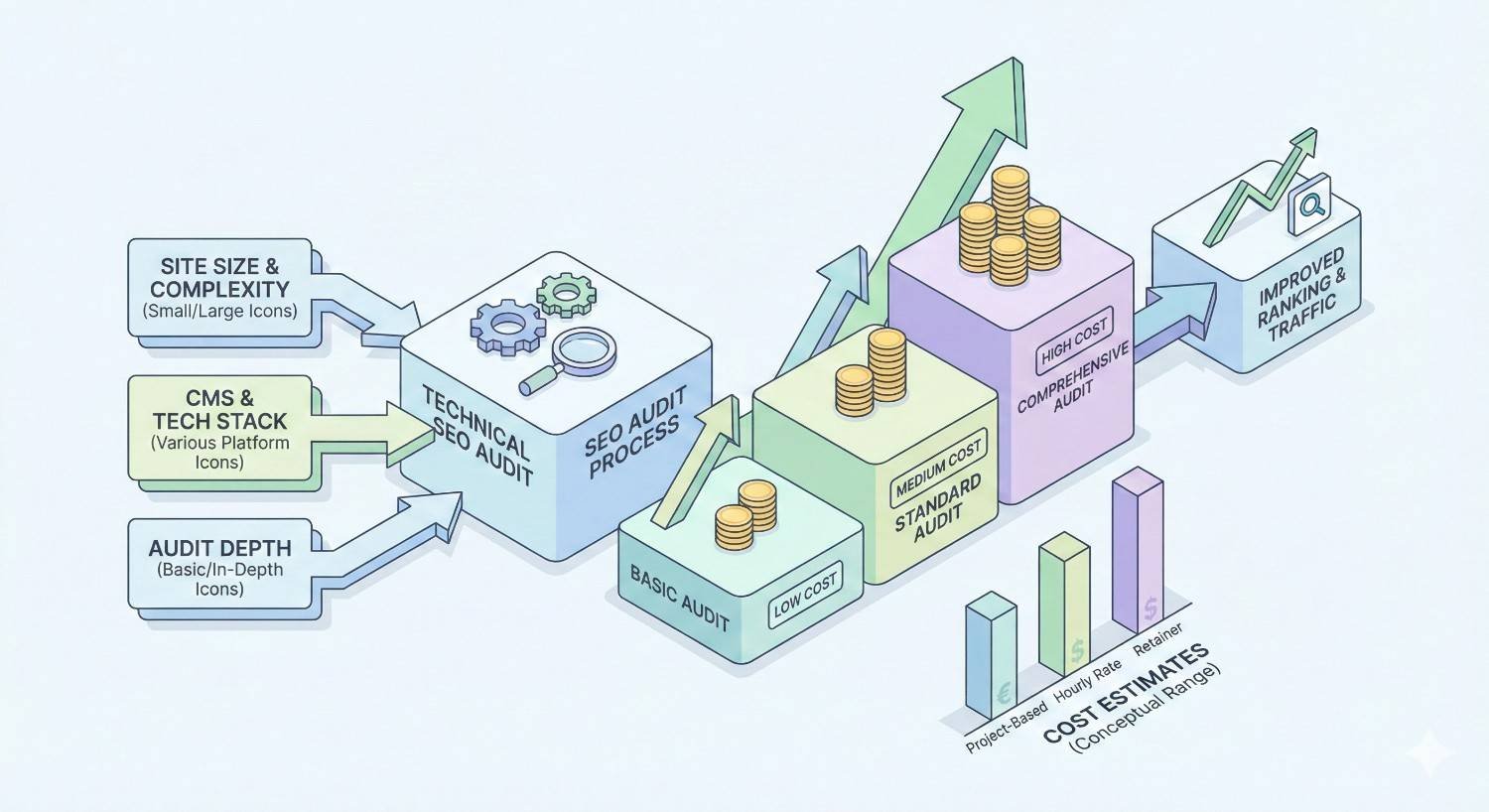
Audit pricing falls into three general tiers based on depth, methodology, and deliverables.
Basic Technical SEO Audit ($500–$2,000)
Basic audits use automated tools to scan your site for common technical issues. You receive a report highlighting crawl errors, broken links, missing meta tags, and obvious performance problems.
These audits work for small sites with straightforward structures. They identify surface-level issues but may miss complex problems requiring manual analysis.
Deliverables typically include a prioritized issue list, basic recommendations, and tool-generated reports. Turnaround is usually one to two weeks.
Comprehensive Technical SEO Audit ($2,000–$7,500)
Comprehensive audits combine automated scanning with manual expert analysis. Specialists review your site architecture, crawl behavior, indexation patterns, and performance metrics in depth.
This tier suits mid-market businesses with moderately complex sites. Auditors examine JavaScript rendering, mobile usability, structured data implementation, and competitive technical benchmarks.
Deliverables include detailed findings, prioritized action plans, implementation guidance, and often a presentation walkthrough. Expect three to six weeks for thorough analysis.
Enterprise Technical SEO Audit ($7,500–$30,000+)
Enterprise audits address large-scale sites with complex technical environments. Multiple specialists may analyze different aspects including server configuration, CDN setup, database optimization, and international targeting.
These audits suit sites with hundreds of thousands of pages, multiple subdomains, complex JavaScript frameworks, or significant technical debt. They often include stakeholder interviews and cross-functional recommendations.
Deliverables include comprehensive documentation, executive summaries, technical specifications for developers, and roadmap planning. Timelines extend to two to three months for thorough enterprise analysis.
What’s Included in Each Audit Tier
| Component | Basic | Comprehensive | Enterprise |
| Automated crawl analysis | ✓ | ✓ | ✓ |
| Manual expert review | Limited | ✓ | ✓ |
| Competitor benchmarking | ✗ | ✓ | ✓ |
| JavaScript rendering analysis | ✗ | ✓ | ✓ |
| Server log analysis | ✗ | Limited | ✓ |
| Custom tool development | ✗ | ✗ | ✓ |
| Stakeholder interviews | ✗ | ✗ | ✓ |
| Implementation support | ✗ | Limited | ✓ |
How Much Does Technical SEO Implementation Cost?
Implementation costs depend on your business size, issue severity, and whether you need ongoing support.
Small Business/Startup Implementation ($1,000–$5,000)
Small business implementation addresses common issues on sites under 500 pages. Work typically includes fixing crawl errors, optimizing page speed, implementing basic schema markup, and resolving mobile usability problems.
This budget suits businesses with relatively healthy sites needing optimization rather than major overhauls. Implementation usually completes within one to three months.
Expect providers to prioritize high-impact fixes within budget constraints. Not every issue gets addressed, but critical problems affecting rankings receive attention.
Mid-Market Business Implementation ($5,000–$20,000)
Mid-market implementation handles more complex sites with significant technical debt. Work may include site architecture restructuring, comprehensive schema implementation, Core Web Vitals optimization, and crawl budget management.
This budget suits businesses with 500 to 50,000 pages facing moderate to serious technical challenges. Implementation timelines extend to three to six months depending on scope.
Providers at this level often coordinate with your development team, providing specifications and guidance while your engineers execute changes.
Enterprise Implementation ($20,000–$100,000+)
Enterprise implementation addresses large-scale technical challenges requiring specialized expertise. Work may include platform migrations, international SEO setup, custom tool development, and fundamental architecture changes.
This budget suits organizations with complex technical environments, multiple stakeholders, and significant organic search revenue at stake. Implementation can extend beyond twelve months for major initiatives.
Enterprise engagements often include dedicated project management, regular stakeholder reporting, and integration with broader digital transformation efforts.
Ongoing Technical Maintenance Costs ($500–$5,000/month)
After initial implementation, ongoing maintenance prevents technical regression and addresses new issues. Monthly costs depend on site size, change frequency, and service level.
Basic monitoring and quarterly reviews cost $500 to $1,500 monthly. Active management with continuous optimization costs $2,000 to $5,000+ monthly.
Maintenance includes monitoring for new crawl errors, addressing algorithm updates, optimizing new content, and maintaining performance standards.
Technical SEO Cost Breakdown by Service Type
Different technical SEO services carry different price tags. Understanding individual service costs helps you prioritize investments.
Site Speed and Core Web Vitals Optimization
Speed optimization addresses page load times and Google’s Core Web Vitals metrics. Work includes image optimization, code minification, caching configuration, and render-blocking resource elimination.
Costs range from $1,000 to $15,000 depending on current performance and improvement targets. Sites with severe performance issues or complex architectures cost more to optimize.
Google’s PageSpeed Insights provides free baseline measurements. Aim for scores above 90 on mobile for competitive advantage.
Mobile Optimization and Responsive Design Fixes
Mobile optimization ensures your site performs well on smartphones and tablets. Work addresses responsive design issues, touch target sizing, viewport configuration, and mobile-specific performance problems.
Costs range from $500 to $10,000 depending on existing mobile experience quality. Sites built without mobile-first principles require more extensive work.
With mobile-first indexing, Google primarily uses your mobile site for ranking. Poor mobile experience directly impacts search visibility.
Crawlability and Indexability Improvements
Crawlability work ensures search engines can discover and access your content. Indexability work controls which pages appear in search results.
Services include robots.txt optimization, XML sitemap creation, canonical tag implementation, and crawl budget management. Costs range from $500 to $5,000 for most sites.
Large sites with millions of pages may require more sophisticated crawl optimization costing $10,000+ including log file analysis and custom solutions.
Site Architecture and Internal Linking Restructure
Architecture work organizes your content hierarchy and navigation structure. Internal linking optimization distributes page authority and helps users find content.
Costs range from $2,000 to $25,000 depending on restructuring scope. Minor linking improvements cost less than complete architecture overhauls.
Architecture changes often require coordination with UX designers, content strategists, and developers. Budget for cross-functional collaboration.
Schema Markup and Structured Data Implementation
Schema markup helps search engines understand your content context. Implementation enables rich results like review stars, FAQ dropdowns, and product information in search results.
Basic schema implementation costs $500 to $2,000. Comprehensive structured data strategies for large sites cost $3,000 to $10,000+.
Schema types vary by industry. E-commerce sites need Product and Review schema. Local businesses need LocalBusiness schema. Publishers need Article and FAQ schema.
HTTPS Migration and Security Fixes
HTTPS migration secures your site with SSL certificates. Security fixes address vulnerabilities that could harm users or trigger search engine warnings.
Simple HTTPS migrations cost $500 to $2,000. Complex migrations with multiple subdomains or legacy systems cost $3,000 to $10,000.
HTTPS is a confirmed Google ranking factor. Unsecured sites display browser warnings that damage user trust and conversion rates.
International SEO and Hreflang Setup
International SEO optimizes your site for multiple countries or languages. Hreflang tags tell search engines which content version to show different audiences.
Implementation costs range from $2,000 to $15,000 depending on the number of markets and content variations. Ongoing management adds monthly costs.
Incorrect hreflang implementation causes duplicate content issues and wrong-country rankings. Expert setup prevents costly mistakes.
JavaScript SEO and Rendering Optimization
JavaScript SEO ensures search engines can render and index content generated by JavaScript frameworks. Work addresses client-side rendering issues, dynamic content, and single-page application challenges.
Costs range from $3,000 to $20,000 depending on framework complexity. React, Angular, and Vue applications each present unique challenges.
JavaScript SEO requires specialized expertise. Not all technical SEO providers have deep JavaScript knowledge. Verify capabilities before hiring.
Freelancer vs. Agency vs. In-House: Cost Comparison
Your provider choice significantly impacts both cost and outcomes. Each option has distinct advantages and limitations.
Freelance Technical SEO Specialist Costs
Freelancers typically charge $75 to $200 per hour or $1,000 to $5,000 for project-based work. Monthly retainers range from $1,500 to $4,000.
Advantages include lower rates, direct communication, and flexibility. Disadvantages include limited availability, narrower expertise, and potential reliability concerns.
Freelancers work well for specific projects or ongoing advisory relationships. They may struggle with large-scale implementations requiring multiple skill sets.
SEO Agency Technical SEO Costs
Agencies charge $150 to $500+ per hour or offer packaged services. Monthly retainers range from $3,000 to $15,000+ for comprehensive technical SEO.
Advantages include broader capabilities, multiple specialists, structured processes, and accountability. Disadvantages include higher costs and potentially less personalized attention.
Agencies suit businesses needing comprehensive services, multiple skill sets, or enterprise-level support. They provide more resources but at premium prices.
In-House Technical SEO Hire Costs
In-house technical SEO specialists command salaries of $70,000 to $150,000+ annually depending on experience and location. Add 20-30% for benefits, tools, and training.
Total annual cost ranges from $90,000 to $200,000+ for a fully-loaded in-house position. This makes sense only for organizations with substantial ongoing needs.
Advantages include dedicated focus, deep organizational knowledge, and immediate availability. Disadvantages include high fixed costs, single-point-of-failure risk, and limited perspective.
Which Option Delivers the Best ROI?
ROI depends on your specific situation. Consider these factors:
Choose freelancers when: Budget is limited, needs are specific, or you want advisory support alongside internal resources.
Choose agencies when: You need comprehensive services, lack internal expertise, or require enterprise-level capabilities.
Choose in-house when: Technical SEO is core to your business, needs are continuous, and you can justify the fixed cost investment.
Many businesses use hybrid approaches. An in-house coordinator manages strategy while agencies or freelancers handle specialized implementation.
Hidden Costs and Additional Expenses to Consider
Technical SEO quotes often exclude related expenses. Budget for these additional costs to avoid surprises.
Developer and Engineering Resources
Technical SEO recommendations require implementation. Unless your provider handles development, you need engineering resources to make changes.
Developer costs range from $50 to $200+ per hour depending on skill level and location. Complex implementations may require $5,000 to $50,000+ in development work beyond SEO consulting fees.
Clarify implementation responsibilities upfront. Some providers include development. Others provide specifications for your team to execute.
SEO Tools and Software Subscriptions
Professional technical SEO requires specialized tools. Crawlers, log analyzers, and monitoring platforms carry subscription costs.
Essential tools cost $200 to $1,000+ monthly. Enterprise tool stacks can exceed $5,000 monthly. Common tools include Screaming Frog, Ahrefs, Semrush, and Lumar.
Some providers include tool costs in their fees. Others expect you to provide tool access or pay separately.
Hosting and Infrastructure Upgrades
Technical SEO recommendations may require hosting improvements. Faster servers, CDN implementation, or increased resources add costs.
Hosting upgrades range from $50 to $500+ monthly for most businesses. Enterprise infrastructure changes can cost $10,000+ for implementation plus ongoing fees.
Poor hosting limits what technical optimization can achieve. Budget for infrastructure improvements if current hosting constrains performance.
Content Management System (CMS) Limitations
Some CMS platforms limit technical SEO capabilities. Proprietary systems may prevent certain optimizations. Legacy platforms may require expensive customization.
CMS migrations cost $5,000 to $100,000+ depending on site size and complexity. Sometimes migration is more cost-effective than working around platform limitations.
Evaluate whether your current platform supports your technical SEO goals. Factor potential migration costs into long-term planning.
Third-Party Integrations and Plugin Costs
Technical SEO may require new plugins, integrations, or third-party services. Schema plugins, caching solutions, and CDN services add costs.
Plugin and integration costs range from free to $500+ monthly depending on functionality. Premium solutions often outperform free alternatives.
Audit your current tech stack for gaps. Budget for tools that enable recommended optimizations.
How to Budget for Technical SEO: A Strategic Approach
Strategic budgeting maximizes technical SEO impact while managing costs effectively.
Assessing Your Current Technical SEO Needs
Start with a baseline assessment. Run your site through free tools like Google Search Console, PageSpeed Insights, and Screaming Frog’s free version.
Identify obvious issues: crawl errors, slow pages, mobile problems, security warnings. This preliminary analysis helps you estimate scope before engaging providers.
Consider your business goals. Are you launching new products? Entering new markets? Recovering from a traffic drop? Different goals require different technical priorities.
Prioritizing Technical SEO Fixes by Impact
Not all technical issues matter equally. Prioritize fixes based on potential traffic and revenue impact.
High priority issues include: indexation problems preventing pages from ranking, severe speed issues causing user abandonment, and mobile problems affecting the majority of your traffic.
Medium priority issues include: schema markup opportunities, minor speed improvements, and crawl efficiency optimizations.
Low priority issues include: minor validation errors, aesthetic code improvements, and edge-case fixes affecting few users.
Focus budget on high-impact fixes first. Address lower priorities as resources allow.
Allocating Budget Across Audit, Implementation, and Maintenance
A balanced technical SEO budget typically allocates:
Audit phase: 10-20% of first-year budget. Invest in thorough analysis before committing to implementation.
Implementation phase: 50-70% of first-year budget. This is where most value gets created through actual fixes.
Maintenance phase: 20-30% of ongoing budget. Continuous monitoring and optimization prevent regression.
Adjust ratios based on your situation. Sites with severe issues need more implementation budget. Healthy sites need more maintenance focus.
Building a 6–12 Month Technical SEO Roadmap
Create a phased roadmap rather than trying to fix everything immediately. This approach manages costs and allows for learning.
Months 1-2: Comprehensive audit and prioritization. Understand full scope before committing resources.
Months 3-6: High-priority implementation. Address critical issues affecting rankings and user experience.
Months 7-9: Medium-priority implementation. Optimize areas with moderate impact potential.
Months 10-12: Refinement and maintenance. Fine-tune optimizations and establish ongoing monitoring.
Review and adjust the roadmap quarterly based on results and changing priorities.

What ROI Can You Expect from Technical SEO?
Technical SEO investment should generate measurable returns. Understanding realistic expectations helps you evaluate success.
Traffic and Ranking Improvements from Technical Fixes
Technical fixes remove barriers preventing your content from ranking. Results vary based on issue severity and competitive landscape.
Sites with severe technical problems often see 20-50%+ traffic increases after fixing critical issues. Sites with minor issues see more modest gains.
Ranking improvements typically appear within 2-6 months after implementation. Google needs time to recrawl and reevaluate your site.
Conversion Rate Gains from Better Site Performance
Faster sites convert better. Google research shows that improving Core Web Vitals correlates with lower bounce rates and higher engagement.
Speed improvements of one second can increase conversions by 7% or more. Mobile performance improvements often show even larger gains.
Calculate potential conversion value when budgeting. A $10,000 speed optimization investment that increases conversions by 5% pays for itself quickly on high-traffic sites.
Long-Term Value: Technical SEO as Infrastructure Investment
Technical SEO creates lasting value. Unlike paid advertising that stops when you stop paying, technical improvements continue benefiting your site.
Proper site architecture supports content scaling. Fast performance maintains user satisfaction as traffic grows. Clean technical foundations reduce future maintenance costs.
Think of technical SEO as infrastructure investment rather than marketing expense. The value compounds over time.
Measuring Technical SEO Success: Key Metrics to Track
Track these metrics to evaluate technical SEO ROI:
Crawl metrics: Pages crawled per day, crawl errors, indexation rate. Monitor in Google Search Console.
Performance metrics: Core Web Vitals scores, page load times, mobile usability. Track in PageSpeed Insights and Search Console.
Ranking metrics: Keyword positions, SERP features, visibility scores. Monitor in rank tracking tools.
Traffic metrics: Organic sessions, pages per session, bounce rate. Analyze in Google Analytics.
Business metrics: Organic conversions, revenue from organic traffic, cost per acquisition. Connect to your analytics and CRM.
How to Choose the Right Technical SEO Provider
Provider selection significantly impacts outcomes. Use these criteria to evaluate options.
Questions to Ask Before Hiring
Ask potential providers:
“What is your specific experience with our platform/technology stack?”
“Can you share case studies from similar projects?”
“Who will actually do the work? What are their qualifications?”
“How do you prioritize recommendations?”
“What does your reporting include and how often?”
“How do you handle implementation? Do you work with our developers or provide your own?”
“What happens if we don’t see results?”
Detailed answers reveal expertise and professionalism. Vague responses suggest limited capabilities.
Red Flags to Avoid in Technical SEO Pricing
Watch for these warning signs:
Prices far below market rates. Quality technical SEO requires expertise that commands fair compensation.
Guaranteed rankings. No one can guarantee specific positions. Search algorithms are beyond any provider’s control.
Vague deliverables. Unclear scope leads to disputes and disappointment.
No discovery process. Providers quoting without understanding your site can’t accurately estimate work.
Pressure tactics. Legitimate providers don’t use high-pressure sales techniques.
No references or case studies. Established providers have track records they can share.
Evaluating Technical SEO Case Studies and Results
Request case studies relevant to your situation. Look for:
Specific metrics: Traffic increases, ranking improvements, performance gains with actual numbers.
Similar contexts: Sites comparable to yours in size, industry, or technical challenges.
Realistic timelines: Results achieved over reasonable periods, not overnight miracles.
Clear attribution: Evidence that technical SEO caused the improvements, not other factors.
Contact references when possible. Ask about communication, deliverables, and whether they’d hire the provider again.
Understanding Deliverables and Reporting
Clarify exactly what you’ll receive:
Audit deliverables: Report format, level of detail, prioritization framework, implementation guidance.
Implementation deliverables: What gets fixed, documentation of changes, before/after measurements.
Reporting frequency: Weekly, monthly, quarterly updates. What metrics are included.
Communication channels: Email, calls, project management tools. Response time expectations.
Written agreements prevent misunderstandings. Document deliverables, timelines, and success criteria before starting.
DIY Technical SEO vs. Hiring a Professional: Cost-Benefit Analysis
Some technical SEO work suits DIY approaches. Other work requires professional expertise.
When DIY Technical SEO Makes Sense
DIY works well for:
Basic optimizations: Installing caching plugins, compressing images, fixing obvious broken links.
Monitoring: Using free tools to track performance and identify issues.
Simple implementations: Adding basic schema markup, creating XML sitemaps, configuring robots.txt.
Learning: Building foundational knowledge before engaging professionals.
DIY suits technically comfortable site owners with time to learn and implement. It works best for small sites with straightforward structures.
When to Hire a Technical SEO Expert
Hire professionals for:
Complex diagnostics: Identifying root causes of ranking drops or crawl problems.
Platform-specific expertise: Optimizing Shopify, Magento, custom platforms, or JavaScript frameworks.
Large-scale implementations: Site migrations, architecture overhauls, international SEO setup.
High-stakes situations: Sites generating significant revenue where mistakes are costly.
Time constraints: When you need results faster than learning curves allow.
Professional expertise prevents expensive mistakes and accelerates results.
Free and Low-Cost Technical SEO Tools
Start with these free tools:
Google Search Console: Crawl data, indexation status, Core Web Vitals, mobile usability.
Google PageSpeed Insights: Performance analysis and improvement recommendations.
Screaming Frog (free version): Crawl up to 500 URLs for technical analysis.
Google Rich Results Test: Validate structured data implementation.
Mobile-Friendly Test: Check mobile usability issues.
Low-cost tools under $100/month include Screaming Frog paid version, Sitebulb, and various Chrome extensions for technical analysis.
The True Cost of Technical SEO Mistakes
DIY mistakes can cost more than professional services. Common expensive errors include:
Blocking important pages: Incorrect robots.txt changes preventing indexation.
Redirect loops: Broken redirect chains crashing site performance.
Canonical confusion: Wrong canonical tags causing duplicate content issues.
Speed regressions: Plugin conflicts or configuration errors slowing sites.
Migration disasters: Lost rankings from poorly executed platform changes.
Recovery from major mistakes can cost $10,000 to $50,000+ in emergency remediation and lost revenue. Factor risk into DIY decisions.
Common Technical SEO Pricing Mistakes to Avoid
Avoid these budgeting errors that waste money or limit results.
Choosing Based on Price Alone
The cheapest option rarely delivers the best value. Low-cost providers often lack expertise, use automated-only approaches, or cut corners on implementation.
Compare value, not just price. A $5,000 audit that identifies critical issues and provides actionable guidance delivers more value than a $500 automated report you can’t act on.
Evaluate expertise, deliverables, and track record alongside pricing.
Underestimating Implementation Complexity
Audits identify problems. Fixing them requires additional investment. Many businesses budget for audits but not implementation.
Implementation typically costs 2-5x the audit investment. A $3,000 audit might reveal $10,000 in necessary fixes.
Budget for the full cycle: audit, implementation, and maintenance. Partial investment yields partial results.
Skipping Ongoing Maintenance and Monitoring
Technical SEO isn’t a one-time project. Sites change. Algorithms update. New issues emerge.
Skipping maintenance leads to technical regression. Issues you fixed return. New problems go undetected.
Budget $500 to $5,000 monthly for ongoing technical SEO maintenance depending on site size and complexity.
Not Aligning Technical SEO with Business Goals
Technical SEO should support business objectives, not exist in isolation. Optimizing pages that don’t drive revenue wastes budget.
Connect technical priorities to business metrics. Focus on pages that generate leads, sales, or other valuable actions.
Communicate business goals to your technical SEO provider. Alignment ensures investment drives meaningful results.
Technical SEO Cost by Industry and Business Type
Different industries face different technical SEO challenges and costs.
E-commerce Technical SEO Costs
E-commerce sites face unique challenges: large product catalogs, faceted navigation, duplicate content from product variations, and complex site architecture.
Typical e-commerce technical SEO costs:
- Audit: $3,000 to $15,000
- Implementation: $10,000 to $50,000
- Monthly maintenance: $2,000 to $7,500
Product schema markup, category page optimization, and crawl budget management are common priorities.
SaaS and Tech Company Technical SEO Costs
SaaS sites often use JavaScript frameworks that create rendering challenges. Documentation sites may have thousands of pages requiring careful architecture.
Typical SaaS technical SEO costs:
- Audit: $2,500 to $10,000
- Implementation: $7,500 to $35,000
- Monthly maintenance: $1,500 to $5,000
JavaScript SEO, documentation structure, and international targeting are common priorities.
Local Business Technical SEO Costs
Local businesses typically have smaller sites with simpler technical needs. Focus areas include mobile optimization, local schema markup, and Google Business Profile integration.
Typical local business technical SEO costs:
- Audit: $500 to $2,000
- Implementation: $1,000 to $5,000
- Monthly maintenance: $300 to $1,000
LocalBusiness schema, mobile performance, and NAP consistency are common priorities.
Enterprise and Multi-Location Technical SEO Costs
Enterprise sites face scale challenges: millions of pages, multiple subdomains, complex governance, and legacy systems.
Typical enterprise technical SEO costs:
- Audit: $10,000 to $50,000
- Implementation: $50,000 to $250,000+
- Monthly maintenance: $5,000 to $25,000
Crawl budget optimization, international SEO, and cross-team coordination are common priorities.
Media and Publishing Technical SEO Costs
Publishers manage high-volume content with frequent updates. News sites need fast indexation. Archive management and pagination create unique challenges.
Typical publishing technical SEO costs:
- Audit: $3,000 to $12,000
- Implementation: $8,000 to $40,000
- Monthly maintenance: $2,000 to $8,000
Article schema, pagination handling, and Core Web Vitals for ad-heavy pages are common priorities.
How Technical SEO Costs Fit into Your Overall SEO Budget
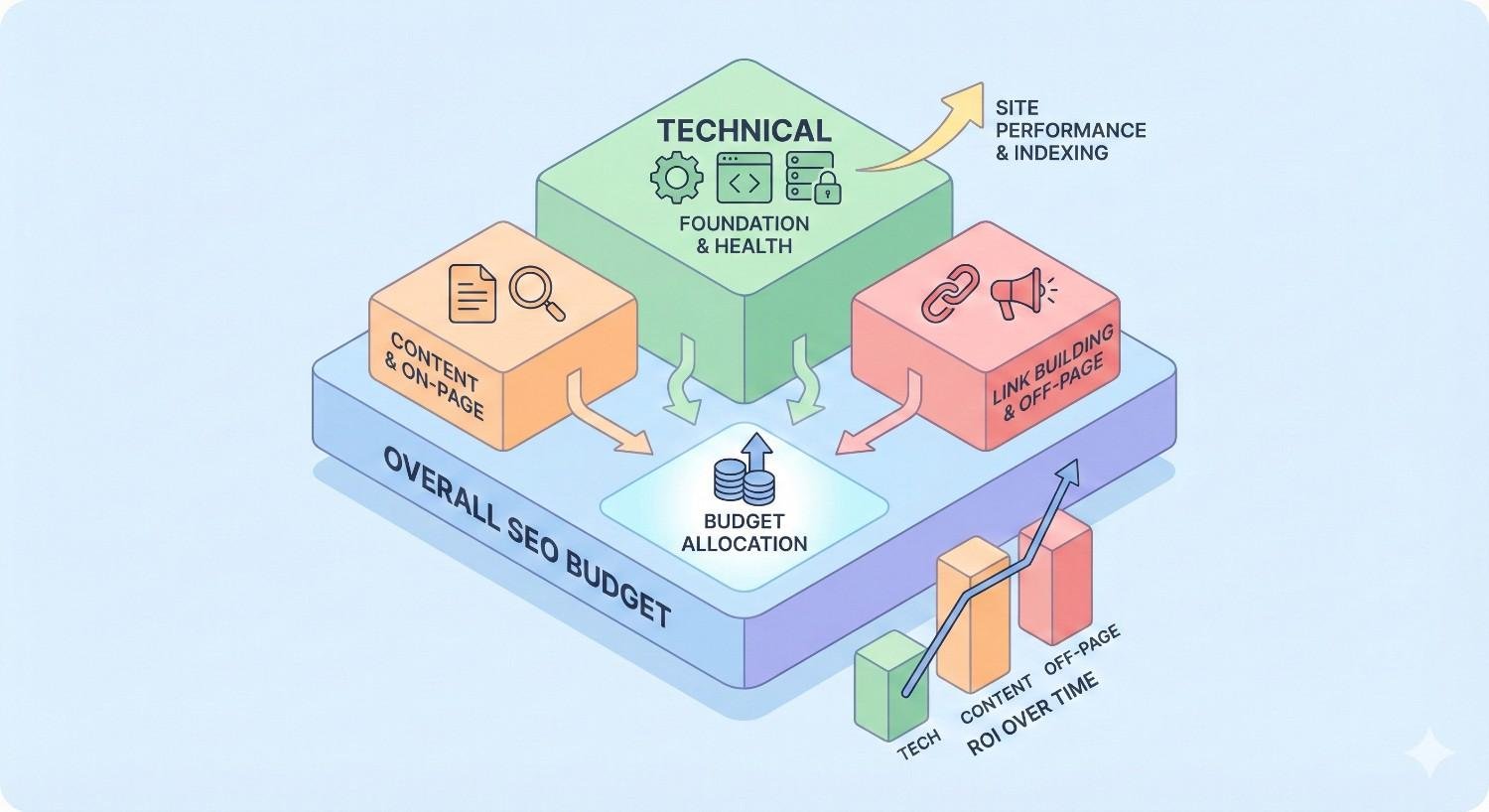
Technical SEO is one component of comprehensive search optimization. Balance investment across all SEO disciplines.
Technical SEO vs. Content SEO Budget Allocation
Content SEO creates the pages that rank. Technical SEO ensures those pages can rank. Both are necessary.
Typical allocation for established sites: 20-30% technical, 50-60% content, 20-30% off-page.
New sites or sites with significant technical debt may need 40-50% technical allocation initially, shifting toward content as foundations stabilize.
Technical SEO vs. Link Building Budget Allocation
Link building builds authority. Technical SEO ensures that authority translates to rankings.
Sites with strong technical foundations benefit more from link building. Sites with technical problems may see limited link building ROI.
Fix critical technical issues before investing heavily in link building. Authority signals matter less if search engines can’t properly crawl and index your content.
Balancing Short-Term Fixes with Long-Term Strategy
Some technical fixes deliver immediate impact. Others build long-term foundations.
Short-term priorities: Critical crawl errors, severe speed issues, mobile problems affecting current traffic.
Long-term priorities: Architecture improvements, schema expansion, performance optimization for competitive advantage.
Balance quick wins with strategic investments. Both contribute to sustainable organic growth.
When to Increase Your Technical SEO Investment
Increase technical SEO budget when:
Launching major initiatives: New products, market expansion, or platform changes require technical support.
Experiencing traffic declines: Technical issues often cause ranking drops. Increased investment may be needed for diagnosis and recovery.
Scaling content production: More content requires stronger technical foundations to support crawling and indexation.
Facing increased competition: Competitors improving their technical performance raises the bar you need to meet.
Preparing for algorithm updates: Proactive technical optimization reduces vulnerability to algorithm changes.
Real-World Technical SEO Pricing Examples and Case Studies
These examples illustrate typical technical SEO investments and outcomes.
Case Study: Small Business Technical SEO Audit and Implementation
Business: Local service company with 75-page WordPress site
Challenge: Slow page speed, missing schema markup, mobile usability issues
Investment:
- Basic audit: $1,200
- Implementation: $3,500
- Total: $4,700
Timeline: 8 weeks
Results:
- Page speed improved from 2.8s to 1.4s
- Mobile usability score increased from 65 to 94
- Organic traffic increased 35% over 6 months
Case Study: Mid-Market Site Migration and Technical Overhaul
Business: B2B software company migrating from legacy CMS to headless architecture
Challenge: Platform migration without losing rankings, JavaScript rendering optimization, international SEO setup
Investment:
- Comprehensive audit: $6,500
- Migration planning and support: $18,000
- Post-migration optimization: $8,500
- Total: $33,000
Timeline: 6 months
Results:
- Zero ranking loss during migration
- Core Web Vitals scores improved across all metrics
- International traffic increased 45% after hreflang implementation
Case Study: Enterprise Technical SEO Retainer
Business: E-commerce retailer with 500,000+ product pages
Challenge: Crawl budget optimization, faceted navigation management, ongoing Core Web Vitals maintenance
Investment:
- Initial enterprise audit: $22,000
- Monthly retainer: $8,500
- Annual investment: $124,000
Results:
- Crawl efficiency improved 60%
- Indexed page count optimized from 800,000 to 450,000 (removing low-value pages)
- Organic revenue increased 28% year-over-year
Frequently Asked Questions About Technical SEO Costs
How much should I budget for technical SEO monthly?
Most businesses should budget $1,500 to $5,000 monthly for ongoing technical SEO maintenance. Smaller sites with stable structures may need only $500 to $1,000. Enterprise sites often require $5,000 to $15,000+ monthly for comprehensive support.
Is technical SEO a one-time cost or ongoing?
Technical SEO requires both initial investment and ongoing maintenance. Initial audits and implementation are one-time costs. However, continuous monitoring, algorithm adaptation, and optimization of new content require ongoing investment to maintain results.
What’s the difference between a $500 and $5,000 technical audit?
A $500 audit typically uses automated tools with minimal expert analysis. A $5,000 audit includes comprehensive manual review, competitive benchmarking, prioritized recommendations, and implementation guidance from experienced specialists.
Can I do technical SEO myself to save money?
Basic technical SEO tasks suit DIY approaches if you have technical comfort and time to learn. Complex diagnostics, platform-specific optimization, and large-scale implementations typically require professional expertise to avoid costly mistakes.
How long does technical SEO take to show results?
Technical SEO improvements typically show measurable results within 2-6 months. Critical fixes like resolving indexation issues may show faster impact. Comprehensive optimizations like site architecture changes take longer to fully reflect in rankings.
Do I need technical SEO if my site is new?
New sites benefit from technical SEO foundations from the start. Proper setup prevents problems that become expensive to fix later. Budget for technical SEO during site development rather than treating it as an afterthought.
What’s more important: technical SEO or content?
Both are essential. Technical SEO creates the foundation that allows content to rank. Great content on a technically broken site underperforms. Prioritize fixing critical technical issues, then balance investment between technical maintenance and content creation.
Conclusion: Making Smart Technical SEO Investment Decisions
Technical SEO costs range from $500 for basic audits to $100,000+ for enterprise implementations. Most businesses invest $3,000 to $30,000 for initial optimization plus $1,500 to $5,000 monthly for ongoing maintenance. Your specific costs depend on site size, technical complexity, and business goals.
Strategic budgeting starts with understanding your current technical health and prioritizing fixes by business impact. Allocate resources across audit, implementation, and maintenance phases rather than treating technical SEO as a one-time project.
We help businesses build sustainable organic growth through comprehensive technical SEO services. White Label SEO Service provides expert audits, implementation support, and ongoing optimization tailored to your specific needs and budget. Contact us for a technical SEO assessment and customized pricing proposal.