
Top-of-funnel SaaS keywords are the search terms your ideal customers use before they know your product exists. These informational and problem-aware queries represent the earliest stage of the buyer journey, where prospects research challenges, explore concepts, and seek education rather than solutions.
For SaaS companies competing in crowded markets, TOFU keywords create the first touchpoint with future customers. They build the organic traffic foundation that feeds your entire marketing funnel.
This guide covers everything from identifying and prioritizing TOFU keywords to creating content that ranks, measuring performance, and connecting awareness-stage traffic to pipeline growth.
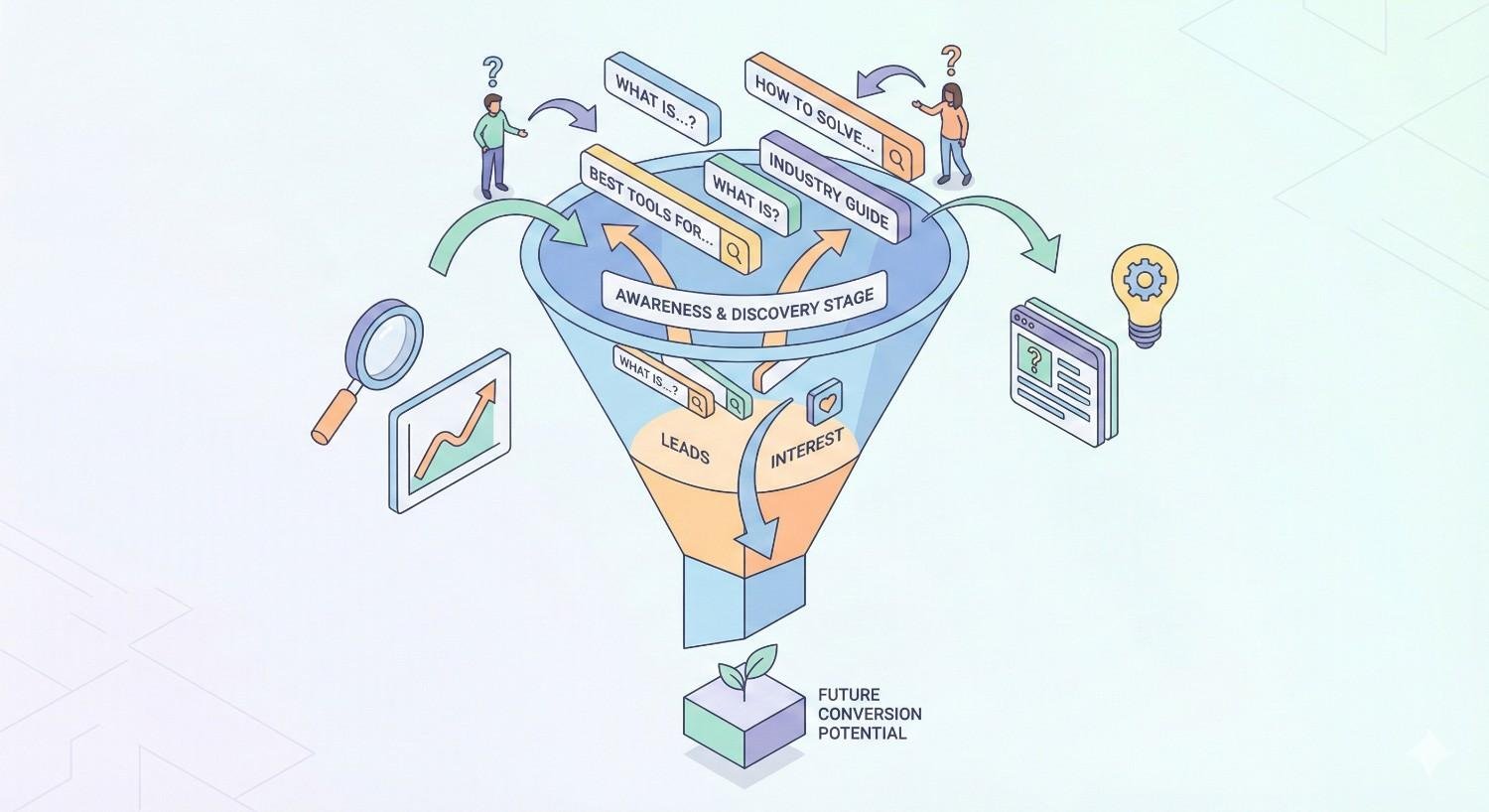
What Are Top-of-Funnel SaaS Keywords?
Top-of-funnel keywords represent the awareness stage of the SaaS buyer journey. Understanding their characteristics helps you target the right searches and create content that resonates with early-stage prospects.
Definition and Core Characteristics
Top-of-funnel SaaS keywords are search queries used by people who have a problem or interest but haven’t started evaluating specific solutions. These keywords typically exhibit high search volume, broad intent, and educational focus.
The defining characteristics include informational search intent, general topic focus, and low commercial commitment. Someone searching “how to improve team productivity” isn’t ready to buy project management software. They’re exploring a challenge.
TOFU keywords often contain question modifiers like “what is,” “how to,” “why does,” and “guide to.” They focus on problems, concepts, and industry topics rather than product categories or brand names.
Search volume tends to be higher than bottom-funnel terms because more people experience problems than actively shop for solutions. However, conversion rates are lower since these searchers need nurturing before they’re ready to evaluate products.
How TOFU Keywords Differ from MOFU and BOFU Keywords
The marketing funnel divides keywords into three stages based on buyer readiness. Each stage requires different content approaches and success metrics.
Top-of-funnel (TOFU) keywords target awareness. Examples include “what is customer churn,” “remote team communication challenges,” or “benefits of automation.” Searchers want education, not sales pitches.
Middle-of-funnel (MOFU) keywords target consideration. Examples include “best CRM software for startups,” “Salesforce vs HubSpot,” or “CRM pricing comparison.” Searchers are evaluating solution categories.
Bottom-of-funnel (BOFU) keywords target decision. Examples include “HubSpot free trial,” “Salesforce implementation cost,” or “buy CRM software.” Searchers are ready to purchase.
The key difference lies in commercial intent. TOFU searchers don’t know they need your product category yet. MOFU searchers know the category but not the vendor. BOFU searchers are comparing specific options.
Content strategy must match these intent differences. TOFU content educates without selling. MOFU content compares options objectively. BOFU content removes purchase friction.
The Role of TOFU Keywords in the SaaS Buyer Journey
SaaS purchases rarely happen impulsively. The average B2B buying cycle involves multiple stakeholders, extensive research, and careful evaluation. TOFU keywords capture prospects at the beginning of this journey.
Consider a marketing manager struggling with lead attribution. Their search journey might start with “why is marketing attribution difficult,” progress to “multi-touch attribution models,” then “best marketing attribution software,” and finally “Bizible pricing.”
Each search represents a different funnel stage. By ranking for the earliest queries, you establish brand awareness before competitors enter the conversation. You become the trusted resource that educated them about the problem.
This early positioning creates significant advantages. Prospects who learn from your content develop familiarity and trust. When they’re ready to evaluate solutions, your brand already has credibility.
TOFU keywords also expand your addressable audience. Not everyone searching “how to reduce customer churn” will buy your retention software. But some will. And you’ll never reach them if you only target “customer retention software.”
Why Top-of-Funnel Keywords Matter for SaaS Growth
TOFU keywords deliver strategic value beyond immediate conversions. They build the organic foundation that supports sustainable SaaS growth across multiple dimensions.
Building Brand Awareness at Scale
Paid advertising builds awareness but stops when budgets run out. TOFU content creates compounding awareness that grows over time.
Every ranking TOFU article introduces your brand to new prospects. These impressions accumulate. Someone might encounter your content five times across different searches before they ever consider your product category.
This repeated exposure builds brand recognition. When prospects eventually need your solution, they remember the company that educated them. Brand recall influences vendor shortlists and demo requests.
TOFU content also positions your company as a thought leader. Comprehensive, helpful content signals expertise. Prospects trust companies that demonstrate deep understanding of their challenges.
The scale potential is significant. A single well-ranking TOFU article can generate thousands of monthly visitors. A content library targeting dozens of TOFU keywords creates substantial organic reach.
Capturing Demand Before Competitors
Most SaaS companies focus SEO efforts on high-intent keywords. They compete fiercely for “best project management software” while ignoring “how to manage remote teams effectively.”
This creates opportunity. TOFU keywords often have lower competition because the conversion path is less direct. Companies focused on immediate ROI overlook awareness-stage traffic.
By capturing prospects early, you influence their journey before competitors engage. You shape how they think about the problem. You introduce concepts that align with your solution’s strengths.
Early capture also builds remarketing audiences. Visitors who read your TOFU content can be retargeted with MOFU and BOFU content. You nurture them through the funnel on your terms.
The competitive advantage compounds over time. As your TOFU content library grows, you capture more early-stage prospects. Competitors who ignored awareness-stage SEO must work harder to win prospects you’ve already engaged.
Creating Sustainable Organic Traffic Pipelines
TOFU keywords create traffic foundations that support entire marketing operations. This organic pipeline reduces dependence on paid channels and improves unit economics.
Sustainable traffic means predictable lead flow. Unlike paid campaigns that fluctuate with budget changes, organic traffic from established content remains relatively stable. You can forecast and plan around consistent visitor volumes.
The economics improve over time. Content creation requires upfront investment, but ongoing costs are minimal. A three-year-old article ranking for a TOFU keyword delivers essentially free traffic.
This sustainability matters for SaaS metrics. Customer acquisition cost (CAC) decreases as organic traffic grows. Marketing efficiency improves. Payback periods shorten.
TOFU traffic also diversifies acquisition channels. Over-reliance on any single channel creates risk. Organic traffic from educational content provides a stable foundation that complements paid, social, and referral channels.
Types of Top-of-Funnel SaaS Keywords
TOFU keywords fall into distinct categories based on searcher mindset and content expectations. Understanding these types helps you build comprehensive keyword coverage.
Problem-Aware Keywords
Problem-aware keywords express challenges without implying solution awareness. Searchers know something is wrong but haven’t identified what might fix it.
Examples include “why do sales reps miss quota,” “customer support response time too slow,” and “employee onboarding takes too long.” These queries describe symptoms rather than seeking cures.
Content targeting problem-aware keywords should validate the problem, explore its causes, and discuss its impact. You’re helping searchers understand their situation more deeply.
The content can introduce solution categories without being promotional. “One approach companies use to address slow response times is help desk software” educates without selling.
Problem-aware keywords often have strong emotional resonance. Searchers are frustrated. Content that acknowledges their pain and provides genuine insight builds trust and engagement.
Educational and How-To Keywords
Educational keywords seek knowledge and skill development. Searchers want to learn concepts, processes, or techniques relevant to their work.
Examples include “how to calculate customer lifetime value,” “what is product-led growth,” and “guide to sales forecasting.” These queries expect comprehensive, instructional content.
How-to keywords often have high search volume because they serve broad audiences. Anyone in marketing might search “how to calculate CLV,” regardless of their software stack.
Content should deliver genuine educational value. Thorough explanations, step-by-step processes, examples, and templates perform well. The goal is becoming the definitive resource for that topic.
Educational content naturally positions your expertise. A company that publishes the best guide to sales forecasting demonstrates deep understanding of sales operations. That expertise transfers to product credibility.
Industry Trend Keywords
Trend keywords focus on changes, developments, and emerging topics within an industry. Searchers want to stay current and understand what’s happening in their field.
Examples include “AI in customer service trends,” “remote work statistics 2025,” and “SaaS pricing model changes.” These queries expect timely, data-informed content.
Trend content requires regular updates to maintain relevance. A “2024 trends” article loses value in 2025. Plan for annual refreshes or evergreen framing.
These keywords attract engaged professionals who actively follow their industry. They’re often decision-makers or influencers within their organizations.
Trend content also earns links and shares. Original research, unique data analysis, and insightful predictions get referenced by other publications. This builds domain authority.
Comparison and Alternative Keywords (Early Stage)
Early-stage comparison keywords explore categories rather than specific products. Searchers are learning what options exist without evaluating particular vendors.
Examples include “types of CRM software,” “project management methodologies compared,” and “cloud vs on-premise software.” These differ from BOFU comparisons like “Salesforce vs HubSpot.”
Content should objectively explain different approaches, their strengths, and their ideal use cases. Avoid pushing your solution. Provide genuinely balanced information.
This objectivity builds trust. Searchers recognize when content is helpful versus promotional. Balanced comparison content positions you as a trustworthy guide.
These keywords often lead to MOFU searches. Someone who reads “types of CRM software” might next search “best CRM for small business.” Your internal linking can guide this progression.
Definition and “What Is” Keywords
Definition keywords seek clear explanations of terms, concepts, or technologies. Searchers encounter unfamiliar terminology and want basic understanding.
Examples include “what is SaaS,” “customer success definition,” and “what does MRR mean.” These queries expect concise, accessible explanations.
Definition content should start with a clear, direct answer. The first paragraph should define the term completely. Subsequent sections can add depth, examples, and context.
These keywords often have featured snippet opportunities. Google frequently pulls definition content into position zero. Structure content with the definition prominently displayed.
Definition keywords serve as entry points to broader topics. Someone learning “what is customer success” might explore related concepts. Internal linking to deeper content captures this interest.
How to Find Top-of-Funnel SaaS Keywords
Systematic keyword research uncovers TOFU opportunities your competitors miss. Multiple methods and sources ensure comprehensive coverage.
Keyword Research Tools and Methods
Professional keyword research tools provide the foundation for TOFU keyword discovery. Each tool offers different data and capabilities.
Ahrefs and Semrush provide search volume, keyword difficulty, and related keyword suggestions. Start with seed terms related to your product category and explore the suggestions.
Filter for informational intent. Both tools classify keywords by intent type. Focus on informational and educational queries rather than commercial or transactional.
Look for question keywords specifically. Filter for queries containing “how,” “what,” “why,” “when,” and “guide.” These typically indicate TOFU intent.
Explore the “Questions” reports in these tools. They aggregate question-format queries related to your seed terms. This surfaces queries you might not discover through standard keyword research.
Use Google Keyword Planner for additional volume data. While designed for ads, it provides search volume estimates useful for prioritization.
Analyzing Competitor TOFU Strategies
Competitor analysis reveals proven TOFU keywords and content gaps you can exploit. Study what’s working for others in your space.
Identify competitors ranking for educational content. Use Ahrefs or Semrush to analyze their organic keywords. Filter for informational intent and high-traffic pages.
Examine their blog content specifically. What topics do they cover? What questions do they answer? Which articles drive the most traffic?
Look for patterns in their keyword targeting. Do they focus on specific subtopics? Do they target certain question formats? Understanding their strategy reveals opportunities.
Identify gaps in competitor coverage. Topics they haven’t addressed or keywords where their content is weak represent opportunities for you to capture.
Don’t just copy competitor strategies. Use their success as validation, then create better content. Aim to be more comprehensive, more current, and more useful.
Mining Customer Questions and Pain Points
Your existing customers and prospects reveal TOFU keywords through their questions and challenges. This internal data often surfaces opportunities tools miss.
Review sales call recordings and notes. What questions do prospects ask before they understand your product category? What problems do they describe? These become keyword targets.
Analyze support tickets and chat logs. Customer questions reveal knowledge gaps. If customers ask “how do I calculate X,” prospects probably search for the same thing.
Survey customers about their research process. Ask what they searched for before finding your product. Ask what resources helped them understand their problem.
Interview customer-facing teams. Sales, support, and customer success teams hear questions daily. Their insights identify topics prospects care about.
This research often reveals long-tail keywords with high relevance. Tools might miss “how to convince my boss to approve software budget,” but your sales team hears this concern regularly.
Using Search Intent Signals
Search intent signals help distinguish TOFU keywords from other funnel stages. Learn to read these signals accurately.
Examine the SERP for each keyword. What type of content ranks? If results are primarily educational blog posts and guides, the keyword is likely TOFU. If results show product pages and pricing, it’s BOFU.
Look at the featured snippet type. Definition boxes suggest informational intent. Product carousels suggest commercial intent. The SERP layout reveals what Google believes searchers want.
Check “People Also Ask” questions. These related queries indicate the broader topic context. TOFU keywords typically have PAA questions focused on understanding rather than purchasing.
Review the top-ranking content. Is it educational or promotional? Does it explain concepts or sell products? The content that ranks reveals the intent Google rewards.
Consider the searcher’s likely next step. After reading content for this keyword, what would they do? If the answer is “learn more,” it’s TOFU. If it’s “request a demo,” it’s BOFU.
Leveraging Google Autocomplete and PAA
Google’s own features reveal what people actually search. These free resources surface keyword variations and related queries.
Use Google Autocomplete systematically. Type your seed keyword and note the suggestions. Add letters after your keyword to see more variations. “How to improve” followed by each letter reveals dozens of queries.
Explore “People Also Ask” boxes thoroughly. Click on questions to expand more related questions. This cascading feature reveals extensive question networks around your topic.
Check “Related Searches” at the bottom of results pages. These queries show what else people search in the same session. They often reveal adjacent TOFU topics.
Use tools that aggregate autocomplete data. AnswerThePublic visualizes autocomplete suggestions organized by question type. AlsoAsked maps PAA question relationships.
Document everything systematically. Create a spreadsheet tracking keywords, search volume, difficulty, and intent classification. This becomes your TOFU keyword database.
Evaluating and Prioritizing TOFU Keywords
Not all TOFU keywords deserve equal attention. Systematic evaluation ensures you invest in keywords that drive meaningful business results.
Search Volume vs. Intent Quality
High search volume doesn’t guarantee value. A keyword with 10,000 monthly searches but irrelevant intent wastes resources. Balance volume against relevance.
Evaluate whether searchers could become customers. “What is project management” has high volume but attracts students, job seekers, and casual researchers alongside potential buyers.
Consider the specificity of intent. “How to manage remote engineering teams” has lower volume than “remote work tips” but attracts a more defined audience likely to need collaboration software.
Look for keywords where your expertise provides unique value. Generic topics attract generic audiences. Specialized topics attract prospects who need specialized solutions.
Calculate potential value, not just traffic. A keyword bringing 500 highly relevant visitors might generate more pipeline than one bringing 5,000 random visitors.
Keyword Difficulty and Competition Analysis
Keyword difficulty scores estimate how hard it will be to rank. Use these scores to identify realistic opportunities given your domain authority.
Compare your domain authority to competitors ranking for each keyword. If top results come from sites with DA 80+ and yours is DA 30, that keyword requires significant investment.
Look beyond difficulty scores to actual competition. Who ranks currently? How good is their content? A high-difficulty keyword with mediocre ranking content might be winnable.
Consider your content creation capabilities. Can you produce something substantially better than what exists? If not, even low-difficulty keywords might not be worth pursuing.
Factor in time to rank. New sites might need 6-12 months to rank for competitive keywords. Prioritize lower-difficulty keywords for early wins while building authority for harder targets.
Mapping Keywords to Business Relevance
Business relevance measures how closely a keyword connects to your product and ideal customer profile. High relevance keywords attract prospects who could actually buy.
Score keywords on ICP alignment. Does the searcher match your ideal customer profile? A keyword attracting enterprise IT directors matters more to enterprise software than one attracting small business owners.
Evaluate problem-solution fit. Does the keyword relate to problems your product solves? “How to reduce customer churn” is highly relevant for retention software, less so for accounting software.
Consider the path to conversion. How many steps separate this keyword from a purchase decision? Shorter paths indicate higher relevance.
Map keywords to your product’s value propositions. Keywords that connect to your core differentiators have higher strategic value than tangentially related topics.
Building a TOFU Keyword Scoring Framework
A scoring framework systematizes prioritization. Consistent criteria prevent subjective decisions and ensure resources go to highest-value opportunities.
Create a weighted scoring model with factors like:
- Search volume (1-10 scale)
- Keyword difficulty inverse (1-10, where 10 is easiest)
- Business relevance (1-10)
- Content creation feasibility (1-10)
- Competitive gap opportunity (1-10)
Assign weights based on your priorities. A startup might weight difficulty higher (need quick wins). An established company might weight volume higher (can compete for harder keywords).
Calculate composite scores and rank keywords. The highest-scoring keywords become your priority targets.
Review and adjust the framework quarterly. As your domain authority grows and content library expands, your prioritization criteria should evolve.
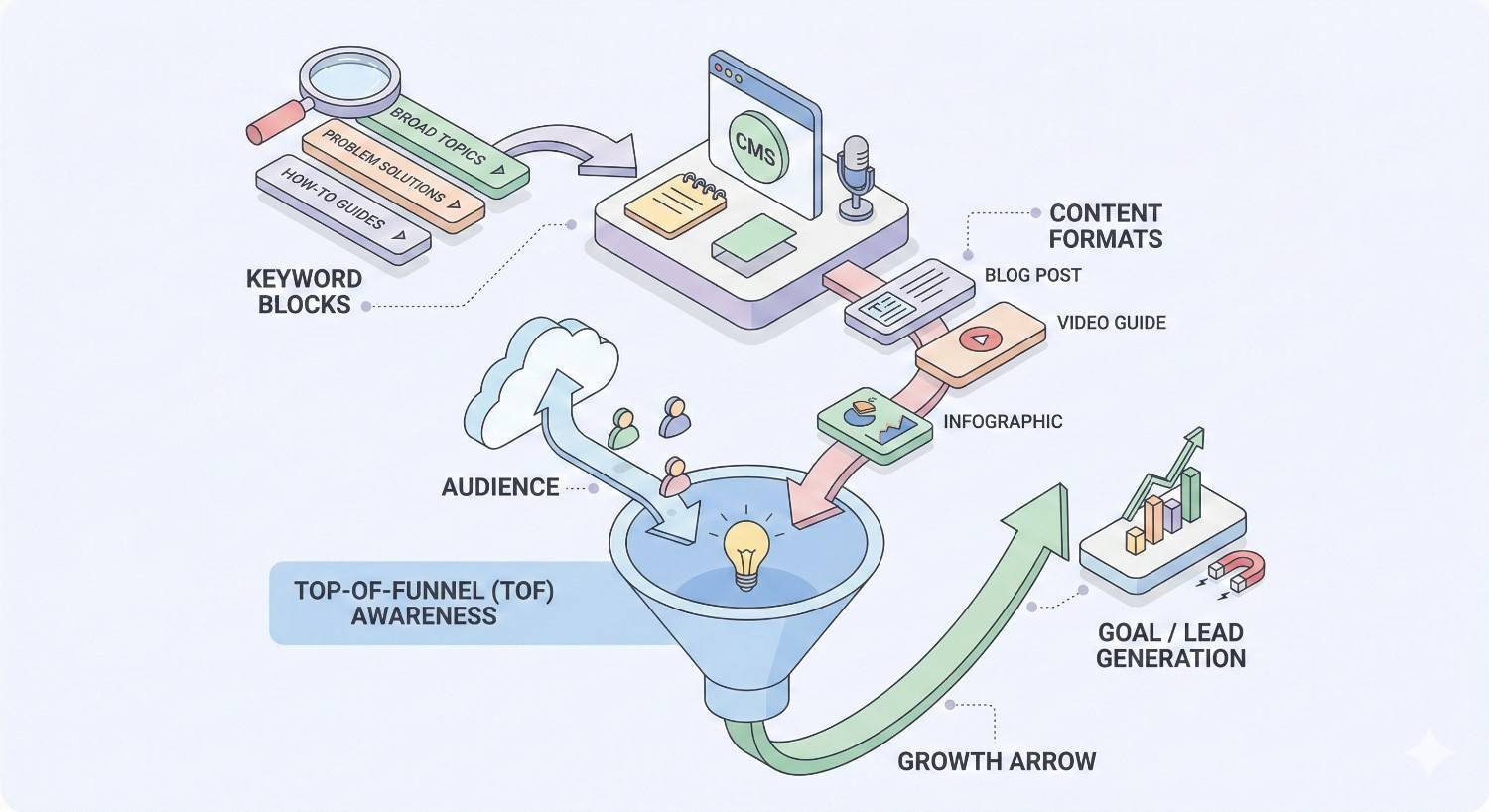
Creating Content for Top-of-Funnel SaaS Keywords
TOFU content must educate genuinely while building brand awareness. The format, structure, and approach all influence performance.
Content Formats That Work for TOFU
Different formats serve different TOFU purposes. Match format to keyword intent and audience preferences.
Blog Posts and Guides
Long-form blog posts and comprehensive guides dominate TOFU content. They provide the depth searchers expect for educational queries.
Aim for thoroughness over brevity. TOFU searchers want complete answers. A 3,000-word guide that covers every aspect of a topic outperforms a 500-word overview.
Structure content for scanning. Use clear headings, short paragraphs, bullet points, and visual breaks. Readers should find specific information quickly.
Include practical elements. Templates, checklists, frameworks, and examples add tangible value. Readers bookmark and share content they can actually use.
Update content regularly. TOFU topics evolve. Annual reviews ensure accuracy and maintain rankings.
Infographics and Visual Content
Visual content explains complex concepts quickly. Infographics, diagrams, and charts enhance understanding and shareability.
Use visuals to simplify complicated topics. A flowchart explaining a process communicates faster than paragraphs of text.
Create original graphics rather than stock images. Custom visuals demonstrate investment and expertise. They also earn links when others embed them.
Optimize images for search. Descriptive file names, alt text, and surrounding context help images rank in Google Images, driving additional traffic.
Consider visual content as supplements to written content. An infographic embedded in a comprehensive guide adds value. A standalone infographic without context provides less SEO benefit.
Videos and Webinars
Video content captures attention and explains concepts effectively. Some audiences prefer watching to reading.
Create videos for topics that benefit from demonstration. “How to set up X” works better as video than text. Conceptual explanations might work equally well in either format.
Host videos on YouTube for additional search visibility. YouTube is the second-largest search engine. Optimize titles, descriptions, and tags for discovery.
Embed videos in blog content. This increases time on page and provides format options for different learning preferences.
Webinars capture leads while delivering TOFU content. Live events create urgency. Recordings provide ongoing value.
Interactive Tools and Calculators
Interactive content engages users actively. Calculators, assessments, and tools provide personalized value.
Build tools that solve specific problems. A “customer lifetime value calculator” serves TOFU searchers while demonstrating your expertise in retention metrics.
Interactive content earns links naturally. Other sites reference useful tools. This builds domain authority.
Capture leads through tool access. Require email for results or offer enhanced features for registered users. Balance lead capture against user experience.
Maintain tools over time. Broken calculators damage credibility. Budget for ongoing maintenance.
Structuring TOFU Content for SEO Performance
Content structure affects both rankings and user experience. Optimize structure for search engines and readers simultaneously.
Start with a clear, direct answer. The first paragraph should address the core query. This satisfies searchers and positions content for featured snippets.
Use heading hierarchy logically. H2s for main sections, H3s for subsections. This helps search engines understand content organization.
Include the target keyword in strategic locations: H1, first paragraph, at least one H2, and naturally throughout the content. Avoid forced repetition.
Add semantic variations naturally. Use related terms, synonyms, and conceptually connected phrases. This signals topical depth to search engines.
Structure for featured snippets. Use definition paragraphs, numbered lists, and tables where appropriate. Format content how Google displays it in SERPs.
Include internal links to related content. Connect TOFU articles to MOFU content, product pages, and other relevant resources. This distributes authority and guides user journeys.
Balancing Education with Brand Introduction
TOFU content should educate first and promote second. Heavy-handed selling alienates awareness-stage readers.
Lead with value. The majority of content should deliver genuine education. Readers should learn something useful regardless of whether they ever consider your product.
Introduce your brand contextually. Mention your product where naturally relevant, not forced. “Tools like [Your Product] help teams implement this approach” works. “Buy [Your Product] today” doesn’t.
Use author bios and about sections for brand building. These elements establish credibility without interrupting educational content.
Include soft CTAs appropriate to the funnel stage. “Subscribe for more insights” fits TOFU better than “Request a demo.” Match the call to action to reader readiness.
Let quality build brand perception. Exceptional content reflects well on your company. Readers associate helpful resources with trustworthy brands.
Measuring TOFU Keyword Performance
TOFU metrics differ from conversion-focused measurements. Track the right indicators to understand awareness-stage content performance.
Key Metrics for Top-of-Funnel Success
TOFU success metrics focus on reach, engagement, and audience building rather than immediate conversions.
Organic traffic measures content visibility. Track sessions from organic search to TOFU content. Growth indicates improving rankings and expanded reach.
Keyword rankings show search visibility. Monitor position changes for target keywords. Track movement into top 10, top 3, and featured snippets.
Impressions and click-through rate from Google Search Console reveal search presence. High impressions with low CTR suggest title/description optimization opportunities.
Engagement metrics indicate content quality. Time on page, scroll depth, and pages per session show whether content resonates. Low engagement suggests content doesn’t match intent.
New vs. returning visitors tracks audience building. TOFU content should attract new visitors. High new visitor percentages indicate successful awareness generation.
Email subscribers and content downloads measure lead capture. These micro-conversions indicate interest beyond casual reading.
Attribution Challenges and Solutions
Connecting TOFU traffic to eventual revenue is notoriously difficult. Long sales cycles and multiple touchpoints obscure the relationship.
The challenge: Someone reads your TOFU article today, returns via paid ad in three months, and converts via direct visit six months later. Standard last-click attribution credits the direct visit, ignoring the TOFU content that started the journey.
Implement multi-touch attribution to capture TOFU influence. First-touch attribution credits the initial touchpoint. Linear attribution distributes credit across all touchpoints.
Use assisted conversion reports in Google Analytics. These show which channels and content contributed to conversions without being the final touchpoint.
Track micro-conversions from TOFU content. Newsletter signups, content downloads, and return visits indicate engagement even without immediate purchase.
Survey customers about their research journey. Ask how they first discovered your company. This qualitative data supplements analytics.
Accept that some TOFU value is unmeasurable. Brand awareness and trust-building don’t always show in attribution reports. Directionally correct measurement is better than false precision.
Connecting TOFU Traffic to Pipeline and Revenue
Despite attribution challenges, you can build reasonable connections between TOFU content and business outcomes.
Track content consumption in your CRM. When leads enter your pipeline, record which content they consumed. Over time, patterns emerge showing which TOFU content influences deals.
Implement content scoring in marketing automation. Assign points for TOFU content consumption. Higher scores indicate more engaged prospects.
Analyze closed-won deals for content touchpoints. What did customers read before becoming customers? This retrospective analysis reveals influential content.
Calculate content-influenced pipeline. Tag opportunities where contacts consumed specific content. Sum the pipeline value associated with each content piece.
Build cohort analyses. Track visitors who consumed TOFU content and measure their conversion rates over 6-12 months. Compare against visitors who didn’t consume that content.
Report on leading indicators while building lagging indicator data. Traffic and engagement today predict pipeline influence months from now.
Top-of-Funnel Keywords vs. Full-Funnel SaaS SEO Strategy
TOFU keywords work best as part of a comprehensive funnel strategy. Integration with MOFU and BOFU content maximizes overall SEO impact.
Integrating TOFU with MOFU and BOFU Keywords
A complete SEO strategy covers all funnel stages. Each stage serves different purposes and requires different content approaches.
TOFU content builds audience and authority. It attracts the largest visitor volumes and establishes topical expertise. Without TOFU, you’re invisible to early-stage prospects.
MOFU content captures consideration-stage searches. Comparison guides, category overviews, and evaluation content serve prospects actively researching solutions.
BOFU content converts ready buyers. Product pages, pricing information, and competitor comparisons serve prospects ready to purchase.
Balance investment across stages based on your situation. New companies might prioritize BOFU for immediate revenue. Established companies might invest more in TOFU for long-term growth.
Create content pathways between stages. TOFU articles should link to relevant MOFU content. MOFU content should link to BOFU pages. Guide visitors through the funnel.
Content Hub and Pillar Page Strategies
Content hubs organize related content around central themes. This structure builds topical authority and improves user navigation.
Create pillar pages for major topics. These comprehensive resources cover a topic broadly and link to detailed subtopic content. “The Complete Guide to Customer Retention” links to articles on churn analysis, retention strategies, and success metrics.
Cluster content around pillars. Each cluster article targets a specific subtopic keyword and links back to the pillar. This internal linking structure signals topical relationships to search engines.
TOFU keywords often form the foundation of content clusters. Educational and problem-aware keywords become cluster articles supporting broader pillar topics.
Plan hub architecture before creating content. Map keywords to pillars and clusters. Ensure comprehensive coverage without redundancy.
Update pillar pages as you add cluster content. Pillars should link to all relevant cluster articles. This keeps the hub structure current.
Internal Linking for Funnel Progression
Strategic internal linking guides visitors from awareness to consideration to decision. Links create pathways through your content.
Link TOFU content to relevant MOFU content. An article on “what is customer churn” should link to “best customer retention software.” This natural progression serves reader needs.
Use contextual anchor text. “Learn more about retention software options” is better than “click here.” Descriptive anchors help search engines understand link relationships.
Add MOFU and BOFU links within TOFU content naturally. Don’t force promotional links. Include them where genuinely relevant to the topic.
Create “next step” sections in TOFU content. After educating readers, suggest logical next resources. “Now that you understand churn, explore strategies to reduce it.”
Audit internal links regularly. As you publish new content, update older articles with relevant links. This distributes authority and keeps content interconnected.
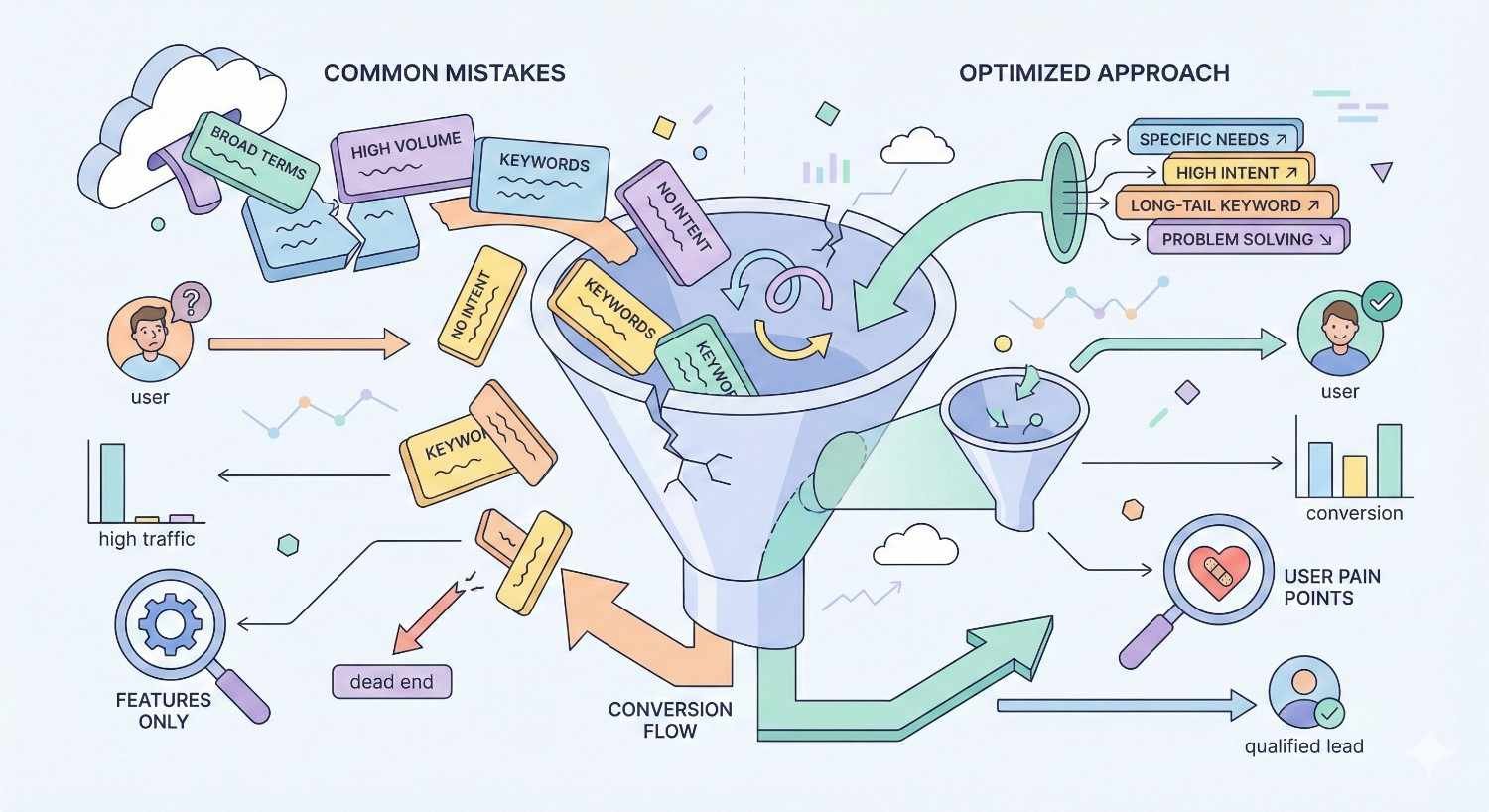
Common Mistakes with Top-of-Funnel SaaS Keywords
TOFU keyword strategies fail for predictable reasons. Avoid these common mistakes to maximize your investment.
Targeting Keywords Too Broad or Irrelevant
Broad keywords attract traffic that never converts. Relevance matters more than volume.
“How to be more productive” has massive search volume but attracts everyone from students to retirees. Most visitors have no need for your B2B software.
Narrow targeting improves quality. “How to improve sales team productivity” attracts a defined audience more likely to need sales tools.
Test relevance before investing. Ask: “Would someone searching this plausibly become our customer?” If the answer is uncertain, the keyword might be too broad.
Balance reach and relevance. Some broad keywords are worth targeting for brand awareness even with low conversion rates. But don’t build your entire strategy on them.
Neglecting Search Intent Alignment
Content that doesn’t match intent fails regardless of keyword targeting. Understand what searchers actually want.
Someone searching “what is CRM” wants a definition, not a product pitch. Content that immediately sells CRM software misses the intent.
Analyze SERPs before creating content. What type of content ranks? Match your format and approach to proven intent signals.
Satisfy the primary intent first. Answer the core question completely before introducing related topics or your product.
Test intent assumptions. If content ranks poorly despite quality, intent mismatch might be the cause. Revise to better align with what searchers want.
Failing to Nurture TOFU Traffic
TOFU visitors who leave without any engagement represent wasted opportunity. Create pathways to continued relationship.
Offer value exchanges. Newsletter subscriptions, content downloads, and tool access capture contact information for future nurturing.
Implement retargeting. Visitors who read TOFU content can see MOFU ads. This continues the conversation across channels.
Build email sequences for TOFU leads. Subscribers who downloaded a TOFU resource should receive related content that moves them toward consideration.
Don’t expect immediate conversion. TOFU visitors need time and additional touchpoints. Nurturing bridges the gap between awareness and purchase readiness.
Expecting Immediate Conversions
TOFU content rarely drives direct conversions. Measuring it by conversion rate misses the point.
The purpose of TOFU content is awareness and audience building, not immediate sales. Judging it by BOFU metrics leads to wrong conclusions.
Set appropriate expectations with stakeholders. Explain the funnel concept and how TOFU contributes to eventual revenue.
Track leading indicators. Traffic, engagement, and email signups show TOFU success. Conversions come later, influenced by TOFU but not directly caused by it.
Build patience into your strategy. TOFU investments pay off over months and years, not days and weeks.
Top-of-Funnel Keyword Examples by SaaS Category
Concrete examples illustrate TOFU keyword patterns across different SaaS categories. Use these as inspiration for your own research.
B2B SaaS TOFU Keyword Examples
B2B SaaS serves business buyers with complex needs. TOFU keywords reflect professional challenges and industry concepts.
Project Management Software:
- “how to manage remote teams effectively”
- “project management methodologies explained”
- “what is agile project management”
- “signs your team needs better collaboration tools”
CRM Software:
- “what is customer relationship management”
- “how to improve sales team productivity”
- “lead qualification best practices”
- “sales pipeline management guide”
Marketing Automation:
- “what is marketing automation”
- “how to nurture leads effectively”
- “email marketing best practices”
- “marketing attribution models explained”
HR Software:
- “how to improve employee onboarding”
- “what is employee engagement”
- “performance review best practices”
- “remote hiring challenges”
B2C SaaS TOFU Keyword Examples
B2C SaaS serves individual consumers. TOFU keywords reflect personal goals and everyday challenges.
Personal Finance Apps:
- “how to create a budget”
- “what is compound interest”
- “saving money tips”
- “how to track expenses”
Fitness Apps:
- “how to start working out”
- “what is HIIT training”
- “home workout ideas”
- “how to stay motivated to exercise”
Productivity Apps:
- “how to be more organized”
- “time management techniques”
- “what is the pomodoro technique”
- “how to reduce distractions”
Learning Platforms:
- “how to learn a new language”
- “best study techniques”
- “what is spaced repetition”
- “how to stay motivated while learning”
Industry-Specific TOFU Keyword Patterns
Different industries have unique terminology and concerns. TOFU keywords reflect these specifics.
Healthcare SaaS:
- “what is HIPAA compliance”
- “patient engagement strategies”
- “healthcare data security best practices”
- “telemedicine implementation guide”
Financial Services SaaS:
- “what is regulatory compliance”
- “KYC requirements explained”
- “fraud detection best practices”
- “financial reporting standards”
E-commerce SaaS:
- “how to reduce cart abandonment”
- “what is conversion rate optimization”
- “inventory management best practices”
- “customer retention strategies for online stores”
Manufacturing SaaS:
- “what is predictive maintenance”
- “supply chain optimization guide”
- “lean manufacturing principles”
- “quality control best practices”
Tools for Top-of-Funnel SaaS Keyword Research
The right tools accelerate keyword discovery and analysis. Options range from free resources to comprehensive paid platforms.
Free Keyword Research Tools
Free tools provide valuable data without budget requirements. They’re sufficient for basic research and small-scale operations.
Google Keyword Planner offers search volume estimates and keyword suggestions. Designed for advertisers but useful for organic research. Requires a Google Ads account.
Google Search Console shows keywords your site already ranks for. Discover TOFU opportunities where you have existing visibility but room to improve.
Google Trends reveals search interest over time. Identify rising topics and seasonal patterns. Compare relative interest between keywords.
AnswerThePublic visualizes autocomplete suggestions organized by question type. Excellent for discovering question-format TOFU keywords.
AlsoAsked maps People Also Ask relationships. See how questions connect to each other and identify comprehensive topic coverage.
Ubersuggest (free tier) provides basic keyword data including volume, difficulty, and suggestions. Limited queries per day but useful for spot research.
Paid SEO Platforms and Features
Paid platforms offer comprehensive data, advanced features, and greater efficiency. They’re essential for serious SEO operations.
Ahrefs provides extensive keyword data, competitor analysis, and content gap identification. The Keywords Explorer and Content Gap tools are particularly valuable for TOFU research.
Semrush offers similar capabilities with strong keyword research and competitive intelligence. The Keyword Magic Tool generates extensive keyword lists from seed terms.
Moz Pro includes keyword research alongside broader SEO tools. The Keyword Explorer provides difficulty scores and organic CTR estimates.
Clearscope and Surfer SEO focus on content optimization. They analyze top-ranking content and recommend terms to include. Useful for ensuring comprehensive TOFU content.
SparkToro reveals audience interests and behaviors. Discover what your target audience reads, watches, and discusses. This informs TOFU topic selection.
AI and Automation in Keyword Discovery
AI tools accelerate research and surface opportunities human analysis might miss. They complement rather than replace traditional methods.
ChatGPT and Claude generate keyword ideas through conversation. Describe your product and audience, then ask for TOFU keyword suggestions. Iterate to refine results.
AI-powered keyword tools like Keyword Insights use machine learning to cluster keywords and identify intent. They process large keyword lists faster than manual analysis.
Content brief generators use AI to analyze SERPs and recommend content structure. They identify questions to answer and topics to cover.
Automated SERP analysis tools monitor rankings and identify opportunities. They alert you to keyword movements and competitive changes.
Use AI as a starting point, not a final answer. Validate AI suggestions with traditional research. Combine AI efficiency with human judgment.
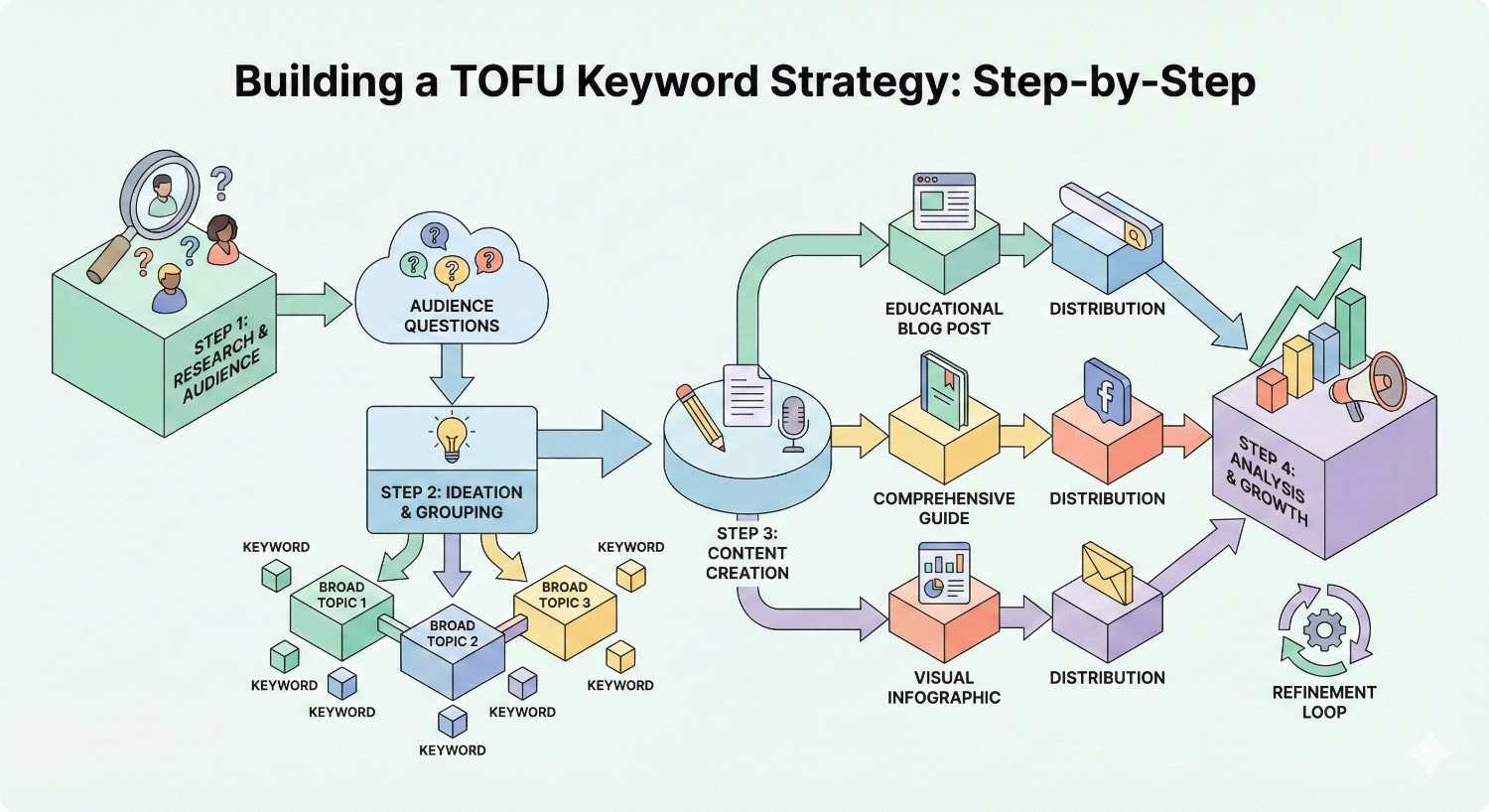
Building a TOFU Keyword Strategy: Step-by-Step
A systematic approach ensures comprehensive coverage and efficient execution. Follow these steps to build your TOFU keyword strategy.
Step 1: Define Your ICP and Pain Points
Strategy starts with understanding who you’re trying to reach. Clear ICP definition focuses keyword research on relevant opportunities.
Document your ideal customer profile in detail. Include job titles, company sizes, industries, and responsibilities. The more specific, the better your targeting.
List the problems your ICP faces. What challenges do they experience? What frustrations do they have? What goals are they trying to achieve?
Map problems to your product’s solutions. Which problems does your product address? These connections guide keyword relevance assessment.
Interview customers and prospects. Ask about their challenges, research processes, and information needs. First-hand insights reveal keywords tools might miss.
Step 2: Generate Seed Keywords
Seed keywords are starting points for expanded research. Generate a comprehensive list of terms related to your product and audience.
Start with your product category and features. What do you call what you do? What terms describe your capabilities?
Add problem-related terms. How do customers describe their challenges? What words do they use?
Include industry terminology. What concepts and jargon are relevant to your space?
Brainstorm question stems. Combine “how to,” “what is,” “why does” with your seed terms.
Aim for 20-50 seed keywords to start. You’ll expand from here.
Step 3: Expand and Categorize
Use tools to expand seed keywords into comprehensive lists. Then organize for strategic planning.
Run each seed keyword through research tools. Collect suggestions, related terms, and questions. Build a master list of hundreds or thousands of keywords.
Categorize by intent. Separate TOFU keywords from MOFU and BOFU. Focus on informational and educational queries.
Group by topic. Cluster related keywords together. These clusters become content planning units.
Tag by keyword type. Mark problem-aware, educational, trend, comparison, and definition keywords. This informs content approach.
Remove irrelevant keywords. Delete terms that don’t connect to your ICP or product. Quality over quantity.
Step 4: Prioritize by Impact and Effort
Not all keywords deserve equal investment. Prioritize based on potential value and required resources.
Apply your scoring framework. Rate each keyword on volume, difficulty, relevance, and feasibility.
Identify quick wins. Low-difficulty keywords with decent volume and high relevance should be early priorities.
Flag strategic targets. High-value keywords worth long-term investment even if difficult.
Consider content efficiency. Can one piece of content target multiple related keywords? Cluster keywords that can share content.
Create a prioritized list. Rank keywords by composite score. This becomes your targeting roadmap.
Step 5: Map to Content Calendar
Transform prioritized keywords into a production schedule. Realistic planning ensures consistent execution.
Assign keywords to content pieces. Determine which keywords each article will target. Primary and secondary keyword assignments.
Estimate production requirements. How long will each piece take to create? What resources are needed?
Build a realistic calendar. Schedule content production based on capacity. Don’t overcommit.
Balance quick wins and strategic investments. Mix easier content with more ambitious projects.
Plan for updates and refreshes. Schedule reviews of published content. TOFU topics evolve.
Step 6: Track, Iterate, and Scale
Ongoing measurement and optimization improve results over time. Build feedback loops into your process.
Monitor rankings and traffic. Track performance for target keywords. Identify what’s working and what isn’t.
Analyze content performance. Which pieces drive the most traffic? Which have the best engagement? Learn from successes.
Identify optimization opportunities. Underperforming content might need updates. Successful content might deserve expansion.
Expand keyword coverage. As you build authority, target more competitive keywords. Grow your TOFU footprint.
Refine your process. What have you learned? How can you improve research, prioritization, or content creation?
Frequently Asked Questions About Top-of-Funnel SaaS Keywords
What is an example of a top-of-funnel keyword?
A top-of-funnel keyword example is “how to improve team communication.” This query indicates someone experiencing a challenge but not yet searching for specific solutions like team chat software. They want to understand the problem and explore approaches, not evaluate products.
How many TOFU keywords should I target?
The number depends on your resources and market size. Most SaaS companies benefit from targeting 50-200 TOFU keywords across their content strategy. Start with 10-20 high-priority keywords, then expand as you build content capacity and see results.
Can TOFU keywords generate leads?
Yes, TOFU keywords can generate leads through content upgrades, newsletter subscriptions, and gated resources. While visitors aren’t ready to buy, they may exchange contact information for valuable content. These leads require nurturing before they’re sales-ready.
How do I know if a keyword is top-of-funnel?
Check the search intent signals. TOFU keywords typically have informational intent, question formats, and SERPs dominated by educational content rather than product pages. If someone searching the keyword wouldn’t be ready to evaluate solutions, it’s likely TOFU.
Should startups focus on TOFU or BOFU first?
Most startups should prioritize BOFU keywords initially for faster revenue impact. However, some TOFU investment builds long-term traffic foundations. A balanced approach targets high-intent BOFU keywords while building a small TOFU content library for future growth.
How long does it take for TOFU content to rank?
TOFU content typically takes 3-6 months to reach stable rankings, though this varies by keyword difficulty and domain authority. Lower-competition keywords may rank faster. High-competition keywords may take 12+ months. Consistent publishing and link building accelerate results.
What’s the ROI of top-of-funnel SEO?
TOFU SEO ROI is difficult to measure directly due to long attribution windows. However, companies with strong TOFU content typically see lower customer acquisition costs, higher brand awareness, and more sustainable traffic growth over time. The ROI compounds as content ages and accumulates authority.
Conclusion: Turning TOFU Keywords into Sustainable SaaS Growth
Top-of-funnel SaaS keywords represent the foundation of sustainable organic growth. They capture prospects at the earliest stage of their journey, build brand awareness at scale, and create traffic pipelines that compound over time.
Success requires systematic research, strategic prioritization, and content that genuinely educates. TOFU content must serve reader needs first while building the trust that eventually drives conversions.
We help SaaS companies build comprehensive SEO strategies spanning all funnel stages. White Label SEO Service provides the technical foundation, content strategy, and authority building needed to turn TOFU keywords into measurable business growth. Contact us to discuss your organic growth goals.