

San Francisco remains the epicenter of digital innovation, and choosing the right web design agency here can directly impact your traffic, conversions, and long-term growth. With over 2,000 agencies operating in the Bay Area, finding the perfect partner requires more than a quick Google search.
This guide matters because your website is often the first touchpoint for potential customers. A poorly designed site costs you leads. A strategically built one compounds your marketing ROI for years.
We’ve evaluated 55+ agencies across enterprise, startup, e-commerce, and UX specializations. You’ll find detailed breakdowns, pricing insights, comparison tables, and a proven framework for making your final decision.
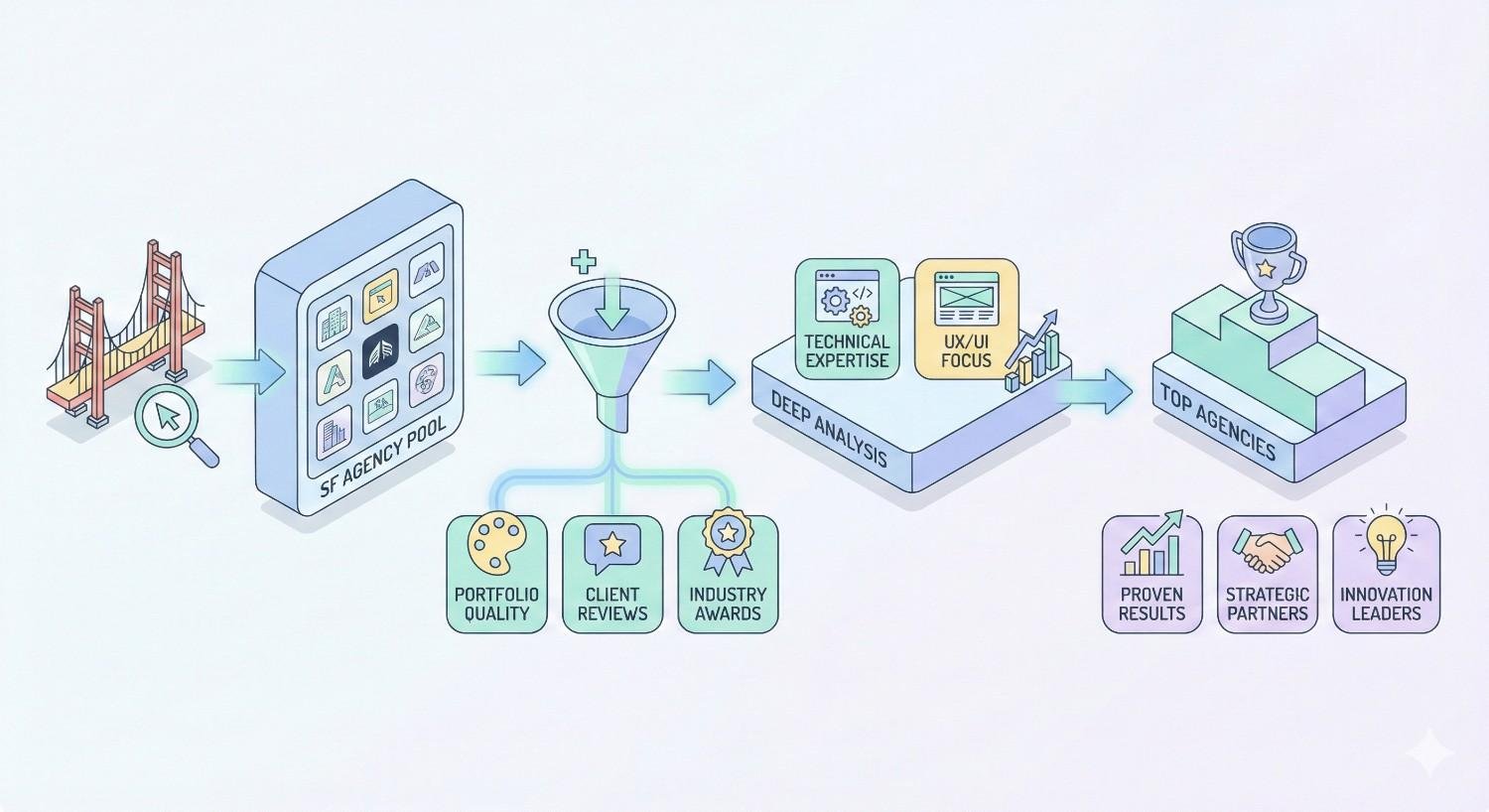
How We Selected the Best San Francisco Web Design Agencies
Selecting the right web design partner requires objective criteria, not just flashy portfolios. Our methodology combines quantitative metrics with qualitative assessments to identify agencies that consistently deliver measurable results.
Evaluation Criteria & Ranking Methodology
We assessed each agency across five core dimensions. Technical capability measured their proficiency with modern frameworks, CMS platforms, and development standards. Design quality evaluated visual aesthetics, brand alignment, and creative innovation.
Performance metrics examined their track record with Core Web Vitals, page speed optimization, and mobile responsiveness. Business impact analyzed documented case studies showing traffic growth, conversion improvements, and revenue attribution. Finally, client retention rates indicated long-term satisfaction and partnership quality.
Each agency received weighted scores across these categories. Enterprise agencies required demonstrated experience with complex integrations and scalability. Startup-focused agencies needed proven ability to deliver within tighter budgets and timelines.
Industry Expertise & Portfolio Assessment
Portfolio depth reveals more than design taste. We examined whether agencies demonstrated vertical expertise in specific industries like fintech, healthcare, SaaS, or retail.
Agencies with concentrated industry experience typically deliver faster because they understand sector-specific compliance requirements, user expectations, and competitive benchmarks. A healthcare web design agency already knows HIPAA considerations. An e-commerce specialist understands checkout optimization patterns.
We prioritized agencies showing measurable outcomes in their case studies. Vague claims like “improved user experience” ranked lower than specific metrics like “increased conversion rate by 34% within 90 days.”
Client Reviews & Reputation Analysis
Third-party review platforms provided unfiltered client perspectives. We analyzed ratings and reviews from Clutch, Google Business Profile, and LinkedIn recommendations.
Consistent themes in negative reviews flagged potential concerns. Agencies with recurring complaints about communication delays, scope creep, or post-launch support received lower rankings regardless of portfolio quality.
We also verified claimed client relationships. Some agencies list logos without permission or exaggerate project scope. Direct verification through LinkedIn connections and public case studies confirmed legitimate partnerships.
Top 10 Enterprise-Level Web Design Agencies in San Francisco
Enterprise web design demands more than aesthetic excellence. These agencies handle complex technical requirements, multi-stakeholder approval processes, and integrations with existing enterprise systems.
Huge Inc. – Overview, Services, Notable Projects, Pricing
Huge operates as a global digital agency with significant San Francisco presence. Their enterprise practice focuses on digital transformation for Fortune 500 companies.
Services: Brand strategy, UX research, custom web development, digital product design, and enterprise CMS implementation. They specialize in Adobe Experience Manager and Sitecore deployments.
Notable Projects: Huge has delivered enterprise platforms for Google, Nike, and McDonald’s. Their work typically involves multi-market rollouts requiring localization and accessibility compliance across dozens of countries.
Pricing: Enterprise engagements typically start at $500,000+ for comprehensive website redesigns. Smaller discovery and strategy projects begin around $75,000.
AKQA – Overview, Services, Notable Projects, Pricing
AKQA combines creative excellence with technical depth. Their San Francisco studio serves as a hub for West Coast enterprise clients.
Services: Experience design, technology platforms, content production, and data-driven personalization. They build custom solutions rather than template-based sites.
Notable Projects: AKQA’s portfolio includes work for Audi, Nike, and Verizon. Their projects often integrate physical and digital experiences through connected platforms.
Pricing: Full website projects range from $300,000 to $2 million+ depending on scope. AKQA positions itself at the premium end of enterprise pricing.
Instrument – Overview, Services, Notable Projects, Pricing
Instrument balances creative ambition with practical business outcomes. Based in Portland with strong San Francisco client relationships, they serve enterprise clients seeking distinctive digital experiences.
Services: Brand identity, web design and development, content strategy, and digital campaigns. They emphasize design systems that scale across touchpoints.
Notable Projects: Instrument has created digital experiences for Spotify, Google, and Sonos. Their work often wins industry awards while delivering measurable business results.
Pricing: Enterprise projects typically range from $200,000 to $750,000. They offer modular engagement structures for phased implementations.
Ueno – Overview, Services, Notable Projects, Pricing
Ueno (now part of Twitter/X) built its reputation on bold design and meticulous craft. Their San Francisco team continues serving external enterprise clients.
Services: Brand design, product design, web development, and motion design. They’re known for pushing creative boundaries while maintaining usability.
Notable Projects: Ueno’s portfolio includes Uber, Google, and Slack. Their work emphasizes emotional connection through design details.
Pricing: Projects typically start at $150,000 for smaller scopes, with comprehensive enterprise engagements reaching $500,000+.
Odopod – Overview, Services, Notable Projects, Pricing
Odopod specializes in digital experiences for premium brands. Their San Francisco headquarters serves clients requiring sophisticated design execution.
Services: Digital strategy, experience design, technology development, and content creation. They focus on brands where design quality directly impacts perception.
Notable Projects: Odopod has worked with Tesla, Sony PlayStation, and Google. Their automotive and technology sector expertise runs deep.
Pricing: Engagements typically range from $250,000 to $1 million for comprehensive website projects.
Frog Design – Overview, Services, Notable Projects, Pricing
Frog combines design thinking methodology with digital execution. Their San Francisco studio serves enterprise clients across technology, healthcare, and financial services.
Services: Strategy and innovation, product and service design, digital transformation, and organizational design. They approach web design as part of broader business transformation.
Notable Projects: Frog’s client list includes GE, Pfizer, and Disney. Their work often extends beyond websites into connected product ecosystems.
Pricing: Enterprise web projects typically start at $300,000, with transformation initiatives reaching several million dollars.
Character – Overview, Services, Notable Projects, Pricing
Character focuses on brand-driven digital experiences. Their San Francisco team serves enterprise clients seeking cohesive brand expression across digital touchpoints.
Services: Brand strategy, visual identity, web design, and digital campaigns. They emphasize brand consistency across all customer interactions.
Notable Projects: Character has worked with Dropbox, Fitbit, and Cisco. Their strength lies in translating brand strategy into digital execution.
Pricing: Website projects typically range from $150,000 to $400,000 depending on complexity and integration requirements.
Tolleson – Overview, Services, Notable Projects, Pricing
Tolleson brings decades of brand design expertise to digital experiences. Their San Francisco studio serves enterprise clients valuing design heritage.
Services: Brand identity, print design, web design, and environmental graphics. They approach digital as an extension of comprehensive brand systems.
Notable Projects: Tolleson’s portfolio includes Adobe, Gap, and Williams-Sonoma. Their work demonstrates how established brands evolve digitally.
Pricing: Enterprise web projects typically range from $200,000 to $500,000.
Astro Studios – Overview, Services, Notable Projects, Pricing
Astro Studios combines industrial design heritage with digital expertise. Their San Francisco team serves technology companies requiring cohesive physical and digital experiences.
Services: Product design, brand strategy, web design, and connected experiences. They specialize in technology brands with hardware components.
Notable Projects: Astro has worked with Nike, HP, and Microsoft. Their digital work often connects to physical product launches.
Pricing: Web projects typically range from $175,000 to $450,000 depending on integration complexity.
Method – Overview, Services, Notable Projects, Pricing
Method (now part of GlobalLogic) delivers human-centered design for enterprise clients. Their San Francisco practice focuses on complex digital products and platforms.
Services: Research and strategy, experience design, technology development, and organizational transformation. They emphasize research-driven design decisions.
Notable Projects: Method has served Google, Capital One, and Hyatt. Their work often involves multi-year platform development.
Pricing: Enterprise engagements typically start at $250,000 for website projects, with platform initiatives reaching $1 million+.
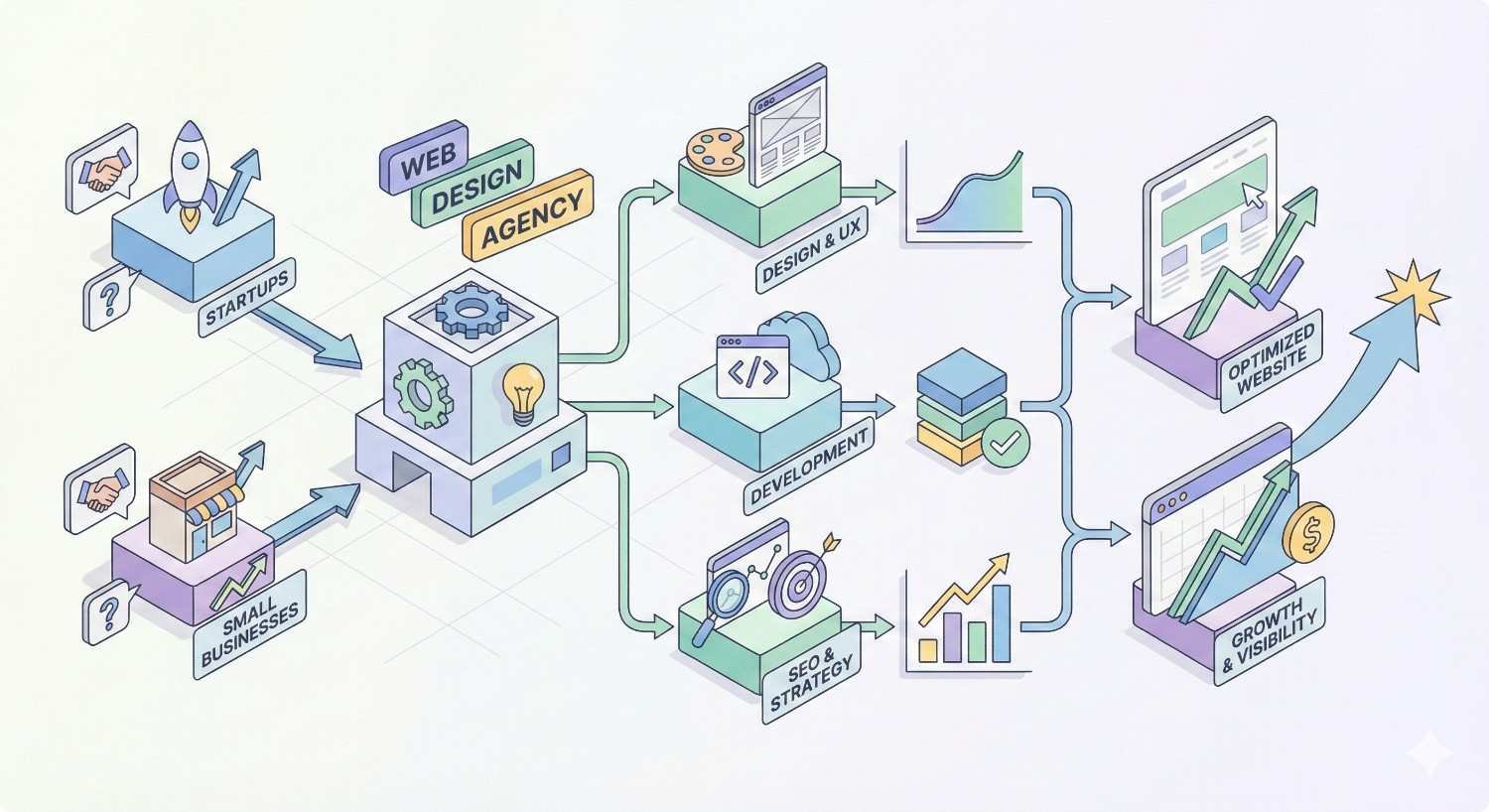
Best Web Design Agencies for Startups & Small Businesses
Startups need agencies that understand rapid iteration, limited budgets, and the pressure to launch quickly. These agencies specialize in helping early-stage companies establish digital presence without enterprise-level investment.
Startup-Focused Agencies
Clay operates at the intersection of brand and digital. They’ve built websites for numerous Y Combinator startups, understanding the specific needs of venture-backed companies. Projects typically range from $50,000 to $150,000.
Unfold specializes in brand identity and web design for emerging technology companies. Their process emphasizes speed without sacrificing quality. Typical projects range from $30,000 to $80,000.
Basic/Dept serves growth-stage startups with comprehensive digital services. They understand the transition from scrappy startup to scaling company. Projects typically start at $75,000.
Focus Lab combines brand strategy with web execution. They’ve helped numerous startups establish distinctive market positions. Engagements typically range from $40,000 to $120,000.
Ramotion offers design services specifically structured for startups. Their team understands investor expectations and market positioning needs. Projects typically range from $25,000 to $75,000.
Budget-Friendly Options
Jenga Creative delivers quality web design at accessible price points. They use efficient processes to reduce costs without compromising results. Projects typically range from $15,000 to $40,000.
Traction focuses on conversion-optimized websites for growing businesses. Their data-driven approach maximizes ROI on limited budgets. Typical projects range from $20,000 to $50,000.
Butcher & Baker serves small businesses with straightforward web design needs. They specialize in service businesses and local companies. Projects typically range from $10,000 to $30,000.
Liminal Creative offers modular web design packages for budget-conscious clients. Their template-based approach reduces costs while maintaining customization. Projects start at $8,000.
Matchbox Design Group provides affordable web design with strong SEO foundations. They understand small business constraints and priorities. Typical projects range from $12,000 to $35,000.
Growth-Stage Specialists
Barrel serves companies transitioning from startup to scale-up. They understand the infrastructure needs of rapidly growing businesses. Projects typically range from $75,000 to $200,000.
Viget combines strategy, design, and development for growth-stage companies. Their process emphasizes scalable solutions. Engagements typically start at $100,000.
Cantilever specializes in WordPress and headless CMS solutions for growing companies. They build sites designed to scale with business growth. Projects typically range from $50,000 to $150,000.
Mightybytes focuses on sustainable growth through strategic web design. They emphasize long-term performance over quick launches. Typical projects range from $40,000 to $100,000.
Cohere serves growth-stage B2B companies with complex sales cycles. They understand how websites support enterprise sales processes. Projects typically range from $60,000 to $175,000.
Top E-Commerce Web Design Agencies in San Francisco
E-commerce web design requires specialized expertise in conversion optimization, payment processing, inventory management, and platform-specific development.
Shopify & WooCommerce Experts
Pointer Creative specializes in Shopify Plus implementations for high-volume merchants. They understand the platform’s capabilities and limitations deeply. Projects typically range from $30,000 to $100,000.
Electric Eye focuses exclusively on Shopify development. Their specialization enables faster delivery and deeper platform expertise. Typical projects range from $25,000 to $75,000.
Ethercycle delivers conversion-focused Shopify stores. They emphasize data-driven design decisions that impact revenue. Projects typically range from $20,000 to $60,000.
Netalico Commerce serves mid-market e-commerce brands on Shopify and WooCommerce. They understand the operational needs of growing merchants. Typical projects range from $35,000 to $90,000.
Swanky specializes in Shopify Plus for enterprise e-commerce. Their UK-based team serves San Francisco clients requiring sophisticated implementations. Projects typically start at $50,000.
Custom E-Commerce Development
Guidance builds custom e-commerce solutions on Magento and BigCommerce. They serve merchants requiring capabilities beyond standard platforms. Projects typically range from $100,000 to $500,000.
Gorilla Group (now Wunderman Thompson Commerce) delivers enterprise e-commerce implementations. They handle complex integrations with ERP and fulfillment systems. Engagements typically start at $200,000.
Something Digital specializes in Magento development for complex e-commerce requirements. They understand enterprise-grade e-commerce architecture. Projects typically range from $150,000 to $400,000.
Corra focuses on enterprise e-commerce with emphasis on customer experience. They serve brands requiring sophisticated personalization. Typical projects range from $175,000 to $600,000.
Blue Acorn iCi delivers comprehensive e-commerce solutions including strategy, design, and development. They emphasize measurable business outcomes. Projects typically start at $125,000.
B2B E-Commerce Specialists
Oro Inc. specializes in B2B e-commerce platforms. They understand complex pricing, approval workflows, and account hierarchies. Projects typically range from $100,000 to $350,000.
Americaneagle.com serves B2B companies with complex e-commerce requirements. They handle integrations with existing business systems. Typical projects range from $75,000 to $250,000.
Perficient delivers enterprise B2B e-commerce implementations. They understand the unique requirements of wholesale and distribution businesses. Engagements typically start at $150,000.
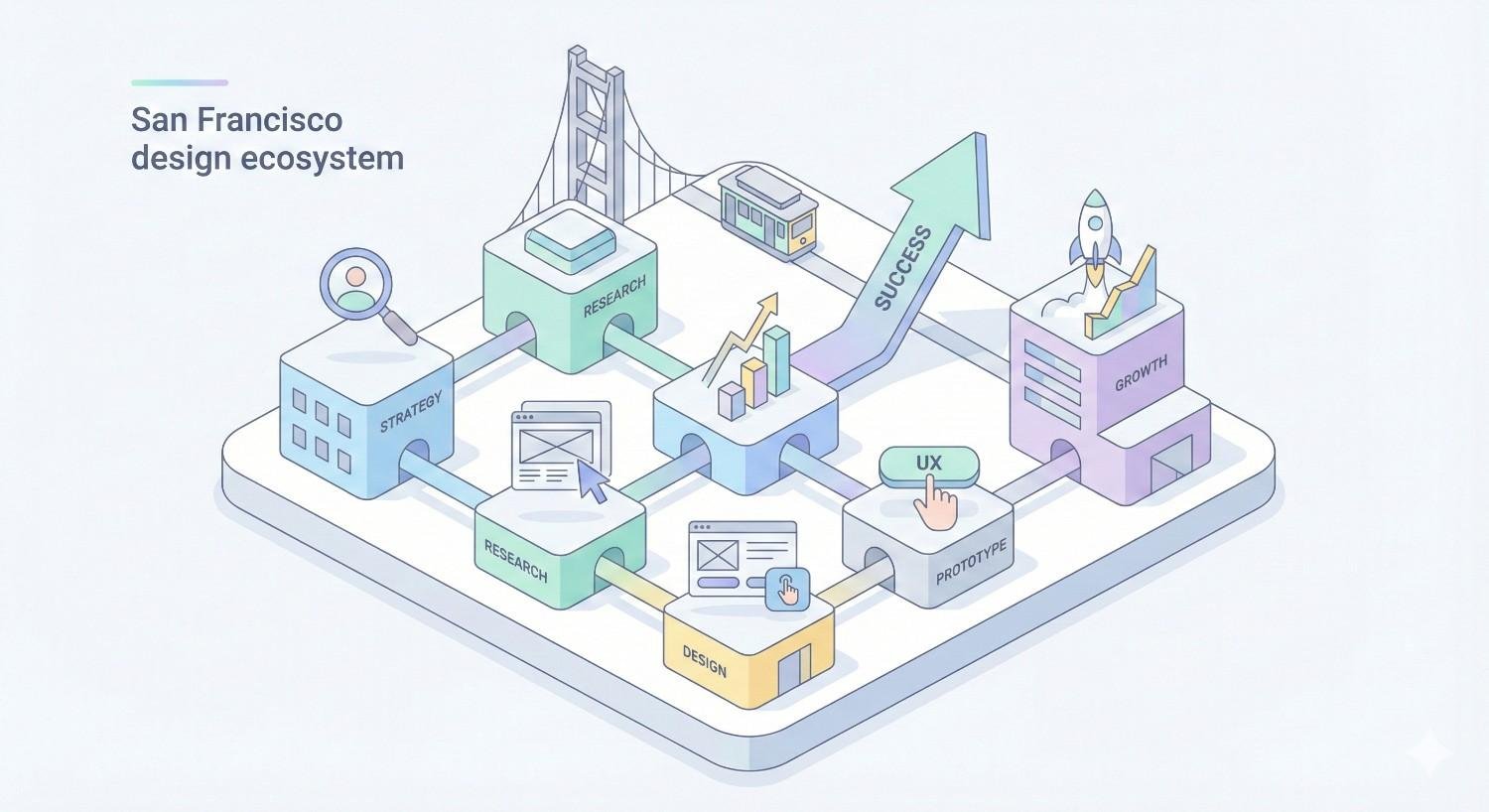
Best UX/UI Design Agencies in San Francisco
User experience design directly impacts conversion rates, customer satisfaction, and long-term retention. These agencies specialize in research-driven design that delivers measurable improvements.
User Experience Leaders
Cooper pioneered interaction design methodology. Their San Francisco team continues leading UX practice for complex digital products. Engagements typically range from $100,000 to $300,000.
Adaptive Path (now part of Capital One) established many UX best practices still used today. Their alumni have founded numerous San Francisco agencies. Historical projects ranged from $75,000 to $200,000.
Blink UX combines research rigor with design execution. They serve clients requiring evidence-based design decisions. Projects typically range from $50,000 to $175,000.
Punchcut specializes in connected experiences across devices. They understand how users move between touchpoints. Typical projects range from $75,000 to $225,000.
Mobile-First Design Specialists
Y Media Labs focuses on mobile experiences for enterprise clients. They understand the unique constraints and opportunities of mobile design. Projects typically range from $100,000 to $400,000.
Fueled specializes in mobile app design and development. Their web work emphasizes mobile-first responsive design. Typical projects range from $75,000 to $250,000.
Prolific Interactive delivers mobile-first digital experiences. They serve brands where mobile represents the primary customer touchpoint. Projects typically range from $80,000 to $300,000.
Conversion-Focused Design Agencies
Conversion specializes in conversion rate optimization through design. They use testing and data to drive design decisions. Engagements typically range from $25,000 to $100,000.
Invesp combines CRO expertise with UX design. They understand how design choices impact business metrics. Projects typically range from $30,000 to $125,000.
The Good focuses on e-commerce conversion optimization. They deliver measurable improvements in revenue per visitor. Typical engagements range from $20,000 to $75,000.
Top WordPress & CMS Web Design Agencies
Content management system expertise enables clients to maintain and grow their websites independently. These agencies specialize in building flexible, scalable CMS solutions.
WordPress Development Experts
WebDevStudios ranks among the largest WordPress-focused agencies. They handle enterprise WordPress implementations with complex requirements. Projects typically range from $75,000 to $300,000.
10up specializes in enterprise WordPress and headless implementations. They contribute significantly to WordPress core development. Typical projects range from $100,000 to $400,000.
Human Made delivers enterprise WordPress solutions for publishers and media companies. They understand high-traffic, content-heavy requirements. Projects typically start at $150,000.
Headless CMS & Custom CMS Agencies
Sanity.io Partners specialize in headless CMS implementations using Sanity. They build flexible content architectures for modern web applications. Projects typically range from $50,000 to $200,000.
Contentful Partners deliver headless CMS solutions on the Contentful platform. They serve enterprises requiring content infrastructure. Typical projects range from $75,000 to $250,000.
Prismic Experts build headless websites using Prismic CMS. They understand the benefits and tradeoffs of headless architecture. Projects typically range from $40,000 to $150,000.
Strapi Specialists implement open-source headless CMS solutions. They serve clients preferring self-hosted infrastructure. Typical projects range from $35,000 to $125,000.
Comparison Table: San Francisco Web Design Agencies at a Glance
| Agency | Specialty | Price Range | Team Size | Notable Clients |
| Huge Inc. | Enterprise Digital | $500K+ | 1,000+ | Google, Nike |
| AKQA | Experience Design | $300K-$2M | 2,000+ | Audi, Verizon |
| Instrument | Brand + Digital | $200K-$750K | 200+ | Spotify, Sonos |
| Clay | Startup Branding | $50K-$150K | 50+ | Slack, Facebook |
| Pointer Creative | Shopify Plus | $30K-$100K | 25+ | Allbirds, MVMT |
| Cooper | UX Research | $100K-$300K | 75+ | SAP, Citrix |
| 10up | Enterprise WordPress | $100K-$400K | 200+ | Microsoft, TIME |
| Barrel | Growth-Stage | $75K-$200K | 50+ | Warby Parker |
| Guidance | Custom E-commerce | $100K-$500K | 100+ | Foot Locker |
| Blink UX | UX Design | $50K-$175K | 150+ | Amazon, Starbucks |
How to Choose the Right Web Design Agency for Your Business
Selecting an agency requires systematic evaluation beyond portfolio aesthetics. The right partner aligns with your business goals, budget constraints, and working style.
Define Your Website Goals & Requirements
Start by documenting specific objectives. Are you prioritizing lead generation, e-commerce sales, brand awareness, or customer support? Each goal requires different design approaches and technical capabilities.
List required features and integrations. CRM connections, payment processing, inventory management, and marketing automation all influence agency selection. Agencies with relevant integration experience deliver faster and with fewer complications.
Establish success metrics before engaging agencies. Defining what “success” looks like enables meaningful proposal comparisons and post-launch evaluation.
Evaluate Portfolio & Industry Experience
Review portfolios for relevant work. An agency excelling at consumer e-commerce may struggle with B2B lead generation. Look for projects similar to your requirements in scope, industry, and objectives.
Request case studies with measurable outcomes. Beautiful designs mean little without business impact. Agencies confident in their work share specific metrics from past projects.
Check if portfolio pieces are still live. Agencies sometimes showcase work that clients have since replaced. Current live sites demonstrate lasting quality.
Understand Pricing Models & Budget Alignment
Agencies use different pricing structures. Fixed-price projects provide budget certainty but may limit flexibility. Time-and-materials arrangements offer adaptability but require careful scope management.
Request detailed proposals breaking down costs by phase. Understanding where budget allocates helps identify potential savings and ensures alignment on deliverables.
Factor in ongoing costs. Hosting, maintenance, updates, and support represent recurring expenses beyond initial development. Some agencies bundle these services while others charge separately.
Assess Communication & Project Management Style
Communication compatibility often determines project success more than technical capability. Ask about project management tools, meeting cadences, and escalation procedures.
Request references from recent clients. Ask specifically about communication responsiveness, problem resolution, and overall collaboration experience.
Evaluate cultural fit during initial conversations. You’ll work closely with this team for months. Personality alignment and shared values matter.
Check Reviews, Testimonials & Case Studies
Third-party reviews provide unfiltered perspectives. Clutch, Google Business Profile, and LinkedIn recommendations offer insights beyond curated testimonials.
Look for patterns in feedback. Isolated complaints happen to every agency. Recurring themes indicate systemic issues worth investigating.
Verify claimed client relationships. Some agencies exaggerate involvement or list logos without permission. LinkedIn connections and public case studies confirm legitimate partnerships.
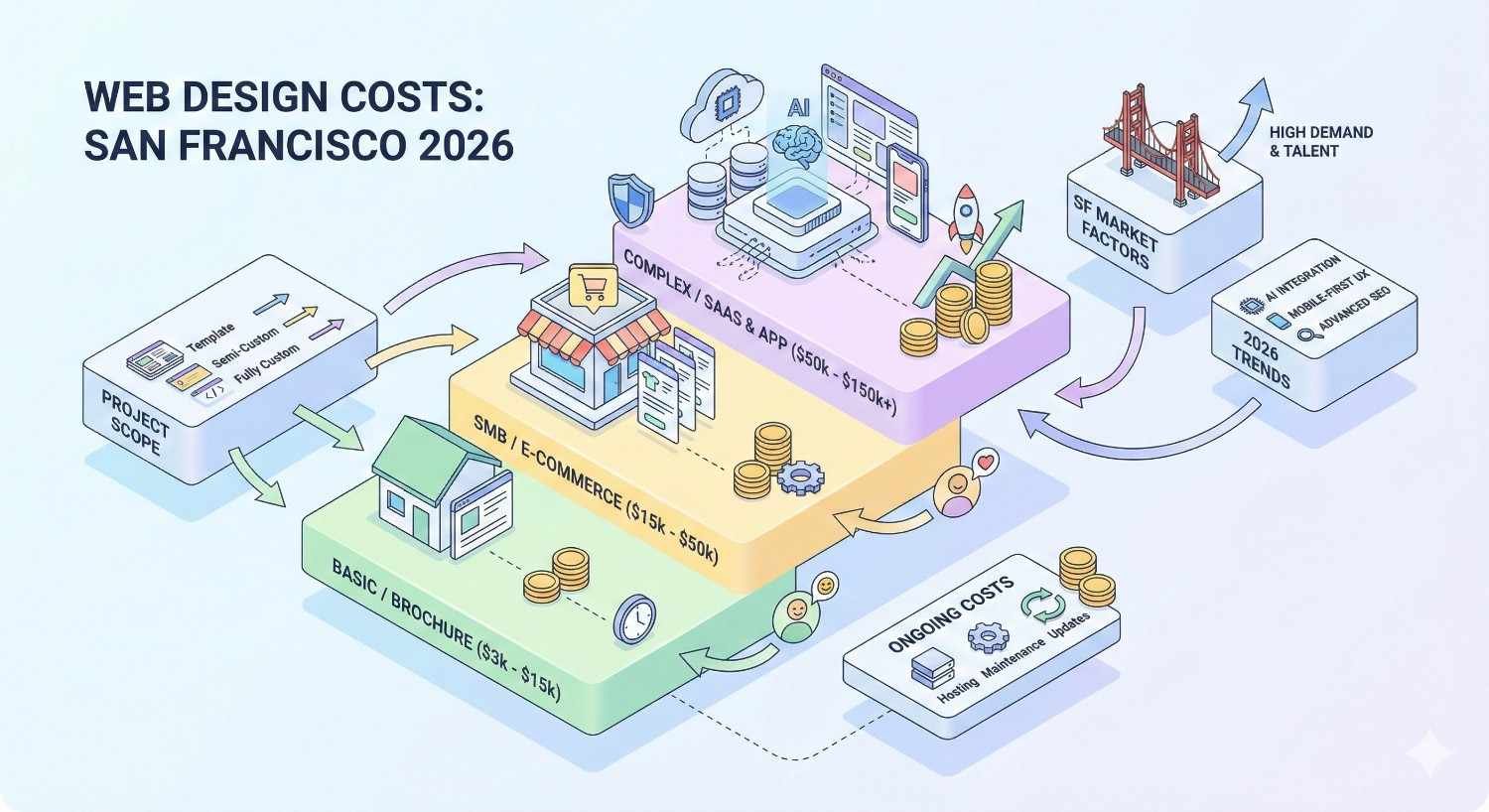
Web Design Costs in San Francisco: What to Expect in 2026
San Francisco web design pricing reflects the region’s high talent costs and competitive market. Understanding typical ranges helps set realistic budgets and evaluate proposals.
Average Pricing by Project Type
Simple brochure websites with 5-10 pages typically cost $10,000 to $30,000. These include basic design, responsive development, and CMS integration.
Mid-market business websites with custom functionality range from $30,000 to $100,000. These projects include strategy, custom design, development, and integrations.
Enterprise websites with complex requirements typically cost $100,000 to $500,000+. These involve extensive discovery, custom development, multiple integrations, and ongoing support.
E-commerce websites vary significantly based on platform and complexity. Basic Shopify stores start around $15,000, while custom enterprise e-commerce can exceed $500,000.
Hourly Rates vs. Fixed Project Pricing
San Francisco agency hourly rates typically range from $150 to $300 for design and development work. Strategy and consulting often command $200 to $400 per hour.
Fixed pricing provides budget certainty but requires detailed scope definition. Changes during the project typically incur additional costs through change orders.
Hybrid models combine fixed pricing for defined phases with time-and-materials for discovery or ongoing optimization. This balances predictability with flexibility.
Hidden Costs & Ongoing Maintenance Fees
Third-party tools and licenses add recurring costs. Premium plugins, stock photography, fonts, and software subscriptions accumulate quickly.
Hosting and infrastructure varies from $50 to $500+ monthly depending on traffic, security requirements, and performance needs.
Ongoing maintenance typically costs $500 to $5,000 monthly for updates, security patches, content changes, and technical support.
Future development for new features, integrations, or redesigns represents additional investment. Budget for continuous improvement rather than one-time projects.
ROI Considerations for Web Design Investment
Calculate potential return before setting budgets. A website generating $100,000 in annual revenue justifies significantly more investment than one serving as a digital brochure.
Consider opportunity cost of delays. Launching three months earlier with a slightly smaller budget may generate more value than waiting for a “perfect” site.
Factor in competitive positioning. In competitive markets, superior web presence directly impacts market share and customer acquisition costs.
San Francisco Web Design Trends for 2026
Staying current with design trends ensures your website meets user expectations and leverages emerging capabilities.
AI-Powered Design & Personalization
Artificial intelligence now enables real-time content personalization. Websites adapt messaging, imagery, and offers based on visitor behavior and characteristics.
AI-assisted design tools accelerate production without replacing human creativity. Designers use AI for ideation, asset generation, and optimization while maintaining creative direction.
Chatbots and conversational interfaces have matured significantly. Modern implementations provide genuine value rather than frustrating users with limited capabilities.
Accessibility & Inclusive Design Standards
WCAG 2.2 compliance has become standard expectation rather than optional enhancement. Legal requirements and ethical considerations drive universal adoption.
Inclusive design extends beyond compliance checkboxes. Leading agencies design for diverse abilities, contexts, and preferences from project inception.
Accessibility improvements benefit all users. Features designed for users with disabilities often enhance experience for everyone through clearer navigation and content structure.
Performance-First & Core Web Vitals Optimization
Google’s Core Web Vitals directly impact search rankings. Agencies now prioritize performance metrics alongside visual design from project start.
Modern frameworks and hosting solutions enable exceptional performance without sacrificing design quality. The tradeoff between beauty and speed has largely disappeared.
Performance optimization requires ongoing attention. Initial launch metrics degrade without continuous monitoring and improvement as content accumulates.
Sustainable & Eco-Friendly Web Design
Digital sustainability has emerged as meaningful consideration. Efficient websites consume less energy, reducing environmental impact at scale.
Sustainable design practices often align with performance optimization. Smaller file sizes, efficient code, and optimized images benefit both environment and user experience.
Some clients now request carbon footprint assessments for digital properties. Agencies offering sustainability audits differentiate themselves in environmentally conscious markets.
Questions to Ask Before Hiring a Web Design Agency
Structured questioning reveals agency capabilities and fit better than portfolio review alone.
Discovery & Strategy Questions
“How do you approach understanding our business and audience?” Strong agencies invest in research before design. Weak agencies jump directly to visual concepts.
“What strategy deliverables do you provide before design begins?” Look for documented personas, journey maps, content strategies, and technical specifications.
“How do you measure project success?” Agencies focused on business outcomes define metrics upfront. Those focused only on deliverables may not prioritize results.
Technical & Development Questions
“What platforms and technologies do you recommend, and why?” Answers reveal whether recommendations serve client needs or agency preferences.
“How do you handle security, performance, and accessibility?” These considerations should be integrated throughout the process, not addressed as afterthoughts.
“What’s your approach to quality assurance and testing?” Systematic testing processes prevent launch-day disasters and ongoing issues.
Timeline & Deliverables Questions
“What does your typical project timeline look like for similar scope?” Realistic timelines indicate experience. Overly aggressive timelines suggest either cutting corners or inevitable delays.
“What do you need from us, and when?” Understanding client responsibilities prevents bottlenecks and misaligned expectations.
“How do you handle scope changes during the project?” Clear change management processes protect both parties from budget and timeline surprises.
Post-Launch Support & SEO Questions
“What support do you provide after launch?” Some agencies disappear after final payment. Others offer ongoing partnerships for continuous improvement.
“How do you approach SEO during design and development?” SEO should be integrated throughout, not bolted on afterward. Technical foundations matter.
“What training do you provide for our team?” Effective knowledge transfer enables client independence for routine updates and content management.
Web Design vs. Web Development: Understanding the Difference
Clarity on these distinct disciplines helps you evaluate agency capabilities and assemble the right team.
What Web Designers Do
Web designers focus on visual appearance and user experience. They create layouts, select typography, define color palettes, and design interface elements.
Designers use tools like Figma, Sketch, and Adobe XD to create mockups and prototypes. Their deliverables include visual designs, style guides, and interactive prototypes.
Strong designers understand user psychology, accessibility principles, and brand expression. They translate business objectives into visual solutions that guide user behavior.
What Web Developers Do
Web developers build functional websites from design specifications. They write code, implement features, and ensure technical performance.
Front-end developers focus on user-facing elements using HTML, CSS, and JavaScript. Back-end developers handle server-side functionality, databases, and integrations.
Full-stack developers work across both areas. Their breadth enables efficient small-team execution but may sacrifice depth in specialized areas.
When You Need Both Services
Most website projects require both design and development. The question is whether to hire separately or engage an agency providing both.
Integrated agencies offer smoother handoffs and shared accountability. Separate specialists may provide deeper expertise but require more coordination.
Consider project complexity when deciding. Simple sites work well with integrated teams. Complex projects may benefit from specialized design and development partners.
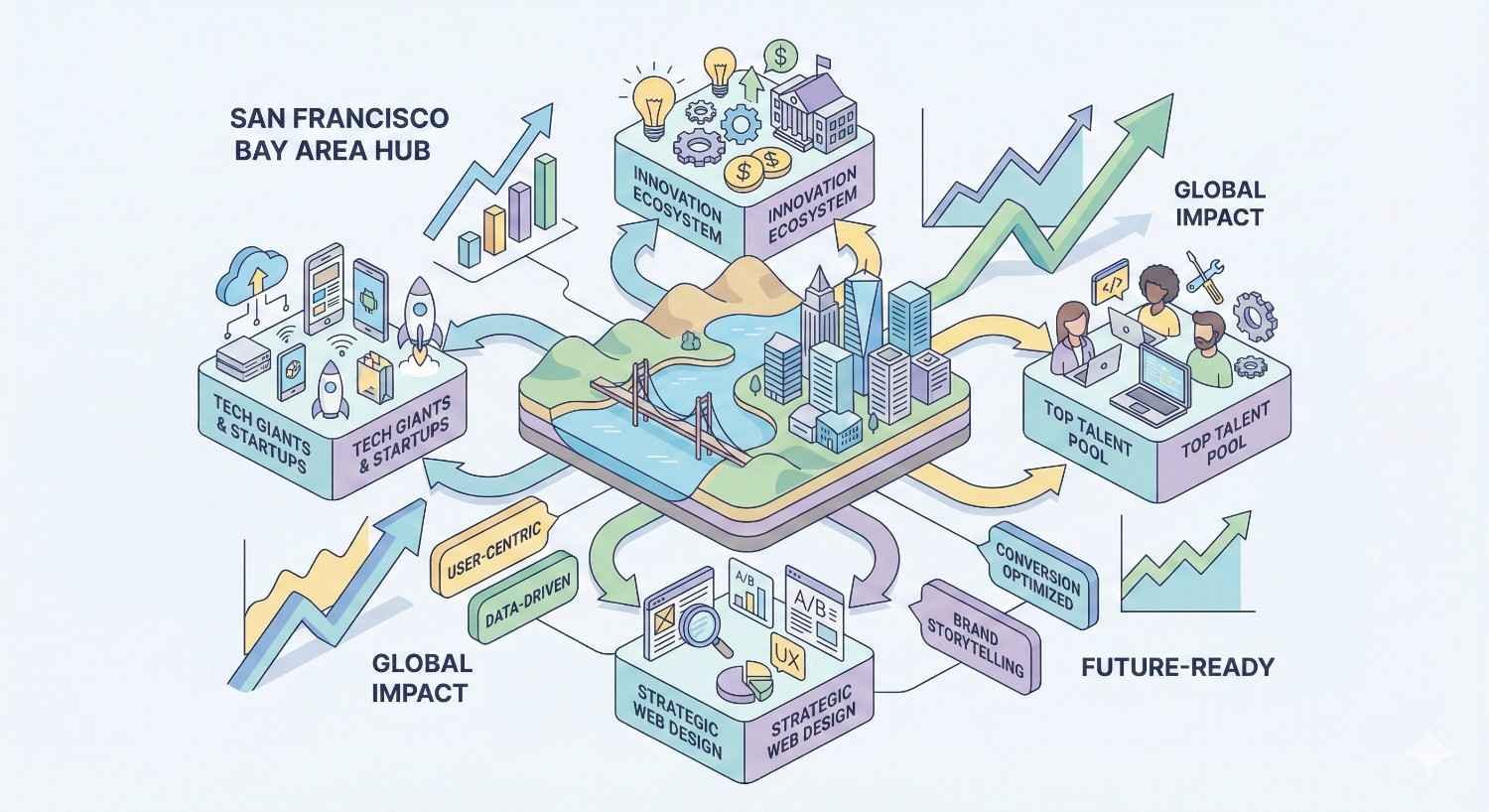
Why San Francisco for Web Design? The Bay Area Advantage
San Francisco’s unique ecosystem offers distinct advantages for web design projects.
Access to Top Tech Talent
The Bay Area concentrates exceptional design and development talent. Proximity to major technology companies creates a deep talent pool with cutting-edge experience.
Competition for talent drives quality. Agencies must offer compelling work and culture to attract and retain top performers.
Diverse backgrounds enrich creative output. San Francisco’s international population brings varied perspectives to design challenges.
Innovation & Cutting-Edge Design Practices
San Francisco agencies often pioneer new approaches. Proximity to technology innovation encourages experimentation and early adoption.
Client expectations drive advancement. Working with sophisticated technology companies pushes agencies to continuously improve capabilities.
Knowledge sharing accelerates learning. Meetups, conferences, and informal networks spread best practices throughout the community.
Proximity to Startup Ecosystem & Venture Capital
Startup experience translates to efficient execution. Agencies serving startups learn to deliver quality within constraints.
Understanding investor expectations helps agencies create sites that support fundraising and growth objectives.
Network effects benefit clients. Agency relationships often facilitate introductions to investors, partners, and talent.
Frequently Asked Questions About San Francisco Web Design Agencies
How long does a website design project take?
Simple websites typically require 8-12 weeks from kickoff to launch. Mid-complexity projects take 3-6 months. Enterprise websites often require 6-12 months or longer depending on scope and approval processes.
What’s included in a typical web design package?
Standard packages include discovery and strategy, visual design, responsive development, CMS integration, and basic SEO setup. Additional services like content creation, photography, and ongoing maintenance typically cost extra.
Should I hire a local agency or work remotely?
Local agencies offer easier in-person collaboration and shared cultural context. Remote agencies may provide cost savings and access to specialized expertise. Consider your communication preferences and project complexity when deciding.
How do I evaluate a web design agency’s portfolio?
Look for projects similar to yours in scope and industry. Check if showcased sites are still live and performing well. Request case studies with measurable outcomes rather than just visual examples.
What’s the difference between a freelancer and an agency?
Freelancers offer lower costs and direct communication but limited capacity and potential availability risks. Agencies provide team depth, diverse expertise, and business continuity but at higher price points.
How important is SEO in web design?
SEO should be integrated from project inception. Technical foundations, site architecture, and content structure all impact search visibility. Retrofitting SEO after launch costs more and delivers inferior results.
How to Work Effectively With Your Web Design Agency
Partnership quality significantly impacts project outcomes. These practices maximize your investment.
Setting Clear Expectations & Milestones
Document objectives, success metrics, and deliverables before work begins. Written agreements prevent misunderstandings and provide reference points for decisions.
Establish milestone checkpoints with clear approval criteria. Regular reviews catch issues early when corrections cost less.
Define decision-making authority upfront. Projects stall when approvals require multiple stakeholders with conflicting schedules.
Providing Effective Feedback
Consolidate feedback from all stakeholders before sharing. Contradictory input confuses agencies and delays progress.
Focus feedback on objectives rather than solutions. Explain what isn’t working and why rather than prescribing specific fixes.
Respond to requests promptly. Client delays cascade through project timelines, often more severely than agency delays.
Ensuring Long-Term Partnership Success
Treat agency relationships as partnerships rather than vendor transactions. Mutual investment in success produces better outcomes.
Provide context beyond immediate project scope. Understanding your business strategy helps agencies make better recommendations.
Plan for ongoing collaboration. Websites require continuous improvement. Establishing long-term relationships reduces ramp-up costs for future work.
Conclusion
San Francisco offers unparalleled options for web design partnerships. Enterprise clients find world-class agencies delivering sophisticated digital experiences. Startups access specialists understanding their unique constraints. E-commerce brands connect with platform experts maximizing conversion potential.
Your website represents a strategic asset deserving careful partner selection. The agencies profiled here demonstrate proven capabilities across diverse requirements and budgets. Use the evaluation framework provided to identify partners aligned with your specific needs.
At White Label SEO Service, we help businesses maximize their web investments through comprehensive organic growth strategies. Contact us to discuss how strategic SEO integration can amplify your new website’s performance from day one.
Frequently Asked Questions
What is the average cost of hiring a web design agency in San Francisco?
San Francisco web design costs range from $10,000 for simple sites to $500,000+ for enterprise projects. Mid-market business websites typically fall between $30,000 and $100,000 depending on complexity and customization requirements.
How do I know if a web design agency is right for my industry?
Review their portfolio for projects in your sector or similar verticals. Ask for case studies demonstrating industry-specific knowledge. Agencies with relevant experience understand compliance requirements, user expectations, and competitive benchmarks.
What questions should I ask during a web design agency consultation?
Ask about their discovery process, typical timelines, pricing structure, and post-launch support. Request references from similar projects and inquire about their approach to SEO, accessibility, and performance optimization.
Can a web design agency also handle my SEO and digital marketing?
Many full-service agencies offer SEO, content marketing, and paid advertising alongside web design. However, specialized SEO agencies often deliver superior results for organic growth. Consider your priorities when deciding between integrated and specialized partners.
How long should I expect to wait before seeing results from a new website?
Visual and functional improvements appear immediately at launch. Traffic and conversion improvements typically emerge over 3-6 months as search engines index new content and users adapt to changes. Significant SEO gains often require 6-12 months of consistent optimization.
What happens if I’m not satisfied with the web design agency’s work?
Review your contract for revision policies and dispute resolution procedures. Most agencies include defined revision rounds. Address concerns early through direct communication before escalating. Document all feedback in writing to maintain clear records.
Should I provide content to the web design agency or have them create it?
Both approaches work depending on your resources and expertise. Providing content reduces costs but requires significant internal effort. Agency-created content ensures professional quality but increases project investment. Many clients use hybrid approaches with agency guidance on structure and client-provided core messaging.