Topical authority is the search-engine signal that identifies a website as a credible expert across an entire subject domain, not just a single keyword. It is built by covering a topic comprehensively, structuring content around entities and relationships, and connecting pages through a deliberate internal architecture that search engines can map.
For business owners and marketers, topical authority is the difference between ranking for a handful of long-tail terms and dominating an entire niche with compounding organic traffic.
This guide covers what topical authority is, why it matters, the components that build it, how to construct a topical map, the cluster architecture that supports it, and how to measure progress over time.

What Is Topical Authority?
Topical authority is a website’s recognized expertise over a defined subject domain, measured by how comprehensively and accurately it covers every concept, entity, and query within that domain. Unlike domain authority — which is a third-party metric based on backlinks — topical authority is signal that emerges directly from content depth, entity coverage, and semantic relationships.
Topical Authority Defined
When a website publishes consistent, high-quality content across every meaningful subtopic in a niche, search engines begin associating that domain with the topic itself. The site stops competing for individual keywords and starts being treated as a reference point for the subject as a whole.
How Google Recognizes Topical Authority
Google’s systems evaluate topical authority through query coverage, entity recognition, internal link structure, and engagement patterns. A 2022 update introduced explicit “topical authority systems” into Google’s ranking documentation, confirming what semantic SEO specialists had inferred for years — that topic-level expertise is now a ranking signal in its own right.
Topical Authority vs Domain Authority
Domain authority predicts ranking probability based on backlinks. Topical authority predicts ranking probability based on content depth within a subject. The two are correlated but distinct, and topical authority is far more controllable through content strategy.
Topical authority is built on the same foundation as semantic SEO — both rely on entities, attributes, and relationships rather than isolated keywords, and our complete semantic SEO framework walks through how search engines map meaning across an entire content domain.
Why Topical Authority Matters for SEO in 2026
Search engines have shifted from matching keywords to understanding topics, and that shift makes topical authority the dominant ranking factor for competitive niches. Sites with shallow keyword coverage no longer compete with sites that have built deep, interconnected topic clusters.
The Shift from Keywords to Topics
Modern search algorithms parse queries through entity recognition and intent classification. They no longer reward sites that cover one keyword well — they reward sites that cover every related concept comprehensively. A page about “email marketing automation” ranks better when the site also covers email deliverability, segmentation, lifecycle campaigns, and platform comparisons.
Topical Authority and E-E-A-T
Experience, Expertise, Authoritativeness, and Trustworthiness — Google’s E-E-A-T evaluation framework — relies heavily on topical depth as a proxy for expertise. A site that covers a subject from every angle demonstrates expertise more credibly than a site that publishes occasional posts on the same topic.
Topical authority also aligns directly with Google’s Helpful Content System, which rewards content that serves people and demonstrates first-hand knowledge of the subject domain.

Core Components of Topical Authority
Topical authority is not a single metric — it is the combined output of three measurable dimensions: coverage, depth, and relevance. All three must develop in parallel for authority to compound.
Topical Coverage
Coverage refers to the breadth of subtopics a site addresses within its domain. A site claiming authority on SEO must cover technical SEO, on-page SEO, off-page SEO, content strategy, analytics, and dozens of subdimensions beneath each. Gaps in coverage create competitive openings for other sites.
Topical Depth
Depth refers to how thoroughly each subtopic is treated. A 500-word post on keyword research signals shallow coverage; a 3,000-word guide with execution steps, examples, and decision frameworks signals genuine expertise.
Topical Relevance
Relevance refers to how tightly every page on a site connects back to the core subject domain. A site about SEO that publishes posts about productivity and remote work dilutes its topical relevance, even if those posts are well-written.
These three components only produce results when wired into a coherent plan, which is why our comprehensive SEO strategy resource breaks down how to align coverage, depth, and relevance with measurable business outcomes.
Building a Topical Map
A topical map is a structured plan that documents every entity, subtopic, attribute, and query a website must cover to establish authority over its subject domain. It is the blueprint that every piece of content references.
Central Entity Identification
The starting point is identifying the central entity — the primary subject the site claims expertise on. For an SEO service, the central entity is “search engine optimization.” Every other concept in the map exists as a sub-entity, attribute, or related entity orbiting that core.
Subtopic and Attribute Mapping
From the central entity, the map branches into major subtopics (technical SEO, content SEO, link building), then into attributes (page speed, schema, internal links), then into specific queries (what is Core Web Vitals, how to fix crawl errors). Each leaf of the map becomes a content asset.
A well-constructed map prevents content gaps, eliminates cannibalization, and gives every piece of content a clear position in the silo.
Translating subject expertise into a structured hierarchy is the most underestimated step in modern SEO, and our complete guide to building a topical map walks through central entity identification, attribute extraction, and the full mapping workflow used by topical authority specialists.
Keyword Research for Topical Authority
Keyword research within a topical authority framework looks different from traditional keyword research. Instead of hunting for high-volume terms, the goal is to identify every meaningful query users ask within the subject domain and cluster those queries by intent and entity.
Query Patterns and Search Intent
Each query falls into one of four primary intents: informational, navigational, commercial, and transactional. A complete topical authority strategy covers all four for the central topic, ensuring the site serves users at every stage of the journey.
According to Ahrefs’ 2024 research, over 92% of search queries are long-tail terms — which means topical authority is built primarily by covering the wide spread of low-volume, specific questions, not by chasing a handful of head terms.
Long-Tail Opportunities
Long-tail queries are where topical authority compounds fastest. Each long-tail page contributes to topical coverage, signals depth, and reinforces the site’s relevance for the broader subject.
Pulling these query patterns out of search data requires a disciplined workflow, and our full keyword research process explains how to collect, cluster, and prioritize queries so every spoke page targets a defensible search demand pocket.

Pillar and Cluster Content Architecture
Pillar and cluster content architecture is the structural framework that turns a topical map into a working website. A pillar page covers a core topic at hub level; cluster pages cover each subtopic in depth; internal links connect them in a hub-and-spoke pattern.
The Hub-and-Spoke Model
The pillar sits at the center as the definitive resource on the core topic. Each cluster (spoke) page covers one subtopic deeply and links back to the pillar. The pillar links out to every spoke. This two-way linking architecture signals to search engines that the site has organized its expertise hierarchically.
Pillar Content vs Cluster Content
| Attribute | Pillar Content | Cluster Content |
| Scope | Broad, hub-level | Narrow, deep |
| Length | 3,000–6,000+ words | 1,500–3,000 words |
| Purpose | Orient and link out | Answer fully |
| Link role | Links to all spokes | Links back to pillar |
Designing a clean hub-and-spoke network is where most sites stall, and our complete content cluster strategy resource explains how to plan, write, and connect pillar and cluster pages so every URL strengthens the authority of the whole silo.
Semantic SEO and Entity Optimization
Semantic SEO treats content as a network of entities and relationships rather than a collection of keywords. Entity optimization makes each page legible to search engine knowledge graphs, which is how modern algorithms understand what a page is actually about.
Entities, Attributes, and Relationships
An entity is any distinct concept — a person, place, product, idea. Attributes describe that entity. Relationships connect entities to each other. A page about “Google Search Console” should mention its attributes (coverage report, performance data) and its relationships (owned by Google, complements Google Analytics, used by SEO professionals).
Optimizing for Knowledge Graphs
Search engines build knowledge graphs by extracting entities and relationships from indexed content. Pages that name entities clearly, structure them with schema markup, and connect them to authoritative sources contribute directly to those graphs — and benefit from elevated visibility as a result.
Aligning your content with how search engines store knowledge is the difference between ranking and being ignored, and our dedicated entity optimization tactics resource explains how to use named entities, structured data, and topical context to feed the knowledge graph directly.
On-Page SEO for Topical Depth
On-page SEO is how topical authority becomes machine-readable. Heading hierarchy, schema markup, internal anchors, and structured content all communicate to crawlers that a page belongs to a specific subject domain and covers that subject at depth.
Heading Hierarchy and Content Structure
A clear H1–H2–H3 hierarchy maps the page’s information architecture for both readers and crawlers. Each H2 should represent a distinct subtopic; each H3 should support its parent H2 logically. Skipping levels or repeating H1s signals poor topical organization.
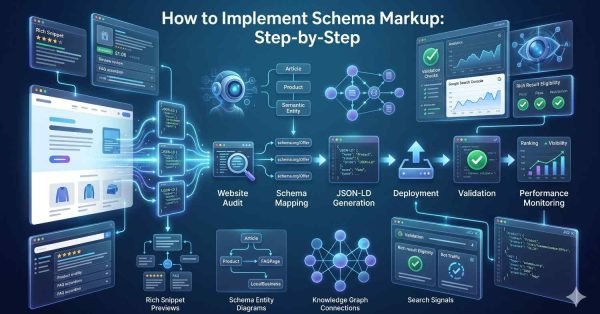
Schema Markup for Entities
Structured data — particularly Article, Organization, Person, and FAQ schema — tells search engines exactly which entities a page references and how they relate. Google’s own documentation confirms that structured data eligibility directly improves search appearance and clarity.
Hub-level content needs precise on-page execution to be machine-readable, and our complete on-page SEO checklist walks through heading hierarchy, schema implementation, and content structuring decisions that signal topical depth to crawlers.

Internal Linking for Authority Distribution
Internal linking is how topical authority physically circulates through a website. Every internal link transfers a portion of equity, establishes contextual relevance, and helps search engines discover and prioritize pages within the silo.
Hub-to-Spoke Linking
In a topical authority architecture, the pillar links down to every cluster page, and every cluster links back up to the pillar. Cluster pages also cross-link when they share contextual relevance. This two-way structure compounds authority across the entire silo.
Contextual Anchor Text
Anchor text functions as a relevance signal. Descriptive, entity-rich anchors tell search engines what the destination page is about. Generic anchors like “click here” or “learn more” waste the relevance opportunity entirely and dilute the link’s value.
Authority flows through your site only as well as your link graph allows it to, and our complete internal linking strategy resource explains how to distribute equity, build contextual relevance, and engineer a discoverable architecture from the homepage outward.
Off-Page Signals and Link Building
Off-page signals — primarily backlinks and brand mentions from external sites — validate topical authority from outside the domain. A site cannot claim expertise on a subject if no credible source in that subject ever references it.
Topical Relevance of Backlinks
A backlink from a site that already ranks for the topic transfers far more authority than a backlink from a generic, unrelated site. According to a 2024 Backlinko study, the number of unique referring domains correlates strongly with first-page rankings, and topical relevance of those domains amplifies that effect significantly.
Earning Mentions from Niche Authorities
Niche-relevant mentions in podcasts, industry roundups, expert quotes, and partnership content reinforce topical credibility even without traditional follow links. Search engines increasingly weight unlinked brand mentions as authority signals.
Earning links from sources that already rank for your topic accelerates authority faster than volume ever will, and our complete topical link building guide explains how to identify, qualify, and outreach to niche-relevant publishers.
Measuring Topical Authority
Topical authority is measurable through a combination of visibility metrics, coverage metrics, and cluster-level performance data. Without measurement, no SEO investment can demonstrate ROI to stakeholders.
Visibility and Coverage Metrics
Share of voice within the topic, total keywords ranking, average position across the cluster, and impressions in Google Search Console all serve as visibility indicators. Coverage metrics track how many planned subtopics have been published versus the full topical map.
Tracking Cluster Performance
Beyond individual page rankings, monitor cluster-level metrics: total traffic across the silo, internal link equity distribution, and the percentage of cluster pages reaching first-page visibility. A healthy cluster shows the pillar ranking for head terms while spokes capture long-tail variations.
Coverage and depth only matter if you can prove movement, and our full guide on tracking SEO performance breaks down the visibility, ranking, and cluster-level metrics that show whether your topical authority is compounding or stalling.
Common Mistakes That Stall Topical Authority
Most topical authority strategies fail not because the framework is wrong, but because execution drifts. The most common mistakes include publishing pillar content without spoke support, writing spokes that fully duplicate pillar coverage instead of going deeper, neglecting internal linking between cluster pages, abandoning the topical map after the first dozen articles, and chasing unrelated keywords that dilute topical relevance.
Other recurring mistakes include treating word count as a depth signal (long content is not the same as deep content), ignoring entity optimization, and failing to measure cluster-level performance — which means problems are invisible until rankings stagnate.
The pattern across all these mistakes is the same: a strategy that started clean gets compromised by short-term decisions that erode topical relevance over time.
How Long Does It Take to Build Topical Authority?
Topical authority is not a fast outcome. For most competitive niches, meaningful visibility takes 6–12 months of consistent publishing, with full topical authority typically establishing over 12–24 months. The exact timeline depends on existing domain strength, niche competitiveness, content velocity, and link acquisition pace.
In the first three months, indexation and early ranking signals appear. Between months three and six, cluster-level rankings begin to consolidate. From months six to twelve, the pillar starts ranking for head terms and the silo begins compounding. Beyond twelve months, topical authority becomes increasingly difficult for competitors to disrupt.
For businesses that need to compress that timeline and execute a topical authority strategy without building an in-house team from scratch, our white label SEO services deliver pillar-and-spoke content production, technical SEO, and link acquisition under one engagement.
Conclusion
Topical authority is the modern foundation of organic growth, built through coverage, depth, relevance, structured content architecture, and disciplined internal linking across an entire subject domain.
Every element covered here connects to deeper resources in our SEO knowledge base, and each spoke page reinforces the methodology this guide introduces at hub level.
We help businesses build sustainable topical authority through full-service strategy and execution — explore how White Label SEO Service can accelerate your organic growth today.
Frequently Asked Questions
What is topical authority in SEO?
Topical authority is a website’s recognized expertise over a defined subject domain. It is built through comprehensive content coverage, entity optimization, and structured internal linking across all related subtopics.
How is topical authority different from domain authority?
Domain authority predicts ranking probability based on backlinks, while topical authority predicts ranking based on content depth within a subject. Topical authority is more controllable through deliberate content strategy.
How long does it take to build topical authority?
Most competitive niches require 6–12 months for meaningful visibility and 12–24 months for full topical authority. Timeline depends on domain strength, niche competition, and publishing consistency.
What is a topical map?
A topical map is a structured plan documenting every entity, subtopic, attribute, and query a site must cover to establish authority. It serves as the blueprint guiding all content production decisions.
Do I need a pillar page for every topic cluster?
Yes. Every cluster needs a pillar page to anchor the silo, orient readers, and serve as the hub that links out to all spoke content while spokes link back to it.
Can small websites build topical authority?
Yes. Small sites often build topical authority faster than large sites because they can focus narrowly on one subject domain without diluting relevance across unrelated topics or sections.
How do I measure topical authority progress?
Track share of voice, total keywords ranking across the cluster, average ranking position, impressions in Search Console, and the percentage of planned topical map pages published and indexed.