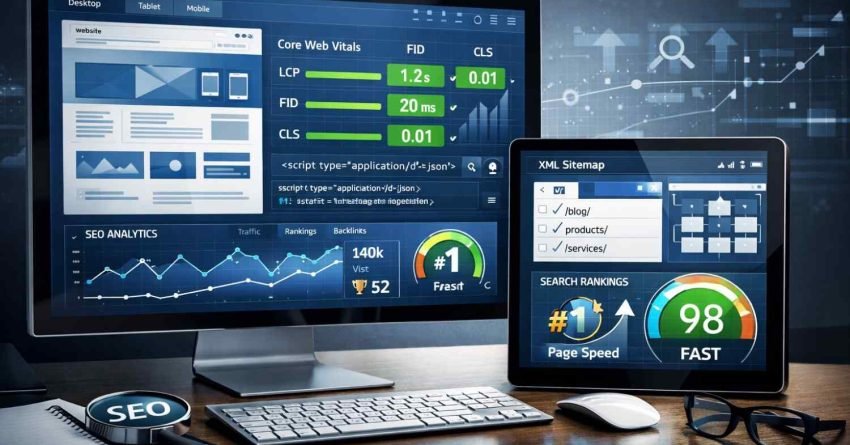
An SEO-friendly website combines visual design with technical architecture that search engines can crawl, index, and rank effectively. This integration determines whether your site attracts organic traffic or remains invisible to potential customers searching for your products and services.
For business owners and marketing managers, understanding how web design impacts SEO performance is essential for making informed investment decisions. The wrong approach wastes budget on beautiful sites that generate zero organic visibility.
This guide covers everything from technical SEO architecture and on-page optimization to realistic pricing, timelines, and provider selection criteria. You will learn exactly what separates high-performing websites from those that fail to rank.
What Are SEO-Friendly Web Design Services?
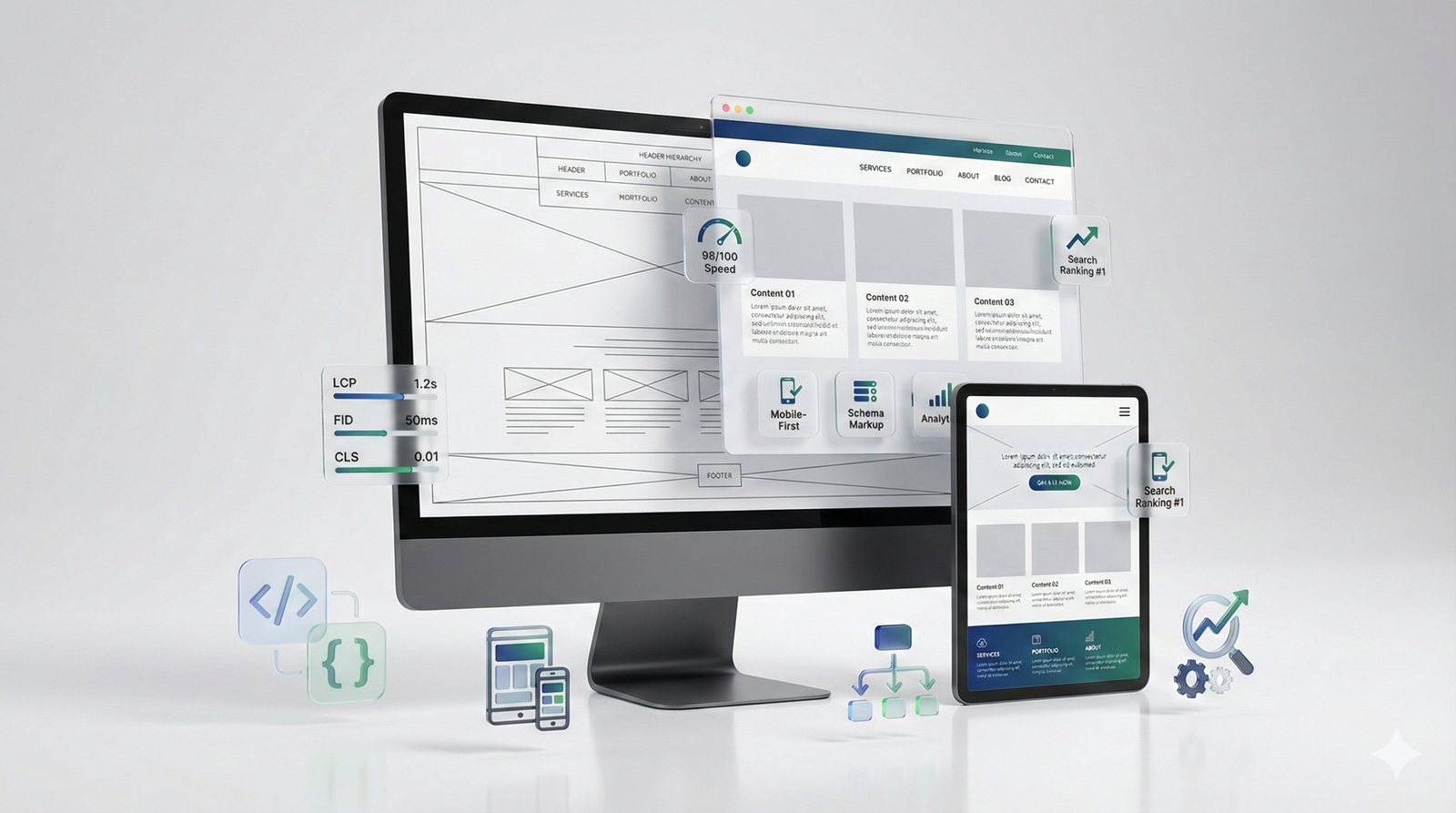
SEO-friendly web design services create websites engineered for both human visitors and search engine crawlers. These services merge aesthetic design principles with technical optimization strategies that improve organic search visibility from day one.
Definition of SEO-Friendly Web Design
SEO-friendly web design is the practice of building websites with search engine optimization integrated into every structural and visual element. This approach considers how Google’s crawlers interpret page content, site architecture, loading speed, and mobile responsiveness during the design phase rather than as an afterthought.
The core principle is simple: design decisions impact rankings. A visually stunning website built on poor technical foundations will struggle to compete against properly optimized competitors. SEO-friendly design ensures that creative choices support rather than undermine search visibility.
This methodology addresses crawlability, indexation, page experience signals, and content accessibility simultaneously. Every navigation element, image file, URL structure, and code snippet serves both user experience and search engine requirements.
How Web Design and SEO Work Together
Web design and SEO share a common goal: delivering valuable content to users efficiently. Design determines how information is organized and presented. SEO ensures that organization aligns with how search engines understand and rank content.
Technical design choices directly influence ranking factors. Page speed depends on image optimization, code efficiency, and server response times. Mobile usability requires responsive layouts and touch-friendly navigation. Site architecture affects how link equity flows between pages and how deeply crawlers can access content.
Content presentation also matters significantly. Header tag hierarchy signals topic importance to algorithms. Internal linking structures guide both users and crawlers through related content. Schema markup helps search engines understand page context and display rich results.
When design and SEO teams work separately, conflicts emerge. Designers may prioritize visual elements that slow page loading. Developers might create JavaScript-heavy interfaces that crawlers cannot render. SEO-integrated design prevents these issues by establishing optimization requirements before creative work begins.

Why Businesses Need SEO-Integrated Web Design
Businesses investing in web design without SEO integration face a costly problem: rebuilding or retrofitting sites that fail to generate organic traffic. According to BrightEdge research, organic search drives 53% of all website traffic, making it the largest single traffic source for most businesses.
Retrofitting SEO onto an existing site is significantly more expensive than building it correctly from the start. Technical debt accumulates when sites launch with poor URL structures, missing schema markup, or crawlability issues. Fixing these problems often requires substantial redevelopment work.
SEO-integrated design also accelerates time to results. New websites typically enter a “sandbox” period where Google evaluates their quality before granting significant rankings. Sites built with proper technical foundations and content architecture move through this evaluation faster than those requiring post-launch corrections.
The competitive landscape demands this approach. Your competitors who invest in SEO-friendly design gain compounding advantages over time. Their sites accumulate authority, rank for more keywords, and capture traffic that could have gone to your business.
Core Components of SEO-Friendly Website Design
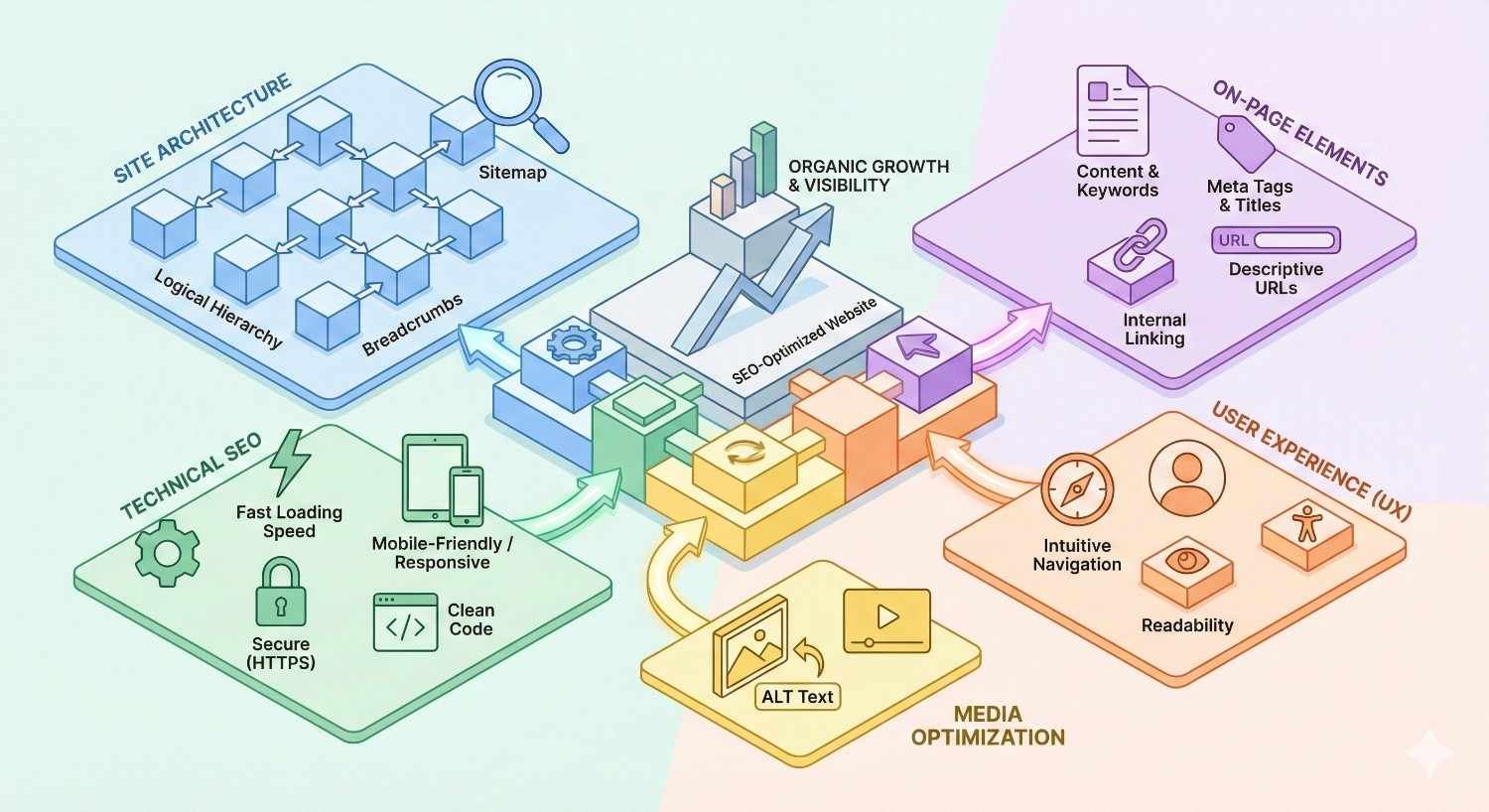
Building an SEO-friendly website requires attention to four interconnected areas: technical architecture, on-page elements, user experience, and content structure. Each component influences how search engines evaluate and rank your pages.
Technical SEO Architecture
Technical SEO architecture forms the foundation that determines whether search engines can effectively crawl, render, and index your content. Without solid technical foundations, even exceptional content struggles to rank.
Site Speed and Core Web Vitals Optimization
Page speed directly impacts both rankings and user behavior. Google’s Core Web Vitals measure three specific performance metrics: Largest Contentful Paint (LCP), First Input Delay (FID), and Cumulative Layout Shift (CLS). These metrics evaluate loading performance, interactivity, and visual stability.
LCP should occur within 2.5 seconds of page load. This metric measures when the largest visible content element renders. Optimizing LCP requires efficient image delivery, fast server response times, and minimized render-blocking resources.
FID measures responsiveness to user interactions and should remain below 100 milliseconds. Heavy JavaScript execution delays interactivity. Code splitting, deferred loading, and efficient scripting improve this metric.
CLS tracks unexpected layout shifts during loading. A score below 0.1 indicates good visual stability. Proper image dimensions, reserved space for dynamic content, and careful ad placement prevent layout shifts.
Speed optimization techniques include image compression, browser caching, content delivery networks, code minification, and lazy loading for below-fold content. Each millisecond of improvement contributes to better user experience and ranking potential.
Mobile-First and Responsive Design
Google uses mobile-first indexing, meaning the mobile version of your site determines rankings for both mobile and desktop searches. Responsive design ensures your site adapts seamlessly across all device sizes.
Mobile optimization extends beyond responsive layouts. Touch targets must be appropriately sized and spaced. Text should be readable without zooming. Horizontal scrolling should never be required. Forms must be easy to complete on small screens.
Mobile page speed often differs significantly from desktop performance. Cellular connections introduce latency that wired connections avoid. Mobile devices have less processing power for rendering complex pages. Testing mobile performance separately from desktop is essential.
Viewport configuration, flexible images, and CSS media queries form the technical foundation of responsive design. These elements ensure content reflows appropriately regardless of screen dimensions.
URL Structure and Site Architecture
URL structure communicates page content to both users and search engines. Clean, descriptive URLs improve click-through rates from search results and help crawlers understand page topics.
Effective URLs are short, readable, and include relevant keywords. They use hyphens to separate words, avoid unnecessary parameters, and follow a logical hierarchy that reflects site structure. For example: /services/web-design/ clearly indicates a web design services page within a services section.
Site architecture determines how pages connect and how link equity distributes throughout your site. Flat architectures keep important pages within three clicks of the homepage. Siloed structures group related content together, strengthening topical relevance.
Proper architecture ensures crawlers can discover all important pages efficiently. Orphan pages with no internal links may never get indexed. Deep pages requiring many clicks to reach receive less crawl attention and link equity.
SSL Security and HTTPS Implementation
HTTPS encryption is a confirmed Google ranking factor. Sites without SSL certificates display security warnings that drive visitors away and signal untrustworthiness to search engines.
SSL implementation requires obtaining a certificate, installing it on your server, and configuring proper redirects from HTTP to HTTPS. Mixed content issues occur when secure pages load insecure resources, triggering browser warnings.
Beyond rankings, HTTPS protects user data during transmission. Contact forms, login pages, and e-commerce transactions require encryption to prevent interception. Modern users expect security, and browsers increasingly restrict functionality on non-secure sites.
XML Sitemaps and Robots.txt Configuration
XML sitemaps provide search engines with a roadmap of your site’s important pages. They list URLs along with metadata about update frequency and relative priority. Submitting sitemaps through Google Search Console accelerates discovery of new and updated content.
Effective sitemaps include only indexable, canonical URLs. They exclude duplicate content, paginated archives, and pages blocked by robots.txt. Large sites may require multiple sitemaps organized by content type or section.
Robots.txt files instruct crawlers which areas of your site to access or avoid. Proper configuration prevents crawling of admin areas, duplicate content, and resource-intensive pages that waste crawl budget. Mistakes in robots.txt can accidentally block important content from indexing.
On-Page SEO Design Elements
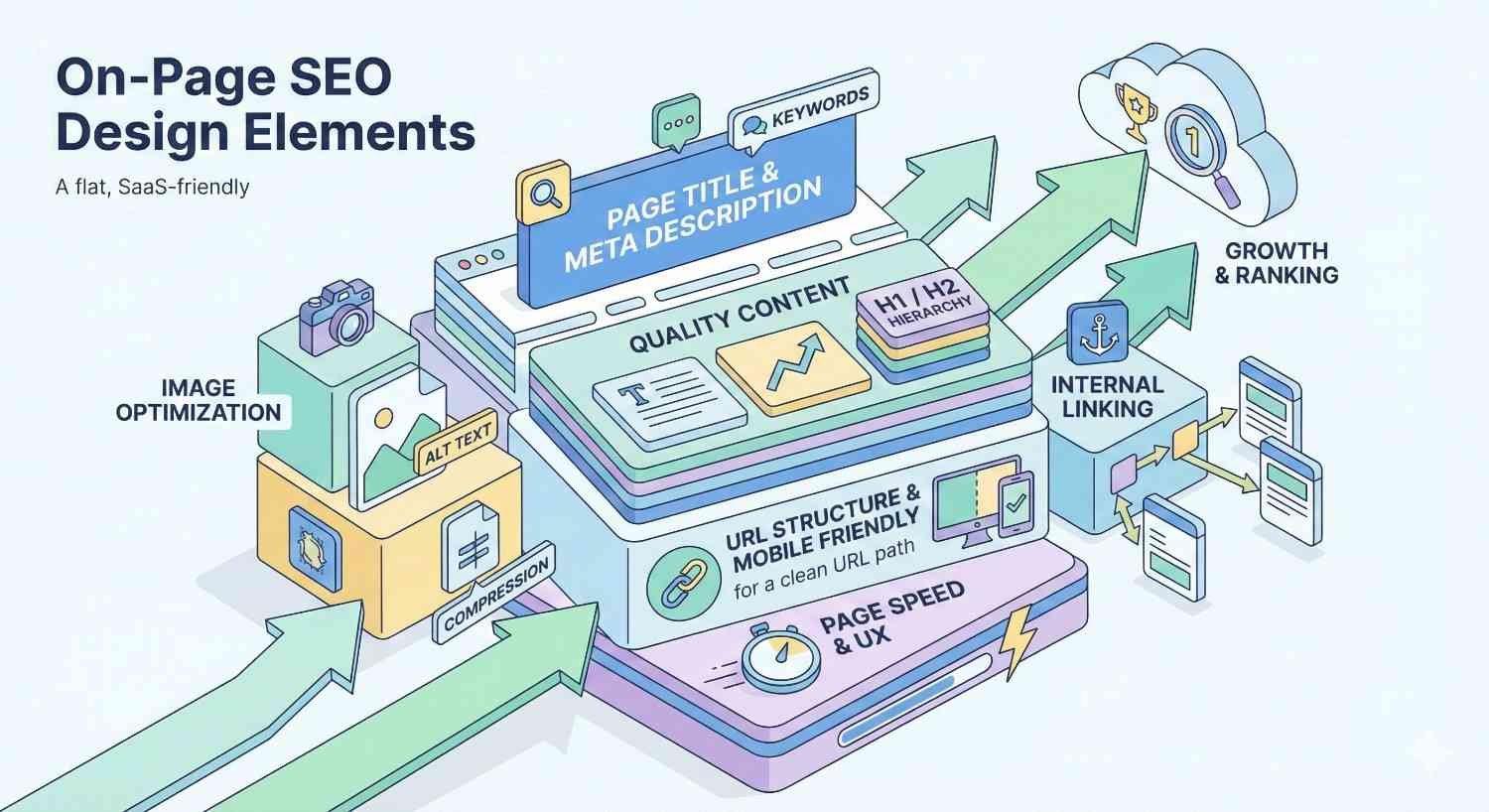
On-page elements bridge the gap between visual design and search optimization. These components appear directly on your pages and influence how search engines interpret content relevance and quality.
Header Tag Hierarchy (H1-H6 Structure)
Header tags create a content outline that search engines use to understand page structure and topic hierarchy. Proper implementation uses a single H1 for the main page title, followed by H2s for major sections, H3s for subsections, and so on.
This hierarchy should be logical and sequential. Skipping levels (H1 directly to H3) confuses both users and crawlers. Each header should accurately describe the content that follows, incorporating relevant keywords naturally.
Headers also improve accessibility for screen reader users who navigate by heading structure. This dual benefit makes proper header implementation essential for both SEO and inclusive design.
Image Optimization and Alt Text Strategy
Images require optimization for both file size and search visibility. Large image files slow page loading significantly. Proper compression, modern formats like WebP, and responsive image delivery balance quality with performance.
Alt text describes image content for users who cannot see images and for search engines that cannot interpret visual content directly. Effective alt text is descriptive, concise, and naturally incorporates relevant keywords when appropriate.
File names also contribute to image SEO. Descriptive names like “seo-friendly-website-architecture.jpg” provide more context than “IMG_12345.jpg”. Combined with alt text and surrounding content, these signals help images rank in Google Image Search.
Internal Linking Architecture
Internal links distribute page authority throughout your site and guide users to related content. Strategic internal linking strengthens topical clusters and helps search engines understand content relationships.
Anchor text for internal links should be descriptive and varied. Using the same anchor text repeatedly appears manipulative. Natural variations that accurately describe linked content perform best.
Important pages should receive more internal links than less critical content. Homepage links carry the most weight, followed by main navigation links. Contextual links within body content also pass significant value.
Schema Markup and Structured Data Integration
Schema markup provides explicit context about page content using a standardized vocabulary that search engines understand. This structured data enables rich results like star ratings, FAQ accordions, and event details in search listings.
Common schema types include Organization, LocalBusiness, Product, Article, FAQ, and HowTo. Implementation requires adding JSON-LD code to page headers or embedding microdata within HTML elements.
Rich results increase click-through rates by making listings more visually prominent and informative. Pages with proper schema markup often outperform competitors in click-through rate even when ranking in lower positions.
Meta Tags and Title Tag Optimization
Title tags appear in search results as clickable headlines and significantly influence click-through rates. Effective titles include target keywords near the beginning, stay under 60 characters to avoid truncation, and compel users to click.
Meta descriptions provide the snippet text below titles in search results. While not a direct ranking factor, compelling descriptions improve click-through rates. They should summarize page content, include relevant keywords, and end with a call to action when appropriate.
Other meta tags include canonical tags that specify preferred URLs for duplicate content, robots meta tags that control indexing behavior, and Open Graph tags that determine how pages appear when shared on social media.
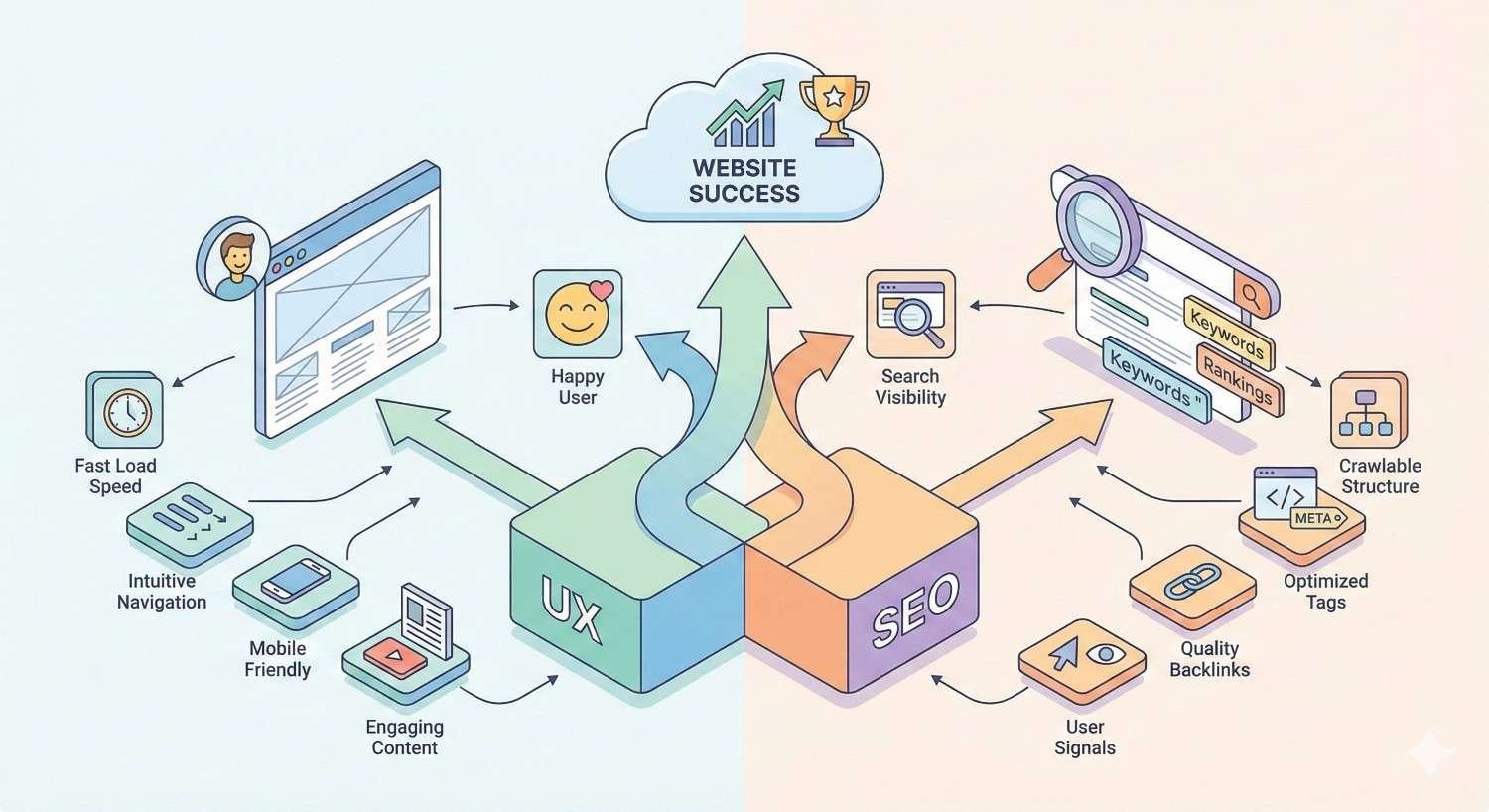
User Experience (UX) and SEO Alignment
Google’s algorithms increasingly evaluate user experience signals when determining rankings. Sites that frustrate users with poor navigation, slow loading, or confusing layouts struggle to maintain rankings regardless of content quality.
Navigation and Information Architecture
Navigation determines how easily users find content and how effectively crawlers discover pages. Clear, consistent navigation structures reduce bounce rates and increase pages per session.
Primary navigation should include your most important pages and use descriptive labels. Mega menus work well for large sites with many categories. Breadcrumb navigation helps users understand their location within site hierarchy.
Footer navigation provides secondary access to important pages and often includes links to legal pages, contact information, and sitemap pages. Both header and footer navigation contribute to internal linking structure.
Bounce Rate and Dwell Time Optimization
Bounce rate measures the percentage of visitors who leave after viewing only one page. Dwell time measures how long users stay before returning to search results. Both metrics indicate content relevance and quality.
Reducing bounce rates requires matching content to search intent, providing clear value immediately, and offering logical next steps. Above-fold content must engage visitors quickly before they decide to leave.
Increasing dwell time involves creating comprehensive content that answers questions thoroughly, using engaging formatting that encourages reading, and including multimedia elements that extend time on page.
Accessibility and ADA Compliance
Web accessibility ensures people with disabilities can use your site effectively. Accessible sites also tend to perform better in search because accessibility requirements overlap significantly with SEO best practices.
Key accessibility requirements include proper heading structure, descriptive alt text, sufficient color contrast, keyboard navigation support, and screen reader compatibility. These elements improve usability for all visitors while meeting legal compliance requirements.
The Americans with Disabilities Act applies to many business websites, and lawsuits over accessibility violations have increased substantially. Building accessibility into initial design is far more cost-effective than retrofitting later.
Conversion-Focused Design Elements
SEO drives traffic, but conversion-focused design turns visitors into leads and customers. Effective landing pages balance SEO requirements with conversion optimization principles.
Clear calls to action guide users toward desired outcomes. Trust signals like testimonials, certifications, and security badges reduce friction. Form optimization minimizes fields while capturing necessary information.
Page layout should direct attention toward conversion elements without sacrificing content quality. Heat mapping and user testing reveal how visitors actually interact with pages, informing design improvements.
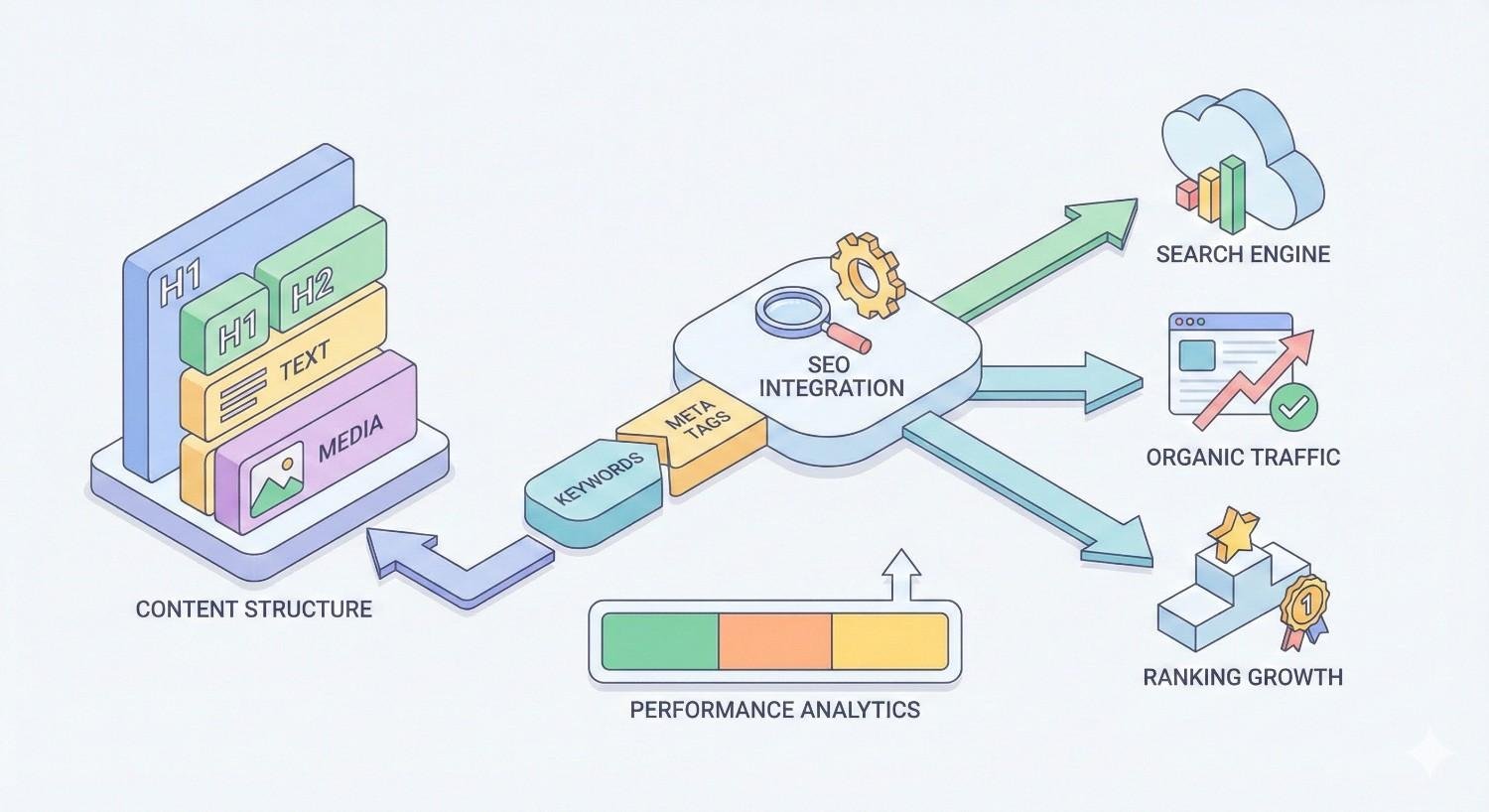
Content Structure and SEO Integration
Content structure determines how effectively your pages communicate with both readers and search algorithms. Proper structure improves readability, supports keyword targeting, and enables featured snippet capture.
Content Hierarchy and Readability
Content hierarchy organizes information from most to least important, with key points appearing early. This structure serves users who scan content and search engines that weight early content more heavily.
Short paragraphs, bullet points, and subheadings break content into digestible sections. White space improves readability and reduces cognitive load. Varied sentence length maintains reader engagement.
Reading level should match your target audience. Technical audiences accept specialized terminology. General audiences require simpler language. Tools like Hemingway Editor help assess and improve readability.
Keyword Placement in Design Elements
Strategic keyword placement reinforces topical relevance without appearing manipulative. Primary keywords belong in titles, H1 tags, first paragraphs, and meta descriptions. Secondary keywords fit naturally throughout body content.
Design elements like image alt text, button labels, and navigation text provide additional keyword placement opportunities. These elements should prioritize usability while incorporating relevant terms where natural.
Keyword density matters less than semantic relevance. Modern algorithms understand synonyms, related concepts, and natural language variations. Writing naturally while covering topic comprehensively outperforms mechanical keyword insertion.
Blog and Resource Section Architecture
Blog sections provide ongoing content opportunities that attract organic traffic and build topical authority. Proper blog architecture organizes posts by category, enables easy discovery, and supports internal linking strategies.
Category and tag structures should reflect your keyword strategy. Each category page can target valuable keywords while individual posts target long-tail variations. Avoiding duplicate content between categories and tags requires careful planning.
Resource sections like guides, tools, and downloadable content attract links and establish expertise. These assets require prominent placement and clear navigation paths to maximize their SEO value.
The Web Design Process for SEO Success
Building an SEO-friendly website follows a structured process that integrates optimization considerations at every stage. Rushing through phases or skipping steps creates technical debt that undermines long-term performance.
Discovery and SEO Strategy Phase
The discovery phase establishes the strategic foundation for all design and development decisions. Skipping this phase leads to websites that look good but fail to achieve business objectives.
Keyword Research and Competitive Analysis
Keyword research identifies the search terms your target audience uses when looking for your products or services. This research informs site architecture, page creation priorities, and content strategy.
Effective keyword research examines search volume, ranking difficulty, and commercial intent. High-volume keywords attract more traffic but face more competition. Long-tail keywords with lower volume often convert better and rank faster.
Competitive analysis reveals what’s working for sites currently ranking for your target keywords. Examining competitor site structures, content depth, and backlink profiles identifies opportunities and establishes benchmarks for your own site.
Target Audience and Search Intent Mapping
Search intent describes what users actually want when they enter a query. The same keyword can have informational, navigational, transactional, or commercial investigation intent depending on context.
Mapping intent to pages ensures content matches what searchers expect. Informational queries require educational content. Transactional queries need product pages with clear purchase paths. Mismatched intent causes high bounce rates and poor rankings.
Audience research identifies demographics, pain points, and decision-making processes. This understanding shapes content tone, depth, and calls to action. Personas help design teams create experiences that resonate with actual users.
Technical SEO Audit (for Redesigns)
Redesign projects require thorough audits of existing site performance. This audit identifies what’s working, what’s broken, and what opportunities exist for improvement.
Technical audits examine crawlability, indexation status, page speed, mobile usability, and existing rankings. Content audits assess which pages drive traffic and conversions versus which underperform. Backlink audits reveal link equity that must be preserved during migration.
Audit findings inform redesign priorities and migration planning. Pages with strong rankings require careful handling to preserve their value. Underperforming pages may need consolidation, improvement, or removal.
Design and Development Phase
The design and development phase translates strategy into functional websites. SEO considerations must influence decisions throughout this phase rather than being addressed only at the end.
Wireframing with SEO Considerations
Wireframes establish page layouts before visual design begins. SEO-informed wireframes ensure proper placement of headers, content blocks, internal links, and conversion elements.
Above-fold content receives priority placement in wireframes. Key information and calls to action must appear before users scroll. Navigation structures and internal linking opportunities are mapped at this stage.
Wireframes should account for content length requirements. Pages targeting competitive keywords need substantial content. Wireframes that allocate insufficient space for content create problems during development.
SEO-Optimized Theme/Template Selection
Theme and template selection significantly impacts SEO potential. Poorly coded themes create speed issues, accessibility problems, and crawlability barriers that are difficult to overcome.
Evaluation criteria include code quality, loading speed, mobile responsiveness, schema markup support, and customization flexibility. Popular themes often have bloated code from features most sites don’t need.
Custom themes offer maximum control but require larger budgets and longer timelines. Premium themes from reputable developers balance quality with cost-effectiveness for many projects.
CMS Selection for SEO (WordPress, Shopify, Custom)
Content management system selection affects long-term SEO capabilities. Different platforms offer varying levels of optimization control, plugin ecosystems, and technical limitations.
WordPress powers approximately 43% of all websites according to W3Techs and offers extensive SEO plugin options. Yoast SEO and Rank Math provide comprehensive optimization tools. WordPress flexibility supports virtually any SEO requirement.
Shopify works well for e-commerce but has URL structure limitations and restricted access to certain technical elements. Built-in SEO features handle basics, but advanced optimization requires workarounds.
Custom CMS solutions offer maximum control but require ongoing development resources. They make sense for large enterprises with unique requirements but are overkill for most small and medium businesses.
Development Best Practices for Search Engines
Development practices directly impact crawlability and rendering. Clean, semantic HTML helps search engines understand content structure. Efficient JavaScript implementation ensures crawlers can access content.
Server-side rendering or pre-rendering ensures search engines see complete page content. Client-side JavaScript frameworks can create indexation problems if not implemented carefully. Testing rendered output in Google Search Console reveals potential issues.
Code efficiency affects page speed. Minification, compression, and efficient resource loading improve Core Web Vitals scores. Lazy loading defers non-critical resources until needed.
Launch and Technical SEO Implementation
Launch phase execution determines whether your new site captures or loses existing search equity. Proper implementation preserves rankings while establishing foundations for future growth.
Pre-Launch SEO Checklist
Pre-launch verification prevents costly post-launch problems. Comprehensive checklists cover technical configuration, content completion, and tracking setup.
Technical checks include robots.txt configuration, XML sitemap generation, canonical tag implementation, and redirect mapping. Content checks verify all pages have unique titles, meta descriptions, and properly formatted content.
Staging environment testing should replicate production conditions as closely as possible. Speed testing, mobile testing, and crawl testing on staging reveal issues before they affect live rankings.
Google Search Console and Analytics Setup
Google Search Console provides direct communication with Google about your site’s search performance. Setup requires domain verification and sitemap submission. The tool reveals indexation status, search queries, and technical issues.
Google Analytics tracks user behavior after visitors arrive. Proper configuration includes goal tracking, e-commerce tracking if applicable, and event tracking for important interactions. GA4 implementation requires attention to data streams and conversion setup.
Both tools should be configured before launch to establish baseline data. Post-launch comparison reveals the impact of changes and identifies unexpected issues.
Indexation and Crawlability Verification
Post-launch verification confirms search engines can access and index your content properly. Google Search Console’s URL Inspection tool shows how Google sees individual pages.
Coverage reports reveal indexation status across your entire site. Pages excluded from indexing may have technical issues, quality problems, or intentional noindex tags. Unexpected exclusions require investigation.
Crawl stats show how frequently Google visits your site and whether errors occur during crawling. Sudden drops in crawl activity may indicate technical problems. Increases after launch suggest Google is actively discovering new content.
301 Redirects and Migration SEO (if applicable)
Site migrations require comprehensive redirect mapping to preserve search equity. Every old URL that received traffic or links needs a 301 redirect to its new equivalent.
Redirect chains (A redirects to B, B redirects to C) waste crawl budget and dilute link equity. Direct redirects from old URLs to final destinations perform better.
Post-migration monitoring tracks ranking changes for important keywords. Some fluctuation is normal during migrations. Significant drops may indicate redirect problems, content changes, or technical issues requiring attention.
Post-Launch SEO Monitoring and Optimization
Launch is the beginning, not the end, of SEO work. Ongoing monitoring and optimization compound initial investments into long-term organic growth.
Performance Tracking and KPI Measurement
Key performance indicators for SEO include organic traffic, keyword rankings, conversion rates from organic traffic, and revenue attributed to organic search. Tracking these metrics reveals whether SEO efforts produce business results.
Regular reporting cadences keep stakeholders informed and identify trends early. Monthly reports work for most businesses. Weekly monitoring catches sudden changes that require immediate attention.
Attribution modeling connects organic traffic to business outcomes. Last-click attribution undervalues SEO’s contribution to conversions that involve multiple touchpoints. Multi-touch attribution provides more accurate pictures of SEO ROI.
Ongoing Technical SEO Maintenance
Technical SEO requires ongoing attention as sites evolve. New content, platform updates, and third-party integrations can introduce issues that affect performance.
Regular technical audits catch problems before they significantly impact rankings. Quarterly comprehensive audits supplemented by monthly spot checks balance thoroughness with resource efficiency.
Core Web Vitals monitoring ensures performance remains within acceptable thresholds. Site changes, traffic increases, and third-party script updates can degrade performance over time.
Content Updates and Continuous Improvement
Content freshness signals relevance to search engines. Updating existing content with new information, improved formatting, and expanded coverage often produces faster ranking improvements than creating new content.
Content gap analysis identifies topics your competitors cover that you don’t. Filling these gaps strengthens topical authority and captures additional search traffic.
User feedback and search query data reveal content improvement opportunities. Questions users ask that your content doesn’t answer represent expansion opportunities. High-impression, low-click queries may benefit from title and description optimization.
How to Choose the Right SEO Web Design Service Provider
Selecting the right provider significantly impacts project outcomes. The wrong choice wastes budget on sites that require expensive fixes or complete rebuilds.
Key Qualifications and Expertise to Look For
Qualified providers demonstrate both design excellence and SEO competence. Portfolio sites should rank well for relevant keywords, not just look attractive.
Technical SEO knowledge is essential. Providers should understand Core Web Vitals optimization, schema markup implementation, and crawlability requirements. Ask about their approach to these technical elements.
Content strategy capabilities matter for comprehensive projects. Providers who only handle design and development may deliver technically sound sites that lack content foundations for ranking.
Questions to Ask Before Hiring
Effective vetting requires specific questions about process, deliverables, and expectations.
Ask how they integrate SEO into the design process. Providers who treat SEO as an add-on service rather than a core consideration may produce suboptimal results.
Request examples of sites they’ve built that rank well organically. Ask about the timeline from launch to meaningful organic traffic. Providers should set realistic expectations rather than promising immediate results.
Inquire about their approach to site migrations if redesigning an existing site. Proper migration planning prevents ranking losses that can take months to recover.
Red Flags and Warning Signs to Avoid
Certain warning signs indicate providers who may underdeliver or cause problems.
Guarantees of specific rankings or traffic numbers are red flags. No provider can guarantee rankings because Google’s algorithm is outside anyone’s control. Ethical providers set realistic expectations.
Extremely low prices often indicate corner-cutting that creates technical debt. SEO-friendly web design requires expertise and time. Providers charging significantly below market rates may skip important steps.
Lack of transparency about process, timeline, or deliverables suggests potential problems. Professional providers clearly communicate what they’ll deliver and when.
Agency vs. Freelancer vs. In-House Considerations
Different provider types suit different situations and budgets.
Agencies offer comprehensive services and team depth but charge premium rates. They work well for complex projects requiring multiple specialties.
Freelancers provide cost savings and direct communication but may lack capacity for large projects. They suit smaller businesses with straightforward requirements.
In-house teams offer maximum control and institutional knowledge but require ongoing salary and training investments. They make sense for organizations with continuous web development needs.
Portfolio and Case Study Evaluation
Portfolio review should examine both visual quality and SEO performance. Beautiful sites that don’t rank represent incomplete success.
Request case studies with specific metrics. Traffic growth percentages, ranking improvements, and conversion rate changes demonstrate actual results. Vague claims without data may indicate limited success.
Check portfolio sites using SEO tools. Examine their Core Web Vitals scores, backlink profiles, and keyword rankings. This independent verification reveals whether claimed results match reality.
Web Design Services Pricing and SEO Investment
Understanding pricing helps set realistic budgets and evaluate proposals. Costs vary significantly based on project scope, provider type, and optimization depth.
Typical Cost Ranges for SEO-Friendly Web Design
Pricing depends on site complexity, customization requirements, and provider expertise. The following ranges represent typical market rates for quality work.
Small Business Website Costs
Small business websites with 5-15 pages typically cost between $3,000 and $15,000 for SEO-friendly design and development. This range includes custom design, responsive development, basic SEO implementation, and CMS setup.
Lower-end projects use premium themes with customization. Higher-end projects include custom design, more extensive content, and deeper SEO integration.
Template-based solutions from website builders cost less but offer limited SEO control and customization. They may suit very small businesses with minimal requirements but create limitations as businesses grow.
E-commerce Website Costs
E-commerce sites require additional functionality that increases costs. SEO-friendly e-commerce websites typically range from $10,000 to $50,000 depending on product catalog size and feature requirements.
Product page optimization, category structure, and technical e-commerce SEO add complexity. Integration with inventory systems, payment processors, and shipping calculators requires development time.
Platform selection significantly impacts costs. Shopify reduces development time but has ongoing transaction fees. WooCommerce offers more flexibility but requires more custom development.
Enterprise and Custom Website Costs
Enterprise websites with complex requirements, custom functionality, and extensive content can cost $50,000 to $250,000 or more. These projects involve multiple stakeholders, custom integrations, and sophisticated SEO strategies.
Custom CMS development, advanced personalization, and multi-language support increase costs substantially. Enterprise projects also require more extensive discovery, planning, and testing phases.
Ongoing maintenance and optimization for enterprise sites represent significant additional investments beyond initial development.
Factors That Affect Web Design Pricing
Multiple factors influence project costs beyond basic page counts.
Customization level significantly impacts pricing. Template-based designs cost less than fully custom designs. Custom functionality requires development time that increases budgets.
Content creation adds substantial costs if not handled internally. Professional copywriting, photography, and video production require separate budgets or provider add-ons.
Timeline compression increases costs. Rush projects require providers to prioritize your work over other clients, commanding premium rates.
ROI of SEO-Integrated Web Design
SEO-integrated design produces measurable returns through organic traffic acquisition. Calculating ROI requires comparing organic traffic value against investment costs.
Organic traffic value can be estimated by multiplying monthly organic visitors by average conversion rate and customer lifetime value. Alternatively, compare against equivalent paid traffic costs.
A site generating 1,000 monthly organic visitors with a 2% conversion rate and $500 average customer value produces $10,000 monthly revenue from organic search. Annual value of $120,000 easily justifies substantial design investments.
Time to positive ROI varies based on competition and execution quality. Most businesses see meaningful organic traffic within 6-12 months of launching properly optimized sites.
Budget Allocation: Design vs. Ongoing SEO
Initial design investment establishes foundations, but ongoing SEO produces compounding returns. Budget allocation should account for both phases.
A common allocation dedicates 60-70% of first-year budget to design and development, with 30-40% reserved for ongoing optimization. Subsequent years shift toward higher ongoing SEO investment as the site matures.
Ongoing SEO activities include content creation, link building, technical maintenance, and performance optimization. These activities build on initial design investments to accelerate organic growth.
Underfunding ongoing SEO after investing in quality design wastes initial investment. Sites require continuous attention to maintain and improve rankings in competitive markets.
SEO Results Timeline: What to Expect After Launch
Setting realistic timeline expectations prevents frustration and supports informed decision-making. SEO produces results over months, not days.
Realistic SEO Timeline Expectations (3-12 Months)
New websites typically require 3-6 months to see initial ranking improvements and 6-12 months to achieve significant organic traffic growth. These timelines assume consistent optimization efforts throughout.
Months 1-3 focus on indexation, initial crawling, and establishing baseline visibility. New sites may rank for brand terms and low-competition keywords during this phase.
Months 4-6 typically show ranking improvements for target keywords as Google evaluates content quality and user engagement signals. Traffic growth accelerates as more pages gain visibility.
Months 7-12 produce compounding results as authority builds and content library expands. Sites with consistent optimization often see exponential traffic growth during this phase.
Ranking Factors That Influence Speed of Results
Multiple factors accelerate or slow ranking progress.
Competition level significantly impacts timelines. Low-competition niches see faster results than highly competitive markets. Local businesses often rank faster than national competitors.
Domain authority affects starting position. New domains start from zero authority. Established domains with existing backlinks have advantages that accelerate results.
Content quality and quantity influence ranking speed. Comprehensive content that thoroughly addresses search intent ranks faster than thin content. Regular publishing builds topical authority over time.
Technical foundation quality determines whether optimization efforts translate into rankings. Sites with technical problems may see limited results despite content investments.
Measuring Success: Traffic, Leads, and Revenue Metrics
Effective measurement connects SEO activities to business outcomes.
Traffic metrics include organic sessions, new users from organic search, and pages per session. These metrics indicate visibility and engagement improvements.
Lead metrics track form submissions, phone calls, and other conversions from organic traffic. Conversion rate optimization ensures traffic improvements translate into business results.
Revenue metrics attribute sales to organic search traffic. E-commerce sites can track direct revenue. Service businesses may use lead values and close rates to estimate organic revenue contribution.
Long-Term Organic Growth Strategy
Sustainable organic growth requires ongoing investment in content, authority building, and technical maintenance.
Content strategy should target progressively more competitive keywords as authority builds. Early content targets long-tail keywords. Later content pursues higher-volume terms.
Link building accelerates authority growth. Quality backlinks from relevant sites signal trustworthiness to search engines. Consistent link acquisition compounds over time.
Technical maintenance prevents degradation. Regular audits catch issues before they impact rankings. Platform updates and security patches maintain site health.
Web Design vs. SEO Services: Understanding the Difference
Clarity about service distinctions helps businesses make appropriate investment decisions. Web design and SEO services overlap but serve different primary purposes.
When You Need Web Design Only
Pure web design projects suit businesses with existing SEO strategies or those prioritizing other traffic sources.
Businesses relying primarily on paid advertising, social media, or referral traffic may need attractive, functional websites without deep SEO integration. Their traffic acquisition strategies don’t depend on organic search.
Companies with in-house SEO teams may outsource design while handling optimization internally. This approach works when internal teams have sufficient expertise and capacity.
Redesigns focused purely on visual updates or user experience improvements may not require comprehensive SEO services if existing optimization remains intact.
When You Need SEO Services Only
Existing websites with solid technical foundations may need SEO services without redesign.
Sites built recently with proper technical architecture may simply need content optimization, link building, and ongoing maintenance. Redesigning functional sites wastes resources.
Businesses with adequate websites but poor organic visibility benefit from SEO services that improve existing assets. Content improvements and authority building can transform underperforming sites.
Technical SEO audits and fixes address specific issues without requiring complete redesigns. Targeted interventions often produce significant improvements at lower cost than rebuilding.
When You Need Both (Integrated Approach)
Most businesses benefit from integrated web design and SEO services.
New businesses launching their first websites need both design and SEO to establish effective online presence. Building SEO into initial design prevents costly retrofitting.
Businesses with outdated websites often need redesigns that incorporate modern SEO requirements. Older sites may have technical limitations that prevent effective optimization.
Companies entering competitive markets need every advantage. Integrated approaches ensure design decisions support SEO goals and optimization efforts leverage design investments.
Common Web Design Mistakes That Hurt SEO
Avoiding common mistakes prevents costly problems that undermine organic visibility. Many issues stem from prioritizing aesthetics over functionality.
Technical Mistakes (Slow Speed, Poor Mobile Experience)
Technical mistakes create barriers that prevent effective crawling and indexing.
Unoptimized images represent the most common speed issue. Large image files dramatically slow page loading. Proper compression and modern formats solve this problem easily.
Heavy JavaScript frameworks can prevent content rendering for search engines. Client-side rendering without server-side alternatives creates indexation problems.
Poor mobile experiences violate Google’s mobile-first indexing requirements. Sites that work well on desktop but poorly on mobile face ranking penalties.
Structural Mistakes (Flat Architecture, Orphan Pages)
Structural mistakes prevent effective crawling and link equity distribution.
Flat architectures place all pages at the same level without logical hierarchy. This structure fails to signal topic relationships and importance to search engines.
Orphan pages have no internal links pointing to them. Search engines may never discover these pages, and they receive no link equity from other site pages.
Excessive pagination splits content across many pages, diluting relevance signals. Infinite scroll implementations can prevent crawlers from accessing content below initial loads.
Content Mistakes (Thin Content, Keyword Stuffing)
Content mistakes undermine relevance signals and user experience.
Thin content provides insufficient value to rank competitively. Pages with only a few sentences cannot demonstrate expertise or comprehensively address topics.
Keyword stuffing attempts to manipulate rankings through excessive keyword repetition. Modern algorithms easily detect and penalize this practice.
Duplicate content across multiple pages confuses search engines about which version to rank. Canonical tags and content consolidation address this issue.
How to Fix SEO Issues on an Existing Website
Existing sites with SEO problems can be improved through systematic remediation.
Technical audits identify specific issues requiring attention. Prioritize fixes based on impact and effort required. Address critical crawlability issues before optimizing content.
Content audits reveal pages needing improvement, consolidation, or removal. Improving existing content often produces faster results than creating new content.
Structural improvements may require significant changes to navigation and internal linking. Implement changes carefully to avoid disrupting existing rankings during transitions.
SEO-Friendly Web Design for Specific Industries
Different industries have unique SEO requirements based on their business models and target audiences.
Local Business and Service Area Websites
Local businesses need websites optimized for geographic search terms and Google Business Profile integration.
Location pages targeting specific service areas help capture local search traffic. Each location page should have unique content relevant to that area.
Google Business Profile optimization complements website SEO. Consistent NAP (name, address, phone) information across website and business listings strengthens local signals.
Local schema markup helps search engines understand business location and service areas. LocalBusiness schema with geographic coordinates improves local pack visibility.
E-commerce and Online Store Design
E-commerce sites face unique challenges including large product catalogs and faceted navigation.
Product page optimization requires unique descriptions, optimized images, and proper schema markup. Duplicate manufacturer descriptions create content quality issues.
Category page optimization targets broader keywords while product pages target specific product terms. Proper hierarchy ensures both page types can rank effectively.
Faceted navigation creates potential duplicate content and crawl budget issues. Proper implementation uses canonical tags and crawl directives to manage these challenges.
B2B and Lead Generation Websites
B2B websites prioritize lead generation over direct sales, requiring different optimization approaches.
Content marketing plays a larger role in B2B SEO. Educational content attracts prospects earlier in buying cycles and builds authority.
Conversion optimization focuses on lead capture rather than purchases. Form optimization, gated content, and nurturing sequences convert organic traffic into qualified leads.
Long-tail keyword targeting often works better for B2B. Specific, technical queries indicate higher purchase intent than broad terms.
SaaS and Technology Company Websites
SaaS companies need websites that support both acquisition and product education.
Feature pages targeting specific use cases capture search traffic from prospects researching solutions. Each feature deserves dedicated optimization.
Integration and comparison pages target prospects evaluating alternatives. “Alternative to [competitor]” and “[product] vs [competitor]” queries represent valuable traffic.
Documentation and help content serves existing users while capturing search traffic from prospects researching capabilities.
Tools and Technologies for SEO Web Design
Proper tools support effective implementation and ongoing optimization. Tool selection depends on project requirements and team capabilities.
Best CMS Platforms for SEO
Content management system selection affects long-term SEO capabilities.
WordPress offers maximum flexibility and extensive plugin ecosystem. Proper theme selection and plugin configuration create highly optimized sites.
Webflow provides visual design capabilities with clean code output. Built-in SEO features handle basics well, though advanced customization requires workarounds.
Shopify dominates e-commerce but has URL structure limitations. Apps extend SEO capabilities, but some technical elements remain inaccessible.
Essential SEO Plugins and Extensions
Plugins extend CMS capabilities for SEO implementation.
Yoast SEO and Rank Math provide comprehensive WordPress optimization including meta tags, schema markup, and content analysis. Both offer free versions with premium upgrades.
Schema Pro and similar plugins simplify structured data implementation. Visual interfaces make schema markup accessible to non-developers.
Speed optimization plugins like WP Rocket and Autoptimize improve Core Web Vitals through caching, minification, and lazy loading.
Analytics and Tracking Tools Setup
Proper analytics configuration enables performance measurement and optimization.
Google Analytics 4 tracks user behavior and conversions. Proper configuration includes goal setup, e-commerce tracking, and event tracking for important interactions.
Google Search Console provides search performance data including queries, impressions, clicks, and average positions. Integration with Analytics connects search data to user behavior.
Third-party tools like Semrush and Ahrefs provide competitive intelligence, rank tracking, and backlink analysis that complement Google’s free tools.
Technical SEO Audit Tools
Audit tools identify technical issues requiring attention.
Screaming Frog crawls websites to identify technical issues including broken links, missing meta tags, and duplicate content. The free version handles smaller sites.
Google PageSpeed Insights and GTmetrix analyze page speed and Core Web Vitals. These tools provide specific recommendations for performance improvements.
Sitebulb and DeepCrawl offer advanced crawling capabilities for larger sites with complex technical requirements.
Conclusion
SEO-friendly web design integrates technical optimization, user experience, and content strategy into cohesive websites that attract organic traffic and convert visitors into customers. The investment pays dividends through sustainable traffic growth that compounds over time.
At White Label SEO Service, we help businesses build websites engineered for organic visibility from the ground up. Our integrated approach ensures design decisions support long-term SEO success rather than creating technical debt that undermines future growth.
We invite you to schedule a consultation to discuss your web design and SEO requirements. Our team will assess your current situation, identify opportunities, and recommend strategies aligned with your business objectives.
Frequently Asked Questions About SEO Web Design Services
How long does it take to build an SEO-friendly website?
Most SEO-friendly websites require 8-16 weeks from project kickoff to launch. This timeline includes discovery, design, development, content creation, and testing phases. Complex projects with extensive content or custom functionality may require longer timelines.
Can I add SEO to my existing website?
Yes, existing websites can be optimized for SEO through technical improvements, content optimization, and structural changes. However, some older sites have fundamental limitations that make redesigning more cost-effective than retrofitting. A technical audit reveals whether optimization or redesign makes more sense.
What’s the difference between SEO and SEM?
SEO focuses on organic search visibility through optimization techniques. SEM (Search Engine Marketing) typically refers to paid search advertising like Google Ads. SEO produces long-term results through ongoing investment, while SEM provides immediate visibility that stops when ad spend stops.
How often should I update my website for SEO?
Content updates should occur regularly based on your industry and competition. Most businesses benefit from monthly content additions and quarterly reviews of existing content. Technical maintenance should occur continuously, with comprehensive audits at least quarterly.
Do I need a blog for SEO?
Blogs provide significant SEO benefits by creating ongoing content opportunities and building topical authority. However, blogs require consistent publishing to be effective. Businesses unable to maintain regular publishing may benefit more from comprehensive service pages and resource content.
What are Core Web Vitals and why do they matter?
Core Web Vitals are Google’s metrics for measuring page experience: loading performance (LCP), interactivity (FID), and visual stability (CLS). These metrics directly influence rankings. Sites failing Core Web Vitals thresholds face ranking disadvantages compared to faster, more stable competitors.
How do I know if my current website is SEO-friendly?
Run your site through Google PageSpeed Insights to check Core Web Vitals. Use Google Search Console to identify indexation issues. Check mobile usability with Google’s Mobile-Friendly Test. Review your site structure for proper heading hierarchy, internal linking, and URL organization. Professional audits provide comprehensive assessments.