
SaaS SEO is the specialized practice of optimizing software-as-a-service websites to attract, convert, and retain customers through organic search. Unlike traditional SEO, it addresses unique challenges: long sales cycles, complex buyer journeys, and subscription-based revenue models that demand consistent visibility.
For SaaS founders and marketing teams, organic search represents the most scalable customer acquisition channel available. Paid ads stop working when budgets dry up. SEO compounds over time.
This guide covers everything you need to understand SaaS SEO: core components, funnel strategies, realistic timelines, common challenges, and actionable steps to build your organic growth engine.

What Is SaaS SEO?
Defining SaaS SEO
SaaS SEO refers to search engine optimization strategies designed specifically for software-as-a-service businesses. The goal extends beyond ranking keywords. It focuses on attracting qualified prospects at every stage of the buyer journey and converting them into trial users, paying customers, and long-term subscribers.
The practice encompasses technical optimization, content strategy, keyword research, and link building. However, each element adapts to SaaS-specific needs. Product pages require different optimization than blog content. Feature comparisons serve different intent than educational guides. Pricing pages need distinct approaches from documentation.
What separates SaaS SEO from general optimization is the direct connection to revenue metrics. Success measures in monthly recurring revenue (MRR), customer acquisition cost (CAC), and lifetime value (LTV). Traffic matters only when it converts.
How SaaS SEO Differs from Traditional SEO
Traditional SEO often targets broad visibility. SaaS SEO targets precision. The differences emerge across multiple dimensions.
Conversion paths are longer. A SaaS buyer might read five blog posts, compare three competitors, watch a demo, and start a free trial before converting. Traditional e-commerce might involve a single session purchase. This extended journey requires content at every touchpoint.
Keywords carry different weight. Bottom-of-funnel terms like “project management software pricing” drive immediate revenue. Top-of-funnel terms like “how to manage remote teams” build awareness. SaaS SEO balances both while traditional SEO might focus heavily on transactional terms.
Technical requirements differ. Many SaaS platforms use JavaScript frameworks that create indexation challenges. Application interfaces, login walls, and dynamic content require specialized technical approaches that static websites never encounter.
Content serves product education. SaaS content must explain complex features, demonstrate use cases, and reduce friction in the buying process. This educational burden exceeds what most traditional businesses face.
The Role of SEO in SaaS Business Models
Subscription revenue changes everything about marketing economics. Customer acquisition cost must stay below lifetime value for the business to survive. SEO offers the most favorable unit economics of any acquisition channel.
Paid advertising requires continuous spending. Stop the ads, stop the leads. SEO investments compound. Content published today generates traffic for years. Links built this quarter strengthen domain authority permanently.
For SaaS companies, organic search typically delivers the highest quality leads. Users actively searching for solutions demonstrate intent. They arrive educated about their problems. They convert at higher rates than interruption-based channels.
SEO also supports retention. Help documentation, feature guides, and educational content keep existing customers engaged. Strong organic presence reinforces brand authority, reducing churn by maintaining top-of-mind awareness.
The recurring revenue model means each organic conversion carries amplified value. A customer acquired through SEO who stays for three years represents far more value than the initial conversion suggests.
Why SaaS SEO Matters
Sustainable Customer Acquisition
Paid channels create dependency. Increase spend to increase leads. Decrease spend and leads disappear. This volatility makes forecasting difficult and scaling expensive.
SEO builds an asset. Every piece of content, every link earned, every technical improvement contributes to a foundation that generates leads without proportional ongoing costs. The marginal cost of the next organic visitor approaches zero once content ranks.
This sustainability proves critical during economic uncertainty. When budgets tighten, paid campaigns get cut first. Organic traffic continues flowing. Companies with strong SEO foundations weather downturns better than those dependent on advertising.
The compounding nature of SEO also means early investment pays disproportionate returns. A blog post ranking for three years generates far more value than its creation cost. This dynamic favors long-term thinking over short-term tactics.
Lower Customer Acquisition Cost (CAC)
Customer acquisition cost determines SaaS profitability. Most SaaS companies target a CAC payback period under 12 months. SEO dramatically improves this metric.
Consider the math. A paid search click for competitive SaaS keywords might cost $15-50. Converting at 2% means $750-2,500 per customer from paid search alone. Add sales team costs, and CAC climbs further.
Organic traffic carries no per-click cost. The investment is content creation, technical optimization, and link building. These costs spread across all visitors, reducing per-acquisition expense as traffic grows.
HubSpot’s research indicates that inbound leads from organic search cost 61% less than outbound leads. For SaaS companies operating on thin margins, this difference determines viability.
Predictable Revenue Growth
SEO traffic follows patterns. Seasonal fluctuations exist, but the overall trajectory remains predictable once rankings stabilize. This predictability enables better financial planning.
Paid advertising fluctuates with auction dynamics, competitor behavior, and platform changes. A competitor increasing bids can double your costs overnight. Algorithm changes on ad platforms can tank performance without warning.
Organic rankings change more gradually. Google updates cause shifts, but diversified content portfolios absorb these impacts. Companies rarely lose all organic traffic simultaneously.
This stability allows SaaS companies to forecast revenue more accurately. When you know organic traffic generates a consistent percentage of trials, and trials convert at known rates, revenue projections become reliable.
Competitive Advantage in Crowded Markets
Most SaaS categories contain dozens of competitors. Differentiation through features alone proves difficult when competitors copy innovations within months.
SEO creates defensible positioning. Ranking first for important keywords means competitors must outwork you to displace your content. The effort required to overtake established rankings creates a moat.
Topical authority compounds this advantage. As you publish comprehensive content across your category, search engines recognize your expertise. New content ranks faster. Competitors starting later face an uphill battle against your established authority.
Brand searches also benefit. Users who discover you through informational content later search your brand name directly. These branded searches signal relevance to search engines, strengthening overall rankings.
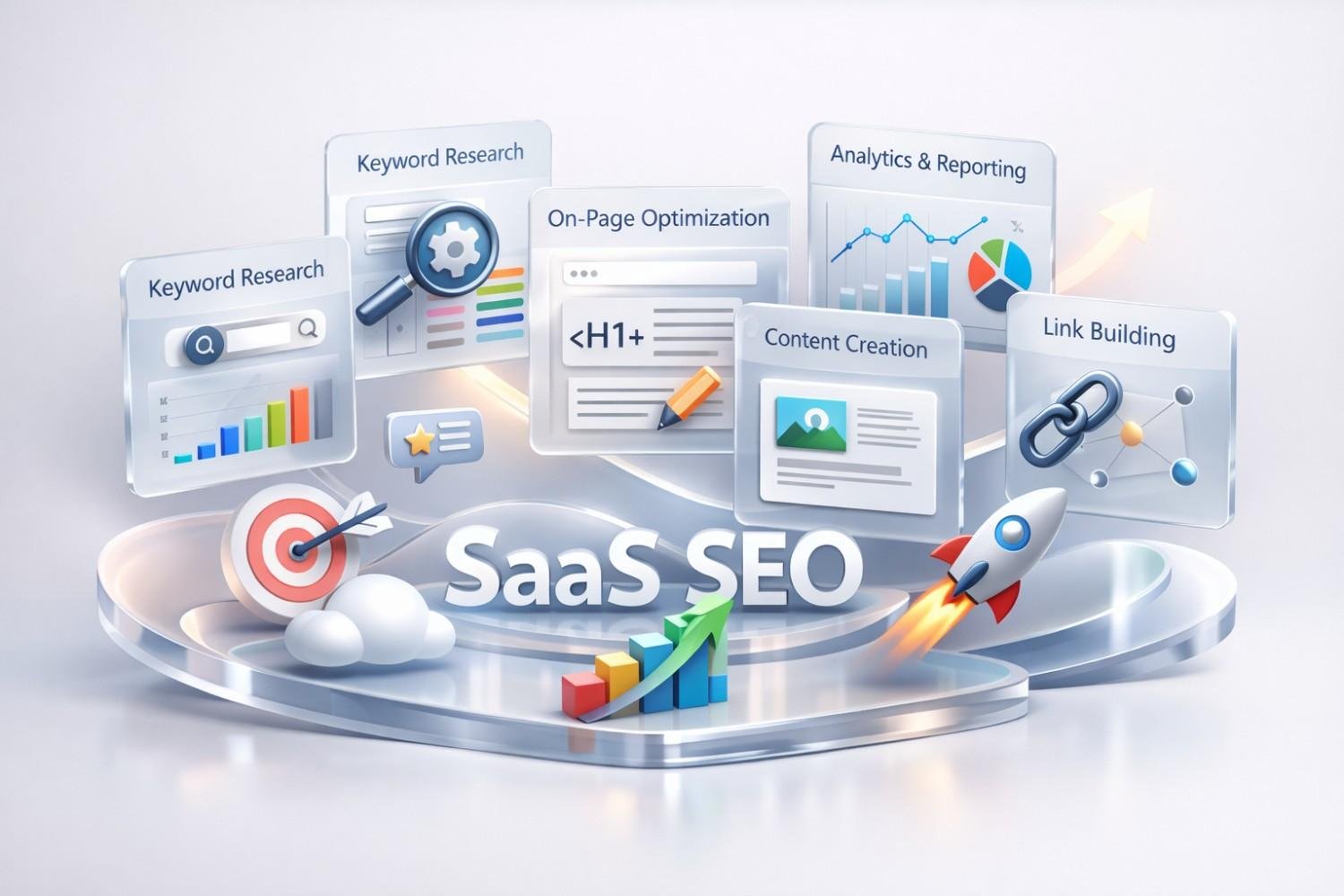
Core Components of SaaS SEO
Technical SEO for SaaS Platforms
Technical SEO ensures search engines can discover, crawl, render, and index your content. For SaaS platforms, technical challenges often exceed those of simpler websites.
Site Architecture & Crawlability
Effective site architecture organizes content logically for both users and search engines. SaaS sites typically need distinct sections for marketing pages, product features, pricing, documentation, and blog content.
URL structure should reflect this hierarchy. Clear paths like /features/reporting/ or /solutions/enterprise/ communicate content relationships. Flat structures where everything sits at the root level confuse crawlers and users alike.
Internal linking distributes authority throughout the site. Feature pages should link to relevant blog content. Blog posts should link to product pages where appropriate. This interconnection helps search engines understand topical relationships.
XML sitemaps guide crawlers to important pages. Large SaaS sites benefit from segmented sitemaps: one for marketing pages, another for documentation, a third for blog content. This organization helps identify indexation issues by section.
Crawl budget matters for larger sites. Search engines allocate limited resources to each domain. Blocking unimportant pages (admin areas, duplicate parameters, internal search results) preserves budget for valuable content.
Page Speed & Core Web Vitals
Google’s Core Web Vitals measure user experience through three metrics: Largest Contentful Paint (LCP), Interaction to Next Paint (INP), and Cumulative Layout Shift (CLS). These factors influence rankings directly.
SaaS marketing sites often suffer from bloated page builders, excessive tracking scripts, and unoptimized images. Each element adds load time. Users abandon slow pages before converting.
LCP should occur within 2.5 seconds. Achieve this through optimized images, efficient hosting, content delivery networks, and minimized render-blocking resources. Hero images and above-fold content deserve priority loading.
INP measures responsiveness to user interactions. Heavy JavaScript frameworks can delay response to clicks and taps. Optimize event handlers and reduce main thread blocking to improve this metric.
CLS measures visual stability. Elements shifting during load frustrate users and harm rankings. Reserve space for images and ads before they load. Avoid inserting content above existing elements.
JavaScript Rendering & Indexation
Many SaaS platforms use React, Vue, Angular, or similar JavaScript frameworks. These create rendering challenges for search engines.
Googlebot can render JavaScript, but the process is resource-intensive and delayed. Content rendered client-side may not get indexed for days or weeks after crawling. Critical content should be server-rendered or pre-rendered.
Server-side rendering (SSR) delivers fully rendered HTML to crawlers. This approach ensures immediate indexation but requires more complex infrastructure. Frameworks like Next.js and Nuxt.js simplify SSR implementation.
Pre-rendering generates static HTML for specific pages. This works well for marketing content that changes infrequently. Dynamic application content may need different approaches.
Test rendering using Google Search Console’s URL Inspection tool. Compare the rendered HTML to your source. Missing content indicates rendering failures that prevent indexation.
SaaS Content Strategy
Content drives SaaS SEO. Without substantial, valuable content, there’s nothing to rank. Strategy determines what content to create, for whom, and how it connects to business goals.
Product-Led Content
Product-led content demonstrates your software solving real problems. This content type converts readers into users by showing rather than telling.
Feature pages explain what your product does. Each major feature deserves dedicated content optimized for relevant keywords. “Email automation software” or “invoice tracking features” represent searchable terms that feature pages can target.
Use case content shows the product in action for specific scenarios. “Project management for marketing teams” or “CRM for real estate agents” addresses niche audiences with tailored messaging.
Template and resource pages provide immediate value while showcasing product capabilities. A project management tool might offer free project templates. Users download templates, experience the product’s approach, and convert to paid plans.
Tutorial content teaches users to accomplish specific tasks. “How to create automated email sequences” can rank for informational queries while demonstrating product functionality.
Educational & Thought Leadership Content
Educational content attracts top-of-funnel visitors who aren’t yet searching for solutions. These readers have problems but haven’t identified software as the answer.
Industry guides establish expertise. A comprehensive guide to “B2B sales strategies” from a CRM company demonstrates understanding of customer challenges. Readers trust the company’s product recommendations after consuming valuable free content.
Research and data content earns links and citations. Original surveys, benchmark reports, and trend analyses provide unique value that other sites reference. These links strengthen domain authority.
Thought leadership positions company leaders as industry experts. Opinion pieces on industry direction, predictions, and best practices build personal and brand authority simultaneously.
Use Case & Industry-Specific Content
Vertical content targets specific industries or use cases. Generic messaging rarely resonates as strongly as tailored content addressing specific contexts.
Industry pages speak directly to target segments. “Accounting software for law firms” addresses different needs than “accounting software for restaurants.” Each vertical deserves dedicated content addressing industry-specific challenges.
Use case content addresses specific applications. “Inventory management for e-commerce” differs from “inventory management for manufacturing.” Tailored content converts better and often faces less competition.
Customer story content combines social proof with use case demonstration. Case studies showing how specific companies achieved results provide both credibility and practical examples.
Comparison & Alternative Pages
Comparison content captures high-intent traffic from users evaluating options. These searchers are close to purchase decisions.
Competitor comparison pages address searches like “HubSpot vs Salesforce” or “Slack alternatives.” Users making these searches have identified their shortlist. Appearing in these results influences final decisions.
Category comparison pages address broader evaluations. “Best project management software 2025” or “top CRM platforms compared” capture users earlier in evaluation but still demonstrate purchase intent.
Alternative pages target users searching for options to specific competitors. “Asana alternatives” or “alternatives to Mailchimp” reach users potentially dissatisfied with current solutions.
Keyword Research for SaaS
Keyword research identifies what your target audience searches for and how to prioritize content creation. SaaS keyword research must account for the extended buyer journey.
Bottom-of-Funnel Keywords
Bottom-of-funnel (BOFU) keywords indicate immediate purchase intent. These searches come from users ready to buy or start trials.
Pricing keywords show strong intent. “Salesforce pricing,” “HubSpot cost,” and “project management software pricing” indicate users comparing options before purchase.
Feature-specific searches indicate evaluation. “CRM with email integration” or “project management with time tracking” show users seeking specific capabilities.
Comparison and alternative keywords demonstrate active evaluation. Users searching “Monday vs Asana” or “Trello alternatives” are choosing between options.
BOFU keywords typically have lower search volume but higher conversion rates. Prioritize these for immediate revenue impact despite smaller traffic potential.
Middle-of-Funnel Keywords
Middle-of-funnel (MOFU) keywords indicate solution awareness. Users know they need a category of solution but haven’t chosen specific products.
Category searches fall here. “Best CRM software,” “email marketing platforms,” and “project management tools” indicate category exploration.
How-to searches with solution implications fit MOFU. “How to automate email marketing” suggests the user needs email automation software but hasn’t selected one.
Problem-aware searches indicate users understanding their challenges. “How to reduce customer churn” or “improving team productivity” show problem recognition without solution commitment.
MOFU content should educate while positioning your product as a natural solution. Balance helpful information with appropriate product mentions.
Top-of-Funnel Keywords
Top-of-funnel (TOFU) keywords attract users before they recognize needing your solution. These searches relate to broader topics your audience cares about.
Industry topic searches bring relevant audiences. A sales CRM might target “B2B sales strategies” or “cold email best practices.” Users interested in these topics likely need CRM software eventually.
Problem-unaware searches address challenges users face without recognizing them as problems. “Signs your team needs better communication” might attract users who don’t yet realize they need collaboration software.
Educational searches build audience relationships. Comprehensive guides, tutorials, and explanations attract users who may convert months later.
TOFU keywords have highest volume but lowest immediate conversion. They build brand awareness and email lists for long-term nurturing.
Link Building & Authority Development
Links from other websites signal trust and authority to search engines. For SaaS companies, link building requires strategies aligned with the software industry.
SaaS-Specific Link Acquisition
Guest posting on industry publications builds authority and referral traffic. Target sites your customers read. SaaS-focused publications, marketing blogs, and industry-specific outlets provide relevant link opportunities.
Resource link building creates content others want to reference. Original research, comprehensive guides, and useful tools earn natural links from writers seeking sources.
HARO (Help A Reporter Out) and similar services connect experts with journalists. Responding to relevant queries can earn links from major publications. Focus on topics where your expertise adds genuine value.
Podcast appearances build personal authority and often include website links in show notes. Industry podcasts reach your target audience while providing link opportunities.
Product Reviews & Directories
Software review sites like G2, Capterra, and TrustRadius provide valuable links and referral traffic. Claim and optimize your profiles on major platforms.
Encourage customer reviews on these platforms. Review quantity and quality influence visibility within these directories. Positive reviews also support conversion when prospects research options.
Industry-specific directories list software by category. Ensure your product appears in relevant directories with complete, optimized listings.
Award and recognition programs provide link opportunities and credibility. Apply for relevant industry awards. Winners receive links and badges that strengthen authority signals.
Strategic Partnerships & Integrations
Integration partnerships create natural link opportunities. When your software integrates with other platforms, both parties benefit from cross-linking.
Integration directories on partner sites provide contextual links. Slack’s app directory, Salesforce’s AppExchange, and similar marketplaces link to integrated products.
Co-marketing with partners produces content that earns links from both audiences. Joint webinars, research reports, and guides multiply reach and link potential.
Affiliate and referral programs incentivize links from partners. While these links may carry less SEO weight, they drive referral traffic and brand awareness.
The SaaS SEO Funnel
Awareness Stage: Problem-Focused Content
Awareness stage content addresses problems before users recognize solutions. The goal is reaching potential customers early in their journey.
Content at this stage focuses on symptoms and challenges. “Why is my sales team missing quotas?” addresses a problem. The reader hasn’t yet connected this problem to CRM software needs.
Educational content dominates the awareness stage. How-to guides, industry trends, and best practice articles attract readers seeking knowledge. Product mentions remain minimal or absent.
The conversion goal at awareness is email capture, not trial signup. Offer valuable resources in exchange for contact information. Nurture these leads toward solution awareness over time.
Measure awareness content by traffic, engagement, and email signups. Direct conversions are rare and shouldn’t be expected.
Consideration Stage: Solution-Focused Content
Consideration stage content helps users evaluate solution categories. They know they need something but haven’t chosen what.
Comparison content performs well at this stage. “CRM vs spreadsheets for sales tracking” helps users understand why dedicated software beats manual approaches.
Buyer’s guides explain what to look for in solutions. “How to choose project management software” educates users on evaluation criteria while positioning your strengths.
Category content introduces solution types. “What is marketing automation?” explains the concept to users unfamiliar with the category.
Conversion goals shift toward product engagement. Free trials, demos, and product tours become appropriate calls to action. Users at this stage are ready to explore specific options.
Decision Stage: Product-Focused Content
Decision stage content supports final purchase decisions. Users have shortlisted options and need reasons to choose you.
Product pages must convert at this stage. Clear feature explanations, pricing transparency, and strong calls to action drive trial signups and purchases.
Social proof becomes critical. Case studies, testimonials, and review aggregations reduce purchase anxiety. Users want evidence that others succeeded with your product.
Comparison content addressing specific competitors influences final decisions. “Why choose [Your Product] over [Competitor]” directly addresses user concerns.
Objection handling content removes barriers. FAQ pages, security documentation, and implementation guides answer questions that might otherwise prevent conversion.
Key SaaS SEO Metrics & KPIs
Organic Traffic Growth
Organic traffic measures total visitors from search engines. Track this metric monthly and year-over-year to identify trends.
Segment traffic by page type. Blog traffic, product page traffic, and documentation traffic serve different purposes. Growth in product page traffic matters more for revenue than blog traffic growth.
New vs returning visitors indicates content effectiveness. High new visitor rates suggest successful top-of-funnel content. Strong returning visitor rates indicate engagement and brand building.
Traffic quality matters more than quantity. 1,000 visitors who match your ideal customer profile outperform 10,000 irrelevant visitors.
Keyword Rankings by Funnel Stage
Track rankings across funnel stages separately. BOFU keyword improvements drive immediate revenue. TOFU improvements build long-term pipeline.
Monitor ranking distribution. How many keywords rank in positions 1-3? Positions 4-10? Page two? Movement between these tiers indicates progress.
Track featured snippet ownership. Position zero results capture significant traffic. Identify opportunities and optimize content for snippet capture.
Competitor ranking comparison reveals market position. Track how your rankings compare to key competitors for important terms.
Trial Signups from Organic
Trial signups represent the primary conversion metric for most SaaS companies. Track organic-attributed trials separately from other channels.
Segment trials by landing page. Which content drives the most trials? Double down on what works. Fix or remove what doesn’t convert.
Trial-to-paid conversion rates by source reveal traffic quality. If organic trials convert to paid at higher rates than paid advertising trials, organic traffic quality exceeds paid.
Attribution modeling affects this metric significantly. First-touch attribution credits the initial organic visit. Last-touch credits the final converting visit. Multi-touch models distribute credit across the journey.
Customer Lifetime Value (CLV) from SEO
Lifetime value measures total revenue from a customer over their entire relationship. Track CLV by acquisition source to understand channel quality.
Organic-acquired customers often show higher CLV. They arrived through research, understood their needs, and chose deliberately. This informed decision-making correlates with longer retention.
Segment CLV by content type. Do customers acquired through comparison content retain differently than those from educational content? These insights inform content strategy.
CLV informs acceptable CAC. If organic customers have 20% higher CLV, you can justify higher acquisition costs while maintaining profitability.
SEO-Attributed MRR/ARR
Monthly recurring revenue (MRR) and annual recurring revenue (ARR) are the ultimate SaaS metrics. Connecting SEO efforts to revenue demonstrates channel value.
Build attribution models that connect organic traffic to revenue. This requires tracking from first visit through trial signup through paid conversion through ongoing subscription.
Report SEO-attributed revenue alongside traffic metrics. Executives care about revenue impact more than ranking improvements.
Calculate SEO ROI by comparing attributed revenue to SEO investment. Content creation, tools, and team costs should return multiples in attributed revenue.
SaaS SEO Timeline & Expectations
Months 0-3: Foundation & Quick Wins
The first three months focus on technical foundations and identifying quick opportunities.
Technical audits identify issues preventing indexation and ranking. Fix critical problems first: broken pages, crawl errors, duplicate content, and mobile usability issues.
Keyword research establishes targeting priorities. Map existing content to keywords. Identify gaps requiring new content.
Quick wins come from optimizing existing content. Pages ranking on page two often need minor improvements to reach page one. Title tag updates, content expansion, and internal linking can produce fast results.
Set up tracking and reporting infrastructure. Google Search Console, Google Analytics, and rank tracking tools provide data for ongoing optimization.
Expect minimal traffic improvements during this phase. Foundation work pays off later.
Months 4-6: Momentum Building
Months four through six see initial results from foundation work while scaling content production.
New content begins ranking. Posts published in months one and two start appearing in search results. Early rankings indicate content quality and targeting accuracy.
Link building efforts gain traction. Outreach initiated earlier produces placements. Domain authority begins improving.
Traffic growth becomes measurable. Month-over-month increases should be visible, though still modest compared to long-term potential.
Refine strategy based on early data. Which content performs best? Which keywords prove easier to rank? Adjust priorities accordingly.
Months 7-12: Scaling & Compounding Growth
The second half of year one shows compounding effects from earlier investments.
Content velocity increases as processes mature. Writers understand the audience. Topics are well-researched. Production becomes efficient.
Rankings improve across the portfolio. Individual pages climb. New pages rank faster due to growing domain authority.
Traffic growth accelerates. The compounding effect becomes visible. Each month adds to the foundation built by previous months.
Conversions increase proportionally. More traffic at consistent conversion rates means more trials and customers.
12+ Months: Sustained Competitive Advantage
Beyond year one, SEO becomes a defensible competitive advantage.
Topical authority establishes market position. Search engines recognize your expertise. New content ranks faster than competitors’ similar content.
Traffic becomes predictable. Historical data enables accurate forecasting. Revenue projections gain reliability.
Cost efficiency improves continuously. Fixed content investments spread across growing traffic. Per-visitor and per-acquisition costs decline.
Competitors face increasing barriers. Catching up requires outworking your established foundation. The gap widens over time.
Common SaaS SEO Challenges
Long Sales Cycles & Attribution
SaaS purchases often involve multiple stakeholders and extended evaluation periods. A visitor today might convert six months later.
Attribution becomes complex. Which touchpoint deserves credit? The first blog post that introduced the brand? The comparison page that influenced shortlisting? The pricing page visited before signup?
Multi-touch attribution models distribute credit across touchpoints. These models better reflect reality but require sophisticated tracking and analysis.
Long sales cycles make ROI measurement difficult. Investment today produces returns months later. Patience and proper tracking are essential.
Technical Complexity of SaaS Platforms
SaaS applications often use technologies that create SEO challenges.
Single-page applications (SPAs) render content client-side. Search engines may not see this content without proper server-side rendering.
Login walls hide valuable content from crawlers. Help documentation, feature guides, and user-generated content behind authentication don’t get indexed.
Dynamic content changes based on user state. Personalization that helps users can confuse search engines expecting consistent content.
Application and marketing site separation creates authority fragmentation. Subdomains for apps dilute domain authority compared to subdirectory structures.
High Competition for Commercial Keywords
Valuable keywords attract competition. Every SaaS company wants to rank for “best [category] software.”
Established players dominate commercial terms. New entrants face years of work to compete for high-volume keywords.
Paid search competitors inflate perceived difficulty. Companies bidding heavily on keywords often rank organically too, creating formidable competition.
Differentiation through long-tail targeting offers alternatives. Niche keywords with lower volume but less competition can drive meaningful traffic.
Balancing Product Updates with SEO Stability
SaaS products evolve constantly. Features change. Pricing updates. New capabilities launch.
URL changes break existing rankings. Redirects preserve some authority but rankings often drop during transitions.
Content accuracy requires ongoing maintenance. Feature descriptions become outdated. Screenshots show old interfaces. Outdated content harms credibility.
Coordination between product and marketing teams prevents SEO damage. Advance notice of changes allows proper redirect planning and content updates.
Content Differentiation in Saturated Markets
Most SaaS categories have abundant content. Standing out requires more than covering the same topics.
Unique data and research differentiate. Original surveys, proprietary benchmarks, and exclusive insights provide value competitors can’t replicate.
Depth exceeds competitors. If existing content covers topics superficially, comprehensive treatment stands out.
Perspective and voice create distinctiveness. Strong opinions, unique frameworks, and memorable presentation differentiate similar information.
SaaS SEO vs. Other SEO Types
SaaS SEO vs. E-commerce SEO
E-commerce SEO optimizes for product purchases. SaaS SEO optimizes for subscription relationships.
Product pages differ fundamentally. E-commerce products have specifications, prices, and availability. SaaS products have features, plans, and trial options.
Conversion paths vary in length. E-commerce often involves single-session purchases. SaaS typically requires multiple touchpoints over extended periods.
Content strategy differs in purpose. E-commerce content supports product discovery. SaaS content educates and nurtures through longer consideration phases.
Technical requirements diverge. E-commerce faces inventory, variant, and faceted navigation challenges. SaaS faces application rendering and authentication challenges.
SaaS SEO vs. Local SEO
Local SEO targets geographic-specific searches. SaaS SEO typically targets global or national audiences.
Google Business Profile optimization dominates local SEO. SaaS companies rarely need location-based optimization unless serving specific regions.
Local keywords include geographic modifiers. “Plumber in Chicago” versus “project management software” represent fundamentally different search patterns.
Review platforms differ. Local businesses focus on Google reviews and Yelp. SaaS companies prioritize G2, Capterra, and industry-specific platforms.
Link building strategies diverge. Local SEO emphasizes local citations and community involvement. SaaS SEO targets industry publications and technology sites.
SaaS SEO vs. Enterprise SEO
Enterprise SEO addresses large organizations with massive websites. SaaS SEO may operate at enterprise scale but often involves smaller, more focused sites.
Scale creates different challenges. Enterprise sites with millions of pages face crawl budget and indexation issues that smaller SaaS sites don’t encounter.
Organizational complexity affects enterprise SEO. Multiple stakeholders, approval processes, and competing priorities slow implementation.
Technical resources differ. Enterprises often have dedicated development teams. Smaller SaaS companies may have limited technical SEO resources.
Content production scales differently. Enterprises may have content teams producing hundreds of pieces monthly. SaaS companies often work with smaller, more focused content operations.
Building a SaaS SEO Strategy
Conducting a SaaS SEO Audit
Audits establish baselines and identify opportunities. Comprehensive audits cover technical, content, and competitive dimensions.
Technical audits examine crawlability, indexation, site speed, mobile usability, and structured data. Tools like Screaming Frog, Sitebulb, and Google Search Console provide technical insights.
Content audits inventory existing content, assess quality, identify gaps, and flag outdated material. Evaluate each piece for traffic, rankings, and conversion contribution.
Competitive audits analyze competitor strategies. What keywords do they target? What content performs best? Where are their weaknesses?
Synthesize findings into prioritized recommendations. Not everything needs fixing immediately. Focus on high-impact opportunities first.
Defining Your ICP & Target Keywords
Ideal customer profile (ICP) definition precedes keyword research. Understanding who you serve determines what keywords matter.
Document ICP characteristics: company size, industry, role titles, pain points, and buying triggers. These attributes inform keyword selection.
Map keywords to ICP needs. Which searches do your ideal customers perform? At what journey stages? Prioritize keywords that reach the right people.
Balance volume with relevance. High-volume keywords that attract wrong-fit visitors waste resources. Lower-volume keywords reaching ideal customers often perform better.
Validate keyword choices with sales and customer success teams. They know what customers actually say and search for.
Creating a Content Roadmap
Content roadmaps plan production over time. Effective roadmaps balance funnel stages, keyword priorities, and resource constraints.
Prioritize BOFU content for immediate revenue impact. Comparison pages, feature content, and pricing information convert visitors already evaluating options.
Build MOFU content to capture solution-aware searchers. Category guides, buyer’s guides, and educational content reach users earlier in their journey.
Develop TOFU content for long-term pipeline building. Industry topics, thought leadership, and broad educational content attract future customers.
Schedule production realistically. Ambitious plans that exceed capacity produce rushed, low-quality content. Sustainable pace beats sporadic bursts.
Setting Realistic Goals & Milestones
Goal setting requires understanding SEO timelines. Expecting immediate results leads to disappointment and premature strategy changes.
Set traffic goals by quarter, not month. Monthly fluctuations obscure trends. Quarterly comparisons reveal meaningful progress.
Establish ranking milestones for priority keywords. Track movement from page three to page two to page one. Celebrate progress, not just final positions.
Connect SEO goals to business outcomes. Traffic goals should ladder to trial goals which ladder to revenue goals. This connection demonstrates SEO value.
Review and adjust goals quarterly. Initial estimates may prove optimistic or conservative. Adjust based on actual performance.
Resource Allocation: In-House vs. Agency
Resource decisions significantly impact SEO success. Both in-house and agency approaches have merits.
In-house teams offer deep product knowledge, faster communication, and dedicated focus. They understand the business intimately and can respond quickly to changes.
Agencies provide specialized expertise, established processes, and scalable resources. They bring experience from multiple clients and can ramp quickly.
Hybrid approaches combine benefits. In-house strategy and oversight with agency execution often works well. Internal teams maintain control while accessing external capabilities.
Budget constraints influence decisions. Agencies may cost more monthly but avoid hiring, training, and management overhead. In-house may cost less long-term but requires upfront investment.
SaaS SEO Tools & Technology Stack
Keyword Research Tools
Keyword research tools reveal search volume, competition, and related terms.
Ahrefs provides comprehensive keyword data, competitor analysis, and content gap identification. Its Keywords Explorer shows volume, difficulty, and click potential.
Semrush offers similar capabilities with strong competitive intelligence features. Its Keyword Magic Tool generates extensive keyword lists.
Google Keyword Planner provides free volume estimates, though ranges rather than exact numbers. Useful for validation and PPC-informed research.
Clearscope and Surfer SEO analyze top-ranking content to identify semantic terms and coverage requirements.
Technical SEO Tools
Technical tools identify and diagnose site issues.
Google Search Console provides direct data from Google: indexation status, crawl errors, Core Web Vitals, and search performance.
Screaming Frog crawls sites to identify technical issues: broken links, redirect chains, duplicate content, and missing metadata.
PageSpeed Insights and GTmetrix measure page speed and provide optimization recommendations.
Schema markup validators confirm structured data implementation. Google’s Rich Results Test shows how content appears in search results.
Content Optimization Tools
Content tools help create and optimize content for search performance.
Clearscope analyzes top-ranking content to recommend terms, headings, and coverage depth. Content grades indicate optimization completeness.
Surfer SEO provides similar content optimization with additional on-page recommendations.
MarketMuse uses AI to identify content gaps and suggest topic coverage.
Grammarly and Hemingway Editor improve writing quality and readability.
Rank Tracking & Analytics
Tracking tools monitor rankings and traffic over time.
Ahrefs Rank Tracker monitors keyword positions with daily updates and SERP feature tracking.
Semrush Position Tracking provides similar capabilities with additional competitive comparison features.
Google Analytics 4 measures traffic, engagement, and conversions. Essential for understanding user behavior and attribution.
Looker Studio (formerly Data Studio) creates custom dashboards combining data from multiple sources.
Link Building & Outreach Tools
Link building tools streamline prospecting and outreach.
Ahrefs and Semrush provide backlink analysis for competitor research and link opportunity identification.
Hunter.io and Apollo.io find contact information for outreach targets.
Pitchbox and BuzzStream manage outreach campaigns at scale.
HARO and similar services connect experts with journalists seeking sources.
SaaS SEO Best Practices
Optimize for User Intent, Not Just Keywords
Keywords indicate intent, but intent drives rankings. Understanding why users search matters more than matching exact phrases.
Analyze SERP results for target keywords. What content types rank? Lists? Guides? Tools? Match your content format to demonstrated intent.
Consider the user’s next question. Comprehensive content anticipates and answers follow-up queries. This thoroughness satisfies intent better than narrow answers.
Test and refine based on engagement metrics. High bounce rates and low time-on-page suggest intent mismatch. Adjust content to better serve user needs.
Create Scalable Content Systems
Sustainable SEO requires consistent content production. Systems enable scale without proportional resource increases.
Develop content templates for repeatable formats. Comparison pages, feature pages, and how-to guides follow patterns. Templates accelerate production.
Build content briefs that capture research and requirements. Writers produce better content faster with clear direction.
Establish editorial workflows with defined roles and handoffs. Clarity prevents bottlenecks and ensures quality.
Repurpose content across formats. Blog posts become videos. Webinars become blog posts. Maximize return on content investment.
Leverage Product Data for SEO
SaaS products generate data that can fuel content and SEO.
Aggregate and anonymize usage data for benchmark content. “Average email open rates by industry” from your email platform provides unique value.
Feature usage patterns reveal content opportunities. Highly used features deserve comprehensive documentation. Underused features need educational content.
Customer questions inform FAQ and help content. Support tickets reveal what users struggle with. Address these topics proactively.
Integration data shows ecosystem connections. Content about popular integrations attracts users of connected platforms.
Build Topical Authority
Topical authority comes from comprehensive coverage of a subject area. Search engines recognize and reward expertise.
Map your topic cluster completely. Identify all subtopics, related concepts, and adjacent areas. Plan content to cover the entire territory.
Interlink content within topic clusters. Hub pages link to detailed subtopic pages. Subtopic pages link back to hubs and to each other.
Update and expand existing content. Topical authority requires current, comprehensive coverage. Outdated content undermines expertise signals.
Demonstrate expertise through depth. Surface-level content covering many topics builds less authority than deep content covering fewer topics thoroughly.
Implement Structured Data
Structured data helps search engines understand content and enables rich results.
Organization schema establishes brand identity. Include logo, social profiles, and contact information.
Article schema marks up blog content with author, publication date, and other metadata.
FAQ schema enables FAQ rich results. Questions and answers appear directly in search results, increasing visibility.
Product schema applies to SaaS product pages. Include pricing, features, and review aggregations where applicable.
HowTo schema marks up tutorial content. Step-by-step instructions can appear as rich results.
Monitor & Adapt to Algorithm Changes
Search algorithms evolve continuously. Staying current prevents sudden traffic losses.
Follow industry news sources. Search Engine Journal, Search Engine Land, and Google’s official channels announce and explain changes.
Monitor traffic for unexplained changes. Sudden drops may indicate algorithm impacts or technical issues.
Diversify traffic sources. Over-reliance on any single keyword or page creates vulnerability. Broad keyword portfolios absorb algorithm shifts better.
Focus on quality over manipulation. Algorithm updates consistently reward genuinely valuable content. Short-term tactics that exploit loopholes eventually fail.
Real-World SaaS SEO Examples
Case Study: B2B SaaS Company
A B2B project management SaaS implemented comprehensive SEO over 18 months.
Starting position: 5,000 monthly organic visitors, minimal BOFU rankings, heavy paid advertising dependence.
Strategy: Technical foundation fixes, comparison content for competitors, comprehensive feature documentation, and industry-specific landing pages.
Month 6 results: 12,000 monthly visitors. First page rankings for three competitor comparison terms. Trial signups from organic increased 40%.
Month 12 results: 28,000 monthly visitors. Featured snippets for five how-to queries. Organic became the second-largest trial source behind paid.
Month 18 results: 45,000 monthly visitors. Organic trials exceeded paid trials. CAC from organic was 65% lower than paid channels.
Case Study: Vertical SaaS Platform
A vertical SaaS serving the restaurant industry focused on niche authority.
Starting position: New market entrant with minimal organic presence. Established competitors dominated category terms.
Strategy: Hyper-specific content targeting restaurant industry keywords. Integration partnerships with restaurant technology providers. Industry publication guest posting.
Results: Within 12 months, ranked first for 15 long-tail restaurant-specific keywords. Organic traffic reached 8,000 monthly visitors. 35% of trials came from organic search.
Key insight: Vertical focus enabled faster authority building than competing broadly. Industry-specific content faced less competition than generic SaaS terms.
Lessons from Successful SaaS SEO Programs
Patterns emerge from successful SaaS SEO implementations.
Patience pays off. Companies that maintained consistent effort for 12+ months saw compounding returns. Those expecting quick results often abandoned strategies prematurely.
BOFU content converts. Comparison and alternative pages consistently drove highest conversion rates despite lower traffic than educational content.
Technical foundations matter. Companies that fixed technical issues early saw faster content ranking than those who ignored technical SEO.
Content quality beats quantity. Fewer, better pieces outperformed high-volume low-quality content. Depth and comprehensiveness correlated with rankings.
Integration with product teams accelerates results. Companies where SEO teams collaborated closely with product teams produced more relevant, accurate content.
When to Invest in SaaS SEO
Product-Market Fit Indicators
SEO investment makes sense after achieving product-market fit. Premature investment wastes resources.
Signs of product-market fit include: consistent trial-to-paid conversion, positive customer feedback, organic word-of-mouth referrals, and retention rates above industry benchmarks.
Without product-market fit, SEO traffic won’t convert. Visitors arrive, try the product, and churn. Fix the product before scaling acquisition.
Early-stage companies should focus on customer development and product iteration. SEO becomes valuable once you have something worth scaling.
Budget & Resource Considerations
SEO requires sustained investment. Sporadic efforts produce sporadic results.
Minimum viable SEO investment includes: technical audit and fixes, keyword research, content strategy, and ongoing content production. Budget for at least 6-12 months of consistent effort.
Content costs vary by quality and volume. Expect $500-2,000 per high-quality blog post. Comparison pages and comprehensive guides cost more.
Tool costs add up. Ahrefs or Semrush subscriptions run $100-500 monthly. Additional tools for content optimization, outreach, and tracking increase costs.
Agency partnerships typically start at $3,000-10,000 monthly for meaningful SaaS SEO programs. Lower-cost options exist but often deliver proportionally lower results.
Competitive Landscape Assessment
Competitive analysis reveals SEO opportunity and difficulty.
Analyze competitor organic traffic using Ahrefs or Semrush. High competitor traffic indicates market demand. Low traffic might indicate limited search volume or untapped opportunity.
Assess competitor content quality. Weak competitor content presents opportunity. Strong competitor content requires significant investment to compete.
Identify gaps in competitor coverage. Topics they haven’t addressed represent opportunities for faster ranking.
Evaluate competitor domain authority. Competing against sites with DA 70+ requires more time and links than competing against DA 30 sites.
Long-Term Growth Commitment
SEO rewards long-term thinking. Short-term focus produces disappointing results.
Commit to at least 12 months of consistent effort before evaluating success. Earlier judgments lack sufficient data.
Plan for ongoing investment beyond initial ramp-up. SEO isn’t a project with an end date. It’s an ongoing program requiring continuous content and optimization.
Align stakeholder expectations with realistic timelines. Executives expecting immediate results will lose patience. Set appropriate expectations from the start.
Getting Started with SaaS SEO
First Steps for SaaS Founders
Founders can take immediate actions to begin SEO momentum.
Claim and verify Google Search Console. This free tool provides essential data about how Google sees your site.
Install Google Analytics 4. Proper tracking from the start enables future analysis. Retrofitting tracking loses historical data.
Conduct basic keyword research. Identify 10-20 keywords your ideal customers search. Understand volume and competition.
Audit existing content. What do you already have? What performs well? What needs improvement?
Fix obvious technical issues. Broken links, missing titles, and slow pages harm rankings. Address these basics immediately.
Building Your SEO Foundation
Foundation building prepares for scaled growth.
Establish site architecture that supports growth. Plan URL structures, navigation, and content organization before creating extensive content.
Create cornerstone content for primary keywords. Comprehensive guides targeting your most important terms establish topical foundations.
Build internal linking structures. Connect related content. Distribute authority throughout the site.
Implement basic structured data. Organization schema, article schema, and FAQ schema provide quick wins.
Set up rank tracking for priority keywords. Baseline data enables progress measurement.
Choosing the Right SEO Partner
Partner selection significantly impacts results.
Evaluate SaaS experience specifically. General SEO knowledge doesn’t address SaaS-specific challenges. Look for demonstrated SaaS client success.
Request case studies with measurable results. Traffic increases, ranking improvements, and revenue impact should be documented.
Understand their approach to content. Do they create content or expect you to? What’s their quality standard? How do they ensure accuracy?
Clarify communication and reporting expectations. Regular updates, clear metrics, and accessible contacts indicate professional operations.
Check references from similar companies. Speak with current or past clients about their experience.
Measuring Early Success
Early metrics indicate whether strategy is working before major results appear.
Track indexation progress. Are new pages getting indexed? Indexation issues indicate technical problems requiring attention.
Monitor ranking movement. Pages moving from position 50 to position 20 show progress even without traffic impact yet.
Measure content engagement. Time on page, scroll depth, and internal link clicks indicate content quality.
Track keyword portfolio growth. Total keywords ranking, even at lower positions, indicates expanding visibility.
Watch for early conversions. Even small numbers of organic trials validate targeting and content quality.
Conclusion
SaaS SEO combines technical optimization, strategic content creation, and authority building to drive sustainable organic growth for software companies. The approach differs fundamentally from traditional SEO, addressing unique challenges like long sales cycles, complex buyer journeys, and subscription-based revenue models.
Success requires patience, consistent investment, and alignment between SEO efforts and business outcomes. Companies that commit to comprehensive SaaS SEO programs build defensible competitive advantages that compound over time, reducing customer acquisition costs while increasing predictable revenue.
We help SaaS companies build and execute SEO strategies that drive measurable growth. Contact White Label SEO Service to discuss how we can accelerate your organic visibility and customer acquisition.
Frequently Asked Questions
How long does SaaS SEO take to show results?
Most SaaS companies see initial ranking improvements within 3-4 months, with meaningful traffic growth by months 6-9. Significant revenue impact typically requires 12+ months of consistent effort. Timeline varies based on competition, starting position, and investment level.
What makes SaaS SEO different from e-commerce SEO?
SaaS SEO addresses longer sales cycles, subscription-based conversions, and complex buyer journeys. Content must educate and nurture over extended periods rather than driving immediate purchases. Technical challenges also differ, with SaaS platforms often using JavaScript frameworks that require special handling.
Do I need a dedicated SEO team for my SaaS?
Not necessarily. Early-stage companies can start with founder-led SEO or agency partnerships. As organic becomes a significant revenue channel, dedicated resources become more valuable. The right approach depends on budget, growth stage, and internal capabilities.
How much should a SaaS company budget for SEO?
Meaningful SaaS SEO programs typically require $3,000-15,000 monthly, including content creation, tools, and either agency fees or team salaries. Lower budgets can work for early-stage companies focusing on foundations, but scaled growth requires proportional investment.
What’s the most important SaaS SEO metric?
SEO-attributed revenue or trials matter most. Traffic and rankings are leading indicators, but conversion to business outcomes determines actual value. Track the full funnel from organic visit through trial signup through paid conversion.
Should SaaS companies prioritize BOFU or TOFU content?
Start with BOFU content for faster revenue impact. Comparison pages, feature content, and pricing information convert visitors already evaluating solutions. Add TOFU content once BOFU foundations are established to build long-term pipeline.
Can a new SaaS compete with established players in SEO?
Yes, through strategic focus. Target long-tail keywords with less competition. Build deep expertise in specific niches. Create content quality that exceeds established competitors. New entrants won’t outrank incumbents for head terms quickly, but can build meaningful organic traffic through smart targeting.