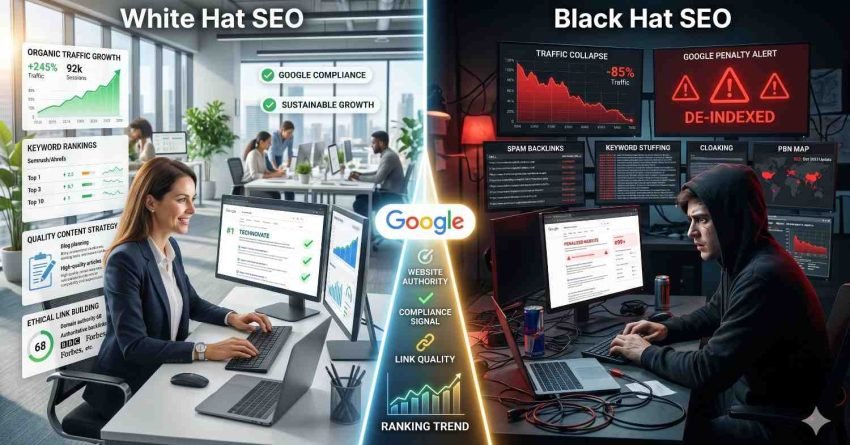
White hat SEO follows Google’s guidelines to build sustainable organic rankings, while black hat SEO uses manipulative tactics that risk severe penalties and lost traffic. For business owners, marketers, and founders investing in search visibility, understanding the line between these two approaches determines whether your strategy compounds or collapses.
Every dollar spent on the wrong tactic delays growth, drains budgets, and can wipe out months of progress through a single algorithm update or manual action from Google.
This guide covers definitions, key differences, gray hat tactics, white hat and black hat techniques, Google penalty risks, sustainable strategy building, and how to choose the right approach for your business.
What Is White Hat SEO?
White hat SEO refers to search engine optimization practices that strictly follow Google’s Webmaster Guidelines and prioritize delivering genuine value to users. These methods focus on long-term ranking growth through quality content, technical excellence, ethical authority building, and user experience improvements.
The defining feature of white hat SEO is that it works in alignment with how search engines actually want websites to operate. Practitioners optimize for searchers first, then for crawlers, treating ranking improvements as a downstream result of solving real problems.
Core Principles of White Hat SEO
White hat strategies share four foundational principles. First, every optimization must improve the user’s experience, not deceive them. Second, content must be original and substantively useful. Third, technical changes serve crawlability and accessibility. Fourth, link signals must be earned through merit, not manipulated through schemes.
Why Google Rewards White Hat Practices
Google’s algorithms have evolved over two decades to identify and elevate sites that demonstrate expertise, authoritativeness, and trustworthiness. White hat techniques align with these signals because they produce genuinely helpful content backed by real authority.
White hat SEO covers every Google-approved practice that prioritizes long-term ranking stability over shortcuts, and our complete guide to white hat SEO techniques <!–NEW PAGE NEEDED–> walks through each compliant tactic, from content quality standards to ethical outreach methods you can apply this quarter.

What Is Black Hat SEO?
Black hat SEO describes practices that deliberately violate search engine guidelines in an attempt to gain rankings faster than organic growth allows. These tactics exploit algorithmic weaknesses, manipulate ranking signals artificially, and prioritize search engines over users.
Practitioners often justify black hat methods as “loopholes” or “advanced strategies,” but Google treats them as policy violations subject to penalties ranging from ranking suppression to complete deindexation.
How Black Hat SEO Tries to Game the System
Black hat methods focus on creating shortcuts that mimic the signals Google uses to identify quality. Instead of earning backlinks through valuable content, black hat practitioners buy them. Instead of writing original work, they scrape and spin existing content. The fundamental approach is replication of legitimate signals without the underlying merit.
Warning Signs Your SEO May Be Black Hat
If an agency promises top rankings within weeks, guarantees specific positions, refuses to explain their link sources, or builds hundreds of backlinks rapidly, these are common warning signs. Sustainable agencies discuss timelines in months, not weeks, and document every technique transparently.
Black hat SEO exploits algorithmic loopholes to manipulate rankings before search engines catch on, and our detailed breakdown of black hat SEO techniques <!–NEW PAGE NEEDED–> explains every manipulative tactic, how Google detects them, and the penalty patterns that follow.
Gray Hat SEO Explained
Gray hat SEO describes tactics that sit between fully compliant and clearly prohibited methods. These techniques may not directly violate published guidelines today but exist in a high-risk zone where future algorithm updates can reclassify them as violations.
Common gray hat examples include guest posting purely for links, building expired domain networks, mass-purchasing aged domains for authority transfer, and creating thin content optimized for specific long-tail terms. None of these are guaranteed penalties, but all carry meaningful risk.
For businesses operating in competitive markets, the temptation toward gray hat tactics is real because results appear faster. The hidden cost emerges when Google’s next core update changes how a tactic is evaluated, and previously safe techniques become liabilities overnight.
Gray hat practices occupy a risk-heavy middle ground between safe and prohibited tactics, and our gray hat SEO guide <!–NEW PAGE NEEDED–> breaks down every borderline strategy, the conditions that turn them risky, and how penalty thresholds shift after each algorithm update.
Key Differences Between White Hat and Black Hat SEO
The contrast between these approaches extends across timeline, risk profile, audience focus, and long-term outcome. White hat investments compound over years, with each piece of content and earned link continuing to deliver returns. Black hat campaigns produce short bursts followed by sharp declines once penalties activate.
| Dimension | White Hat SEO | Black Hat SEO |
| Audience focus | Users first | Search engines first |
| Timeline to results | 6–12 months | Days to weeks |
| Result durability | Compounding, long-term | Temporary, volatile |
| Penalty risk | Minimal | High |
| Cost trajectory | Front-loaded, declining | Recurring, escalating |
| Recovery if penalized | Rarely needed | Months to years |
The most important difference is sustainability. A well-built white hat asset continues earning traffic three to five years later. A black hat asset typically loses its rankings within one to two algorithm cycles.

Common White Hat SEO Techniques
White hat SEO operates across five interconnected disciplines. Each one contributes signals that compound when executed together, but each requires its own depth of expertise and ongoing attention.
Quality Content Creation
Original, useful, and well-researched content remains the foundation of every successful organic strategy. Search engines have grown sophisticated at distinguishing genuinely helpful content from filler optimized for keywords alone. The pages that rank consistently demonstrate depth, accuracy, and clear topical focus.
High-quality content remains the most defensible ranking asset because it earns links, builds topical authority, and serves real user intent, and our complete content strategy guide <!–NEW PAGE NEEDED–> walks through topic clustering, editorial planning, and content scoring frameworks built for SMEs.
On-Page Optimization
On-page SEO involves structuring each page so that both users and search engines understand its purpose. Title tags, header hierarchy, internal anchor text, image alt attributes, and schema markup all communicate context. Done well, on-page optimization helps a single piece of content rank for dozens of related queries.
On-page optimization shapes how search engines interpret each page’s purpose through structured signals like titles, headings, and internal anchors, and our complete on-page SEO guide <!–NEW PAGE NEEDED–> covers every element you need to optimize, with templates and audit checklists included.
Keyword Research
Keyword research identifies what your audience actually searches, the intent behind those queries, and the competitive landscape for each term. Without disciplined research, even excellent content can target queries that produce no business value or sit in saturated markets where smaller sites cannot compete.
Keyword research grounds every white hat strategy in real search demand instead of guesswork, and our step-by-step keyword research guide <!–NEW PAGE NEEDED–> walks through tool selection, competitive analysis, intent mapping, and prioritization frameworks built for new and growing sites.
Technical SEO Fundamentals
Technical SEO ensures search engines can efficiently crawl, render, and index every important page on your site. Page speed, mobile usability, structured data, XML sitemaps, canonical handling, and Core Web Vitals all influence how Google evaluates your site’s quality. According to Google’s published documentation, page experience signals factor directly into ranking decisions.
Technical SEO covers the infrastructure-level optimizations that allow search engines to crawl, render, and index your content accurately, and our comprehensive technical SEO guide <!–NEW PAGE NEEDED–> walks through every audit point, from Core Web Vitals to structured data and crawl budget management.
Ethical Link Building
Backlinks remain among the strongest ranking signals because they represent third-party endorsements. White hat link building earns these endorsements through digital PR, original research, expert commentary, guest contributions on relevant publications, and relationship-building with editors and journalists.
Earning quality backlinks signals editorial trust to Google more strongly than any other off-page factor, and our ethical link building guide <!–NEW PAGE NEEDED–> explains every white hat acquisition method, from digital PR campaigns to relationship-driven outreach that compounds over time.
Common Black Hat SEO Techniques to Avoid
Recognizing black hat tactics protects your site from inheriting them through inexperienced agencies, well-meaning freelancers, or outdated playbooks still circulating online. The most common techniques fall into five categories.
Keyword Stuffing
Repeating target keywords excessively in content, meta tags, or alt attributes signals manipulation. Google’s algorithms identify unnatural keyword density and either devalue the page or apply a penalty.
Cloaking and Hidden Text
Cloaking shows different content to search engines than to users, attempting to rank for terms unrelated to actual page content. Hidden text uses invisible elements, off-screen positioning, or matching text colors to load pages with keywords. Both violations carry severe consequences.
Private Blog Networks
PBNs are networks of websites built or acquired solely to pass link authority. Google’s link spam algorithm, including its SpamBrain system, is specifically designed to identify and neutralize PBNs.
Content Scraping and Spinning
Copying content from other sites or using software to rewrite existing articles creates duplicate or low-quality material. These pages rarely rank long-term and damage overall site quality scores.
Link Schemes and Paid Links
Buying backlinks, participating in link exchanges, or using automated tools to acquire links at scale all violate Google’s link spam policies. Penalties from link schemes are among the most damaging because they affect entire domains.

Google Penalties and Risks of Black Hat SEO
Google enforces its guidelines through two penalty mechanisms. Manual actions are issued by human reviewers and appear in Search Console with specific reasons. Algorithmic suppressions happen automatically as part of core updates and spam updates, and they do not generate notifications.
The financial impact of either type can be severe. A site that loses 70% of its organic traffic overnight typically requires months of cleanup work before recovery becomes possible, and some penalty types result in permanent ranking damage even after the issue is addressed.
Google issues both manual actions and algorithmic suppressions that can erase months of traffic overnight, and our complete Google penalties guide <!–NEW PAGE NEEDED–> walks through every penalty type, how to diagnose it inside Search Console, and the step-by-step recovery playbook.
How to Build a Sustainable White Hat SEO Strategy
A sustainable strategy sequences work in the correct order rather than attempting every tactic simultaneously. The first phase focuses on technical foundations, ensuring the site is crawlable, fast, and properly structured. The second phase builds content depth around well-researched keyword clusters that match your audience’s actual searches.
The third phase develops authority through ethical link acquisition, digital PR, and brand-building activities that earn organic mentions. Throughout all phases, measurement and iteration matter as much as initial setup. Tracking ranking movements, traffic quality, engagement signals, and conversion behavior reveals which efforts produce real business outcomes.
Building lasting rankings requires more than tactic checklists — it demands a sequenced plan that prioritizes the right work each quarter, and our SEO strategy framework <!–NEW PAGE NEEDED–> lays out the full 12-month roadmap from technical foundations to authority building and performance review.
White Hat vs. Black Hat SEO: Which Should Your Business Choose?
For any business building long-term value, white hat SEO is the only defensible choice. The math is straightforward: every black hat campaign carries a probability of catastrophic loss, and the timeline of penalty enforcement keeps shortening as Google’s detection systems improve.
White hat investments produce assets your business owns indefinitely. A well-ranked piece of cornerstone content continues delivering qualified traffic for years, often returning hundreds of times its original production cost. Black hat tactics, by contrast, require continuous reinvestment to maintain rankings that can disappear with a single update.
For businesses that want sustainable organic growth without the trial-and-error of in-house experimentation, working with a team that delivers professional SEO services compresses months of guesswork into a structured engagement with clear deliverables and performance benchmarks.
Conclusion
White hat SEO and black hat SEO represent fundamentally different philosophies, with one building durable organic assets and the other gambling rankings against algorithmic detection systems that grow stronger every year.
The full topic ecosystem extends across keyword research, content strategy, technical SEO, link building, and penalty recovery, each deserving dedicated study within the cluster resources linked throughout this guide.
We help businesses build sustainable organic growth through compliant, results-driven strategies. Partner with White Label SEO Service to grow rankings the right way.
Frequently Asked Questions
Is white hat SEO better than black hat SEO?
Yes. White hat SEO produces durable rankings that compound over time, while black hat SEO carries severe penalty risks. Sustainable organic growth always favors compliant, user-focused practices over short-term manipulation.
How long does white hat SEO take to show results?
White hat SEO typically shows meaningful results within 6–12 months, depending on site authority, competition, and execution quality. New domains take longer, while established sites see faster gains from technical and content improvements.
Can a site recover from a Google penalty?
Yes, recovery is possible but often slow. Manual actions require fixing violations and submitting reconsideration requests, while algorithmic suppressions resolve only after core updates re-evaluate the site, which can take months.
What is the difference between gray hat and black hat SEO?
Gray hat SEO uses tactics that bend Google’s guidelines without clearly violating them, while black hat SEO directly breaks the rules. Gray hat carries variable risk that changes with each algorithm update.
Are paid backlinks always considered black hat?
Yes. Buying or selling links that pass PageRank violates Google’s link spam policies. Sponsored or affiliate links require proper rel=”sponsored” or rel=”nofollow” attributes to remain compliant.
Can small businesses succeed with only white hat SEO?
Absolutely. Small businesses often outperform larger competitors through focused white hat strategies targeting niche keywords, local intent, and topical depth. Authority builds steadily through consistent quality work.
How can I tell if my SEO agency uses black hat tactics?
Ask for full transparency on every link source, content method, and ranking technique. Agencies that refuse to disclose tactics, promise guaranteed rankings, or build links rapidly are likely using black hat methods.