
Link building remains one of the most powerful ranking factors in SEO, directly influencing where your website appears in search results. When authoritative websites link to your content, search engines interpret these connections as votes of confidence, signaling that your site deserves higher visibility.
For business owners and marketing teams investing in organic growth, understanding link building isn’t optional. It’s the difference between pages that languish on page five and content that captures qualified traffic month after month.
This guide breaks down exactly how link building works, why it impacts rankings, proven strategies that deliver results, and how to measure ROI from your efforts.
What Is Link Building in SEO?
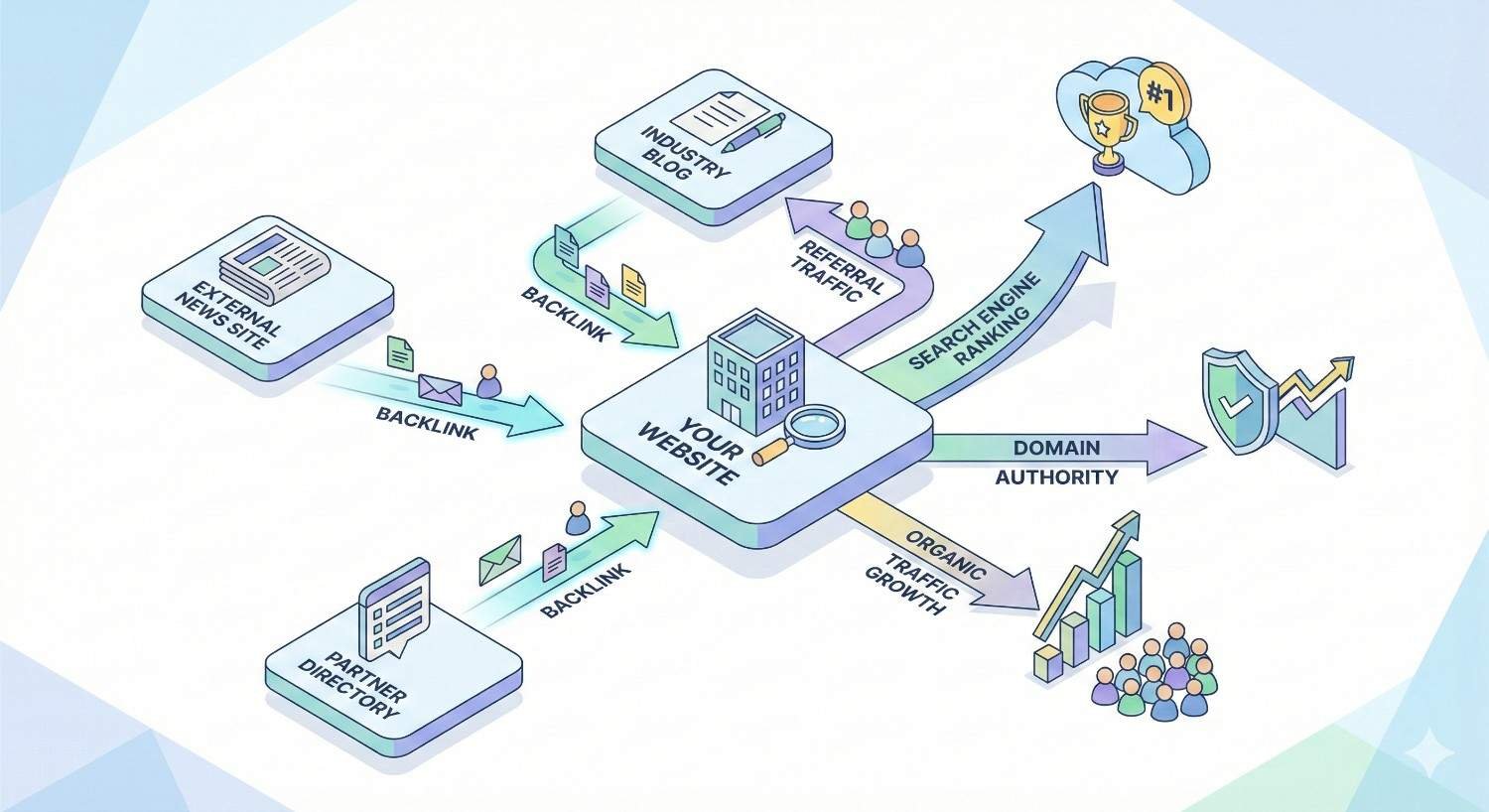
Link building is the process of acquiring hyperlinks from external websites that point back to your own. These inbound links, commonly called backlinks, serve as pathways between websites and play a critical role in how search engines discover, crawl, and rank content.
At its core, link building connects your website to the broader web ecosystem. When another site links to your page, it creates a relationship that search engines can follow and evaluate.
Definition of Backlinks and Their Role
A backlink is simply a link from one website to another. When Site A links to Site B, Site B has earned a backlink from Site A.
Backlinks function as digital endorsements. Each link tells search engines that the linking site found your content valuable enough to reference. The more quality endorsements you accumulate, the stronger your site’s perceived value becomes.
These links serve multiple purposes beyond SEO. They drive direct referral traffic from readers who click through. They establish relationships between related content across the web. They help search engine crawlers discover new pages and understand topical connections.
Not all backlinks carry equal weight. A link from a trusted industry publication holds far more value than one from an obscure, low-quality directory. Context, relevance, and the linking site’s authority all influence how much benefit each backlink provides.
How Search Engines Evaluate Links
Search engines use sophisticated algorithms to assess every link pointing to your website. Google’s original PageRank algorithm revolutionized search by treating links as votes, and while the technology has evolved dramatically, the fundamental concept remains.
Modern search engines evaluate links across multiple dimensions:
Authority of the linking domain. Links from established, trusted websites carry more weight than those from new or low-quality sites. A backlink from a major news outlet or respected industry resource signals stronger endorsement than one from a random blog.
Relevance to your content. A link from a website in your industry or covering related topics provides more value than one from an unrelated source. Search engines understand topical relationships and reward contextually appropriate links.
Anchor text usage. The clickable text of a link provides context about the destination page. Natural, varied anchor text helps search engines understand what your content covers without appearing manipulative.
Link placement. Links embedded naturally within main content typically carry more weight than those buried in footers, sidebars, or author bios. Editorial links that add value for readers signal genuine endorsement.
Follow status. Standard links pass ranking value, while nofollow, sponsored, and UGC attributes tell search engines to treat links differently. A healthy link profile includes a natural mix of link types.
Why Link Building Matters for Search Rankings
Search engines face an enormous challenge: determining which pages among billions deserve top positions for any given query. Links provide crucial signals that help algorithms make these decisions with confidence.
Without external validation through backlinks, even exceptional content struggles to compete. Link building bridges the gap between creating valuable content and earning the visibility it deserves.
Links as a Core Google Ranking Factor
Google has consistently confirmed that links remain among the most important ranking signals. Andrey Lipattsev, a Google Search Quality Senior Strategist, identified links as one of the top three ranking factors alongside content and RankBrain.
This isn’t surprising when you understand Google’s mission. The search engine aims to surface the most relevant, authoritative content for every query. Links from other websites provide external validation that algorithms cannot generate internally.
Think of it this way: Google can analyze your content’s relevance to a search query. But determining whether your content is trustworthy, accurate, and valuable requires external signals. Links from respected sources provide exactly that validation.
The relationship between backlinks and rankings has been studied extensively. Analysis by Backlinko found strong correlation between the number of referring domains and Google rankings, with the top result typically having significantly more backlinks than lower positions.
How Backlinks Signal Authority and Trust
Authority in SEO isn’t self-declared. You can’t simply claim expertise and expect search engines to believe you. Authority must be earned through recognition from other trusted sources.
Backlinks function as this recognition mechanism. When an established website links to your content, it transfers a portion of its own authority. This concept, sometimes called “link equity” or “link juice,” explains why links from high-authority sites provide outsized benefits.
Trust works similarly. Search engines maintain sophisticated models of which websites can be trusted for accurate information. Links from trusted sources help establish your site within these trust networks.
This creates a compounding effect. As you earn links from authoritative sources, your own authority grows. Higher authority makes it easier to rank, which increases visibility, which often leads to more natural link acquisition. The rich get richer in link building.
The Relationship Between Links and Organic Visibility
Organic visibility depends on ranking for relevant keywords. Rankings depend heavily on authority signals. Authority signals come largely from backlinks. This chain reaction explains why link building directly impacts how much organic traffic your site receives.
Consider two competing pages targeting the same keyword. Both have excellent content, proper on-page optimization, and fast loading speeds. The page with stronger backlink support will almost always outrank the other.
This relationship extends beyond individual pages. Domain-level authority, built through accumulated backlinks across your entire site, influences how easily new pages can rank. Websites with established authority often see new content rank faster and for more competitive terms.
For businesses, this translates directly to bottom-line results. Higher organic visibility means more qualified traffic. More traffic means more leads, sales, and revenue. Link building isn’t just an SEO tactic—it’s a business growth strategy.
Key Benefits of Link Building for Businesses
Understanding why links matter conceptually is important. But business owners and marketing managers need to know the tangible benefits that justify investment in link building campaigns.
The advantages extend far beyond simple ranking improvements. A strategic link building program delivers compounding returns across multiple business metrics.
Increased Domain Authority
Domain authority represents your website’s overall strength and credibility in search engines’ eyes. While Google doesn’t use a single “domain authority” metric publicly, the concept accurately describes how accumulated trust and authority influence rankings.
Third-party tools like Moz’s Domain Authority, Ahrefs’ Domain Rating, and Semrush’s Authority Score attempt to quantify this strength. These metrics correlate strongly with ranking potential and provide useful benchmarks for measuring progress.
Building domain authority through quality backlinks creates a rising tide that lifts all pages. New content published on a high-authority domain starts with an advantage. Existing pages become more competitive against rivals.
This authority compounds over time. Each quality link adds to your foundation. Unlike paid advertising that stops working when you stop paying, authority built through link building persists and grows.
Higher Search Engine Rankings
The most direct benefit of link building is improved rankings for target keywords. Pages with strong backlink profiles consistently outperform those without, assuming comparable content quality and on-page optimization.
Ranking improvements follow a predictable pattern. Initial link building efforts may produce modest gains as you establish baseline authority. Continued investment creates momentum, with each additional quality link pushing rankings higher.
The impact varies by keyword competitiveness. Low-competition terms may require only a handful of quality links. Highly competitive keywords in lucrative industries might demand sustained link building over months or years.
What matters is the trajectory. Consistent link acquisition creates consistent ranking improvements. Businesses that commit to ongoing link building see their organic positions strengthen quarter over quarter.
More Referral Traffic
Backlinks don’t just influence algorithms—they drive direct traffic. Readers who encounter links to your content on other websites often click through to learn more.
This referral traffic carries distinct advantages. Visitors arriving via links from relevant, authoritative sources tend to be highly qualified. They’ve already demonstrated interest in your topic by reading related content elsewhere.
Referral traffic also diversifies your traffic sources. Relying entirely on organic search creates vulnerability to algorithm changes. A healthy referral traffic stream provides stability and additional growth opportunities.
Some backlinks generate substantial ongoing traffic. A link from a popular industry blog or news site can send visitors for months or years after publication. These become valuable assets beyond their SEO impact.
Faster Indexing of New Content
Search engines discover new content primarily by following links. When you publish a new page, Google’s crawlers must find it before it can appear in search results.
Sites with strong backlink profiles get crawled more frequently. Search engines recognize these sites as important and allocate more crawl resources accordingly. New pages get discovered and indexed faster.
This matters for time-sensitive content. Product launches, news coverage, seasonal campaigns—all benefit from rapid indexing. Link building accelerates the path from publication to ranking.
Internal linking from well-linked pages also helps. When your authoritative pages link to new content, crawlers follow those paths quickly. A strong external link profile enhances your entire site’s crawl efficiency.
Long-Term Competitive Advantage
Perhaps the most valuable benefit of link building is its durability. Unlike paid advertising or social media posts that deliver temporary visibility, quality backlinks provide lasting value.
A link earned today continues working for years. It passes authority, drives referral traffic, and supports rankings long after the initial outreach effort. This creates compounding returns on investment.
Competitors cannot easily replicate your link profile. Building authority takes time, relationships, and consistent effort. A strong backlink foundation becomes a genuine competitive moat.
Businesses that invest early in link building establish advantages that late entrants struggle to overcome. The gap between link-rich and link-poor competitors widens over time, making early investment particularly valuable.
How Link Building Works in Practice
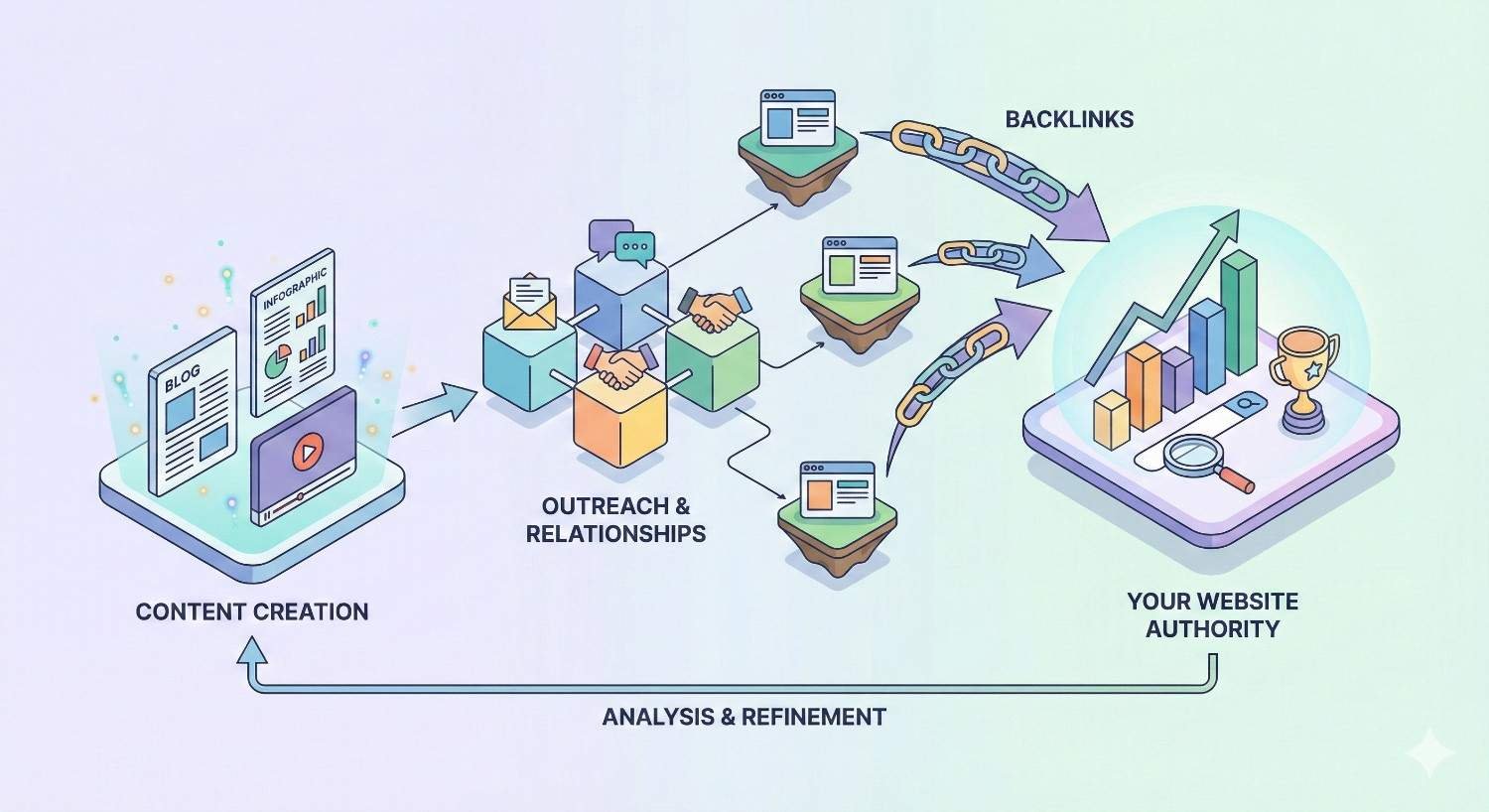
Understanding link building theory is essential. But execution requires knowing what actually makes links valuable and how to pursue them effectively.
The gap between successful and unsuccessful link building often comes down to understanding these practical realities. Quality matters more than quantity. Relevance matters more than raw metrics. Sustainability matters more than short-term gains.
Quality vs. Quantity: What Makes a Good Backlink
Not all backlinks are created equal. A single link from a highly authoritative, relevant source can outweigh dozens of low-quality links. Understanding what makes a backlink valuable helps focus efforts where they matter most.
Domain authority of the linking site. Links from established, trusted websites carry more weight. A backlink from a site with strong authority transfers more value than one from a weak domain.
Relevance to your industry or topic. Contextual relevance signals to search engines that the link makes sense. A marketing agency benefits more from links on marketing blogs than from unrelated sites.
Editorial placement within content. Links embedded naturally in article body text typically carry more value than those in sidebars, footers, or author bios. Editorial links suggest genuine endorsement.
Traffic and engagement on the linking page. Links from pages that receive actual visitors provide referral traffic benefits alongside SEO value. Dead pages offer limited benefit.
Link neighborhood quality. Sites that link to spam or low-quality content may transfer negative associations. Quality sites maintain quality link neighborhoods.
Pursuing a smaller number of high-quality links consistently outperforms chasing volume through low-quality sources. One authoritative, relevant backlink often delivers more ranking impact than ten mediocre ones.
Link Relevance and Topical Authority
Search engines have grown sophisticated at understanding topical relationships. Links from topically relevant sources carry more weight than those from unrelated websites.
This concept connects to topical authority—the idea that websites can establish expertise in specific subject areas. A site known for comprehensive coverage of digital marketing topics holds more authority for marketing-related links than a general interest blog.
When building links, prioritize sources that make contextual sense. Ask whether a link from a particular site would seem natural to a human reader. If the connection feels forced or random, search engines likely view it similarly.
Topical relevance extends to the specific page linking to you. A link from a relevant article on a general site may provide more value than one from an irrelevant page on a niche site. Context matters at every level.
Building topical authority through link building creates a virtuous cycle. As you earn links from respected sources in your industry, your own topical authority grows. This makes future link acquisition easier and more impactful.
Natural vs. Built Links: What Google Expects
Google’s guidelines distinguish between links earned naturally and those acquired through manipulation. Understanding this distinction helps build sustainable link profiles that avoid penalties.
Natural links occur when other websites discover your content and choose to reference it without prompting. These represent the ideal—genuine endorsements based on content merit.
Built links result from deliberate outreach, relationship building, or promotional efforts. These aren’t inherently problematic when they represent genuine value exchange. Creating excellent content and letting relevant sites know it exists is legitimate marketing.
What Google penalizes are manipulative link schemes. Buying links, participating in link exchanges, using automated link building tools, or acquiring links through deceptive practices all violate guidelines.
The key distinction is whether links represent genuine editorial endorsement. If a site would link to your content based on its merit—regardless of whether you asked—the link is likely fine. If the link exists only because of payment or manipulation, it’s problematic.
Sustainable link building focuses on creating link-worthy content and building relationships that lead to natural editorial links. This approach takes longer but builds lasting authority without penalty risk.
Link Building and SEO ROI: Setting Realistic Expectations
Link building requires investment—whether through internal resources, agency partnerships, or content creation costs. Understanding realistic timelines and measurement approaches helps set appropriate expectations.
Many businesses abandon link building prematurely because they expect immediate results. Others fail to measure properly and miss the value being created. Clear expectations prevent both mistakes.
How Long Does Link Building Take to Impact Rankings?
Link building is not a quick fix. The timeline from acquiring links to seeing ranking improvements typically spans weeks to months, depending on multiple factors.
Crawl and indexation delays. Search engines must discover new links before they can influence rankings. This can take days to weeks depending on how frequently the linking site gets crawled.
Algorithm processing time. Even after discovery, search engines don’t instantly recalculate rankings. Changes propagate gradually through index updates.
Competitive landscape. Highly competitive keywords require more authority to move rankings. The gap between your current position and target position affects how much link building is needed.
Starting authority level. New sites with minimal existing authority may need to build foundational links before seeing significant movement. Established sites often see faster results from incremental link building.
As a general guideline, expect to wait 3-6 months before link building efforts produce measurable ranking improvements. Some movement may occur sooner, but substantial gains typically require sustained effort over quarters, not weeks.
This timeline underscores the importance of starting link building early. Businesses that wait until they “need” better rankings face months of delay before seeing results.
Measuring Link Building Success
Effective measurement connects link building activities to business outcomes. Tracking the right metrics helps demonstrate ROI and guide strategy refinement.
Link acquisition metrics:
- Number of new referring domains acquired
- Domain authority/rating of linking sites
- Relevance of linking sites to your industry
- Anchor text distribution and naturalness
SEO performance metrics:
- Ranking changes for target keywords
- Organic traffic growth
- Organic visibility scores
- Click-through rates from search results
Business outcome metrics:
- Leads generated from organic traffic
- Revenue attributed to organic search
- Cost per acquisition compared to other channels
Tools like Ahrefs, Semrush, Moz, and Google Search Console provide data for tracking these metrics. Regular reporting helps identify what’s working and where to adjust efforts.
Avoid fixating on any single metric. A holistic view that connects link acquisition to rankings to traffic to business results provides the clearest picture of link building ROI.
Link Building as Part of a Sustainable SEO Strategy
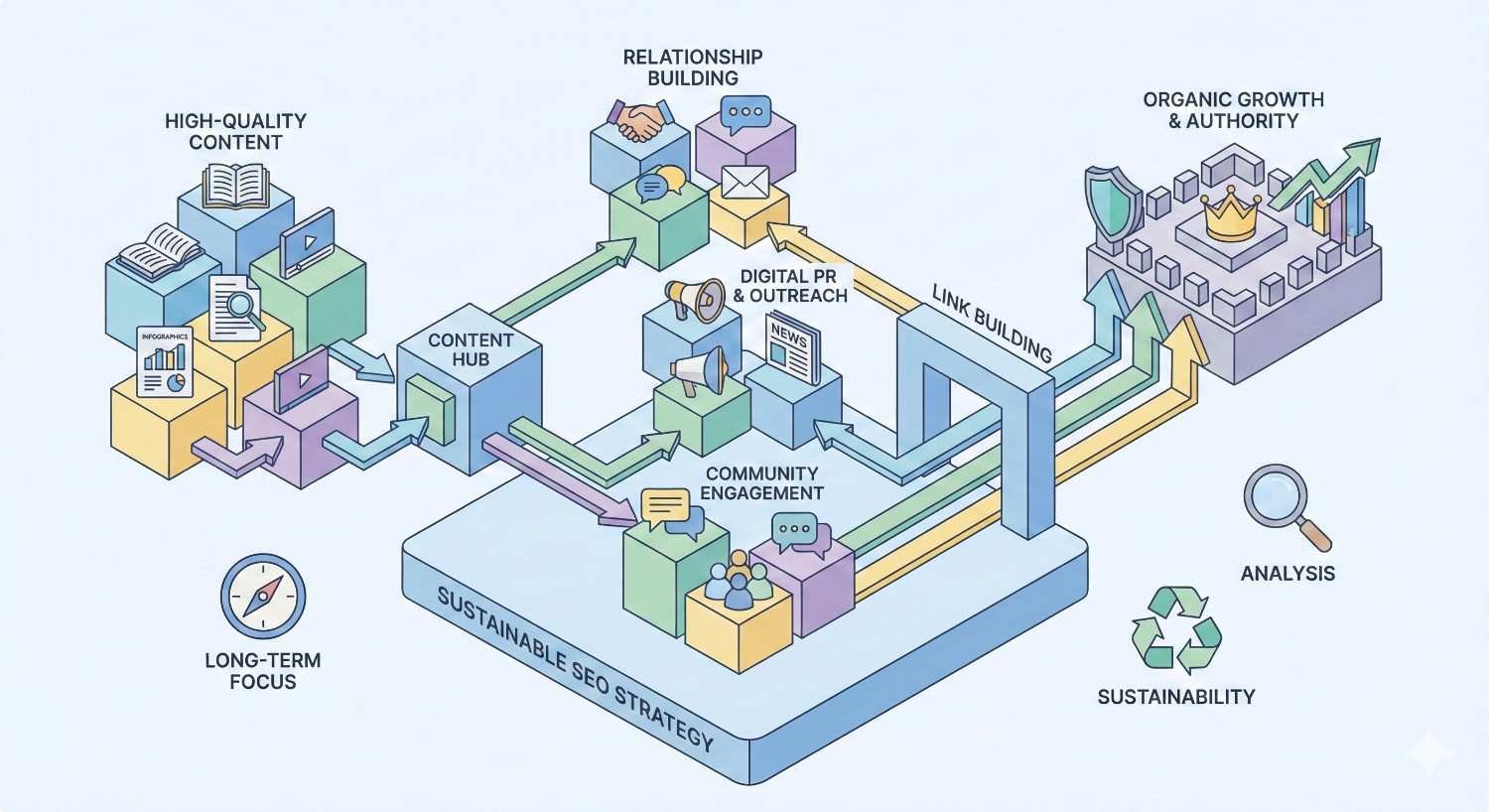
Link building doesn’t exist in isolation. Maximum impact comes from integrating link building with content strategy, technical SEO, and on-page optimization.
Content provides link targets. You need pages worth linking to before outreach can succeed. Investing in high-quality, link-worthy content creates assets that attract and retain links.
Technical SEO ensures links work. Broken pages, redirect chains, and crawl issues can waste link equity. Technical health maximizes the value of every link earned.
On-page optimization captures intent. Links drive authority, but pages must be optimized to rank for specific queries. Combining link building with keyword targeting produces results.
Sustainable SEO strategies balance all three pillars. Over-investing in link building while neglecting content or technical foundations limits results. A coordinated approach delivers compounding returns.
Plan link building as an ongoing program, not a one-time project. Consistent monthly link acquisition builds authority steadily. Sporadic efforts produce sporadic results.
Common Link Building Strategies That Work
With foundational understanding in place, let’s examine specific strategies that consistently deliver quality backlinks. Each approach has distinct advantages and works best in particular situations.
Successful link building programs typically combine multiple strategies. Diversification reduces risk and captures opportunities across different link sources.
Content-Driven Link Acquisition
Creating exceptional content that naturally attracts links remains the most sustainable link building approach. When your content provides unique value, other sites want to reference it.
Original research and data. Publishing proprietary research, surveys, or data analysis gives other content creators something to cite. Statistics and findings get referenced repeatedly across the web.
Comprehensive guides and resources. Definitive guides that cover topics exhaustively become go-to references. When someone needs to link to an explanation of a concept, the best resource wins.
Visual assets and tools. Infographics, interactive tools, calculators, and templates attract links from sites that want to share useful resources with their audiences.
Contrarian or unique perspectives. Content that challenges conventional wisdom or offers fresh angles generates discussion and links from those engaging with your ideas.
Content-driven link building requires upfront investment in creation but generates ongoing returns. A single exceptional piece can attract links for years after publication.
The key is creating content specifically designed to earn links, not just rank. Link-worthy content often differs from standard SEO content in depth, originality, or utility.
Digital PR and Outreach
Digital PR applies traditional public relations tactics to earn online coverage and links. This approach leverages newsworthy angles to secure placements on media sites and industry publications.
Newsjacking. Connecting your expertise to trending news stories positions you as a source for journalists covering those topics. Timely commentary can earn links from major publications.
Expert commentary and quotes. Journalists frequently seek expert sources for articles. Platforms like HARO (Help a Reporter Out) connect businesses with media opportunities.
Data-driven stories. Packaging your research or data into newsworthy narratives gives journalists ready-made stories. Original data is particularly valuable to reporters.
Brand mentions to links. Monitoring unlinked mentions of your brand and requesting link additions converts existing coverage into backlinks.
Digital PR typically produces high-authority links from news sites and major publications. These links carry significant weight and often drive substantial referral traffic.
Success requires understanding what makes stories newsworthy and building relationships with relevant journalists and editors over time.
Guest Posting and Contributor Opportunities
Writing content for other websites in exchange for author attribution and links remains a viable strategy when executed properly.
Quality over quantity. Focus on respected publications in your industry rather than sites that exist primarily for guest posts. Editorial standards indicate link value.
Genuine value contribution. Guest posts should provide real value to the host site’s audience. Thin content written solely for links damages relationships and provides minimal benefit.
Relevant author attribution. Links in author bios carry less weight than contextual links within content. Negotiate for in-content links where appropriate and natural.
Relationship building. The best guest posting opportunities come through genuine relationships with editors and site owners. Cold pitching works but relationship-based outreach performs better.
Guest posting has been abused extensively, leading Google to discount obvious guest post links. Focus on legitimate contributor relationships with quality publications to maintain effectiveness.
Broken Link Building
Broken link building identifies dead links on other websites and offers your content as a replacement. This provides value to site owners while earning links for you.
The process:
- Find resource pages or articles in your niche
- Identify broken outbound links using tools like Check My Links or Ahrefs
- Create or identify content on your site that could replace the dead resource
- Contact the site owner, alert them to the broken link, and suggest your content
This approach works because you’re solving a problem for the site owner. Broken links create poor user experience and reflect badly on their content. Your outreach provides a solution.
Success rates vary, but broken link building consistently produces results when executed at scale. The key is finding relevant broken links where your content genuinely serves as a suitable replacement.
Resource Page Link Building
Many websites maintain resource pages—curated lists of helpful links on specific topics. Getting included on relevant resource pages provides contextual, editorial links.
Finding opportunities:
- Search for “[your topic] + resources” or “[your topic] + useful links”
- Identify industry associations, educational institutions, and organizations with resource sections
- Look for competitor backlinks from resource pages
Earning inclusion:
- Ensure your content genuinely belongs among the other resources listed
- Craft personalized outreach explaining why your resource adds value
- Follow up appropriately without being pushy
Resource page links tend to be highly relevant and come from sites that curate quality content. The editorial nature of these pages signals genuine endorsement to search engines.
Competition for resource page inclusion can be intense. Having genuinely exceptional content significantly improves success rates.
Link Building Mistakes to Avoid
Understanding what not to do is as important as knowing effective strategies. Link building mistakes can waste resources, damage rankings, or trigger penalties.
Many businesses learn these lessons the hard way. Avoiding common pitfalls accelerates progress and protects your site’s long-term health.
Buying Links and Link Schemes
Purchasing links violates Google’s guidelines and risks severe penalties. Despite this, link buying remains common—and remains risky.
Why it’s tempting: Buying links offers predictable costs and guaranteed placements. Building links organically requires more effort with less certain outcomes.
Why it fails: Google has invested heavily in detecting paid links. Patterns in anchor text, link velocity, and site relationships reveal manipulation. Penalties can devastate organic traffic.
Link schemes to avoid:
- Paying for links directly
- Exchanging products or services for links
- Excessive link exchanges (“link to me and I’ll link to you”)
- Private blog networks (PBNs)
- Automated link building tools and services
The risk-reward calculation doesn’t favor link buying. Short-term gains rarely justify potential penalties that can take months or years to recover from.
If a link building offer seems too easy or too cheap, it probably involves tactics that will eventually cause problems.
Low-Quality Directory Submissions
Directory links were once a staple of SEO. Today, most directories provide minimal value and some actively harm your profile.
Directories to avoid:
- General directories with no editorial standards
- Directories that accept any submission for a fee
- Directories filled with spam and low-quality listings
- Directories with no real traffic or users
Directories that may help:
- Industry-specific directories with editorial review
- Local business directories (Google Business Profile, Yelp, industry associations)
- Professional organization directories
- Highly curated niche directories
The test is whether real users actually use the directory to find businesses. If a directory exists only for SEO purposes, it provides little value and may cause harm.
Focus directory efforts on legitimate, relevant listings that also drive referral traffic and brand visibility.
Irrelevant or Spammy Anchor Text
Anchor text—the clickable text of a link—provides context about the destination page. Over-optimized anchor text is a clear manipulation signal.
Problematic patterns:
- Exact-match keyword anchors on most links
- Unnatural phrases that wouldn’t occur in normal writing
- Repetitive anchor text across many links
- Anchors that don’t match the linked content
Natural anchor text distribution:
- Branded anchors (your company name)
- URL anchors (naked URLs)
- Generic anchors (“click here,” “this article,” “learn more”)
- Partial match anchors (variations of target keywords)
- Natural descriptive phrases
A healthy link profile shows diverse, natural-looking anchor text. If your anchor text distribution looks manipulated, search engines will notice.
When building links, vary anchor text naturally. Don’t request specific keyword-rich anchors. Let linking sites choose anchors that fit their content naturally.
Ignoring Link Profile Diversity
Healthy link profiles show diversity across multiple dimensions. Over-concentration in any area raises red flags.
Dimensions of diversity:
- Source types: Mix of blogs, news sites, industry publications, educational resources
- Domain authority range: Links from various authority levels, not just high or low
- Link types: Dofollow and nofollow, contextual and navigational
- Anchor text: Varied as described above
- Geographic distribution: For international businesses, links from relevant regions
Warning signs of poor diversity:
- All links from one type of source
- Sudden spikes in link acquisition followed by nothing
- Links only from sites in one country when targeting multiple markets
- Unnatural concentration of any single pattern
Building diverse link profiles requires pursuing multiple strategies over time. Relying on a single tactic or source creates vulnerability.
Monitor your link profile regularly to identify concentration issues before they become problems.
How to Evaluate Your Current Link Profile
Before building new links, understand your current position. Link profile analysis reveals strengths to leverage, weaknesses to address, and opportunities to pursue.
Regular audits ensure your link profile remains healthy and guide strategic decisions about where to focus efforts.
Tools for Backlink Analysis
Several tools provide comprehensive backlink data. Each has strengths, and using multiple tools gives the most complete picture.
Ahrefs: Industry-leading backlink index with detailed metrics on referring domains, anchor text, and link quality. Excellent for competitive analysis and link prospecting.
Semrush: Comprehensive SEO platform including robust backlink analysis. Strong integration with other SEO data for holistic strategy development.
Moz Link Explorer: Provides Domain Authority and Page Authority metrics widely used as benchmarks. Good for tracking authority growth over time.
Google Search Console: Free tool showing links Google has actually discovered. Limited data compared to paid tools but authoritative source.
Majestic: Specializes in link analysis with unique metrics like Trust Flow and Citation Flow. Useful for assessing link quality patterns.
For most businesses, one primary tool supplemented by Google Search Console provides sufficient data. Choose based on your broader SEO toolset and specific needs.
Identifying Toxic Links
Not all backlinks help your site. Some actively harm rankings or create penalty risk. Identifying and addressing toxic links protects your site’s health.
Signs of toxic links:
- Links from sites penalized by Google
- Links from obvious spam or hacked sites
- Links from irrelevant foreign-language sites (if you don’t target those markets)
- Links from private blog networks
- Links with manipulative anchor text patterns
Assessment process:
- Export your complete backlink profile from your analysis tool
- Review links flagged as potentially toxic or low quality
- Manually evaluate questionable links for legitimacy
- Compile a list of genuinely harmful links
Addressing toxic links:
- First, attempt to have links removed by contacting site owners
- For links that cannot be removed, use Google’s Disavow Tool
- Document your efforts for potential future reference
Most sites have some low-quality links—this is normal. Focus disavow efforts on clearly manipulative or harmful links rather than simply low-authority ones.
Benchmarking Against Competitors
Understanding how your link profile compares to competitors reveals gaps and opportunities. Competitive analysis informs realistic goal-setting and strategy prioritization.
Key competitive metrics:
- Total referring domains
- Domain authority/rating comparison
- Link velocity (rate of new link acquisition)
- Top linking domains (who links to competitors but not you)
- Content types attracting most links
Analysis process:
- Identify your top 5-10 organic search competitors
- Pull backlink data for each competitor
- Compare aggregate metrics to your own profile
- Identify linking domains that link to multiple competitors but not you
- Analyze what content types earn competitors the most links
Competitive gaps highlight where you need to build. If competitors have significantly more referring domains, closing that gap becomes a priority.
Link intersection analysis—finding sites that link to competitors but not you—provides a prospecting list of sites already inclined to link to content like yours.
When to Invest in Professional Link Building Services
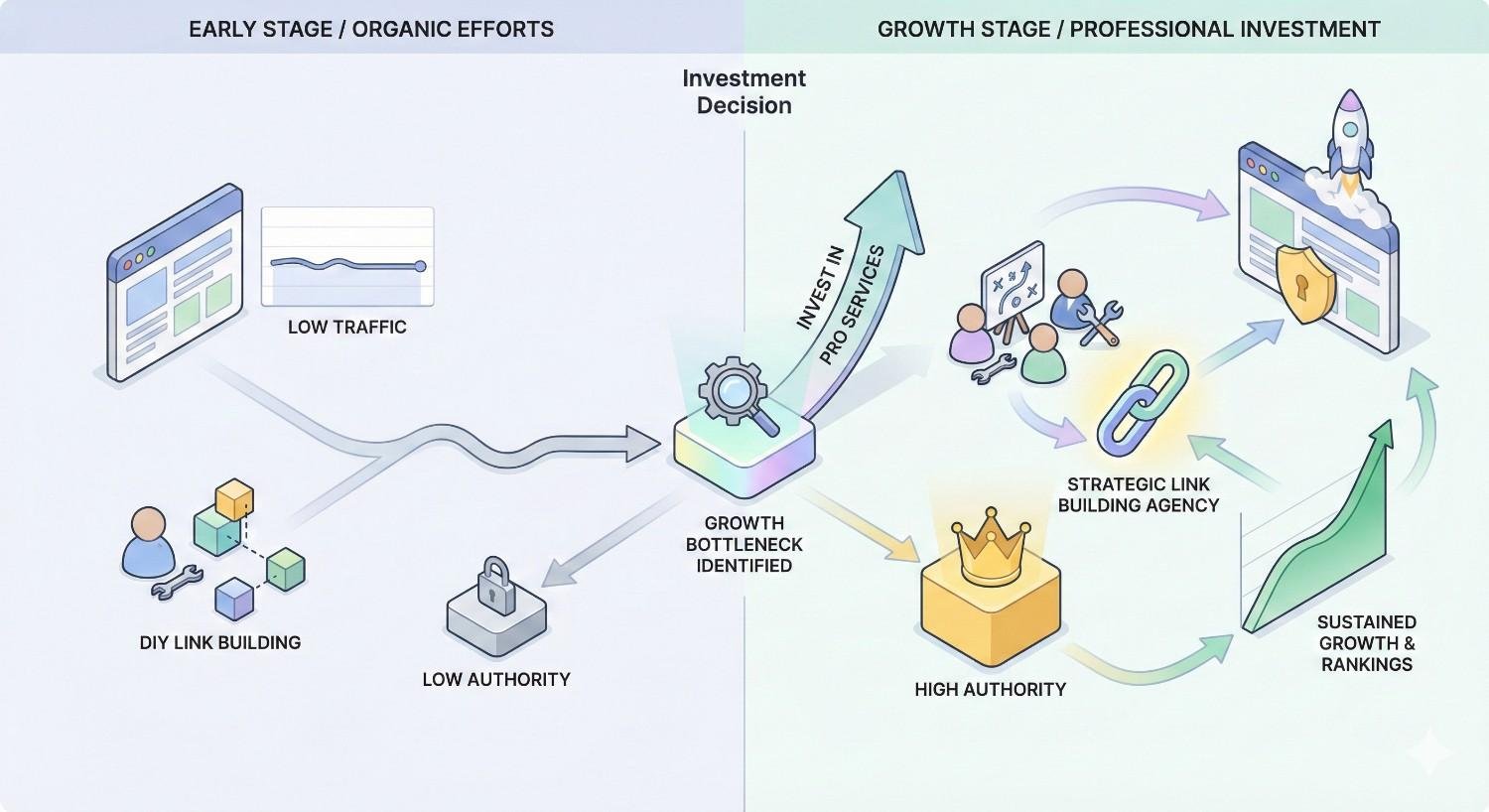
Link building can be executed in-house or through agency partnerships. Understanding when professional support makes sense helps allocate resources effectively.
The right choice depends on your team’s capabilities, available time, and growth objectives.
Signs Your SEO Strategy Needs Link Building Support
Several indicators suggest it’s time to invest more heavily in link building:
Stalled rankings despite quality content. If your content is comprehensive and well-optimized but rankings aren’t improving, weak link profile is often the cause.
Competitors outranking you with inferior content. When less helpful content ranks above yours, authority differences likely explain the gap. Link building closes that gap.
New site or domain. New websites lack established authority. Proactive link building accelerates the authority-building process that would otherwise take years.
Entering competitive markets. Highly competitive keywords require substantial authority to rank. Link building provides the authority needed to compete.
Plateaued organic traffic. When organic traffic growth stalls despite ongoing content investment, link building often provides the catalyst for renewed growth.
Limited internal resources. Effective link building requires consistent effort. If your team lacks bandwidth, outsourcing ensures the work gets done.
Recognizing these signals early allows proactive investment before competitors extend their lead.
What to Look for in a Link Building Partner
Choosing the right agency or service provider significantly impacts results. Not all link building services deliver equal value.
Quality indicators:
- Transparent about their methods and link sources
- Focus on relevance and quality over volume
- Provide examples of links they’ve built for similar clients
- Realistic about timelines and expected results
- Clear reporting on links acquired and their attributes
Warning signs:
- Promises of specific ranking improvements
- Unusually low prices (quality link building isn’t cheap)
- Unwillingness to disclose link sources
- Guarantees of specific link quantities from high-authority sites
- No discussion of your content or target audience
Questions to ask:
- How do you identify link opportunities?
- What does your outreach process look like?
- How do you ensure link relevance to our industry?
- What metrics do you report on?
- Can you share case studies from similar clients?
The best partnerships involve collaboration. Agencies need your industry knowledge and content assets. You need their link building expertise and relationships.
How Agencies Approach Link Acquisition Differently
Professional link building agencies bring capabilities that most in-house teams lack. Understanding these differences helps evaluate whether agency support makes sense.
Established relationships. Agencies maintain relationships with publishers, editors, and site owners across industries. These relationships enable placements that cold outreach rarely achieves.
Dedicated resources. Link building requires consistent effort—prospecting, outreach, follow-up, relationship management. Agencies dedicate full-time staff to these activities.
Proven processes. Experienced agencies have refined their approaches through thousands of campaigns. They know what works and can avoid common pitfalls.
Scale and efficiency. Agencies can pursue more opportunities simultaneously than most in-house teams. Volume matters when conversion rates on outreach are inherently low.
Content creation support. Many agencies offer content creation services that produce link-worthy assets. This addresses a common bottleneck in link building programs.
Risk management. Reputable agencies understand Google’s guidelines and build links that won’t cause problems. They protect clients from tactics that might work short-term but create long-term risk.
The trade-off is cost. Agency services require investment. But for businesses serious about organic growth, professional link building often delivers positive ROI.
Conclusion
Link building remains essential for SEO success in 2024 and beyond. Backlinks signal authority and trust to search engines, directly influencing where your pages rank. Without a strategic approach to earning quality links, even excellent content struggles to achieve visibility.
The benefits extend beyond rankings. Increased domain authority, referral traffic, faster indexing, and sustainable competitive advantage all flow from consistent link building investment. These outcomes compound over time, making early and ongoing investment particularly valuable.
At White Label SEO Service, we help businesses build sustainable organic growth through strategic link acquisition, content development, and comprehensive SEO support. If you’re ready to strengthen your link profile and improve your search visibility, our team is here to help you develop and execute a link building strategy that delivers measurable results.
Frequently Asked Questions About Link Building
Is link building still important in 2024?
Yes, link building remains one of the most important ranking factors. Google continues to use backlinks as key signals of authority and trust. While the emphasis on link quality over quantity has increased, earning links from relevant, authoritative sources still significantly impacts rankings.
How many backlinks do I need to rank?
There’s no universal number. The backlinks needed depend on keyword competitiveness, your current authority, and competitor link profiles. Low-competition terms might require only a few quality links, while highly competitive keywords may need dozens or hundreds of referring domains.
Can I rank without link building?
For low-competition keywords, ranking without active link building is possible if your content is exceptional and your site has some baseline authority. However, for moderately to highly competitive terms, link building is typically necessary to achieve and maintain top rankings.
What is the difference between dofollow and nofollow links?
Dofollow links pass ranking value (link equity) to the destination page. Nofollow links include an attribute telling search engines not to pass ranking value. Both types appear in natural link profiles, and nofollow links still provide referral traffic and brand visibility benefits.
How long does it take to see results from link building?
Expect 3-6 months before link building efforts produce measurable ranking improvements. Search engines must discover new links, process them, and recalculate rankings. Competitive keywords and new sites typically require longer timeframes to see significant movement.
Are all backlinks equally valuable?
No. Link value varies based on the linking site’s authority, relevance to your industry, placement within content, and anchor text. A single link from a highly authoritative, relevant source often provides more benefit than dozens of low-quality links.
What makes a backlink high quality?
High-quality backlinks come from authoritative, trusted websites relevant to your industry. They’re placed editorially within content, use natural anchor text, and exist on pages that receive actual traffic. The linking site should have genuine editorial standards and a clean link profile itself.