
Technical SEO is the invisible infrastructure that determines whether search engines can find, understand, and rank your website. Without a solid technical foundation, even the best content and strongest backlinks fail to deliver results. Your site becomes invisible to the algorithms that drive organic traffic.
This matters because search engines process billions of pages daily. Sites with technical barriers get skipped, buried, or ignored entirely. The businesses that fix these issues first capture the traffic their competitors lose.
This guide breaks down what technical SEO actually is, why it directly impacts your revenue, and how to identify and fix the issues holding your site back.
What Is Technical SEO?
Technical SEO encompasses the backend optimizations that help search engines crawl, index, and render your website effectively. It focuses on the infrastructure rather than the content itself.
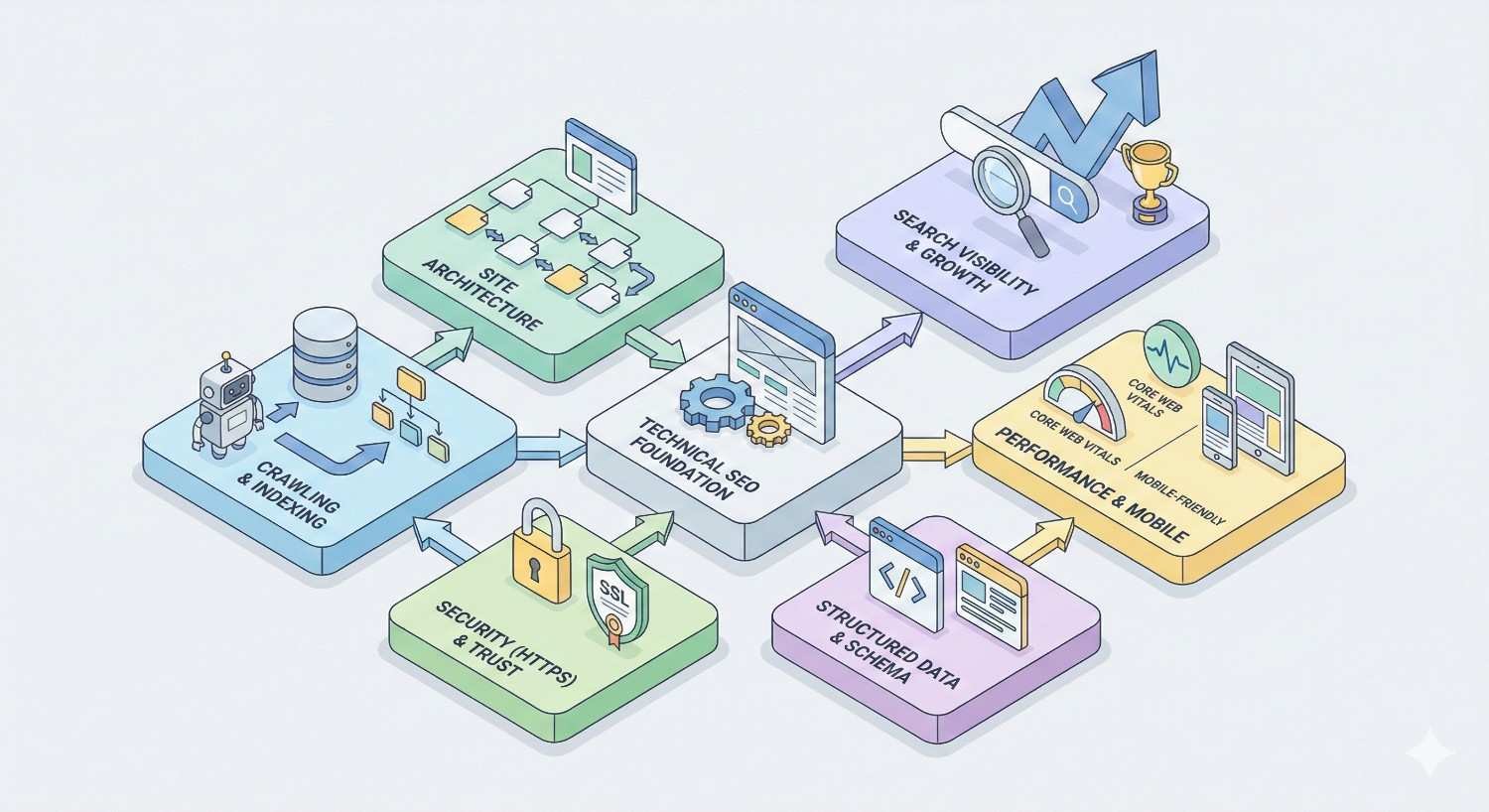
Technical SEO Definition and Core Components
Technical SEO refers to the process of optimizing your website’s technical elements to improve search engine visibility. It ensures that search engine bots can access your pages without obstacles and understand your content structure.
The core components include site speed optimization, mobile responsiveness, secure connections via HTTPS, XML sitemaps, robots.txt configuration, canonical tags, and structured data implementation. Each element works together to create a crawlable, indexable website.
Think of technical SEO as the foundation of a building. Content is the interior design. Backlinks are the reputation. But without a solid foundation, the entire structure becomes unstable. Search engines prioritize sites that load quickly, work on all devices, and present information in a structured, accessible format.
How Technical SEO Differs from On-Page and Off-Page SEO
On-page SEO focuses on content optimization. This includes keyword placement, meta descriptions, header tags, and internal linking within your actual pages. It answers the question: “Is this content relevant to what users are searching for?”
Off-page SEO builds authority through external signals. Backlinks from reputable sites, brand mentions, and social signals tell search engines that other websites trust your content. It answers: “Do others consider this site authoritative?”
Technical SEO operates at a different level entirely. It answers: “Can search engines actually access and understand this website?” A site with perfect content and thousands of backlinks still fails if Googlebot cannot crawl it properly.
These three pillars work together. Technical SEO creates accessibility. On-page SEO creates relevance. Off-page SEO creates authority. Neglecting any one pillar undermines the others.
Why Technical SEO Matters for Business Growth
Technical SEO directly impacts your ability to generate organic traffic, leads, and revenue. It is not a nice-to-have optimization. It is a business-critical requirement.
The Foundation of Search Visibility
Search engines use automated bots to discover and index web pages. These bots have limited time and resources allocated to each website, known as crawl budget. Technical issues waste this budget on pages that should not be indexed while leaving important pages undiscovered.
When your site architecture is clean and your technical foundation is solid, search engines can efficiently find every page that matters. They understand the relationships between your content. They can serve your pages to users searching for relevant queries.
Visibility in search results is not guaranteed. It is earned through technical excellence. Sites that make crawling easy get indexed faster and more completely than sites that create obstacles.
How Technical Issues Block Rankings and Revenue
Technical problems create direct barriers between your business and potential customers. A slow-loading page causes users to abandon before they see your offer. A mobile-unfriendly design alienates the majority of searchers. Crawl errors prevent pages from appearing in search results at all.
According to Google’s research, 53% of mobile users abandon sites that take longer than 3 seconds to load. Every second of delay reduces conversions. Technical SEO directly addresses these revenue-killing issues.
Duplicate content confuses search engines about which page to rank. Broken internal links waste crawl budget and frustrate users. Missing canonical tags split ranking signals across multiple URLs. Each technical issue compounds, creating a cumulative drag on your organic performance.
Technical SEO’s Impact on User Experience and Conversions
Google’s algorithm updates increasingly prioritize user experience signals. Core Web Vitals measure loading performance, interactivity, and visual stability. These metrics directly influence rankings.
But the impact extends beyond rankings. Users who experience fast, stable, mobile-friendly websites convert at higher rates. They stay longer. They view more pages. They return more often.
Technical SEO improvements create a virtuous cycle. Better performance leads to better user signals. Better user signals lead to better rankings. Better rankings lead to more traffic. More traffic with better conversion rates leads to more revenue.
Key Technical SEO Elements That Affect Rankings
Understanding the specific technical factors that influence search rankings allows you to prioritize your optimization efforts effectively.
Site Speed and Core Web Vitals
Page speed has been a confirmed ranking factor since 2010. Google’s Core Web Vitals, introduced in 2020, formalized specific performance metrics that impact rankings.
Largest Contentful Paint (LCP) measures loading performance. It tracks how long the main content takes to appear. Target: under 2.5 seconds.
First Input Delay (FID) measures interactivity. It tracks the time between a user’s first interaction and the browser’s response. Target: under 100 milliseconds. Note: Google is transitioning to Interaction to Next Paint (INP) as the primary responsiveness metric.
Cumulative Layout Shift (CLS) measures visual stability. It tracks unexpected layout shifts during page load. Target: under 0.1.
Improving these metrics requires optimizing images, minimizing JavaScript, leveraging browser caching, using content delivery networks, and reducing server response times. Each optimization compounds to create faster, more stable experiences.
Mobile-Friendliness and Responsive Design
Google uses mobile-first indexing for all websites. This means the mobile version of your site is the primary version Google evaluates for rankings. Desktop optimization alone is insufficient.
Responsive design ensures your site adapts to any screen size. Text remains readable without zooming. Buttons are large enough to tap. Content does not require horizontal scrolling.
Mobile usability issues include text too small to read, clickable elements too close together, content wider than the screen, and viewport not configured. Google Search Console reports these issues, allowing you to identify and fix them systematically.
Crawlability and Indexation
Crawlability determines whether search engine bots can access your pages. Indexation determines whether those pages are added to the search engine’s database and eligible to appear in results.
Robots.txt files tell crawlers which pages to access and which to ignore. Misconfigured robots.txt can accidentally block important pages from being crawled.
XML sitemaps provide a roadmap of your site’s important pages. They help search engines discover content, especially on large or complex sites.
Canonical tags tell search engines which version of a page is the primary one. They prevent duplicate content issues and consolidate ranking signals.
Noindex tags prevent specific pages from appearing in search results. They are useful for thin content, duplicate pages, or private sections of your site.
Site Architecture and URL Structure
Site architecture refers to how your pages are organized and linked together. A logical hierarchy helps both users and search engines understand your content relationships.
Flat architecture keeps important pages within a few clicks of the homepage. Deep architecture buries content under multiple navigation layers, making it harder to discover and less likely to receive crawl attention.
URL structure should be descriptive, concise, and consistent. Use hyphens to separate words. Include relevant keywords naturally. Avoid parameters, session IDs, and unnecessary complexity.
Internal linking distributes authority throughout your site. Pages with more internal links receive more crawl attention and pass more ranking signals. Strategic internal linking guides both users and bots to your most important content.
Structured Data and Schema Markup
Structured data uses standardized formats to help search engines understand your content’s meaning. Schema markup is the most common implementation, using vocabulary from Schema.org.
Implementing structured data can enable rich results in search. These include review stars, FAQ dropdowns, recipe cards, event details, and product information. Rich results increase click-through rates by making your listings more visually prominent.
Common schema types include Organization, LocalBusiness, Product, Article, FAQ, HowTo, and BreadcrumbList. Each type provides specific information that search engines can display in enhanced formats.
Structured data does not directly improve rankings. However, the increased click-through rates from rich results can indirectly boost performance by sending positive user signals.
Security (HTTPS) and Technical Trust Signals
HTTPS encryption has been a ranking signal since 2014. Sites without SSL certificates display “Not Secure” warnings in browsers, damaging user trust and increasing bounce rates.
Beyond HTTPS, technical trust signals include consistent NAP (Name, Address, Phone) information, clear privacy policies, accessible contact information, and transparent business practices.
Security also encompasses protection against malware, hacking, and spam. Google penalizes sites that have been compromised. Regular security audits and updates protect both your rankings and your users.
Signs Your Website Has Technical SEO Problems
Recognizing technical issues early prevents them from compounding into major ranking problems.
Common Technical SEO Issues and Warning Signs
Declining organic traffic without algorithm updates or content changes often indicates technical problems. Check Google Search Console for crawl errors, indexation drops, or manual actions.
Pages not appearing in search results despite being published and linked suggests indexation issues. The page may be blocked by robots.txt, marked noindex, or suffering from crawl budget limitations.
Slow page load times frustrate users and hurt rankings. If your pages take more than 3 seconds to load, speed optimization should be a priority.
Mobile usability errors in Search Console indicate responsive design problems. These directly impact mobile-first indexing and user experience.
Duplicate content warnings from SEO tools suggest canonical tag issues or content management problems. Search engines may be splitting ranking signals across multiple URLs.
High bounce rates and low time on site can indicate technical problems like slow loading, poor mobile experience, or intrusive interstitials.
How to Identify Technical SEO Problems
Google Search Console is the primary diagnostic tool. The Coverage report shows indexation status. The Core Web Vitals report shows performance issues. The Mobile Usability report shows responsive design problems.
Site crawlers like Screaming Frog, Sitebulb, or Ahrefs Site Audit simulate how search engines crawl your site. They identify broken links, redirect chains, duplicate content, missing meta tags, and structural issues.
PageSpeed Insights analyzes individual page performance and provides specific recommendations for improvement. It shows both lab data and field data from real users.
Mobile-Friendly Test evaluates how easily users can navigate your site on mobile devices. It identifies specific usability issues.
Manual testing remains valuable. Browse your site on different devices. Check that all pages load correctly. Verify that forms work. Test the checkout process. User experience issues often reveal underlying technical problems.
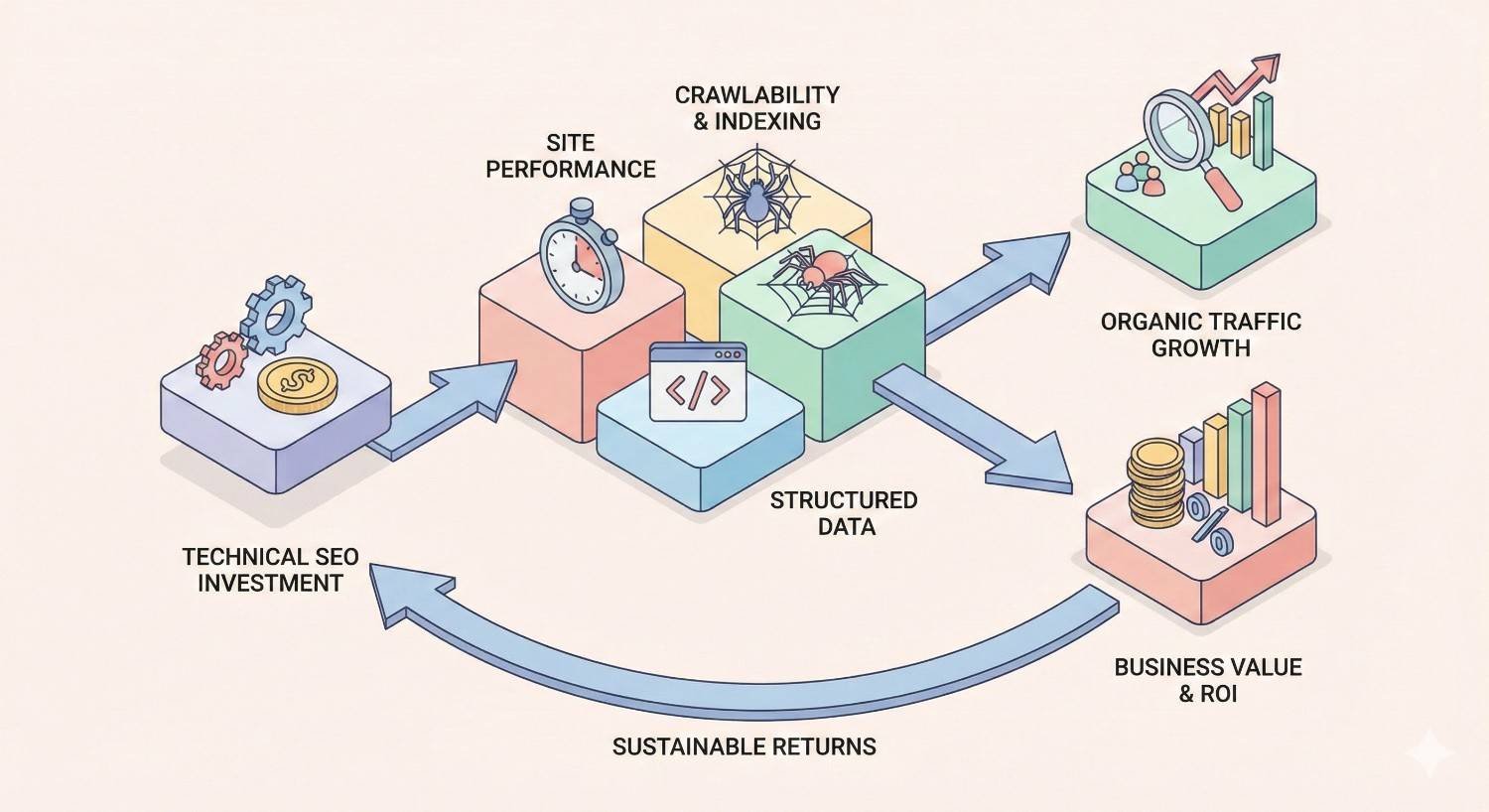
The ROI of Technical SEO Investment
Technical SEO delivers measurable returns through increased traffic, improved conversions, and reduced wasted spend.
How Technical SEO Drives Organic Traffic Growth
Fixing technical issues removes barriers to indexation and ranking. Pages that were previously invisible become discoverable. Pages that ranked poorly due to speed or mobile issues climb higher.
The traffic gains from technical SEO are often dramatic because they unlock existing potential. Your content and backlinks were already working. Technical problems were simply preventing that work from translating into results.
Technical improvements also create compounding benefits. Faster sites earn more backlinks because publishers prefer linking to quality experiences. Better mobile experiences increase social sharing. Improved crawlability ensures new content gets indexed quickly.
Technical SEO Timelines: What to Expect
Technical SEO results vary based on the severity of issues and the competitiveness of your market. However, general timelines provide realistic expectations.
Immediate improvements (days to weeks): Fixing critical crawl errors, removing noindex tags from important pages, and resolving redirect chains can show results quickly once Google recrawls affected pages.
Short-term improvements (1-3 months): Speed optimizations, mobile usability fixes, and structural improvements typically show measurable impact within one to three months as Google processes the changes.
Long-term improvements (3-6+ months): Comprehensive technical overhauls, site migrations, and architecture restructuring require more time. Search engines need to recrawl and reevaluate the entire site.
Patience is essential. Technical SEO creates the foundation for sustainable growth rather than quick wins. The results compound over time as your improved infrastructure supports all other SEO efforts.
Measuring Technical SEO Success
Organic traffic growth is the ultimate metric. Track sessions from organic search in Google Analytics, segmented by landing page to identify which improvements drove results.
Indexation rates show whether more of your pages are appearing in search results. Compare indexed pages in Search Console to total pages on your site.
Core Web Vitals scores track performance improvements. Monitor the percentage of URLs with good scores over time.
Crawl stats in Search Console show how efficiently Google is crawling your site. Look for increases in pages crawled per day and decreases in crawl errors.
Keyword rankings for target terms indicate whether technical improvements are translating into visibility gains. Track positions for priority keywords weekly or monthly.
Conversion rates from organic traffic reveal whether improved user experience is driving business results. Technical SEO should improve both traffic quantity and quality.
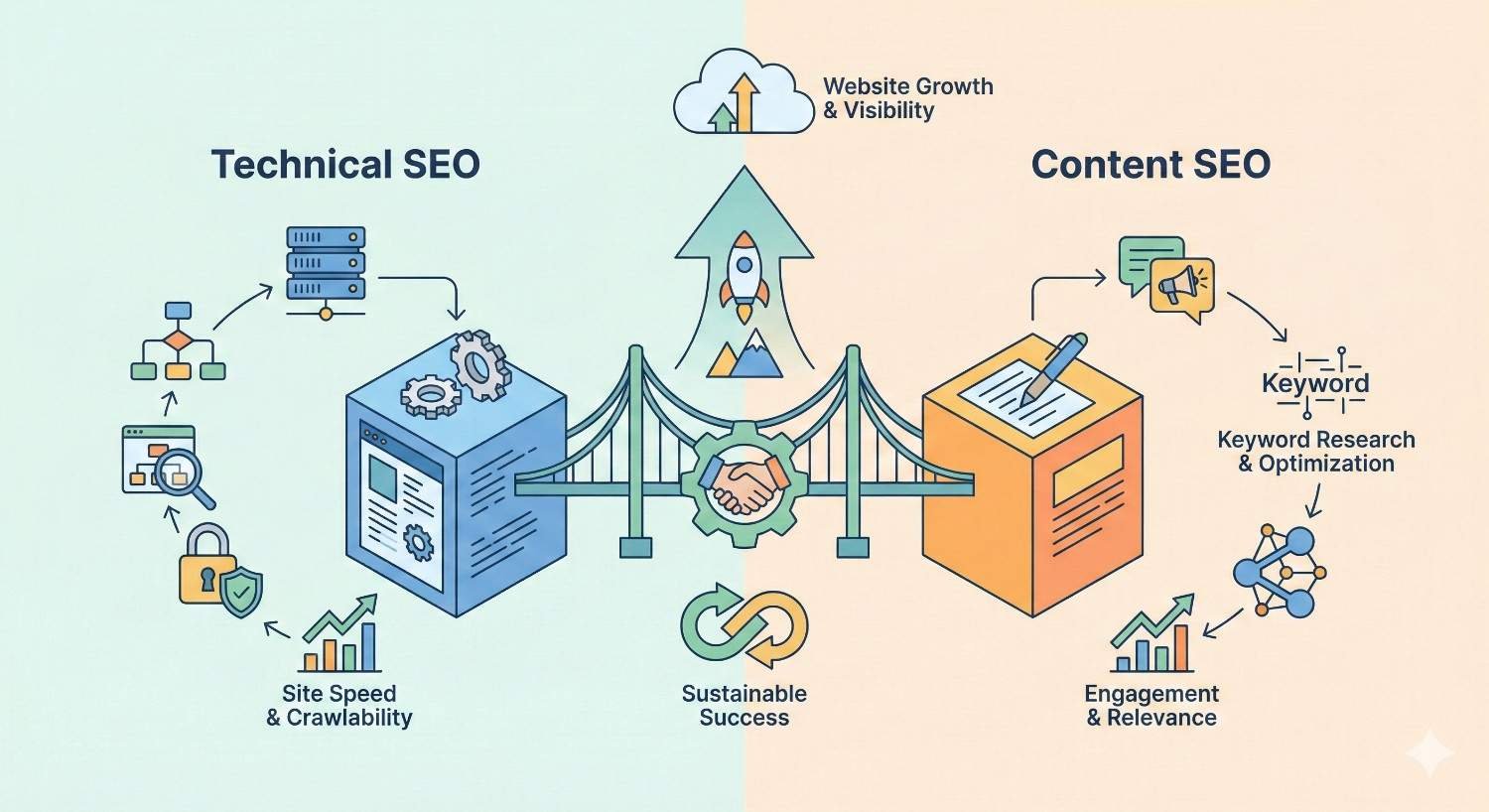
Technical SEO vs Content SEO: Why You Need Both
Technical SEO and content SEO are complementary disciplines. Neither can succeed without the other.
The Relationship Between Technical Foundation and Content Performance
Content SEO creates the relevance signals that match your pages to user queries. Keyword research, topic coverage, and content quality determine whether your pages deserve to rank.
Technical SEO ensures those pages can actually compete. A perfectly optimized article on a slow, mobile-unfriendly site with crawl errors will underperform compared to good content on a technically sound site.
The relationship works both ways. Technical excellence without quality content produces an empty shell. Search engines can crawl and index your pages perfectly, but if the content does not satisfy user intent, rankings will not follow.
Building a Balanced SEO Strategy
Effective SEO strategies address both technical and content elements simultaneously. Prioritization depends on your current situation.
If you have significant technical issues, fix them first. Content investments are wasted if pages cannot be crawled, indexed, or loaded quickly enough to retain users.
If your technical foundation is solid, shift focus to content. Create comprehensive resources that target valuable keywords and satisfy user intent better than competitors.
Ongoing maintenance requires attention to both. Technical debt accumulates as sites grow and change. Content becomes outdated and requires refreshing. Allocate resources to both disciplines continuously.
The most successful sites treat technical and content SEO as integrated functions rather than separate departments. Technical decisions impact content performance. Content decisions create technical requirements. Collaboration produces better outcomes.
How to Get Started with Technical SEO
Taking action on technical SEO requires systematic assessment, prioritization, and execution.
Technical SEO Audit Essentials
A comprehensive technical SEO audit evaluates all aspects of your site’s technical health. Start with these core areas:
Crawlability assessment: Review robots.txt, XML sitemaps, and crawl stats. Identify blocked pages, orphan pages, and crawl budget waste.
Indexation analysis: Compare indexed pages to total pages. Identify pages that should be indexed but are not, and pages that are indexed but should not be.
Performance evaluation: Test Core Web Vitals across key pages. Identify the slowest pages and the most common performance issues.
Mobile usability review: Check for responsive design issues, tap target problems, and viewport configuration.
Security check: Verify HTTPS implementation, check for mixed content warnings, and scan for malware or security vulnerabilities.
Structured data validation: Test schema markup implementation and identify opportunities for additional structured data.
Document all findings with severity ratings and estimated impact. This creates a prioritized roadmap for improvements.
Prioritizing Technical SEO Fixes
Not all technical issues are equally important. Prioritize based on impact and effort.
Critical issues block crawling, indexation, or rendering of important pages. Fix these immediately. Examples: robots.txt blocking the entire site, noindex on key pages, server errors.
High-impact issues significantly affect rankings or user experience. Address these quickly. Examples: slow page speed, mobile usability errors, duplicate content.
Medium-impact issues create inefficiencies or minor ranking drags. Schedule these for systematic resolution. Examples: redirect chains, missing alt text, suboptimal URL structures.
Low-impact issues are best practices that provide marginal improvements. Address these during regular maintenance. Examples: minor schema enhancements, internal link optimization.
Focus resources on critical and high-impact issues first. The 80/20 rule applies: a small number of fixes typically produce the majority of results.
When to DIY vs Hire Technical SEO Experts
DIY is appropriate when issues are straightforward, your team has technical capabilities, and you have time to learn and implement. Basic speed optimizations, simple schema markup, and routine maintenance can often be handled in-house.
Hiring experts makes sense when issues are complex, stakes are high, or internal resources are limited. Site migrations, major architecture changes, and diagnosing mysterious ranking drops benefit from specialized expertise.
Consider the cost of mistakes. A botched site migration can destroy years of SEO progress. Complex technical issues can take months to diagnose without experience. The cost of expert help is often less than the cost of extended problems.
Hybrid approaches work well. Use experts for audits and strategy, then implement simpler fixes in-house. Bring in specialists for complex projects while building internal capabilities over time.
Conclusion
Technical SEO forms the foundation that determines whether your content and authority-building efforts translate into rankings, traffic, and revenue. Without addressing crawlability, speed, mobile experience, and site structure, even the best content remains invisible to search engines and frustrating for users.
At White Label SEO Service, we help businesses build the technical infrastructure that supports sustainable organic growth. Our comprehensive approach addresses technical foundations, content strategy, and authority building as integrated components of search success.
Ready to identify and fix the technical issues holding your site back? Contact our team for a technical SEO audit that reveals exactly what is blocking your rankings and how to fix it.
Frequently Asked Questions About Technical SEO
What happens if I ignore technical SEO?
Ignoring technical SEO allows problems to compound over time. Crawl errors multiply, speed degrades, and mobile issues worsen. Your site gradually becomes less visible in search results while competitors who maintain their technical health capture the traffic you lose.
How long does technical SEO take to show results?
Results depend on issue severity and site size. Critical fixes like removing accidental noindex tags can show impact within days. Comprehensive improvements typically require one to three months. Major overhauls may take six months or longer to fully materialize in rankings.
Is technical SEO a one-time fix or ongoing process?
Technical SEO requires ongoing attention. Sites change constantly through new content, design updates, and platform changes. Each modification can introduce new technical issues. Regular audits and monitoring prevent small problems from becoming major obstacles.
How much does technical SEO cost?
Costs vary widely based on site complexity and issue severity. Basic audits range from a few hundred to several thousand dollars. Comprehensive fixes for enterprise sites can require significant investment. The ROI typically justifies the cost through increased organic traffic and conversions.
Can I do technical SEO myself without coding knowledge?
Many technical SEO tasks require minimal coding. CMS platforms and plugins handle common optimizations. However, complex issues often require developer involvement. Start with accessible improvements and escalate technical challenges to specialists when needed.
What tools do I need for technical SEO?
Essential tools include Google Search Console for indexation and performance data, a site crawler like Screaming Frog for comprehensive audits, PageSpeed Insights for performance analysis, and Google Analytics for measuring results. Premium tools add features but free options cover the basics.
How do I know if my technical SEO is working?
Track organic traffic trends, indexation rates, Core Web Vitals scores, and keyword rankings over time. Improvements in these metrics indicate technical SEO success. Declining metrics despite content efforts often signal technical problems requiring attention.