Technical SEO is the work of making your website easy for search engines to crawl, render, index, and rank — and for small businesses, getting the basics right is often the single highest-ROI marketing investment available. Most SMB owners do not need enterprise-grade technical work; they need a clear, prioritized list of what actually moves rankings.
The problem is noise. Most technical SEO advice was written for large sites with engineering teams, leaving small business owners overwhelmed and unsure where to start or what is genuinely worth fixing first.
This guide covers what technical SEO is, crawlability, site architecture, mobile-first optimization, Core Web Vitals, HTTPS, structured data, sitemaps, internal linking, auditing, prioritization frameworks, and when to bring in expert help.
What Is Technical SEO and Why Small Businesses Can’t Ignore It
Technical SEO is the foundational layer of search optimization that ensures search engines can access, understand, and rank your website properly. Unlike content or link building, it deals with the infrastructure beneath your pages: how they load, how they are structured, and how search bots interact with them.
For a small business, technical SEO is the difference between a website that competes for local and niche keywords and one that quietly gets ignored by Google despite having good content. According to Google Search Central documentation, even well-written content cannot rank if it is not crawlable, mobile-friendly, or technically sound.
How Technical SEO Differs From On-Page and Off-Page SEO
On-page SEO covers content, keywords, and metadata. Off-page SEO covers backlinks and brand mentions. Technical SEO is the foundation that lets both of those efforts compound: without it, content goes undiscovered and link equity flows inefficiently.
The Real Business Impact for SMBs
Page-experience and indexing issues directly affect lead generation. A site that fails Core Web Vitals or has crawl errors will see degraded rankings even when competitors are weaker on content. Technical SEO covers the infrastructure-level work that lets search engines crawl, render, and rank your content correctly, and our technical SEO services page walks through the full audit, fix, and monitoring process we run for small business clients.

Crawlability and Indexing: The Foundation Layer
Before Google can rank your pages, it must first find them (crawl) and store them in its database (index). If either step fails, no amount of content or link building will help. For small businesses, the most common ranking-suppressor we see is not poor content — it is pages that Google literally cannot see.
Crawl issues usually trace back to a handful of root causes: incorrect robots.txt directives, accidentally applied noindex tags, weak internal linking that buries pages too deep, or JavaScript-heavy templates that block rendering.
Key checks every small business should run regularly:
- Verify your site is submitted in Google Search Console and pages are indexing
- Check the Coverage report for excluded or error URLs
- Inspect important pages with the URL Inspection tool to confirm Google sees them as you do
Crawling and indexing are the two gates every page must pass before it can rank, and our crawlability and indexing guide breaks down every directive, error type, and recovery workflow that controls whether Google can actually see your pages. <!–NEW PAGE NEEDED–>
Site Architecture and URL Structure
Site architecture is the blueprint that decides how pages connect, how link equity flows, and how easily search engines understand the relationships between your topics. For small business sites, a flat architecture — where any important page is reachable in three clicks or fewer from the homepage — almost always outperforms deep, nested structures.
Good URL structure reinforces that architecture. URLs should be short, descriptive, lowercase, and hyphenated. Avoid query strings for primary pages, avoid dates in URLs unless you publish news, and avoid changing URL slugs after publishing without proper 301 redirects.
The mistake most SMBs make is letting their CMS auto-generate messy URLs and category trees, which fragments topical authority. Site architecture decides how link equity, crawl priority, and topical signals flow through your website, and our site architecture for SEO guide walks through flat structures, silo modeling, and the URL patterns that work best for small business sites. <!–NEW PAGE NEEDED–>
Mobile-First Optimization (Non-Negotiable in 2026)
Google has used mobile-first indexing as the default ranking signal for all sites since 2023, which means the version Google ranks is your mobile version — not your desktop site. If your mobile experience is broken, slow, or harder to use, your rankings reflect that, regardless of how polished the desktop site looks.
Mobile optimization for small businesses comes down to three priorities: a responsive design that adapts to any screen size, properly configured viewport meta tags, and tap targets large enough to interact with on a phone. Most modern themes handle this by default, but custom-built sites, older templates, and heavily modified pages routinely break mobile usability.
Run a real-world test: open your site on your own phone, scroll through your top five pages, and try to complete the actions you want a customer to take. If any step feels clumsy, search engines are likely seeing the same friction.
Mobile-first indexing means Google ranks your mobile version, not your desktop version, and our mobile SEO guide goes deeper into responsive design, viewport configuration, and the mobile usability errors that quietly suppress rankings. <!–NEW PAGE NEEDED–>

Core Web Vitals and Page Speed Performance
Core Web Vitals are Google’s measurable benchmarks for page experience, focused on three real-user metrics: Largest Contentful Paint (LCP) measures loading speed, Interaction to Next Paint (INP) measures interactivity, and Cumulative Layout Shift (CLS) measures visual stability. Per Google’s official guidance, pages that pass all three thresholds earn measurable ranking advantages.
For small business owners, the practical breakdown is simple:
- LCP under 2.5 seconds — controlled by image compression, server response time, and hosting quality
- INP under 200 milliseconds — improved by reducing heavy JavaScript and third-party scripts
- CLS under 0.1 — fixed by setting image dimensions and avoiding layout-shifting ads
The good news: most SMB sites can pass Core Web Vitals with three changes — better hosting, image optimization, and removing unused plugins or scripts. Core Web Vitals measure how real users experience page speed, interactivity, and visual stability, and our Core Web Vitals guide explains how to diagnose LCP, INP, and CLS issues and which fixes deliver the fastest ranking impact. <!–NEW PAGE NEEDED–>
HTTPS, Security, and Trust Signals
HTTPS has been a confirmed Google ranking signal since 2014, but its modern importance is broader. Browsers now flag any non-HTTPS site as “Not Secure,” which destroys conversion rates regardless of the search ranking conversation. For a small business, this is no longer optional infrastructure — it is a baseline requirement.
If your site is already on HTTPS, the work shifts to maintenance: certificate renewal, mixed-content cleanup (where an HTTPS page loads HTTP images, scripts, or stylesheets), and ensuring every HTTP URL 301-redirects to its HTTPS equivalent. Migrations done incorrectly can cause weeks of ranking drops that are entirely avoidable.
HTTPS is now a baseline trust signal that affects both rankings and conversions, and our HTTPS migration checklist walks through certificate setup, mixed-content cleanup, and the redirect rules that prevent traffic loss during the switch. <!–NEW PAGE NEEDED–>
Structured Data and Schema Markup
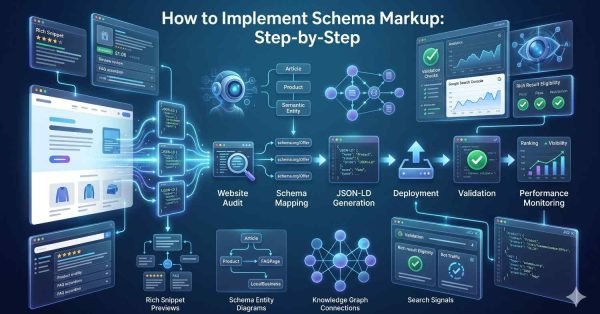
Structured data is code (typically JSON-LD) you add to your pages that tells search engines exactly what each page is about — what entity it represents, what attributes it has, and how it relates to other entities. For small businesses, schema markup unlocks rich results: star ratings, FAQ accordions, business information panels, event details, and product information that visibly stand out in search results.
The schema types that deliver the most value for SMBs include:
- LocalBusiness for any business with a physical location or service area
- Organization for branding and knowledge panel signals
- FAQPage for content with frequently asked questions
- Product and Review for eCommerce pages
- Article for blog and resource content
Schema must be validated using Google’s Rich Results Test to confirm it parses correctly. Structured data tells search engines exactly what each page is about and unlocks rich results, and our schema markup for small business guide covers every JSON-LD type SMBs should implement, with code examples and validation steps. <!–NEW PAGE NEEDED–>
XML Sitemaps and Robots.txt Configuration
Your XML sitemap is the directory you hand to search engines, telling them exactly which pages exist and which deserve crawling priority. Your robots.txt file is the gatekeeper, telling crawlers which folders or paths to avoid. Together, they govern crawl behavior across your entire site.
Common small business mistakes include letting auto-generated sitemaps include thin tag pages, author archives, and duplicate URLs — diluting the crawl signal. On the robots.txt side, the dangerous error is accidentally blocking entire folders (Disallow: /) during a site rebuild and forgetting to remove it.
Both files should be submitted in Google Search Console and re-verified after any major site change. Sitemaps and robots.txt files give search engines the navigation and access rules they need to crawl efficiently, and our XML sitemap setup walks through generation, submission, and the directive errors that block important pages from indexing. <!–NEW PAGE NEEDED–>
Internal Linking as a Technical SEO Lever
Internal linking is often classified as on-page SEO, but its technical impact is enormous. Internal links distribute PageRank across your site, define topical relationships between pages, and signal to search engines which pages matter most. A page with no internal links pointing to it (an “orphan”) will struggle to rank regardless of its content quality.
For small businesses, three principles cover most of the value:
- Every important page should receive at least 2–3 contextual internal links
- Anchor text should be descriptive and varied — not generic phrases like “click here”
- Hub-and-spoke architecture (a pillar page linking to detailed subtopic pages) builds topical authority faster than scattered linking
Internal links distribute authority and define topical relationships across your site, and our internal linking strategy guide breaks down anchor text best practices, hub-and-spoke modeling, and the orphan-page audits that recover wasted link equity. <!–NEW PAGE NEEDED–>

How to Audit Your Site and Detect Technical Errors
A technical SEO audit is the structured process of identifying every crawl, render, indexation, performance, and architecture issue affecting your site. For small businesses, a quarterly lightweight audit is enough to catch most regressions before they erode rankings.
The audit toolkit most SMBs need is short and mostly free:
- Google Search Console for indexing, Core Web Vitals, and manual action data
- PageSpeed Insights for performance diagnostics on individual URLs
- Screaming Frog SEO Spider (free up to 500 URLs) for crawl-level analysis
- Google’s Rich Results Test for schema validation
- Mobile-Friendly Test for mobile usability spot-checks
Audits should produce a prioritized fix list — not a 200-item dump. The goal is to identify the five or six issues that matter most this quarter, fix them, and re-audit. A structured audit is how you find every crawl, render, and indexation issue before they cost rankings, and our technical SEO audit checklist walks through the exact 40-point process we use for client engagements. <!–NEW PAGE NEEDED–>
A Prioritization Framework for Small Business Owners
This is where most technical SEO advice fails small businesses. Knowing every possible fix is useless if you do not know which ones matter for your situation, budget, and traffic level. Here is the framework we use with SMB clients.
Tier 1 — Foundational (fix first, always):
- HTTPS active across the entire site
- Mobile-friendly across all key pages
- No crawl-blocking errors in robots.txt or noindex tags
- XML sitemap submitted and indexing
- Search Console verified and monitored
Tier 2 — High-Impact (fix next):
- Core Web Vitals passing on top 20% of traffic-driving pages
- Site architecture flat enough that important pages are within 3 clicks
- Internal linking covers all priority pages with 2+ inbound links
- Schema markup on homepage, location pages, and FAQs
Tier 3 — Optimization (fix when above are stable):
- Image optimization and lazy loading across all pages
- Advanced schema for products, articles, reviews
- Log-file analysis (only if site has 10,000+ URLs)
- Crawl budget optimization (rarely relevant for sites under 10,000 pages)
Most small businesses never need to touch Tier 3. The compounding ROI lives in Tiers 1 and 2.
DIY vs. Hiring a Technical SEO Expert
Technical SEO sits at an awkward intersection of marketing and development. Most SMB owners can handle Tier 1 items themselves with a weekend of focused work, especially with modern CMS platforms that automate much of the foundation. Tier 2 starts to require either real time investment or paid help — particularly Core Web Vitals optimization and schema implementation, which often touch code.
The honest test: if technical fixes are competing with the customer-facing work that pays your bills, the math usually favors getting help. For owners who need to move faster than a self-taught learning curve allows, partnering with a team that delivers full-service SEO support can compress months of trial and error into a structured, results-driven engagement.

How Long Until Technical SEO Results Appear
Technical fixes produce different timelines for different changes. Crawl and indexing fixes show up within days to weeks once Google recrawls the affected pages. Core Web Vitals improvements typically take 28 days to fully reflect in Search Console because the metric uses a rolling field-data window. Architecture and internal linking improvements compound over months as search engines re-evaluate your topical authority.
Setting realistic expectations is half the battle. Technical fixes can produce visible movement within weeks, but compounding gains take longer, and our breakdown of realistic SEO timelines explains exactly when to expect crawling, indexing, and ranking changes after each fix.
Conclusion
Technical SEO is the foundation that lets every other marketing investment compound, from content to backlinks to paid traffic that returns through organic search.
For small businesses, the playbook is straightforward: fix Tier 1 first, work through Tier 2 deliberately, and ignore Tier 3 unless your scale demands it.
We help small businesses build sustainable organic growth at White Label SEO Service — start with a structured audit and a clear, prioritized roadmap.
Frequently Asked Questions
What is the most important technical SEO factor for small businesses?
Crawlability and indexing come first. If Google cannot find or store your pages, nothing else matters. Verify Search Console coverage before optimizing anything else.
Can a small business owner do technical SEO themselves?
Yes, for Tier 1 fundamentals like HTTPS, mobile-friendliness, and basic Search Console setup. Tier 2 work like Core Web Vitals and schema markup usually benefits from expert help.
How much does technical SEO cost for a small business?
Costs range from zero for DIY foundational work to $500–$3,000 monthly for managed services. The right budget depends on site complexity and competition level.
How often should I audit my technical SEO?
A lightweight audit every quarter is enough for most small business sites. Run a full audit annually or after any major site change, redesign, or migration.
Does technical SEO matter more than content?
Neither works without the other. Technical SEO ensures your content is discoverable and rankable, while content gives search engines and users a reason to value your pages.
What technical SEO mistakes hurt rankings the most?
Accidental noindex tags, blocked robots.txt directives, broken mobile experiences, and failing Core Web Vitals cause the largest preventable ranking losses we see.
How long does it take to fix technical SEO issues?
Most foundational fixes take a few days to implement and 2–4 weeks to reflect in Search Console data. Compounding ranking gains build over 3–6 months.