Local link building in 2026 is the practice of earning relevant, geographically anchored backlinks from community sources, local media, regional partners, and trusted local institutions to strengthen local search visibility, trust signals, and map pack rankings.
With local search competition tightening and Google’s local algorithm prioritizing real-world relevance, your link profile signals trust and authority within a specific geographic market today.
This guide breaks down the local link building strategies that actually work in 2026, the metrics that matter, and the mistakes that quietly kill rankings.
What Is Local Link Building?
Local link building is the process of acquiring backlinks from websites that are geographically or contextually tied to the area your business serves. Unlike general link building, where any high-authority referring domain may help, local links work because they connect your business to a defined region in ways search engines can verify.
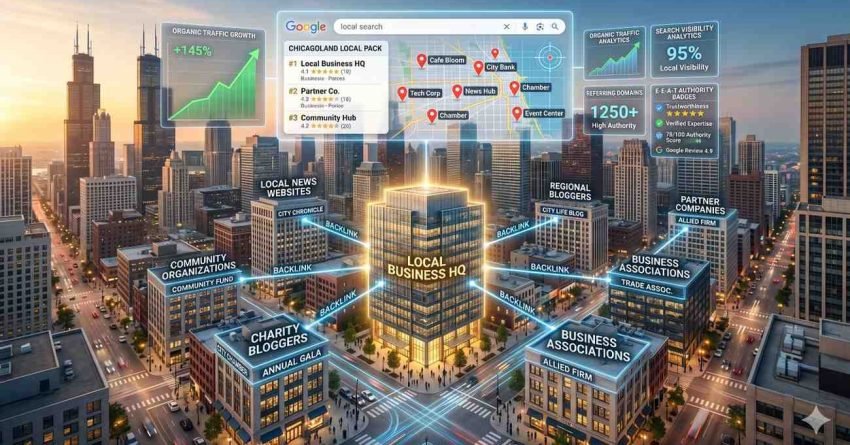
These links typically come from local news outlets, community organizations, regional blogs, business associations, sponsored events, partner companies, and locally focused directories. Each link tells Google two things at once: your business exists in this area, and credible entities in this area vouch for you.
Local link building is one branch of a much broader discipline, and our complete link building guide walks through every method, framework, and prioritization model you need to design a full backlink strategy from scratch.
How Local Links Differ from Standard Backlinks
A standard backlink is evaluated on authority, topical relevance, and trust. A local link adds a fourth dimension: geographic relevance. A link from a regional newspaper in your city carries more local ranking weight than a link from a high-authority site with no geographic alignment. The link does not need to be from a high domain authority source to influence local rankings. It needs to be real, relevant, and rooted in the community.

Why Local Link Building Still Drives Rankings in 2026
Google’s local ranking system continues to rely on three core inputs: relevance, distance, and prominence. According to Google’s official guidance on local rankings, prominence is partially shaped by information Google finds about your business across the web, which includes links, articles, and citations. Local backlinks remain one of the strongest prominence signals available.
Backlinks alone do not move the needle without solid on-page and profile signals, which is why our breakdown of local SEO fundamentals explains how proximity, prominence, and relevance work together to shape map pack rankings.
The Role of Proximity, Prominence, and Relevance
Proximity is geographic distance to the searcher. Prominence is how well known and trusted your business appears across the web. Relevance is how well your business matches the search intent. Local links influence prominence directly and reinforce relevance when the linking page discusses your service, location, or industry.
How Local Links Strengthen E-E-A-T Signals
Experience, Expertise, Authoritativeness, and Trustworthiness all rely on third-party validation. A community sponsorship page, a quote in a regional news story, or a partner site referencing your work all act as external evidence. These signals strengthen E-E-A-T because they are independent confirmations of who you are and what you do in a specific market.

The Local Link Building Strategies That Work in 2026
The tactics below are the ones still producing measurable ranking and traffic gains. They share three traits: each link is editorially earned, contextually relevant, and tied to a real geographic relationship.
Sponsor Local Events, Charities, and Sports Teams
Event and charity sponsorships remain one of the highest leverage local link tactics. Most organizations publish a sponsors page that links to contributing businesses. Choose sponsorships aligned with your audience and brand values, contribute meaningfully, and ensure the receiving site links to a relevant landing page on your domain rather than only a logo.
Build Relationships with Local Journalists and Bloggers
Local press coverage produces some of the strongest geographically relevant links available. Pitch original data, expert commentary, or community angles to reporters covering your region. Sustained relationships outperform one-off pitches because journalists return to trusted sources repeatedly, generating multiple linked mentions over time.
Partner with Complementary Local Businesses
Cross-promotion with non-competing local businesses creates natural link opportunities. A wedding photographer can partner with venues, florists, and planners. A roofing company can partner with HVAC contractors and home inspectors. Each partner adds a relevant local backlink and often a steady referral channel.
Earn Links from Chambers and Business Associations
Chambers of commerce, industry associations, and professional bodies typically maintain member directories with linked profiles. Memberships pass moderate authority and strong local trust signals. Association links work hardest when paired with a fully optimized listing, and our guide to Google Business Profile optimization covers the attributes, categories, and review signals that amplify every local link you earn.
Create Linkable Local Resources
Build genuinely useful local resources that other community sites will reference. Examples include a guide to local regulations relevant to your industry, a directory of community events, an annual local market report, or original survey data about your region. Linkable assets compound because they attract links passively for years after publication.
Get Listed on Authoritative Local Directories
Not every directory deserves your time, but the right ones still influence local rankings. Focus on platforms tied to your geography, industry, or both. Skip low-quality submission sites that accept any business for a fee. Directory links and citations overlap heavily, and our dedicated walkthrough on local citation building shows which platforms still pass authority in 2026 and which ones quietly waste your time.

How to Measure Local Link Building Success
A link building program without measurement quickly drifts into vanity work. Track the metrics that connect link acquisition to business outcomes.
Tracking Referring Domains and Local Relevance
Count new referring domains per month, not raw link totals. One link from a respected local newspaper outperforms ten links from low-quality syndication sites. Tag each new referring domain by geographic relevance, topical relevance, and authority tier so you can see which categories drive the strongest ranking lifts.
Connecting Links to Rankings, Traffic, and Leads
Local link building only matters if it moves rankings, organic traffic, and leads. Tie every link campaign back to keyword ranking shifts in the map pack and the standard organic results, organic session growth from the target region, and conversion volume from local searches. Tying link acquisition to revenue requires a defined measurement layer, and our framework to track SEO performance maps referring domains, rankings, organic traffic, and leads into a single reporting view.
Local Link Building Mistakes That Hurt Rankings in 2026
Several common mistakes still produce real ranking damage. Buying links from private blog networks remains the fastest way to trigger a manual action or algorithmic suppression. Pursuing high-volume low-quality directory submissions wastes budget and dilutes profile quality. Stuffing exact-match anchor text into every link looks unnatural and invites scrutiny. Ignoring geographic relevance entirely produces backlinks that pass authority but contribute nothing to local prominence signals.
Cheap or spammy local links create more damage than they solve, and a dedicated walkthrough on toxic backlink cleanup <!–NEW PAGE NEEDED–> explains how to detect, document, and disavow harmful links before they suppress local visibility.
The other quiet killer is inconsistency. Local link building compounds when executed steadily over months and quarters. Burst campaigns followed by long silences rarely produce durable rankings. Plan for sustained outreach, sustained relationship building, and sustained content creation rather than isolated pushes.
Conclusion
Local link building in 2026 rewards businesses that earn geographically relevant backlinks through real community relationships, original local content, and sustained outreach to credible regional sources.
The brands winning local search are the ones building authority the slow, defensible way, and that advantage compounds every quarter as competitors keep chasing shortcuts that no longer work.
At White Label SEO Service, we help local brands earn the kind of relevant, geographically anchored links that actually move map pack rankings, organic traffic, and qualified leads.
Frequently Asked Questions
How long does local link building take to impact rankings?
Most businesses see early ranking movement within three to six months of consistent local link acquisition. Durable map pack gains typically build over six to twelve months as referring domains, relevance, and prominence signals compound.
How many local backlinks do I need to rank?
There is no fixed number. What matters is link relevance, geographic alignment, and source authority compared to direct local competitors. Audit competing businesses ranking in the map pack and aim to match or exceed their referring domain quality.
Are local directory links still valuable in 2026?
Yes, but only authoritative directories tied to your geography or industry. Skip generic submission sites that accept any business. Focus on chambers, association directories, and respected regional platforms that real users actually visit and trust.
Does Google penalize paid local sponsorships?
No. Sponsoring real local events, teams, or charities is a legitimate community activity and the resulting links are editorially given. Problems only arise when sponsorships are fabricated solely to manufacture backlinks without any real-world contribution.
What is the difference between local citations and local backlinks?
A citation is a mention of your business name, address, and phone number, sometimes without a link. A local backlink is a clickable link from a relevant local source. Both contribute to local prominence but backlinks pass more direct ranking weight.
Can I do local link building without a physical storefront?
Yes. Service area businesses and remote-first local brands can earn local links through sponsorships, partnerships, community content, expert commentary, and association memberships. Geographic relevance matters more than having a public storefront address.
Should I use exact match anchor text for local link building?
Avoid over-optimizing anchor text. Use a natural mix of branded anchors, partial match phrases, and contextual phrases. Heavy use of exact match anchors like your city plus your service looks manipulative and increases the risk of algorithmic suppression.