Link building is the practice of earning hyperlinks from other websites to your own, and for beginners it remains the single fastest way to build domain authority, rankings, and qualified organic traffic when executed with the right strategy.
Backlinks signal trust to search engines, and Google still treats them as a top-three ranking factor in 2026. Most beginners waste months chasing low-value links that move nothing.
This guide walks through proven beginner strategies, evaluation frameworks, common mistakes, tools, and realistic timelines so you can build authority safely from day one.
What Is Link Building in SEO?
Link building is the structured process of acquiring inbound hyperlinks, also called backlinks, from external websites pointing to pages on your domain. Each backlink functions as a vote of confidence, telling search engines that another site finds your content valuable enough to reference.
Search engines use these signals to determine how authoritative, relevant, and trustworthy a page is for any given query. Backlinks remain one of Google’s strongest ranking signals, and our complete link building guide breaks down every principle, framework, and workflow you need to scale authority responsibly.
How Backlinks Influence Search Rankings
Every backlink passes a portion of authority, often called link equity, from the linking page to the destination page. Pages with more high-quality referring domains consistently outrank pages with thin link profiles, especially in competitive niches.
Authority, Relevance, and Trust Signals
Google evaluates three core dimensions of every backlink: the authority of the linking domain, the topical relevance between the two pages, and the trust signals surrounding the placement. Beginners who balance all three see compounding ranking gains over six to twelve months.
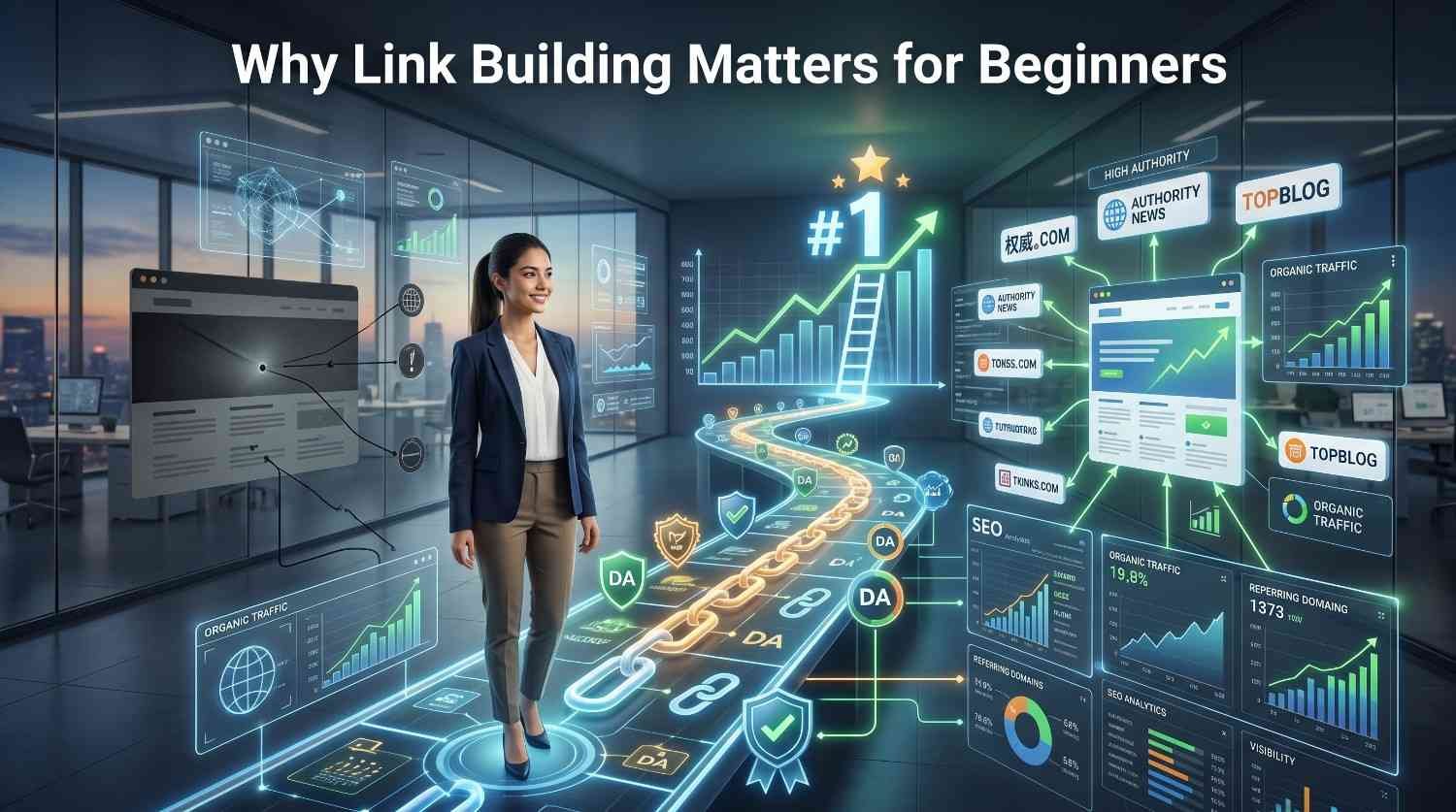
Why Link Building Matters for Beginners
For new websites, content alone rarely ranks. Without external trust signals, even well-optimized pages remain invisible in search results. Link building accelerates discovery, indexation, and ranking velocity.
Organic Visibility and Domain Authority
Domain authority grows in direct proportion to the quality and diversity of referring domains. A single relevant link from a respected publisher often outperforms fifty links from low-quality directories.
Referral Traffic and Brand Credibility
Beyond rankings, backlinks send qualified referral traffic directly from the linking page. Readers who arrive through editorial mentions convert at significantly higher rates than cold organic visitors because the recommending site has already endorsed your brand. Search engines weigh trust signals across the entire site, and our domain authority explained resource shows exactly how backlinks shape this metric over time.
Core Principles Every Beginner Should Know
Successful link building follows a small set of immovable principles. Ignoring any one of them creates risk, wastes budget, or invites penalties.
Quality Over Quantity
One contextual backlink from an industry-leading publication outperforms hundreds of low-quality links. Focus on relevance, editorial standards, and traffic potential before considering volume.
Relevance and Topical Alignment
Links from sites covering related topics carry far more weight than unrelated ones. A backlink from a marketing blog to an SEO agency is significantly more valuable than a link from an unrelated lifestyle site, regardless of domain rating.
Natural Link Velocity
Acquiring hundreds of links in a single week from a previously inactive profile is a clear manipulation pattern. Anchor diversity protects your link profile from over-optimization penalties, and our anchor text optimization breakdown covers natural ratios, branded mixes, and safe distribution patterns.

Beginner-Friendly Link Building Strategies That Work
Beginners need tactics that produce measurable results without requiring large budgets or advanced outreach infrastructure. The following strategies consistently deliver early authority gains.
Guest Posting on Niche Blogs
Publishing original, valuable content on relevant industry blogs in exchange for a contextual backlink remains one of the most predictable acquisition channels. Pitch sites with engaged audiences rather than chasing domain rating alone. Guest contributions still deliver contextual authority when executed correctly, and our guest posting best practices walkthrough shows how to pitch, write, and place links that editors actually accept.
Resource Page Link Building
Many websites maintain curated resource pages listing tools, guides, and references for their audience. Identifying these pages, then pitching your content as a useful addition, produces high-conversion outreach with minimal effort.
Broken Link Building
This involves finding broken outbound links on relevant pages, creating or referencing a comparable resource on your site, and emailing the webmaster suggesting your link as a replacement. It works because you provide immediate value by fixing their page. A dedicated broken link building tutorial <!–NEW PAGE NEEDED–> walks through every step from prospecting to outreach templates.
Digital PR and HARO Outreach
Responding to journalist queries through services like HARO, Qwoted, and Featured earns editorial mentions on major publications. Earning press mentions accelerates trust faster than manual outreach, and our digital PR for SEO resource explains how to craft data stories journalists naturally cite.
Skyscraper Content Technique
Identify top-ranking content for target keywords, create a significantly improved version, then reach out to sites linking to the original. Our skyscraper technique explained <!–NEW PAGE NEEDED–> guide details the exact prospecting and outreach sequence that turns this into a repeatable system.
Internal Linking as a Foundation
Before chasing external links, ensure internal links distribute authority correctly across your own pages. A strong internal structure multiplies the impact of every external backlink you eventually earn.

How to Evaluate a Backlink Opportunity
Not every link is worth pursuing. Evaluating opportunities before outreach prevents wasted hours and protects your link profile from low-quality associations.
Domain Authority and Trust Flow
Use established metrics like Ahrefs Domain Rating, Moz Domain Authority, and Majestic Trust Flow as initial filters. Avoid sites with high authority but unnatural traffic-to-link ratios.
Relevance, Traffic, and Spam Score
A relevant site with modest authority and real organic traffic almost always outperforms a high-authority site with no audience. Vetting opportunities before outreach saves months of wasted effort, and our backlink quality checklist details the exact metrics, filters, and red flags every beginner should screen for.
Anchor Text and Placement Context
Editorial links placed within the body of relevant articles carry far more weight than sidebar or footer placements. Branded and partial-match anchors look natural; exact-match commercial anchors trigger scrutiny.
Common Link Building Mistakes to Avoid
Most beginner penalties trace back to a handful of repeatable errors. Avoiding them is often more valuable than any single tactic.
Buying Low-Quality Links
Purchased link packages on private blog networks remain one of the fastest ways to trigger manual actions. Manual actions can wipe out years of growth, and our Google penalty recovery walkthrough explains how to audit toxic links and rebuild trust safely.
Over-Optimized Anchor Text
Repeating the same exact-match commercial anchor across dozens of backlinks signals manipulation. Keep branded, naked URL, and partial-match anchors as the majority of your profile.
Ignoring Nofollow vs Dofollow Balance
A natural profile contains both nofollow and dofollow links. A nofollow vs dofollow links <!–NEW PAGE NEEDED–> breakdown explains why diverse attribution mirrors authentic editorial behavior.
Tools to Help Beginners Build Links Smarter
Choosing the right software stack shortens the learning curve dramatically, and our best SEO tools comparison breaks down what each platform delivers for outreach, tracking, and analysis. Beginners benefit most from one prospecting tool, one outreach tool, and Google Search Console for monitoring earned links.

Bridging Beginner Tactics to Long-Term Authority
Beginner tactics build the foundation, but true ranking dominance comes from systematizing acquisition at scale. Once beginner tactics are in place, scaling requires a deeper system, and our full link building strategy framework shows how cluster tactics roll up into long-term authority.
How Long Does Link Building Take to Show Results?
Most beginner link building campaigns produce measurable ranking shifts within three to six months, with compounding gains visible from month six onward. Link equity compounds over months not days, and our realistic SEO timeline guide explains exactly when to expect movement in rankings, traffic, and conversions.
Conclusion
Link building combines authority, relevance, and trust into a single growth lever that separates ranking sites from invisible ones. Beginners who follow proven strategies, avoid common pitfalls, and evaluate every opportunity carefully build durable organic visibility.
The brands that win in search treat link acquisition as an ongoing discipline rather than a one-time campaign, layering tactics over months to compound authority steadily.
At White Label SEO Service, we help businesses build sustainable backlink profiles that drive real rankings, qualified traffic, and long-term ROI through transparent, data-driven strategy.
Frequently Asked Questions
What is the easiest link building strategy for beginners?
Resource page link building and guest posting are the easiest entry points because they require minimal infrastructure and rely on offering genuine value. Both produce consistent results within the first ninety days of focused outreach.
How many backlinks does a new website need to rank?
There is no fixed number, but most new sites need between twenty and fifty quality referring domains to begin ranking competitively for medium-difficulty keywords. Relevance and authority matter far more than total quantity.
Are paid backlinks worth the risk?
No. Paid links violate Google’s webmaster guidelines and frequently trigger manual actions or algorithmic suppression. The short-term gain rarely justifies the long-term recovery cost or lost organic visibility.
How long until link building improves rankings?
Most beginner campaigns produce measurable ranking improvements within three to six months. Authority gains compound, with the strongest results typically appearing between months six and twelve of consistent effort.
What makes a backlink high quality?
A high-quality backlink comes from a relevant, authoritative site with real organic traffic, is placed editorially within body content, and uses natural anchor text. Spam score and outbound link patterns also matter.
Should beginners focus on dofollow or nofollow links?
Beginners should pursue both. A natural profile contains a healthy mix of dofollow and nofollow links because real editorial behavior produces both. Over-optimizing for dofollow looks unnatural to search engines.
How often should I build new backlinks?
Aim for steady, consistent acquisition rather than spikes. Earning a handful of relevant, quality links each month produces stronger long-term results than sudden bursts that look manipulative to search algorithms.