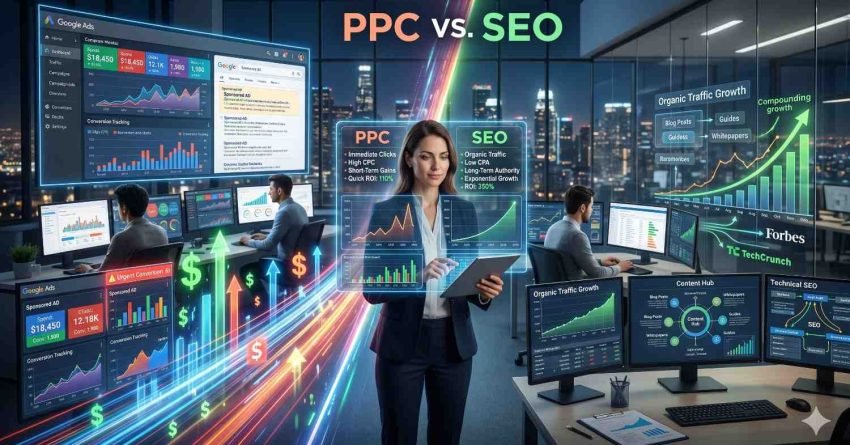
SEO and PPC are not competitors, they are complementary growth channels. PPC delivers immediate visibility through paid placement, while SEO builds compounding organic traffic that lowers customer acquisition cost over time.
Choosing between paid search and organic search will directly shape your marketing budget, conversion timelines, and the long-term return on investment for sustainable business growth.
This guide compares costs, timelines, ROI, and strategic fit, helping you decide when PPC works best, when SEO wins, and how to combine both successfully.
Understanding PPC and SEO: Core Definitions
PPC (pay-per-click) is a paid advertising model where businesses pay search engines a fee each time a user clicks one of their ads. These ads appear at the top of search results, on display networks, or across social platforms, giving advertisers instant visibility for targeted keywords. Google Ads dominates the PPC landscape, but Microsoft Advertising, LinkedIn Ads, and Meta also offer powerful paid search and social advertising channels.
SEO (search engine optimization) is the practice of improving a website’s organic visibility through technical optimization, content quality, and authority signals. Unlike PPC, SEO traffic is earned rather than purchased. It depends on how well your site aligns with user intent, how trustworthy your domain becomes over time, and how thoroughly your content covers the topics your audience searches for.
While both channels share the same goal of qualified search traffic, they operate on fundamentally different mechanics. PPC delivers measurable clicks the moment your budget is live. SEO builds a compounding asset that grows in value as your authority strengthens. Most growing businesses eventually need both. The strategic question is not which channel wins, but which channel earns more of your budget at each stage of growth.
For business owners and marketers planning long-term visibility, understanding how organic search builds momentum over months is essential, and our complete SEO timeline breakdown explains exactly how rankings, traffic, and ROI scale across the first 12 months of an organic campaign.
Key Differences Between PPC and SEO
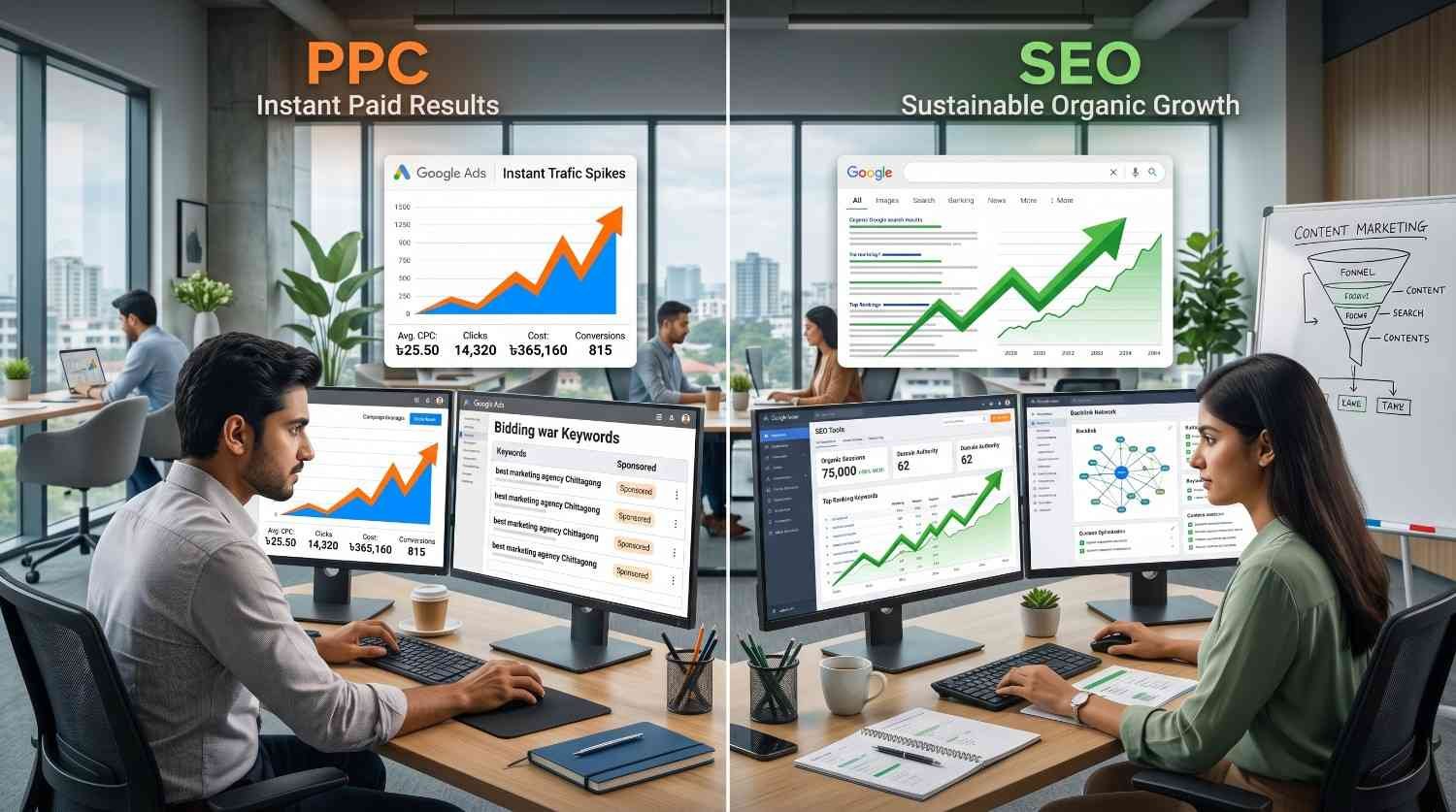
The differences between PPC and SEO go far beyond paid versus organic. Each channel has distinct mechanics that affect cost, control, scalability, and risk.
Visibility and Placement
PPC ads appear in clearly marked “Sponsored” positions above and below organic results. SEO listings appear in the main organic block, where users place significantly more trust. The majority of clicks for informational queries still go to organic listings, while transactional queries with strong purchase intent often favor paid placements.
Targeting Control
PPC offers granular control. You can target specific keywords, locations, devices, demographics, dayparts, and even retarget previous visitors. SEO targeting is more indirect. You optimize for search intent and topical relevance, and Google decides when to show you. The trade-off is less control, but higher long-term return when rankings stabilize.
Cost Structure
PPC follows a continuous payment model. The moment ads pause, traffic stops. SEO follows an investment model. You pay for strategy, technical work, content, and authority building, but once rankings are earned, traffic continues without ongoing per-click costs. This is why SEO consistently produces a lower cost per acquisition once mature.
Measurability
Both channels are measurable, but in different ways. PPC offers near real-time data on impressions, clicks, conversions, and cost per acquisition. SEO performance is measured through tools like Google Search Console and Google Analytics, focusing on ranking positions, click-through rates, and organic conversion paths over longer reporting windows.
For a deeper view of how organic rankings are built, our technical SEO checklist walks through the foundational signals search engines use to evaluate every site.
Cost and ROI Comparison
Cost is often the deciding factor between PPC and SEO for SMEs and startups. Both channels have very different cost curves and ROI patterns over time.
PPC Costs
PPC costs scale linearly with traffic. Average cost per click varies dramatically by industry. Legal, insurance, and B2B SaaS keywords frequently exceed $20 to $50 per click, while ecommerce keywords often range between $0.50 and $5. Monthly PPC budgets for serious campaigns typically start around $3,000 and scale to $50,000 or more for enterprise accounts. Conversion rates and customer lifetime value determine whether spend is profitable.
SEO Costs
SEO costs are upfront and ongoing, but they shift over time. Initial investment covers technical audits, content production, on-page optimization, and link acquisition. Monthly SEO retainers typically range from $2,000 to $10,000 depending on scope, competition, and content velocity. Unlike PPC, the spend does not directly equal the traffic. A single well-ranked piece of content can attract thousands of qualified visitors every month, indefinitely.
ROI Patterns
PPC ROI is immediate but flat. You pay X, you get Y. The math works only as long as customer acquisition cost stays below customer lifetime value. SEO ROI is delayed but compounding. The first six months may show modest gains, but by month 12 to 18, well-executed SEO campaigns frequently produce 3 to 5 times the ROI of paid search at scale. The reason is simple: organic clicks have no per-click cost.
Effective long-term planning starts with strategic keyword research that identifies the search terms most likely to drive qualified traffic, conversions, and sustainable organic growth.

Speed, Timelines, and Sustainability
Time is the most misunderstood factor in the PPC vs. SEO debate. Each channel operates on a completely different velocity curve.
PPC Speed
PPC delivers traffic the same day a campaign launches. Within 24 to 48 hours of approval, ads can appear at the top of Google for your target keywords. This makes PPC ideal for product launches, seasonal promotions, time-sensitive offers, and rapid market validation. However, PPC traffic exists only while budget exists. Pause the campaign, and visibility disappears instantly.
SEO Timelines
SEO requires patience. New domains may see meaningful traffic within 4 to 6 months, while established sites can rank faster on lower-competition terms. For competitive commercial keywords, expect 6 to 12 months of consistent execution before significant ranking improvements. Authority building, content depth, and technical health all influence how quickly Google trusts your site enough to rank it well.
Sustainability and Compounding
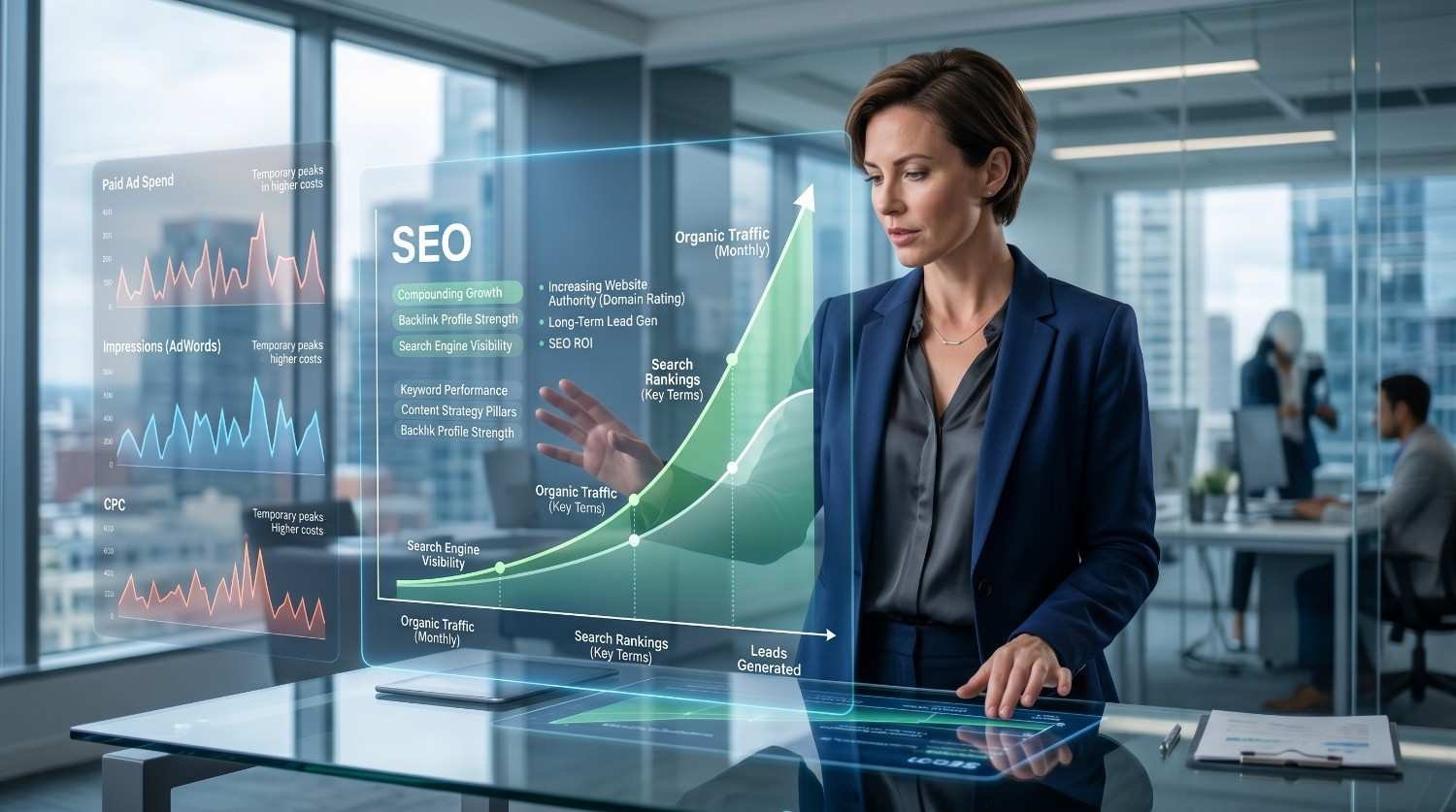
PPC is a flat-line asset. SEO is a compounding asset. Every piece of optimized content, every earned backlink, and every internal link signal continues to drive value long after it is created. A blog post that ranks on page one can deliver leads for years. A PPC ad delivers only as long as you keep paying.
For most growing businesses, the right answer is to use PPC for speed and SEO for sustainability, and a strong content strategy for SEO turns one-time investment into a long-term organic engine that reduces dependence on paid acquisition.
When PPC Makes the Most Sense
Some business situations strongly favor PPC, at least in the short term. Knowing when to lean into paid search prevents wasted spend on slower channels.
Time-Sensitive Campaigns
If you need traffic this week, PPC is the answer. Product launches, limited-time promotions, event registrations, and seasonal sales all benefit from immediate visibility. SEO cannot match this speed for net-new sites.
New Businesses Without Authority
Startups with no domain authority, no content history, and no backlinks face a long climb in organic search. PPC bypasses this entirely, putting you in front of qualified buyers from day one. Many founders use PPC for the first 6 to 12 months while SEO is being built in parallel.
Highly Commercial Keywords
Some queries are so transactional that organic results are pushed below the fold. “Buy [product] online,” “[service] near me,” and similar bottom-funnel queries often show shopping ads, local packs, and multiple paid results before any organic listing. PPC is structurally favored in these cases.
Testing Markets and Messaging
PPC is the fastest way to validate offers, headlines, landing pages, and audience segments. Data from PPC campaigns can directly inform your SEO content strategy by revealing which keywords convert, which value propositions resonate, and which markets are most responsive.
When SEO Is the Smarter Investment
For most businesses focused on sustainable growth and long-term ROI, SEO is the higher-leverage channel. The question is when it becomes the priority.
Long-Term Brand Building
SEO builds equity. Every published article, every internal link, and every earned backlink strengthens your domain. Over 3 to 5 years, this becomes a competitive moat that paid spend alone cannot replicate.
Lower Customer Acquisition Cost
Once organic rankings stabilize, the cost per visitor drops sharply. SEO traffic does not stop when budgets shift. This is critical for SMEs operating with limited acquisition budgets and for SaaS businesses where unit economics demand a low CAC.
High-Intent Informational Queries
When buyers research products, services, and solutions before purchasing, they almost always start with informational search. Ranking for these queries builds trust early in the buying journey, long before a prospect is ready to click a paid ad. This is where content-led SEO outperforms PPC for influence and persuasion.
Compounding Authority and Topical Coverage
SEO rewards depth and breadth. Sites that cover their topic comprehensively build topical authority that lifts every page, not just individual articles. This is impossible to replicate in PPC, where each keyword stands alone.
To accelerate organic growth without compromising quality, working with an experienced partner that handles strategy, content, and technical execution is the fastest path, and our SEO services help businesses build sustainable organic visibility through technical foundations, strategic content, and authority building.
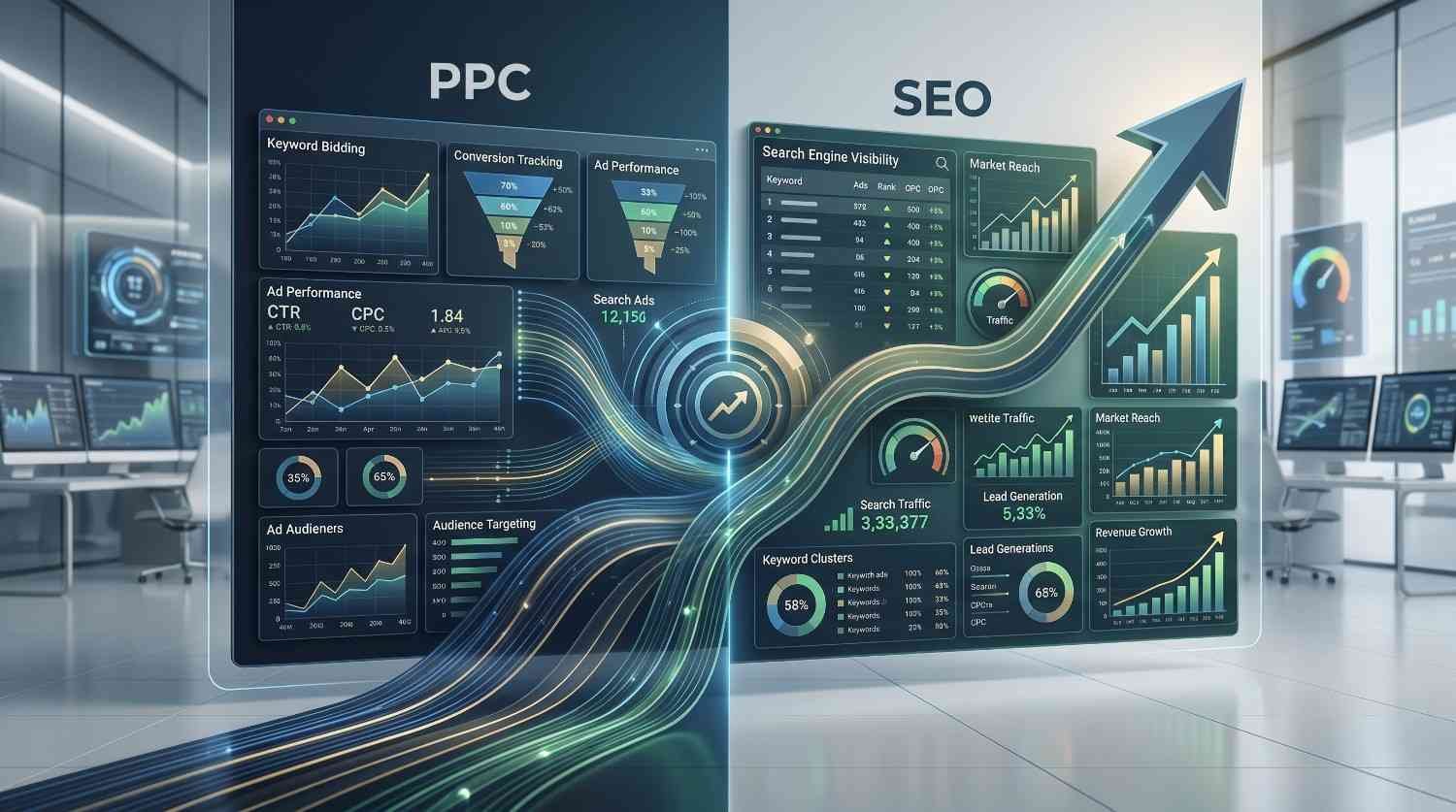
Combining PPC and SEO for Maximum Growth
The most effective digital strategies do not choose between PPC and SEO. They use both channels strategically, letting each do what it does best while reinforcing the other.
Use PPC for Speed and Validation
Run PPC for new product launches, competitive keyword research, and short-term promotions. PPC data reveals which keywords convert, which messages resonate, and which audiences are most profitable. Feed these insights into your SEO content plan.
Use SEO for Compounding Growth
While PPC drives immediate revenue, SEO builds the long-term asset. Prioritize cornerstone content, technical SEO, and authority building from day one. By month 12, SEO should be picking up a growing share of your traffic, gradually reducing PPC dependency.
Capture Branded Searches
When users search for your brand name, both organic and paid results compete for the same click. Running PPC on your brand defends against competitor bidding while SEO holds the organic top spot. Together, they dominate the SERP.
Retarget Organic Visitors with PPC
Visitors who arrive through SEO but do not convert are some of your most valuable audiences. Retargeting them through PPC display or social ads can lift conversion rates significantly. This is one of the highest-ROI uses of paid media for SEO-led businesses.
The combined approach is not theoretical. It is how high-growth companies build defensible search visibility while controlling cost per acquisition.
Conclusion
PPC and SEO are not rivals. PPC delivers immediate visibility, while SEO compounds into a long-term traffic engine that lowers acquisition cost as authority grows.
The smartest businesses run both channels strategically, using PPC for speed and SEO for sustainability, while each channel informs and amplifies the other.
We help businesses build organic growth through strategy, content, and authority. Partner with White Label SEO Service to build SEO investments that compound into revenue.
Frequently Asked Questions
Is PPC better than SEO for new businesses?
PPC delivers immediate visibility, making it strong for new businesses without authority. However, SEO should run in parallel to build long-term traffic and reduce dependency on paid spend.
How long until SEO outperforms PPC?
For most businesses, SEO outperforms PPC on cost per acquisition between months 9 and 18, depending on competition, content quality, technical health, and consistency of execution.
Can SEO and PPC be used together?
Yes. PPC drives immediate revenue, validates keywords, and supports brand defense, while SEO builds compounding traffic. Together, they capture more SERP real estate and reduce overall acquisition cost.
What is more expensive, PPC or SEO?
PPC is more expensive over time. SEO has higher upfront investment but no per-click costs once rankings are earned, leading to significantly lower customer acquisition cost long term.
Does PPC help SEO rankings?
PPC does not directly influence SEO rankings. However, PPC drives traffic, brand awareness, and conversion data that indirectly support SEO through engagement signals and improved content decisions.
Which has better ROI, SEO or PPC?
SEO typically delivers higher long-term ROI because traffic continues without per-click costs. PPC provides faster, more predictable short-term ROI, especially for transactional keywords and time-sensitive campaigns.
Should small businesses choose PPC or SEO first?
Small businesses should start SEO immediately for long-term growth and use PPC selectively for short-term revenue, lead generation, and validating which keywords drive qualified buyers.