A local citation is any online mention of a business’s name, address, and phone number, appearing on directories, review platforms, apps, and websites. Citations confirm that a business exists at a specific location, and search engines use them to verify and rank local businesses in map and geographic search results.
I’ve watched businesses pour money into content and links while their address sits wrong on forty directories. Search engines notice that contradiction long before customers do, and rankings suffer quietly.
This guide covers what citations are and why search engines weigh them, how citation data flows through aggregators and directories, the practical work of auditing, building, and cleaning listings, how citations behave for multi-location and service-area businesses, and what realistic volume, timelines, and costs look like.
What Local Citations Actually Are
A local citation is any online reference to a business’s core contact details, whether or not that reference includes a link. The mention itself carries the value, because search engines treat repeated, consistent contact data across independent sources as corroborating evidence that a business is real and operating where it claims.
I think of citations less as a marketing asset and more as a public record. Every directory listing, chamber of commerce page, app database entry, and news mention adds one more data point to the record search engines assemble about your business.
That distinction matters because it changes how you evaluate opportunities. A citation on a low-traffic regional directory has almost no referral value, and it still contributes to the verification picture Google builds.
Structured vs. Unstructured Citations
Structured citations appear in dedicated business listing formats with defined fields for name, address, phone, category, and hours. Yelp, Apple Maps, Bing Places, and industry directories all produce structured citations, and they’re the easiest for search engines to parse because the data sits in predictable places.
Unstructured citations are mentions inside ordinary web content. A local news article naming your bakery and its street address, a blog roundup of neighbourhood restaurants, a sponsorship page listing your details all unstructured, all still counted.
Structured citations are what you actively build. Unstructured citations mostly accumulate as a byproduct of doing business visibly in a community, and I’ve found they carry disproportionate trust weight precisely because you can’t submit a form to create them.
The Anatomy of a Citation: NAP and Beyond
NAP stands for name, address, and phone number, and it’s the minimum viable citation. Most modern platforms accept far more, and the additional fields materially affect how useful the listing becomes.
A complete listing typically includes website URL, business categories, operating hours, service area, payment methods, business description, photos, and attributes like wheelchair access or parking. Each field you populate gives search engines another attribute to match against, and it gives the platform’s own internal search more to work with.
I fill every field a platform offers. Partial listings look abandoned, and abandoned listings invite user-suggested edits that introduce errors nobody catches for months.
Why Local Citations Still Matter for Rankings
Citations remain a confirmed local ranking factor because they supply the corroborating evidence search engines need before trusting a business’s location claim. Whitespread’s 2023 Local Search Ranking Factors survey placed citation signals among the top contributors to local pack rankings, alongside Google Business Profile signals, reviews, and on-page factors.
The weighting has shifted over the past decade, and that shift gets misread constantly. Citations no longer produce ranking gains through volume alone, and they still function as a prerequisite; a business with inconsistent or missing citations struggles to rank regardless of how strong its other signals are.
I describe them to clients as table stakes rather than a growth lever. You don’t win local search with citations, and you can absolutely lose it without them.
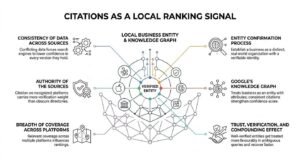
Citations as a Local Ranking Signal
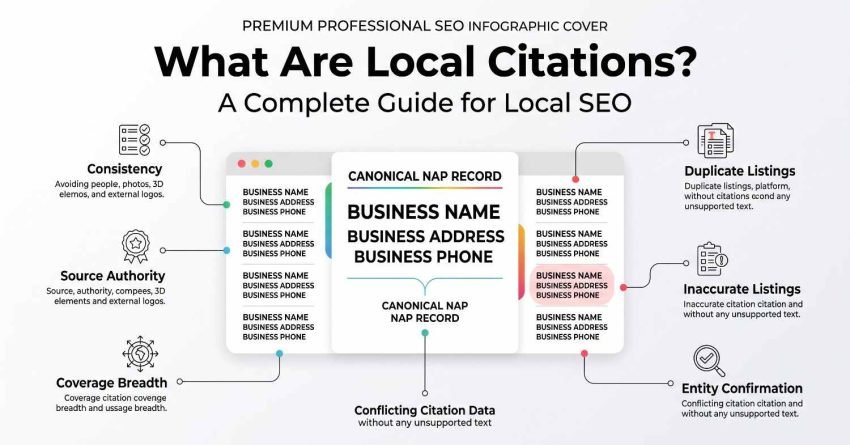
Citation signals influence rankings through three measurable dimensions: consistency of data across sources, authority of the sources carrying the citation, and breadth of coverage across relevant platforms. Google weighs these together rather than counting raw listings.
Consistency carries the most weight of the three. A business with thirty perfectly matched citations typically outperforms one with two hundred citations carrying three different phone numbers, because conflicting data forces search engines to lower confidence in every version they hold.
Authority matters second. A citation on Yelp, Apple Maps, or a recognised industry association carries more verification weight than one on a directory nobody visits, and nobody moderates.
Trust, Verification, and Entity Confirmation
Entity confirmation is the process search engines use to establish that a business is a distinct, real-world organisation with a verifiable identity. Citations feed this process directly by supplying independent third-party confirmation of the same facts.
Google’s Knowledge Graph treats your business as an entity with attributes attached to it. Every consistent citation strengthens the confidence score on those attributes, and every conflicting one weakens it.
This is why citation work compounds with everything else. A well-verified entity gets treated more favourably in ambiguous queries, gets richer knowledge panel treatment, and recovers faster from algorithm volatility.
How Search Engines Use Citation Data
Search engines process citation data through a sequence of crawling, extraction, matching, and reconciliation before any of it influences rankings. Understanding that sequence explains why citation fixes take weeks rather than days to show effect.
Here’s how the pipeline runs in practice:
- Crawlers discover a page containing business contact details
- Extraction identifies the name, address, phone, and any structured markup present
- Matching compares the extracted entity against known businesses in the index
- Reconciliation resolves conflicts between this source and existing records
- Confidence scoring updates based on how well the new data corroborates the old
- The updated record feeds into local ranking calculations
Crawling, Matching, and Reconciliation
Matching is the step where most citation problems originate. Search engines have to decide whether “Riverside Dental” at 42 Oak St and “Riverside Dental Care” at 42 Oak Street are the same entity or two businesses sharing an address.
They resolve this probabilistically, weighting exact matches heavily and treating near-matches with suspicion. Small variations that look trivial to a human a suite number omitted, a suffix abbreviated differently can push a listing below the matching threshold.
When matching fails, you get a duplicate entity rather than a strengthened one. That duplicate then competes with your primary listing, splitting review signals and diluting authority.
What Happens When Data Conflicts
Conflicting citation data triggers a confidence penalty rather than an outright rejection. Search engines keep both versions, assign lower confidence to the disputed attributes, and lean more heavily on sources they trust most, typically your own website and your verified Google Business Profile.
The practical effect is muted visibility. Your business still appears, and it appears less often for competitive queries where confidence thresholds are higher.
I’ve seen a single wrong phone number on a data aggregator propagate to sixty downstream directories over eight months. Fixing the aggregator source is the only durable remedy, because fixing the downstream listings individually just invites re-overwriting.
NAP Consistency and Why It Breaks
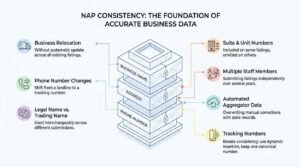
NAP consistency means your business name, address, and phone number appear in identical format across every citation source. Identical means character-for-character, including abbreviations, punctuation, suite designations, and phone formatting.
Most businesses assume they have consistency and don’t. I run audits expecting to find three or four variants and routinely find eleven.
The breakage rarely comes from carelessness. It comes from time, growth, and the number of hands that touch a business’s public data over a decade.
The Most Common Sources of Inconsistency
Six patterns account for the overwhelming majority of NAP inconsistency I encounter:
- Business relocation without a systematic update sweep across all existing listings
- Phone number changes, particularly the shift from a landline to a tracking number
- Legal name versus trading name used interchangeably across different submissions
- Suite and unit numbers included on some listings, omitted on others
- Multiple staff members submitting listings independently over several years
- Automated aggregator data overwriting manual corrections with stale records
Tracking numbers deserve specific attention. Call tracking is genuinely useful, and dropping a unique tracking number into citation listings breaks NAP consistency at scale. Use dynamic number insertion on your website instead and keep one canonical number in every citation.
The Main Types of Citation Sources
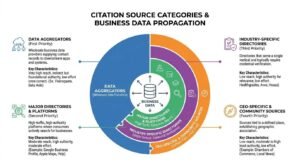
Citation sources fall into four functional categories, and each plays a different role in how your business data propagates. Building across all four produces better coverage than saturating any single one.
This table shows how the four categories compare on the factors that determine where you spend effort first:
| Source Type | Propagation Reach | Authority Weight | Effort to Maintain | Priority |
| Data aggregators | Very high | Indirect but foundational | Low, once correct | First |
| Major directories | Moderate | High | Moderate | Second |
| Industry-specific | Low | High for relevance | Low | Third |
| Geo-specific / community | Low | Moderate, high trust | Low | Fourth |
Data Aggregators
Data aggregators are wholesale business data providers that supply contact records to hundreds of downstream directories, apps, and navigation systems. Foursquare and Data Axle remain the primary aggregators serving the US market after Neustar Localeze, and Factual consolidated their operations.
Aggregators matter disproportionately because they operate upstream. A correction made at the aggregator level propagates outward automatically, while a correction made downstream gets overwritten on the aggregator’s next sync.
I always start here. Fixing forty directory listings while the aggregator still holds bad data is unpaid work you’ll repeat next quarter.
Major Directories and Platforms
Major directories are high-traffic, high-authority platforms where consumers actively search for businesses. Google Business Profile, Apple Maps, Bing Places, Yelp, Facebook, Yellow Pages, Better Business Bureau, and Nextdoor form the core set for most US businesses.
These listings carry dual value. They contribute citation signals, and they generate direct discovery traffic that never touches a search engine results page.
Claim and verify each one rather than leaving auto-generated listings unclaimed. An unclaimed listing accepts public edits, and public edits go wrong.
Industry-Specific Directories
Industry-specific directories serve a single vertical and typically require credential verification before listing. Healthgrades and Zocdoc for medical practices, Avvo and Justia for legal, Houzz and Angi for home services, TripAdvisor and OpenTable for hospitality.
Relevance is what makes these valuable. A citation from a directory that only lists licensed contractors carries a stronger topical association than a general directory that lists anyone.
Verification requirements work in your favour here. Barriers to entry mean fewer spam listings and higher trust from search engines.
Geo-Specific and Community Sources
Geo-specific citations come from sources tied to a defined place: chambers of commerce, local business improvement districts, city directories, regional news outlets, and community organisations. These sources establish geographic association in a way national directories cannot.
They’re also the hardest to acquire at scale, which is precisely why they carry weight. Chamber membership costs money, and local sponsorships require actual community involvement.
I treat these as a slow-burn asset. A handful of genuine local citations outperforms a hundred generic directory submissions for queries with strong geographic intent.
Google Business Profile and Its Role
Google Business Profile is a verified business listing that appears in Google Maps and the local pack, and it functions as the authoritative source Google trusts above all other citations. Every other citation is measured against it.
That authority creates a clear sequencing rule. Get your Google Business Profile complete, accurate, and verified before building anything else, because it becomes the reference point against which every subsequent citation is reconciled.
The profile also does work no citation can. Reviews, posts, Q&A, messaging, product listings, and performance insights all live there, and none of them exist on a standard directory listing. Treat it as the hub and treat citations as the supporting structure that confirms what it claims.
How to Audit Your Existing Citations
A citation audit is a systematic inventory of every existing online mention of your business contact details, scored for accuracy and completeness. Run one before building anything new, because building on top of inconsistency multiplies the problem.
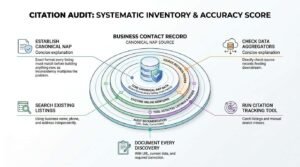
The audit follows five steps:
- Establish your canonical NAP, the exact format every listing must match
- Search for existing listings using your business name, phone number, and address independently
- Check the three data aggregators directly for the source records feeding downstream
- Run a citation tracking tool to catch listings and manual search misses
- Document every discovered listing with its URL, current data, and required correction
What a Citation Audit Should Uncover
A thorough audit surfaces five categories of problems: inaccurate listings carrying wrong data, duplicate listings competing with each other, unclaimed listings vulnerable to public editing, missing listings on relevant platforms, and abandoned listings from closed locations or prior business names.
Duplicates cause the most damage and get overlooked most often. A duplicate splits your review count, divides your engagement signals, and creates a competing entity that Google may prefer over your real one.
Document everything in a single spreadsheet with columns for platform, URL, current NAP, correct NAP, claim status, and action required. That spreadsheet becomes your working document for the cleanup and build phases.
How to Build New Citations
Building citations means submitting accurate, complete business information to relevant platforms in a deliberate order rather than blasting submissions everywhere at once. Order matters because upstream sources overwrite downstream ones.
Work in this sequence:
- Verify and complete Google Business Profile
- Submit to the primary data aggregators
- Claim and complete the major directories and platforms
- Add industry-specific directories relevant to your vertical
- Pursue geo-specific and community sources
- Capture unstructured mentions through local PR and partnerships
Complete every field each platform offers. A listing with hours, categories, photos, description, and attributes outperforms a bare NAP entry both in platform search and in the signal it sends.
Manual Submission vs. Automated Services
Manual submission gives you complete control over field-level accuracy and permanent ownership of every login. Automated citation services trade that control for speed, submitting to dozens or hundreds of platforms from a single data entry.
The trade-off is real, and it has a catch. Many automated services maintain listings only while you keep paying, and cancelling can revert or remove the listings they created.
I use automation for aggregator submission and high-volume general directories, and manual submission for anything where the listing carries ongoing value on major platforms, industry directories, and community sources.
Cleaning Up Duplicate and Inaccurate Listings
Duplicate listing cleanup is the process of merging, suppressing, or removing redundant business records so a single authoritative listing remains on each platform. Cleanup delivers faster ranking impact than new citation building for most established businesses.
The process differs by platform. Google supports duplicate reporting and merging through the profile interface, Yelp requires a support ticket, and aggregators generally need a correction submission followed by a propagation wait of four to twelve weeks.
Always fix upstream before downstream. Correcting sixty directory listings while an aggregator still holds the old record means watching those corrections silently revert over the following two quarters. Fix the aggregator, wait for propagation, then clean up whatever remains stale.
Citations for Multi-Location and Service-Area Businesses
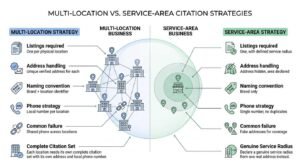
Multi-location and service-area businesses need fundamentally different citation strategies, because one has physical addresses to verify and the other does not. Applying single-location tactics to either produces predictable failures.
This table shows where the two models diverge:
| Factor | Multi-Location | Service-Area Business |
| Listings required | One per physical location | One, with defined service radius |
| Address handling | Unique verified address for each | Address hidden, area declared |
| Naming convention | Brand + location identifier | Brand only |
| Phone strategy | Local number per location | Single number, no duplicates |
| Common failure | Shared phone across locations | Fake addresses for coverage |
For multi-location businesses, each location needs its own complete citation set with its own address and local phone number. Sharing one central phone number across every listing merges the locations in matching algorithms and collapses them into one entity.
For service-area businesses, the temptation to create virtual addresses across a coverage region is the single most common cause of listing suspension. Declare a genuine service radius from one real address instead.
How Citations Interact With Reviews and Local Links
Citations, reviews, and local links form three distinct signal categories that reinforce one another rather than substituting for each other. Citations verify existence, reviews demonstrate legitimacy and quality, and local links transfer authority.
The interaction is compounding. A platform like Yelp delivers all three simultaneously: a structured citation, a review repository, and a link, which is why a small number of major platforms outperform a large number of thin directories.
Local link building overlaps with citation work more than most people expect. Chamber memberships, sponsorships, and community partnerships generate citations and links from the same activity, which makes them the highest-efficiency work in local SEO.
Measuring Citation Performance
Citation performance is measured through consistency rates, listing coverage, and downstream visibility metrics rather than through raw listing counts. Counting citations tells you almost nothing about whether they’re working.
Attribution is genuinely difficult here, and pretending otherwise misleads clients. Citations rarely produce a clean before-and-after traffic curve, because their effect surfaces as improved eligibility rather than a direct traffic spike.
Metrics That Actually Reflect Citation Health
Track these five metrics rather than listing volume:
| Metric | What It Measures | Healthy Target |
| NAP consistency rate | Listings matching canonical NAP | 95%+ |
| Coverage on priority platforms | Presence on your defined core set | 100% |
| Duplicate count | Competing records per platform | 0 |
| Local pack impressions | Google Business Profile visibility | Trending up |
| Discovery searches | Users finding you without your name | Trending up |
Discovery searches in Google Business Profile insights are the closest thing to a direct citation performance indicator. A rising share of discovery versus branded searches means Google is surfacing you for category queries, which is exactly what improved verification confidence produces.
How many citations do I actually need, and how long before they affect rankings?
How Many Citations You Need and How Long They Take
Most local businesses need between 30 and 80 accurate citations, and effects on rankings typically appear within four to twelve weeks of correction or creation. The range depends on market competitiveness and industry norms rather than on any universal number.
Competitive urban markets with mature local competition sit at the upper end. A dentist in Manhattan needs deeper coverage than a dentist in a town of eight thousand, because the competitive baseline is set by whoever already ranks.
Timeline variance comes almost entirely from propagation lag. Google Business Profile updates reflect within days, major directories within two to three weeks, and aggregator-driven changes across the long tail within one to three months.
Common Citation Mistakes That Hurt Local Visibility
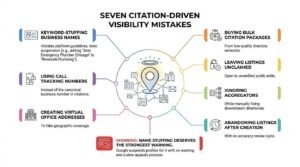
Seven mistakes account for most citation-driven visibility problems I encounter in audits:
- Keyword-stuffing the business name on listings, which violates platform guidelines and risks suspension
- Using call tracking numbers in citations instead of the canonical business number
- Creating virtual office addresses to fake geographic coverage
- Buying bulk citation packages from low-quality directory networks
- Leaving listings unclaimed and open to unverified public edits
- Ignoring aggregators while manually fixing downstream directories
- Abandoning listings after creation with no accuracy review cycle
Name stuffing deserves the strongest warning. Adding “Best Emergency Plumber Chicago” to a business name called “Riverside Plumbing” is a direct guideline violation, and Google suspends profiles for it with no warning and a slow appeals process.
Citation Costs, Tools, and In-House vs. Outsourced
Citation management costs range from roughly $200 for a one-time DIY cleanup to $2,000+ annually for fully managed multi-location programs. The variable is location count and how much cleanup the existing footprint requires.
Here’s how the three delivery models compare:
| Model | Typical Annual Cost | Time Required | Best For |
| Fully manual / in-house | $0–400 in tools | 20–40 hours initially | Single location, low competition |
| Automated platform | $300–1,000 per location | 3–5 hours setup | Multi-location, ongoing sync needs |
| Managed service | $1,000–3,000 per location | Minimal | Complex footprints, agency clients |
Tooling sits in the middle. BrightLocal, Whitespark, Moz Local, and Yext all handle audit and submission, and they differ meaningfully on whether listings persist after cancellation; check that clause before committing.
I recommend in-house for single-location businesses with time and patience, and managed service for anything above three locations, where the coordination overhead outpaces the cost difference.
Conclusion
Citations verify your business exists where you claim, and search engines weigh consistency, source authority, and coverage breadth far more heavily than raw listing volume.
The work sequences predictably: audit first, fix aggregators, claim major platforms, then build relevance through industry and community sources over time.
We help businesses build and maintain accurate local footprints that hold up under scrutiny. Talk to White Label SEO Service about auditing yours.
Frequently Asked Questions
Are local citations still relevant in 2025?
Yes, local citations remain relevant as a verification signal for local rankings. Their weight has shifted from volume to accuracy, so consistency matters far more than the number of listings you hold.
Do citations need to include a link to my website?
No, a citation counts without a link because the contact data itself supplies the verification signal. Links add authority value, and the mention alone still confirms your business details.
What is the difference between a citation and a backlink?
A citation is a mention of your business contact details, while a backlink is a hyperlink pointing to your site. Many citations include links, and the two serve different ranking purposes.
How do I find my existing citations?
Search Google for your business name, phone number, and address separately, then check the major data aggregators directly. Citation tracking tools catch listings that manual searching misses.
Can bad citations actively hurt my rankings?
Yes, inconsistent or duplicate citations lower search engine confidence in your business data. That reduced confidence suppresses visibility for competitive local queries rather than triggering a penalty.
Should I pay for a citation building service?
Paid services make sense for multi-location businesses or messy existing footprints. Single-location businesses with time available get equivalent results doing the work manually and keeping permanent listing ownership.
How often should I check my citations?
Review your citations quarterly, and immediately after any address, phone, or business name change. Aggregator syncs periodically overwrite manual corrections, so periodic verification prevents silent reversion.