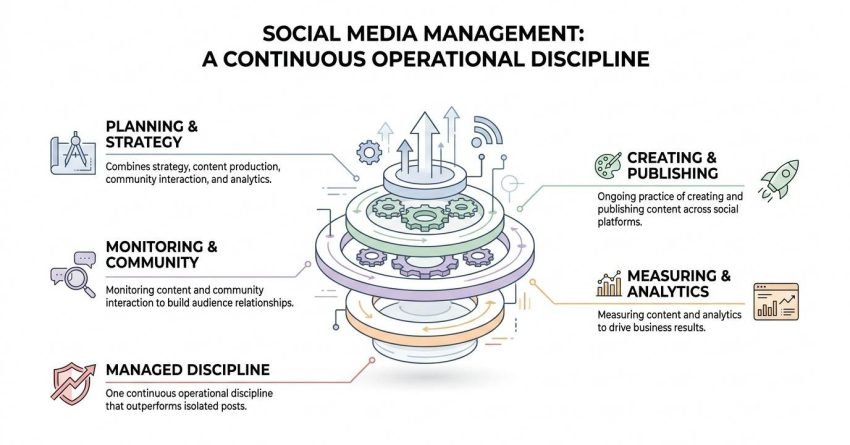
Social media management is the ongoing practice of planning, creating, publishing, monitoring, and measuring content across social platforms to build audience relationships and business results. It combines strategy, content production, community interaction, and analytics into one continuous operational discipline rather than a series of isolated posts.
I have watched businesses treat social media as an afterthought for years. The ones who structure it as a managed discipline consistently outperform the ones who post whenever inspiration strikes.
This guide covers what the role actually involves and why it matters commercially, the five components that make up the work, how to build a strategy and pick platforms, how content planning and community management run day to day, what metrics and tools produce results, and what it all costs in time, money, and realistic timelines.
What Social Media Management Actually Means
Social media management is a marketing function that owns the full lifecycle of a brand’s presence on social platforms, from strategy through publishing to performance reporting. The definition matters because most beginners collapse the whole discipline into “posting,” which is a single task inside a much larger system.
I break the work into two halves. One half is proactive: deciding what to say, producing it, and scheduling it. The other half is reactive: responding to comments, handling messages, and adjusting to what the data shows.
Both halves run continuously. That continuity is what separates a managed account from an abandoned one.
The Core Responsibilities Inside the Role
The day-to-day responsibilities cluster into a predictable set. A social media manager is a marketing specialist who owns content planning, publishing, audience engagement, and performance analysis for a brand’s social channels.
I see the same recurring duties across every business size. Strategy definition sits at the top, followed by content calendar ownership, asset production or coordination, scheduled publishing, inbox and comment monitoring, community moderation, and monthly reporting against agreed goals.
Smaller businesses compress all of this into one person. Larger teams split it across specialists, which I cover later in the workflows section.
What Social Media Management Is Not
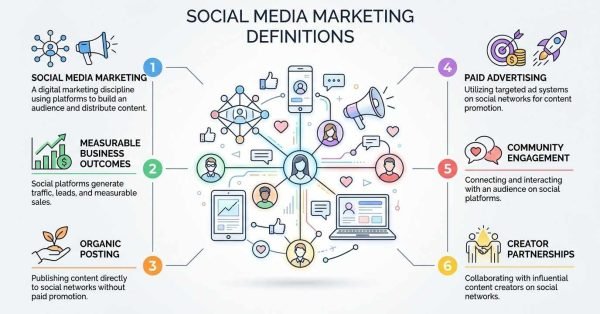
Social media management is not the same as social media marketing, advertising, or content creation alone. The distinction saves a lot of budget confusion.
Social media marketing is the broader commercial umbrella that includes paid campaigns, influencer partnerships, and social commerce. Management is the operational engine that keeps the owned channels running well.
I also separate it from public relations and from customer support, even though it borders both. The overlap is real, but the ownership lines need to be explicit or messages fall through the gaps.
Why Social Media Management Matters for Business Growth
Social media management matters because it converts scattered brand activity into a measurable acquisition and retention channel. Consistency, not volume, is what compounds.
DataReportal’s Digital 2024 report found that 5.04 billion people use social media worldwide, representing over 62% of the global population. That reach is why the channel earns a permanent line in most marketing budgets.
The commercial case rests on three functions: discovery, trust, and retention. Each one behaves differently, and I plan for them separately.
Visibility, Trust, and Buying Decisions
Social platforms now sit inside the buying journey rather than beside it. Sprout Social’s 2023 Index reported that 68% of consumers follow brands on social media specifically to stay informed about new products and services.
I treat that as a research behavior, not a vanity metric. When someone checks a brand’s profile before buying, an inactive or inconsistent account becomes a friction point.
Trust builds through evidence over time. Reviews, customer photos, behind-the-scenes content, and visible responsiveness do more for credibility than any single campaign.
Where Social Media Fits Alongside Search Visibility
Social media and search visibility solve related problems through different mechanisms. Search captures existing demand; social creates and warms it.
I run them as complements. Content produced for one channel usually feeds the other, and branded search volume tends to rise when social presence strengthens, which makes the two channels easier to justify together than separately.
The measurement frameworks differ, though. I never judge social performance using search metrics or the reverse.
The Core Components of Social Media Management
Social media management breaks into five components: strategy, content creation, publishing, community management, and measurement. Every functioning program contains all five, regardless of team size.
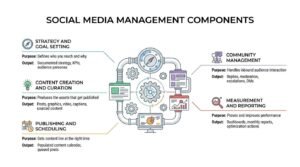
The table below shows what each component does and what it produces.
| Component | Purpose | Primary Output |
| Strategy and goal setting | Defines who you reach and why | Documented strategy, KPIs, audience personas |
| Content creation and curation | Produces the assets that get published | Posts, graphics, video, captions, sourced content |
| Publishing and scheduling | Gets content live at the right time | Populated content calendar, queued posts |
| Community management | Handles inbound audience interaction | Replies, moderation, escalations, DMs |
| Measurement and reporting | Proves and improves performance | Dashboards, monthly reports, optimization actions |
Most beginners over-invest in the middle three and under-invest in the first and last. That imbalance is the single most common reason accounts stay busy but flat.
Strategy and Goal Setting
Strategy defines the audience, the objectives, the platforms, and the content themes before any asset gets produced. Skipping it produces content nobody asked for.
I anchor strategy to a business outcome rather than a platform metric. Lead volume, booked calls, email signups, and repeat purchase rate all work; follower count on its own does not.
Content Creation and Curation
Content creation covers original assets, while curation covers sourcing and reframing third-party material. Both belong in a healthy mix.
I use curation to fill gaps without exhausting production capacity. User-generated content earns its place here too, since it carries social proof that branded assets cannot manufacture.
Publishing and Scheduling
Publishing turns finished assets into live posts on a planned cadence. Scheduling tools remove the need for someone to be present at every posting moment.
Cadence beats timing in my experience. A reliable three-posts-per-week rhythm outperforms a scattered daily burst that stops after a month.
Community Management
Community management is the practice of responding to comments, messages, and mentions to maintain relationships and protect brand reputation. It is the half of the job that cannot be scheduled in advance.
I set response-time targets and stick to them. Unanswered comments read as abandonment, and the audience notices faster than most owners expect.
Measurement and Reporting
Measurement connects activity to outcomes and tells you what to stop doing. Without it, optimization becomes guesswork dressed up as intuition.
I report monthly against the same metric set every time. Changing the metrics between reports hides trends and makes the whole exercise decorative.
How to Build a Social Media Strategy From Scratch
A social media strategy is built in six steps: define business goals, research the audience, select platforms, set content pillars, establish cadence and workflow, then define measurement. Working in that order prevents rework.
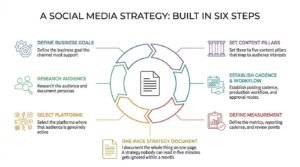
- Define the business goal the channel must support
- Research the audience and document personas
- Select the platforms where that audience is genuinely active
- Set three to five content pillars that map to audience interests
- Establish posting cadence, production workflow, and approval routes
- Define the metrics, reporting cadence, and review points
I document the whole thing on one page. A strategy nobody can read in five minutes gets ignored within a month.
Defining Business Goals Before Channels
Goals come before platforms, always. Choosing Instagram first and then reverse-engineering a reason is how budgets disappear.
I start with the commercial question: does this channel need to generate demand, capture demand, retain customers, or support recruitment? Each answer points to different platforms, formats, and metrics.
Then I attach a number and a date. “Grow awareness” is not a goal; “generate 40 qualified inbound enquiries per quarter” is.
Audience Research and Persona Development
Audience research is the process of gathering demographic, behavioral, and motivational data about the people a brand wants to reach. It determines platform choice, tone, format, and posting times simultaneously.
I pull from existing customer data first, then platform-native audience insights, then competitor comment sections. That last source is undervalued and free.
Personas stay short. Three to four documented segments with their questions, objections, and preferred formats is enough to direct a year of content.
Choosing the Right Social Media Platforms
Platform selection depends on where the target audience is active and what content format the business can sustainably produce. Being present everywhere is the fastest route to being weak everywhere.
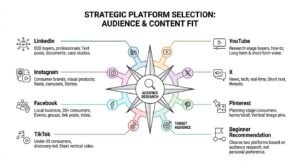
This table maps the major platforms to their typical audience and strongest content format.
| Platform | Primary Audience Fit | Strongest Content Format |
| B2B buyers, professionals, recruiters | Text posts, documents, case studies | |
| Consumer brands, visual products, lifestyle | Reels, carousels, Stories | |
| Local business, community groups, 35+ consumers | Events, groups, link posts, video | |
| TikTok | Under-35 consumers, discovery-led buying | Short vertical video |
| YouTube | Research-stage buyers, how-to demand | Long-form and short-form video |
| X | News, tech, real-time commentary | Short text, threads |
| Planning-stage consumers, home, food, retail | Vertical image pins |
I recommend two platforms for beginners. One primary, one secondary, both chosen based on audience research rather than personal preference.
Matching Platform to Audience and Objective
The match runs on three filters: audience presence, format capability, and commercial intent. A platform passing only one filter is a distraction.
I check format capability honestly. Committing to TikTok without a way to produce consistent video is a decision that fails in week three.
Intent matters as much as presence. LinkedIn audiences accept a direct commercial message that would be rejected outright on TikTok, which changes what “good content” means on each.
Content Planning and the Social Media Content Calendar
A social media content calendar is a scheduling document that maps what will be published, on which platform, and on what date across a defined period. It turns strategy into an executable plan.
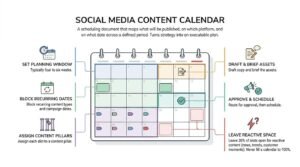
Building one follows a repeatable sequence:
- Set the planning window, typically four to six weeks
- Block recurring content types and campaign dates
- Assign each slot to a content pillar
- Draft copy and brief the assets
- Route for approval, then schedule
- Leave 20% of slots open for reactive content
I never fill a calendar to 100%. Reactive space is what lets a brand respond to news, trends, and customer moments without derailing the plan.
Content Pillars and Posting Mix
Content pillars are the three to five recurring themes a brand publishes against. They keep output coherent and stop the calendar drifting into randomness.
I use a simple mix as a starting point: educational content, social proof, brand personality, and offers. The ratio shifts by industry, but offers rarely exceed one in five posts without engagement dropping.
Creating Content That Performs on Social Media
High-performing social content shares four traits: it stops the scroll, delivers a single clear idea, matches the platform’s native format, and gives a reason to engage. Everything else is production polish.
- Hook within the first three seconds or first line. Attention is decided before the message arrives.
- One idea per post. Multi-point posts underperform focused ones consistently.
- Native format. Reposting a horizontal video to a vertical feed signals low effort.
- Clear next action. Comment, save, share, or click, chosen deliberately.
- Visual consistency. Recognizable brand treatment builds recall across the feed.
I test formats rather than debating them internally. Two weeks of data settles arguments that would otherwise run for months.
Formats, Hooks, and Repurposing
Repurposing is the practice of adapting one core asset into multiple platform-specific formats. It is the highest-leverage habit a small team can adopt.
I build from a single anchor piece each week. A long-form video becomes clips, a carousel, three text posts, and a newsletter section without any new research.
Hooks get written separately from the body. Writing them last, as an afterthought, is why strong content underperforms.
Community Management and Audience Engagement
Community management is the ongoing practice of responding to comments, direct messages, mentions, and reviews to sustain audience relationships. It is reactive work with a measurable effect on conversion.
I treat every inbound message as a sales or service touchpoint. The audience does not distinguish between a marketing channel and a support channel, so the brand should not either.
Proactive engagement counts too. Commenting on relevant industry posts and replying inside niche communities builds reach that publishing alone cannot.
Response Times and Escalation
Response time targets should be written down and monitored. Vague intentions produce inconsistent service.
I use a tiered structure: routine questions within four working hours, complaints within one hour, and anything involving safety, legal, or press escalated immediately to a named owner. Documented escalation paths prevent junior staff from improvising during a crisis.
Paid Social vs. Organic Social Media
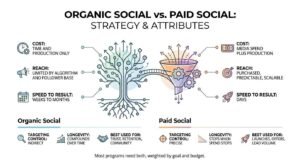
Organic social builds owned audience relationships at no media cost, while paid social buys guaranteed reach against defined targeting. Most programs need both, weighted by goal and budget.
| Attribute | Organic Social | Paid Social |
| Cost | Time and production only | Media spend plus production |
| Reach | Limited by algorithm and follower base | Purchased, predictable, scalable |
| Speed to result | Weeks to months | Days |
| Targeting control | Indirect | Precise |
| Longevity | Compounds over time | Stops when spend stops |
| Best used for | Trust, retention, community | Launches, offers, lead volume |
I use organic to build the asset and paid to amplify what already works. Promoting an underperforming post rarely fixes it; it just buys a wider audience for a weak idea.
Social Media Metrics and Analytics That Matter
The metrics that matter are the ones tied to the documented business goal, typically reach, engagement rate, click-through rate, conversion, and cost per result. Everything else is context.
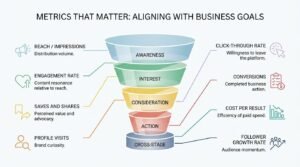
This table maps common metrics to what they actually measure and where they sit in the funnel.
| Metric | What It Measures | Funnel Stage |
| Reach / Impressions | Distribution volume | Awareness |
| Engagement rate | Content resonance relative to reach | Awareness / Interest |
| Saves and shares | Perceived value and advocacy | Interest |
| Profile visits | Brand curiosity | Consideration |
| Click-through rate | Willingness to leave the platform | Consideration |
| Conversions | Completed business action | Action |
| Cost per result | Efficiency of paid spend | Action |
| Follower growth rate | Audience momentum | Cross-stage |
I review weekly at the content level and monthly at the strategy level. Mixing those cadences produces overreaction to normal variance.
Vanity Metrics vs. Business Metrics
Vanity metrics are numbers that rise without affecting revenue, such as raw follower count and total impressions viewed in isolation. They are not useless, but they are not decision-grade.
I keep them in the report as context and out of the headline. When a stakeholder asks about followers, I show follower growth rate against conversion trend on the same slide.
Business metrics tie back to the goal set in the strategy. Enquiries, bookings, signups, and revenue attributed to social are the numbers that renew a budget.
Reporting Cadence and Stakeholder Reporting
Monthly reporting is the standard cadence for strategy-level decisions. Weekly reporting suits content optimization but not budget conversations.
I structure every report identically: goal, result against goal, what drove it, what changes next month. Four sections, one page, no exceptions.
Consistency is what makes trends visible. A report that reinvents its format each month hides exactly the patterns it should reveal.
The Social Media Management Tool Stack
The typical tool stack covers five categories: scheduling, design, analytics, listening, and asset storage. Small teams often consolidate several categories into one platform.
| Tool Category | Function | Typical Examples |
| Scheduling and publishing | Queue and auto-publish content | Buffer, Hootsuite, Later, Sprout Social |
| Design and video editing | Produce native-format assets | Canva, Adobe Express, CapCut |
| Analytics and reporting | Track performance, build reports | Native platform insights, Sprout, Metricool |
| Social listening | Monitor mentions, sentiment, competitors | Brandwatch, Mention, Talkwalker |
| Asset management | Store and organize approved files | Google Drive, Dropbox, DAM platforms |
I start beginners with one scheduling tool, one design tool, and native analytics. Adding listening and dedicated reporting makes sense once volume justifies the cost.
Tools do not create strategy. A well-run spreadsheet beats an expensive platform operated without a plan.
Social Media Management Workflows and Team Roles
A social media workflow moves content through five stages: ideation, production, approval, scheduling, and post-publish engagement. Defining ownership at each stage removes bottlenecks.
| Role | Core Responsibility |
| Social media manager | Owns strategy, calendar, and performance |
| Content creator/designer | Produces graphics, video, and photography |
| Copywriter | Writes captions, hooks, and campaign copy |
| Community manager | Handles comments, DMs, and moderation |
| Analyst | Builds reports and surfaces optimization insights |
| Approver/stakeholder | Signs off on brand, legal, and campaign content |
In a solo setup, one person holds every role. I still map them separately because the mapping shows exactly which task to outsource first when capacity runs out.
Approval is the stage that breaks most often. I set a fixed approval window and a default-approve rule after it lapses, which keeps calendars moving.
How Much Social Media Management Costs
Social media management typically costs between $500 and $5,000 per month in the US depending on scope, platform count, and content volume, with agency retainers and in-house salaries sitting at the higher end. Costs scale with production requirements far more than with posting frequency.
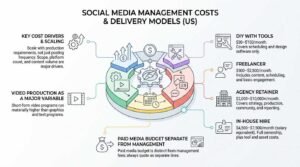
| Delivery Model | Typical US Monthly Cost | What It Usually Covers |
| DIY with tools | $30–$150 | Scheduling and design software only |
| Freelancer | $500–$2,500 | Content, scheduling, basic engagement |
| Agency retainer | $2,000–$10,000+ | Strategy, production, community, reporting |
| In-house hire | $4,500–$7,500 (salary equivalent) | Full ownership, plus tool and asset costs |
Video production is the biggest single cost variable. A program built on short-form video runs materially higher than one built on graphics and text.
Paid media budget sits separately from management fees. I always quote the two as distinct lines so nobody mistakes ad spend for service cost.
Should I manage social media in-house or hire help?
In-House, Freelancer, or Agency: Choosing a Model
The right model depends on budget, required output volume, and how much brand context the work demands. Each option trades cost against control and capacity.
| Model | Cost | Control | Best Fit |
| In-house | Highest fixed cost | Highest | High volume, deep product complexity |
| Freelancer | Low to moderate, variable | Moderate | Single platform, steady modest output |
| Agency | Moderate to high retainer | Shared | Multi-platform, strategy plus production needed |
| Hybrid | Moderate | High on strategy | In-house strategy, outsourced production |
I recommend the hybrid model most often. Keeping strategy and brand voice internal while outsourcing production and scheduling gives small teams agency-level output without the retainer.
Whichever model gets chosen, ownership must sit with a named person. Shared responsibility with no owner is how accounts go quiet.
Common Social Media Management Mistakes to Avoid
The most damaging mistakes are strategic, not tactical, and they repeat across every industry I work in.
- Posting without a documented goal. Activity without direction cannot be optimized or defended.
- Spreading across too many platforms. Two strong channels beat five neglected ones.
- Broadcasting instead of engaging. Ignored comments train an audience to stop responding.
- Chasing follower count. Growth without conversion is an expensive hobby.
- Inconsistent cadence. Algorithms and audiences both reward reliability.
- No reporting rhythm. Unmeasured programs get cut first in every budget review.
- Copying competitors directly. Their strategy was built for their audience and their goals.
I fix cadence before anything else. Consistency alone resolves a surprising share of underperformance without changing the content itself.
How Long Social Media Management Takes to Show Results
Social media management typically takes three to six months to produce reliable engagement gains and six to twelve months to produce consistent lead or revenue contribution, assuming steady posting and active community management.
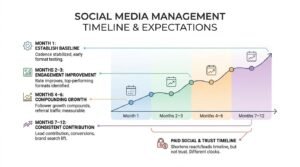
| Timeframe | Realistic Expectation |
| Month 1 | Baseline established, cadence stabilized, early format testing |
| Months 2–3 | Engagement rate improves, top-performing formats identified |
| Months 4–6 | Follower growth compounds, referral traffic becomes measurable |
| Months 7–12 | Consistent lead contribution, attributable conversions, brand search lift |
Paid social shortens the timeline for reach and leads but does not shorten the timeline for trust. The two run on different clocks.
I set these expectations before the first post goes live. Misaligned timelines end more social programs than poor content ever does.
Conclusion
Social media management combines strategy, content, community, and measurement into one continuous discipline that turns scattered posting into a predictable business channel.
Everything covered here connects to deeper decisions around platform choice, content production, paid amplification, and performance reporting worth exploring further.
We help brands build organic visibility that lasts. Talk to White Label SEO Service about integrating social and search into one growth system.
Frequently Asked Questions
What does a social media manager do?
A social media manager plans content, publishes posts, responds to the audience, and reports on performance. The role owns strategy and execution across a brand’s chosen platforms.
Do small businesses need social media management?
Yes, small businesses benefit most because social visibility is free to build. Even two well-managed platforms improve discovery, trust, and repeat custom without media spend.
How many times a week should a business post?
Three to five posts per week suits most businesses on a primary platform. Consistency matters far more than frequency, so pick a cadence you can sustain.
Is social media management the same as marketing?
No, management is the operational layer inside social media marketing. Marketing includes paid campaigns and partnerships; management runs the owned channels day-to-day.
Which platform should a beginner start with?
Start where your existing customers already spend time, usually LinkedIn for B2B and Instagram or Facebook for consumer brands. One primary platform beats five weak ones.
Can social media management be automated?
Scheduling and reporting automate well, but strategy and community management do not. Automated replies damage trust faster than delayed human responses do.
Does social media help SEO?
Social media does not directly influence rankings, but it drives referral traffic, content discovery, and branded search demand. Those signals support organic performance indirectly.