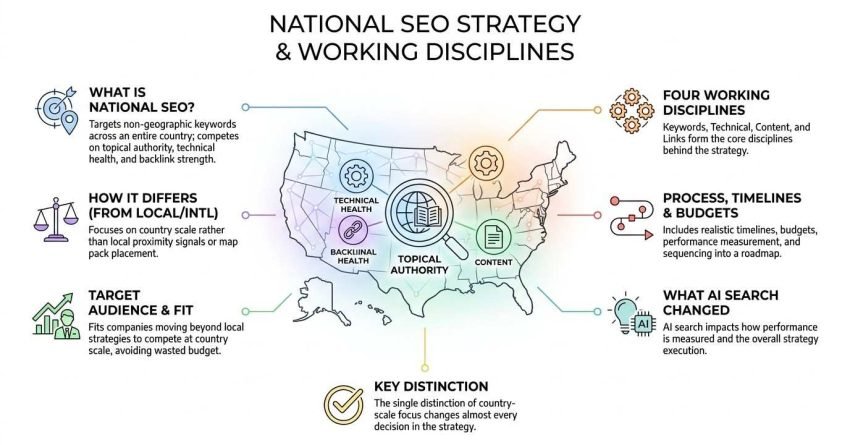
National SEO is a search optimization discipline that targets non-geographic keywords across an entire country, competing on topical authority, technical health, and backlink strength rather than local proximity signals or map pack placement. That single distinction changes almost every decision you make.
I see companies burn budget for a year because nobody explained that difference upfront. They optimize like a plumber in Denver and wonder why nothing moves nationally.
This guide covers what national SEO is and how it differs from local and international search, how search engines actually rank pages at country scale, who this strategy fits, the four working disciplines behind it keywords, technical, content, and links plus realistic timelines and budgets, how performance gets measured, what AI search has changed, and how to sequence the whole thing into a roadmap.
What Is National SEO?
National SEO targets keywords with country-wide search demand and no local intent attached. Think “project management software” instead of “project management software in Austin.” The prize is bigger, and so is the fight.
I describe it to clients as competing in an open field instead of a fenced yard. In local search, your physical address does a lot of the work for you. Nationally, nothing does the work for you except the strength of your site.
That means every ranking factor carries more weight. Your technical foundation, your content depth, your backlink profile all of it gets stress-tested against companies with real budgets.
How National SEO Differs From Local SEO
Local SEO wins on proximity, Google Business Profile signals, citations, and reviews. National SEO wins on none of those.
I strip proximity out of the equation entirely when I plan a national campaign. There is no map pack to chase and no service-area radius to define, so the ranking battle shifts to content quality and domain authority.
The keyword sets look different too. Local terms carry modifiers like “near me” or a city name, while national terms are bare and broad, which pulls in national competitors on every single query.
| Factor | Local SEO | National SEO |
| Primary ranking lever | Proximity + GBP | Authority + content depth |
| Keyword modifiers | City, “near me” | None, or category descriptors |
| Typical competition | Local businesses | National brands, publishers |
| Map pack eligibility | Yes | No |
| Typical time to traction | 3–6 months | 6–12 months |
How National SEO Differs From International SEO
International SEO adds language targeting, hreflang implementation, and country-specific domains or subfolders. National SEO stays inside one country and one language, so the technical overhead drops considerably.
I treat that simplicity as an advantage. You are solving one market’s intent instead of reconciling six, and your content calendar stays focused.
The trade-off is concentration. All of your competitive pressure lands in a single SERP rather than spreading across markets.
How National SEO Actually Works
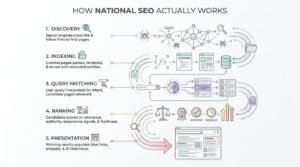
National SEO works by making a site the most authoritative, technically accessible, and semantically complete answer for a country-wide query set. Search engines then rank it above competing sites for those queries.
The mechanics come down to five stages, and every campaign runs through all of them in order.
This is the sequence I follow on every national engagement:
- Discovery: Search engines crawl your site and follow internal and external links to find pages.
- Indexing: Crawled pages get parsed, rendered, and stored with their extracted entities and topics.
- Query matching: A user query gets interpreted for intent, and candidate pages are retrieved from the index.
- Ranking: Candidates are scored on relevance, authority, experience signals, and freshness.
- Presentation: The winning results populate blue links, snippets, and AI Overviews.
Nothing in that list is optional. A page that never gets crawled cannot rank, and a page that ranks for the wrong intent converts nobody.
Crawling, Indexing, and Ranking at National Scale
Crawl budget becomes a real constraint on national sites. A 40-page local site gets fully crawled constantly, while a 4,000-page national site does not.
I audit crawl efficiency on any site above roughly 10,000 URLs. Wasted crawl on faceted parameters, thin tag archives, and duplicate paginated sets starves the pages that actually earn revenue.
Indexing is where most large sites leak value. Google’s own documentation confirms that Google does not index every page it crawls, and low-value pages routinely get discovered and then discarded.
Why Nationwide Queries Behave Differently
Nationwide queries return results without geographic personalization, so every user in the country sees a near-identical SERP. That makes your ranking position uniform and your traffic ceiling much higher.
It also makes movement slower. You are not gaining ground against twelve local competitors; you are gaining ground against the entire national field for that term.
I set expectations around that early. The first three months usually produce indexation and impression growth, not rankings.
Who National SEO Is Right For
National SEO fits businesses that sell or deliver across an entire country without depending on physical proximity to the customer. Fit matters more than budget here.
I qualify prospects against four conditions before recommending a national strategy:
- You serve customers anywhere in the country: SaaS, ecommerce, D2C, remote services, media, and B2B all qualify.
- Your buyers search without a location modifier: If the keyword research shows bare category terms carrying the volume, national is the right lane.
- Your margins support a 6–12 month runway: National returns arrive late and compound, so short cash cycles struggle.
- You can produce content consistently: Topical authority requires publishing volume that a single part-time writer cannot sustain.
Business Models That Benefit Most
SaaS and ecommerce see the strongest national returns because their delivery model has no geographic ceiling. Every ranking gain converts into addressable demand.
Publishers and affiliate sites follow closely. Their entire revenue model depends on national organic reach, and they have no local fallback channel.
B2B service companies sit in the middle. They benefit nationally on educational and comparison terms while often running a parallel local play on branded and city-level searches.
When National SEO Is the Wrong Fit
Single-location service businesses waste money on national campaigns. A dental practice in Phoenix gains nothing from ranking nationally for “teeth whitening” because it cannot serve those clicks.
I also steer very new domains away from head terms. A site with no backlink profile chasing a 40,000-volume keyword will spend twelve months and rank on page four.
Businesses with under three months of runway are the third exclusion. National SEO rewards patience and punishes campaigns that get cancelled at month five.
Keyword Research for National Search Campaigns
National keyword research maps an entire category’s search demand, then splits it into head, mid-tail, and long-tail tiers so a site can win the winnable terms first while building toward the competitive ones.
The mistake I see constantly is a keyword list built entirely from head terms. That list looks impressive and produces nothing for a year.
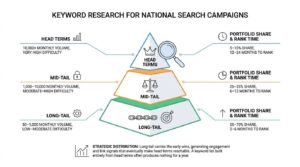
The table below shows how I distribute a national keyword portfolio at the start of a campaign.
| Tier | Monthly volume | Difficulty | Share of portfolio | Time to rank |
| Head terms | 10,000+ | Very high | 5–10% | 12–24 months |
| Mid-tail | 1,000–10,000 | Moderate–high | 25–35% | 6–12 months |
| Long-tail | 50–1,000 | Low–moderate | 55–70% | 2–6 months |
Long-tail carries the early wins. Those rankings generate the engagement and link signals that eventually make head terms reachable.
Head Terms, Mid-Tail, and Long-Tail Distribution
Head terms anchor the strategy but rarely start it. I map them to pillar pages, then build the supporting cluster underneath before expecting movement.
Mid-tail terms do the heaviest commercial lifting. They carry enough volume to matter and enough specificity to convert, and they are usually where national campaigns first turn profitable.
Long-tail terms are the proving ground. They validate that your technical setup and content quality actually work before you spend money fighting for expensive terms.
Search Intent Mapping Across the Funnel
Every keyword gets tagged by intent before it gets assigned to a page. Informational, commercial investigation, transactional, and navigational each demand a different content format.
I have watched teams target “best CRM software” with a product page and lose to comparison articles every time. The SERP tells you the required format, and arguing with it costs you the ranking.
Intent mapping also prevents cannibalization. Two pages chasing the same intent split their signals, and neither one wins.
Technical SEO Foundations for National Visibility
Technical SEO is the infrastructure layer that determines whether search engines can efficiently crawl, render, index, and understand a site at scale. On national sites, it is a prerequisite, not an optimization.
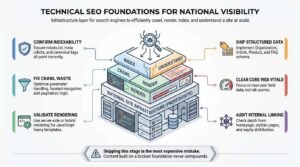
I run this checklist before any content or link work begins:
- Confirm indexability: robots.txt, meta robots, and canonical tags all pointing the right direction.
- Fix crawl waste: parameter handling, faceted navigation controls, and pagination logic.
- Validate rendering: server-side or hybrid rendering for JavaScript-heavy templates.
- Ship structured data: Organization, Article, Product, and FAQ schema where applicable.
- Clear Core Web Vitals: real-user field data, not lab scores.
- Audit internal linking: depth from homepage, orphan pages, and equity distribution.
Skipping this stage is the most expensive mistake in national SEO. Content built on a broken foundation never compounds.
Site Architecture and Crawl Efficiency
Site architecture determines how link equity flows and how quickly new pages get discovered. Flat is better than deep on national sites.
I target three clicks or fewer from the homepage to any revenue page. Every additional click layer measurably reduces crawl frequency and internal authority.
Category and hub pages do the structural work. They collect related content, pass equity downward, and give search engines an explicit map of your topical coverage.
Core Web Vitals and Page Experience
Core Web Vitals measure loading, interactivity, and visual stability using real Chrome user data. Google confirms these metrics are part of its page experience signals.
I treat them as a tiebreaker rather than a primary lever. They rarely lift a weak page, but they routinely cost a strong one its position against an equally strong competitor.
Mobile performance carries the weight. Mobile-first indexing means the mobile render is the version that gets evaluated.
Content Strategy and Topical Authority
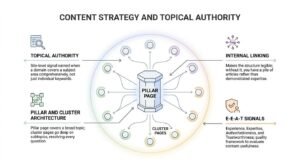
Topical authority is a site-level signal earned when a domain covers a subject area comprehensively enough that search engines treat it as a reliable source across the entire topic, not just individual keywords.
Single articles do not build authority. Coverage does.
I plan national content as clusters from day one. A pillar page establishes the topic, and eight to twenty supporting pages resolve every question that pillar raises.
Pillar and Cluster Architecture
A pillar page covers a broad topic at orientation depth and links to cluster pages that go deep on each subtopic. The clusters link back, and the whole structure signals coverage.
I size clusters by competitive pressure. A low-competition topic survives on six supporting pages, while a head term in a crowded category needs twenty or more.
Internal linking makes the structure legible. Without it, you have a pile of articles rather than a demonstrated area of expertise.
E-E-A-T Signals at National Scale
E-E-A-T stands for Experience, Expertise, Authoritativeness, and Trustworthiness, and it is the quality framework Google’s search quality rater guidelines use to evaluate content usefulness.
Nationally, these signals get harder to fake. Author bios need real credentials, claims need real citations, and the organization behind the site needs a verifiable footprint.
I push clients to publish original data. Proprietary research earns links and demonstrates first-hand experience in a way that aggregated content never does.
On-Page Optimization for Competitive National Terms
On-page optimization aligns a single page’s content, structure, and semantics with the intent behind its target query. On competitive national terms, the margins are thin enough that these details decide positions.
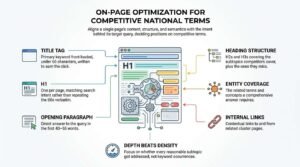
Here is what I optimize on every page targeting a national term:
- Title tag: primary keyword front-loaded, under 60 characters, written to earn the click.
- H1: one per page, matching search intent rather than repeating the title verbatim.
- Opening paragraph: direct answer to the query in the first 40–55 words.
- Heading structure: H2s and H3s covering the subtopics competitors cover, plus the ones they miss.
- Entity coverage: the related terms and concepts a comprehensive answer requires.
- Internal links: contextual links to and from related cluster pages.
Depth beats density. I stopped counting keyword occurrences years ago and started counting whether every reasonable subtopic got addressed.
Link Building and Digital PR for National Authority
Link building for national SEO earns editorial backlinks from relevant, authoritative domains to raise a site’s competitive standing on high-difficulty terms. It remains the hardest-to-replicate ranking input.
I allocate roughly 30% of a national budget here. Content alone stalls against established competitors, and the gap almost always traces to link authority.
Digital PR is the most reliable engine. Original research, data studies, and expert commentary earn coverage that manual outreach cannot match at scale.
What National-Grade Links Look Like
National-grade links come from domains with genuine topical relevance and independent editorial standards. Volume is irrelevant if the sources have no authority in your subject area.
I qualify prospects on three things: topical alignment, organic traffic to the linking page, and whether a real editor made the placement decision. Anything failing all three gets dropped.
One link from a respected trade publication outperforms fifty directory listings. The scoring is not linear.
Anchor Text and Link Velocity Discipline
Anchor text distribution should look organic, weighted toward branded and naked-URL anchors with a minority of exact-match terms. Over-optimized profiles invite manual review.
I keep exact-match anchors under 10% of the total profile. That ratio has held up across every national campaign I have run.
Velocity matters equally. A domain that acquires four links a month for two years looks entirely different from one that acquires ninety-six in a single week.
National SEO Timelines: What to Expect Month by Month
National SEO typically produces first meaningful ranking movement in months three to six, initial revenue impact in months six to nine, and compounding returns from month nine onward. An Ahrefs study of two million keywords found only 5.7% of pages reach the top 10 within their first year.
That statistic reframes the conversation. Slow is normal, and campaigns cancelled at month four were never given a fair test.
The table below shows what a typical national campaign produces at each stage.
| Phase | Months | What happens | What you see |
| Foundation | 0–3 | Technical fixes, keyword mapping, content production begins | Indexation and impression growth |
| Early traction | 3–6 | Long-tail rankings, first links landing | Rankings on low-difficulty terms, early clicks |
| Acceleration | 6–9 | Mid-tail movement, cluster authority forming | Measurable traffic and first conversions |
| Compounding | 9–18 | Head terms become reachable, authority compounds | Sustained traffic and revenue growth |
Timeline Table by Site Maturity
Site maturity shifts every date in that table. An established domain with existing authority moves roughly twice as fast as a new one.
I adjust expectations by three variables: domain age, existing backlink profile, and content inventory. A five-year-old site with 400 referring domains sees traction in month two, not month six.
New domains carry a discovery lag on top of everything else. Search engines need time to establish trust before they will rank a site for commercially valuable terms.
What National SEO Costs and How Budgets Are Allocated
National SEO in the US typically costs between $3,000 and $15,000 per month depending on category competitiveness, site size, and content volume, with most mid-market campaigns landing around $5,000 to $8,000.
That range is wide because the inputs vary enormously. A 200-page SaaS site in a niche category costs a fraction of a 50,000-SKU ecommerce site in a crowded vertical.
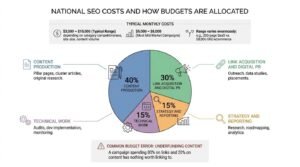
I allocate a typical national budget across four buckets:
| Allocation | Share | What it funds |
| Content production | 40% | Pillar pages, cluster articles, original research |
| Link acquisition and digital PR | 30% | Outreach, data studies, placements |
| Technical work | 15% | Audits, dev implementation, monitoring |
| Strategy and reporting | 15% | Research, roadmapping, analytics |
Underfunding content is the most common budget error. A campaign spending 80% on links and 20% on content has nothing worth linking to.
Measuring National SEO Performance
National SEO performance is measured through a layered set of metrics that track crawl and index health first, ranking and traffic movement second, and revenue attribution last. Reading them out of order produces false conclusions.
I report on all three layers monthly. Clients who only see revenue metrics in month three assume the campaign failed, when the leading indicators were already trending correctly.
Leading vs. Lagging Indicators
Leading indicators move first and predict future performance. Lagging indicators confirm what already happened.
| Type | Metric | Typical lag |
| Leading | Indexed pages, impressions, average position | 0–2 months |
| Leading | Referring domains acquired | 1–3 months |
| Lagging | Organic clicks and sessions | 3–6 months |
| Lagging | Conversions and pipeline | 6–12 months |
Impressions rising while clicks stay flat is the healthiest early signal in national SEO. It means you are entering the consideration set before you win the click.
Attribution and Revenue Reporting
Attribution ties organic sessions to actual revenue using goal tracking, CRM integration, and assisted-conversion reporting. Last-click models systematically undervalue organic search.
I set up GA4 conversion events and CRM source tracking before month one ends. Retroactive attribution never recovers the data you failed to capture.
Assisted conversions matter most for B2B. Organic frequently opens the relationship and gets no credit for the close six months later.
How AI Search and AI Overviews Change National SEO
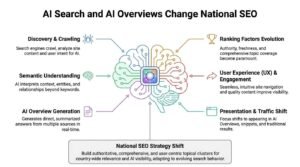
AI Overviews are generative summaries that appear above traditional results and cite source pages inline, which shifts national SEO toward earning citations rather than only earning clicks.
The change is real, but it is not the end of organic search. Citation-worthy content still needs to rank in order to be pulled into the summary.
I optimize for extraction in three ways:
- Answer-first structure: the direct answer sits in the first sentence under each heading, not the third paragraph.
- Self-contained sentences: every key claim names its own subject so it survives being quoted alone.
- In-sentence attribution: statistics carry their source in the same sentence as the number.
Head-term informational queries lose the most clicks. Commercial and comparison queries, where users want to evaluate options themselves, hold up considerably better.
Common National SEO Mistakes That Stall Growth
Most stalled national campaigns fail on execution discipline rather than strategy. The same handful of errors show up in nearly every audit I run.
- Chasing head terms too early: targeting a 30,000-volume keyword on a domain with 12 referring domains.
- Publishing thin content at volume: 200 pages of 600-word articles that cover nothing completely.
- Ignoring technical debt: building content on a site that leaks crawl budget on faceted URLs.
- Keyword cannibalization: multiple pages targeting the same intent and splitting their signals.
- Cancelling at month five: pulling budget exactly when leading indicators start converting to lagging ones.
- Measuring the wrong thing: reporting rankings on vanity terms while conversions stay flat.
Number five costs the most money. Every month of investment gets written off right before the compounding phase begins.
Should you run national SEO in-house, hire an agency, or white label it?
In-House vs. Agency vs. White Label Delivery Models
The delivery model determines your cost structure, speed to execution, and how much specialist expertise you can access. Each of the three fits a different situation.
| Model | Best for | Typical cost | Speed to start |
| In-house | Brands with sustained volume and existing marketing headcount | $180k–$400k/yr fully loaded | 3–6 months to hire |
| Agency | Companies wanting expertise without hiring risk | $3k–$15k/mo | 2–4 weeks |
| White label | Agencies delivering SEO under their own brand | $1.5k–$8k/mo | 1–2 weeks |
I recommend in-house only when the content volume justifies at least three full-time roles. Below that, the specialization gap costs more than the salary savings.
White label suits agencies that own the client relationship but lack the delivery bench. The work ships under your brand while the technical execution sits with a specialist team.
Building Your First 12-Month National SEO Roadmap
A national SEO roadmap sequences technical remediation, content production, and link acquisition across twelve months so each phase supports the next rather than competing for the same resources.
Sequence is everything. Publishing before the technical foundation is fixed wastes the content, and building links to pages that do not convert wastes the links.
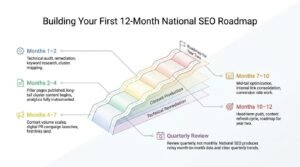
Here is the sequence I use:
- Months 1–2: Technical audit, remediation, keyword research, cluster mapping.
- Months 2–4: Pillar pages published, long-tail cluster content begins, analytics fully instrumented.
- Months 4–7: Content volume scales, digital PR campaign launches, first links land.
- Months 7–10: Mid-tail optimization, internal link consolidation, conversion rate work.
- Months 10–12: Head-term push, content refresh cycle, roadmap for year two.
Review quarterly, not monthly. National SEO produces noisy month-to-month data and clear quarterly trends.
Conclusion
National SEO combines technical health, topical authority, keyword strategy, and link acquisition into one compounding system that ranks a site across an entire country.
Every discipline covered here connects to deeper resources, and the sequence matters more than the individual tactics you choose to prioritize first.
We build and deliver national SEO programs that compound. Talk to White Label SEO Service about your roadmap.
Frequently Asked Questions
How long does national SEO take to work?
National SEO typically shows first ranking movement in three to six months and meaningful revenue impact in six to twelve. New domains sit at the slower end of that range.
Is national SEO harder than local SEO?
Yes, national SEO is significantly harder because it removes proximity advantages and puts you against every competitor in the country. Local campaigns rank faster with smaller budgets.
How much does national SEO cost per month?
National SEO in the US typically costs $3,000 to $15,000 per month. Most mid-market campaigns land between $5,000 and $8,000 depending on competitiveness.
Can a small business compete nationally in search?
Yes, small businesses compete nationally by targeting long-tail and mid-tail terms first rather than head keywords. Narrow topical focus beats broad coverage on limited budgets.
How many keywords should a national SEO campaign target?
Most national campaigns track 300 to 2,000 keywords, weighted heavily toward long-tail terms. Head terms make up under 10% of a healthy portfolio.
Do backlinks still matter for national rankings?
Yes, backlinks remain one of the strongest ranking inputs for competitive national terms. Content alone rarely outranks established competitors without authority support.
Does AI search reduce national SEO traffic?
AI Overviews reduce clicks on informational head terms but have far less impact on commercial and comparison queries. Citation-worthy content still needs to rank.