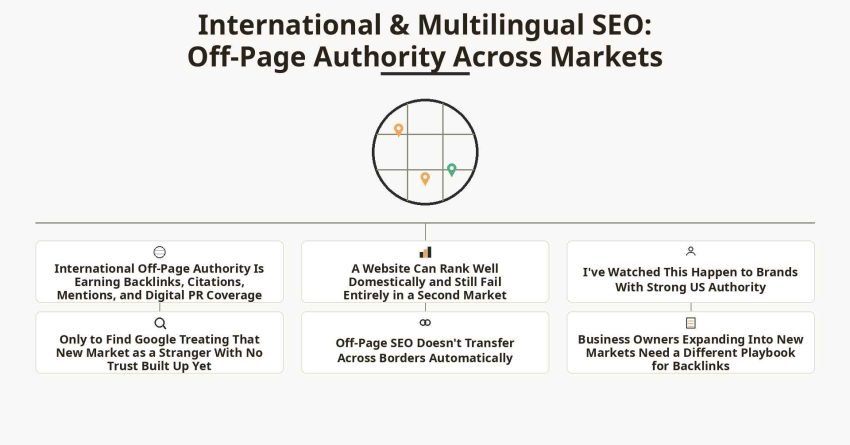
International SEO off-page authority is the practice of earning backlinks, citations, mentions, and digital PR coverage that signal credibility to search engines in each country or language market a business targets. A website can rank well domestically and still fail entirely in a second market if its off-page signals never extend beyond its home country’s link graph. I’ve watched this happen to brands with strong US authority that launched a UK or German site expecting the same rankings, only to find Google treating that new market as a stranger with no trust built up yet.
Off-page SEO doesn’t transfer across borders automatically, and ranking factors shift by region, language, and local competition. Business owners expanding into new markets need a different playbook for backlinks.
This guide covers how off-page authority works differently across countries, the structural choices that shape how link equity flows between markets, where to find authoritative local link sources, and how digital PR, citations, and multilingual content fit into a scalable international strategy. I’ll walk through measurement and timelines too, so expectations stay realistic market by market.
What International SEO Off-Page Authority Means
International off-page SEO authority is the set of trust signals, backlinks, brand mentions, citations, and digital PR coverage, that search engines use to judge a website’s credibility within a specific country or language market. These signals work alongside on-page and technical elements like hreflang tags, but they answer a different question entirely.
Technical setup tells Google which page serves which audience. Off-page authority tells Google whether that page, and the domain behind it, deserves to rank once it’s shown to that audience. A perfectly implemented hreflang structure with zero local backlinks still struggles to rank, because the domain hasn’t earned trust in that specific market yet.
I treat these as two separate workstreams that have to move together. Technical international SEO gets a site seen. Off-page authority gets it believed.
How Off-Page Signals Differ From Technical hreflang Setup
Hreflang annotations tell search engines which URL to serve for which language-country pairing, and they carry zero authority weight on their own. Off-page signals like local backlinks and brand mentions are what convince a search engine that the content deserves visibility once it’s correctly targeted.
A site can have flawless hreflang implementation and still rank poorly in a new market if no local off-page authority exists to support it.
Why Domestic Backlink Profiles Don’t Translate Across Borders
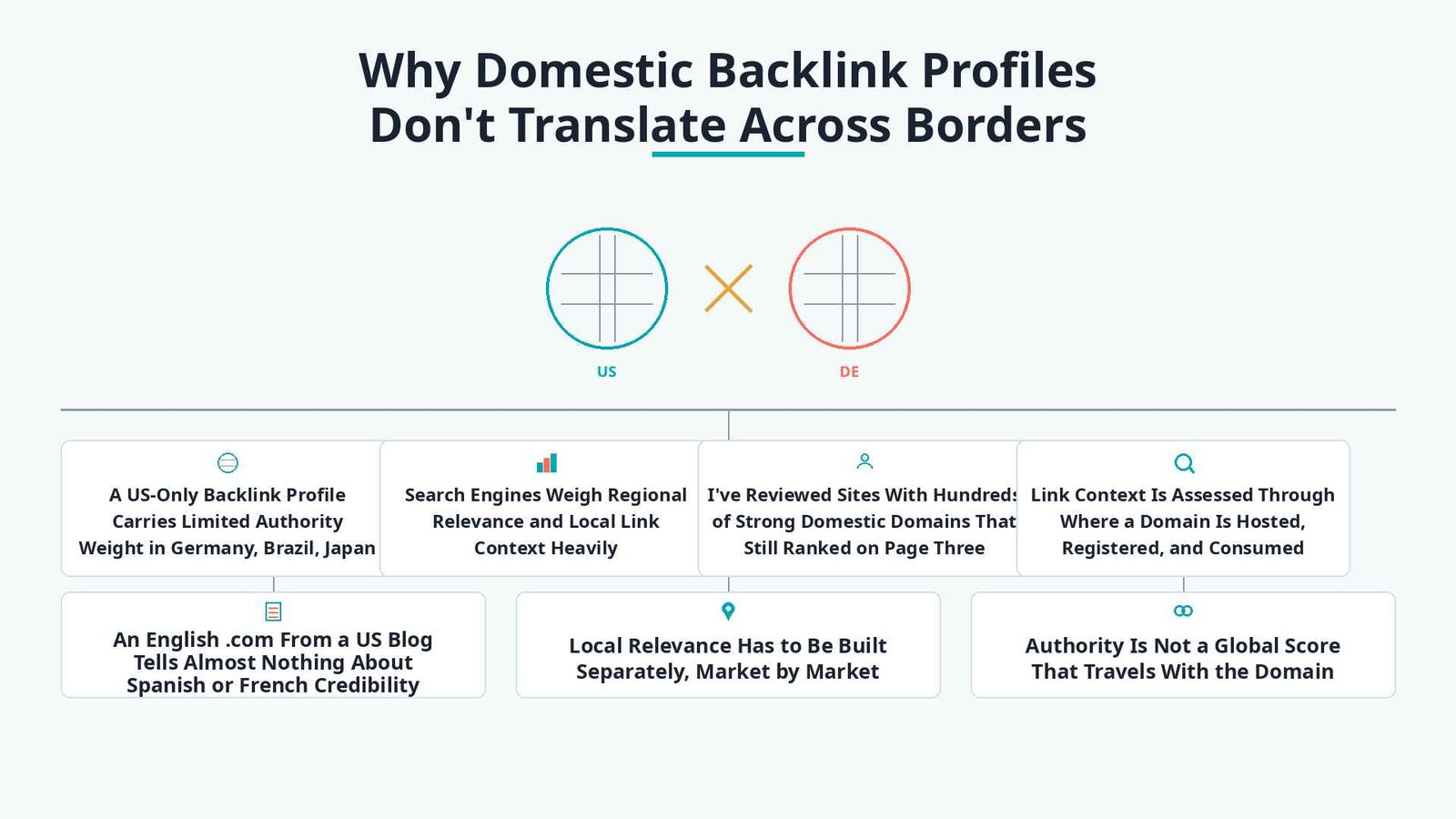
A backlink profile built entirely from US-based domains carries limited authority weight in markets like Germany, Brazil, or Japan, because search engines weigh regional relevance and local link context heavily in non-domestic markets. I’ve reviewed sites with hundreds of strong domestic referring domains that still ranked on page three in a new country, simply because none of those links came from sources the local search engine considered relevant.
Search engines assess link context partly through where a linking domain is hosted, registered, and primarily consumed. A .com domain written in English, linking from a US business blog, tells a search engine almost nothing useful about credibility in the Spanish or French market. Local relevance has to be built separately, market by market.
This is the single biggest misconception I run into with brands expanding internationally for the first time. They assume authority is a global score that travels with the domain. It isn’t. It’s assessed contextually, market by market, and sometimes even language by language within the same country.
Search Engine Market Share by Country
Google holds the dominant share of search traffic across most Western markets, but StatCounter’s global search engine data shows meaningful variation elsewhere. Baidu leads in China, Yandex holds significant share in Russia, and Naver remains dominant in South Korea. Off-page strategy has to account for which engine actually matters in the target market, since ranking factors and link evaluation differ meaningfully between them.
Country-Level vs. Language-Level Authority Building
Country-level authority and language-level authority are two distinct dimensions of international off-page SEO, and treating them as the same thing causes businesses to under-invest in one or the other. Country-level authority reflects trust within a specific geographic market: Mexico, Canada, Australia. Language-level authority reflects trust within a language community that often spans multiple countries, like Spanish across Spain and Latin America.
I separate these because the backlink sources differ. A Mexican business directory builds country-level authority for the Mexican market specifically. A Spanish-language industry publication read across Spain, Mexico, and Argentina builds language-level authority that can support multiple country targets simultaneously, but with less geographic precision for any single one.
The structural decision, ccTLD, subdirectory, or subdomain, determines how much these two authority types can share equity between each other.
| Structure | Authority Sharing | Best Fit |
| ccTLD (example.de) | None — treated as a fully separate domain | Large budget, long-term country-specific investment |
| Subdirectory (example.com/de/) | Full — inherits root domain authority | Most SMEs and growing international sites |
| Subdomain (de.example.com) | Partial — search engines treat it as semi-independent | Mid-size operations with dedicated regional teams |
ccTLDs, Subdirectories, and Subdomains and Their Authority Impact
A ccTLD like example.de builds authority entirely independently of the main domain, which means every country launched this way starts from zero in that market’s eyes. Subdirectories inherit the root domain’s existing authority, giving new markets a running start that ccTLDs don’t offer.
I recommend subdirectories for most businesses still building their international footprint, specifically because off-page work done on the main domain lifts every subdirectory underneath it. That shared equity matters enormously when a company doesn’t yet have the resources for a full local link-building campaign in six different countries at once.
Finding Authoritative Link Sources in New Markets
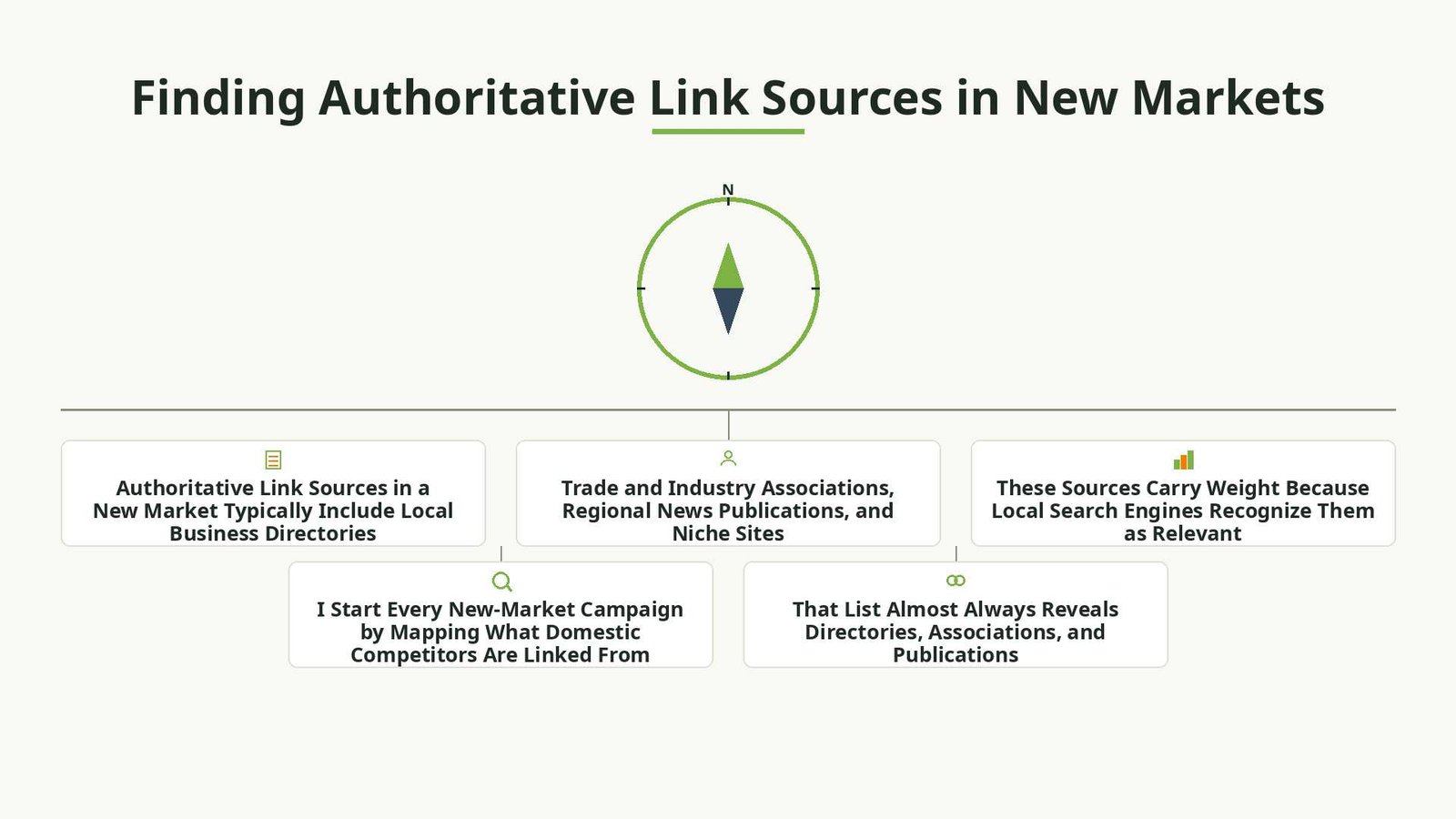
Authoritative link sources in a new market typically include local business directories, trade and industry associations, regional news publications, and niche sites that an in-country audience already trusts and reads regularly. These sources carry weight precisely because local search engines recognize them as relevant to that specific market’s search behavior.
I start every new-market link campaign by mapping what the domestic competitors in that country are already linked from. That list almost always reveals directories, associations, and publications that wouldn’t show up in a US-based link prospecting tool at all.
Local Directories, Associations, and Publications
Local business directories, chamber of commerce listings, and trade association sites provide foundational local relevance that search engines use to confirm a business operates credibly within a specific market. Industry-specific regional publications add topical and geographic authority simultaneously, which makes them disproportionately valuable compared to generic directory listings.
Digital PR for Multilingual and Multi-Market Campaigns
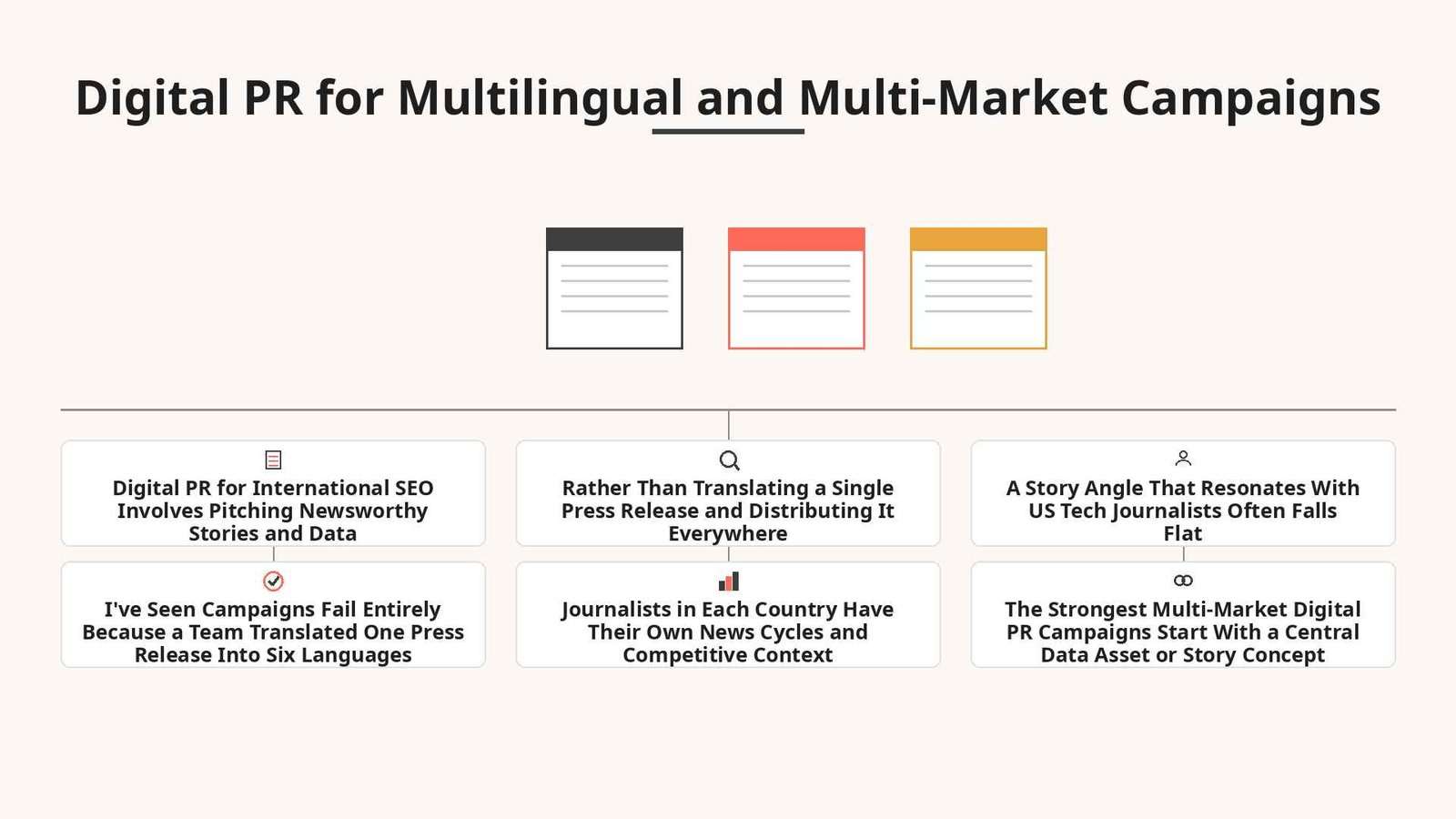
Digital PR for international SEO involves pitching newsworthy stories, data, and expert commentary to journalists and publications within each target market, rather than translating a single press release and distributing it everywhere. A story angle that resonates with US tech journalists often falls flat with German or Japanese outlets, because news value is culturally specific.
I’ve seen campaigns fail entirely because a team translated one press release into six languages and sent the identical pitch to every market. Journalists in each country have their own news cycles, competitive context, and cultural reference points. A campaign built around “surprising American consumer behavior” data means nothing to a French journalist unless it’s reframed around French consumer behavior or positioned as an interesting cross-market comparison.
The strongest multi-market digital PR campaigns start with a central data asset or story concept, then get genuinely localized, not translated, for each market’s media landscape.
Adapting Newsworthy Angles Per Market
A single data study can generate dramatically different press angles across markets, since each country’s journalists respond to locally relevant framing rather than a universal narrative. Adapting the angle, not just the language, is what separates digital PR campaigns that land coverage from ones that get ignored.
Local Citations and NAP Consistency Across Countries
Local citations are mentions of a business’s name, address, and phone number across directories, and maintaining consistent NAP data across every country-specific directory strengthens local trust signals in each individual market. Inconsistent formatting, different address structures, phone number formats, or business name variations, can weaken the local authority these citations are meant to build.
This matters more for businesses with physical locations or regional service areas than for purely digital products, but even digital-only businesses benefit from citations on recognized regional business platforms, since they reinforce legitimate operation within that market.
Country-Specific Business Directories
Most countries maintain their own dominant local business directories distinct from global platforms, and getting listed accurately on these local equivalents builds geographic trust signals that global directories alone can’t replicate. Formatting conventions for addresses and phone numbers vary by country, so citation consistency has to be checked market by market rather than applied as one global template.
Multilingual Content Syndication and Guest Posting
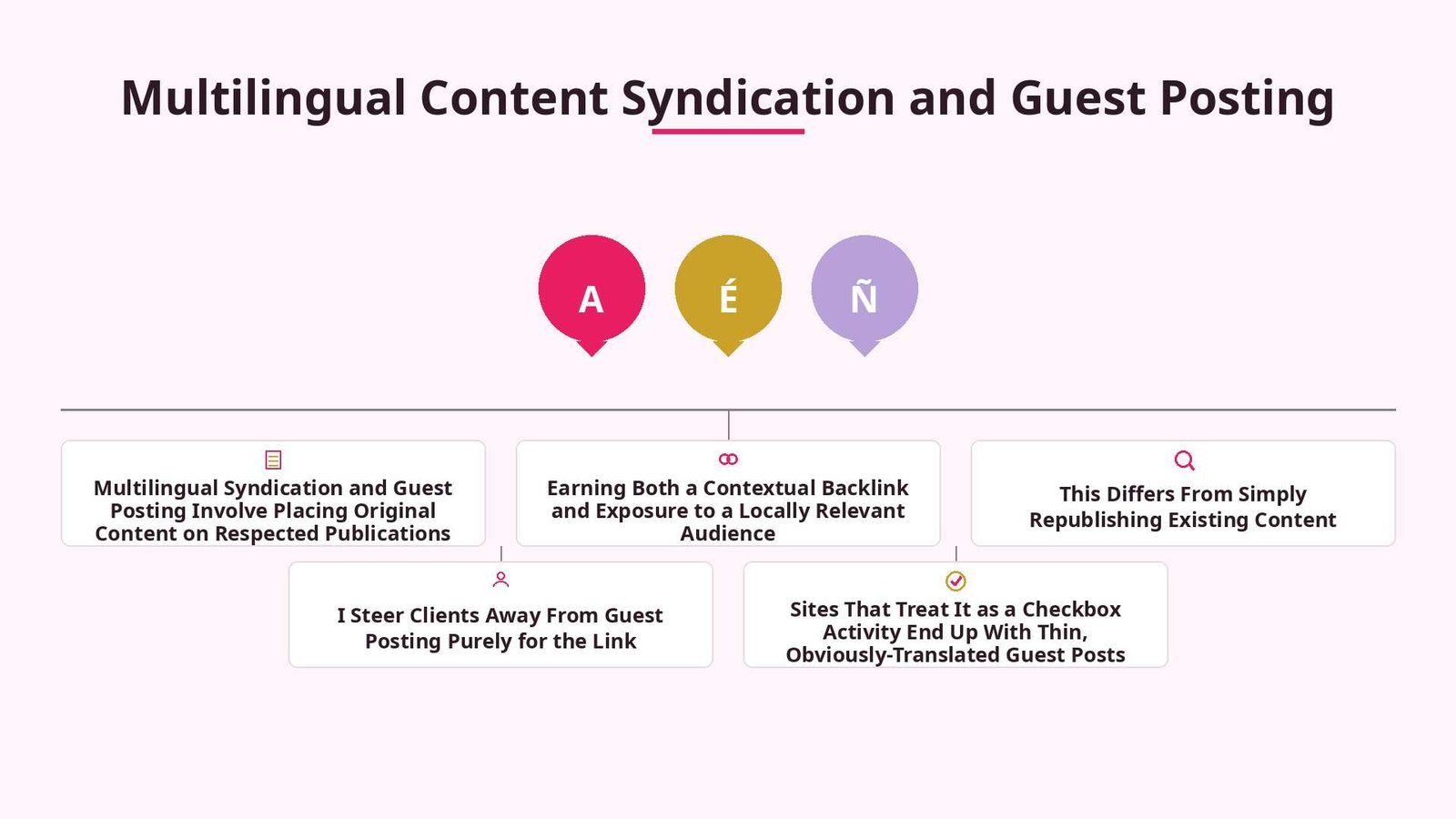
Multilingual content syndication and guest posting involve placing original content on respected publications within each target language or market, earning both a contextual backlink and exposure to a locally relevant audience. This differs meaningfully from simply republishing existing content, because syndication built around genuinely native content performs better with both readers and search engines.
I steer clients away from guest posting purely for the link and toward guest posting as a genuine audience-building exercise in each market. The sites that treat it as a checkbox activity end up with thin, obviously-translated guest posts that local readers can spot immediately, and that undermines the authority the link was supposed to build.
Native-Language Content vs. Translated Content
Content written natively by a fluent speaker familiar with regional idioms and cultural context consistently outperforms directly translated content, both in reader engagement and in how publishers evaluate submission quality. Translated content often carries subtle phrasing that native readers recognize instantly, which can undermine the credibility a guest post is meant to build.
Working With In-Country Publishers, Bloggers, and Influencers
In-country publishers, bloggers, and influencers provide access to an audience that already trusts them within a specific market, and partnering with them for content placements or mentions builds off-page authority that’s both locally relevant and genuinely read. Vetting these partners properly matters just as much internationally as it does domestically. Sometimes more, since verifying metrics across different regional tools adds complexity.
I always cross-check a potential partner’s traffic and audience claims using more than one source, because self-reported numbers from international partners are harder to verify through familiar domestic tools.
Vetting Domain Authority in Non-English Markets
Domain authority metrics from US-centric SEO tools don’t always capture the full picture for non-English sites, since crawl coverage and backlink databases vary in depth by region. Cross-referencing organic traffic estimates, social engagement, and local reputation alongside standard authority metrics gives a more reliable picture of a potential partner’s actual influence in that market.
Social Signals and Brand Mentions Across Regions
Social signals and unlinked brand mentions contribute indirect trust signals that vary significantly in weight and platform relevance from one region to another. A brand mention on a platform that dominates attention in one country might carry far less relevance in a market where a different platform leads.
I map platform usage per target market before investing social effort, because the assumption that the same platform mix that works domestically will transfer internationally wastes resources quickly. A social strategy built around a platform with minimal adoption in the target country produces mentions nobody local ever sees.
Platform Preferences by Market
Platform dominance shifts by region. Certain markets favor messaging-app-based communities over open social feeds, while others concentrate attention on a small number of dominant networks. Brand mention strategies perform better when built around the platforms an in-country audience actually uses daily, rather than the platforms a US-based team defaults to.
Common Off-Page Mistakes in International SEO
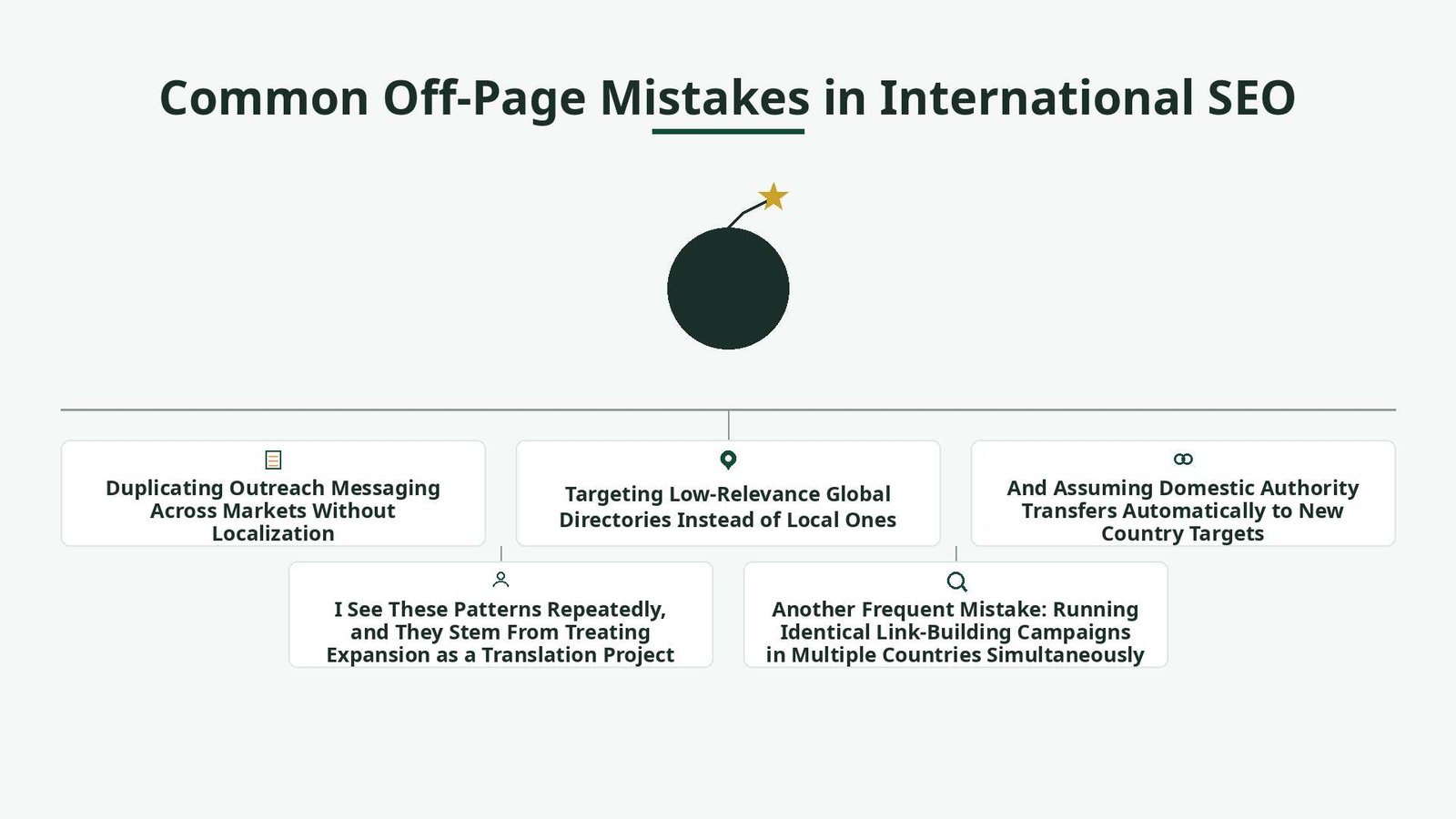
The most frequent off-page mistakes in international SEO include duplicating outreach messaging across markets without localization, targeting low-relevance global directories instead of local ones, and assuming domestic authority transfers automatically to new country targets. I see these patterns repeatedly, and they almost always stem from treating international expansion as a translation project rather than a market-by-market authority-building effort.
Another frequent mistake involves running identical link-building campaigns in multiple countries simultaneously without coordinating outreach targets, which risks pitching the same journalist or site owner with near-identical stories across their international editions.
Duplicate Outreach and Cross-Market Cannibalization
Sending nearly identical pitches to international editions of the same publication group often results in rejected pitches or diluted coverage, since editorial teams frequently coordinate across regional editions and notice duplicate outreach. Coordinating campaign timing and messaging across markets prevents this kind of self-inflicted cannibalization.
Measuring Off-Page Authority Across Multiple Markets
Measuring off-page authority across international markets requires tracking country-specific metrics separately rather than relying on a single global authority score, since aggregate metrics can mask strong performance in one market and weak performance in another. I build separate tracking dashboards per target country specifically so a strong US link profile never masks a struggling German one.
Referring domains by country, local keyword ranking movement, and regional organic traffic growth each need their own baseline and benchmark, because “good” looks different in a market with less overall search volume and competition.
| Metric | Why It Matters Per Market |
| Referring domains from local ccTLDs | Confirms in-country relevance is being built |
| Local keyword ranking movement | Shows authority is translating to visibility |
| Regional organic traffic share | Reveals whether gains are market-specific or global |
| Local brand search volume | Indicates growing recognition within that market |
Country-Specific KPIs Worth Tracking
Referring domains from local country-code top-level domains confirm whether in-country link building is actually gaining traction, separate from a site’s overall global backlink count. Local keyword ranking movement and regional organic traffic share then show whether that growing local authority is translating into actual visibility gains within that specific market.
Timelines and Resource Planning for Multi-Market Link Building
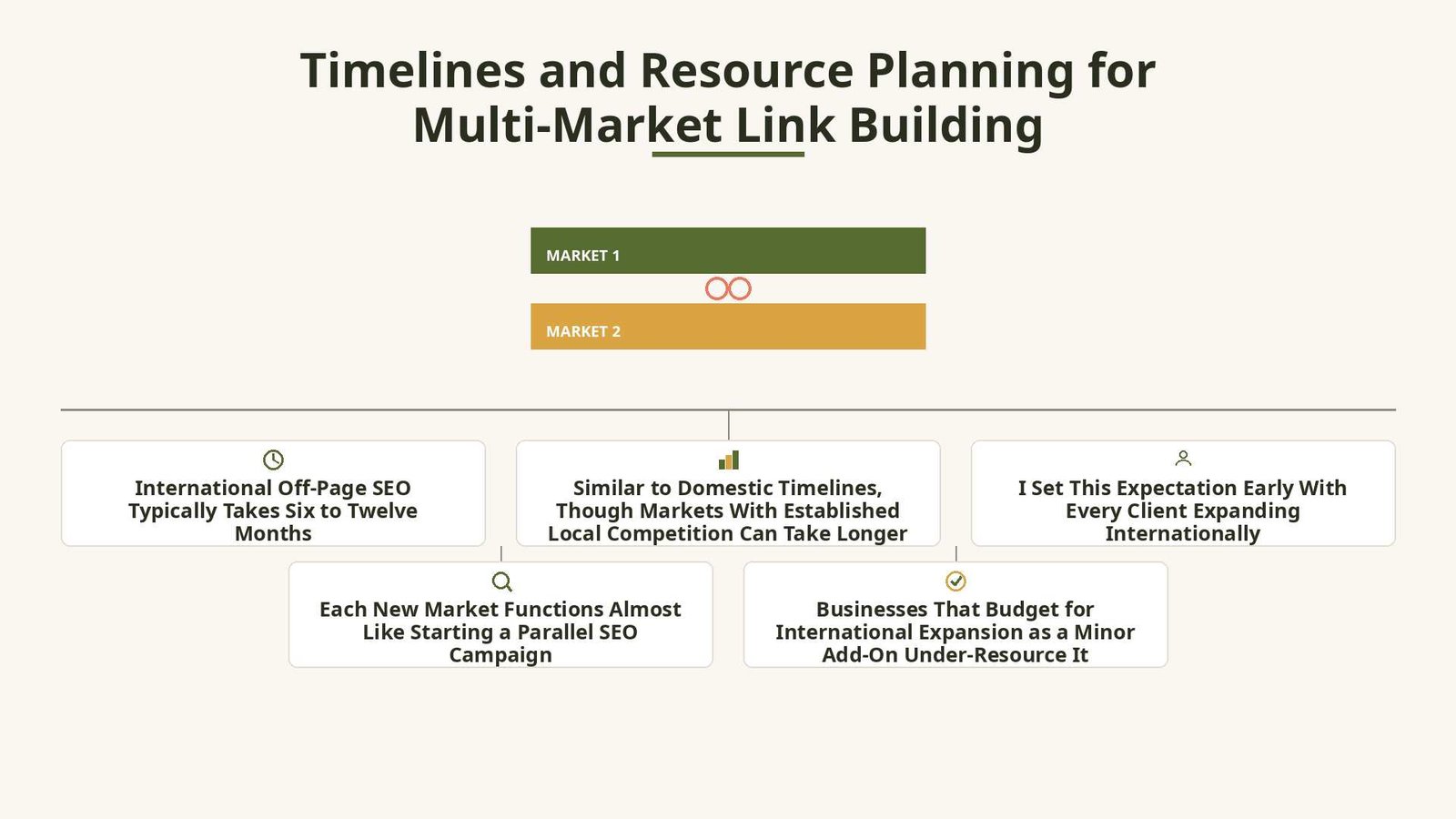
International off-page SEO typically takes six to twelve months to show meaningful ranking movement in a new market, similar to domestic timelines, though markets with established local competition can take longer. I set this expectation early with every client expanding internationally, because the instinct is often to expect faster results since the business already has domestic SEO traction.
Resource planning has to account for the fact that each new market functions almost like starting a parallel SEO campaign, with its own link prospecting, outreach, and content needs. Businesses that budget for international expansion as a minor add-on to their existing SEO spend consistently under-resource it.
Realistic Expectations by Market Maturity
A market with low existing competition and limited local SEO sophistication can show ranking movement faster than a mature, highly competitive market where domestic businesses have been building authority for years. Budgeting more time and resources for mature markets, and expecting faster early wins in less competitive ones, keeps planning realistic.
Building a Scalable International Off-Page Strategy
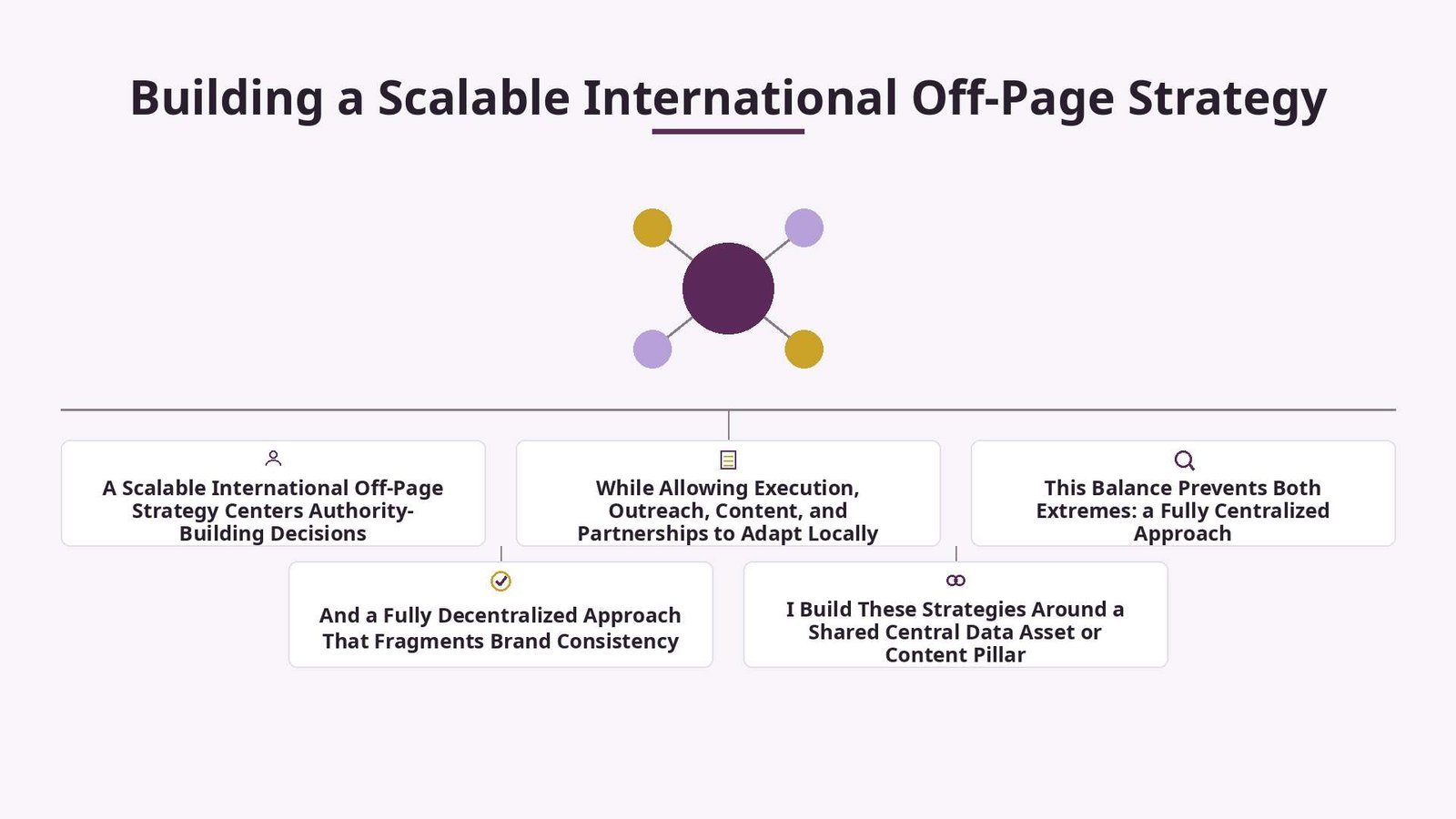
A scalable international off-page strategy centers authority-building decisions and brand standards at a headquarters level while allowing execution, outreach, content, and partnerships, to adapt locally in each market. This balance prevents both extremes: a fully centralized approach that produces generic, culturally tone-deaf outreach, and a fully decentralized approach that fragments brand consistency and wastes resources on duplicated research.
I build these strategies around a shared central data asset or content pillar, then let regional teams or partners localize execution around it. That structure scales far better than starting from scratch in every new market.
Centralized Strategy, Localized Execution
Centralizing research, data assets, and brand guidelines reduces duplicated work across markets, while localizing outreach messaging, media targets, and content adaptation respects what actually resonates in each country. This hybrid model scales more efficiently than either a fully centralized or fully decentralized approach to international off-page SEO.
Conclusion
International off-page authority depends on local backlinks, citations, and digital PR tailored to each market, not a single global link profile. Country structure, platform relevance, and realistic timelines all shape how fast authority builds abroad.
We help businesses plan and execute multi-market off-page strategies that build genuine authority where it counts. Reach out to White Label SEO Service to map your next market’s SEO roadmap.
Frequently Asked Questions
What is off-page SEO for international websites?
Off-page SEO for international websites means earning backlinks, citations, and mentions from sources relevant to each specific country or language market. It builds the local trust signals that technical setup alone cannot provide.
Do I need local backlinks for every country I target?
Yes, local backlinks matter for every country targeted independently, since search engines assess authority contextually by market. Domestic backlink strength doesn’t automatically transfer to new countries.
How long does international link building take to show results?
International link building typically takes six to twelve months to produce meaningful ranking movement. Timelines vary based on local competition and market maturity.
Should I build links in the local language or English?
Native-language links generally perform better for ranking and reader trust in that specific market. English-language links only make sense when targeting English-reading audiences within that country.
What’s the difference between international SEO and multilingual SEO?
International SEO targets different countries, while multilingual SEO targets different languages, and the two often overlap but aren’t identical. A single language can span multiple countries, each requiring separate off-page authority.
How many backlinks do I need per market?
There’s no fixed number, since it depends entirely on local competition and existing authority in that market. Quality and relevance within the specific market matter more than raw quantity.
Can I use the same digital PR strategy in every country?
The core story or data asset can stay the same, but the pitch angle and publication targets need market-specific adaptation. Direct translation of a single campaign typically underperforms localized versions.