
E-E-A-T stands for Experience, Expertise, Authoritativeness, and Trust, the framework Google’s quality raters use to judge whether content deserves to rank. I think of it less as a ranking factor and more as a lens: search engines use it to decide if a page was created by someone who genuinely knows the subject and can be trusted to answer it well.
Google doesn’t ignore E-E-A-T anymore; it increasingly gates visibility behind it. Sites without clear authority signals plateau no matter how much content they publish.
This guide covers what E-E-A-T actually means and how Google evaluates it, the four pillars broken down individually, how off-page signals like backlinks, digital PR, and brand mentions build authoritativeness, the trust markers that keep a site credible, and how we sequence all of it into a strategy that compounds instead of stalling out.
What E-E-A-T Means and Why Google Created It
E-E-A-T is a quality framework Google’s human raters use to assess whether content demonstrates real experience, subject-matter expertise, authoritativeness, and trustworthiness. It isn’t a direct ranking algorithm. It’s a standard baked into the Search Quality Rater Guidelines that shapes what the actual algorithms are trained to reward.
Google added the extra “E” for Experience in December 2022, responding to a flood of AI-generated and SEO-first content with no first-hand knowledge behind it. I’ve watched this shift change how we evaluate client content. Proof of having actually done the thing now matters as much as technical accuracy.
Experience vs. Expertise — The Added “E”
Experience means the author has personally used, tested, or lived through what they’re writing about. Expertise means they understand the subject at a technical or professional level. A product review needs experience; a medical explainer needs expertise. The best content usually has both.
How Google Actually Evaluates E-E-A-T Signals
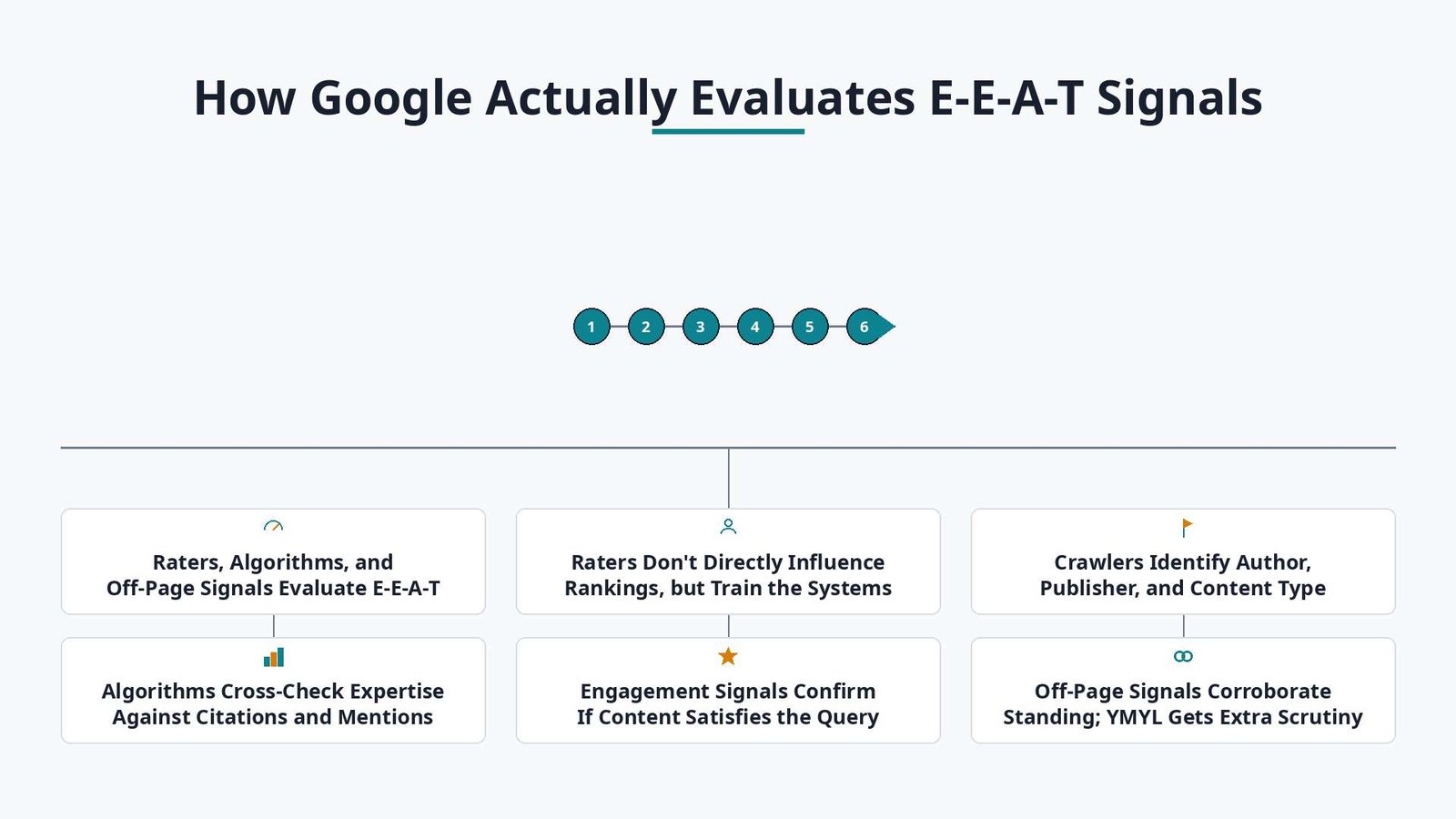
Google evaluates E-E-A-T through a combination of human quality rater assessments, algorithmic pattern matching, and off-page corroboration signals that confirm what a page claims about itself. Quality raters don’t directly influence rankings in real time, but their assessments train the systems that do.
The evaluation generally follows a sequence I’ve mapped out across hundreds of audits:
- Google’s crawlers identify the author, publisher, and content type
- Algorithms cross-reference claimed expertise against external validation (citations, mentions, credentials)
- User engagement signals confirm whether the content satisfies the query
- Off-page authority signals (backlinks, brand mentions) corroborate the site’s standing
- YMYL content receives additional scrutiny layers before ranking eligibility
- Rater guideline patterns get folded into algorithm updates over time
Algorithmic Signals vs. Human Quality Raters
Human raters never touch live rankings directly. We think of their guidelines as a blueprint Google’s engineers use to train and validate the actual ranking algorithms, which is why rater guideline updates often predict algorithm updates months later.
Experience Signals — Proving First-Hand Knowledge
Experience signals are the on-page and off-page indicators that prove an author or brand has genuinely done, used, or lived through the subject they’re covering. I look for these first in any content audit because they’re the easiest signal to fake badly and the hardest to fake convincingly.
Author Bylines and Bio Depth
A thin, generic author bio reads as a red flag to both readers and algorithms. We build out full author authority profiles with verifiable credentials, published history, and social proof, because a well-developed author profile consistently correlates with stronger topical rankings in our client data.
Expertise Signals — Credentials and Technical Accuracy

Expertise signals demonstrate that the content creator has professional or technical command of the subject, typically shown through credentials, citations, accurate terminology, and depth of explanation. This matters most in technical, financial, legal, and medical content where inaccuracy carries real consequences.
Industry-Specific Expertise Markers
Different industries signal expertise differently. Legal content leans on bar admissions and case citations. Medical content leans on clinical credentials. YMYL content standards require the strictest version of this, and we treat that distinction as a core part of content planning from day one.
Authoritativeness — Why Off-Page Signals Matter Most
Authoritativeness measures whether other credible sources across the web treat a site or author as a legitimate reference point on its subject. Unlike experience and expertise, which can mostly be demonstrated on-page, authoritativeness is earned almost entirely through external validation.
This is the pillar that connects everything else in this guide to the open web. A page can have a brilliant author bio and technically flawless content and still rank poorly if nothing outside the site corroborates its standing. I’ve seen this gap sink otherwise excellent content strategies more than any other single factor.
Authority as a Reputation Signal Beyond Your Own Site
Google treats authoritativeness the way a hiring manager treats references. Your own claims matter less than what independent sources confirm. A site that other authoritative sites link to, cite, and mention earns a reputation score no amount of on-page optimization can replicate.
Off-Page SEO Fundamentals — What It Actually Covers

Off-page SEO is the set of activities conducted outside a website that influence its search rankings, primarily backlinks, brand mentions, digital PR, and social signals. It’s distinct from on-page SEO, which covers content and HTML elements, and technical SEO, which covers crawlability and site architecture.
Off-Page vs. On-Page vs. Technical SEO
| SEO Type | Primary Focus | Example Activities |
| On-Page | Content and HTML elements | Title tags, keyword use, internal structure |
| Technical | Crawlability and site health | Site speed, indexability, schema markup |
| Off-Page | External authority signals | Backlinks, digital PR, brand mentions |
Off-page work is where most of the authoritativeness pillar gets built, which is why we treat it as inseparable from any serious E-E-A-T strategy rather than a separate workstream.
Backlinks as the Core Off-Page Authority Signal
Backlinks remain the strongest individual off-page ranking signal Google uses to judge a site’s authoritativeness, acting as votes of confidence from other websites. An Ahrefs study of over one billion pages found a strong correlation between the number of referring domains and organic search traffic, though correlation isn’t causation on its own.
Not every link carries equal weight, and I spend more time explaining this to clients than almost any other concept in SEO.
Link Quality Factors Google Weighs
| Factor | Why It Matters |
| Referring domain authority | Links from established, trusted sites pass more credibility |
| Topical relevance | A link from a related industry site carries more context value |
| Anchor text naturalness | Organic-sounding anchors avoid manipulation signals |
| Link placement | Editorial, in-content links outweigh footer or sidebar links |
| Follow vs. nofollow | Followed links pass authority directly; nofollow links still add trust signals |
Referring Domains vs. Total Backlinks
A hundred links from ten unique domains carry less weight than ten links from ten different authoritative domains. We prioritize referring domain diversity over raw link volume in every link building strategy we execute, because Google’s own patent filings suggest domain diversity is weighted independently from link count.
Digital PR and Earned Media Coverage

Digital PR is the practice of securing media coverage, journalist citations, and editorial backlinks by pitching newsworthy stories, data, or expert commentary to publishers. It’s become one of the fastest ways to earn high-authority links at scale, because a single strong placement can outperform months of outreach-based link building.
How Journalist Outreach Builds Authority Links
Journalists need sources, data, and quotes on tight deadlines, and a responsive expert source becomes a recurring resource. We build digital PR campaigns around original data and survey findings specifically because journalists cite original research far more readily than opinion content.
Brand Mentions and Unlinked Citations
Brand mentions are references to a company or website name across the web that don’t include a hyperlink, and Google’s algorithms can still use them as a trust and authority signal. Patent filings and public statements from Google representatives have both pointed toward mention-based entity recognition independent of links.
Why Google Values Mentions Without Links
An unlinked mention in a reputable publication still tells Google’s knowledge graph that an entity exists and is being discussed in a relevant context. We track brand mention volume and sentiment for clients the same way we track backlinks, because the pattern of growing unlinked citations often precedes a visible authority increase in rankings.
Social Proof, Reviews, and Third-Party Validation

Social proof signals, including customer reviews, testimonials, and third-party ratings, help confirm a business’s trustworthiness to both users and search engines. Review volume and sentiment increasingly factor into local and transactional search visibility, particularly for service-based businesses.
Review Platforms Google Cross-References
Google cross-references Google Business Profile reviews against third-party platforms to validate consistency. A reputation management strategy that keeps review signals consistent across platforms strengthens the trust pillar in ways pure content work cannot replicate.
Trust Signals — Site Transparency and Credibility Markers
Trust signals are the on-site elements that confirm a website is transparent, legitimate, and safe for users to engage with, including clear contact information, privacy policies, and secure connections. Google explicitly references transparency and clarity of purpose in its rater guidelines as trust indicators independent of content quality.
About, Contact, and Policy Pages as Trust Anchors
A missing or vague About page is one of the fastest ways to undermine an otherwise strong E-E-A-T profile. We run a technical trust audit on every new client site because these pages are cheap to fix and disproportionately impactful for YMYL and service businesses alike.
YMYL Content and Why E-E-A-T Standards Are Higher

YMYL stands for “Your Money or Your Life,” referring to content that could impact a reader’s health, financial stability, safety, or wellbeing, and Google holds this content to the strictest E-E-A-T standards. These categories receive additional scrutiny layers in the rater guidelines that general informational content does not.
I treat YMYL classification as the single biggest factor in how aggressive our content and authority strategy needs to be for any given client.
Industries Held to Stricter Scrutiny
Finance, healthcare, legal services, and major life decisions all fall under YMYL classification. A full YMYL compliance review typically changes how we approach authorship, citation density, and even which content formats we recommend, because the margin for ambiguity shrinks considerably in these verticals.
Measuring E-E-A-T and Authority Progress Over Time
E-E-A-T itself isn’t directly measurable through any single metric, but authority progress can be tracked through proxy signals like referring domain growth, branded search volume, and ranking stability across algorithm updates. No tool reports an “E-E-A-T score,” despite what some SEO software vendors claim.
We rely on a combination of data sources rather than any single dashboard number.
Tools and Metrics That Approximate Authority
| Metric | Tool | What It Indicates |
| Referring domain growth | Ahrefs, Semrush | Expanding off-page authority |
| Branded search volume | Google Search Console | Growing brand recognition |
| Ranking volatility during updates | Rank tracking software | Resilience of existing authority |
| Author entity recognition | Google Knowledge Graph search | Established expertise signal |
Tracking these together inside a consistent SEO reporting dashboard gives a far more reliable read than chasing any single proxy number in isolation.
Common E-E-A-T and Authority-Building Mistakes

The most common E-E-A-T mistakes include publishing content with no identifiable author, buying low-quality bulk backlinks, and copying competitor content without adding genuine first-hand insight. I see these three patterns repeated across almost every underperforming site we audit.
Thin Authorship and Manipulative Link Schemes
Anonymous or fabricated author bios are an easy red flag for both users and raters. Paid link networks and private blog networks carry real penalty risk, and recovering from a manipulative link penalty typically takes far longer than building authority the sustainable way from the start.
Building a Sustainable E-E-A-T and Authority Strategy

A sustainable E-E-A-T strategy sequences on-site expertise signals first, then layers off-page authority building on top, rather than chasing backlinks before the content itself can support the authority those links imply. Building links to thin, unverified content rarely sticks, and even when it ranks temporarily, it tends to fall during the next core update.
We generally sequence this in a consistent order across client accounts:
- Audit existing author credentials and content accuracy
- Fix technical trust signals (About, contact, policies, security)
- Build out author and entity authority profiles
- Launch digital PR and earned media campaigns for topical link acquisition
- Monitor brand mention growth and sentiment alongside backlink growth
- Track ranking stability through algorithm updates as the real success measure
Each stage builds on the one before it, which is why skipping straight to link building without the foundational work rarely produces results that last.
Conclusion
E-E-A-T and off-page authority work together as one system: experience and expertise earn trust on-page, while backlinks, mentions, and reviews confirm it externally.
Sustainable rankings come from sequencing these signals correctly, not chasing shortcuts that collapse during algorithm updates or audits.
We build this exact sequence into every engagement at White Label SEO Service, turning authority signals into measurable, lasting organic growth.
Frequently Asked Questions
What is E-E-A-T in SEO?
E-E-A-T stands for Experience, Expertise, Authoritativeness, and Trust. It’s the framework Google’s quality raters use to judge content reliability, and it indirectly shapes how ranking algorithms are trained.
How long does it take to build topical authority?
Topical authority typically takes six to twelve months of consistent content and link building to show measurable ranking improvement. Competitive industries often take longer to see full results.
Do backlinks still matter for E-E-A-T?
Yes, backlinks remain one of the strongest off-page signals for authoritativeness. Quality and topical relevance matter more than raw link volume today.
Can small businesses compete on authority signals?
Small businesses can compete by focusing on niche expertise and local digital PR rather than broad national link building. Depth in a narrow topic often beats shallow coverage of a broad one.
Does author experience affect rankings directly?
Author experience doesn’t directly set rankings but strongly influences how raters and algorithms judge content quality. Clear bylines and credentials consistently correlate with stronger topical performance.
What industries face the strictest E-E-A-T scrutiny?
Finance, healthcare, legal services, and other YMYL categories face the strictest scrutiny. Google applies additional evaluation layers to content that affects health, money, or safety decisions.
How do you measure E-E-A-T improvements?
E-E-A-T itself has no direct score, so we track proxy metrics like referring domain growth, branded search volume, and ranking stability. These combined signals approximate authority progress over time.