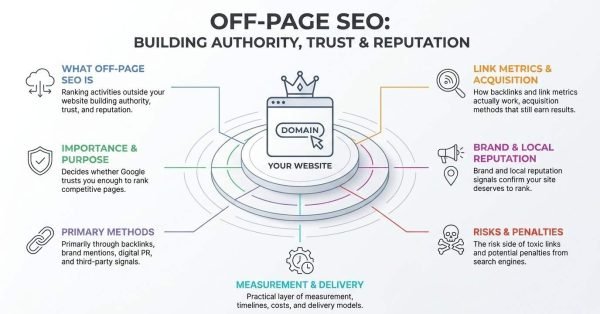

Off-page SEO pricing ranges from $500 a month for basic link building to $20,000+ a month for enterprise authority-building programs, with cost driven mainly by link quality, outreach volume, and agency tier. I’ve priced out campaigns across every tier of this industry, and the spread is wide because the work itself is wide: digital PR, guest posting, citations, and influencer outreach all sit under the “off-page SEO” umbrella but cost nothing alike.
Picking the wrong tier wastes budget or stalls growth for months. I want you walking into any quote knowing exactly what you’re paying for and why.
This guide breaks down pricing models agencies actually use, cost ranges for individual link types, how agency tiers differ in price and output, and how to budget by business size and measure what you get back. We’ll also flag the pricing signals that mean you’re buying junk links instead of authority.
What Off-Page SEO Pricing Actually Covers
Off-page SEO pricing covers any paid activity that builds authority or visibility outside your own website, including link building, digital PR, citations, and brand mentions. I separate this from on-page work immediately, because clients often bundle the two together when comparing quotes, and that’s where confusion starts.
On-page SEO touches your site directly: title tags, content, site speed, internal structure. Off-page SEO touches everything that happens elsewhere: other sites linking to you, press coverage, directory listings, social proof. The deliverable isn’t a change to your website. It’s a change to how the internet refers to it.
Agencies price off-page work differently because the labor behind it is different. On-page SEO is largely internal hours. Off-page SEO involves third-party relationships, placement fees, and outreach that doesn’t always convert on the first attempt.
Off-Page vs. On-Page SEO Cost Differences
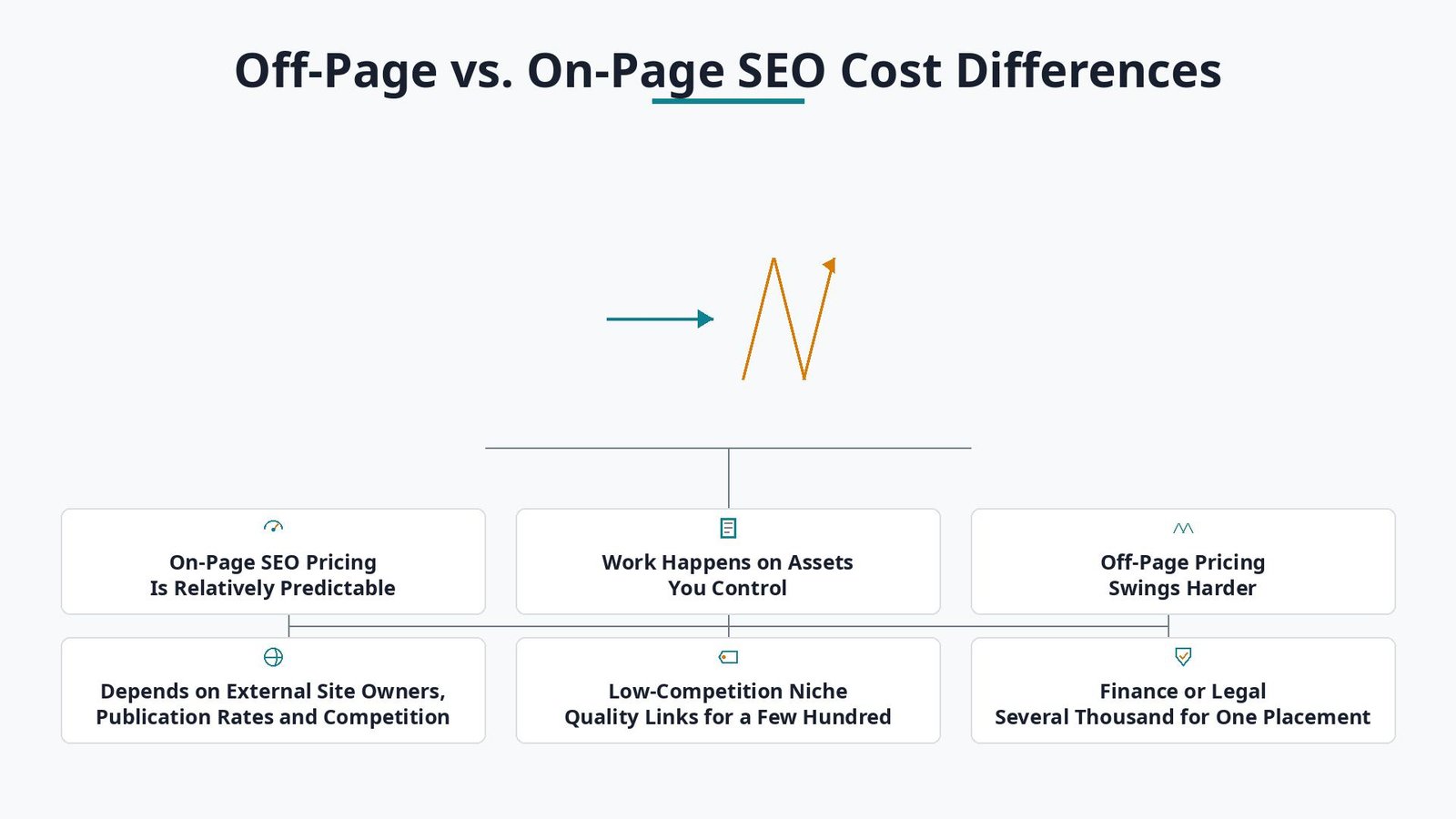
On-page SEO pricing is relatively predictable because the work happens on assets you control. Off-page pricing swings harder because it depends on external site owners, publication rates, and how competitive your niche is for acquiring placements.
A site in a low-competition niche might land quality links for a few hundred dollars each. A site competing in finance or legal might pay several thousand for a single comparable placement.
How Agencies Structure Off-Page SEO Pricing Models
Agencies typically price off-page SEO using one of four models: monthly retainers, per-project fees, hourly consulting, or performance-based pricing tied to results. I’ve worked inside all four, and each one shifts risk differently between agency and client.
The model an agency pushes often says more about their business structure than your actual needs, so it’s worth understanding what each one really means for your budget.
| Pricing Model | Typical Range | Best For | Risk Profile |
| Monthly Retainer | 750–10,000+/mo | Ongoing authority building | Shared, predictable |
| Per-Project | 1,000–15,000 per campaign | One-time PR push or link sprint | Client-funded upfront |
| Hourly Consulting | 100–300/hour | Strategy, audits, advisory | Low commitment |
| Performance-Based | Variable, tied to KPIs | Established sites with baseline traffic | Agency-absorbed |
This table shows how pricing structure shifts with the type of engagement you’re buying, not just the dollar amount.
Monthly Retainer Pricing
A monthly retainer bundles ongoing link acquisition, outreach, and reporting into one recurring fee. Most retainers run three to twelve months because off-page results compound slowly and single-month campaigns rarely show measurable movement.
Per-Project / Per-Campaign Pricing
Per-project pricing fits a defined deliverable, like a digital PR push around a product launch or a fixed batch of guest post placements. You know the total cost upfront, but there’s no guarantee of ongoing authority gains after the project ends.
Hourly Consulting Rates
Hourly rates suit businesses that already run link building in-house but want strategic direction or an outside audit. It’s the lowest-commitment option, and the least useful for businesses with no internal execution capacity.
Performance-Based / Results-Based Pricing
Performance-based pricing ties fees to rankings, traffic, or link placements achieved. It sounds appealing on paper, but agencies offering it usually restrict it to sites with existing traffic and favorable competition, since brand-new sites carry too much execution risk for this model to pencil out.
Link Building Costs: Price Ranges by Service & Link Quality
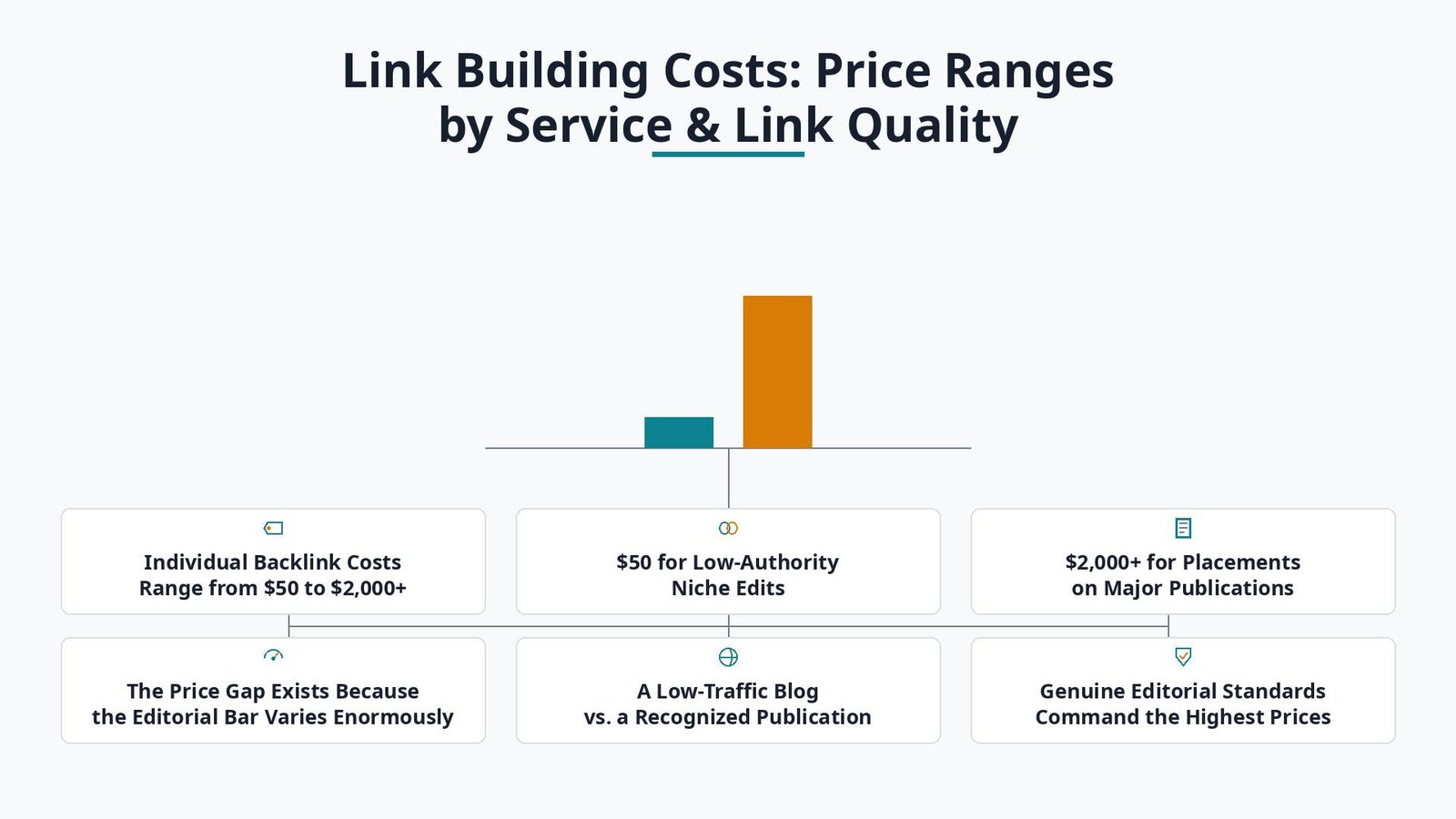
Individual backlink costs range from $50 for low-authority niche edits to $2,000+ for placements on major publications with genuine editorial standards. The price gap exists because the editorial bar for inclusion varies enormously between a low-traffic blog and a recognized industry publication.
| Link Type | Typical Cost Range | What Drives the Price |
| Guest Post (low authority) | 50–150 | Minimal editorial review |
| Guest Post (mid authority) | 150–500 | Established audience, moderate DR |
| Guest Post (high authority) | 500–2,000+ | Strong editorial standards, high DR |
| Niche Edit / Link Insertion | 100–400 | Existing content, faster turnaround |
| Digital PR Placement | 300–3,000+ | Journalist outreach, newsworthy angle |
This table lays out why two agencies quoting “backlinks” can land $1,500 apart on price for what sounds like the same service.
Guest Post Link Pricing
Guest posting remains the most commonly sold off-page service because it’s scalable and relatively predictable in cost. The price mostly reflects the host site’s traffic and how selective their editorial process actually is.
Niche Edit / Link Insertion Pricing
Niche edits insert a link into existing published content rather than creating a new article, which cuts production time and usually costs less than a fresh guest post on a comparable site.
Digital PR & HARO-Style Link Pricing
Digital PR campaigns earn links through journalist relationships and newsworthy pitches rather than paid placement, so pricing reflects the labor of pitching dozens of journalists to land a handful of coverage pieces, not a fixed per-link fee.
Domain Authority & Domain Rating Pricing Tiers

Links from domains with a Domain Rating above 70 typically cost three to five times more than links from domains rated 20–40, because high-DR sites receive far more link requests than they accept. I price DR tiers as a baseline starting point before layering in niche relevance and traffic.
| DR Range | Typical Link Cost |
| DR 10–30 | 50–150 |
| DR 30–50 | 150–400 |
| DR 50–70 | 400–900 |
| DR 70+ | 900–2,500+ |
This table reflects authority pricing alone. Niche relevance and real traffic can push costs higher even within the same DR band.
Why High-DR Links Cost More
High-DR sites reject most outreach pitches because they don’t need the content or the relationship. Getting placed there requires either a genuinely strong story, an existing relationship, or a higher fee to justify the editor’s time.
Digital PR Campaign Costs
A single digital PR campaign typically costs between $2,000 and $10,000, depending on the number of journalists targeted and the strength of the underlying story or data. Campaigns built around original research or survey data tend to command higher fees because that data takes real time to produce and pitch.
Smaller campaigns targeting niche trade publications run cheaper than a nationwide push aimed at tier-one outlets. The story angle matters as much as the budget here. A flat story at a high budget still underperforms a strong story at a modest one.
Guest Posting Service Costs
Managed guest posting services typically charge $300 to $800 per placement when outreach, writing, and publishing are all included in the fee. That bundled price covers finding a relevant site, pitching the content idea, writing to their editorial standards, and securing the actual publish.
Buying guest posts in bulk packages sometimes brings the per-link price down, but bulk packages are where the lowest-quality placements tend to hide, since volume incentives push vendors toward easier, lower-standard sites.
Citation Building & Local SEO Off-Page Costs
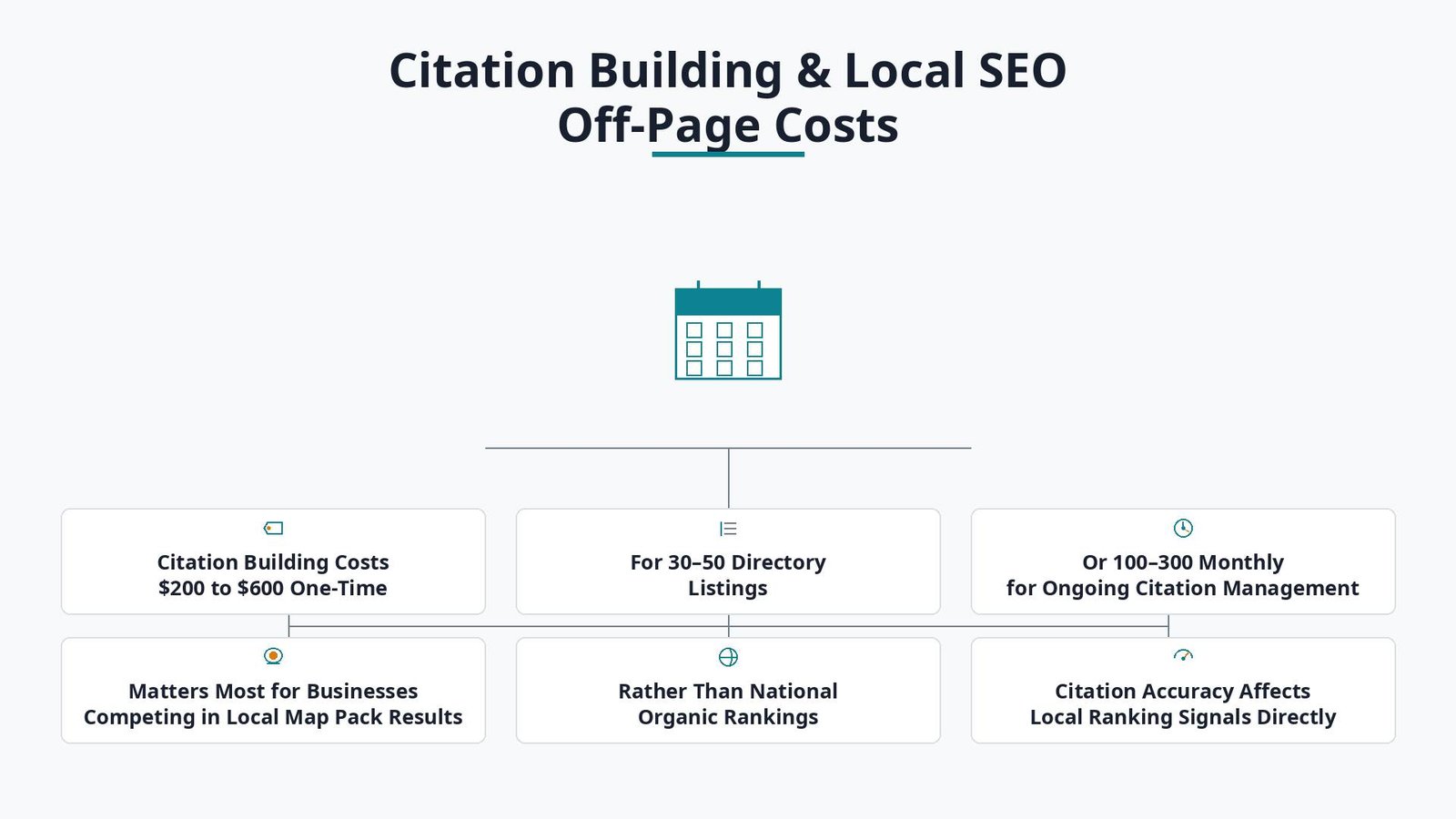
Local citation building typically costs $200 to $600 as a one-time project for 30–50 directory listings, or 100–300 monthly for ongoing citation management. This service matters most for businesses competing in local map pack results rather than national organic rankings.
Citation accuracy affects local ranking signals directly, since inconsistent business name, address, and phone data across directories confuses local ranking algorithms.
Influencer & Brand Partnership Outreach Pricing
Influencer and brand partnership outreach for SEO purposes typically costs $500 to $5,000 per partnership, depending on the influencer’s following size and whether the placement includes a dofollow link. This differs from traditional influencer marketing because the primary goal here is a durable backlink, not a one-time mention.
Smaller, niche-relevant creators often deliver better link value per dollar than large influencers, since relevance matters more to search engines than raw audience size.
Content Promotion & Outreach Costs
Content promotion and outreach services typically cost $500 to $2,500 per campaign, covering the distribution effort needed to get a piece of content noticed, shared, and linked by relevant sites. This service supports link building rather than replacing it, since even excellent content rarely earns links without active outreach behind it.
Paid promotion and amplification can stretch this budget higher, but organic outreach to relevant publishers remains the core cost driver in most quotes.
Agency Tier Breakdown: Budget vs. Mid-Market vs. Enterprise
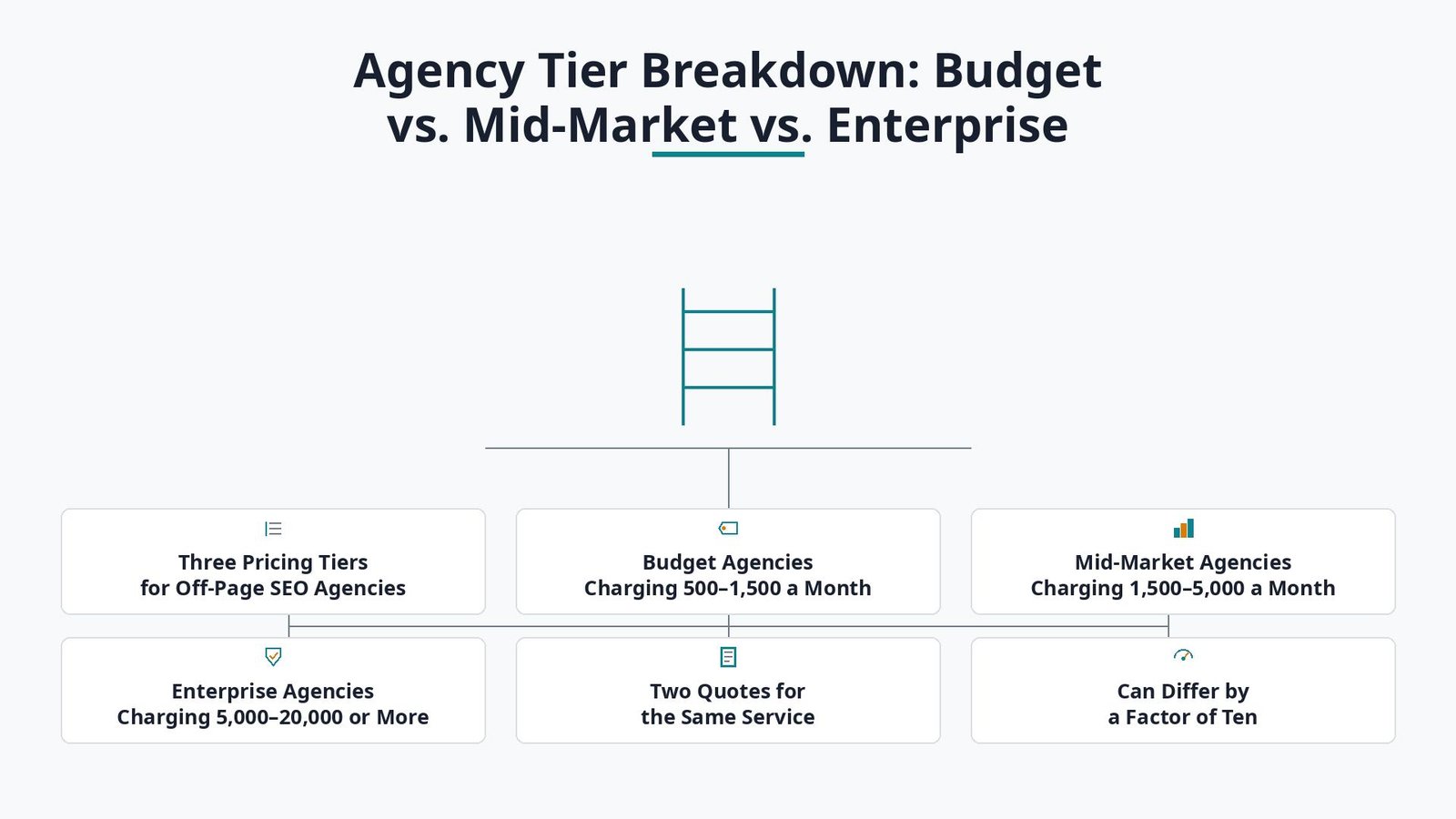
Off-page SEO agencies generally fall into three pricing tiers: budget agencies charging 500–1,500 a month, mid-market agencies charging 1,500–5,000, and enterprise agencies charging 5,000–20,000 or more. I use this three-tier structure constantly when explaining to clients why two quotes for “the same service” can differ by a factor of ten.
| Tier | Monthly Range | Typical Output | Link Quality |
| Budget | 500–1,500 | 2–5 links/month | Lower DR, higher risk |
| Mid-Market | 1,500–5,000 | 5–15 links/month | Moderate-to-strong DR, vetted |
| Enterprise | 5,000–20,000+ | 15+ links/month, full PR support | High DR, editorial-grade |
This table shows the output and quality shift that comes with each pricing jump, not just a bigger invoice.
Budget Agency Tier (500–1,500/mo)
Budget agencies rely heavily on pre-built networks of guest post sites and niche edits, which keeps costs low but caps the authority ceiling of what you’ll acquire.
Mid-Market Agency Tier (1,500–5,000/mo)
Mid-market agencies typically combine guest posting with some genuine outreach and vetting, producing a meaningfully stronger link profile than budget tiers without enterprise-level cost.
Enterprise Agency Tier (5,000–20,000+/mo)
Enterprise agencies run dedicated PR teams, original research campaigns, and relationship-based placements that budget and mid-market tiers simply don’t have the infrastructure to replicate.
Freelancer vs. Agency vs. In-House Off-Page SEO Costs
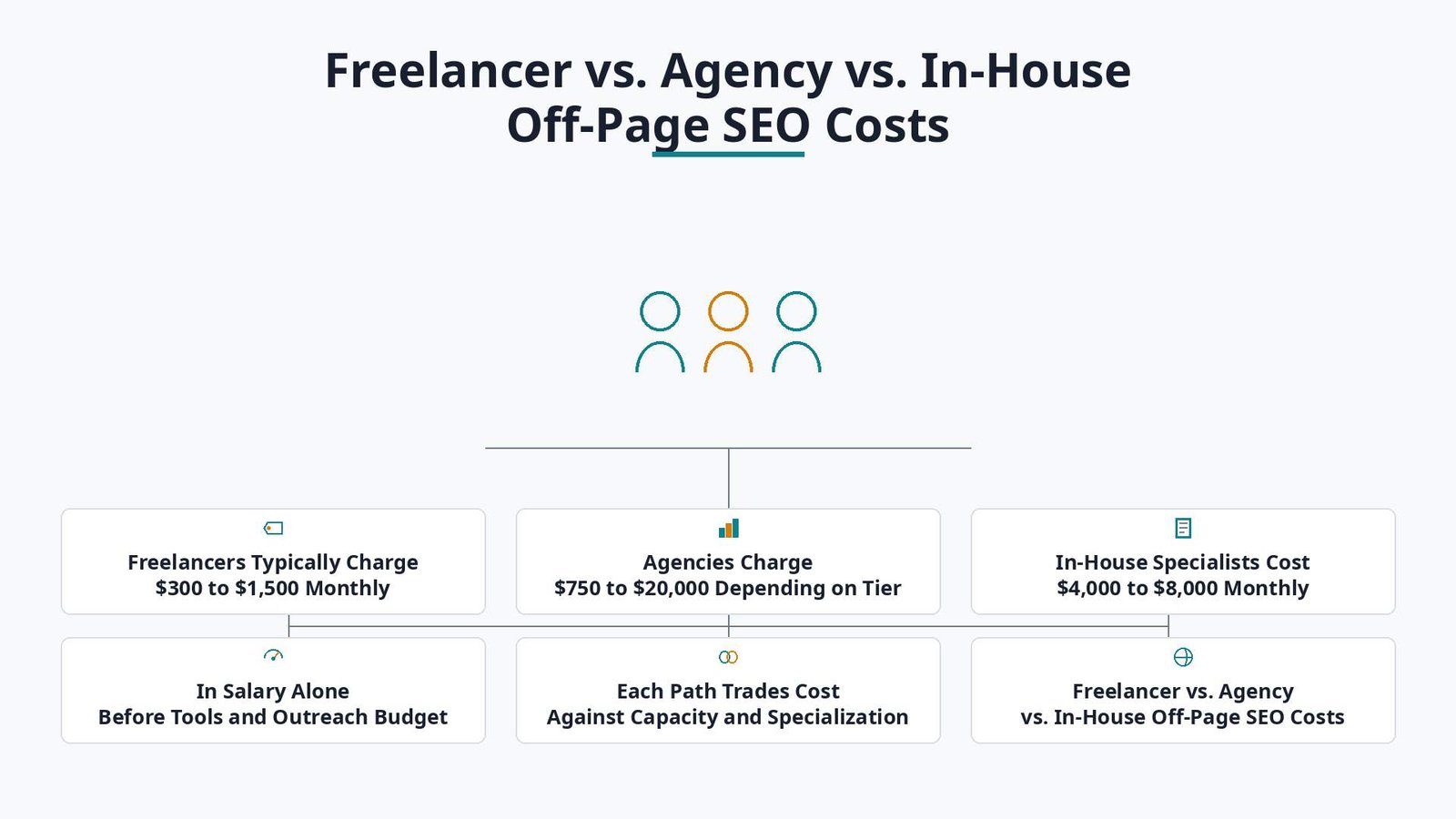
Freelancers typically charge $300 to $1,500 monthly for off-page SEO, agencies charge $750 to $20,000 depending on tier, and in-house specialists cost $4,000 to $8,000 monthly in salary alone before tools and outreach budget. Each path trades cost against capacity and specialization.
| Option | Typical Monthly Cost | Strength | Limitation |
| Freelancer | 300–1,500 | Lower cost, direct communication | Limited capacity, single skillset |
| Agency | 750–20,000 | Full-service capability, scale | Less individualized attention at lower tiers |
| In-House | 4,000–8,000+ salary | Full control, brand alignment | High fixed cost, slower ramp-up |
This table compares total monthly investment across the three most common ways businesses staff off-page SEO work.
A freelancer suits a business with a narrow, well-defined need and a tighter budget. An in-house hire makes sense once off-page work becomes a permanent, large-scale function rather than a periodic campaign.
Factors That Increase or Decrease Off-Page SEO Pricing
Off-page SEO pricing increases with niche competitiveness, target domain authority, content production complexity, and the number of outreach touches required to secure a placement. I walk through these factors with every new client before quoting, because the same service can cost double depending on the industry.
- Industry competitiveness: finance, legal, and health niches cost more due to editorial scrutiny and competitive saturation.
- Target link authority: higher DR and traffic thresholds raise placement fees.
- Content requirements: original research or data journalism costs more to produce than a standard article.
- Geographic targeting: local or international campaigns add research and localization costs.
- Outreach volume needed: low response rates in saturated niches require more pitches per successful placement.
Industry Competitiveness & Niche Difficulty
A SaaS company and a CBD company might both want ten guest post links, but the CBD company pays considerably more because fewer publications accept that content category at all, shrinking the available pool of legitimate placements.
Red Flags: Pricing Signals of Low-Quality Off-Page SEO

Prices far below market rate, bulk link packages sold by volume, and guaranteed ranking promises are the clearest pricing signals of low-quality off-page SEO. I treat any quote under $50 per “high-authority” link as an immediate red flag, since that price point can’t cover genuine editorial placement costs.
- Link packages sold purely by quantity (“100 links for $199”)
- Guaranteed first-page rankings tied to a fixed, low price
- No disclosure of actual target domains before purchase
- Pricing that doesn’t shift regardless of niche difficulty
Any one of these signals suggests the links being sold are low-value, automated, or built on private blog networks rather than genuine editorial placements.
How to Budget for Off-Page SEO by Business Size
Startups should budget $500 to $2,000 monthly for off-page SEO, growing mid-size businesses should plan for $2,000 to $6,000, and enterprise companies typically allocate $8,000 to $25,000 or more. Budget should scale with competitive pressure in your specific niche, not just company revenue.
| Business Size | Monthly Budget | Focus Area |
| Startup / Small Business | 500–2,000 | Foundational links, local citations |
| Growing / Mid-Size | 2,000–6,000 | Guest posting, moderate DR targets |
| Enterprise | 8,000–25,000+ | Digital PR, high-DR placements, brand mentions |
This table sets realistic monthly ranges based on company stage rather than a single flat recommendation.
Startup & Small Business Budgets
Early-stage businesses get more value from a smaller number of highly relevant links than a large volume of weak ones, since domain authority compounds faster with quality than with quantity at this stage.
Scaling & Enterprise Budgets
Larger companies need to budget for diminishing returns on easy wins, since the cheapest, most accessible links typically get acquired early, leaving higher-cost PR and relationship-based placements as the main growth lever later on.
Measuring ROI on Off-Page SEO Spend
ROI on off-page SEO spend is measured by tracking referral traffic, keyword ranking movement, and domain authority growth against the total monthly spend over a minimum six-month window. I never judge off-page ROI on a single month, because link equity accumulates gradually rather than producing immediate ranking jumps.
- Track new referring domains acquired per month against spend.
- Monitor keyword ranking movement for pages receiving new links.
- Measure referral traffic generated directly from placements.
- Compare organic traffic growth rate before and after the campaign start.
Tools like Google Search Console and a rank tracker give the clearest picture of whether spend is translating into visibility gains over time.
How to Evaluate and Compare Off-Page SEO Quotes
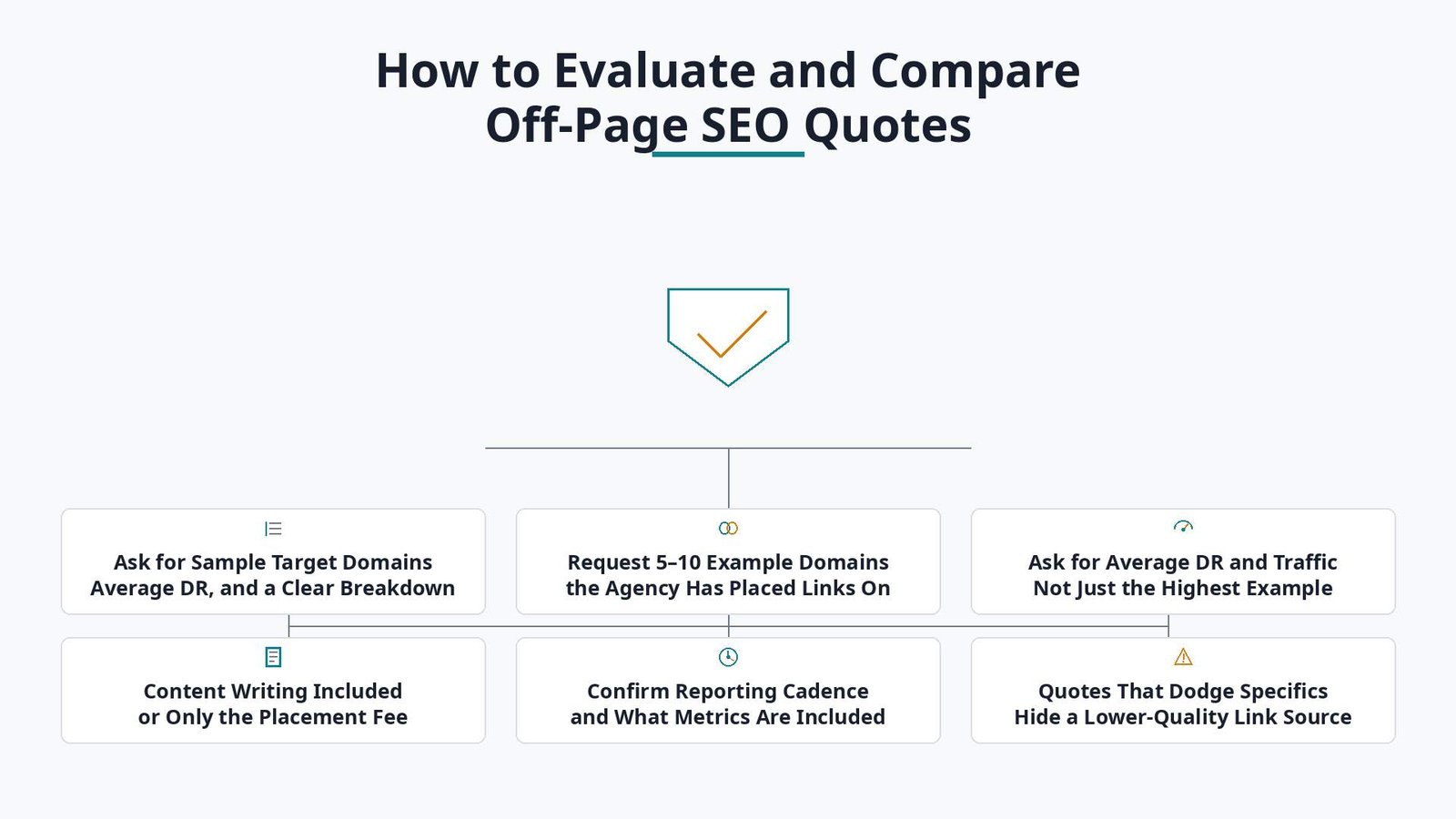
Comparing off-page SEO quotes accurately requires asking for sample target domains, average DR of links delivered, and a clear breakdown of what’s included per dollar spent. A quote without specifics is a quote you can’t actually evaluate against a competitor’s offer.
- Request 5–10 example domains the agency has placed links on recently.
- Ask for average DR and traffic of typical placements, not just the highest example.
- Clarify whether the price includes content writing or only the placement fee.
- Confirm reporting cadence and what metrics are included.
Quotes that dodge specifics on target domains or average authority are usually hiding a lower-quality link source behind a polished sales pitch.
Conclusion
Off-page SEO pricing reflects link quality, agency tier, and the outreach effort behind every placement, not just a flat monthly number. Understanding these cost drivers helps you budget realistically and spot red flags before signing a contract. We built White Label SEO Service to price transparently by tier and quality, so talk to us about building a budget that actually fits your growth stage.
Frequently Asked Questions
What is the average cost of off-page SEO per month?
Most businesses pay between $750 and $5,000 monthly for off-page SEO, depending on agency tier and link volume. Enterprise programs with digital PR can exceed $20,000 monthly.
How much does a single high-quality backlink cost?
A single high-quality backlink from a site with strong domain authority typically costs $400 to $2,000. Price depends heavily on the host site’s traffic and editorial standards.
Is cheap off-page SEO worth it?
Cheap off-page SEO under $50 per link is rarely worth it, since those links usually come from low-quality or automated sources. They often risk penalties rather than building authority.
Why do off-page SEO prices vary so much between agencies?
Prices vary because agencies differ in link quality, outreach labor, and target domain authority. A budget agency and an enterprise agency aren’t selling the same underlying product.
Do higher prices guarantee better SEO results?
Higher prices don’t guarantee results on their own, but they usually correlate with stronger link quality and more thorough outreach. Results still depend on execution and site readiness.
How much should a small business budget for link building?
Small businesses should budget $500 to $2,000 monthly for link building, focused on foundational, relevant placements. This range supports steady authority growth without overspending early.
What is included in an off-page SEO retainer?
A typical retainer includes ongoing link acquisition, outreach management, and monthly reporting on new links and ranking movement. Some retainers also include content creation for guest posts.