
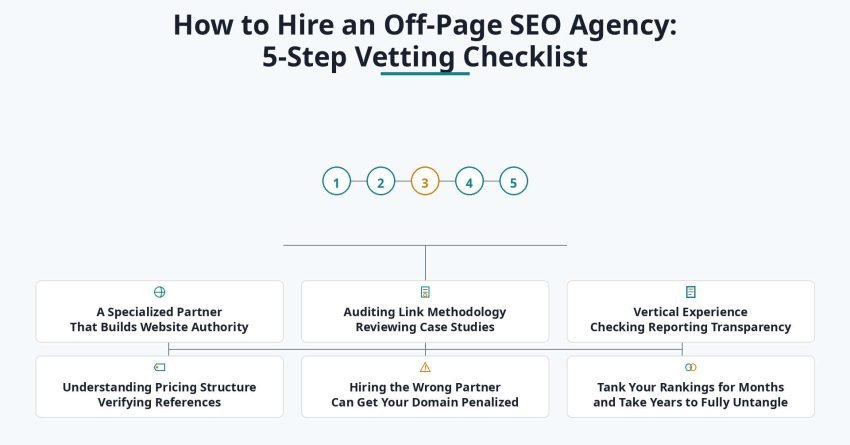
An off-page SEO agency is a specialized partner that builds a website’s authority through activities happening away from the site itself, primarily link acquisition, digital PR, and brand mention building. I’ve sat across the table from enough agency pitches to know that the difference between a good hire and a wasted budget usually comes down to five specific checkpoints. Most businesses never ask about them.
Hiring the wrong partner here doesn’t just waste money. It can get your domain penalized, tank your rankings for months, and take years to fully untangle.
This guide walks through the five-step vetting checklist I use: auditing link methodology, reviewing case studies and vertical experience, checking reporting transparency, understanding pricing structure, and verifying references. I also cover red flags, realistic timelines, and how off-page work fits into a broader SEO strategy.
What Off-Page SEO Actually Includes
Off-page SEO is the set of ranking activities that happen outside your own website, and it centers on earning backlinks, media mentions, and citations that signal trust to search engines. I think of it as reputation-building at scale, where every linking domain acts like a vote of confidence.
The three main pillars are link building, digital PR, and brand mention management, and they overlap more than most agencies admit. Link building focuses on acquiring hyperlinks from other sites. Digital PR earns those links through newsworthy stories, data studies, or expert commentary placed in media outlets. Brand mentions, even unlinked ones, still carry weight because Google’s own documentation on E-E-A-T signals treats consistent brand presence as a trust indicator.
Link Building vs. Digital PR vs. Brand Mentions
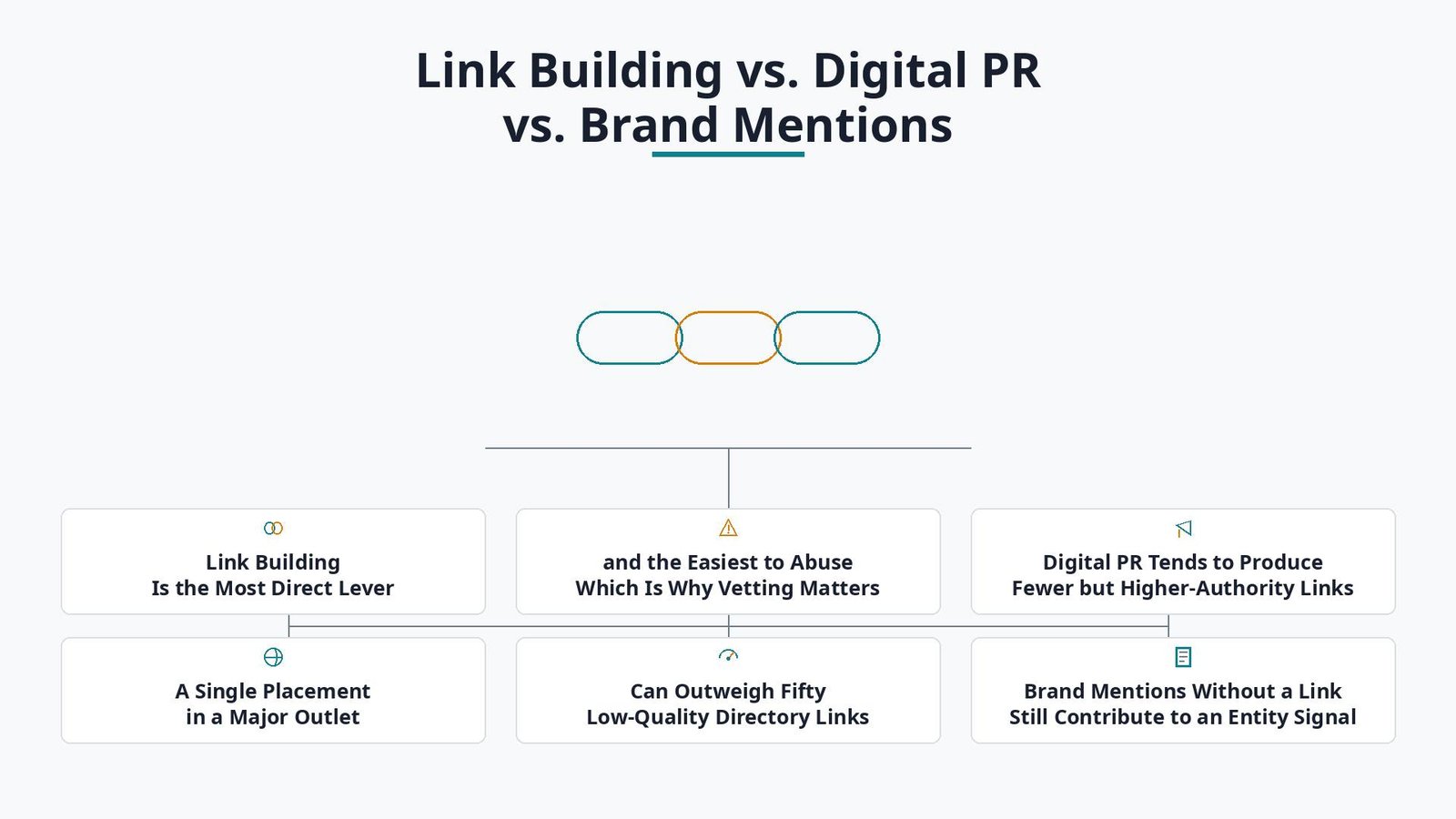
Link building is the most direct lever and the easiest to abuse, which is exactly why vetting matters so much here. Digital PR tends to produce fewer but much higher-authority links, since a single placement in a major outlet can outweigh fifty low-quality directory links combined.
Brand mentions without a link still contribute to what search engines treat as an entity signal. A site mentioned repeatedly across respected publications builds a pattern of trust that compounds over time, even when no anchor text is attached.
Why Off-Page Signals Matter to Google’s Ranking Algorithm
Backlinks remain one of the clearest proxies search engines use to judge how much other sites trust a given page. A study of 11.8 million Google search results by Backlinko found that the number of domains linking to a page correlated more strongly with rankings than almost any other single factor measured.
That correlation doesn’t mean quantity wins. Quality, relevance, and the linking domain’s own authority all factor into how much weight a single link carries.
Signs You Need to Outsource Off-Page SEO
You need an off-page SEO agency when your content quality has plateaued your rankings but your backlink profile hasn’t grown in months. I see this constantly with teams that nailed on-page optimization and technical SEO but never built a repeatable outreach process.
Other signals include a thin or stagnant referring domain count, competitors consistently outranking you despite weaker content, and an internal team with zero bandwidth for the relationship-building that quality link acquisition requires. Outreach at scale is a full-time discipline, not a side project for your content writer.
Step 1 — Audit Their Link Building Methodology
The first and most important vetting step is asking an agency to explain, in specific detail, exactly how they acquire links. Any agency that answers vaguely, or mentions “a network” without naming the process, should be a immediate pause point.
A legitimate methodology typically includes manual outreach, guest content placement on relevant sites, digital PR campaigns tied to original data or research, and broken link reclamation. Ask them to walk through a recent campaign start to finish, including who they contacted and why that site was a fit.
White Hat vs. Gray Hat vs. Black Hat Tactics

White hat link building earns links through genuine outreach, content value, and relationship building, and it’s the only approach that survives algorithm updates long-term. Gray hat tactics, like large-scale guest posting networks or link exchanges, sit in a risk zone that can work short-term and backfire later.
Black hat tactics include paid link schemes bought in bulk, private blog networks, and automated link injection, all of which violate Google’s spam policies directly. An agency that can’t clearly explain which category their work falls into is telling you everything you need to know.
Questions to Ask About Their Outreach Process
Ask how many personalized emails they send per link acquired, since a ratio that sounds too efficient usually signals bulk or paid placements rather than genuine outreach. Ask what percentage of their links come from guest posts versus other formats, and ask to see three recent live examples on sites in your industry.
Step 2 — Request Case Studies and Vertical Experience
Vertical experience matters because link building in healthcare, finance, or legal niches requires navigating compliance and editorial standards that don’t exist in e-commerce or SaaS. An agency with five years in local service businesses may have zero relevant contacts for a fintech client.
Ask for three case studies in industries close to yours, including before-and-after referring domain counts, timeframes, and at least one client reference you can actually call. Case studies without verifiable client names or without a willingness to connect you to a past client are a meaningful warning sign.
Step 3 — Evaluate Their Reporting and Transparency Standards

Reporting transparency separates agencies that want a long-term partnership from those optimizing for a quick contract. Every link acquired should be reported with the URL, the anchor text used, the domain’s authority metric, and the context of the placement.
I expect monthly reporting at minimum, with a live spreadsheet or dashboard the client can access anytime rather than a static PDF sent once a month. Agencies resistant to this level of visibility are usually hiding either low-quality links or inflated activity counts.
What a Legitimate Link Report Should Include
A legitimate link report lists the referring domain, the specific page the link was placed on, the anchor text, the link’s follow or nofollow status, and the domain rating or authority score at time of placement. It should also note whether the placement was editorial, paid, or exchanged.
Red Flags in Agency Reporting
Watch for reports that show link counts without URLs, vague language like “high authority placements” without metrics attached, or reports that can’t be independently verified by visiting the linking page yourself. If you can’t click through and see your link live, treat the report with suspicion.
Step 4 — Understand Their Pricing Model and What It Reveals
Pricing structure tells you more about an agency’s methodology than almost any sales conversation will. Agencies charging per link at very low rates, often under fifty dollars, are almost always buying placements in bulk rather than running genuine outreach.
Retainer-based pricing tied to a monthly link quota, campaign goals, and reporting cadence tends to align incentives better than pay-per-link models, which can quietly incentivize volume over quality. Ask exactly what’s included at each price tier and what happens if a target link count isn’t hit in a given month.
Step 5 — Check References, Reviews, and Retention Rates
Client retention rate is one of the most honest signals an agency can share, since businesses rarely stay long with a partner delivering poor or risky results. Ask directly what percentage of clients renew past the initial six-month or twelve-month contract.
Independent reviews on platforms like Clutch or G2 carry more weight than testimonials on the agency’s own site, since those platforms verify reviewer identity. A pattern of clients mentioning ranking drops, penalty recovery, or sudden unresponsiveness after signing is a consistent warning sign worth taking seriously.
Domain Authority and Domain Rating — What to Verify Before Signing

Domain authority and domain rating are third-party metrics, from Moz and Ahrefs respectively, that estimate how much ranking power a website carries based on its backlink profile. Neither metric is used directly by Google, but both correlate reasonably well with a domain’s overall link equity.
Before signing with an agency, verify the domain rating of sites they claim to have secured past placements on, since some agencies inflate perceived quality by citing the parent domain’s authority rather than the specific subdomain or page where your link would actually live. A link from a weak subpage of an otherwise strong domain carries far less value than the headline metric suggests.
Red Flags That Signal a Risky or Low-Quality Agency
The clearest red flag is a guaranteed ranking promise, since no legitimate SEO agency controls Google’s algorithm closely enough to guarantee position. Any contract language promising “page one in 30 days” should end the conversation immediately.
Other consistent warning signs include refusal to share a sample link report, pricing that seems dramatically lower than every competitor you’ve quoted, and an unwillingness to explain where links actually come from. Agencies relying heavily on private blog networks often disguise this by calling their inventory “exclusive media partnerships” or similar vague branding.
Watch also for agencies that can’t explain how they’d respond to a Google algorithm update affecting your rankings. A partner without a documented recovery process for ranking volatility isn’t equipped to handle the inevitable fluctuations that come with organic search.
How Off-Page SEO Pricing Typically Works in the US Market

Off-page SEO retainers in the US market typically range from $1,500 to $10,000 per month depending on competitiveness of the industry and volume of links targeted. Agencies serving highly competitive niches like legal, finance, or insurance often charge above $5,000 monthly, since quality placements in those verticals require more specialized outreach.
Per-link pricing, when used, generally runs from $150 to $1,000 per placement for genuinely vetted editorial links, with higher authority or more niche-relevant sites commanding the top of that range. Pricing significantly below this band almost always indicates lower-quality or bulk-acquired placements rather than a pricing advantage.
Realistic Timelines for Off-Page SEO Results
Off-page SEO typically takes four to six months to produce measurable ranking movement, and twelve months or more to fully mature a competitive keyword’s position. An Ahrefs study analyzing two million keywords found that only 5.7% of pages reach the top ten search results within a year of publishing, underscoring how gradual authority building really is.
Link building compounds rather than spikes, since each new high-quality link adds incremental trust rather than an immediate ranking jump. Agencies promising fast results within 30 to 60 days are either overpromising or relying on tactics that carry real penalty risk.
In-House vs. Agency vs. Freelancer — Choosing the Right Model
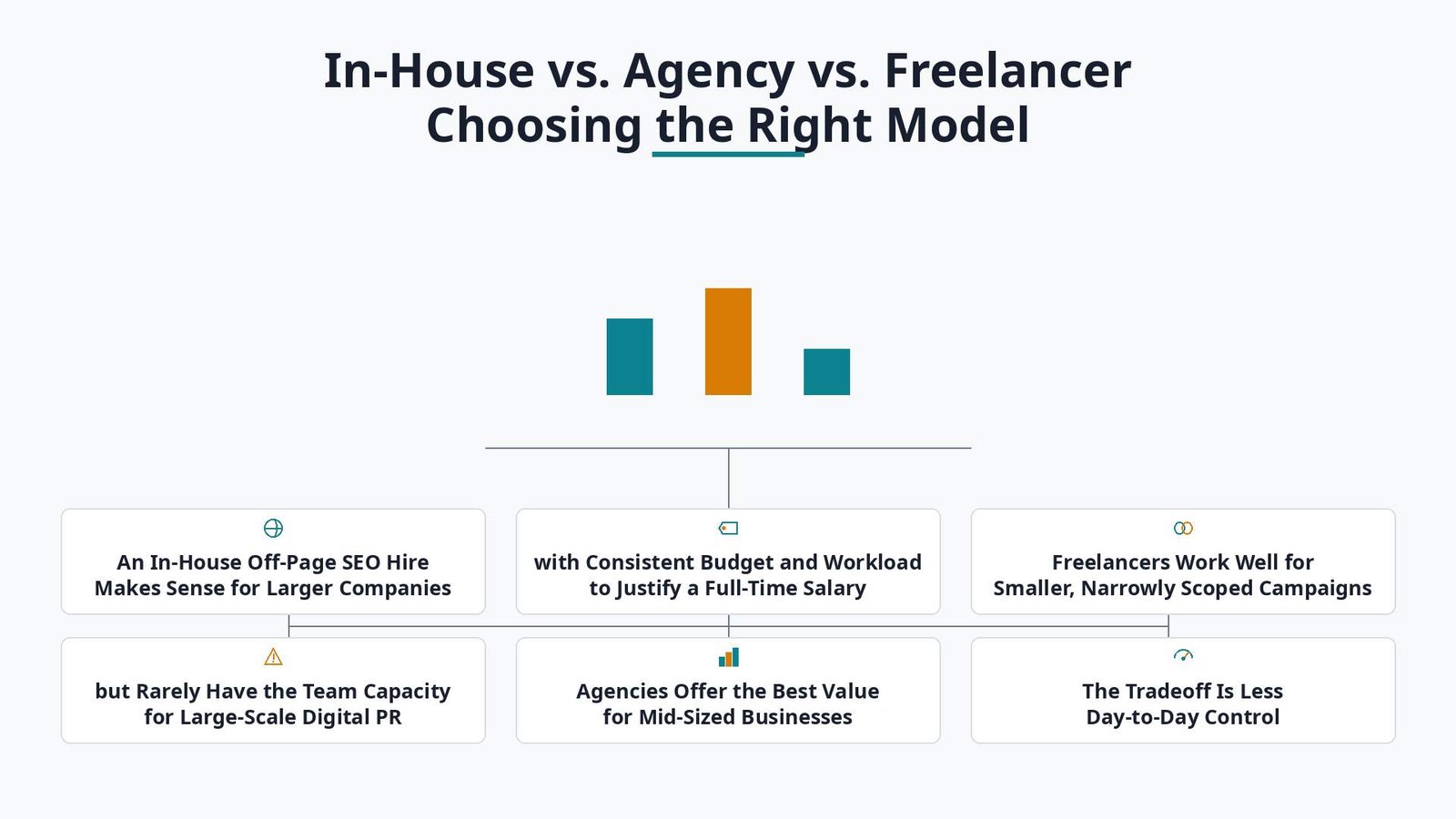
An in-house off-page SEO hire makes sense for larger companies with consistent budget and enough workload to justify a full-time salary plus the relationship-building time outreach requires. Freelancers work well for smaller, narrowly scoped campaigns but rarely have the team capacity for large-scale digital PR.
Agencies typically offer the best value for mid-sized businesses needing consistent monthly link acquisition without the overhead of a full internal team. The tradeoff is less day-to-day control, which is exactly why the vetting process matters as much as it does.
Questions to Ask During the Discovery Call
Ask what percentage of their links are nofollow versus dofollow, since a healthy natural link profile includes both rather than being entirely dofollow, which itself can look manipulative to search engines. Ask how they identify target sites and what minimum quality threshold they apply before pursuing a placement.
Ask directly what happens if a placement gets removed or a linking site gets deindexed, and whether replacement links are included in the retainer. Their answer reveals whether they view the relationship as ongoing partnership or one-time transaction.
Contract Terms and Exit Clauses to Negotiate
Month-to-month contracts offer more flexibility than long-term lock-ins, especially for a first engagement with a new agency. I generally recommend negotiating a 90-day initial term with clear exit clauses rather than committing to a full year upfront.
Ask who owns the link building data and reporting history if the relationship ends, since some agencies treat that information as proprietary rather than client-owned. Clarify in writing whether links already secured remain live after contract termination, since some lower-quality providers remove placements once payment stops.
How Off-Page SEO Fits Into Your Overall SEO Strategy
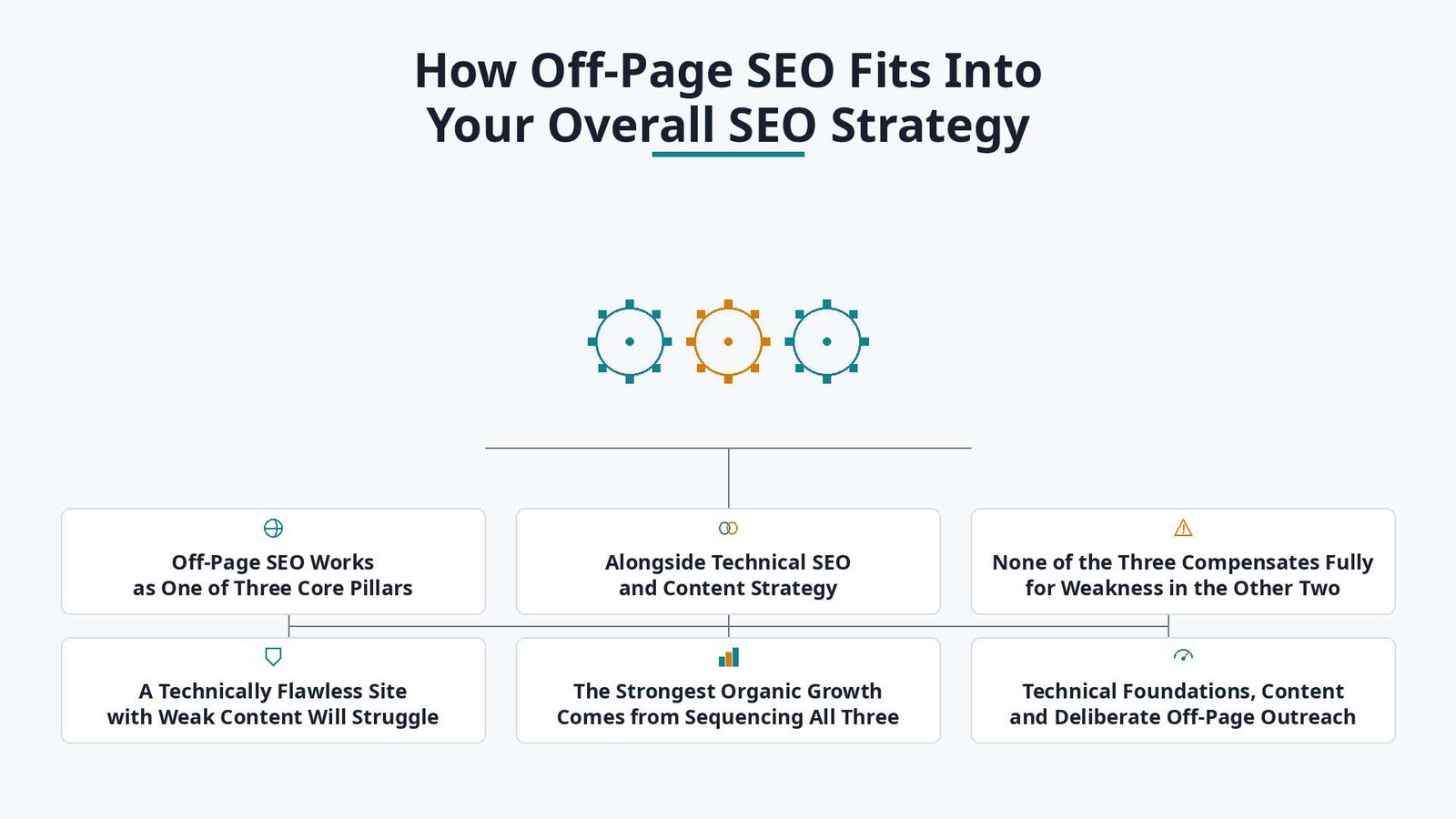
Off-page SEO works as one of three core pillars alongside technical SEO and content strategy, and none of the three compensates fully for weakness in the other two. A technically flawless site with weak content will struggle to earn organic links regardless of outreach effort, since nobody links to thin or unoriginal material.
The strongest organic growth comes from sequencing all three disciplines together: technical foundations that let search engines crawl and index properly, content worth linking to, and deliberate off-page outreach that earns authority at a sustainable pace.
Conclusion
Vetting an off-page SEO agency comes down to five checkpoints: methodology, case studies, reporting, pricing, and references. Each one exposes whether a partner builds real authority or risky shortcuts.
The agencies worth hiring treat link building as a compounding, long-term discipline rather than a quick transaction. Expect steady growth, not overnight rankings.
We built White Label SEO Service around exactly this kind of transparency. Talk to us before you sign with anyone else.
Frequently Asked Questions
How much does off-page SEO cost per month?
Off-page SEO retainers in the US typically cost between $1,500 and $10,000 monthly. Pricing depends on industry competitiveness, target link volume, and the agency’s outreach methodology.
How long does off-page SEO take to show results?
Off-page SEO usually takes four to six months to show measurable ranking movement. Competitive keywords can take twelve months or longer to fully mature.
What’s the difference between white hat and black hat link building?
White hat link building earns links through genuine outreach and valuable content. Black hat tactics use paid schemes or automated networks that violate search engine guidelines.
Can a bad SEO agency hurt my website’s rankings?
Yes, a bad SEO agency can trigger ranking penalties through manipulative link schemes. Recovery from a penalty can take months and sometimes requires a full disavow process.
Should I choose an agency or an in-house SEO hire?
Agencies work best for mid-sized businesses needing consistent monthly link acquisition without full-time overhead. In-house hires make more sense for larger companies with sustained budget and workload.
What questions should I ask an SEO agency before hiring them?
Ask how they acquire links, what percentage are dofollow versus nofollow, and what happens if a placement gets removed. Their answers reveal whether they prioritize quality or volume.
What is a good domain rating for a backlink?
A domain rating above 40 to 50 generally indicates a reasonably authoritative linking site. Context matters more than the number alone, since relevance and traffic also affect link value.


