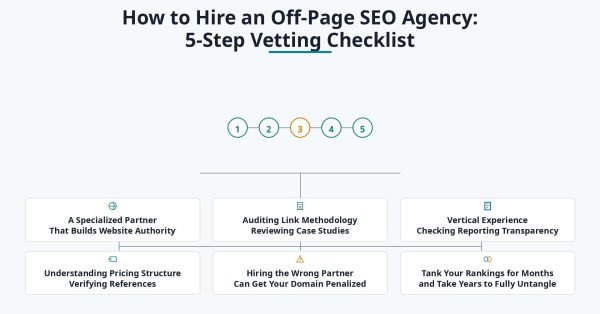

Off-page SEO is the set of actions taken outside your own website that signal trust, relevance, and authority to search engines. Primarily through backlinks, brand mentions, and third-party validation. I think of it as the reputation layer of SEO: it tells Google what the rest of the internet thinks of you, not just what you say about yourself. For businesses trying to rank competitively, off-page work is usually the deciding factor once on-page fundamentals are in place.
Most sites plateau not from weak content but from a lack of external trust signals. I’ve watched technically perfect websites stall at page two because nobody else on the internet vouched for them.
This guide covers what off-page SEO actually is and why it matters, how backlinks and link quality build authority, the core strategies for earning links through outreach and PR, local and brand-based trust signals, how to vet prospects and avoid penalties, and a realistic month-by-month roadmap with the tools to track it all.
What Is Off-Page SEO and Why It Matters for Rankings
Off-page SEO is the practice of building a website’s authority and relevance through external signals like backlinks, brand mentions, and third-party engagement rather than changes made directly on the site. Google’s algorithm treats these external signals as a vote of confidence. The more relevant, authoritative sources that point to a page, the more trustworthy that page appears.
I separate this clearly from on-page SEO in my own process, because the two solve different problems entirely.
Off-Page SEO vs. On-Page SEO

On-page SEO controls what you say about your own content: titles, headers, internal structure. Off-page SEO controls what everyone else says about it. A site can have flawless on-page optimization and still fail to rank if nothing else on the web references it.
I treat on-page work as the prerequisite and off-page work as the multiplier. One without the other rarely produces durable rankings.
How Off-Page Signals Influence Google’s Algorithm
Google’s ranking systems use external signals as a proxy for real-world trust, since a page can’t honestly grade its own authority. Google’s own Search Rater Guidelines describe trustworthiness as a core evaluation factor, built largely through reputation earned outside the page itself.
This is why two pages with identical content can rank completely differently. The one with stronger external validation wins.
How Backlinks Build Domain Authority
A backlink is a link from one website to another that passes a portion of the linking site’s authority, often called link equity, to the destination page. The more authoritative and relevant the linking domain, the more weight that single link carries.
I’ve seen one link from a respected industry publication outperform fifty links from low-quality directories combined.
Link Equity and PageRank Explained
Link equity is the value a backlink transfers based on the authority, relevance, and trustworthiness of the linking page. This concept traces back to Google’s original PageRank algorithm, which treated links as citations in an academic sense. The more a page was cited by respected sources, the more authoritative it became.
Relevance matters as much as authority here. A moderately authoritative site in your exact niche often passes more usable equity than a high-authority site in an unrelated industry.
Follow vs. Nofollow Links
Follow links pass link equity directly to the destination page, while nofollow links tell search engines not to pass that ranking credit, though they can still drive referral traffic and brand visibility. A healthy link profile includes both types naturally, since an all-follow profile looks manufactured rather than organic.
I stopped chasing follow-only links years ago. A mix that includes nofollow mentions from legitimate sites actually builds more trust, not less.
Link Quality Factors That Determine Link Value
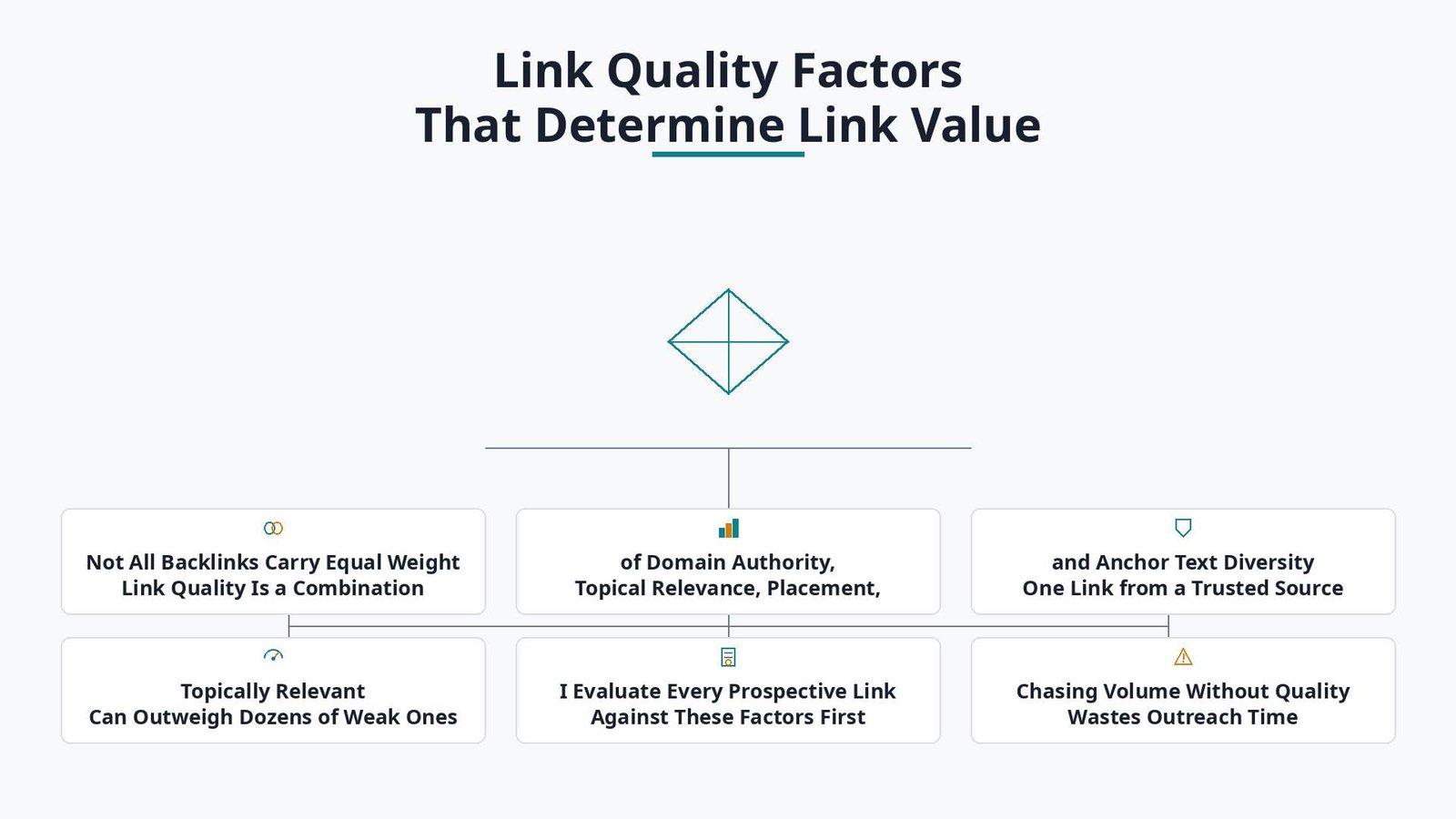
Not all backlinks carry equal weight, and link quality is determined by a combination of domain authority, topical relevance, placement, and anchor text diversity. One link from a trusted, topically relevant source can outweigh dozens of weak, irrelevant ones.
I evaluate every prospective link against these factors before pursuing it, because chasing volume without quality wastes outreach time.
Domain Authority and Relevance
Domain authority measures a site’s overall backlink strength and trust, but relevance measures whether that strength is actually useful in your specific context. A high-authority site in a completely unrelated industry transfers far less practical value than a moderately authoritative site covering your exact topic.
I prioritize relevance first and authority second in nearly every outreach campaign I run.
Anchor Text Diversity
Anchor text diversity refers to varying the clickable text used in backlinks so the link profile looks natural rather than manipulated. Google’s Penguin algorithm update specifically targeted sites with unnaturally repetitive, keyword-stuffed anchor text patterns.
A natural profile mixes branded anchors, naked URLs, generic phrases, and exact-match keywords without any single pattern dominating.
Core Link Building Strategies for Sustainable Growth
Sustainable link building relies on a mix of content-driven outreach, digital PR, and relationship-based acquisition rather than paid or automated shortcuts. The strongest link profiles I’ve built combine several of these methods running simultaneously rather than relying on one single tactic.
Each strategy below plays a different role in a complete authority-building campaign.
Guest Posting and Content Partnerships
Guest posting involves contributing original content to another relevant website in exchange for a contextual backlink, and it remains one of the most reliable ways to earn relevant links when done with genuinely useful content. The key differentiator between effective guest posting and spam is whether the host site’s audience actually benefits from the piece.
I only pursue guest posts on sites whose audience overlaps meaningfully with the target site’s own readers.
Digital PR and Linkable Assets
Digital PR for SEO combines traditional public relations tactics with link acquisition goals, using original research, data studies, or newsworthy content to earn coverage and links from journalists and publishers. A single well-promoted data study can generate dozens of high-authority links in a way that manual outreach alone rarely matches.
Broken Link Building
Broken link building involves finding dead links on other websites and suggesting your own relevant content as a replacement, benefiting both the linking site and the site earning the new link. It works because webmasters generally want to fix broken links on their own pages but may not have noticed them.
This tactic scales slowly but produces a genuinely high acceptance rate when the replacement content is a strong match.
How to Earn Links Through Digital PR and Media Outreach

Digital PR outreach starts with identifying a newsworthy angle, then pitching it directly to journalists, editors, or niche publishers who cover that subject area. The goal is earning coverage because the story or data genuinely deserves it, not because you asked for a favor.
I’ve found that journalists respond far more to a specific, quotable statistic than to a generic pitch about a business.
Building Relationships With Journalists and Publishers
Relationship-based outreach means engaging with journalists and publishers consistently over time rather than only reaching out when you need something. Tools like HARO and similar journalist request platforms connect sources with reporters actively looking for expert commentary, making this one of the more accessible entry points into digital PR.
Consistency compounds here. A journalist who gets one useful quote from you is far more likely to reach out again directly.
Local Off-Page SEO and Citation Building
Local off-page SEO focuses on building consistent business listings, citations, and location-based trust signals that help a business rank in local search results and map packs. For service-area businesses, this often matters more than traditional link building.
I treat citation consistency as foundational local work that has to happen before any other local SEO tactic pays off.
NAP Consistency Across Directories
NAP consistency means ensuring a business’s name, address, and phone number match exactly across every directory, citation, and listing where it appears. Inconsistent NAP data confuses local ranking algorithms and can suppress visibility even when every other signal is strong.
I run a full citation audit before starting any local campaign, because fixing existing errors often produces faster gains than building new citations.
Google Business Profile Signals
A Google Business Profile is the free business listing that powers local map pack rankings, and its signals include review volume, review recency, photo activity, and category accuracy. Google’s own guidance on local ranking factors confirms that relevance, distance, and prominence together determine map pack placement.
Review velocity specifically has become one of the strongest local ranking signals I track month to month.
The Role of Brand Mentions and Unlinked Citations

A brand mention is any reference to a business name across the web, whether or not it includes a hyperlink, and Google’s systems are capable of recognizing these unlinked citations as a trust signal. This means visibility efforts beyond pure link building still contribute meaningfully to authority.
I stopped dismissing unlinked mentions years ago once I saw sites with heavy brand mention volume consistently outrank sites with more links but less brand presence.
Earning these mentions typically happens through press coverage, podcast appearances, and organic word-of-mouth rather than direct outreach for a link.
Social Signals and Their Indirect Impact on SEO
Social signals refer to likes, shares, and engagement a piece of content receives on social platforms, and while Google has stated these aren’t a direct ranking factor, they influence SEO indirectly by increasing content visibility and link-earning potential. Content that spreads widely on social platforms gets seen by more people who might cite or link to it.
I use social distribution as an amplification layer for digital PR campaigns rather than as a standalone ranking strategy.
The indirect effect is real even without a direct algorithmic weight: more eyeballs on content means more natural backlink opportunities.
Influencer and Partnership Outreach for Authority Building
Influencer outreach for link building means partnering with recognized voices in an industry to create content, reviews, or mentions that drive both referral traffic and authoritative backlinks. Unlike traditional advertising, this approach earns organic-feeling citations because the influencer’s audience already trusts their recommendations.
I pick partners based on audience overlap and content fit rather than raw follower count, since a smaller, highly relevant audience converts better than a broad, unrelated one.
How to Evaluate and Vet Link Prospects
Vetting a link prospect means checking its authority, relevance, traffic, and spam indicators before pursuing or accepting a backlink opportunity. Skipping this step is how sites end up with a toxic link profile that eventually requires cleanup.
| Vetting Factor | What to Check | Red Flag |
| Domain Authority | Site-wide trust score | Extremely low or artificially inflated |
| Organic Traffic | Real search visibility | Little to no organic traffic |
| Topical Relevance | Niche overlap | Completely unrelated industry |
| Spam Score | Toxic backlink indicators | High spam score, link farm patterns |
| Content Quality | Editorial standards | Thin, AI-spun, or duplicate content |
Spam Score and Toxic Link Indicators
A spam score estimates how likely a domain is to be penalized or already flagged by search engines, based on patterns like thin content, excessive outbound links, and link farm association. Moz’s Spam Score metric is one of the most widely used tools for this specific check.
I run every prospective link through a spam check before outreach even begins, not after the link is live.
Relevance and Traffic Metrics
Relevance and organic traffic together indicate whether a linking site has a real audience in a related space, rather than existing purely to sell links. A site with zero organic traffic is almost always a red flag regardless of how high its authority score appears.
Common Off-Page SEO Mistakes and Penalty Risks
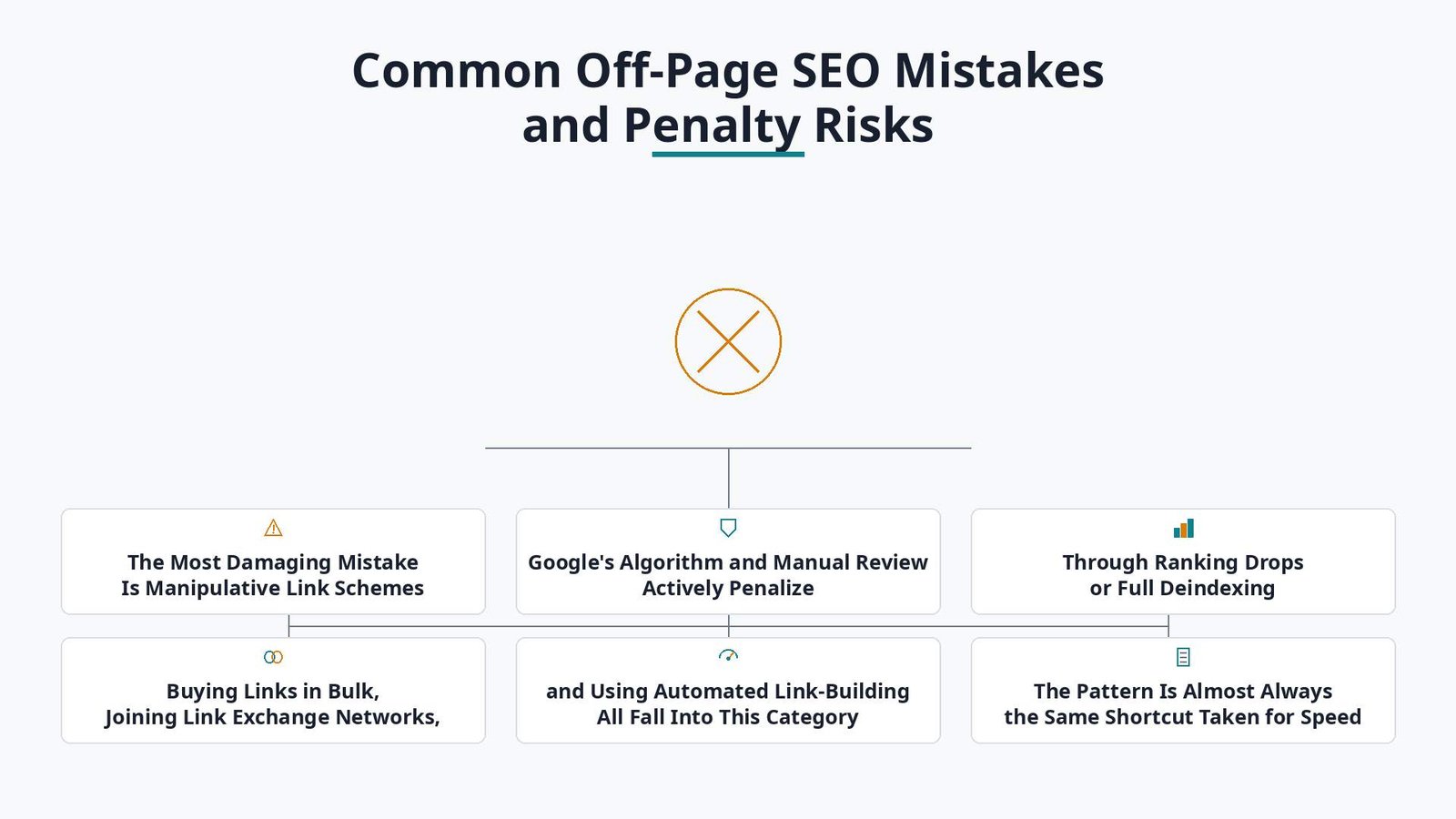
The most damaging off-page SEO mistake is participating in manipulative link schemes, which Google’s algorithm and manual review teams actively penalize through ranking drops or full deindexing. Buying links in bulk, joining link exchange networks, and using automated link-building software all fall into this category.
I’ve helped recover sites from these exact penalties, and the pattern is almost always the same shortcut taken for speed.
Link Schemes and Manipulative Practices
A link scheme is any pattern of link acquisition designed to manipulate rankings rather than earned through genuine editorial merit, including paid links, excessive link exchanges, and automated directory submissions. Google’s own link scheme documentation explicitly lists these practices as violations of its spam policies.
The risk isn’t just a ranking drop. A manual action can take months to fully recover from even after the offending links are removed.
Recovering From a Link-Based Penalty
Recovering from a link penalty requires auditing the entire backlink profile, disavowing toxic links through Google Search Console, and submitting a reconsideration request if a manual action was applied. This process typically takes several months before rankings begin to stabilize again.
I treat link audits as a quarterly habit for established sites specifically to avoid ever reaching this point.
How to Build a Step-by-Step Off-Page SEO Roadmap
A complete off-page SEO roadmap moves through three phases over twelve months: foundational audit and setup, active outreach and link acquisition, and long-term scaling and authority compounding. Skipping the foundation phase to jump straight into outreach is the most common reason campaigns underperform early on.
- Audit the existing backlink profile and disavow toxic links
- Build core citations and local listings for NAP consistency
- Develop linkable assets such as original research or data studies
- Launch targeted outreach campaigns to relevant publishers
- Pursue digital PR coverage around newsworthy angles
- Monitor new links weekly and vet every acquisition
- Scale successful outreach channels and cut underperforming ones
- Reassess domain authority and competitive gaps quarterly
Month 1-3: Foundation and Audit
The first phase focuses on auditing existing links, fixing citation inconsistencies, and identifying linkable asset opportunities before any outreach begins. This groundwork prevents wasted effort chasing links on a foundation that still has technical or trust issues.
Month 4-6: Outreach and Acquisition
The second phase shifts into active outreach, guest posting, and digital PR pitching once the foundation is stable and linkable assets are ready to promote. This is typically when the first meaningful wave of new backlinks starts appearing.
Month 7-12: Scaling and Authority Compounding
The final phase scales whatever outreach channels proved most effective and compounds authority through consistent, ongoing link acquisition rather than one-off campaigns. Off-page SEO never fully stops here. It shifts from building a foundation to maintaining competitive momentum.
Realistic Off-Page SEO Timelines and Milestones
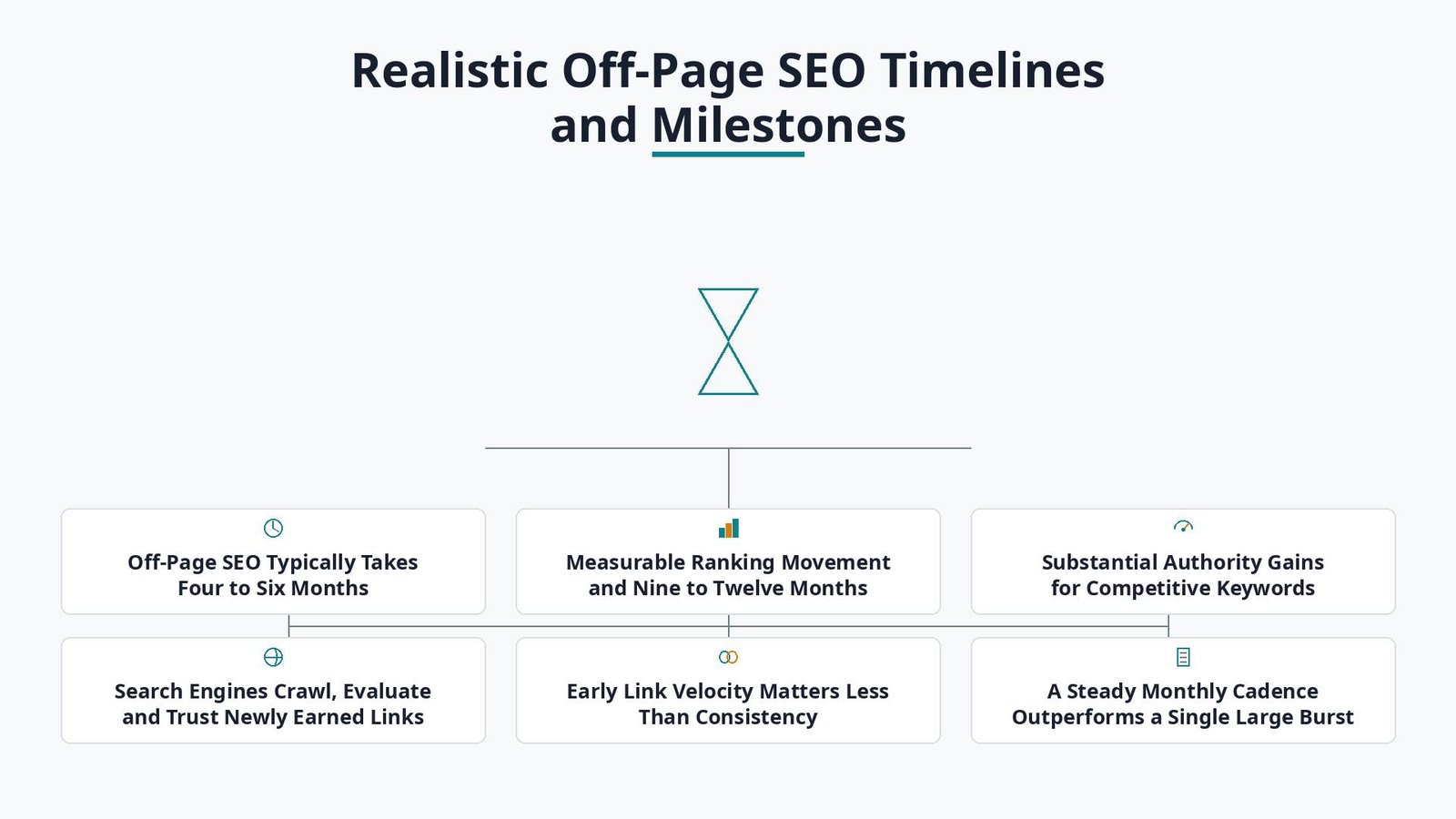
Off-page SEO typically takes four to six months to show measurable ranking movement and nine to twelve months to produce substantial authority gains for competitive keywords. This timeline reflects how long it takes search engines to crawl, evaluate, and trust newly earned links.
I set these expectations with every client upfront specifically because off-page work rewards patience far more than on-page fixes do.
Early link velocity actually matters less than consistency. A steady monthly cadence of quality links outperforms a single large burst followed by months of silence.
Tools for Tracking Off-Page SEO Performance
Tracking off-page SEO performance requires monitoring new and lost backlinks, referring domain growth, domain authority trends, and spam score fluctuations over time. Ahrefs and Google Search Console remain two of the most reliable tools for this ongoing monitoring work.
I check referring domain growth weekly and full backlink audits monthly, since catching a toxic link early is far easier than cleaning up a profile six months later.
Referring domain count matters more than raw backlink count in nearly every audit I run, since ten links from ten different domains carry more weight than fifty links from one single site.
How Off-Page SEO Fits Into a Complete SEO Strategy

Off-page SEO works alongside technical SEO and content strategy as one of three pillars that together determine organic search performance. Technical SEO ensures a site can be crawled and indexed, content strategy ensures it satisfies search intent, and off-page SEO ensures it carries enough external trust to actually rank.
None of these three pillars compensates fully for a severe weakness in another. A technically flawless, content-rich site with zero external authority still struggles against competitors who have all three working together.
Conclusion
Off-page SEO builds the external trust signals, backlinks, and brand authority that search engines use to validate relevance earned elsewhere on a site. Domain authority, link quality, and citation consistency compound together over time rather than in isolation.
Sustainable rankings depend on pairing this authority work with solid technical and content foundations across the full strategy. The deeper tactics in each roadmap phase reward consistent execution over many months.
We build these authority campaigns for clients every day, and {{White Label SEO Service}} can map your realistic roadmap starting now.
Frequently Asked Questions
How long does off-page SEO take to show results?
Off-page SEO typically takes four to six months to show measurable ranking movement. Competitive industries often require nine to twelve months for substantial authority gains to fully materialize.
How many backlinks do I need per month?
There’s no fixed number, since link quality matters more than volume. Most sustainable campaigns target five to fifteen relevant, high-quality links monthly depending on competition.
Is social media part of off-page SEO?
Social media isn’t a direct ranking factor, but it indirectly supports off-page SEO. Increased content visibility from social sharing often leads to more natural backlink opportunities.
What is a good domain authority to aim for?
A “good” domain authority depends entirely on your specific competitive landscape. Comparing your score against direct competitors matters more than chasing an arbitrary number.
Can off-page SEO hurt my rankings?
Yes, manipulative off-page tactics like link schemes can trigger penalties. Buying links in bulk or using automated link networks are the most common causes of ranking drops.
Do I need an agency for off-page SEO or can I do it myself?
Off-page SEO can be done in-house, but it requires significant time for outreach, vetting, and relationship building. Many businesses outsource it to maintain consistent execution.
What is the difference between off-page SEO and link building?
Link building is one component of off-page SEO, focused specifically on earning backlinks. Off-page SEO also includes brand mentions, social signals, and local citation building.