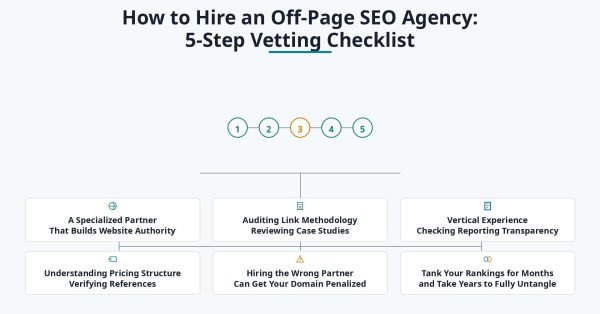

Off-page SEO is the set of activities performed outside your own website that build its authority and trustworthiness in the eyes of search engines, primarily through backlinks, brand mentions, and third-party signals. I’ve watched this category get oversimplified into “just link building” more times than I can count, and that framing costs businesses money. It’s actually a portfolio of distinct services, each with its own pricing logic and expected output.
Getting this wrong usually means overpaying for low-value links or underinvesting in the channels that actually move rankings. Thirty words, no fluff, just the stakes.
This guide covers the full menu of off-page SEO services, how each is typically priced, what counts as a legitimate deliverable, and the red flags that separate a real strategy from a wasted retainer. I’ll also show where off-page work fits inside a complete SEO program.
What Is Off-Page SEO and Why It Still Drives Rankings
Off-page SEO refers to the external actions taken to influence a website’s search rankings, distinct from the on-page work done directly on the site itself. I think of it as reputation management at scale — every backlink, mention, and citation is a small vote of confidence from somewhere else on the internet.
Search engines can’t ask a website “are you trustworthy?” directly, so they infer it from external signals. A site that earns links from respected publications and industry voices reads as more credible than one with none, regardless of how clean its code is.
Off-Page vs. On-Page SEO: Where the Line Falls

On-page SEO happens inside your own HTML, content, and site architecture. Off-page SEO happens everywhere else — other websites, social platforms, directories, and press coverage. I separate the two deliberately because they’re bought, measured, and priced completely differently, and conflating them in a contract is how scope creep starts.
Why Search Engines Weight External Signals So Heavily
External signals are harder to fake than on-page content, which is exactly why Google leans on them. Google’s own search quality guidelines treat backlinks and brand reputation as core trust signals that feed directly into how a site’s authority gets assessed. Anyone can write a page claiming expertise; far fewer third parties will link to or mention a site unless it earned that attention.
Link Building Services
Link building is the practice of acquiring hyperlinks from other websites that point back to your own, and it remains the most heavily invested category inside off-page SEO. I split it into four distinct service types because they’re sold, delivered, and priced on completely different models, and lumping them together in a proposal is usually a sign the agency hasn’t thought it through.
A legitimate provider will tell you exactly which of these four you’re buying before any invoice goes out.
Guest Posting and Editorial Placements
Guest posting means writing original content for publication on another website in exchange for a contextual backlink, usually placed within the body of the article rather than an author bio. I treat editorial placements as the gold standard here — the host site’s editorial team decides the content is genuinely valuable enough to run, rather than accepting it purely because payment changed hands.
Digital PR and Linkable Asset Campaigns
Digital PR campaigns typically combine original research, data studies, or newsworthy assets with targeted outreach to journalists and publications who then link to the source material organically. This is link building through earned coverage rather than direct placement, and it tends to produce the highest-authority links in any campaign.
Niche Edits and Link Insertions
A niche edit is the insertion of a new link into an already-published, often older piece of content on another site, rather than commissioning fresh content. They’re faster and cheaper to execute than guest posts, which is exactly why pricing on this service type runs lower per link.
Broken Link Building and Resource Page Outreach
This approach involves finding dead links on resource and reference pages, then pitching a replacement link to the site owner. It’s labor-intensive relative to its output, so most agencies price it as a flat project fee rather than folding it into a retainer.
Digital PR and Media Outreach Services
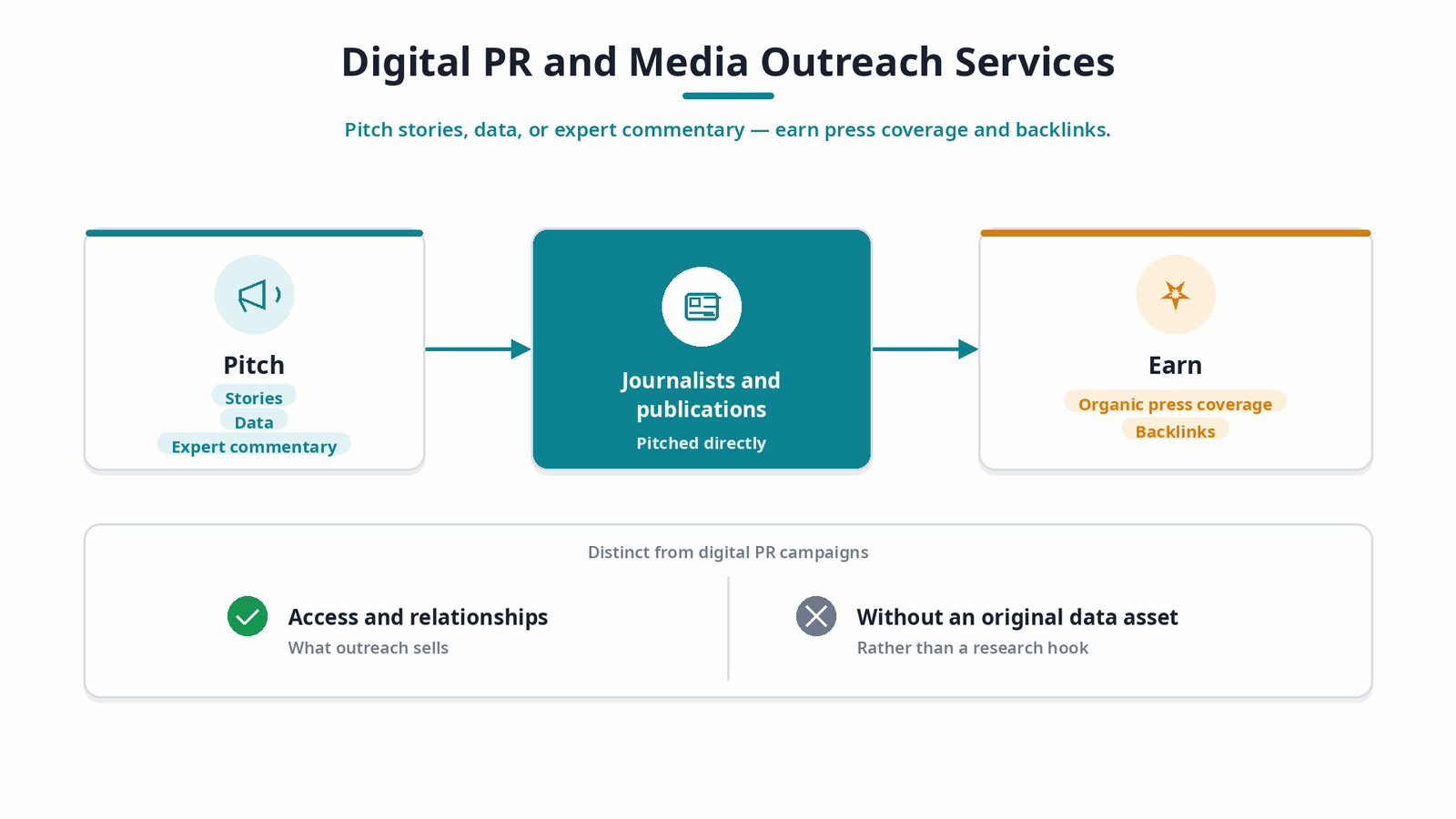
Media outreach is the practice of pitching stories, data, or expert commentary directly to journalists and publications to earn organic press coverage and backlinks. I keep this distinct from the digital PR campaigns mentioned above because pure outreach services often operate without an original data asset — they’re selling access and relationships rather than a research hook.
Journalist and HARO-Style Outreach
HARO-style outreach connects brand spokespeople with journalists actively seeking expert quotes for stories already in production. A 2024 analysis by Terkel found that HARO-style platforms typically convert quote submissions into published, linked mentions at rates well under 10%, which is why pricing here reflects volume of pitches sent, not guaranteed placements.
Press Release Distribution and Its Real SEO Value
Press release distribution pushes an announcement through a newswire network to hundreds of syndication partners simultaneously. Most of those syndicated copies carry nofollow links and provide limited direct ranking value, though the practice can still generate brand visibility and occasional pickup by larger outlets.
Guest Posting and Content Syndication Services
Content syndication republishes existing content on third-party platforms, generally with a canonical tag or attribution link back to the original source, and it’s priced separately from fresh guest posting because no new writing is required. I see it sold as a volume add-on more often than a standalone service, since the content already exists and the labor is purely placement.
The deliverable here is distribution reach rather than link authority, which matters when an agency tries to bundle it into a link-building retainer at the same per-unit price.
Local SEO and Citation Building Services
A citation is any online mention of a business’s name, address, and phone number, typically on directories, review platforms, and industry listings. I treat citation building as foundational rather than advanced — it’s the baseline trust layer that local and multi-location businesses need before anything else off-page matters.
NAP Consistency and Data Aggregators
NAP consistency refers to keeping a business’s name, address, and phone number identical across every directory and listing. Data aggregators feed this information to dozens of smaller directories automatically, which is why a single cleanup project often resolves inconsistencies across far more platforms than a manual edit ever could.
Google Business Profile Optimization as an Off-Page Signal
Google Business Profile optimization sits technically outside a website’s own domain, which classifies it as an off-page activity even though it feels adjacent to on-page work. A complete, actively managed profile with reviews and regular updates functions as a trust signal that search engines weigh heavily for any business targeting local search results.
Social Media Signals and Brand Mention Services

Social signals are the shares, likes, comments, and mentions a brand or piece of content receives across social platforms. I’m direct with clients about this one: social signals are not a confirmed direct ranking factor, but they correlate strongly with increased content visibility, which indirectly drives more natural backlinks and citations.
Agencies selling “social signals for SEO” as a direct ranking lever are usually overselling the mechanism, even when the underlying activity has real indirect value.
Influencer and Partnership Marketing for SEO
Influencer marketing for SEO purposes means partnering with creators or industry figures to generate mentions, backlinks, and referral traffic from their existing audience. The SEO value comes specifically from the backlinks and brand mentions these partnerships generate, not from the influencer’s follower count alone.
I look for partnerships where the creator’s audience genuinely overlaps with the target customer, because a mismatched partnership produces traffic that bounces immediately and signals low relevance back to search engines.
Forum, Community, and Q&A Engagement (Reddit, Quora)
Forum and community engagement involves contributing genuine, helpful answers on platforms like Reddit and Quora, occasionally with a contextual link back to a relevant resource. Google has openly increased visibility for forum content in search results, which has made community engagement a more serious off-page channel than it was several years ago.
The deliverable here is reputational presence and occasional referral traffic rather than high-authority backlinks, since most community platforms nofollow outbound links by default.
Podcast and Video Placement Services
Podcast placement means securing guest appearances on industry podcasts, typically earning a backlink from the show’s episode notes or website alongside audience exposure. This service is priced per placement rather than per link, because the primary deliverable is the appearance itself, with the link treated as a secondary benefit.
Video placement follows a similar logic on platforms like YouTube, where a mention or link in a video description provides modest direct SEO value alongside meaningful brand exposure.
Brand Mention and Unlinked Mention Reclamation
An unlinked mention is any instance where a website references a brand name without actually hyperlinking to the brand’s site. Mention reclamation is the process of contacting those sites and requesting the mention be converted into a clickable link.
This service tends to have the highest conversion rate of any link acquisition tactic, since the site owner already chose to mention the brand voluntarily — the ask is simply to finish the job with a link.
Off-Page SEO Pricing Models Explained

Off-page SEO services are typically sold under one of three pricing structures: monthly retainers, per-link or per-project fees, and performance-based or hybrid arrangements. Each model shifts risk differently between the agency and the client, and understanding which one you’re signing matters more than the headline price.
| Pricing Model | Typical Structure | Best Fit | Risk Position |
| Monthly Retainer | Fixed monthly fee for ongoing activity | Businesses wanting consistent, long-term link velocity | Client bears most risk |
| Per-Link / Per-Project | Fixed fee per deliverable (link, campaign, placement) | Businesses testing a provider or needing specific volume | Shared risk |
| Performance-Based / Hybrid | Base fee plus bonus tied to rankings or links delivered | Businesses wanting cost tied to results | Agency bears more risk |
Monthly Retainer Pricing
A retainer is a recurring fee paid for an ongoing volume of off-page activity, usually scoped around a set number of links, outreach campaigns, or placements per month. Ahrefs’ 2024 agency pricing survey found that most link-building retainers in the US fall between $1,500 and $5,000 per month, with higher tiers reflecting higher-authority placements rather than sheer volume.
Per-Link or Per-Project Pricing
Per-link pricing charges a flat fee for each individual backlink delivered, which gives buyers direct visibility into unit cost but can incentivize agencies to prioritize cheap, lower-quality links to hit a target count. I recommend this model mainly for smaller, defined projects rather than ongoing authority building.
Performance-Based and Hybrid Pricing
Performance-based pricing ties some portion of the fee to actual ranking improvements or confirmed link placements rather than activity alone. These arrangements are rarer because off-page results depend on factors outside any single agency’s control, like algorithm updates and competitor activity, so most hybrids use modest bonuses rather than full performance-only billing.
What’s Included in Off-Page SEO Deliverables
A legitimate off-page SEO deliverable package includes a documented list of links or mentions earned, the authority metrics of each placement, and a monthly performance report connecting that activity to ranking or traffic changes. I ask every new client to request this level of detail upfront, because vague deliverables are the single biggest source of disputes in this industry.
Standard Monthly Reporting Components
A complete monthly report lists every link or mention acquired that period, the referring domain’s authority score, the anchor text used, and the target page it points to. Reports missing any of these four elements make it nearly impossible to judge whether the spend produced real value.
Link Quality Metrics Agencies Should Disclose
Quality metrics worth requesting include domain rating or domain authority, organic traffic to the referring site, topical relevance to your industry, and whether the link is followed or nofollowed. A provider unwilling to share these numbers is usually hiding weak placements behind vague language like “high authority sites.”
How to Evaluate Off-Page SEO Costs vs. Value
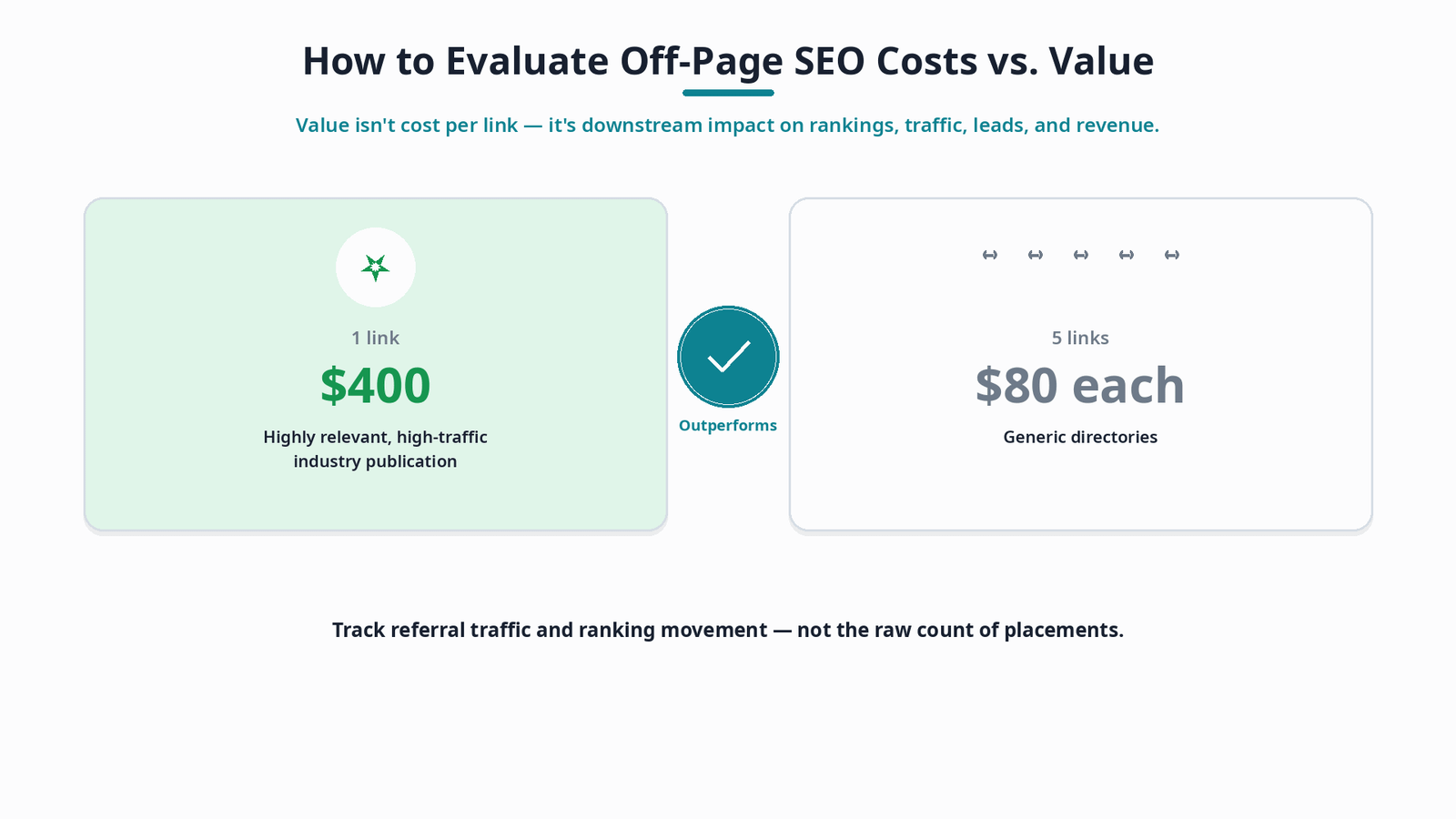
The real measure of off-page SEO value isn’t cost per link, it’s the downstream impact on rankings, organic traffic, and ultimately leads or revenue. A $400 link from a highly relevant, high-traffic industry publication often outperforms five $80 links from generic directories, even though the line-item cost looks higher.
I encourage clients to track referral traffic and ranking movement on pages receiving new links, not just the raw count of placements delivered each month.
Red Flags in Off-Page SEO Pricing and Packages
The clearest warning sign in off-page SEO pricing is a guarantee of a specific number of links at an unusually low flat rate, since quality placements can’t be mass-produced that cheaply. Private blog networks, link farms, and bulk directory submissions are the usual mechanisms behind those low prices, and they carry real penalty risk under Google’s link spam policies.
Other signals worth watching include refusal to name actual publications, reports that show only link counts without authority metrics, and contracts with no clear deliverable definitions at all.
How Off-Page SEO Fits Into a Full SEO Strategy

Off-page SEO works alongside technical SEO and content strategy rather than replacing either one; links earned for a page with poor technical health or thin content rarely produce lasting ranking gains. I treat off-page investment as the amplifier, not the foundation — it makes strong pages rank higher, but it won’t rescue a page that fails to satisfy the search intent behind its target query.
The strongest results I’ve seen come from sequencing: technical fixes and content quality established first, off-page authority building layered in once there’s something worth amplifying.
Conclusion
Off-page SEO spans link building, digital PR, citations, and reputation signals, each priced and delivered differently. Understanding these distinctions turns a vague monthly invoice into a measurable investment.
We treat off-page work as one layer of a complete strategy, not a standalone fix for ranking problems. Pairing it with technical and content work compounds results over time.
We build off-page SEO programs with transparent deliverables and real reporting. Talk to White Label SEO Service about a strategy built around your actual growth goals.
Frequently Asked Questions
What is off-page SEO in simple terms?
Off-page SEO is any activity done outside your own website to build its authority and trust with search engines. It mainly involves backlinks, brand mentions, and citations from other credible sites.
How much does off-page SEO cost per month?
Most US link-building retainers range from $1,500 to $5,000 per month. Pricing depends on link quality, outreach volume, and whether digital PR or citation work is included.
Are backlinks still a major ranking factor?
Yes, backlinks remain one of the strongest off-page ranking signals search engines use. Quality and relevance matter far more than raw quantity today.
What’s the difference between link building and digital PR?
Link building directly acquires or places backlinks through guest posts, edits, or outreach. Digital PR earns links organically through newsworthy campaigns and journalist coverage.
How long does off-page SEO take to show results?
Most off-page campaigns take three to six months to show measurable ranking movement. Authority building compounds gradually rather than producing instant results.
Can I do off-page SEO myself without an agency?
Yes, smaller-scale efforts like citation cleanup or forum engagement are manageable in-house. Large-scale link building and digital PR usually require outreach relationships agencies already have.
What makes a backlink “high quality”?
A high-quality backlink comes from a relevant, authoritative site with real organic traffic. It should also be editorially earned rather than paid placement on a low-value directory.