

A local citation is any online mention of your business name, address, and phone number that helps search engines verify your business is real, active, and trustworthy. Local citations exist across directories, data aggregators, and industry platforms, and they form one of the oldest and most reliable local SEO signals still in use today.
Business owners who skip citation building often wonder why competitors with similar websites outrank them in the local pack. Inconsistent or missing citations are frequently the answer.
This guide covers what citations are and why they matter, the different types of citation sources available, how to audit and fix NAP consistency issues, the exact step-by-step process for building new citations, and how citations fit into a broader local SEO strategy. I will also cover realistic timelines and how to measure whether your citation work is actually paying off.
What Is a Local Citation?
A local citation is an online reference to a business’s name, address, and phone number (NAP), whether or not that reference includes a link back to the business website. Citations can be structured, appearing in a standardized directory listing format, or unstructured, appearing as a casual mention in an article, press release, or blog post.
I think about citations the way I think about a trail of consistent paperwork. Every time your business name, address, and phone number show up somewhere new, you are filing another piece of evidence that your business exists at the location you claim.
Structured vs. Unstructured Citations

Structured citations live inside formal directory fields think Yelp, Yellow Pages, or an industry-specific directory where NAP data sits in dedicated form fields. Unstructured citations are mentions buried inside regular content, like a local news article naming your business and address in a sentence.
Search engines weight structured citations more heavily because the data is clean and easy to parse. Unstructured mentions still count, but they carry less direct ranking weight and are harder to audit at scale.
NAP Consistency Explained
NAP consistency means your business name, address, and phone number appear identically across every platform where your business is listed. Even small formatting differences, like “St.” versus “Street” or a missing suite number, create inconsistency that confuses search engines and erodes trust signals.
I have seen businesses lose local pack visibility simply because an old address lingered on three directories after a move. Search engines interpret that mismatch as a sign the data might not be reliable.
Why Local Citations Matter for Local SEO
Local citations matter because they function as independent, third-party confirmations of a business’s legitimacy and location, which search engines use to validate information pulled from a Google Business Profile. The more consistent and widespread these confirmations are, the more confidently Google can rank that business for local searches.
I treat citations as a trust-building exercise rather than a pure ranking tactic. A business with clean, consistent citations signals stability, and stability is something algorithms are built to reward.
Citations and the Local Pack
The local pack is the three-listing map result that appears for geographically intentioned searches, and citation consistency is one of the variables Google weighs when deciding which three businesses earn that placement. A BrightLocal survey of local search ranking factors found that citation signals remain among the top-cited influences local SEO professionals track year over year.
Businesses chasing local pack visibility often focus entirely on reviews and on-page content, but citations quietly support both. Clean citation data gives Google more confidence in everything else you are trying to rank.
Trust Signals Search Engines Use
Search engines use a combination of citation volume, citation consistency, and citation source authority to assess whether a business listing can be trusted at face value. A business with dozens of matching citations across respected directories sends a stronger trust signal than one with a handful of mismatched entries.
Trust, in this context, is cumulative. No single citation moves rankings on its own, but the aggregate pattern across dozens of sources builds a profile search engines can rely on.
Types of Local Citation Sources
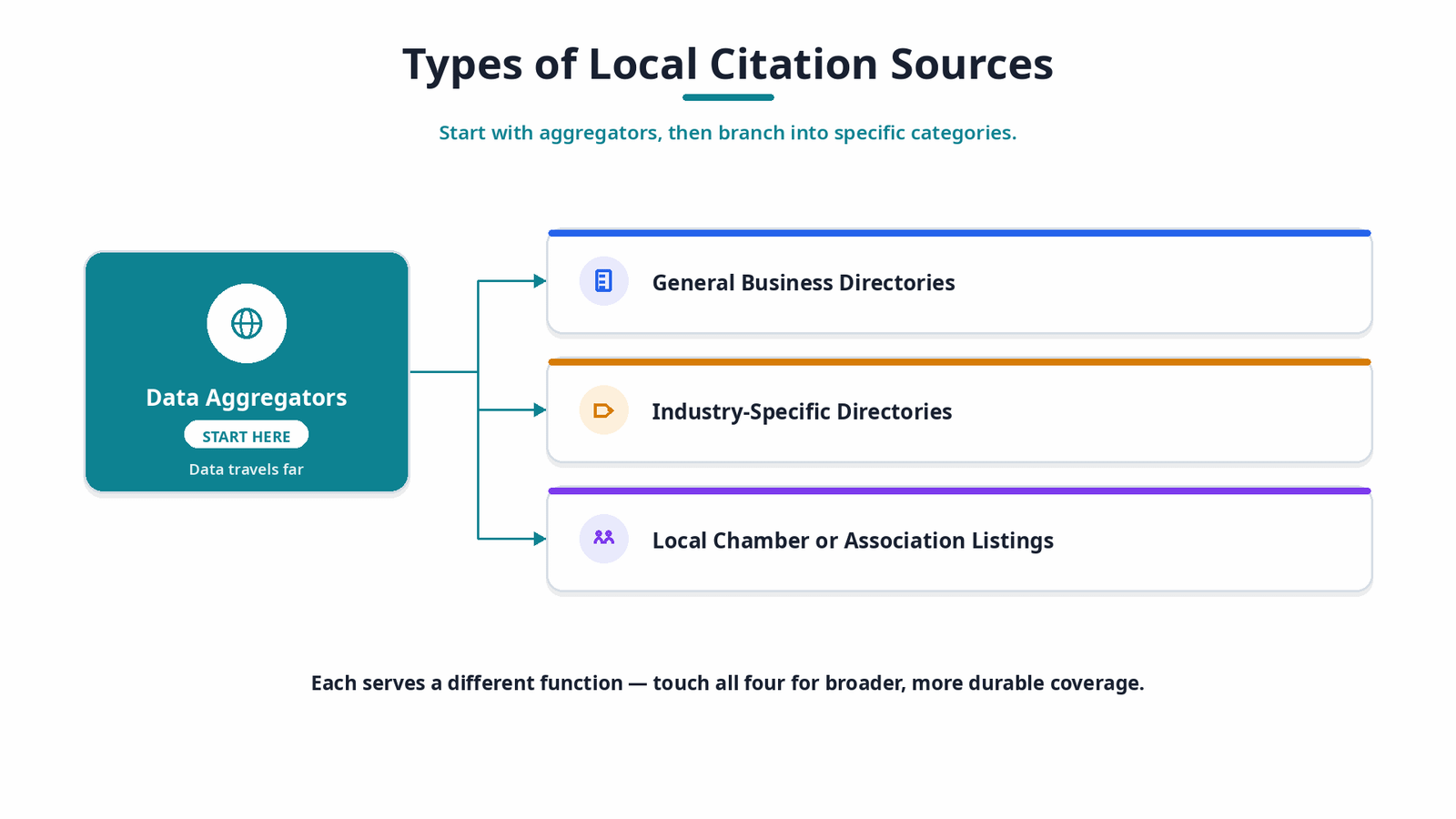
Local citation sources fall into four main categories: data aggregators, general business directories, industry-specific directories, and local chamber or association listings, each serving a different function in the citation ecosystem. Building a citation profile that touches all four categories produces broader and more durable coverage than focusing on just one.
I always start new citation campaigns with aggregators because of how far their data travels, then branch into the more specific categories.
Data Aggregators
Data aggregators are platforms that collect and distribute business information to dozens or hundreds of smaller directories and apps, making them the most efficient starting point for citation building. Submitting accurate NAP data to a major aggregator can cascade that information across a wide network of secondary sites over the following weeks.
| Aggregator Type | Function | Example Use Case |
| Primary aggregators | Distribute data to multiple secondary directories | Correcting NAP across a wide network at once |
| Niche aggregators | Feed data into vertical-specific directory networks | Industry-specific visibility |
| Regional aggregators | Distribute data within specific countries or regions | Localized directory coverage |
General Business Directories
General business directories are broad-platform listings, such as Yelp or the Better Business Bureau, that accept businesses from any industry and typically carry high domain authority. These directories tend to rank well on their own, which means a citation here can also generate direct referral traffic beyond its SEO value.
Industry-Specific Directories
Industry-specific directories cater to a single vertical, such as healthcare, legal, or home services, and typically carry more topical relevance for businesses operating in that niche. A plumbing company listed on a plumbing-specific directory earns a citation that is both a trust signal and a relevance signal at the same time.
Local Chamber and Association Listings
Local chamber and association listings come from membership-based organizations tied to a specific city, region, or trade, and they tend to carry strong local relevance because membership itself implies a verified physical presence. Joining a local chamber of commerce often comes with an automatic directory listing that doubles as a high-trust citation.
How Citations Impact Google Business Profile Rankings

Citations impact Google Business Profile rankings by reinforcing the accuracy of the business information Google already displays, which strengthens the profile’s eligibility for local pack and map placements. When citation data across the web matches a Google Business Profile exactly, Google has less reason to question the profile’s legitimacy during ranking evaluations.
I have watched Google Business Profiles gain local pack traction within weeks of a citation cleanup, especially when the business had accumulated conflicting addresses from a past relocation. The correction alone can remove a hidden ranking obstacle that nothing else addresses.
NAP Consistency: The Foundation of Citation Building
NAP consistency is considered the foundation of citation building because every other citation effort loses value if the underlying business information is not uniform across sources. Building new citations on top of inconsistent existing data compounds the problem rather than solving it.
Before submitting anything new, I always audit what already exists. Fixing old inconsistencies first prevents wasted effort on citations that will need correcting again later.
Common NAP Inconsistencies
Common NAP inconsistencies include abbreviation mismatches (Street vs. St.), outdated phone numbers after a provider switch, missing suite or unit numbers, and old addresses left behind after a business relocation. Even a single stray digit in a phone number across one directory can create enough doubt for an algorithm to treat that listing as unverified.
- Abbreviation differences (Ave. vs. Avenue)
- Old phone numbers still listed after number changes
- Missing suite, unit, or floor numbers
- Outdated addresses following a move
- Business name variations (LLC vs. no suffix)
How to Audit Existing Citations
Auditing existing citations involves searching for every instance of a business’s name, address, and phone number across directories, then cataloging every discrepancy found. Many businesses run this audit manually with search operators, while others use dedicated citation tracking tools to automate discovery.
A thorough audit usually surfaces more listings than expected, including long-forgotten directory submissions from years earlier that are still live and indexed.
How to Find Your Existing Citations
Finding existing citations starts with searching your exact business name and phone number in quotation marks on Google to surface every indexed directory listing currently live. This manual search method catches the majority of visible citations, though some aggregator-fed listings may not surface until weeks later.
Running this search periodically, not just once, catches new citations that appear automatically through aggregator distribution and catches old ones that may have silently reverted to outdated information.
Step-by-Step Process to Build New Citations

Building new local citations follows a four-step sequence: standardizing business information, prioritizing high-authority directories, submitting to niche and local directories, and establishing an ongoing monitoring routine. Skipping the standardization step before submitting anywhere new is the single most common reason citation campaigns underperform.
Step 1 — Standardize Your Business Information
Standardizing business information means deciding on one exact format for your business name, address, and phone number and documenting it before any submission begins. This becomes the single source of truth every future directory submission references.
- Write out the exact legal business name, including or excluding suffixes consistently
- Format the address exactly as it should appear everywhere, abbreviations included
- Confirm the primary phone number tied to the business location
- Save this format in a shared document for anyone handling submissions
Step 2 — Prioritize High-Authority Directories
Prioritizing high-authority directories means submitting first to platforms with strong domain authority and wide reach, since these carry the most weight and often feed data into smaller secondary directories automatically. Getting the top-tier listings correct early reduces the cleanup work needed later in the process.
Step 3 — Submit to Niche and Local Directories
Submitting to niche and local directories means targeting industry-specific platforms and regional directories relevant to the business’s trade and location, layering topical and geographic relevance on top of the broader authority citations. These listings tend to require more manual research since they are less standardized than major aggregators.
Step 4 — Monitor and Maintain Listings
Monitoring and maintaining listings means periodically re-checking existing citations for accuracy, since directories occasionally update their own formatting or pull outdated information from stale aggregator feeds. A citation that was correct at submission can still drift out of consistency months later without any action from the business owner.
Best Citation Sources for US Businesses
The best citation sources for US businesses include major data aggregators, broad platforms like Yelp and the Better Business Bureau, and region-specific chambers of commerce that carry strong domestic trust signals. US-based businesses benefit from prioritizing platforms with strong penetration in American search behavior rather than international directories with limited domestic relevance.
Local relevance matters here. A directory popular in the UK or Australia carries little citation value for a business operating exclusively in the US market.
Citation Building for Multi-Location Businesses

Citation building for multi-location businesses requires creating a separate, fully accurate citation profile for each individual location rather than consolidating all locations under one generic listing. Each location needs its own unique NAP data reflected consistently across every directory tied to that specific address.
Franchises and multi-location brands run into trouble when someone submits a single generic listing meant to represent every location, which confuses search engines about which location actually serves which search query.
How Long It Takes to See Results From Citation Building
Citation building typically takes two to four months to produce measurable ranking movement, since search engines need time to re-crawl directories and reconcile data across multiple sources. Faster movement sometimes appears when a business corrects major NAP inconsistencies that were actively suppressing local pack visibility beforehand.
I tell clients not to expect overnight jumps. Citations work cumulatively, and the timeline depends heavily on how inconsistent the starting data was.
Common Citation Building Mistakes to Avoid
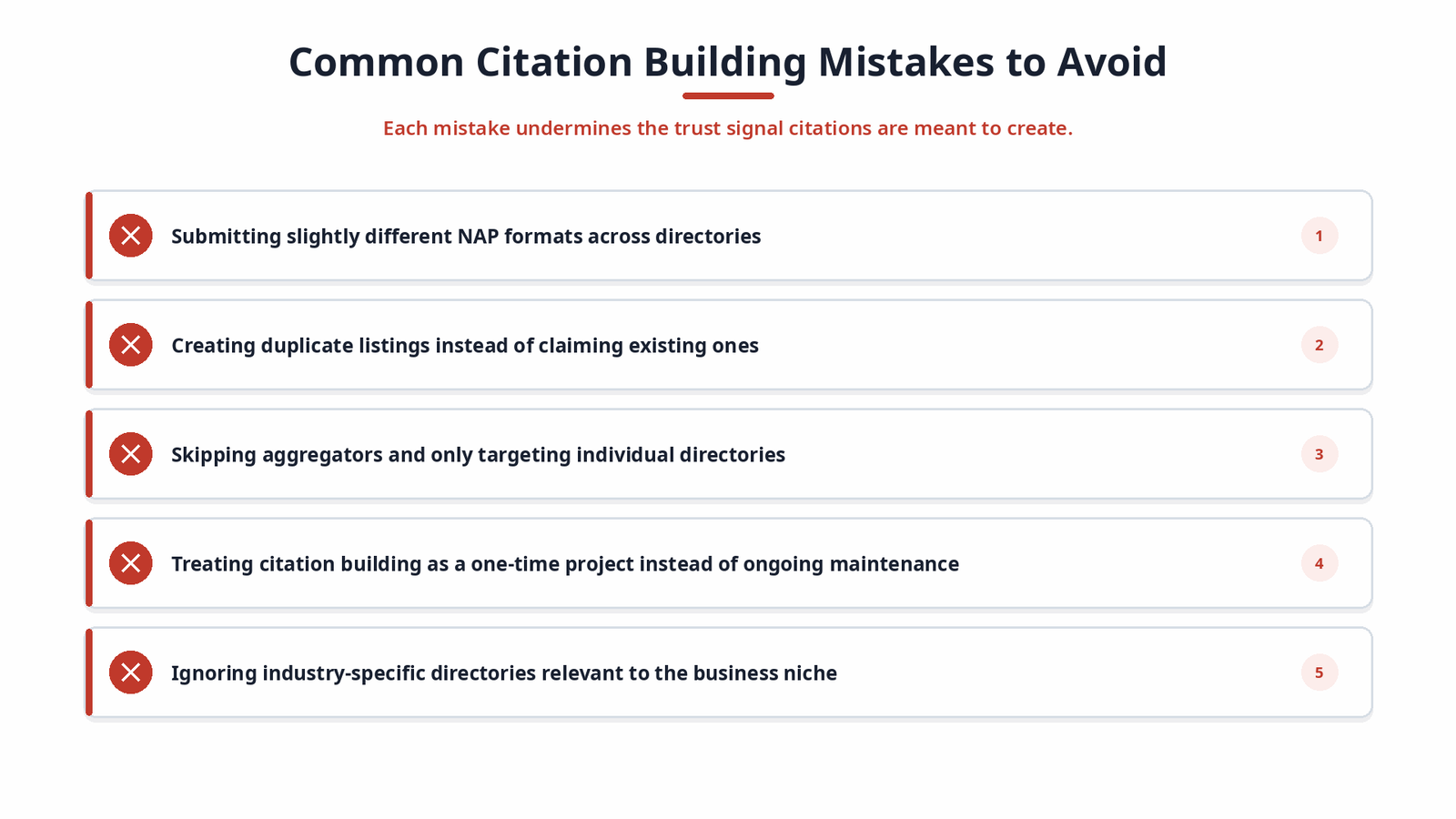
The most common citation building mistakes include inconsistent NAP formatting, duplicate listings on the same directory, ignoring data aggregators in favor of manual submissions only, and abandoning the citation profile after the initial build. Each of these mistakes undermines the trust signal citations are meant to create in the first place.
- Submitting slightly different NAP formats across directories
- Creating duplicate listings instead of claiming existing ones
- Skipping aggregators and only targeting individual directories
- Treating citation building as a one-time project instead of ongoing maintenance
- Ignoring industry-specific directories relevant to the business niche
Manual vs. Automated Citation Building Tools
Manual citation building involves submitting business information to each directory individually, while automated citation tools push standardized data across multiple directories and aggregators simultaneously through a single platform. Automated tools save significant time on volume but still require manual oversight to catch directory-specific quirks that automation sometimes misses.
| Approach | Strength | Tradeoff |
| Manual submission | Full control over formatting and directory selection | Time-intensive at scale |
| Automated tools | Fast, broad distribution across many directories | Less granular control per listing |
How Citations Fit Into a Broader Local SEO Strategy
Citations function as one pillar of local SEO alongside Google Business Profile optimization, customer reviews, and locally relevant on-page content, and none of these pillars perform at full strength in isolation. A business with flawless citations but a neglected Google Business Profile still struggles to compete in the local pack.
I always frame citation work as foundational rather than final. It supports everything else rather than replacing the need for a complete local SEO strategy.
How to Measure Citation Building Success
Measuring citation building success involves tracking local pack ranking positions, Google Business Profile visibility metrics, and referral traffic from directory listings over time rather than judging success by citation count alone. A business with fifty mediocre citations can underperform one with twenty clean, high-authority citations if consistency and source quality differ significantly.
Tools like Google Search Console and Google Business Profile Insights reveal whether visibility is actually shifting, which matters more than simply counting how many directories now list the business.
Conclusion
Local citations work by confirming your business name, address, and phone number across trusted directories, building the consistency search engines rely on for local rankings.
They work best alongside reviews, Google Business Profile optimization, and ongoing local content, not as a standalone tactic for visibility.
We help businesses build and maintain accurate citation profiles at scale through White Label SEO Service, turning consistent data into measurable local ranking gains.
Frequently Asked Questions
What is the difference between a citation and a backlink?
A citation is a mention of your business name, address, and phone number, while a backlink is a hyperlink from another website to yours. Citations do not always include a link, but both contribute to overall search authority.
How many local citations do I need?
There is no fixed number of citations required, since quality and consistency matter more than volume. Most businesses benefit from 30 to 50 accurate citations across authoritative and niche-relevant directories.
Are paid citation services worth it?
Paid citation services can be worth it for businesses lacking time to manage submissions manually, especially across multiple locations. The value depends on the service’s accuracy and the quality of directories it targets.
Can duplicate listings hurt my rankings?
Duplicate listings can hurt rankings by confusing search engines about which listing represents the real business. Removing or merging duplicates typically resolves the inconsistency and restores trust signals.
Do citations work for online-only businesses?
Citations provide less value for online-only businesses since many citation platforms are built around physical address verification. Online-only businesses should prioritize industry directories and review platforms instead.
How often should I update my citations?
Citations should be reviewed any time core business information changes, such as a new address, phone number, or business name. A general audit every six months catches drift even without major changes.
What happens if I ignore local citations?
Ignoring local citations can leave inconsistent or outdated business information circulating across directories, which undermines trust signals and can suppress local pack visibility. Competitors with cleaner citation profiles often outrank businesses that neglect this signal.


