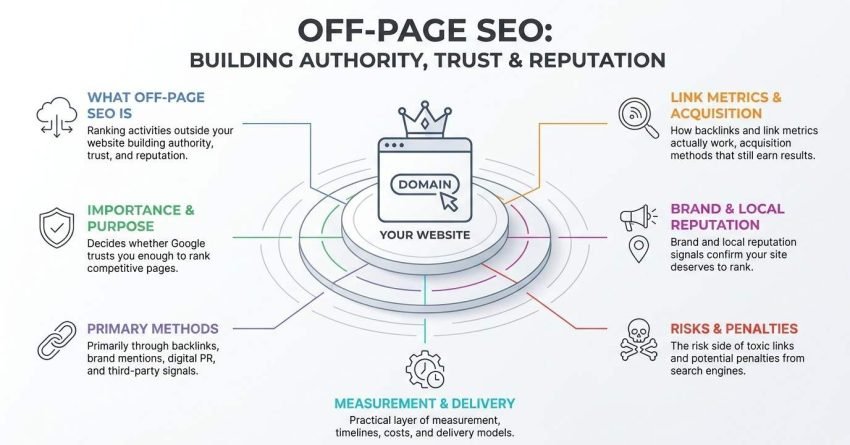
Off-page SEO is the set of ranking activities performed outside your own website that build authority, trust, and reputation in search engines, primarily through backlinks, brand mentions, digital PR, and third-party signals that confirm your site deserves to rank. I have watched businesses pour money into on-page work and still stall, because nothing outside their domain was vouching for them.
Off-page work decides whether Google trusts you enough to rank competitive pages. Without it, strong content sits invisible on page four while weaker pages outrank you every single month.
This guide covers what off-page SEO is and how search engines read external signals, how backlinks and link metrics actually work, the acquisition methods that still earn results, brand and local reputation signals, the risk side of toxic links and penalties, and the practical layer of measurement, timelines, costs, and delivery models. Each area links to deeper resources where you need them.
What Off-Page SEO Actually Means
Off-page SEO is every optimization signal that originates outside your website and influences how search engines judge your authority. Links, mentions, reviews, and citations all sit in this category, and none of them live on pages you control.
I think of it as reputation work. On-page SEO is what you say about yourself, and off-page SEO is what the rest of the internet says about you.
That distinction matters because Google has always weighted third-party validation more heavily than self-declaration. Anyone can write “best plumber in Chicago” on their homepage. It takes something else entirely for fifty other websites to independently say the same thing.
Off-Page SEO vs. On-Page SEO vs. Technical SEO
The three disciplines split cleanly by where the work happens and what it proves. This table shows how the responsibilities divide:
| Discipline | Where the work happens | What it proves | Example activities |
| On-page SEO | Inside your pages | Relevance to the query | Titles, headings, internal copy, keyword targeting |
| Technical SEO | Inside your site infrastructure | Accessibility and crawlability | Site speed, indexation, schema, site architecture |
| Off-page SEO | Outside your domain | Authority and trust | Backlinks, digital PR, citations, reviews, mentions |
None of the three works alone. A technically perfect site with brilliant content and zero external signals will lose to a mediocre competitor with four hundred referring domains, and I have audited that exact scenario more times than I can count.
The reverse is also true. Links pointed at thin, poorly structured pages waste the authority you worked to earn.
Why Signals From Other Sites Carry Weight
External signals are harder to fake than on-site elements, which is precisely why search engines trust them. You can rewrite your own title tag in ten seconds, and you cannot make a national publication cite you in ten seconds.
Google’s own Search Quality Rater Guidelines instruct raters to research a site’s reputation using independent, off-site sources rather than the site’s own claims. That is off-page SEO stated as policy.
This is the cost-of-forgery principle in action. The more expensive a signal is to manufacture, the more weight it carries.
How Search Engines Use Off-Page Signals to Rank Pages
Search engines convert off-page signals into ranking decisions through a sequence of discovery, evaluation, and weighting. Here is how that sequence runs in practice:
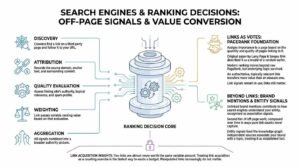
- Discovery: Crawlers find a link on a third-party page and follow it to your URL.
- Attribution: The engine records the source domain, the anchor text, and the surrounding context.
- Quality evaluation: Algorithms assess the linking site’s own authority, topical relevance, and spam profile.
- Weighting: The link passes a variable amount of ranking value based on that evaluation.
- Aggregation: All signals pointing at the page and the domain are combined into a broader authority picture.
The critical word in that sequence is variable. Two links are almost never worth the same amount, and treating link acquisition as a counting exercise is the fastest way to waste a budget.
Links as Votes: The PageRank Foundation
PageRank is a link analysis algorithm that assigns importance to a page based on the quantity and quality of pages linking to it. The original 1998 Stanford paper by Larry Page and Sergey Brin described it as a model of a random surfer clicking links across the web.
Modern ranking has moved far beyond raw PageRank, but the underlying logic survived. A link from an authoritative, topically relevant page still transfers more value than a link from an obscure one.
Google confirmed in a 2023 statement on link spam that link signals remain in use while spam detection has become far more sophisticated. Links still matter. Manipulated links increasingly do not.
Beyond Links: Brand Mentions and Entity Signals
Unlinked brand mentions contribute to how search engines understand your entity, even without a clickable hyperlink attached. Google’s patents on reasonable surfer and implied links describe systems that recognize brand references as association signals.
I treat mentions as the second tier of off-page work. They will not move a page the way a strong editorial link will, and they compound over time in ways that pure link counts never capture.
Entity signals also feed the knowledge graph. When enough independent sources associate your brand with a topic, search engines start treating that association as established fact rather than a claim.
Backlinks: The Core of Off-Page SEO
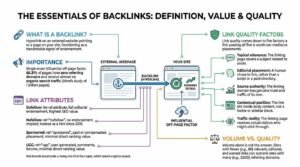
A backlink is a hyperlink on an external website that points to a page on your site, functioning as a transferable signal of endorsement in search engine ranking systems. Backlinks remain the single most influential off-page factor, and every credible correlation study I have reviewed reaches the same conclusion.
An Ahrefs study of 1 billion pages found that 66.31% of pages have zero referring domains and receive almost no organic search traffic as a result. That single statistic explains more stalled SEO campaigns than any other data point I know.
Volume alone is not the answer, though. I have seen sites with 3,000 referring domains outranked by sites with 80, because the 80 were relevant, editorial, and earned.
Dofollow vs. Nofollow, Sponsored, and UGC
Link attributes tell search engines how to treat the endorsement, and understanding the four types prevents wasted outreach effort. This table breaks down what each attribute signals:
| Attribute | HTML | What it signals | SEO value |
| Dofollow | No rel attribute | Full editorial endorsement | Highest |
| Nofollow | rel=”nofollow” | No endorsement implied | Treated as a hint since 2019 |
| Sponsored | rel=”sponsored” | Paid or compensated placement | Minimal direct ranking value |
| UGC | rel=”ugc” | User-generated, comments, forums | Minimal direct ranking value |
Google changed nofollow to a hint in March 2020, which means nofollowed links can now be considered for ranking and crawling purposes. They are no longer worthless, and they are not equivalent to a clean editorial dofollow link either.
Chasing only dofollow links produces an unnatural profile. Real brands accumulate a messy mix of all four types, and search engines expect to see that mix.
What Separates a Strong Backlink From a Worthless One
Link quality comes down to five factors, and I evaluate every prospect against them before spending a single hour on outreach:
- Topical relevance: The linking page covers a subject related to yours
- Editorial placement: A human chose to link, rather than a script or a paid directory
- Source authority: The linking domain has genuine trust and traffic of its own
- Contextual position: The link sits inside body content, not a footer or sidebar block
- Traffic reality: The linking page receives actual visitors who might click through
A link failing three of those five is usually not worth chasing. A link passing all five is worth ten mediocre placements, and that ratio is not an exaggeration.
Domain Authority, Trust, and Link Metrics Explained
Domain Authority is a third-party scoring metric created by Moz that predicts a domain’s ranking strength on a 1 to 100 logarithmic scale. Domain Rating from Ahrefs and Authority Score from Semrush measure similar concepts using different proprietary models.
These metrics help you compare prospects quickly. They do not tell you what Google thinks, and that distinction gets ignored constantly in the outreach world.
Third-Party Metrics Are Estimates, Not Google Scores
Google has repeatedly confirmed it does not use Domain Authority or any equivalent domain-level score in its ranking systems. Google’s Search Advocate John Mueller stated directly that there is no “domain authority” metric used internally.
I still use these scores daily, as a filter rather than a verdict. A DR 15 site with 40,000 monthly organic visitors in your exact niche beats a DR 60 general blog with no traffic, every time.
The useful metrics are organic traffic, referring domain count, topical alignment, and traffic trend direction. Score-chasing produces link profiles that look impressive in a spreadsheet and move nothing in the SERP.
Link Building Methods That Still Work
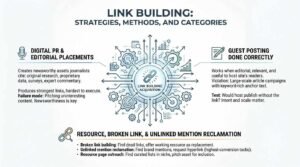
Link building is the practice of actively acquiring backlinks from external websites through outreach, content creation, relationship building, and digital PR. Most tactics that worked a decade ago are now liabilities, and a handful have gotten stronger.
I split working methods into three categories based on how the link is earned. Each carries a different cost, timeline, and risk profile.
Digital PR and Editorial Placements
Digital PR earns links by creating newsworthy assets that journalists and publishers genuinely want to cite. Original research, proprietary data, surveys, and expert commentary all qualify.
This method produces the strongest links available, and it is the hardest to execute. A single national placement can outweigh six months of guest posting, which is why I recommend it to any business with the budget to sustain it.
The failure mode is pitching something nobody finds interesting. Newsworthiness is the whole game here.
Guest Posting Done Correctly
Guest posting still works when the placement is editorial, relevant, and genuinely useful to the host site’s readers. It stops working the moment it becomes a transaction on a link marketplace.
Google’s link spam policies explicitly name large-scale article campaigns with keyword-rich anchor text as a violation. The difference between a legitimate contribution and a violation is intent and scale, and the algorithm has gotten reasonably good at telling them apart.
I apply one test. If the host site would publish the article without the link, the placement is legitimate.
Resource, Broken Link, and Unlinked Mention Reclamation
Reclamation tactics find links that should already exist and convert them. Three methods dominate this category:
- Broken link building: Find dead links on relevant pages, then offer your working resource as a replacement
- Unlinked mention reclamation: Find brand mentions without hyperlinks, then request the link
- Resource page outreach: Find curated lists in your niche, then pitch your asset for inclusion
Unlinked mention reclamation is the highest-conversion tactic in this group, because the publisher already decided you were worth referencing. Asking them to hyperlink an existing mention is a far easier request than asking for a new one.
Anchor Text and Link Diversity
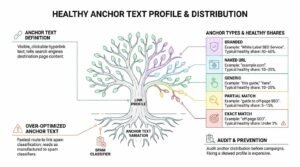
Anchor text is the visible, clickable text of a hyperlink, and it tells search engines what the destination page is about. Over-optimized anchor text is one of the fastest routes to a link spam classification.
Healthy profiles show natural variation across several anchor types. This table shows the categories and where they typically land:
| Anchor type | Example | Typical healthy share |
| Branded | “White Label SEO Service” | 40–60% |
| Naked URL | “example.com” | 10–20% |
| Generic | “this guide,” “here” | 10–20% |
| Partial match | “guide to off-page SEO” | 5–15% |
| Exact match | “off-page SEO” | Under 5% |
Nobody links to you naturally using your exact target keyword at high volume. When 30% of a profile is exact-match, the pattern is obviously manufactured, and it reads that way to a spam classifier too.
I audit anchor distribution before any campaign starts. Fixing a skewed profile is far more expensive than preventing one.
Brand Signals, Mentions, and Search Demand
Brand signals are off-page indicators that show a business exists as a recognized entity, including branded search volume, unlinked mentions, social presence, and review activity. Google treats brand recognition as evidence of legitimacy, and legitimacy correlates strongly with ranking stability.
Branded search volume is the most telling of these. When people search your name directly, you have demand that no algorithm update can strip away.
I have watched two sites with nearly identical link profiles diverge sharply after a core update, and the survivor was always the one with real brand demand behind it. That pattern has held through every major update since 2018.
Content That Earns Links Without Outreach
Linkable assets are content formats that attract backlinks passively because other publishers need to cite them. Building these assets reduces your dependence on cold outreach permanently.
Five formats consistently earn links without a pitch:
- Original research and surveys: Data nobody else has published
- Free tools and calculators: Utility that saves someone work
- Definitive statistics roundups: The page journalists cite when they need a number
- Industry benchmark reports: Recurring data that becomes an annual reference
- Visual explainers and frameworks: Diagrams and models people reuse with attribution
The economics here are strong. One good statistics page can accumulate links for years with zero ongoing outreach cost, and I have seen single assets pull 400+ referring domains over four years.
Most businesses skip this because it requires upfront investment with delayed return. That is exactly why it stays competitive.
Digital PR as an Off-Page SEO Engine
Digital PR is the practice of earning media coverage and editorial links by producing stories that journalists want to publish. It sits at the intersection of traditional public relations and link acquisition.
A digital PR campaign runs through four stages:
- Ideation: Identify a story angle with genuine news value in your sector
- Asset creation: Build the data, survey, or report that supports the story
- Outreach: Pitch relevant journalists with a tight, specific angle
- Amplification: Follow syndication and secondary coverage to capture additional links
The return is uneven and occasionally spectacular. A campaign either lands and generates dozens of authoritative links, or it does not land at all, and budgeting has to account for that variance.
I recommend running digital PR alongside steadier tactics rather than as a sole strategy. The volatility is real.
Local Off-Page SEO: Citations, GBP, and Reviews
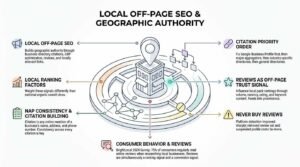
Local off-page SEO builds geographic authority through business directory citations, Google Business Profile optimization, review generation, and locally relevant links. Local ranking factors weight these signals differently than national organic search does.
The BrightLocal 2024 Local Consumer Review Survey found that 75% of consumers regularly read online reviews when researching local businesses. Reviews are simultaneously a ranking signal and a conversion signal, which makes them unusually high-leverage.
NAP Consistency and Citation Building
A citation is any online mention of a business’s name, address, and phone number, whether or not it includes a link. Consistency across every citation is what makes the signal usable.
Inconsistent NAP data confuses entity matching. When three directories list three different phone numbers, search engines lose confidence that they are looking at one business.
The priority order is straightforward. Fix Google Business Profile first, then the major aggregators, then industry-specific directories, then general directories last.
Reviews as an Off-Page Trust Signal
Reviews influence local pack rankings through volume, recency, rating, and keyword content within the review text. Google’s own local ranking documentation names prominence as a ranking factor, and review activity feeds directly into prominence.
Never buy reviews. Platform detection has improved sharply, and a removed review set plus a suspended profile costs far more than the reviews were ever worth.
Social Media, Forums, and Community Signals
Social media links are almost universally nofollow and do not pass direct ranking value, but social activity influences off-page SEO indirectly through content distribution and discovery. Google has stated repeatedly that social shares are not a direct ranking factor.
The indirect value is real, though. Content that circulates on social platforms gets seen by writers and publishers who then link to it from their own sites.
Community platforms like Reddit and niche forums have become more visible in search results since 2023. A genuinely helpful presence there drives referral traffic and brand exposure, and heavy-handed self-promotion gets you removed within hours.
E-E-A-T and Off-Page Reputation
E-E-A-T is Google’s quality framework standing for Experience, Expertise, Authoritativeness, and Trustworthiness, and much of it is assessed using off-site information. Quality raters are explicitly instructed to research reputation beyond the website being evaluated.
Off-page contributions to E-E-A-T include author bylines on external publications, professional profiles, industry recognition, third-party reviews, and citations from recognized bodies. None of these live on your site.
This matters most in YMYL sectors covering health, finance, legal, and safety topics. In those categories, an unverifiable author with no external footprint is a hard ceiling on ranking potential, regardless of content quality.
Toxic Links, Penalties, and Link Spam Risk
Toxic backlinks are inbound links from spam networks, hacked sites, link farms, or paid schemes that violate search engine guidelines and can trigger ranking suppression. Most sites accumulate some without ever buying a link.
Google’s SpamBrain system now neutralizes most spam links algorithmically rather than penalizing the target site, which changed the risk calculus considerably. Manual actions still exist and still hurt.
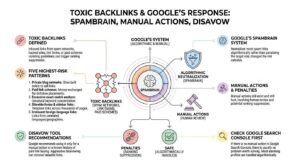
The five highest-risk patterns are:
- Private blog networks: Sites built solely to sell links
- Paid link schemes: Money exchanged for dofollow placements at scale
- Excessive exact-match anchors: Unnatural keyword concentration
- Sitewide footer and sidebar links: Template links across thousands of pages
- Irrelevant foreign-language links: Links from unrelated languages and geographies
Disavow, Manual Actions, and SpamBrain
The disavow tool tells Google to ignore specific backlinks when assessing your site. Google now recommends using it only when you have a manual action or a known history of paid link buying.
I disavow rarely. Most link profiles that look alarming in a third-party tool are being handled algorithmically already, and aggressive disavowing has removed genuinely valuable links more than once in my experience.
Check Google Search Console for manual actions first. If there is no manual action, there is usually no problem worth solving.
Competitor Backlink Analysis and Link Gap Research
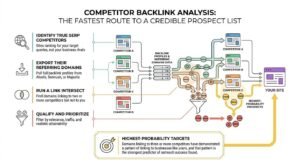
Competitor backlink analysis identifies which domains link to your competitors but not to you, revealing acquisition targets that have already proven willing to link within your niche. This is the fastest route to a credible prospect list.
The process runs in four steps:
- Identify true SERP competitors: The sites ranking for your target queries, not your business rivals
- Export their referring domains: Pull full backlink profiles from Ahrefs, Semrush, or Majestic
- Run a link intersect: Find domains linking to two or more competitors but not to you
- Qualify and prioritize: Filter by relevance, traffic, and realistic attainability
Domains linking to three or more competitors are the highest-probability targets. They have demonstrated a pattern of linking to businesses like yours, and that pattern is the strongest predictor of outreach success I have found.
How to Measure Off-Page SEO Performance
Off-page SEO measurement tracks referring domain growth, link quality, referral traffic, branded search volume, and the ranking movement of linked pages. Measuring link count alone tells you almost nothing useful.
Metrics That Matter vs. Vanity Metrics
This table separates the numbers that predict outcomes from the ones that flatter a report:
| Metric that matters | Why it matters | Vanity metric | Why it misleads |
| Referring domains (new/lost) | Unique domain growth drives authority | Total backlink count | One site can send 10,000 links |
| Organic traffic to linked pages | Direct business outcome | Domain Authority score | Third-party estimate, not a Google metric |
| Branded search volume | Real demand growth | Social share counts | No direct ranking value |
| Ranking movement of target pages | Proves the link worked | Links acquired per month | Ignores quality entirely |
| Referral traffic from links | Proves real audiences exist | Toxic score percentage | Usually algorithmically handled |
Track referring domains monthly and rankings weekly. Everything else is context.
I also log which specific pages received links, because the connection between a link and a ranking gain is only visible at page level.
Off-Page SEO Timelines and Realistic Expectations
Off-page SEO typically shows measurable ranking movement in 3 to 6 months, with meaningful traffic growth appearing between 6 and 12 months for most competitive commercial terms. An Ahrefs study of 2 million keywords found only 5.7% of pages reach a top 10 ranking within one year of publication.
Several factors compress or extend that window:
- Existing domain authority: Established sites see faster movement from new links
- Competition level: Saturated verticals require far more signal
- Link velocity and quality: Ten strong links beat a hundred weak ones
- Page quality: Links to thin content produce weak returns
- Indexation speed: Some links take weeks to be crawled and counted
Anyone promising first-page rankings in 30 days is either buying links or misrepresenting the timeline. Both end badly.
Building a 90-Day Off-Page SEO Plan
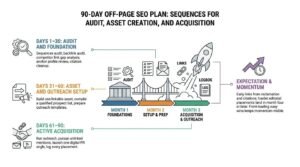
A 90-day off-page SEO plan sequences audit, asset creation, and acquisition so that outreach begins only after the foundations are in place. Skipping the first month is the most common execution error I see.
The sequence runs as follows:
- Days 1–30: Audit and foundation: Backlink audit, competitor link gap analysis, anchor profile review, citation cleanup
- Days 31–60: Asset and outreach setup: Build one linkable asset, compile a qualified prospect list, prepare outreach templates
- Days 61–90: Active acquisition. Run outreach, pursue unlinked mentions, launch one digital PR angle, log every placement.
Expect early links from reclamation and citations, and expect the harder editorial placements to land in month four or later. Front-loading the easy wins keeps momentum visible while the slower work develops.
Do I Need an Agency, or Can I Do Off-Page SEO Myself?
That question separates everything above from everything below. The tactics are learnable, and the constraint is almost always time and relationships rather than knowledge.
In-House vs. Agency vs. White Label Off-Page SEO
The three delivery models differ by cost structure, speed to results, and where the relationships live. This table compares the trade-offs:
| Model | Best for | Typical strength | Main limitation |
| In-house | Brands with ongoing content and PR needs | Deep brand knowledge, full control | Slow to build outreach relationships |
| Agency | Businesses wanting managed execution | Existing publisher relationships, speed | Higher cost, less direct control |
| White label | Agencies reselling under their own brand | Scalable capacity without hiring | Requires trusted delivery partner |
In-house teams win on brand authenticity and lose on outreach velocity, because publisher relationships take years to build. Agencies arrive with those relationships already in place.
White label sits between the two. Marketing agencies use it to deliver off-page work under their own name without building a link acquisition team from scratch.
Off-Page SEO Costs and Budgeting
Off-page SEO in the US typically costs $1,500 to $10,000 per month depending on link volume, target authority, and whether digital PR is included. Individual quality editorial placements commonly run $300 to $1,500 each when sourced through legitimate outreach.
The cost drivers are straightforward. Higher-authority targets require more outreach volume, better assets, and more experienced people.
Budget for a minimum six-month commitment. Three-month off-page engagements almost never produce enough signal to measure, and cutting the budget at month three wastes everything spent in months one and two.
Common Off-Page SEO Mistakes Beginners Make
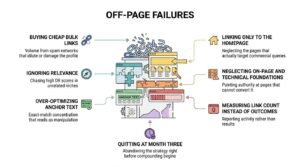
Most off-page failures come from a small set of repeated errors. These seven account for the majority of the wasted budgets I have audited:
- Buying cheap bulk links: Volume from spam networks that dilute or damage the profile
- Ignoring relevance: Chasing high DR scores in unrelated niches
- Over-optimizing anchor text: Exact-match concentration that reads as manipulation
- Linking only to the homepage: Neglecting the pages that actually target commercial queries
- Neglecting on-page and technical foundations: Pointing authority at pages that cannot convert it
- Measuring link count instead of outcomes: Reporting activity rather than results
- Quitting at month three: Abandoning the strategy right before compounding begins
The last one is the most expensive. Off-page SEO compounds, and compounding requires time nobody wants to give it.
Conclusion
Off-page SEO builds authority through backlinks, brand signals, digital PR, local citations, and reputation, all earned outside the website itself.
These signals compound. Each dedicated resource in this guide goes deeper into the tactics, metrics, and execution details covered here at an orientation level.
We build sustainable off-page authority for agencies and brands at White Label SEO Service, with transparent reporting and no shortcuts.
Frequently Asked Questions
Is off-page SEO still important in 2026?
Off-page SEO remains one of the strongest ranking influences in 2026. Google still uses link and reputation signals, though spam detection now neutralizes manipulated links algorithmically rather than passing their value.
How many backlinks do I need to rank?
There is no fixed number, because ranking depends on competitor link profiles in your specific niche. Analyze the top five ranking pages, then plan to match their referring domain count with better relevance.
Can I do off-page SEO without buying links?
Yes, and it is the only sustainable approach. Digital PR, linkable assets, unlinked mention reclamation, guest contributions, and citations all earn links without any payment for placement.
How long does it take for backlinks to work?
Backlinks typically influence rankings within three to six months of acquisition. Crawling and indexing take days to weeks, and the ranking effect builds gradually as the signal accumulates alongside others.
Does social media help off-page SEO?
Social media does not pass direct ranking value because platform links are nofollow. It helps indirectly by putting content in front of writers and publishers who then link to it editorially.
What is the difference between off-page SEO and link building?
Link building is one tactic within off-page SEO. Off-page SEO also includes brand mentions, citations, reviews, digital PR, and reputation signals that involve no hyperlink at all.
Should I disavow bad backlinks?
Only disavow if you have a manual action or a known history of buying links. Google’s SpamBrain neutralizes most spam links automatically, and aggressive disavowing often removes valuable links by mistake.