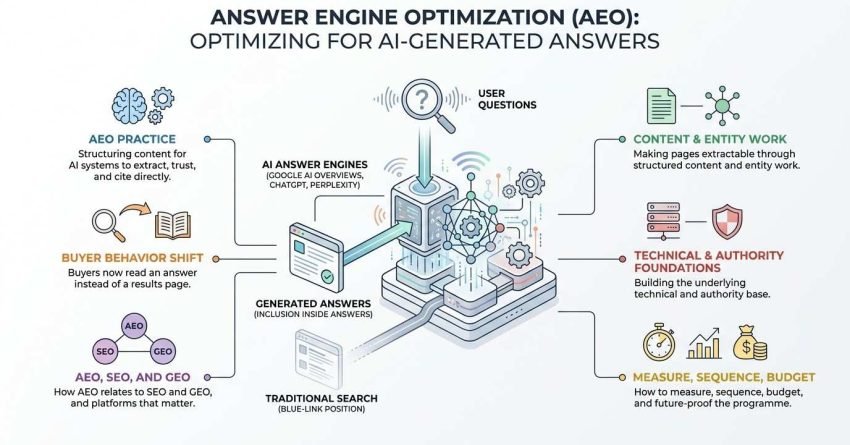
Answer engine optimization is the practice of structuring content so AI systems like Google AI Overviews, ChatGPT, and Perplexity can extract, trust, and cite it directly when answering user questions. AEO targets inclusion inside generated answers rather than a blue-link position.
Search behaviour shifted faster than most marketing budgets did. Buyers now read an answer instead of a results page, and invisible brands lose pipeline before a click ever happens.
This guide covers what AEO actually means and how answer engines retrieve information, how AEO relates to SEO and GEO, the platforms that matter, the content and entity work that makes pages extractable, the technical and authority foundations underneath it, and how to measure, sequence, budget, and future-proof the whole programme.
What Answer Engine Optimization Actually Means
Answer engine optimization is a search discipline that structures content so machines can lift a specific, correct answer out of a page and attribute it to the source. I think of it as optimising for the sentence, not the page.
That distinction matters more than it sounds. Traditional search engine optimization earns a position in a list, and the user decides which result to open. An answer engine skips that step entirely and hands back a synthesised response.
The Definition of an Answer Engine
An answer engine is a search system that returns a direct, synthesised response to a query instead of a ranked list of documents. Google AI Overviews, ChatGPT, Perplexity, and Copilot all behave this way.
These systems still read the open web. They just compress it before showing it to anyone.
How AEO Differs From Traditional Search Optimization
The unit of competition changes. In classic search, I optimise a page against a keyword, and success is a position number.
In AEO, I optimise a passage against a question, and success is being quoted. A page can rank fourth and still be the source an AI Overview cites, because extraction and ranking are related but separate judgments.
Why the Term Emerged When It Did
Google began rolling out AI Overviews broadly in 2024, and Gartner forecast a 25% drop in traditional search engine volume by 2026 as AI chatbots absorb query demand. Marketers needed a name for the work that keeps brands visible when the results page stops being a list.
How Answer Engines Retrieve and Cite Information
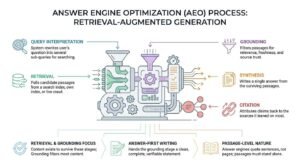
Answer engines build responses through retrieval-augmented generation, which means they fetch relevant source passages first and then generate an answer grounded in what they found. Understanding that sequence explains almost every AEO tactic.
Here is the process most systems follow, simplified:
- Query interpretation: the system rewrites the user’s question into several sub-queries it can actually search.
- Retrieval: it pulls candidate passages from a search index, its own index, or a live crawl.
- Grounding: it filters those passages for relevance, freshness, and source trust.
- Synthesis: it writes a single answer from the surviving passages.
- Citation: it attributes claims back to the sources it leaned on most.
I care most about steps two and three. Everything I do on a page exists to survive retrieval and grounding.
Retrieval, Grounding, and Synthesis
Grounding is the filter that kills most content. A passage that hedges, buries its point, or depends on the paragraph above it gets dropped because it cannot stand alone as evidence.
That is why answer-first writing works. It hands the grounding stage a clean, complete, verifiable statement.
Why Citation Is Not the Same as Ranking
Ranking is a document-level judgment. Citation is a passage-level judgment, and the two run on different signals.
I have watched pages outside the top ten get cited because they contained the only clearly stated number on the topic. The reverse happens too, and it stings.
The Passage-Level Nature of Extraction
Answer engines quote sentences, not pages. So the practical question I ask about every paragraph is simple.
Would this survive being copied out of the page and pasted somewhere else with no context? If the answer is no, the paragraph cannot earn a citation.
AEO vs SEO vs GEO: How the Disciplines Relate
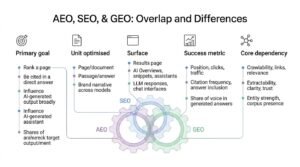
AEO, SEO, and generative engine optimization overlap heavily and differ mainly in what they treat as the win condition. None of them replaces the others.
This table shows how the three compare across the attributes that actually change your work:
| Attribute | SEO | AEO | GEO |
| Primary goal | Rank a page | Be cited in a direct answer | Influence AI-generated output broadly |
| Unit optimised | Page/document | Passage/answer | Brand narrative across models |
| Surface | Results page | AI Overviews, snippets, assistants | LLM responses, chat interfaces |
| Success metric | Position, clicks, traffic | Citation frequency, answer inclusion | Share of voice in generated answers |
| Core dependency | Crawlability, links, relevance | Extractability, clarity, trust | Entity strength, corpus presence |
Where the Three Overlap
All three need the same foundation. Crawlable pages, accurate information, clear entity signals, and credible authority feed every one of them.
Roughly 80% of the underlying work is shared. I have never built an AEO programme that did not sit on competent technical SEO underneath it.
Where They Genuinely Diverge
Divergence shows up in formatting and measurement. SEO tolerates a long warm-up before the point, and AEO punishes it immediately.
Generative engine optimization pushes further out, into how a brand is described across model training data and third-party sources you do not control. That is a different lever than editing your own page.
The Answer Engine Landscape: Platforms That Matter
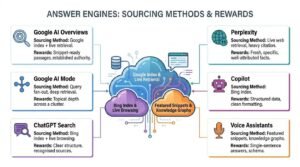
Answer engines now span search results, standalone assistants, and voice interfaces, and each one sources content slightly differently. Knowing which platform pulls from where tells you where effort pays.
This table shows the main surfaces and how they source answers:
| Platform | Sourcing method | What it rewards |
| Google AI Overviews | Google index + live retrieval | Snippet-ready passages, established authority |
| Google AI Mode | Query fan-out, deep retrieval | Topical depth across a cluster |
| ChatGPT Search | Bing index + live browsing | Clear structure, recognised sources |
| Perplexity | Live web retrieval, heavy citation | Fresh, specific, well-attributed facts |
| Copilot | Bing index | Structured data, clean formatting |
| Voice assistants | Featured snippets, knowledge graphs | Single-sentence answers, schema |
Google AI Overviews and AI Mode
AI Overviews sit above organic results and pull from Google’s existing index, so classic ranking strength still helps enormously. AI Mode goes further by fanning a single query into many sub-queries, which rewards sites with genuine coverage across a topic rather than one strong page.
ChatGPT, Perplexity, Claude, and Copilot
These assistants either browse live or lean on a search index, and they cite far more visibly than Google does. Perplexity in particular puts sources on screen, which makes it a useful early signal for whether content is extractable.
Voice Assistants and Featured Snippets
Voice answers were the original answer engine, and featured snippets remain the mechanism behind many of them. The formatting discipline that wins a snippet is nearly identical to the discipline that wins an AI citation.
Content Structure for Machine Extraction
Extractable content answers the heading directly in its first sentence and states every key claim in a form that survives being quoted alone. Structure does more for AEO than word count ever will.
Answer-First Writing
Put the answer first, then the context. A reader gets to the point faster, and a retrieval system finds a clean candidate passage immediately under the heading.
I removed every warm-up sentence from a client’s FAQ block and citations in Perplexity started appearing within three weeks. Nothing else on those pages changed.
Self-Contained Sentences
A self-contained sentence names its own subject rather than leaning on “it,” “this,” or “the above.” Pronoun chains read fine on the page and break completely once extracted.
“It usually takes six months” tells a machine nothing. “AEO usually takes four to six months to produce measurable citation gains” survives anywhere.
Extractable Shapes by Query Type
Different questions demand different formats. This table maps query type to the shape that gets lifted:
| Query type | Required shape |
| “what is X” | Definition paragraph, 40–55 words, entity first |
| “X vs Y” / “types of X” | Table with compared attributes as columns |
| “how long / how much” | One numeric sentence with in-sentence attribution |
| “how does X work” | Numbered list, 4–8 steps, one line each |
| “best X for Y” | Criteria-led list, each item with its condition |
Match the shape to the question and the extraction rate climbs. Mismatch it, and the passage gets skipped even when the information is correct.
Entity Optimization and Semantic Clarity
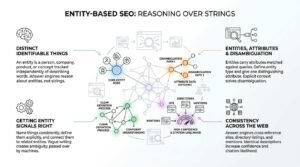
An entity is a distinct, identifiable thing a person, company, product, or concept that search systems track independently of the words used to describe it. Answer engines reason about entities, not strings.
Getting entity signals right means naming things consistently, defining them explicitly, and connecting them to the entities they relate to. Vague writing creates ambiguity, and ambiguous content gets passed over for something the machine understands with confidence.
Entities, Attributes, and Disambiguation
Every entity carries attributes, and attributes are what answer engines match against queries. Define the entity, state its type, and give it at least one distinguishing attribute in the same sentence.
Disambiguation matters when your entity shares a name with something else. Explicit context solves it in one clause.
Consistency Across the Web
Answer engines cross-reference. When your site, your directory listings, and your third-party mentions describe your business identically, confidence rises, and citation likelihood rises with it.
Structured Data and Schema Markup for AEO
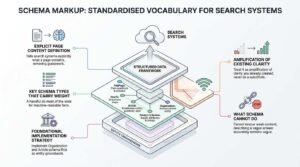
Schema markup is a standardised vocabulary that tells search systems explicitly what a page contains, rather than leaving them to infer it. Structured data does not force a citation, but it removes guesswork.
Which Schema Types Carry Weight
A handful do most of the work:
- FAQPage pairs questions with answers in machine-readable form
- HowTo sequences steps for process queries
- Article establishes author, publisher, and publication date
- Organization anchors your brand as a defined entity
- Product and Review supply attributes and ratings for commercial queries
I implement Organization and Article schema on every site before touching anything else. Those two do the entity groundwork everything else builds on.
What Schema Cannot Do?
Schema cannot rescue weak content. Markup describes what is on the page, and describing a vague answer accurately still leaves you with a vague answer.
Treat it as amplification of clarity you already created, never as a substitute for it.
Technical Foundations That Enable Answer Extraction
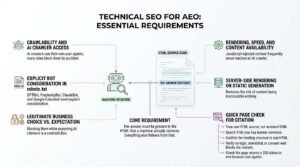
Technical SEO for AEO comes down to one requirement: the answer must be present in the HTML that a machine actually receives. Everything else follows from that.
Crawlability and AI Crawler Access
AI crawlers use their own user agents, and many sites block them by accident. GPTBot, PerplexityBot, ClaudeBot, and Google-Extended each need explicit consideration in robots.txt.
Blocking them is a legitimate business choice. Blocking them while expecting AI citations is not, and I see that contradiction constantly.
Rendering, Speed, and Content Availability
Content injected by JavaScript after load frequently never reaches an AI crawler. Server-side rendering or static generation removes that risk entirely.
Run this quick check on any page you want cited:
- View the raw HTML source, not the rendered DOM
- Search it for your key answer sentence
- Confirm the heading structure is real HTML, not styled divs
- Verify no login, interstitial, or consent wall blocks the content
- Check the page returns a 200 status to non-browser user agents
Any failure here makes the rest of your technical SEO work irrelevant for answer engines.
Question Research: Finding the Queries Answer Engines Serve
AEO question research identifies the specific questions your audience asks and the exact phrasing they use, then maps each one to a section that answers it directly. Keyword lists alone will not get you there.
Question Mining Sources
I pull from these, in this order:
- People Also Ask boxes on your target queries
- Google Search Console queries containing question words
- Reddit and industry forum threads
- Sales and support conversation transcripts
- AI assistants themselves, asked what people commonly want to know
- Competitor FAQ blocks and H2 structures
Support transcripts consistently produce the best material. Real customers phrase things in ways no keyword tool ever surfaces.
Mapping Questions to Page Sections
One question maps to one heading, and that heading gets answered in its first sentence. Bundling three questions under one vague heading guarantees none of them gets extracted cleanly.
This is where keyword research and question research converge, since demand data tells you which questions justify a full section.
E-E-A-T, Authority, and Source Trust in AI Answers
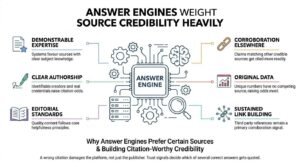
Answer engines weight source credibility heavily because a wrong citation damages the platform, not just the publisher. Trust signals decide which of several correct answers gets quoted.
Why Answer Engines Prefer Certain Sources
Systems favour sources with demonstrable expertise, clear authorship, editorial standards, and corroboration elsewhere on the web. Google’s own guidance on AI features states that content shown in AI experiences follows the same core quality and helpfulness principles as organic ranking.
Corroboration is the underrated one. A claim that matches what other credible sources say gets cited more readily than a novel claim with no support.
Building Citation-Worthy Credibility
Named authors with real credentials, cited primary sources, visible publication dates, and original data all raise citation odds. Original data raises them most, because a unique number has no competing source.
Sustained link building still matters here, since third-party references remain a primary corroboration signal for both search and answer systems.
Topical Authority and Content Clusters for AEO
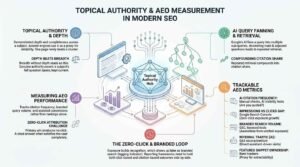
Topical authority is the demonstrated depth and completeness of a site’s coverage across a subject, and answer engines use it as a proxy for reliability. One excellent page rarely beats a well-built cluster.
Google’s AI Mode makes this concrete by fanning a query into multiple sub-queries. A site that answers the main question and eight adjacent ones gets retrieved repeatedly, and repeated retrieval compounds into citation share.
Why Depth Beats Breadth for Machine Trust
Breadth without depth reads as thin to both readers and retrieval systems. I would rather own twenty questions completely than touch two hundred superficially.
Building genuine topical authority means covering a subject’s full question space, then keeping it current.
Measuring AEO Performance
AEO measurement tracks citation frequency, branded query volume, and assisted conversions rather than rankings alone, because the primary win produces no click. Attribution is genuinely harder here.
What You Can Actually Track Today
These are the metrics I report on:
| Metric | Source | What it tells you |
| AI citation frequency | Manual checks, AI visibility tools | Whether you are being quoted |
| Impressions vs clicks gap | Google Search Console | Zero-click exposure growth |
| Branded search volume | GSC, keyword tools | Awareness generated by uncited exposure |
| Referral traffic from AI platforms | GA4 source/medium | Direct assistant-driven visits |
| Featured snippet ownership | Rank trackers | Proxy for extractability |
Referral traffic from ChatGPT and Perplexity appears in GA4 and remains small for most sites. Treat it as a directional signal rather than a target.
The Zero-Click Attribution Problem
A cited answer often satisfies the user completely, and no session is created. That exposure still builds recognition, and recognition shows up later as branded search.
I watch branded query volume as the lagging indicator. When AI citations rise and branded searches follow eight to twelve weeks later, the loop is working.
Broader SEO reporting frameworks need adjusting to hold both click-based and citation-based outcomes side by side.
Common AEO Mistakes and Misconceptions
Most AEO failures come from applying old formatting habits to a new extraction surface. These are the errors I correct most often:
- Burying the answer under three paragraphs of context
- Pronoun-heavy writing that breaks the moment a sentence is extracted
- Blocking AI crawlers in robots.txt while expecting citations
- Treating AEO as a replacement for search fundamentals
- Stat-stuffing without attribution, which fails the grounding filter
- Chasing every platform at once instead of the one your buyers use
- Measuring only rankings and concluding nothing is working
Number three appears on roughly a third of the sites I audit. It is a five-minute fix that unlocks everything downstream.
How to Build an AEO Strategy: A Practical Sequence
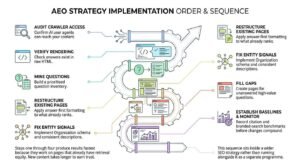
An AEO strategy sequences technical access, question research, content restructuring, entity work, and measurement in that order, because each stage depends on the one before it. Order failures waste months.
The Implementation Order That Works
- Audit crawler access: confirm AI user agents can reach your content
- Verify rendering: check answers exist in raw HTML
- Mine questions: build a prioritised question inventory
- Restructure existing pages: apply answer-first formatting to what already ranks
- Fix entity signals: implement Organization schema and consistent descriptions
- Fill gaps: create pages for unanswered high-value questions
- Establish baselines and monitor: record citation and branded-search benchmarks before changes compound
Steps one through four produce results fastest because they work on pages that already have retrieval equity. New content takes longer to earn trust.
This sequence sits inside a wider SEO strategy rather than running alongside it as a separate programme.
What AEO Costs and How Long It Takes
Most businesses see measurable AEO gains within three to six months, with restructured existing pages producing citations faster than newly published content. Budgets vary more than timelines do.
Retrofitting a page that already ranks often produces citations within four to eight weeks. Building authority for a new topic from zero takes six to twelve months, the same as any organic growth effort.
Costs depend on whether you already have competent technical foundations. Sites with clean architecture and existing rankings need editing work, and sites without them need remediation first, which changes the number substantially. SEO pricing generally reflects that gap directly.
Does AEO Replace SEO?
No. AEO extends search optimisation to a new surface, and it depends entirely on the crawlability, relevance, and authority that SEO produces.
Where Answer Engine Optimization Is Heading
Answer engines are moving toward personalised, multi-step, agent-driven responses that complete tasks rather than just answering questions. Three shifts look durable to me.
Retrieval is getting more granular, which raises the value of precise passage-level writing further. Attribution is becoming more visible as platforms compete on transparency, and publishers push back on uncredited use.
And brand recognition is becoming a ranking-adjacent asset, because assistants surface names users already trust. The sites winning citations in 2026 will be the ones that built genuine subject depth in 2025.
Conclusion
Answer engine optimization structures content for machine extraction, combining answer-first writing, entity clarity, structured data, technical access, and demonstrable authority into one discipline.
It sits on top of search fundamentals rather than replacing them, and the deeper resources in this cluster cover each component in full detail.
We build AEO programmes that earn citations and compound into durable organic growth. Talk to White Label SEO Service about your visibility.
Frequently Asked Questions
What is answer engine optimization in simple terms?
Answer engine optimization means writing and structuring content so AI systems can quote it directly when answering questions. It targets citations inside answers rather than positions on a results page.
Is AEO the same as SEO?
No. AEO is a specialised layer that focuses on passage extraction and citation, while SEO focuses on ranking pages. AEO depends on SEO foundations to work at all.
How long does AEO take to show results?
Most sites see citation gains in three to six months. Restructuring pages that already rank produces results faster, often within four to eight weeks.
Do I need schema markup for AEO?
Schema helps by removing ambiguity about what a page contains, but it does not guarantee citations. Clear, answer-first content matters more than markup alone.
Which answer engines should I optimise for first?
Start with Google AI Overviews, since it reaches the widest audience and draws from your existing index. Add Perplexity and ChatGPT once foundations are solid.
Can AEO work without good technical SEO?
No. If crawlers cannot reach your content or answers only load via JavaScript, extraction fails regardless of content quality. Technical access comes first.
How do I know if AI is citing my content?
Check manually by asking target questions in each assistant, then track branded search volume and AI referral traffic in GA4 as supporting signals over time.