Agentic search is a model of information retrieval where AI agents autonomously plan, execute, and complete multi-step tasks on a user’s behalf, rather than simply returning a list of links. I’ve watched this shift accelerate over the past year, and it changes what “ranking” even means. Instead of a person scanning ten blue links, an AI agent now reads, compares, and often decides for them.
This matters right now because purchase and research decisions are quietly moving away from human eyes. If your content and product data aren’t structured for machines to parse, an agent simply skips you and picks a competitor it can understand.
This guide covers what agentic search actually is and how it differs from traditional search, how AI shopping agents evaluate and select products, how autonomous discovery works across content and structured data, and what this means for SEO strategy, measurement, and the risks ahead.
What Is Agentic Search?
Agentic search is a retrieval model where an AI system autonomously completes a task researching, comparing, booking, or buying instead of just returning results for a human to sort through. I think of it as the difference between handing someone a map versus driving them to the destination.
Agentic search is a search paradigm that uses autonomous AI agents to plan, execute, and complete tasks based on a stated goal. The agent decides which sources to check, which data points matter, and when it has enough information to act.
We’re already seeing this in tools that book restaurant reservations, compare flight prices, or draft a shopping cart without a person clicking through each page. Gartner predicts that by 2028, at least 15% of day-to-day business decisions will be made autonomously through agentic AI, up from effectively zero in 2024.
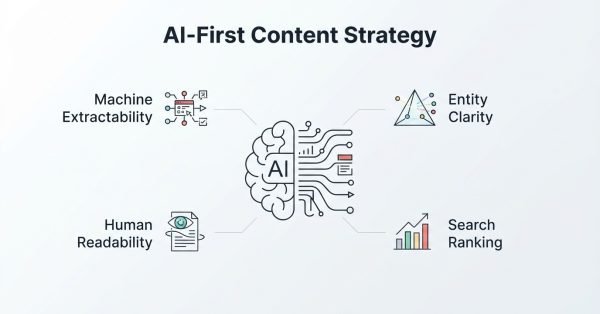
The practical effect is that content now has two audiences: the human reader and the agent acting on their behalf.
How Agentic Search Differs from Traditional Search Engines
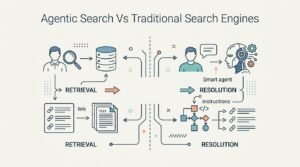
Traditional search returns a ranked list of pages and leaves interpretation to the user. Agentic search skips that step entirely; the agent reads the pages itself and hands the user a synthesized answer or completed action.
I’d describe the difference as retrieval versus resolution. A traditional query says “show me options.” An agentic query says “solve this for me.”
Three shifts define this gap: agents chain multiple queries together instead of running one search, agents evaluate content quality and structure programmatically rather than relying on a human’s judgment, and agents can execute an action (booking, purchasing, filling a form) rather than stopping at a results page. McKinsey’s 2024 research on agentic AI found that early adopters of autonomous agents reported up to 30% reductions in task completion time across research-heavy workflows.
This is also why traditional keyword-matching content strategies are losing ground. An agent doesn’t care how many times a phrase appears; it cares whether the page answers its specific sub-question cleanly.
The Technology Behind Autonomous AI Agents
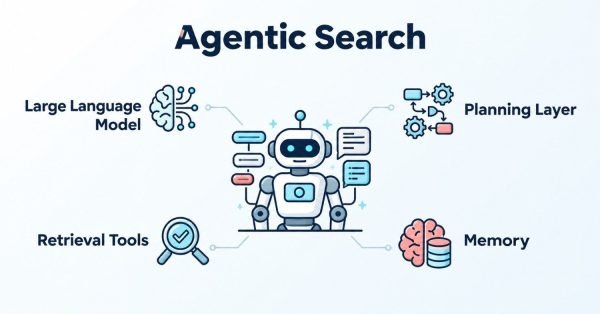
Autonomous AI agents run on a stack of large language models, retrieval-augmented generation, and function calling that lets them pull live data and take real actions instead of just generating text. I find it easier to explain as three layers stacked on top of each other.
The reasoning layer is the large language model itself, which plans steps and interprets instructions. The retrieval layer, often built on retrieval-augmented generation (RAG), pulls in real-time or external data so the agent isn’t limited to its training data. The action layer uses function calling and APIs to actually do something: search a database, submit a form, complete a checkout.
Retrieval-augmented generation is a technique that combines a language model’s reasoning with real-time data retrieval from external sources. This is the piece that lets an agent cite a current price or a live inventory count instead of a stale guess.
Websites become inputs to this stack the moment their content is clean enough for an API or a crawler to parse reliably.
What Is AI Shopping and How Do AI Shopping Agents Work?
AI shopping is the use of autonomous agents to research, compare, and complete purchase decisions on a shopper’s behalf, often without the shopper visiting a retailer’s site directly. I think this is the clearest commercial expression of agentic search so far.
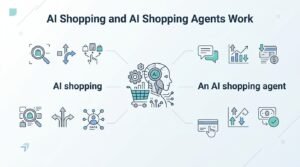
An AI shopping agent is a software system that identifies, compares, and selects products or services based on a user’s stated preferences and constraints. A shopper might say “find me a durable, under-$100 pair of running shoes with good arch support,” and the agent handles the rest.
The agent typically pulls product data, reviews, pricing, and availability from multiple sources, weighs them against the stated criteria, and returns a shortlist or completes the purchase directly. Adobe’s 2024 holiday shopping data showed AI-driven traffic to US retail sites grew by 1,300% year-over-year during the period studied.
That kind of growth means retailers who aren’t structured for agent readability are becoming invisible at exactly the moment demand is shifting toward this channel.
Major AI Shopping Platforms and Agents
Several major platforms now run shopping-specific agent features rather than treating commerce as an afterthought. The table below shows where the shift is furthest along.
| Platform | Agentic Shopping Feature | Primary Use Case |
| ChatGPT (OpenAI) | Shopping integration with product cards and checkout links | Conversational product research and comparison |
| Perplexity | Shopping results embedded in answer threads | Research-driven purchase decisions |
| Google AI Mode | AI-generated shopping summaries with product grids | Broad comparison shopping |
| Amazon Rufus | Conversational shopping assistant native to Amazon | On-platform product Q&A and recommendations |
Each of these treats the product page or feed as raw material rather than a destination, which is a meaningful shift for anyone measuring success by site visits alone.
How AI Agents Evaluate and Select Products or Brands
AI shopping agents select products by scoring them against structured signals like price, specifications, review sentiment, and availability rather than by brand familiarity alone. I’ve noticed this levels the playing field for smaller brands with clean data.
The agent typically pulls from structured product feeds, schema markup, and third-party review aggregators to build its comparison set. Review sentiment analysis is a process that uses natural language processing to determine whether customer feedback is broadly positive, negative, or neutral, and agents lean on it heavily when specs are similar across competitors.
Price and availability tend to be treated as hard filters first, with qualitative signals like review sentiment and brand reputation used to break ties afterward. A product with incomplete or inconsistent data across feeds often gets dropped from consideration entirely, regardless of its actual quality.
This is less about gaming an algorithm and more about giving the agent unambiguous facts it can trust enough to act on.
The Impact of Agentic Commerce on Retailers and Brands
Agentic commerce is shifting purchase influence away from the retailer’s own website and toward the data layer that agents actually read. I think this is the single biggest operational change retailers need to plan for.
When an agent completes a purchase or comparison without the shopper landing on a brand’s site, traditional conversion tracking and on-site personalization lose most of their value. Brand loyalty also behaves differently an agent optimizing for stated criteria won’t favor a brand simply because of past purchase history unless that preference is explicitly programmed in.
Salesforce’s 2024 Shopping Index found that AI-referred traffic converted at rates up to 9 times higher than traditional referral traffic, though volume from these channels is still a fraction of total traffic.
Retailers who treat structured product data as a marketing asset, not just a technical requirement, are positioned to benefit most from this shift.
What Is Autonomous Discovery in the AI Search Era?
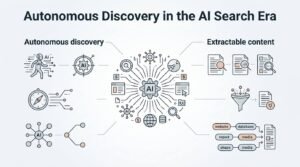
Autonomous discovery describes the process by which AI agents independently find, evaluate, and cite content or sources without a human manually searching or clicking through results. I see it as the research equivalent of AI shopping.
Autonomous discovery is a content retrieval process in which an AI system identifies and selects sources based on relevance, structure, and trustworthiness signals rather than a human’s manual review. This applies to everything from answering a factual question to compiling a competitive analysis.
The agent doesn’t browse the way a person does. It queries, retrieves candidate sources, extracts the relevant pieces, and often never surfaces the original page to a human at all.
This is exactly why extractable content built to be lifted cleanly out of context matters more now than traditional click-through optimization.
How AI Agents Crawl, Retrieve, and Cite Content
AI agents retrieve content by issuing structured queries against search indexes and APIs, then extracting the specific passages that answer a sub-question rather than reading a page top to bottom. I find this is the part most site owners misunderstand.
The retrieval step typically favors pages where the answer to a likely question sits in a clean, self-contained sentence near the top of a section. Passage-level retrieval is a technique search and AI systems use to extract a relevant snippet from within a page rather than treating the whole page as a single unit.
Citation follows a similar logic: an agent is more likely to cite a source when the claim being cited is attributed clearly within the same sentence, with a credible name or study attached. Ahrefs’ 2024 study of AI Overview citations found that cited pages ranked in the traditional top 10 organic results 74.3% of the time, showing real overlap between classic SEO strength and AI citation likelihood.
Pages that bury their answers in dense paragraphs without clear structure are simply harder for this retrieval step to use, no matter how accurate the content is.
Structured Data, Schema, and Machine Readability for Agentic Systems
Structured data is what allows AI agents to parse a page’s content reliably instead of guessing at meaning from unstructured text. I treat this as the technical foundation everything else in this guide depends on.
Schema markup is a standardized vocabulary of tags added to a webpage’s code that explicitly describes its content to search engines and AI systems. Product schema, FAQ schema, and Organization schema are the three types agents rely on most heavily for commerce and informational queries.
Machine readability goes beyond schema alone. Clean HTML hierarchy, consistent product attribute naming across a feed, and accurate structured data reduce the chance an agent misreads or skips a page entirely.
Sites without this layer are still visible to human visitors but functionally invisible to the agents now doing a growing share of the research and purchasing.
How Agentic Search Is Changing SEO and Organic Visibility
Agentic search is shifting SEO’s objective from ranking a page to becoming the source an agent trusts enough to extract from and cite. I’ve had to rethink how I explain “rankings” to clients because of this.
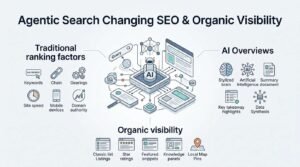
Traditional ranking factors like backlinks and on-page keywords still matter, but they now sit alongside a newer requirement: can an agent parse this page’s claims cleanly enough to reuse them? A page can rank well in classic search and still get skipped by an agent if its key facts aren’t stated in self-contained, attributable sentences.
Organic visibility is increasingly measured across two surfaces at once: traditional SERP position and inclusion in AI-generated answers or agent citations. BrightEdge’s 2024 research found that AI Overviews now appear on roughly 47% of tracked search queries, a substantial jump from the prior year.
This doesn’t replace SEO. It adds a second scoring system running in parallel to the first.
Generative Engine Optimization (GEO) and Answer Engine Optimization (AEO) Explained
GEO and AEO are the emerging disciplines focused on optimizing content specifically for citation and extraction by generative AI systems and answer engines. I use both terms carefully because they overlap but aren’t identical.
Generative Engine Optimization is the practice of structuring content so generative AI systems are more likely to cite, quote, or reference it in their responses. Answer Engine Optimization is the practice of formatting content to directly answer specific questions in a way that snippet and voice-based answer engines can extract cleanly.
| Discipline | Primary Target | Core Technique |
| Traditional SEO | Search engine rankings | Keywords, backlinks, technical health |
| AEO | Featured snippets, voice answers | Direct question-answer formatting |
| GEO | AI Overviews, chatbot citations | Extractable, attributable, structured claims |
The three disciplines share a foundation in technical health and content clarity, but each has a distinct success metric worth tracking separately.
How to Prepare Your Website and Content for AI Agents
Preparing a website for AI agents means making its content structurally easy to parse, its claims clearly attributed, and its product or business data consistently formatted across every surface an agent might check.
I generally walk clients through the same sequence:
- Audit existing content for answer-first structure, making sure key questions are answered in the first sentence of each section.
- Add or clean up schema markup, prioritizing Product, FAQ, and Organization types first.
- Ensure every statistic or claim names its source within the same sentence, not in a separate footnote.
- Standardize product attribute naming across all feeds and listings so agents don’t encounter conflicting data.
- Test how pages render for crawlers and agents, not just human browsers, checking for JavaScript-dependent content that may not load.
- Strengthen topical authority by covering a subject comprehensively across a connected set of pages rather than one isolated post.
None of these steps replace foundational technical SEO; they extend it toward a machine-reading audience that didn’t exist at this scale two years ago.
Measuring Visibility and Performance in Agentic Search
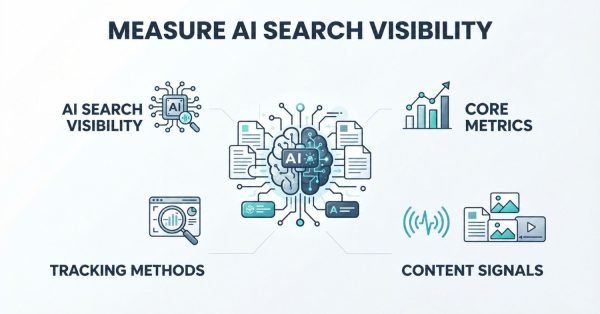
Measuring performance in agentic search requires tracking citation and inclusion in AI-generated answers alongside traditional rankings, since a page can succeed in one system and remain invisible in the other. I check both dashboards now, not just one.
Share of AI voice is an emerging metric that estimates how often a brand or domain is cited across AI-generated answers for a defined set of queries, similar in concept to share of search but applied to generative engines. Tools tracking this are still maturing, and most rely on sampled queries rather than exhaustive coverage.
Traditional metrics like organic sessions and keyword rankings from Google Search Console remain useful, but they increasingly undercount total visibility since agent-driven answers often don’t generate a click at all.
Businesses that only measure clicks and sessions risk concluding their content is underperforming when it may actually be getting cited and acted on without ever showing up in that data.
Challenges, Risks, and Limitations of Agentic Search and AI Shopping
Agentic search introduces real risks, including reduced referral traffic, loss of brand control over how products are described, and dependency on third-party platforms whose ranking logic isn’t transparent. I don’t think these risks are a reason to ignore the shift, but they’re worth naming plainly.
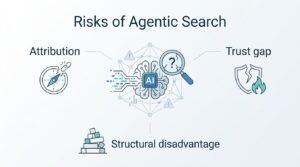
Attribution becomes harder when an agent completes a task without the user ever visiting the source site, which breaks conventional analytics models built around sessions and pageviews. There’s also a trust gap: agents can misinterpret outdated or poorly structured data and represent a product or claim incorrectly, with no easy way for the business to correct it in real time.
Smaller businesses face a structural disadvantage too, since building clean, structured data and technical infrastructure at the level agents require takes resources many haven’t budgeted for yet.
The Future of Agentic Search and Autonomous Commerce
Agentic search and autonomous commerce are moving toward a model where AI agents handle an increasing share of research, comparison, and transaction completion across both informational and commercial queries. I expect the next two years to bring far more standardization around how agents read and trust structured data.
Regulatory attention is also likely to increase as autonomous purchasing decisions raise new questions around consumer protection and disclosure. The businesses that treat this as infrastructure now, rather than a future problem, will have a real head start once agent-driven discovery becomes the default rather than the exception.
Conclusion
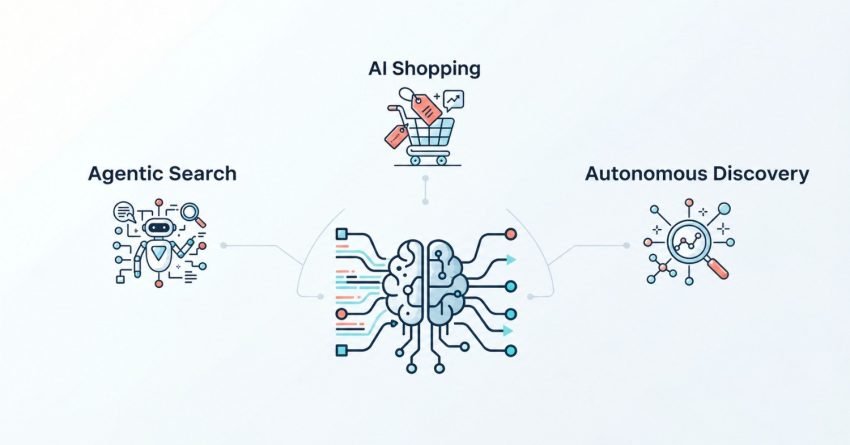
Agentic search, AI shopping, and autonomous discovery are converging into one shift: machines now research, compare, and act on behalf of humans. Understanding this changes how visibility, trust, and structured data connect across your entire digital presence.
The path forward runs through both traditional SEO and emerging disciplines like GEO and AEO working together, not one replacing the other.
We help businesses build the technical and content foundation this new landscape demands. Partner with White Label SEO Service to make sure your brand is ready to be found, trusted, and chosen by both humans and the agents acting for them.
Frequently Asked Questions
What is the difference between agentic search and traditional search?
Agentic search completes tasks autonomously on a user’s behalf, while traditional search returns a list of links for the user to evaluate manually. The agent handles research, comparison, and sometimes the transaction itself.
Is AI shopping the same as e-commerce?
AI shopping is not the same as e-commerce; it’s a layer built on top of e-commerce where AI agents handle discovery and comparison. E-commerce still refers broadly to any online buying and selling.
Do I need schema markup for AI agents to find my content?
Schema markup significantly improves how reliably AI agents parse and cite your content, though it isn’t strictly required for discovery. Pages without it are harder for agents to interpret accurately and get skipped more often.
Can small businesses compete in agentic search against large brands?
Small businesses can compete in agentic search since agents weigh structured data and specific criteria over brand size alone. Clean, accurate product and content data often matters more than brand recognition here.
How is GEO different from traditional SEO?
GEO focuses specifically on getting content cited or quoted by generative AI systems, while traditional SEO focuses on ranking in search engine results pages. The two share technical foundations but target different success metrics.
Will AI shopping agents replace human browsing entirely?
AI shopping agents are unlikely to fully replace human browsing in the near term, since many purchases still involve personal preference and visual evaluation. Adoption is growing fastest for repeat, well-defined purchases.
How do I measure if my content is being cited by AI agents?
Measuring AI citation currently requires a mix of manual query testing, emerging share-of-voice tools, and monitoring referral patterns from AI platforms in analytics. This measurement space is still maturing and lacks a single standard tool.