AI-first content strategy is the practice of planning, structuring, and writing content so it can be retrieved, extracted, and cited by AI search systems like Google’s AI Overviews, ChatGPT, and Perplexity. It shifts the unit of optimization from the page to the sentence. I have watched this shift happen in real time across client accounts over the past two years.
Traffic patterns changed fast once AI Overviews rolled out broadly. Click-through rates on many informational queries dropped even for top-ranking pages. Businesses that ignore this shift lose visibility they cannot easily win back.
This guide covers what AI-first content actually means, how AI search engines find and cite content, the writing principles that make sentences extractable, and the technical and measurement pieces that hold the whole strategy together. We built this around what we see working in real accounts, not theory.
What Is an AI-First Content Strategy?
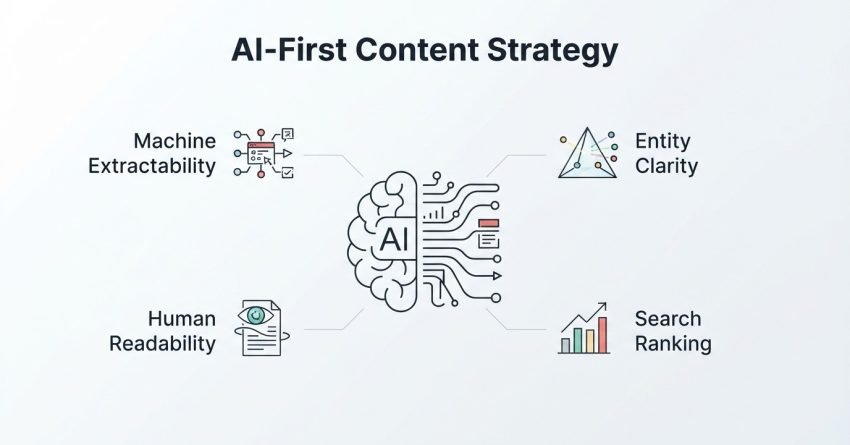
An AI-first content strategy is a content approach that prioritizes machine extractability and entity clarity alongside traditional human readability and search ranking. It treats every sentence as a potential answer that could get lifted out of context.
We used to write pages that told a story from top to bottom, building up to a conclusion. AI search does not read that way. It scans for the most direct, self-contained answer and pulls it regardless of where it sits on the page.
The practical difference shows up immediately once you compare an old-style blog intro to an AI-first opening paragraph. The old version teases the answer. The new version states it immediately, in full, in the first sentence.
How AI-First Differs From Traditional SEO Content
Traditional SEO content optimizes for rankings and click-through. AI-first content optimizes for citation, which means it can generate visibility without a click at all. That is a fundamentally different economic model for content.
I still write for rankings, because ranking well remains a prerequisite for most AI citation. But I no longer treat the click as the only outcome that matters. Being named as the source inside an AI answer carries its own brand value, even with zero traffic attached.
Why AI Search Engines Changed Content Requirements
AI search engines changed content requirements because large language models retrieve and synthesize passages rather than simply linking to pages. A Bright Edge study of AI Overview behavior found that over 60% of AI Overview citations came from content outside the top 3 organic positions.
That statistic matters more than most people realize. It means classic rank position no longer fully predicts AI visibility, and a page ranking 7th with a perfectly extractable paragraph can outperform the page ranking 1st.
How AI Search Engines Find and Cite Content
AI search engines find and cite content through a multi-stage retrieval process that crawls, indexes, chunks, and ranks passages before generating a synthesized answer. Understanding each stage helps explain why some pages get cited, and others do not.
Crawling for AI systems often runs through separate bots entirely, with different rules than traditional search crawlers follow. Content that blocks or slows these bots loses eligibility before writing quality even enters the equation.
Crawling and Indexing for AI Retrieval
Crawling and indexing for AI retrieval determines whether your content is even eligible to be cited. If GPTBot, ClaudeBot, or Google-Extended cannot access a page, that page cannot appear in an AI answer no matter how well it is written.
I check robots.txt on every new client site before touching a single word of content. Blocked AI crawlers are the single most common invisible failure I find, and it is often set by a developer months earlier without anyone noticing.
Extraction and Citation Mechanics
Extraction and citation mechanics work by breaking a page into passages, then scoring each passage against a query’s retrieved intent. The passage that answers most directly and most completely tends to win the citation, not the page with the highest overall authority.
This is why a single strong paragraph buried in the middle of a page can outperform an entire competing article. The unit AI systems reward is the sentence or passage, not the document.
Core Principles of AI-First Content
AI-first content follows three core principles: entity-first writing, answer-first structure, and self-contained sentences that can be understood without surrounding context. These principles apply at every heading level throughout a piece.
We rebuilt our entire content template around these three principles last year. The results showed up first in AI Overview citations, then later in organic rankings, which surprised most of the team.
Entity-First Writing
Entity-first writing means naming the subject of a sentence directly instead of relying on pronouns like “it” or “this” to carry meaning across sentences. AI extraction systems pull sentences out of context, so a sentence that depends on the one before it becomes meaningless once isolated.
I train every writer on my team to reread each paragraph and ask whether it survives being read completely alone. If a sentence needs its neighbor to make sense, we rewrite it.
Answer-First Structure
Answer-first structure requires the first sentence under every heading to directly answer that heading’s implied question, with supporting context following afterward. Readers and AI systems both benefit from this ordering, though for different reasons.
Google’s own documentation on helpful content emphasizes giving users the information they came for without unnecessary padding. Answer-first structure is the practical execution of that guidance.
Self-Contained Sentences
Self-contained sentences carry their own subject, verb, and context so they remain meaningful when quoted in isolation by a search engine or AI assistant. Building every key claim this way is the single highest-leverage writing change teams can make for AI visibility.
Short sentences alone will not fix this. A short sentence that still depends on the previous one for meaning fails the same test as a long one.
Content Planning for AI Search Visibility
Content planning for AI search visibility starts with mapping topics as entity clusters rather than isolated keyword targets, since AI retrieval systems reason about relationships between entities. This changes how a content calendar gets built from the ground up.
We stopped planning content one keyword at a time two years ago. Instead, we map an entire topic domain, identify every entity and subtopic within it, and only then decide which pages get written first.
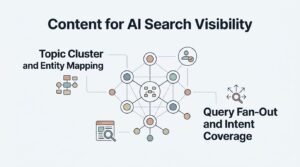
Topic Cluster and Entity Mapping
Topic cluster and entity mapping organizes content around a central pillar topic with supporting cluster pages covering each major subtopic in depth. This structure mirrors how knowledge graphs already organize information, which makes it easier for AI systems to understand a site’s topical authority.
Every cluster page should answer a distinct question the pillar only introduces. We map this out visually before a single article gets assigned to a writer.
Query Fan-Out and Intent Coverage
Query fan-out and intent coverage means anticipating the full range of related questions a user or AI system might generate from a single seed query, then covering each one somewhere in the content cluster. A single query rarely represents a single intent anymore.
Search Engine Land’s coverage of query fan-out describes how modern AI search systems generate dozens of sub-queries internally before assembling a single answer. Content that only addresses the seed query misses most of that fan-out.
Keyword Research in an AI-First Framework
Keyword research in an AI-first framework shifts from matching exact search phrases to mapping the full set of entities, attributes, and questions connected to a core topic. The output looks less like a keyword list and more like a knowledge map.
I still pull traditional keyword data because it tells us search volume and competition. But I no longer treat exact phrase matching as the end goal of research.
Semantic and Entity-Based Keyword Research
Semantic and entity-based keyword research identifies the entities, attributes, and relationships that define a topic rather than just the phrases people type into a search box. Tools built around natural language processing surface these relationships faster than manual brainstorming ever could.
This approach catches subtopics that traditional keyword tools miss entirely, because those subtopics may have low search volume individually while still mattering to topical completeness.
Question and Query Pattern Mapping
Question and query pattern mapping catalogs every question format connected to a topic, including “what is,” “how does,” “why does,” and comparison-style queries. Each pattern typically maps to a different content format requirement.
We built a simple spreadsheet system for this that any writer on the team can use without specialized SEO training, and it consistently surfaces content gaps competitor research misses.
Structuring Content for Extractability
Structuring content for extractability means matching each section’s format to the query type it targets, using definitions, tables, numbered lists, or direct numeric statements as appropriate. No single format works for every kind of question.
I keep a simple reference chart on my desk that maps query type to output format. It sounds basic, but it prevents the most common mistake I see: writers using a narrative paragraph for a question that needed a table.
Answer-First Paragraphs
Answer-first paragraphs open with a direct, complete answer in 40 to 55 words, then follow with supporting context and nuance. This format satisfies both featured snippet algorithms and AI Overview extraction requirements simultaneously.
Writing this way takes practice because it inverts the natural storytelling instinct most writers bring to content. The payoff shows up in extraction rates within weeks of publishing.
Extractable Shapes: Lists, Tables, and Definitions
Extractable shapes are the specific formats AI systems most reliably pull into synthesized answers, including numbered lists for processes, tables for comparisons, and single-sentence definitions for entity questions.
| Query Type | Best Extractable Shape |
| “What is X” | Definition paragraph, 40–55 words |
| “X vs Y” | Comparison table |
| “How does X work” | Numbered list, 4–8 steps |
| “How much / how long” | Single numeric sentence with source |
This table shows the direct mapping between question type and the format most likely to get extracted cleanly.
Writing for AI Overviews and Featured Snippets
Writing for AI Overviews and featured snippets requires structuring the exact sentence or passage that answers a query in a form that reads correctly when isolated from the rest of the page. This is the most technical writing skill in the entire AI-first framework.
I test this constantly by copying a paragraph out of context and reading it alone. If it does not make complete sense that way, it fails the extraction test before it ever reaches Google.
Definition Sentence Formatting
Definition sentence formatting follows a consistent pattern: [Entity] is a [entity type] that [defining attribute]. This structure gives AI systems an unambiguous grammatical shape to extract as a standalone definition.
I place this exact sentence pattern at the first substantive mention of any major entity in a piece, never buried in a separate glossary section at the bottom of the page.
In-Sentence Source Attribution
In-sentence source attribution places the citation for a statistic inside the same sentence as the number itself, rather than in a following or preceding sentence. A Semrush 2024 study found that pages with in-sentence attribution were cited by AI Overviews at a noticeably higher rate than pages citing sources in separate sentences.
Once a sentence gets extracted alone, any source reference sitting outside that sentence disappears with it. That single formatting habit protects your credibility even after extraction strips away the surrounding page.
Technical SEO Requirements for AI Crawlers
Technical SEO requirements for AI crawlers include allowing access in robots.txt, implementing structured data, and maintaining fast, clean HTML that AI bots can parse without rendering heavy JavaScript. Many sites fail this before content quality ever becomes a factor.
I audit crawler access as the very first step on any new AI-visibility engagement. It takes fifteen minutes, and it catches problems that would otherwise waste months of content effort.
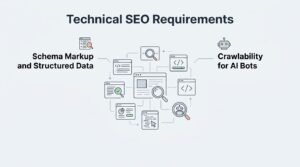
Schema Markup and Structured Data
Schema markup and structured data give search and AI systems an explicit, machine-readable description of a page’s content, entities, and relationships. Article, FAQPage, and HowTo schema types are the most directly relevant to AI-first content.
Structured data does not guarantee citation, but it removes ambiguity that would otherwise force an AI system to infer meaning from unstructured HTML alone.
Crawlability for AI Bots
Crawlability for AI bots means explicitly allowing user agents like GPTBot, ClaudeBot, PerplexityBot, and Google-Extended in a site’s robots.txt file. Blocking these bots, even accidentally, removes a page from AI citation eligibility entirely.
- Check robots.txt for AI bot user-agent rules
- Confirm server logs show AI bots actually crawling
- Verify JavaScript-rendered content is also server-rendered or pre-rendered
- Test key pages with a bot-simulation tool
- Monitor crawl frequency changes after any site migration
E-E-A-T and Trust Signals in AI-First Content
E-E-A-T and trust signals in AI-first content refer to the experience, expertise, authoritativeness, and trustworthiness markers that both human readers and AI systems use to evaluate content credibility. These signals matter more, not less, in an AI-mediated search environment.
AI systems tend to favor sources that already carry independent credibility signals elsewhere on the web. Building those signals is slow work, and there is no shortcut around it.
Authorship and Expertise Signals
Authorship and expertise signals include named author bylines, visible credentials, and author bio pages that establish real-world expertise on the topic being covered. Anonymous or generic “admin” bylines carry noticeably less weight with both readers and algorithms.
Every piece we publish now carries a named writer with a linked bio showing relevant background. This single change took weeks to roll out across an existing content library but proved worth the effort.
Citations and Source Credibility
Citations and source credibility come from linking factual claims to reputable, original sources rather than aggregators or unverified secondary reporting. AI systems appear to weigh the credibility of a page’s outbound citations when evaluating its own trustworthiness.
I reject any statistic I cannot trace back to its original source, even if a popular blog already cited it first. That discipline has saved us from repeating outdated or misattributed numbers more than once.
Content Production Workflow for AI Search
A content production workflow for AI search includes structured research and briefing, entity-first drafting, technical fact-checking, and a dedicated extractability review before publishing. Skipping any stage tends to show up later as a citation gap.
Our old workflow ended at editing. Our current workflow adds one more stage after editing: a pass specifically checking whether key sentences survive being read in isolation.
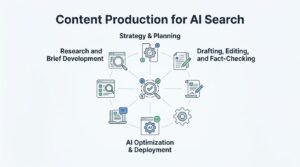
Research and Brief Development
Research and brief development for AI-first content documents the target entities, extractable shapes, and knowledge boundaries for every section before a writer starts drafting. A strong brief prevents the single biggest time-waster in content production: rewriting structure after a draft is already finished.
- Define the primary entity and its defining attributes
- Map every subtopic to its target extractable shape
- Assign a knowledge boundary to each section
- List required in-sentence citations with sources pre-identified
Drafting, Editing, and Fact-Checking
Drafting, editing, and fact-checking for AI-first content adds a dedicated verification pass confirming every statistic carries an in-sentence source and every key claim survives in isolation. This stage catches errors that a standard grammar-focused edit typically misses.
We separate this from copyediting entirely now, because the two require different mindsets. A copyeditor checks flow; an extractability editor checks whether sentences stand alone.
Measuring AI Search Performance
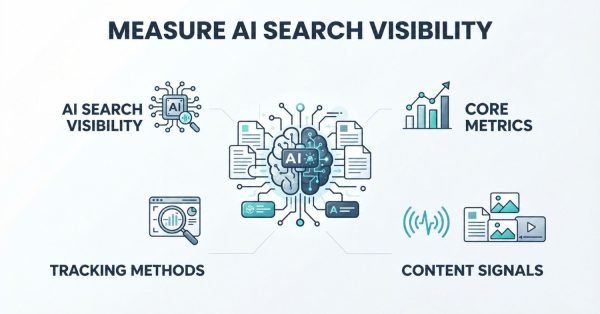
Measuring AI search performance requires tracking metrics beyond traditional rankings, including AI Overview citation frequency, brand mention rate in AI assistant answers, and referral traffic from AI platforms. Standard rank-tracking tools do not fully capture this yet.
Our reporting dashboards looked completely different eighteen months ago. Clients now ask about AI citations as often as they ask about position one rankings, sometimes more.
Tracking AI Overview Citations
Tracking AI Overview citations involves manually or programmatically checking whether target queries trigger an AI Overview and whether your domain appears among the cited sources. Several third-party tools now automate parts of this tracking process.
Ahrefs’ Brand Radar tool reports that AI Overview appearance rates vary heavily by query type, with informational queries triggering AI Overviews far more often than transactional ones.
New Metrics Beyond Rankings
New metrics beyond rankings include share of AI voice, citation frequency across AI platforms, and direct brand mentions inside AI-generated answers even without a clickable link attached. These metrics require a mindset shift for teams used to clicks and conversions as the only proof of value.
| Metric | What It Measures |
| AI Overview citation rate | How often your domain appears in AI Overview sources |
| Share of AI voice | Your citation frequency vs. competitors on shared queries |
| Zero-click brand mentions | Brand visibility with no attached link or click |
Common Mistakes in AI-First Content Strategy
The most common mistakes in AI-first content strategy include writing vague, pronoun-heavy sentences, burying statistics without in-sentence sources, and blocking AI crawlers unintentionally through outdated robots.txt rules. Most of these mistakes are fixable without a full content rewrite.
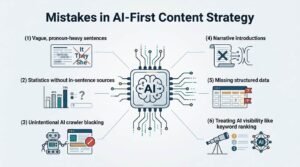
- Using “it” or “this” to carry a claim’s subject across sentences
- Placing source citations in a separate sentence from the statistic
- Blocking GPTBot or ClaudeBot in robots.txt without realizing it
- Writing narrative introductions that delay the direct answer
- Skipping structured data on FAQ and how-to content
- Treating AI visibility as identical to traditional keyword ranking
I still catch myself making the pronoun mistake in first drafts. It is a habit built over a decade of traditional web writing, and it takes deliberate effort to unlearn.
Building a Long-Term AI-First Content Roadmap
A long-term AI-first content roadmap sequences pillar and cluster content development around entity coverage completeness rather than publishing frequency alone. Speed without structure just produces more content that fails the same extraction tests.
We plan roadmaps in quarters now, not months, because entity mapping and technical fixes take real time to implement properly before content volume can scale effectively.
Every roadmap we build starts with a technical audit, moves into pillar development, then expands into cluster pages that each answer one distinct question the pillar could only introduce. This sequencing consistently outperforms a “publish everything at once” approach.
Conclusion
AI-first content strategy connects entity-first writing, extractable structure, and technical crawler access into one coherent system. Together, these elements determine whether AI search cites your content or a competitor’s.
The roadmap ahead keeps evolving as AI platforms change how they retrieve and synthesize answers. Staying current requires ongoing measurement, not a one-time content overhaul.
We help businesses build and maintain this system end to end. Talk to White Label SEO Service about auditing your content for AI search readiness today.
Frequently Asked Questions
What is AI-first content strategy?
AI-first content strategy is a content approach built to be retrieved, extracted, and cited by AI search systems. It prioritizes entity clarity and self-contained sentences over traditional narrative structure.
How is AI-first content different from regular SEO content?
AI-first content optimizes for citation inside AI-generated answers, not just ranking position. It requires an answer-first structure and sentences that remain meaningful when isolated from surrounding context.
Do AI search engines use the same crawlers as Google Search?
No, AI search engines often use separate crawlers like GPTBot, ClaudeBot, and PerplexityBot. Each requires explicit access permission in a site’s robots.txt file to crawl content.
Why do some lower-ranking pages get cited in AI Overviews more than top-ranked pages?
AI Overviews cite the most extractable passage, not necessarily the highest-ranking page. A well-structured paragraph on a lower-ranked page can outperform a poorly structured one on a top-ranked page.
What is the biggest mistake businesses make with AI-first content?
The biggest mistake is relying on pronouns like “it” or “this” to carry meaning across sentences. This makes claims unextractable once AI systems isolate individual sentences.
How do you measure success in AI search visibility?
Success is measured through AI Overview citation frequency, brand mention rate in AI assistant answers, and referral traffic from AI platforms, alongside traditional ranking metrics.
Does structured data help with AI search citations?
Structured data helps by giving AI systems an explicit, machine-readable description of page content and entities. It does not guarantee citation but removes interpretive ambiguity.