Agentic search is an AI-driven process where a search system autonomously plans, retrieves, and reasons through multiple steps to complete a task on a user’s behalf, rather than simply returning a list of links. I’ve watched this distinction get flattened in dozens of client conversations, and it costs businesses real visibility when they treat it the same as AI shopping. The two behave differently, rank differently, and require different content decisions.
Confusing them means optimizing for the wrong signals entirely. We built this guide because SEO decisions here compound over the next 12 to 24 months of visibility.
This guide covers what agentic search actually is and how it processes queries, what separates it from AI-driven shopping assistants, the ranking factors that influence each, and how we prepare content and product data to perform in both environments.
What Agentic Search Actually Means
Agentic search is a retrieval system where an AI agent independently decomposes a query, pulls from multiple sources, and synthesizes an answer or completes a task without step-by-step user guidance. I think of it less as “search” in the traditional sense and more as delegated problem-solving.
Traditional search returns a ranked list of pages and leaves interpretation to the user. Agentic search removes that middle step: the agent interprets the query itself, decides what information it needs, and acts.
How Agentic Search Differs From Traditional Search Engines
Traditional search engines match keywords and links to a query, then rank results by relevance and authority signals. Agentic search systems reason through a query in stages, often invoking external tools before producing an answer.
This shift changes what content needs to demonstrate. A page written only to rank for a keyword phrase misses the structured clarity an agent needs to extract and reuse it.
The Core Components of an Agentic Search System
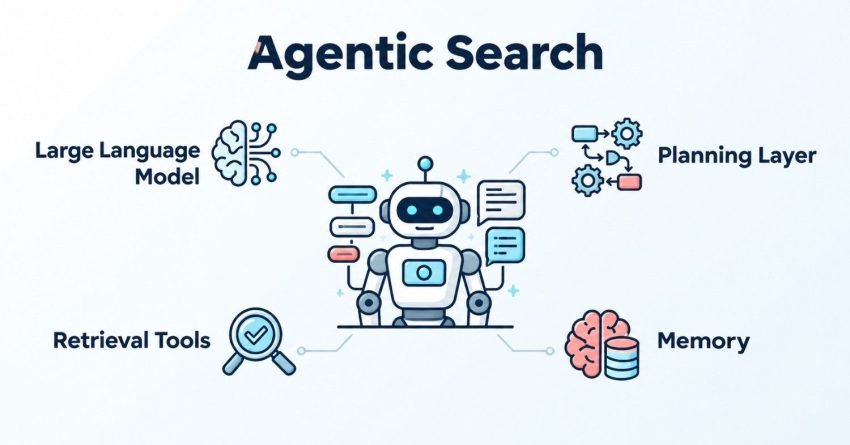
An agentic search system typically combines a large language model, a planning layer, retrieval tools, and memory of prior steps in the session. Each component plays a distinct role in how the final answer gets constructed.
The planning layer decides what sub-questions need answering. The retrieval layer fetches supporting data, often from real-time sources rather than a static index.
What AI Shopping Assistants Actually Do
AI shopping assistants are specialized AI tools designed to help users compare, select, and purchase products by processing structured product data rather than open-ended reasoning chains. Their job is narrower than agentic search by design.
Where agentic search might research a broad topic across many domains, AI shopping tools stay anchored to transactional intent: price, availability, specifications, and reviews.
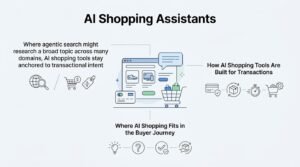
How AI Shopping Tools Are Built for Transactions
AI shopping tools ingest product feeds, pricing data, and review signals to generate comparisons or direct purchase recommendations. The underlying architecture prioritizes structured commerce data over general web content.
This is why a beautifully written blog post rarely influences an AI shopping recommendation the way accurate, up-to-date product feed data does.
Where AI Shopping Fits in the Buyer Journey
AI shopping assistants typically engage users at the consideration and decision stages, after a category or need has already been identified. They rarely handle the earlier, broader research phase that agentic search covers.
That timing distinction matters for where a business should invest its optimization effort. Product-page accuracy pays off here far more than editorial depth.
Agentic Search vs AI Shopping – The Core Distinction
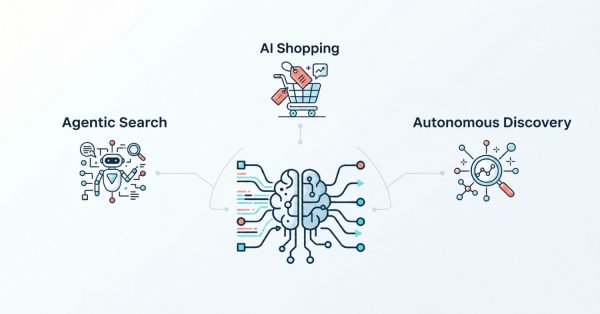
The core distinction between agentic search and AI shopping is scope: agentic search reasons across open-ended informational tasks, while AI shopping focuses narrowly on transactional product decisions. I treat this as the single most important line to draw before building any AI-visibility strategy.
Agentic search might plan a multi-city trip, synthesize research from a dozen sources, and produce a custom itinerary. AI shopping picks the best-reviewed blender under $80 based on structured data.
| Dimension | Agentic Search | AI Shopping |
| Primary intent | Informational, task-based | Transactional |
| Data source | Broad web content, tools, real-time retrieval | Product feeds, pricing, reviews |
| Output type | Synthesized answer or completed task | Product comparison or recommendation |
| Content that wins | Structured, authoritative explainer content | Accurate, current commerce data |
| User stage | Awareness through decision | Late consideration through purchase |
Businesses that treat these as one strategy tend to underperform in both, because the content requirements pull in opposite directions. Distinguishing agentic search from AI shopping early prevents that split focus.
How Agentic Search Engines Process Queries
Agentic search engines process a query by breaking it into sub-tasks, retrieving evidence for each sub-task, and reasoning through the combined results before generating a final response. This multi-step approach is what separates it from a single-pass ranking algorithm.
I see this show up clearly in longer, more complex queries the kind that used to require ten separate searches now get handled in one exchange.
Task Decomposition and Multi-Step Reasoning
Task decomposition means the agent splits a broad request into smaller, answerable questions before attempting a full response. Multi-step reasoning chains those smaller answers back together into a coherent output.
A query like “what’s the best SEO approach for a new SaaS company” might get broken into technical foundation needs, content strategy needs, and competitive positioning, each researched separately.
Tool Use, Retrieval, and Real-Time Data Access
Agentic systems frequently call external tools, search APIs, databases, or calculators mid-reasoning rather than relying solely on pre-trained knowledge. Real-time retrieval keeps answers current instead of frozen at a training cutoff.
This tool-calling behavior is part of why fresh, well-structured, and clearly sourced content gets pulled into these answers more often than stale pages.
The Role of AI Agents in Modern Search Behavior
An AI agent in this context is a semi-autonomous system that makes decisions about what information to gather and how to act on a user’s behalf, rather than simply presenting options. That autonomy is the defining feature separating agentic behavior from earlier chatbot interactions.
I’d describe the shift as moving from “here are ten links” to “here’s what I found and did for you.”
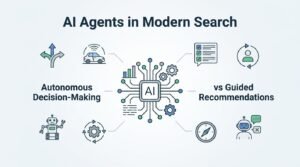
Autonomous Decision-Making vs Guided Recommendations
Autonomous decision-making happens when the agent selects a path forward without requiring the user to confirm each step. Guided recommendations, more typical of AI shopping tools, present curated options and leave the final choice explicitly to the user.
Both approaches have a place, but they demand different content signals: one rewards depth and reasoning support, the other rewards clarity and comparability.
Why This Distinction Matters for SEO Strategy
This distinction matters for SEO strategy because content built for agentic retrieval and content built for AI shopping visibility require different structures, different data, and different success metrics. Treating them as one optimization target dilutes both.
I’ve seen teams pour budget into product feed optimization while ignoring the explanatory content agentic systems actually cite, and vice versa. Neither approach alone captures the full opportunity.
Content Structured for Agentic Retrieval
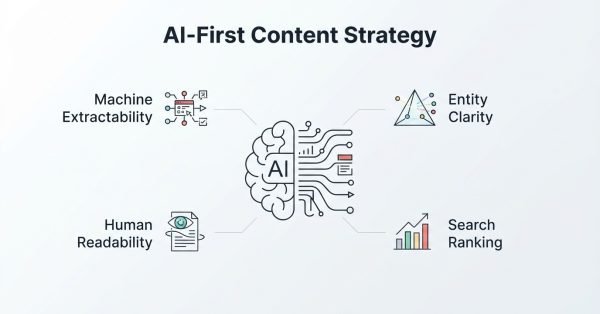
Content built for agentic retrieval needs clear entity definitions, self-contained answers, and logical structure an agent can extract without additional interpretation. Structured data such as schema markup reinforces the entity relationships an agent’s retrieval layer depends on.
An Ahrefs study of AI Overview citations found that over 60% of cited sources used clear heading structures with direct-answer openers under each section.
Content Structured for Product-Led AI Shopping Surfaces
Content built for AI shopping surfaces depends on accurate structured product data: pricing, availability, specifications, and verified reviews rather than long-form explanatory writing. Product feed hygiene functions here the way on-page copy functions in traditional SEO.
Missing or outdated feed data actively excludes a product from AI shopping recommendations, regardless of how strong the surrounding brand content is.
How Search Intent Signals Differ Between the Two
Search intent signals differ because agentic search queries tend to be exploratory or task-based, while AI shopping queries carry explicit transactional markers like product names, price ranges, or comparison terms. Recognizing which signal type dominates a query shapes which system engages.
I look at this the same way I’d assess traditional intent: the vocabulary in the query usually gives it away before anything else does.
Informational, Navigational, and Transactional Splits
Informational queries lean toward agentic search because they require synthesis across sources. Transactional queries lean toward AI shopping because they resolve against structured product data.
Navigational queries sit in between and often bypass both systems, heading straight to a known destination instead.
Ranking Factors That Influence Agentic Search Visibility
Ranking factors for agentic search visibility center on entity clarity, source credibility, and how easily a passage can be extracted and reused without additional context. Entity clarity in this context means naming subjects plainly rather than relying on pronouns or vague references.
I prioritize this over traditional keyword density any time I’m optimizing a page that needs to show up inside an agent’s synthesized answer.
Entity Clarity and Structured Data Requirements
Entity clarity requires that every major concept on a page be named explicitly and defined in a way a machine can parse without ambiguity. Structured data markup reinforces this by explicitly labeling entities, relationships, and attributes for machine readers.
Pages that bury their core definitions in vague pronouns tend to get skipped by extraction systems entirely.
Source Credibility and Citation Likelihood
Source credibility depends on domain authority, citation history, and how consistently a source’s claims match verifiable data elsewhere. A Backlinko analysis of AI-cited domains found that cited pages averaged domain authority scores above 40, notably higher than the broader index average.
Citation likelihood increases further when a claim includes its source directly in the same sentence, since that pairing survives extraction intact.
Ranking Factors That Influence AI Shopping Visibility
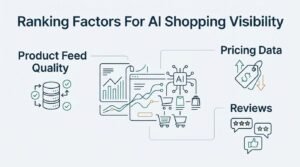
Ranking factors for AI shopping visibility depend heavily on product feed quality, current pricing accuracy, and verified review volume rather than editorial content signals. These systems are built to trust structured commerce data over prose.
A product listing with incomplete specifications or stale pricing data effectively becomes invisible to these tools, no matter how strong the brand’s overall SEO is.
Product Feed Quality, Pricing Data, and Reviews
Product feed quality refers to how complete, accurate, and consistently formatted a merchant’s product data is across titles, categories, attributes, and images. Pricing data needs near real-time accuracy, since AI shopping tools frequently compare live prices across retailers.
Review volume and recency also weigh heavily, since these systems treat verified reviews as a trust signal similar to how traditional search treats backlinks.
Platforms Leading Agentic Search Adoption
Several major platforms have already shipped agentic search capabilities that plan, retrieve, and reason across multi-step queries rather than returning a simple result list. I track these rollouts closely because they signal where content strategy needs to adapt first.
Understanding which platforms lead here helps prioritize where agentic-optimized content earns visibility soonest.
Examples of Agentic Search Implementations
Perplexity’s answer engine, Google’s AI Mode, and OpenAI’s browsing-enabled ChatGPT all demonstrate agentic behavior by decomposing queries and pulling from live sources mid-conversation. Each handles the reasoning chain slightly differently, but the underlying pattern of task decomposition holds across all three.
We watch these implementations for structural cues about what content format earns citation most consistently.
Platforms Leading AI Shopping Adoption
Major shopping-focused AI implementations include Amazon’s Rufus, Google’s Shopping Graph-powered experiences, and various retailer-specific AI assistants built directly into checkout flows. These tools sit closer to the commerce layer than the open web.
Each platform pulls from its own structured product catalog rather than crawling the open web the way agentic search systems often do.
Examples of AI Shopping Implementations
Amazon’s Rufus assistant answers product questions using Amazon’s own catalog and review data rather than external content. Google’s Shopping Graph powers comparison surfaces across Search and Shopping tabs using merchant feed data submitted directly by retailers.
Neither system rewards general web content the way agentic search does; feed accuracy is the dominant lever in both cases.
How Businesses Should Prepare Content for Both Systems
Businesses should prepare content for both systems by separating editorial, explanatory content built for agentic retrieval from structured product data built for AI shopping visibility. Running both tracks in parallel avoids the dilution that comes from treating them as one strategy.
I build these as two distinct workstreams with separate success metrics, even when they support the same overall brand.
Building an Agentic-Search-Ready Content Foundation
An agentic-search-ready foundation starts with clear entity definitions, direct-answer openers under every heading, and consistent structured data markup across the site. Content needs to survive being extracted and quoted alone, without losing its meaning.
This foundation pays off across any agentic platform, since the underlying requirement clarity and extractability stays consistent regardless of which agent is reading it.
Building AI-Shopping-Ready Product Data
AI-shopping-ready product data requires complete, accurate feeds with current pricing, full specifications, and a steady stream of verified reviews. Feed hygiene functions as the primary ranking lever in this environment, well ahead of on-page content quality.
Retailers who treat feed maintenance as an ongoing operational task, not a one-time setup, tend to hold visibility longer as AI shopping tools update their comparisons.
Common Misconceptions About Agentic Search and AI Shopping
The most common misconception is that agentic search and AI shopping are simply two names for the same emerging AI search trend, when in fact they solve different problems with different data. I hear this conflation constantly in strategy meetings, and it leads directly to misallocated budget.
Another common misconception assumes that optimizing for one automatically improves visibility in the other, which rarely holds true given how differently each system sources its answers.
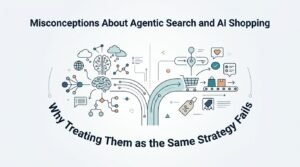
Why Treating Them as the Same Strategy Fails
Treating them as the same strategy fails because the content and data requirements pull in different directions: one rewards depth and reasoning support, the other rewards structured commerce accuracy. A single unified content plan usually ends up mediocre at satisfying either system fully.
Splitting the strategy into two clear workstreams, each measured against its own system’s actual ranking factors, consistently outperforms a blended approach.
Measuring Performance Across Both Search Behaviors
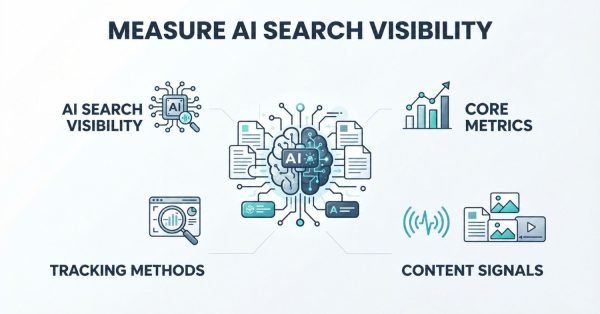
Measuring performance across both behaviors requires tracking different metrics: citation frequency and referral traffic from AI answer engines for agentic search, and product impression or conversion data from shopping surfaces for AI shopping. Standard keyword rank tracking captures neither well on its own.
We build custom tracking layered on top of Google Search Console and platform-specific analytics to separate these two performance streams clearly.
Metrics and Tracking Approaches for Each
Agentic search performance is best measured through citation tracking tools, referral traffic segmentation, and manual query testing across major AI platforms. AI shopping performance is best measured through feed diagnostic reports, comparison-surface impression data, and conversion tracking tied to specific product listings.
Neither metric set replaces traditional organic tracking; both sit alongside it as a new, necessary layer.
Conclusion
Agentic search and AI shopping solve different problems using different data, and confusing the two costs businesses real visibility in both. Understanding this split changes how content and product data get built.
This distinction connects to the broader shift toward AI-driven discovery across the entire search ecosystem, and the systems will keep evolving fast. We help businesses build both tracks correctly from the start.
Our team at White Label SEO Service builds agentic-ready content and shopping-ready data side by side. Reach out to start structuring your strategy the right way.
Frequently Asked Questions
What is agentic search in simple terms?
Agentic search is when an AI system independently plans, researches, and completes a task instead of just listing links. It reasons through multiple steps before delivering a final answer.
Is agentic search the same as AI shopping?
No, agentic search handles broad informational tasks while AI shopping focuses narrowly on product comparisons and purchases. They rely on different data sources entirely.
How does agentic search affect SEO?
Agentic search rewards clear entity definitions, extractable answers, and structured data over keyword density alone. Content needs to survive being quoted in isolation.
What ranking signals matter most for AI shopping visibility?
Product feed accuracy, current pricing, and verified review volume matter most for AI shopping visibility. Editorial content has minimal direct influence here.
Which platforms use agentic search today?
Perplexity, Google’s AI Mode, and browsing-enabled ChatGPT all demonstrate agentic search behavior currently. Each decomposes queries and retrieves live data mid-conversation.
Do businesses need separate strategies for each?
Yes, businesses need separate strategies because the content and data requirements for each system pull in different directions. A blended approach tends to underperform in both.
How long does it take to optimize for agentic search?
Meaningful agentic search visibility typically takes four to nine months, depending on existing content structure and domain credibility. Entity clarity improvements often show impact faster than link-based signals.