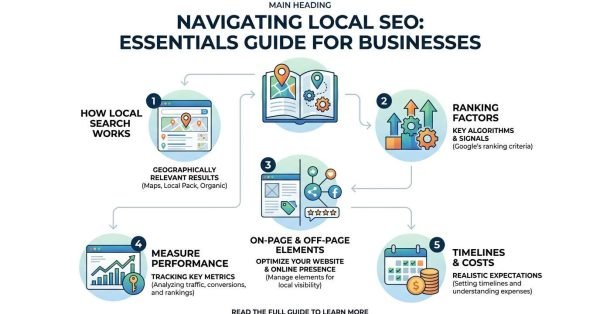
Google Maps SEO is the process of optimizing a business’s Google Business Profile and related local signals so it ranks higher in the Google Maps app and the local map pack that appears above organic results. I’ve watched this single feature drive more phone calls and store visits for local clients than almost any other channel we manage.
Local buyers don’t scroll past the map pack, and I see this daily. A poorly optimized listing loses visibility to competitors with cleaner data and more engagement, even when the underlying business is stronger.
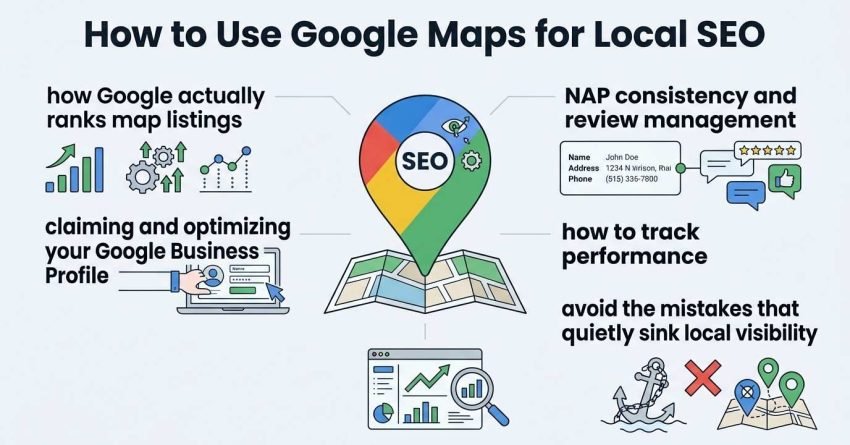
This guide covers how Google actually ranks map listings, the foundational work of claiming and optimizing your Google Business Profile, why NAP consistency and review management drive trust signals, and how to track performance and avoid the mistakes that quietly sink local visibility.
What Is Google Maps SEO and Why It Matters for Local Business
Google Maps SEO is the practice of improving a business’s visibility within Google’s local map results, which appear when someone searches for a product or service near a specific location. I think of it as the local layer sitting on top of traditional organic SEO, with its own ranking inputs and its own real estate on the results page.
This matters because the map pack sits above organic listings on most local queries. A business absent from it loses the most visible slot on the page before a searcher even scrolls.
How Google Maps Ranking Differs from Organic Search Ranking
Organic search ranking relies heavily on backlinks, content depth, and site-wide authority. Google Maps ranking, by contrast, weighs a narrower set of signals: proximity to the searcher, category and profile completeness, and engagement data like reviews and clicks.
I treat these as two separate systems that happen to share a search results page. A site can rank well organically and still be invisible in the map pack, and the reverse happens just as often.
The Business Impact of Appearing in the Local Map Pack
Businesses appearing in the local map pack capture a disproportionate share of local search clicks, since the pack sits above traditional organic listings on mobile and desktop alike. I’ve seen clients double call volume purely from moving into the top three map results.
This isn’t a vanity metric. It converts directly into store visits, phone calls, and direction requests, which is why I push local clients to prioritize it early.
How Google Maps Rankings Actually Work: Relevance, Distance, Prominence
Google ranks map listings using three core factors: relevance, distance, and prominence, according to Google’s own local ranking documentation. I walk every client through these three levers before touching a single setting on their profile, because each one demands a different fix.
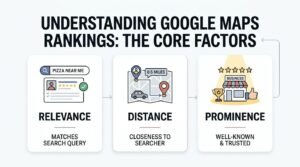
Relevance measures how well a listing matches what someone searched for. Distance measures how close the business is to the searcher’s location or the location implied in the query. Prominence measures how well-known and trusted the business is, based on signals collected from across the web.
Relevance: Matching Your Listing to Search Intent
Relevance is Google’s assessment of how closely a business profile matches the intent behind a specific search query. I get this right by aligning the business category, description, and services list directly with the terms customers actually type.
A plumbing company categorized only as “Contractor” loses relevance for “emergency plumber” searches, even if it does that work daily. Category precision solves more relevance problems than any other single fix I make.
Distance: Why Searcher Location Changes Your Ranking
Distance ranking means the same business can appear in the top three results for one searcher and disappear entirely for another searcher a few miles away. I explain this constantly to clients confused about “losing” a ranking that was never fixed to begin with.
There’s no way to manipulate raw distance, since it’s calculated from the searcher’s real location. The lever that remains is expanding a service-area profile correctly so Google understands every neighborhood genuinely served.
Prominence: Authority Signals Google Uses to Rank You
Prominence reflects a business’s overall reputation and authority, drawn from review counts, review scores, citation consistency, and even offline brand awareness. I treat prominence as the long game, since it builds slowly through consistent operational and marketing effort.
A single well-optimized profile without reviews or citations rarely outranks a mediocre profile backed by hundreds of reviews and consistent local mentions. This is the factor most business owners underestimate.
Setting Up and Claiming Your Google Business Profile
Claiming a Google Business Profile is the first mandatory step in Google Maps SEO, and it means officially verifying ownership of a business listing inside Google’s system. I never skip straight to optimization tactics with a new client until this ownership step is locked down.
An unclaimed listing can be edited by anyone, including competitors, and often displays outdated or incorrect information. I’ve inherited more than one client account where a rival business had quietly altered the hours or category.
Verification Methods and What to Expect
Google verifies business ownership primarily through a postcard mailed to the business address, though phone, email, and instant verification are available for some accounts. I tell clients to budget one to two weeks for postcard delivery, since rushing this step tends to cause more delays than it saves.
Video verification has become more common for service-area businesses without a public storefront. I walk clients through recording a short clip showing signage, equipment, or proof of operation at the registered address.
Choosing the Right Primary and Secondary Categories
The primary category carries the most ranking weight of any single field on a Google Business Profile, since it tells Google the core nature of the business before anything else is read. I spend real time here rather than treating it as a formality.
Secondary categories add relevance for adjacent services without diluting the primary signal. A bakery that also caters events benefits from adding “Caterer” as a secondary category rather than replacing “Bakery” entirely.
NAP Consistency: The Foundation of Local Trust Signals
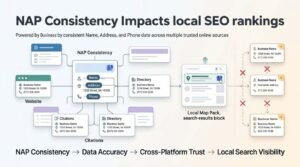
NAP consistency refers to keeping a business’s Name, Address, and Phone number identical across every online location where it appears, including the website, directories, and social profiles. I consider this the single most overlooked ranking factor in local SEO, precisely because it’s invisible until something breaks.
Inconsistent NAP data confuses Google’s trust model, since the algorithm cross-references citations to confirm a business genuinely operates at a given location. A mismatch doesn’t just look sloppy to a human reader; it actively weakens the prominence signal Google relies on.
What Counts as an NAP Inconsistency
An NAP inconsistency exists whenever a business’s name, address, or phone number is displayed differently across two or more online sources. “123 Main St.” on one directory and “123 Main Street, Suite 4” on another counts as an inconsistency, even though a human reader would easily reconcile the two.
Abbreviations, suite numbers, and even old phone numbers left on outdated directories are the most common culprits I find during audits. Small formatting differences accumulate into a real trust problem at scale.
Where NAP Data Lives Across the Web
NAP data typically lives across data aggregators, industry-specific directories, review platforms, social profiles, and the business’s own website footer. I map all five categories during any new client onboarding, since missing even one creates a gap competitors can fill first.
Data aggregators like Data Axle and Foursquare feed information to dozens of smaller directories automatically. Correcting an error at the aggregator level often fixes a dozen downstream listings without touching each one individually.
Auditing and Fixing NAP Errors Across Directories and Citations
A citation audit is a systematic review of every online location listing a business’s name, address, or phone number, conducted to find and correct inconsistencies. I run this audit before making any other local SEO change, since fixing rankings on top of bad citation data rarely holds.
I start with the aggregators, move to major directories, then work down to niche and industry-specific listings. Each correction strengthens the prominence signal a little more, and the effect compounds as consistency spreads across the web.
Manual audits work for single-location businesses, but multi-location brands typically need citation management software to track corrections at scale. I flag this early with any client managing more than five locations, since manual tracking becomes unreliable past that point.
Optimizing Your Google Business Profile for Maximum Visibility
Google Business Profile optimization means completing and enhancing every available field on the profile so it presents maximum relevance and trust signals to both Google and searchers. I treat an incomplete profile as a missed opportunity Google can’t ignore, since profile completeness directly feeds the relevance score.
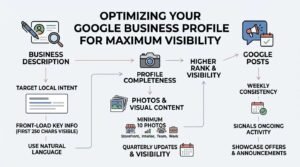
This goes beyond the basics of name and category. Photos, business descriptions, service lists, attributes, and posting activity all contribute to how strongly Google trusts and ranks the profile.
Writing a Business Description That Targets Local Intent
A strong Google Business Profile description explains what a business does, who it serves, and where, using natural language that mirrors how customers actually search. I avoid keyword stuffing here, since Google’s algorithm reads for genuine relevance rather than repetition.
The description field allows 750 characters, but only the first 250 or so display without a “read more” click. I front-load the most important service and location information into that visible portion.
Choosing Photos and Visual Content That Convert
Businesses with complete photo sets receive substantially more direction requests and website clicks than listings with few or no images, according to Google’s own guidance on profile photos. I push every client toward at least ten photos covering the storefront, interior, team, and completed work.
Photo freshness matters as much as volume. I schedule quarterly photo updates for active clients, since stale images signal an inactive or neglected profile to both searchers and Google.
Using Google Posts to Stay Active and Relevant
Google Posts function similarly to short social media updates, appearing directly on the business profile to showcase offers, events, or announcements. I use them as a low-effort signal of ongoing business activity, which factors subtly into how fresh and trustworthy a profile appears.
Posts expire after seven days for most categories, so consistency matters more than any single post’s content. I schedule a standing weekly post for every active client to keep this signal alive.
Managing and Responding to Google Reviews Strategically
Review management is the ongoing process of monitoring, responding to, and encouraging customer reviews on a Google Business Profile. I rank this alongside NAP consistency as one of the two highest-leverage activities in local SEO, since reviews influence both rankings and conversion simultaneously.
Reviews function as a trust signal for Google’s prominence calculation and as social proof for the human reader deciding whether to click. Neglecting this dual purpose is one of the costliest mistakes I see local businesses make.
Why Review Volume and Recency Influence Rankings
Google’s local algorithm weighs both the total number of reviews and how recently they were posted, meaning a business with steady, ongoing reviews outperforms one with a large but stagnant review history. I track review velocity monthly for every client, not just the overall star rating.
A business that earned two hundred reviews three years ago and none since sends a weaker prominence signal than one steadily earning three or four reviews a month. Recency tells Google the business remains active and genuinely engaged with customers.
How to Respond to Negative Reviews Without Damaging Trust
The most effective response to a negative review acknowledges the specific concern, avoids defensiveness, and offers a clear path to resolution outside the public thread. I draft these responses within 24 to 48 hours, since delayed responses read as neglect to future readers.
Google factors review responses into its assessment of business engagement, separate from the star rating itself. A pattern of thoughtful responses to criticism often reassures prospective customers more than a flawless five-star record ever could.
Encouraging Customers to Leave Reviews the Right Way
Review generation means proactively asking satisfied customers to leave a review, typically through a direct link, QR code, or automated follow-up message sent after service completion. I build this into the operational workflow of every client, rather than treating it as an occasional marketing task.
Google prohibits incentivizing reviews with discounts or payment, and enforcement of this policy has tightened noticeably in recent years. I stick to simple, well-timed requests sent at the natural high point of customer satisfaction, right after service delivery.
Timing drives response rates more than wording does, in my experience. A request sent within an hour of a completed job consistently outperforms one sent days later, once the customer’s attention has moved elsewhere.
Using Google Q&A and Messaging to Engage Local Customers
The Questions and Answers feature lets anyone post a public question on a business profile, which the business owner or any other user can answer. I monitor this weekly for active clients, since unanswered questions sit publicly and often address exactly the objection a prospective customer has.
I seed a profile’s Q&A section with common questions during initial setup, covering parking, hours, and service specifics that customers ask about daily. This gets ahead of the same questions being asked publicly later, often with no accurate answer available yet.
Google’s direct messaging feature adds a real-time layer to customer engagement, letting searchers message a business straight from the map listing. Response time to these messages factors into the engagement signals Google tracks, so I recommend enabling automated instant replies for any business not staffed to respond immediately.
Local Keyword Research for Google Maps Optimization
Local keyword research is the process of identifying the specific search terms nearby customers use when looking for a business like this one, including “near me” phrasing and neighborhood-specific queries. I run this before touching a single category or description field, since the wrong keyword focus undermines every optimization built on top of it.
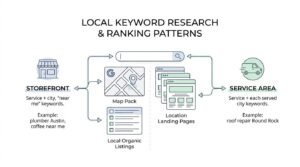
Local intent keywords often differ meaningfully from broader organic keywords, favoring service-plus-location combinations over purely informational phrasing. “Emergency plumber Austin” behaves very differently in search behavior than “how to fix a leaking pipe,” even though both relate to plumbing.
Tools like Google’s Keyword Planner and local rank trackers reveal genuine search volume for these geo-modified terms. I cross-reference this data against the categories and service lists already active on a client’s Google Business Profile to spot gaps.
Building Local Citations and Local Link Signals
Local citations are online mentions of a business’s name, address, and phone number, whether or not they include a link back to the business website. I treat citation building as parallel work to NAP auditing, since new citations need the same consistency standards applied from the start.
Beyond raw citations, local link signals come from being mentioned or linked to by other local organizations, chambers of commerce, sponsorships, and local press coverage. These carry more prominence weight than generic directory listings, since they reflect genuine community presence rather than a database entry.
I prioritize industry-specific directories over generic ones wherever they exist, since a plumbing-specific directory sends a clearer relevance signal than a general business listing site. Building ten well-chosen citations consistently outperforms fifty scattered, low-quality ones.
Multi-Location and Service-Area Business Considerations
Multi-location businesses need a separate, individually optimized Google Business Profile for each physical location, rather than one combined listing attempting to cover multiple addresses. I’ve corrected this mistake more than once for franchise clients who assumed a single strong profile would cover every branch.
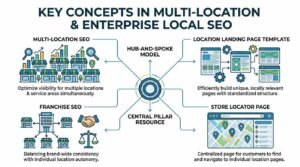
Service-area businesses without a public storefront face a different challenge, since Google requires accurately defining the geographic areas served without displaying a false physical address. I set these profiles to hide the address entirely and instead define the service radius by city or postal code, matching how the business genuinely operates.
Duplicate listings become a common risk once a business expands to multiple locations, particularly after a move or rebrand. I run a duplicate check as standard practice any time a client adds a new location, since duplicates split review counts and confuse the prominence signal across both listings.
Tracking Google Maps Performance and Ranking Metrics
Google Maps performance tracking means monitoring the specific metrics available inside Google Business Profile Insights alongside third-party local rank tracking tools. I set this up during the first week of any engagement, since a baseline is worthless if captured after changes have already been made.
Key Metrics Inside Google Business Profile Insights
Google Business Profile Insights reports on searches, views, and customer actions like calls, direction requests, and website clicks, broken down by direct and discovery search types. I watch the discovery search percentage most closely, since it reflects how well the profile attracts customers who didn’t already know the business by name.
Call tracking data reveals which days and times generate the most customer contact, information I use to adjust posting schedules and staffing recommendations. A profile generating views without corresponding actions usually signals a conversion problem on the listing itself, not a visibility problem.
Tools for Tracking Local Pack Rankings Over Time
Third-party tools like Local Falcon and BrightLocal simulate searches from multiple grid points around a business location, revealing exactly where rankings stand at each point rather than relying on a single, unreliable search result. I run these grid scans monthly for every active local client.
A business might rank first two blocks from its storefront and tenth a mile away, information a single manual search would never reveal. This grid-level data drives decisions about where to expand service-area targeting or invest in additional local content.
Common Google Maps SEO Mistakes That Hurt Local Rankings
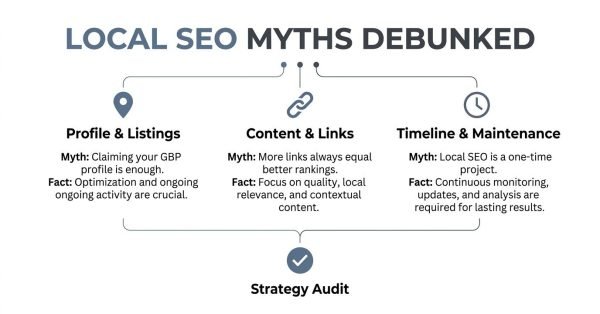
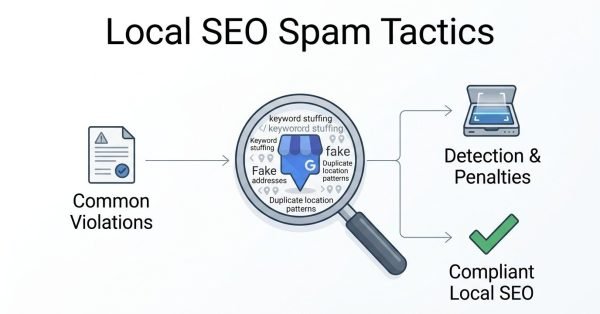
The most damaging Google Maps SEO mistake I encounter is keyword-stuffing the business name field, adding location or service terms that don’t match the legally registered business name. Google has cracked down heavily on this tactic, and profiles caught doing it face suspension rather than a ranking penalty.
Ignoring reviews entirely, whether positive or negative, ranks as the second most common mistake. A profile with no owner responses across dozens of reviews signals neglect to both Google’s algorithm and any prospective customer reading through the feedback.
Duplicate listings, incomplete profiles, and inconsistent NAP data round out the recurring pattern I see across failed local SEO efforts. Each of these problems compounds the others, since Google’s trust model relies on cross-referencing consistent signals across the entire local ecosystem.
How Google Maps SEO Fits Into a Broader Local SEO Strategy
Google Maps SEO forms one pillar of a complete local SEO strategy, sitting alongside on-site local optimization, localized content, and traditional link building. I never treat map optimization as a standalone project, since a strong map listing paired with a weak website still loses conversions once the searcher clicks through.
The website itself needs location-specific landing pages, schema markup, and locally relevant content to reinforce the same signals the Google Business Profile sends. This alignment between on-site and off-site signals is what separates businesses that dominate a local market from those that plateau after initial gains.
Conclusion
Google Maps SEO succeeds through consistent NAP data, an optimized Business Profile, and genuine customer engagement working together. These signals build the relevance, distance, and prominence Google rewards with map pack visibility.
Local search keeps evolving as Google weighs engagement and consistency more heavily each year. Businesses that build these foundations now compound their visibility over time.
We help businesses turn local visibility into measurable leads and revenue. Partner with White Label SEO Service to build a Google Maps presence that converts.
Frequently Asked Questions
What is NAP consistency in local SEO?
NAP consistency means a business’s name, address, and phone number appear identically across every online listing. Mismatches confuse Google’s trust signals and weaken local rankings over time.
How long does it take to rank on Google Maps?
Most businesses see initial movement within 4 to 8 weeks of profile optimization and citation cleanup. Full prominence gains from reviews and citations typically build over 3 to 6 months.
Does responding to Google reviews affect rankings?
Yes, review responses factor into Google’s assessment of business engagement and activity. Consistent, thoughtful responses also improve conversion once prospective customers read them.
Can I have multiple Google Business Profiles for one business?
Only if the business operates multiple distinct physical locations, each requiring its own verified profile. Creating duplicate listings for a single location violates Google’s guidelines and hurts rankings.
What’s the difference between Google Maps SEO and local SEO?
Google Maps SEO focuses specifically on the map pack and Business Profile signals. Local SEO is the broader strategy, including website content, citations, and localized link building.
Why did my Google Maps ranking suddenly drop?
Sudden drops usually trace back to a new NAP inconsistency, a duplicate listing, a policy violation, or a competitor improving their own signals. Reviewing recent profile changes and new citations is the fastest way to diagnose it.
Should service-area businesses show their address on Google Maps?
No, service-area businesses without a public storefront should hide their address and define a service area instead. Displaying a false or residential address risks suspension under Google’s guidelines.