
NAP consistency is the practice of keeping a business’s name, address, and phone number identical across every online listing, directory, and website page. I’ve watched businesses lose local map pack rankings over something as small as a missing suite number or an old phone number still sitting on a directory nobody remembered existed. Google treats every mismatch as a small crack in trust, and local search runs almost entirely on trust signals.
I’ve seen agencies chase backlinks for months while a client’s NAP sat broken across forty directories, quietly capping every ranking gain. Inconsistent NAP data doesn’t just confuse customers who dial a disconnected number. It confuses the algorithm deciding whether your business is even real.
This guide covers what NAP consistency actually means and how search engines use it, why mismatches damage local rankings, the most common sources of NAP errors and where they hide, how to audit and fix them systematically, and how NAP fits alongside schema markup, multi-location SEO, and the broader local ranking picture.
What Is NAP Consistency?
NAP consistency means a business’s name, address, and phone number appear identically across every citation, directory, and web page where that business is listed. I treat it as the foundational layer of local SEO, the thing that has to be right before anything else reviews, backlinks, content can do its job.
The term “NAP” became shorthand in the local SEO community because these three data points are what search engines cross-reference to confirm a business actually exists at the location it claims. Moz’s Local Search Ranking Factors study has tracked citation consistency as a recurring top-tier local ranking input for over a decade.
A single abbreviation difference, like “St.” versus “Street,” rarely breaks anything alone. Dozens of small inconsistencies compounding across citation sources is what erodes trust at scale.
How Search Engines Use NAP Data to Rank Local Businesses
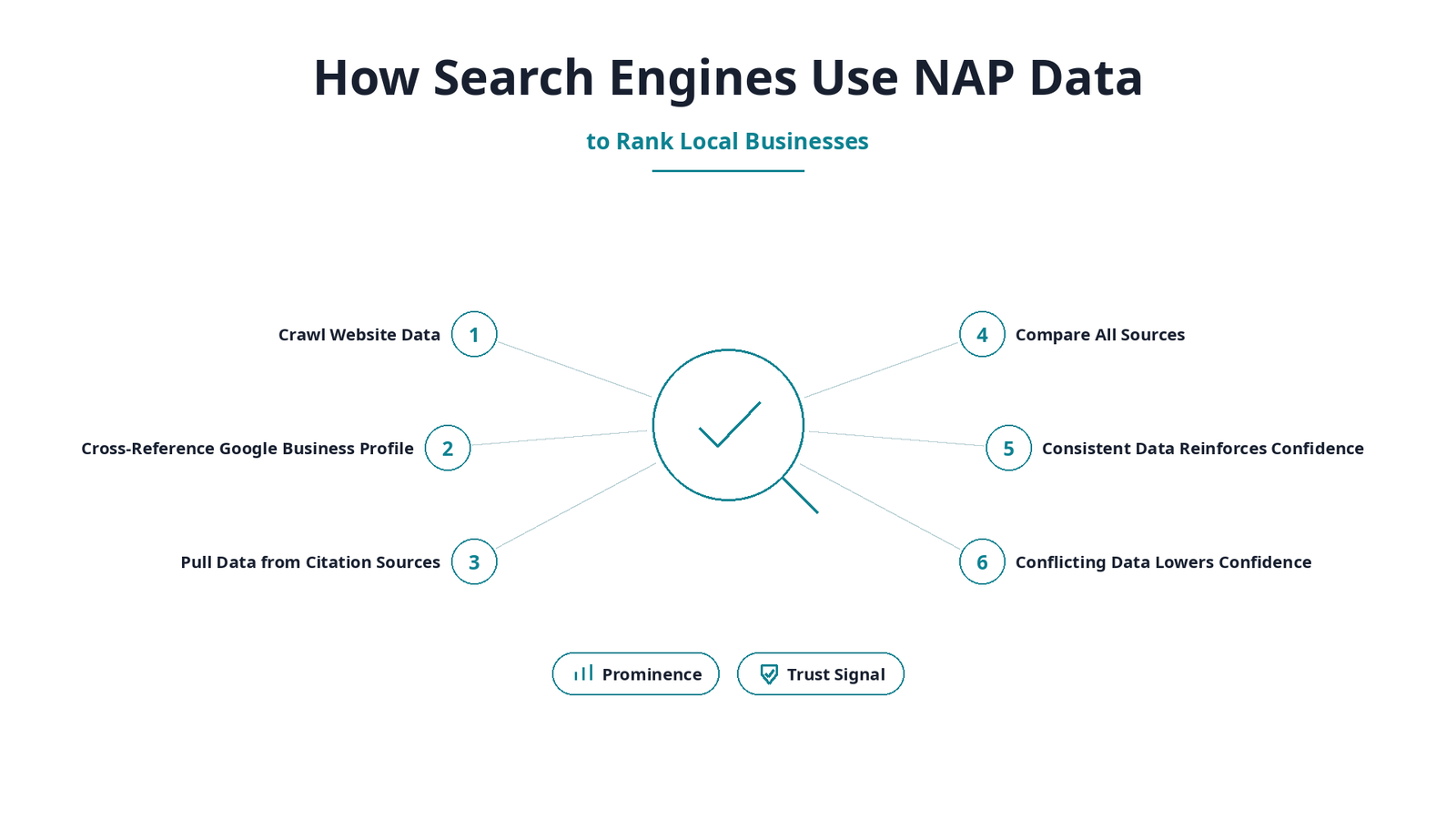
Search engines use NAP data as a cross-referencing signal to verify a business’s legitimacy and determine its relevance to a geographic query. I think of it as a verification web: Google pulls your business details from your website, your Google Business Profile, and dozens of third-party directories, then checks whether they agree with each other.
Here’s how that verification process typically works:
- Google crawls your website’s structured data and visible contact information.
- It cross-references this against your Google Business Profile listing.
- It pulls additional data points from major citation sources like Yelp, Apple Maps, and industry directories.
- It compares all sources for name, address, and phone number agreement.
- Consistent data reinforces confidence in your location and identity.
- Conflicting data lowers confidence and can suppress local visibility.
Google’s local algorithm leans heavily on prominence, and prominence is partly built from how often and how consistently your business appears across the web, a concept Google’s own guidance on local ranking touches on directly. I’ve found that businesses with the cleanest citation profiles tend to recover map pack visibility faster after any algorithm update.
NAP data doubles as a trust signal for the customer side too. Someone searching for emergency plumbing at 11 PM doesn’t have patience for a disconnected number pulled from an outdated directory listing.
Why NAP Inconsistency Hurts Local Rankings
NAP inconsistency hurts local rankings because it weakens the trust signal search engines use to confirm a business is legitimate and accurately located. I’ve audited accounts where the website listed one suite number, the Google Business Profile listed another, and a half-dozen directories listed a third. None of them were wrong exactly, just outdated at different times, and the cumulative effect still tanked local pack visibility.
Confused algorithms produce confused rankings. A search engine that can’t confirm which address is current will often default to trusting none of them fully, which shows up as inconsistent ranking volatility rather than a clean drop. I’ve watched businesses swing in and out of the map pack for months with no obvious cause, only to find three conflicting phone numbers once we ran a full citation audit.
There’s a sharper consequence too. Google Business Profile suspensions frequently trace back to NAP mismatches between the profile and the business’s actual website or physical signage. Google’s guidelines on representing your business list inconsistent information as a direct trigger for manual review, and a suspended profile erases local visibility overnight, not gradually.
Customers notice the same inconsistency Google does, just with less patience. A mismatched phone number costs a phone call. A mismatched address costs a customer who shows up at the wrong building.
Common Causes of NAP Inconsistency
NAP inconsistency most often originates from business changes that never get fully propagated across every listing where the business appears. I rarely find a business that created bad data on purpose. It almost always comes from a legitimate change that only got updated in one or two places.
Business relocations, rebrands, and phone number changes sit at the top of the list. A business that moves offices updates its website and Google Business Profile right away, then forgets the forty directory listings it set up three years earlier and never touched again.
Data aggregator lag compounds this further. Services like Infogroup and Neustar feed business data to dozens of smaller directories on their own update schedules, sometimes refreshing every few months rather than in real time. A correction made directly on one directory can get silently overwritten the next time an aggregator pushes old data back out.
Franchise and multi-location businesses add another layer, since each location often gets listed independently by different staff members using slightly different formatting conventions from day one.
Where NAP Inconsistencies Typically Hide
NAP inconsistencies hide most often in legacy citation sites, data aggregators, and the gap between a Google Business Profile and a website’s own footer or contact page. I start every audit assuming the business’s own website is correct and everything else needs checking against it.
Citation sites and online directories are the biggest offenders because many were created years ago through automated submission tools and never touched again. Old Yellow Pages-style directories, niche industry listings, and chamber of commerce sites often carry the oldest, most outdated information.
The mismatch between a Google Business Profile and a website’s own footer is a surprisingly common and avoidable source. I’ve seen businesses update their Google Business Profile after a move but leave the old address sitting in the website footer for over a year, visible on every single page.
Social media profiles deserve a separate check too, since Facebook, LinkedIn, and Instagram business pages often get set up once and rarely revisited when core business details change.
How to Audit Your NAP Data Across the Web
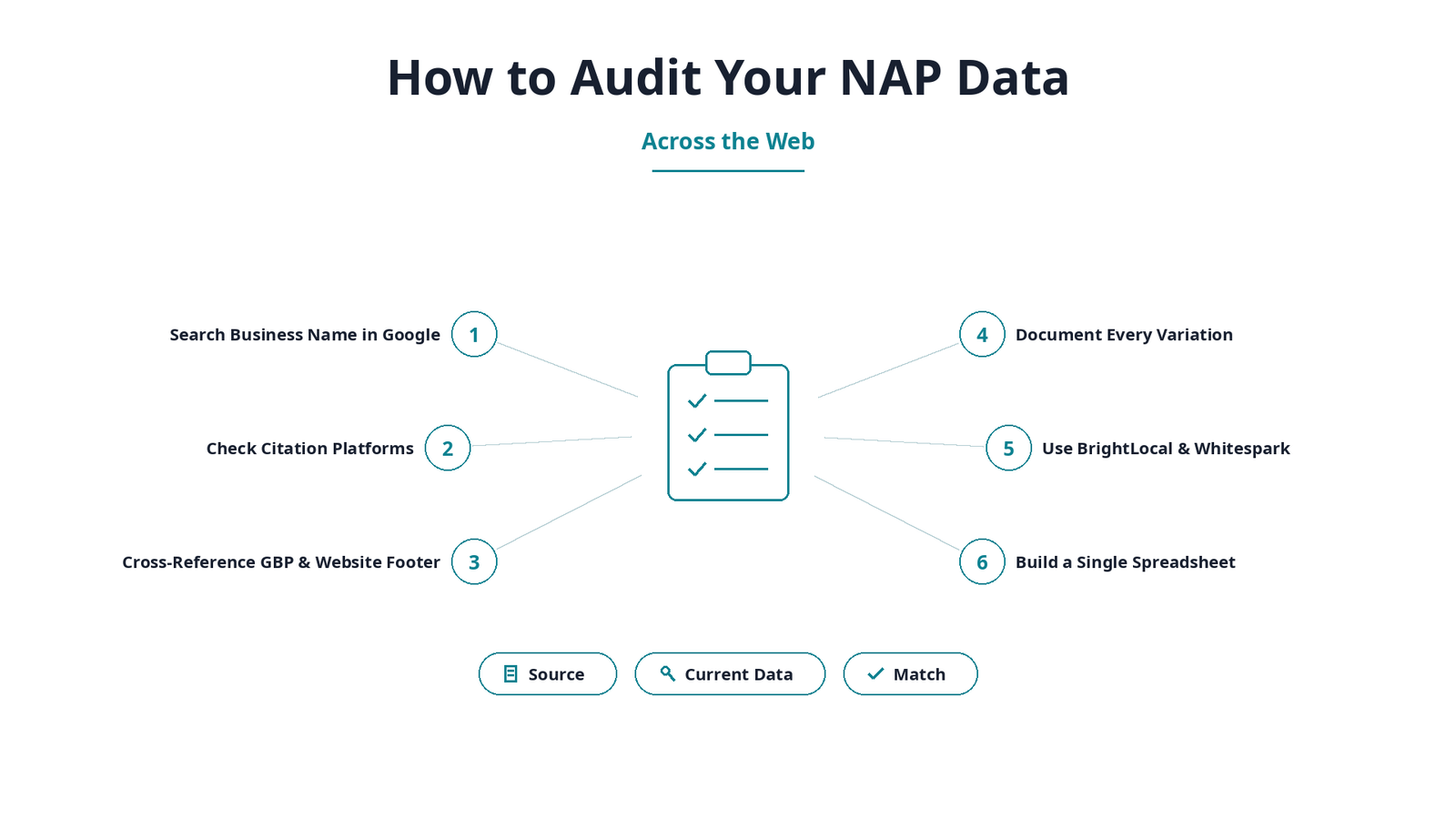
Auditing NAP data across the web means systematically checking every location where a business’s name, address, and phone number appear and documenting every inconsistency found. I treat this as a prerequisite step, not an optional add-on, before any new local SEO work begins.
A manual audit starts with searching the business name directly in Google and reviewing every result on the first few pages. Checking major citation platforms individually, cross-referencing the Google Business Profile against the website footer, and documenting every variation found builds the foundation of the audit.
Manual auditing works for businesses with a handful of locations, but it becomes impractical past a certain scale. Tools built specifically for citation tracking, such as BrightLocal and Whitespark, crawl dozens of directories simultaneously and flag discrepancies automatically, cutting what might take days down to hours.
The output of either method should be the same: a single spreadsheet listing every source, the current data found there, and whether it matches the verified correct version.
How to Fix NAP Inconsistencies Step by Step
Fixing NAP inconsistencies involves standardizing the correct business information first, then systematically correcting every citation source where it appears incorrectly. I never start correcting listings until the “source of truth” version is locked down and agreed upon internally.
- Standardize the exact NAP format to use everywhere, down to abbreviations and punctuation.
- Update the Google Business Profile first, since it carries the most ranking weight.
- Correct the website footer, contact page, and any schema markup referencing the old data.
- Prioritize fixing the highest-authority citation sources before smaller directories.
- Submit correction requests to major data aggregators to prevent old data resurfacing.
- Document every correction with a date to track which sources respond quickly.
- Re-audit after 60–90 days to catch any aggregator rollback or missed listings.
Standardizing the format first matters more than people expect. I’ve seen teams fix an address but introduce a new abbreviation inconsistency in the process, creating a second problem while solving the first.
High-authority citation sources deserve priority because they carry more trust weight and tend to feed data to smaller directories downstream, meaning one correction there can cascade into several smaller fixes automatically.
NAP Consistency and Schema Markup
Schema markup is structured data code added to a website that explicitly tells search engines the business’s name, address, and phone number in a machine-readable format. I treat LocalBusiness schema as a reinforcement layer that sits underneath visible NAP consistency rather than a replacement for it.
Schema.org’s LocalBusiness specification defines the exact fields search engines expect, and matching those fields precisely to the visible NAP data on the page closes a gap that inconsistent businesses often leave open. A website can display the correct address in its footer while an outdated schema markup block quietly tells Google something different behind the scenes.
Getting this layer right doesn’t fix broken citations elsewhere, but it does remove one more source of conflicting signals that a search engine has to reconcile.
NAP Consistency for Multi-Location Businesses
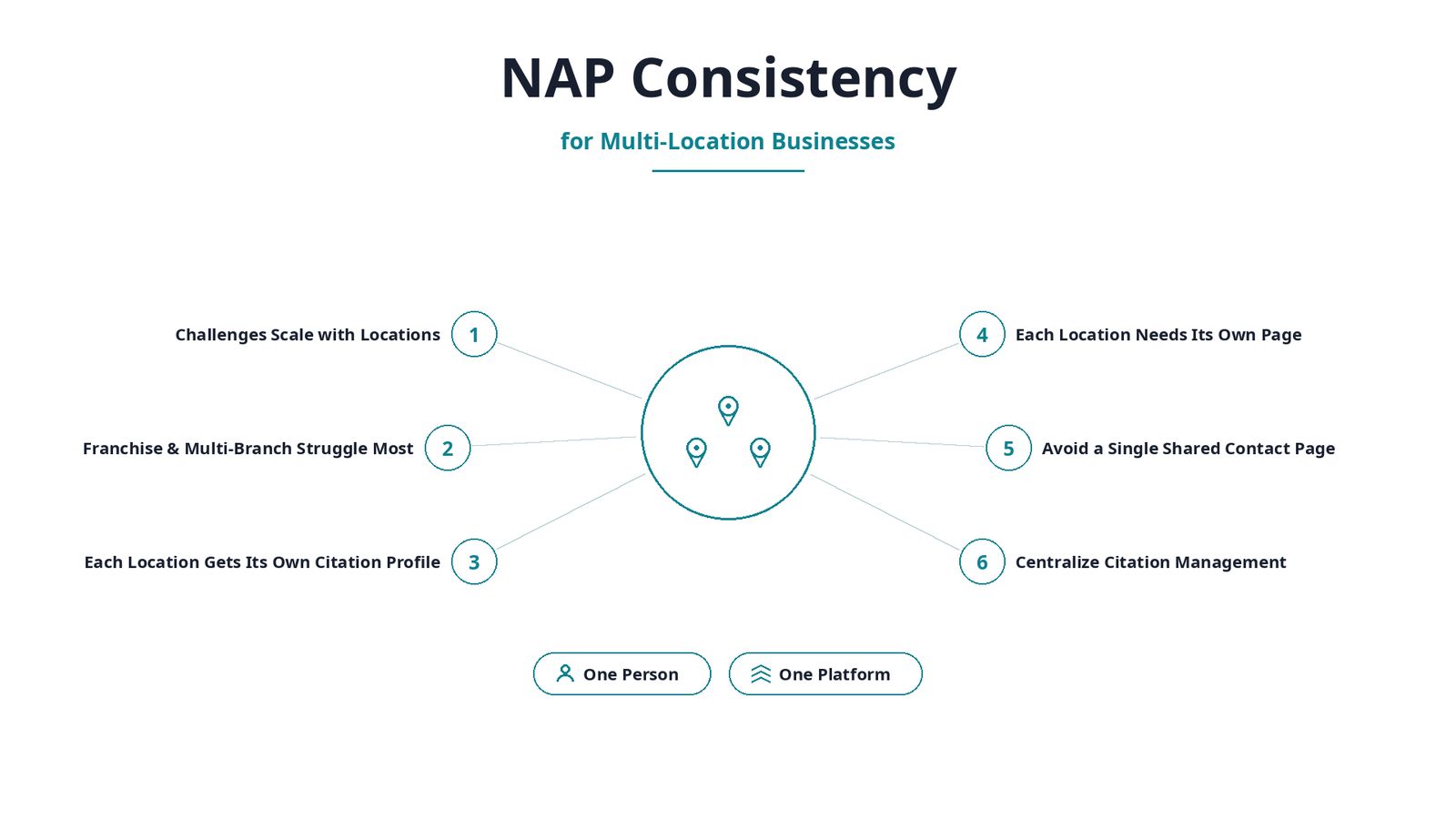
Multi-location businesses face NAP consistency challenges that scale directly with the number of physical locations they operate. I’ve found that franchise and multi-branch businesses struggle the most here because each location often gets its own citation profile, managed inconsistently across different staff or franchisees over time.
Location page structuring on the business’s own website becomes a frequent failure point. Each location needs its own unique, correctly formatted NAP data on a dedicated page, not a single shared contact page listing every branch in a cramped table that search engines struggle to parse cleanly.
Centralizing citation management under one person or one platform tends to produce the cleanest results for businesses operating more than three or four locations.
NAP Consistency vs. Other Local SEO Ranking Factors
NAP consistency is one of several foundational local ranking factors, and it typically ranks below review signals and proximity but above most on-page content factors in direct ranking weight. The table below shows how NAP compares against the other major inputs Google’s local algorithm weighs.
| Ranking Factor | Primary Role | Relative Weight | Fix Difficulty |
| Google Business Profile signals | Core local relevance and proximity | Highest | Medium |
| Review quantity and quality | Trust and prominence | Very high | Ongoing |
| NAP consistency | Trust and verification | High | Low–Medium |
| On-page local content | Topical relevance | Medium | Low |
| Backlink profile | Domain authority | Medium | High |
NAP sits in an unusual spot in this table because it’s one of the cheaper, faster fixes on the list, yet it’s routinely ignored in favor of flashier tactics like backlink campaigns that take months to show any movement at all.
How Long It Takes to See Results After Fixing NAP Issues
Most businesses see measurable local ranking improvement within 4 to 8 weeks of correcting major NAP inconsistencies, though full resolution across all directories can take 3 to 6 months. I set this expectation early with every client because the timeline depends heavily on how many citation sources needed correcting and how quickly those sources process update requests.
Google Business Profile updates tend to reflect in rankings the fastest, often within days to a couple of weeks. Third-party directory and data aggregator corrections lag much further behind, since some aggregators only refresh their feeds on a quarterly cycle.
Tools for Monitoring NAP Consistency Over Time
The best NAP monitoring tools combine automated citation scanning with ongoing alert systems that flag new inconsistencies as they appear. I recommend matching the tool to the business’s scale rather than defaulting to the most expensive option available.
For single-location businesses needing straightforward citation tracking, Whitespark’s citation tracker handles the core job without unnecessary complexity. For agencies or multi-location businesses managing dozens of profiles, BrightLocal’s local rank tracker bundles citation monitoring with broader local SEO reporting in one dashboard. For businesses wanting a free starting point, Google Business Profile’s own insights panel flags some basic profile inconsistencies at no cost.
NAP Consistency Mistakes That Undermine Local SEO Campaigns
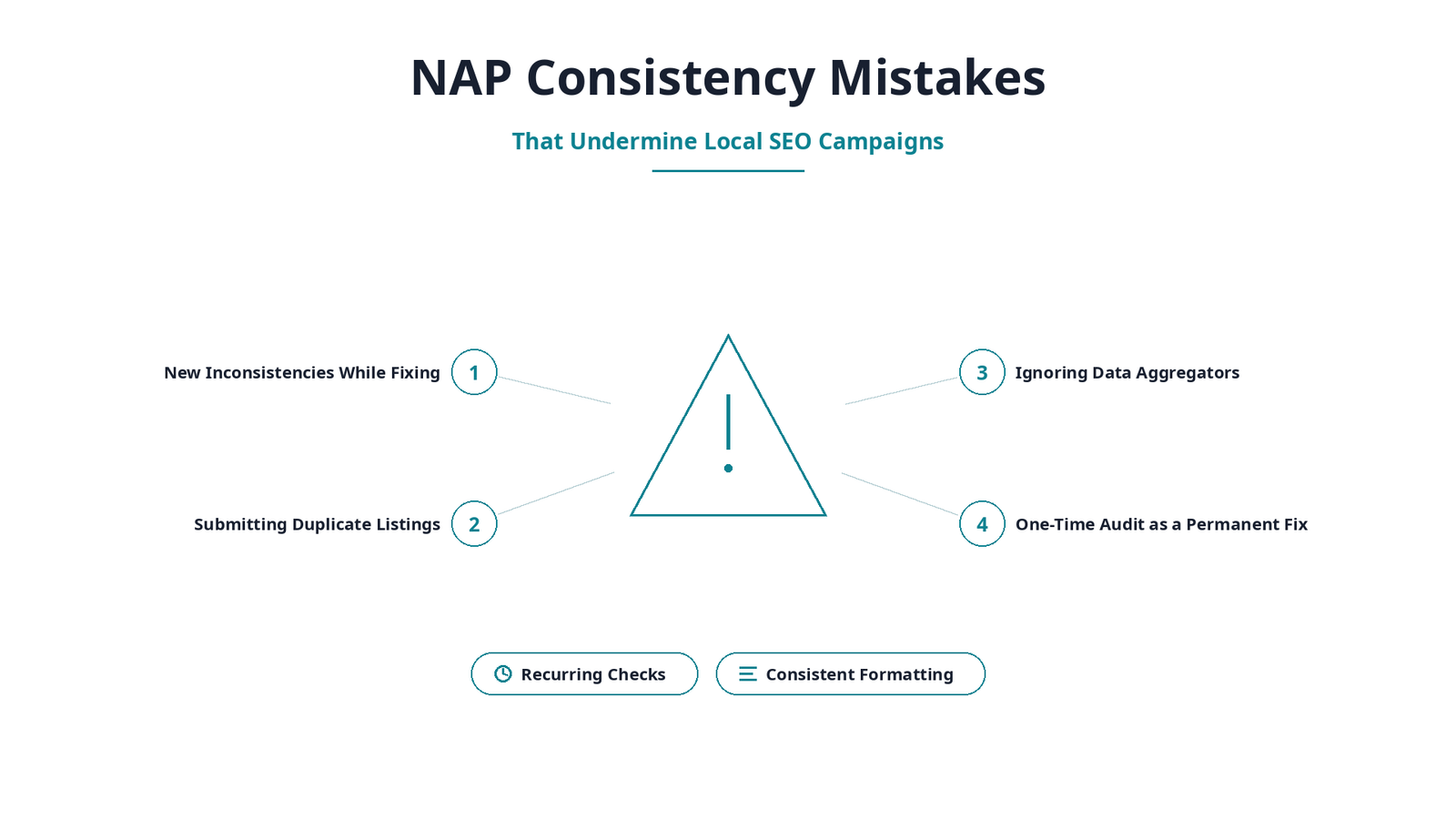
The most damaging NAP mistakes involve creating new inconsistencies while attempting to fix existing ones, usually through rushed corrections or inconsistent formatting standards. I see this constantly when a team fixes an address on ten directories but uses three slightly different formats in the process.
Submitting duplicate listings instead of correcting existing ones ranks among the most common errors, since it creates two conflicting profiles for the same location rather than one accurate one. Ignoring data aggregators entirely after fixing direct listings is another frequent mistake, since aggregator feeds can silently push old data back out months later. Treating a one-time audit as a permanent fix rather than scheduling recurring checks rounds out the most common failures I encounter.
How NAP Consistency Fits Into a Broader Local SEO Strategy
NAP consistency functions as a foundational trust layer that supports every other local SEO effort, including review generation, content optimization, and link building. I never recommend investing heavily in other local SEO tactics before NAP data is clean, because inconsistent foundational data caps the ceiling on everything built above it.
Review generation campaigns perform better once the underlying business data is trusted, since the same verification systems checking NAP also factor into how prominently reviews get weighted. Content and link-building efforts aimed at local relevance work from a stronger base once this foundational trust signal is locked in first.
Conclusion
NAP consistency connects directly to trust, verification, and the local ranking signals search engines depend on most. Getting your name, address, and phone number aligned everywhere closes one of the most overlooked gaps in local search performance.
Local SEO keeps evolving, but foundational trust signals like NAP rarely lose relevance the way surface-level tactics do. Clean data today protects rankings tomorrow.
We built our SEO process around fixing foundations first. Reach out to White Label SEO Service and let’s get your local visibility standing on solid ground.
Frequently Asked Questions
What does NAP stand for in SEO?
NAP stands for Name, Address, and Phone number. It refers to the core business identity details search engines cross-reference to verify legitimacy and location accuracy.
How much does NAP inconsistency hurt rankings?
NAP inconsistency can suppress local map pack visibility significantly, though the exact impact varies by how many sources conflict. Severe cases have triggered Google Business Profile suspensions entirely.
How many citations do I need to fix for NAP consistency?
There’s no fixed number, since it depends on how many directories list the business. Most audits uncover 20 to 50 citation sources needing review for small to mid-sized businesses.
Can I fix NAP issues myself or do I need a tool?
Manual fixes work for businesses with just a handful of listings to correct. Tools become necessary once citation counts climb past what’s manageable to track by hand.
Does NAP consistency matter if I only have one location?
Yes, single-location businesses still depend on NAP consistency for local trust signals. The audit process is simply faster with only one address and phone number to verify.
How often should I audit my NAP data?
A re-audit every 60 to 90 days catches aggregator rollbacks and new inconsistencies early. Businesses that recently moved or rebranded should audit sooner than that.
Is NAP still a ranking factor in 2026?
Yes, NAP consistency remains a foundational trust signal in local search algorithms. Its weight relative to reviews and proximity has shifted, but it hasn’t disappeared from ranking calculations.