
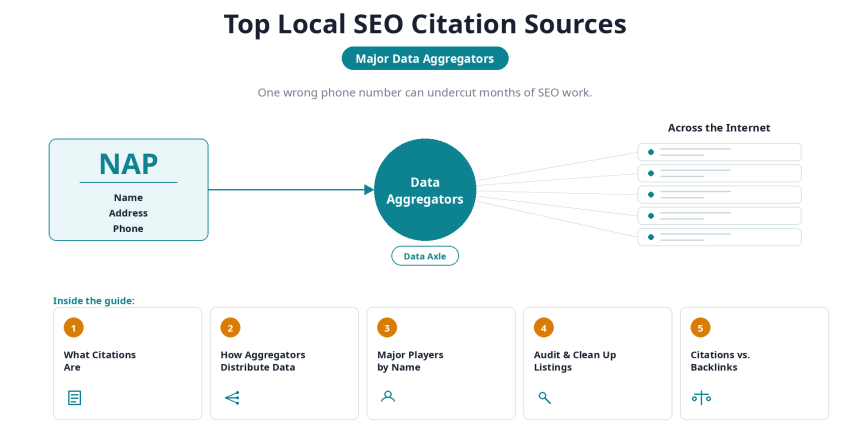
I’ve audited hundreds of local business listings, and the pattern is always the same: a handful of data aggregators control how your business information spreads across the internet. A citation is any online mention of your business name, address, and phone number, and these mentions directly influence whether search engines trust your location data enough to rank you locally. Get the aggregator relationships wrong and inconsistent data follows your business for years.
This matters right now because local algorithms lean harder on consistency signals every year, and a single wrong phone number sitting in Data Axle’s system can quietly undercut months of other SEO work. I’ve watched otherwise solid local campaigns stall for this exact reason.
This guide covers what citations actually are and how the aggregator ecosystem distributes your data, the major players worth knowing by name, how to audit and clean up what’s already out there, and how citations stack up against other ranking signals like backlinks.
What Local Citations Are and Why Data Aggregators Control Them
A local citation is any online reference to a business’s name, address, and phone number (NAP), and data aggregators are the companies that collect, verify, and redistribute that information across directories, apps, and search platforms. I think of aggregators as the wholesale distributors of local business data they don’t run the directories you see, but they feed most of them.
There are two citation types worth separating. Structured citations live in a predictable format on directory pages think name, address, phone, and category fields sitting in neat rows. Unstructured citations show up inside articles, blog posts, or news mentions where your business information appears in regular prose, with no fixed layout.
Structured vs. Unstructured Citations
Structured citations are easier for both search engines and aggregators to parse because the fields are consistent and machine-readable. Unstructured citations carry more trust weight individually, since they imply an editorial or journalistic context rather than a paid directory listing.
How Aggregators Distribute Business Data Downstream
Aggregators push verified business data to a network of smaller directories, apps, GPS systems, and voice assistants that license the feed rather than collect it themselves. I’ve seen a single correction at the aggregator level ripple out to dozens of downstream directories within a few months, which is exactly why getting the source data right matters more than chasing each individual directory one by one.
How the Data Aggregator Ecosystem Actually Works

The data aggregator ecosystem operates through two main pathways: a push model, where aggregators automatically distribute your verified data to partner directories, and a direct submission model, where you manually submit or correct listings on each platform. Most businesses end up using both without realizing it.
The Push Model vs. Direct Submission Model
In the push model, I submit accurate data once to a primary aggregator and it propagates outward on its own schedule, which can be fast or frustratingly slow depending on the platform’s refresh cycle. The direct submission model means claiming and editing a listing on each individual site, which gives more control but takes far more time across dozens of directories.
Why NAP Consistency Breaks Down Across the Chain
NAP consistency breaks down when a business changes its phone number, suite number, or trading name without updating the aggregator source, since every downstream directory that pulled the old data keeps republishing it until the aggregator pushes a correction. I’ve traced ranking dips back to a single outdated suite number sitting untouched in an aggregator’s database for over a year.
Data Axle (Formerly Infogroup)
Data Axle is one of the largest business data aggregators in the US, and it has historically fed listing data to Google, Apple Maps, and dozens of secondary directories. The platform rebranded from Infogroup, and plenty of older citation audits still reference it under the previous name, which causes confusion when businesses search for their own listing history.
Correcting a listing in Data Axle’s system is one of the higher-leverage moves in a citation cleanup because of how widely its feed gets licensed downstream. I treat it as a priority source rather than just another directory to tick off a list.
Foursquare
Foursquare operates as a location data platform that still powers business listing data behind several consumer apps, even though its original check-in app faded from mainstream use. Its database quietly feeds ride-share apps, social platforms, and some voice assistant results, which surprises a lot of business owners who assume Foursquare went away entirely.
Claiming and correcting a Foursquare listing matters more for businesses in food, retail, and hospitality, since those categories lean most heavily on the platform’s dataset for recommendations and nearby-search features.
Localeze / Neustar Localeze
Localeze, now operating under Neustar, is a data aggregator historically focused on distributing business listings to mobile apps, in-car navigation systems, and voice search platforms. Its relevance has shifted over the years as ownership changed hands, but its data still surfaces in automotive GPS systems and some telecom-partnered directories.
I check Neustar Localeze specifically for businesses that rely on drive-by or navigation-based discovery, since that’s where its distribution footprint still carries practical weight.
Google Business Profile as a Primary Data Source

Google Business Profile functions as both a standalone ranking factor and a primary data source that other platforms reference when verifying business information. Unlike the traditional aggregators, Google doesn’t license its data outward in the same wholesale way, but it does cross-reference other aggregator feeds when deciding how much to trust a listing’s accuracy.
Inconsistent information between your Google Business Profile and aggregator-fed directories creates a credibility gap that search engines notice. A Whitespark local SEO ranking factors survey found that Google Business Profile signals account for roughly 32% of local pack ranking factors, which makes it the single heaviest weighted source in the entire citation landscape.
Keeping your profile’s primary category, hours, and service area aligned with what aggregators report elsewhere closes that gap and removes one more reason for Google to discount your location data.
Bing Places for Business
Bing Places for Business is Microsoft’s local business listing platform, and it draws on its own aggregator relationships separate from Google’s data sources. Businesses that skip Bing entirely miss out on a meaningful slice of desktop search traffic, particularly among audiences using Windows devices by default.
Bing’s verification process tends to move faster than some of the pure-play aggregators, so correcting data here often shows up in search results within days rather than months.
Apple Business Connect
Apple Business Connect is Apple’s self-service platform for managing how a business appears across Apple Maps, Siri, and Spotlight search results. It replaced Apple’s older, more opaque listing process, giving business owners direct control over the data instead of relying entirely on third-party aggregators to feed it.
Businesses with a strong mobile customer base, especially in retail and food service, see a disproportionate benefit from keeping this listing accurate, since Apple Maps remains the default navigation app across a large share of US mobile devices.
Yelp as a Secondary Aggregator Hub

Yelp operates less like a pure data aggregator and more like a secondary hub that both receives business data from other sources and distributes its own review and listing data outward to partner sites. Its review volume and star ratings carry independent ranking weight beyond simple NAP accuracy.
I treat Yelp corrections as dual-purpose: fixing the underlying data while also protecting the reputation signals tied to the same profile, since both feed into how local algorithms weigh the listing overall.
Industry-Specific Aggregators
Industry-specific aggregators are directories that collect and distribute business data only within a particular vertical, such as healthcare, legal services, or home repair, rather than across all business types. These niche platforms often carry more ranking weight within their specific industry than general-purpose aggregators do.
Healthcare Directories
Healthcare-focused directories verify credentials, insurance acceptance, and specialty information alongside standard NAP data, which general aggregators rarely capture with the same accuracy.
Legal and Home Services Directories
Legal and home services directories frequently cross-reference licensing boards and trade certifications, adding a layer of trust signal that a general business aggregator simply doesn’t collect.
How to Audit Your Current Citation Profile
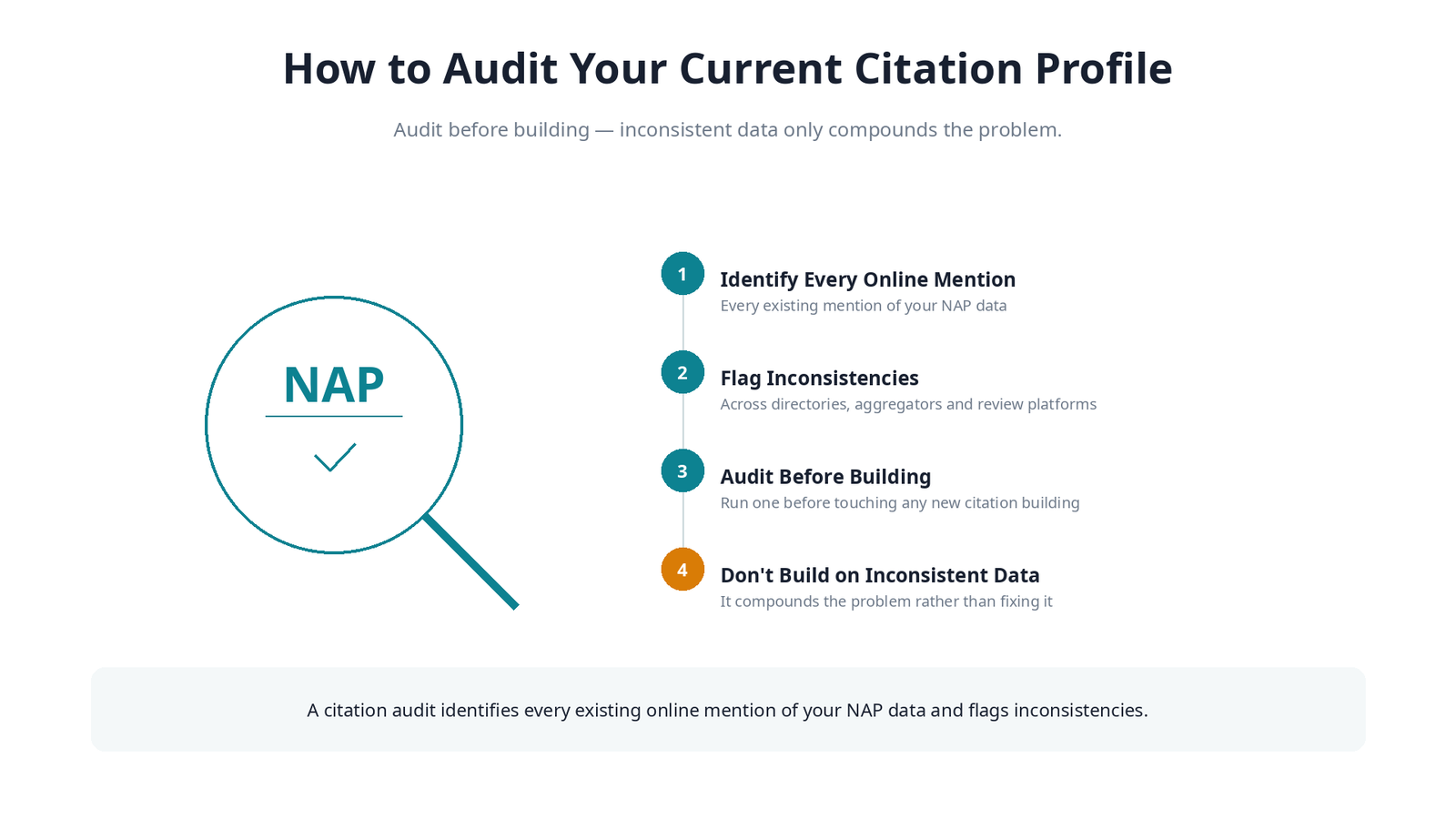
A citation audit is the process of identifying every existing online mention of your business’s NAP data and flagging inconsistencies across directories, aggregators, and review platforms. I run one before touching any new citation building, since building on top of inconsistent data compounds the problem rather than fixing it.
Manual Audit Methods
Searching your exact business name plus city in quotation marks surfaces most existing listings, and cross-checking each result against your verified current NAP data reveals the mismatches worth prioritizing first.
Tools for Citation Tracking
Dedicated citation tracking tools scan dozens of directories simultaneously and flag discrepancies in minutes rather than the hours a manual search takes. Moz Local’s citation research found that inconsistent NAP data appears in roughly 68% of small business listings they scanned across major directories, which signals how common this problem actually is.
Correcting Inaccurate or Duplicate Citations
Correcting a citation means updating the business data at its source, which is usually the aggregator or original directory, rather than editing a copy that was scraped downstream. Duplicate listings form when a business gets submitted to the same directory twice, often by different employees or past marketing vendors unaware of the earlier submission.
Merging or removing duplicates prevents search engines from splitting trust signals across two competing profiles for the same physical location, which dilutes the ranking benefit either listing could otherwise provide on its own.
Citation Building vs. Citation Cleanup: Which Comes First
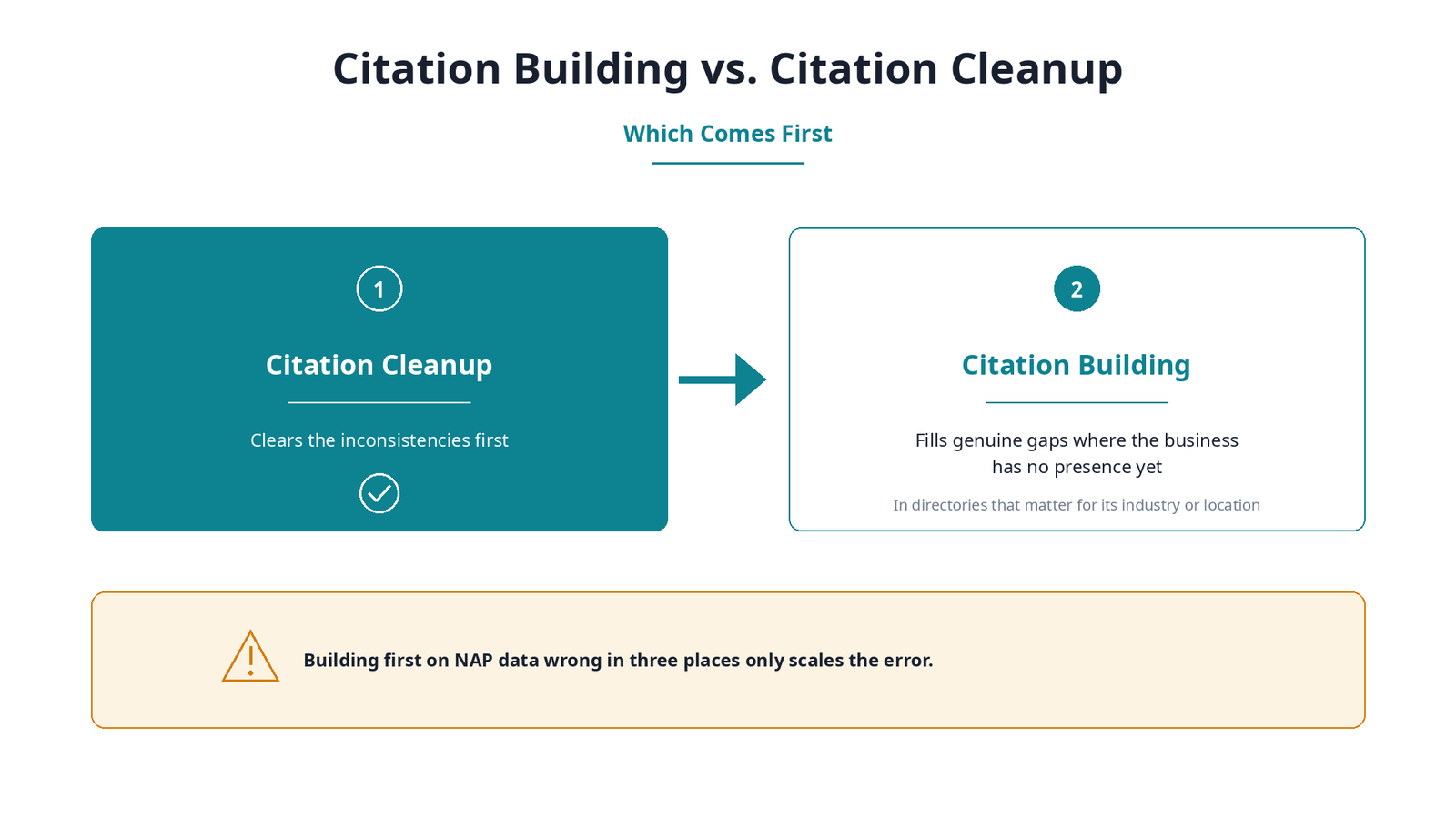
Citation cleanup should come before citation building, since adding new listings on top of inconsistent existing data only multiplies the number of inaccurate mentions search engines find. I’ve seen businesses pay for bulk citation building services while their underlying NAP data was already wrong in three places, which just scaled the error.
Cleanup clears the inconsistencies first, then building fills genuine gaps where the business has no presence yet, in directories that matter for its specific industry or location.
How Long Citation Changes Take to Propagate
Citation changes typically take anywhere from two weeks to six months to fully propagate, depending on which aggregator or directory the correction was submitted through. Direct submissions to platforms like Google Business Profile or Bing Places usually reflect within days, while changes pushed through a slower aggregator feed can take considerably longer to reach every downstream directory.
I set client expectations around the slower end of that range specifically because the aggregator-fed directories, not the direct-submission platforms, tend to be the bottleneck.
Measuring the Impact of Citations on Local Rankings
Citations contribute to local rankings primarily as a trust and consistency signal rather than a direct ranking boost from volume alone. Tracking local pack position before and after a cleanup project, alongside Google Business Profile insights data, shows whether the correction translated into measurable visibility change.
I look for movement in local pack rankings for branded and category-based searches within four to eight weeks of a cleanup project completing, since that’s typically when enough downstream directories have refreshed their data.
Contextual Border
How do I know if my citations are actually hurting my rankings, rather than just being an annoying inconsistency?
Common Citation Mistakes That Undermine Local SEO
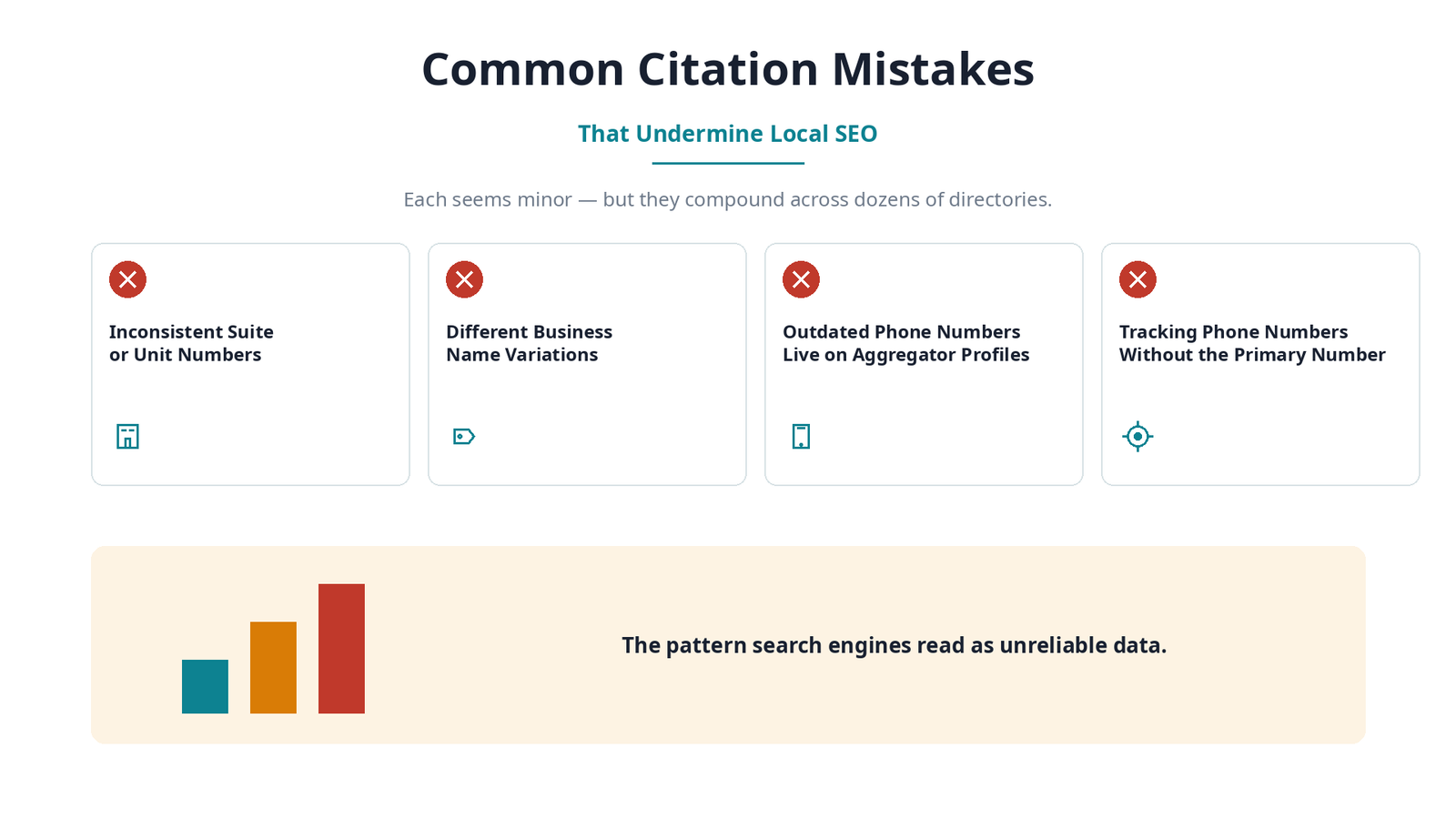
The most common citation mistakes include inconsistent suite or unit numbers, using different business name variations across listings, and leaving outdated phone numbers live on high-authority aggregator profiles. Each of these individually seems minor, but they compound across dozens of directories into a pattern that search engines read as unreliable data.
Businesses that use tracking phone numbers for ad campaigns, without also maintaining the primary number consistently elsewhere, often introduce this problem without realizing their marketing stack is the cause.
Citations vs. Backlinks: Different Roles in Local SEO

Citations and backlinks serve different functions in local SEO: citations establish data consistency and trust around a business’s identity and location, while backlinks pass authority and relevance signals from one web page to another. A citation rarely carries the same direct ranking weight as a strong backlink, but it plays a role backlinks can’t replace.
A business can have an excellent backlink profile and still underperform locally if its citation data is scattered and inconsistent, since the two signal types answer different questions search engines ask before trusting a listing.
Conclusion
Citations and the aggregators behind them form the data backbone of local search trust, and getting the major sources right compounds across every directory they feed.
This space keeps shifting as aggregators merge, rebrand, and change how they verify data, which makes periodic audits a recurring task rather than a one-time project.
We built our citation process at White Label SEO Service around exactly this kind of ongoing accuracy work, so reach out when you’re ready to fix yours.
Frequently Asked Questions
What is a local SEO citation?
A local SEO citation is any online mention of a business’s name, address, and phone number. It can appear on directories, apps, or within articles, and consistency across these mentions builds search engine trust.
Which data aggregators matter most for local SEO?
Data Axle, Foursquare, and Neustar Localeze matter most among traditional aggregators, alongside Google Business Profile, Bing Places, and Apple Business Connect as primary platforms. Each feeds data to a different set of downstream directories and apps.
How long does it take for citation updates to appear online?
Citation updates typically take two weeks to six months to fully propagate. Direct platforms like Google Business Profile update fastest, while aggregator-fed directories lag furthest behind.
Do citations still affect local rankings in 2026?
Yes, citations still affect local rankings by signaling data consistency and trust rather than acting as a direct ranking multiplier. Their impact shows up more in ranking stability than in sudden visibility jumps.
What is the difference between a citation and a backlink?
A citation establishes consistent business identity and location data, while a backlink passes authority and relevance from one website to another. They serve separate functions and neither fully replaces the other.
How much does citation cleanup cost?
Citation cleanup costs vary widely based on how many inaccurate listings exist and how many directories need correction. Most professional cleanup projects price based on the number of locations and the scope of inconsistencies found.
Can I build citations myself, or do I need a service?
Business owners can build and correct citations manually without a service, though it requires auditing dozens of directories individually. A service becomes more practical at scale, especially for multi-location businesses managing many listings at once


