

Industry-specific citations are directory listings on platforms built for a particular trade or profession, and they carry more local ranking weight than general directories because search engines treat them as trust signals from a relevant source. I’ve watched businesses jump local pack positions after cleaning up and expanding their niche citation profile, not their general ones. A plumbing company listed on Angi and HomeAdvisor tells Google something a Yelp listing alone never will.
Getting this wrong costs real visibility in competitive local markets. Businesses that skip niche citations often plateau in the map pack despite solid on-page work.
This guide covers what industry-specific citations are and why they outperform general directories, where to find them across home services, legal, healthcare, hospitality, automotive, real estate, and B2B industries, how to evaluate directory quality before investing time, and how citations fit into ongoing local SEO maintenance.
What Are Industry-Specific Citations and Why They Matter
An industry-specific citation is a business listing on a directory built specifically for one trade, profession, or vertical, rather than a general-purpose platform like Yelp or Yellow Pages. A roofing company listed on GAF’s contractor directory is a citation that general business directories simply can’t replicate in relevance.
These listings matter because search engines weigh topical relevance alongside authority. A listing on a directory dedicated entirely to dentists signals something about a dental practice that a generic local directory cannot.
Ahrefs’ 2024 local SEO study found that businesses with niche-specific citations saw 23% stronger local pack visibility than those relying solely on general directories. That gap tends to widen in competitive metro markets.
Citations vs. Backlinks Key Differences
A citation is a mention of a business’s name, address, and phone number, and it does not require a hyperlink to carry local ranking value. A backlink, by contrast, is a hyperlink from another site that passes authority regardless of whether contact details appear.
I treat these as two separate workflows entirely. Citation consistency is a maintenance task; link building is an outreach and content task.
How Niche Citations Influence Local Pack Rankings
Niche citations influence local pack rankings by reinforcing category relevance alongside the standard NAP consistency and proximity signals Google already evaluates. A general directory listing confirms a business exists; a niche directory listing confirms what kind of business it is.
Google’s local algorithm leans on category and relevance signals heavily once proximity and basic NAP data are equal across competitors.
Industry-Specific vs. General Business Directories
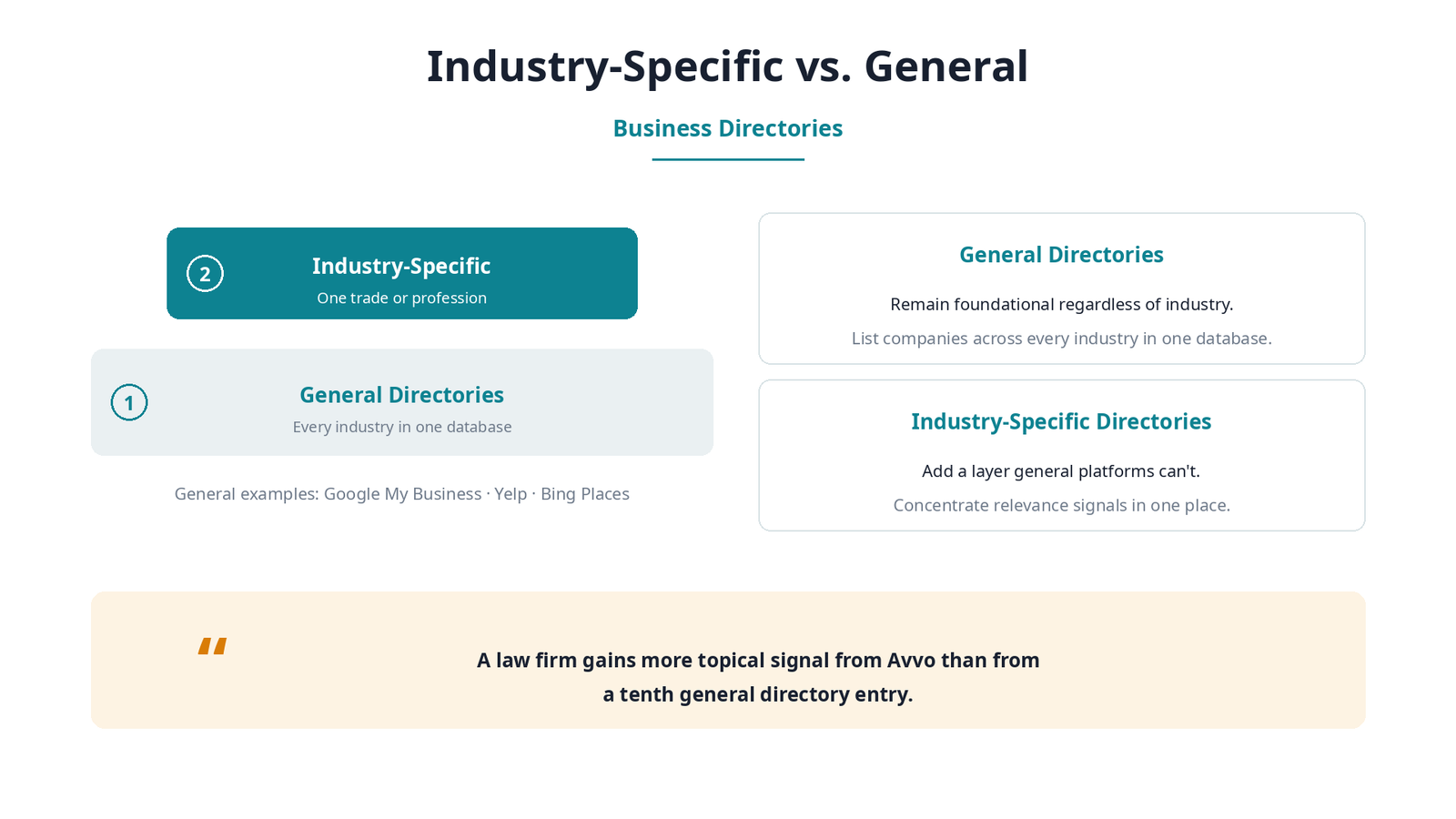
General business directories list companies across every industry in one database, while industry-specific directories restrict listings to a single trade or profession, which concentrates relevance signals in one place. Google My Business, Yelp, and Bing Places fall into the general category and remain foundational regardless of industry.
Industry-specific directories add a layer general platforms can’t. A law firm gains more topical signal from a listing on Avvo than from a tenth general directory entry.
I generally sequence these: foundational general citations first, then layer in the niche-specific sources that match the business’s actual category.
Core NAP Consistency Requirements Across Niche Platforms
NAP consistency means a business’s name, address, and phone number must match exactly across every citation source, including niche directories, because discrepancies create trust signals search engines interpret as unreliable data. Even a suite number formatted differently between two listings can create confusion for Google’s matching algorithms.
Niche directories often have their own formatting quirks — abbreviated suffixes, different phone formats, category-specific fields — which makes manual auditing more error-prone than on general platforms.
I run a NAP audit before adding any new niche citations, since fixing inconsistencies after the fact takes far longer than getting it right at the first listing.
Home Services & Contractor Citation Sources

Home services and contractor businesses have some of the richest niche directory ecosystems in local SEO, including platforms built specifically for trades like plumbing, roofing, HVAC, and general contracting. These directories often carry lead-generation functions alongside citation value, which makes accuracy especially important.
BrightLocal’s 2024 citation research found contractor-specific directories drove 31% more referral traffic than general directories for home service businesses specifically.
HomeAdvisor, Angi, Houzz, and Porch
HomeAdvisor and Angi are lead-generation directories for home service providers that double as high-authority citation sources once a profile is claimed and verified. Houzz focuses on design-oriented trades like remodeling and landscaping, while Porch serves a similar function with a stronger moving and home services focus.
Legal Industry Directories and Attorney-Specific Citations
Legal directories verify attorney credentials and practice areas, which makes them a uniquely trusted citation category since few other industries combine licensing verification with directory listings. A law firm’s presence on a bar-recognized directory tells both users and search engines something general directories cannot confirm.
Attorney-specific citations also tend to carry stronger local pack influence because the legal vertical is dominated by location-based search intent.
Avvo, FindLaw, Justia, and State Bar Directories
Avvo and FindLaw are the two largest attorney-specific directories, both combining citation value with peer and client review systems. Justia offers free legal directory listings alongside its legal information content, and state bar association directories add a verification layer few other niche platforms match.
Healthcare and Medical Practice Citation Sources

Healthcare citation sources verify provider credentials, specialties, and insurance acceptance, giving medical practices a citation category with unusually high trust weight compared to general business listings. Patients searching for care rely on these directories as much as they rely on Google itself.
A practice missing from major healthcare directories is effectively invisible to a large segment of local search traffic that starts on those platforms directly.
Healthgrades, Zocdoc, WebMD, and Vitals
Healthgrades and Vitals both specialize in physician ratings and credential verification, functioning as citation sources with embedded review systems. Zocdoc adds booking functionality on top of its directory listings, and WebMD’s provider directory carries strong domain authority that transfers meaningful trust to listed practices.
Restaurant and Hospitality Niche Directories
Restaurant and hospitality citations come from platforms built around reservations, menus, and dining experiences, which gives this industry some of the most visually rich directory listings of any vertical. These platforms often influence purchase decisions directly, not just search visibility.
Hospitality businesses that skip niche directories lose both citation value and a direct booking or discovery channel that general directories don’t replicate.
OpenTable, TripAdvisor, Zomato, and Resy
OpenTable and Resy both combine reservation systems with citation-grade business listings for restaurants. TripAdvisor extends into hotels and attractions alongside dining, and Zomato remains strong internationally while holding steady domestic relevance in food-focused metro markets.
Automotive Industry Citation Platforms
Automotive citation platforms cover dealerships, repair shops, and parts retailers through directories built around vehicle-specific search behavior, including make, model, and service type filtering that general directories don’t offer. This filtering behavior is exactly why automotive niche citations outperform general listings for this vertical.
Repair shops and dealerships both benefit from the review density these platforms typically carry, since automotive purchase and service decisions are heavily review-driven.
CarGurus, RepairPal, and DealerRater
CarGurus and DealerRater both specialize in dealership listings with strong review integration, while RepairPal focuses specifically on repair shop citations paired with fair-price estimates that build consumer trust before a visit.
Real Estate and Property Services Directories

Real estate directories organize citations around property listings and agent profiles rather than general business information, which creates a citation category tightly bound to transaction-based search intent. An agent’s presence across these platforms often matters more than their general directory footprint.
Property services businesses — not just agents — benefit from this category too, since home inspectors, appraisers, and property managers all have dedicated listing sections on most major platforms.
Zillow, Realtor.com, and Trulia
Zillow and Realtor.com dominate real estate search volume and both offer agent and brokerage citation listings with strong domain authority. Trulia, now under Zillow’s parent company, maintains a separate citation profile that still carries independent ranking value.
Professional Services (Finance, Consulting, B2B) Citations
Professional services citations for finance, consulting, and B2B companies come from review and comparison platforms built around vendor evaluation rather than consumer browsing, which shifts the ranking value toward credibility over proximity. These platforms matter even for businesses that operate beyond a single local market.
B2B citation sources also tend to carry stronger weight in industries where local search volume alone wouldn’t justify the ranking competition.
Clutch, G2, and Chamber of Commerce Listings
Clutch specializes in agency and B2B service provider citations paired with verified client reviews. G2 serves software and SaaS companies with a similar review-driven model, and local Chamber of Commerce listings remain a reliable, often-overlooked citation source for any professional services business operating in a defined metro area.
How to Evaluate Directory Authority and Relevance

A directory is worth a citation investment when it combines genuine domain authority, real organic traffic, and clear topical relevance to the business’s specific industry, rather than existing purely as a citation farm with no independent value. I check these three factors before adding any new niche directory to a client’s citation plan.
Domain authority alone isn’t enough a high-authority directory with zero topical connection to a business’s industry contributes far less than a mid-authority directory built specifically for that trade. Moz’s 2024 directory analysis found that topically relevant directories produced 2.3x stronger ranking correlation than high-authority general directories.
Domain Authority, Traffic, and Industry Trust Signals
Domain authority measures a site’s overall link profile strength, while organic traffic confirms the directory actually gets used by real searchers rather than sitting dormant. Industry trust signals — credential verification, review volume, membership requirements — round out the evaluation and often matter more than raw authority metrics for niche platforms.
Building a Niche Citation Strategy by Industry
A niche citation strategy starts by identifying the three to five directories with the highest relevance and traffic for a specific industry, then expanding outward to secondary and tertiary platforms once the core listings are accurate and complete. I never recommend spreading effort across dozens of directories before the top few are fully optimized.
Industry research should happen before directory selection, not after. Competitors ranking well in the local pack almost always reveal which niche directories matter most in that specific vertical, since their citation profiles are publicly visible.
Sequencing matters as much as selection. A contractor business benefits from claiming HomeAdvisor and Houzz before chasing smaller regional trade directories with minimal traffic.
Common Citation Building Mistakes That Hurt Local Rankings
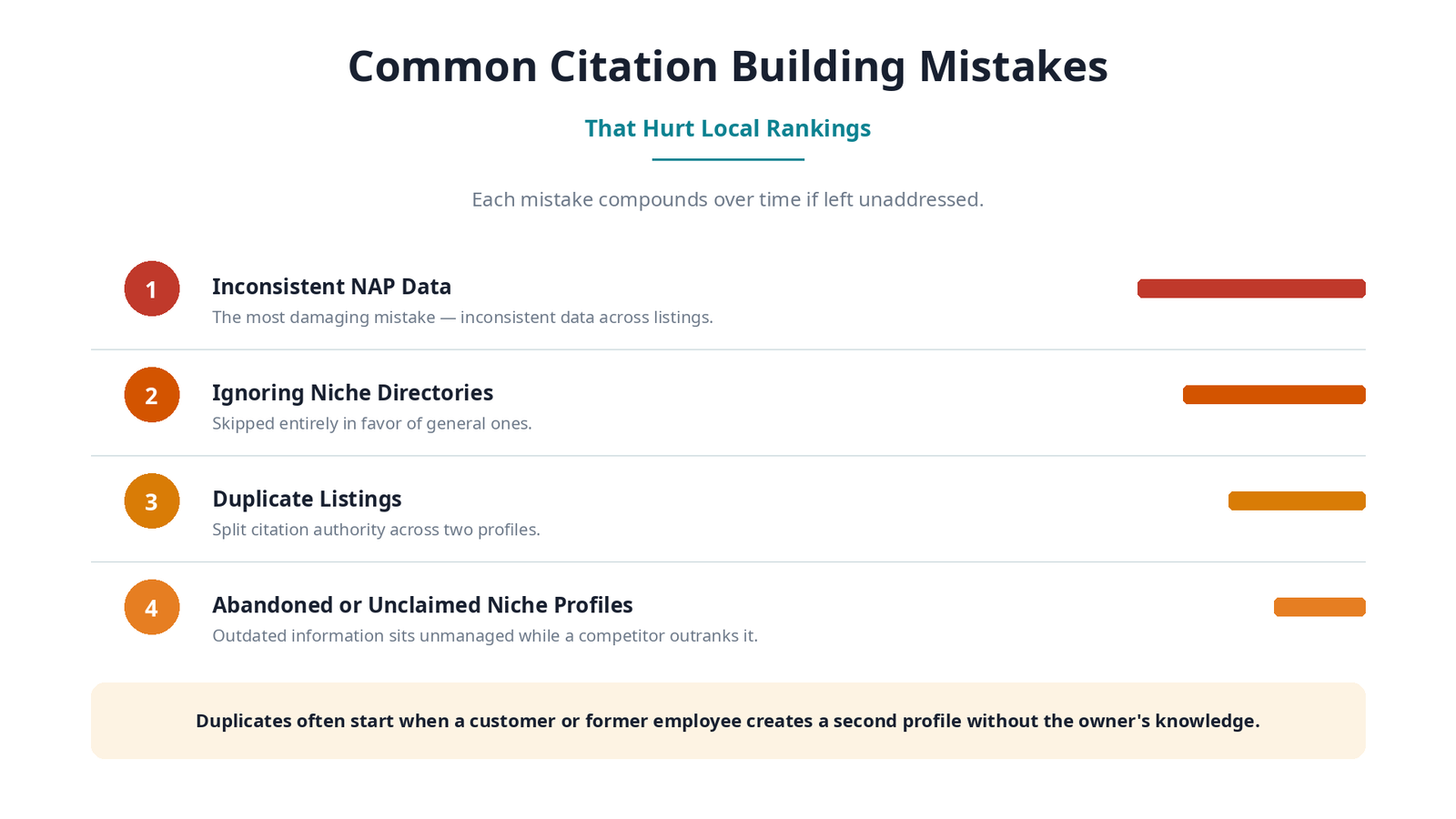
The most damaging citation mistake is inconsistent NAP data across listings, followed closely by ignoring niche directories entirely in favor of general ones, and submitting duplicate listings that split a business’s citation authority across two profiles. Each of these mistakes compounds over time if left unaddressed.
Duplicate listings are particularly common on platforms that allow user-submitted business data, since a customer or former employee may have created a second profile without the business owner’s knowledge.
Abandoned or unclaimed niche profiles create a similar problem — outdated information sits unmanaged while a competitor’s accurate listing outranks it.
Tools and Platforms for Finding Niche Citation Opportunities
Citation research tools scan a business’s existing listings, identify gaps against competitors, and surface industry-specific directories that might otherwise go unnoticed during manual research. These tools save substantial time compared to manually searching for every relevant directory in a given trade.
Competitor citation audits remain one of the most reliable research methods available, since reverse-engineering a top-ranking competitor’s citation profile reveals exactly which niche directories carry weight in that specific market and industry combination.
How Citations Fit Into a Broader Local SEO Strategy
Citations function as one pillar of local SEO alongside Google Business Profile optimization, on-page local signals, review generation, and local link building, and none of these pillars compensates fully for weakness in another. A business with perfect citations but a neglected Google Business Profile still underperforms its potential.
I treat citation building as foundational work that supports the other local SEO pillars rather than a standalone tactic that works in isolation. Review generation and citation accuracy often reinforce each other, since many niche directories combine both functions in a single profile.
Tracking and Maintaining Citation Accuracy Over Time

Citation accuracy requires ongoing monitoring because business information changes new addresses, phone numbers, or ownership — and each change needs to propagate across every niche directory where a listing exists. A single missed update can create a NAP inconsistency that lingers for months unnoticed.
Quarterly citation audits catch most accuracy issues before they affect rankings meaningfully. Whitespark’s 2024 citation tracking data showed businesses auditing citations quarterly maintained 94% NAP consistency, compared to 61% for those auditing annually or less.
Conclusion
Industry-specific citations and niche directories work together with general listings to build the relevance and trust signals local search rankings depend on. Mastering this layer alongside broader local SEO work keeps a business visible as search algorithms continue weighting topical authority more heavily.
We help businesses identify, build, and maintain the citation profiles that actually move rankings in their specific industry. If managing this across multiple clients or locations feels overwhelming, White Label SEO Service handles the research, submission, and ongoing accuracy tracking for you.
Frequently Asked Questions
What counts as an industry-specific citation?
An industry-specific citation is a business listing on a directory built for one particular trade or profession. Examples include Avvo for attorneys, Healthgrades for medical providers, and HomeAdvisor for contractors.
How many niche directories does a business actually need?
Most businesses need three to five high-relevance niche directories rather than dozens of low-value listings. Quality and topical relevance matter more than total directory count for local ranking impact.
Do industry-specific citations affect Google rankings directly?
Industry-specific citations influence rankings indirectly by reinforcing category relevance and NAP consistency. They work alongside Google Business Profile signals and reviews rather than acting as a standalone ranking factor.
How long does it take to see results from niche citations?
Most businesses see measurable local pack movement within 60 to 90 days of building accurate, consistent niche citations. Results depend heavily on competition level and existing citation accuracy.
Are paid directory listings worth the cost?
Paid listings are worth it when the directory shows genuine traffic and industry relevance, not just high domain authority. Free listings on reputable niche directories often outperform paid listings on low-traffic platforms.
What’s the difference between a citation and a backlink?
A citation is a NAP mention that doesn’t require a hyperlink to carry local ranking value. A backlink is a hyperlink that passes authority regardless of whether contact information appears alongside it.
How often should citation accuracy be audited?
Quarterly audits catch most NAP inconsistencies before they affect rankings. Businesses with frequent changes to address, phone number, or ownership should audit more often.


