
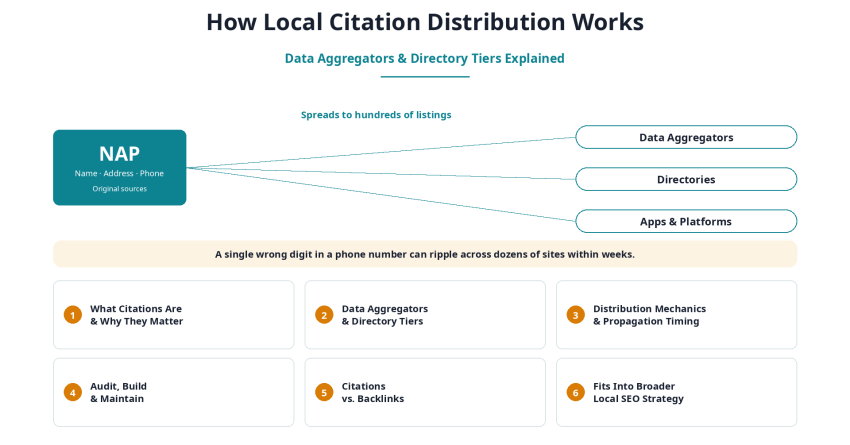
Local citation distribution is the process by which a business’s name, address, and phone number (NAP) spread from a handful of original sources across hundreds of online directories, apps, and platforms. I’ve watched this process confuse business owners more than almost any other local SEO mechanic, mostly because it happens behind the scenes. We rarely see who’s pulling our data or where it ends up next.
Inaccurate citations quietly erode local rankings and confuse potential customers before they ever pick up the phone. A single wrong digit in a phone number can ripple across dozens of sites within weeks.
This guide covers what citations are and why they matter, how data aggregators and directory tiers function together, the actual mechanics of distribution and propagation timing, and how to audit, build, and maintain a clean citation footprint. We’ll also compare citations to backlinks and show where this fits into your broader local SEO strategy.
What Local Citations Are and Why They Matter for Local SEO
A local citation is any online mention of a business’s name, address, and phone number, whether or not it includes a link back to the business’s website. I think of citations as digital breadcrumbs each one tells a search engine “this business exists, and here’s where it is.”
Google cross-references these mentions to verify legitimacy before ranking a business in local results. When the same NAP data appears consistently across dozens of trusted sources, it signals reliability rather than risk.
NAP Consistency as the Foundation of Citation Value
NAP consistency means a business’s name, address, and phone number appear identically across every platform where it’s listed. I’ve seen businesses lose local pack visibility simply because one directory listed a suite number and another didn’t.
Small formatting differences matter less than outright contradictions. A missing suite number rarely hurts, but a wrong phone number or an old address actively confuses both search engines and customers.
How Citations Influence Local Pack and Map Rankings
Citations function as one of several trust signals Google uses to determine which businesses appear in the local pack and on Google Maps. The more consistent and widespread a business’s accurate data is, the more confidently Google can validate it.
Moz’s Local Search Ranking Factors study found that citation signals account for a measurable share of local pack ranking factors, alongside proximity, relevance, and review signals. I don’t treat citations as a silver bullet, but I’ve never seen a strong local campaign skip them entirely.
How Data Aggregators Distribute Business Information
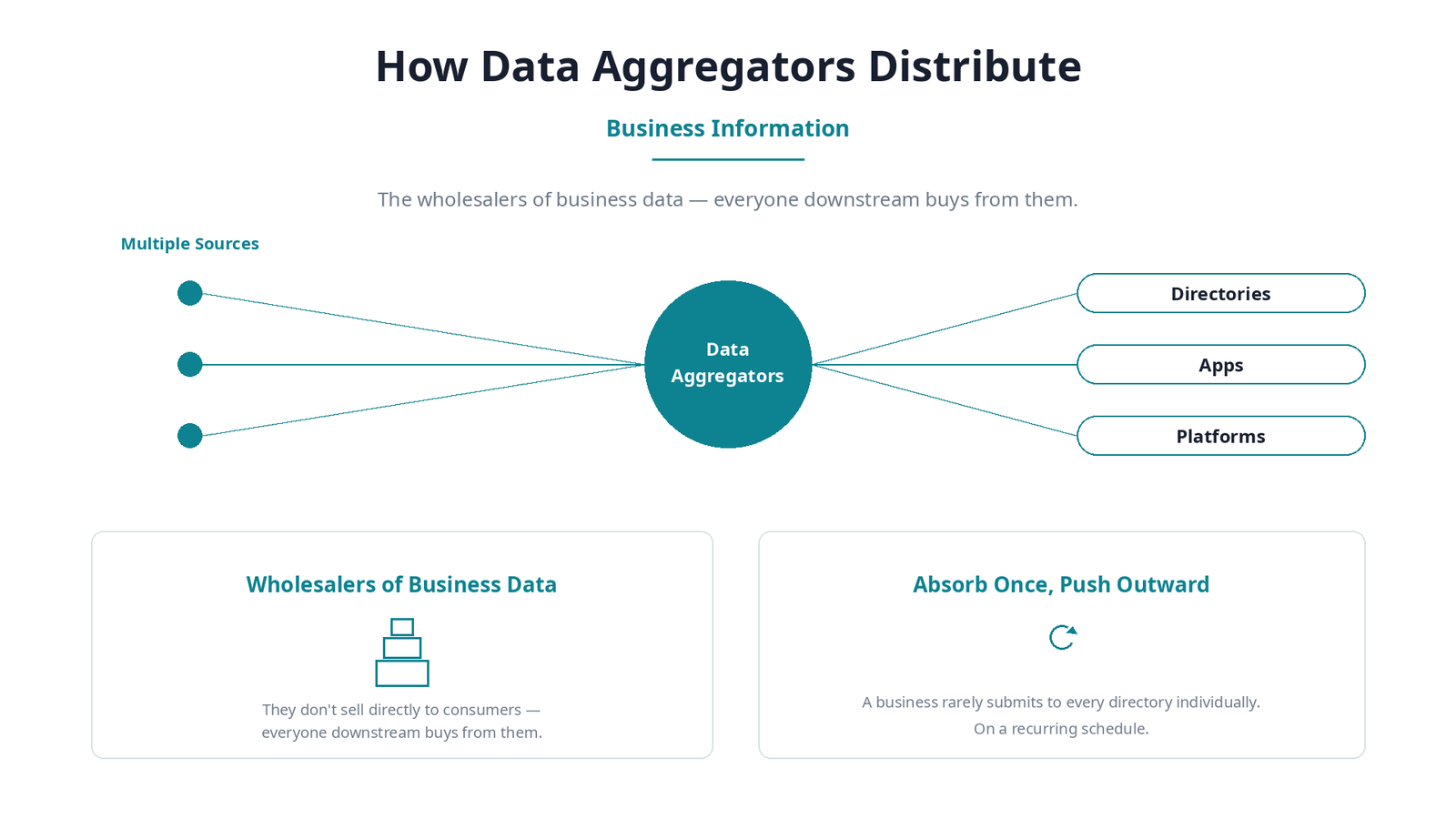
Data aggregators are companies that collect business information from multiple sources and redistribute it to hundreds of downstream directories, apps, and platforms. Think of them as the wholesalers of business data they don’t sell directly to consumers, but everyone downstream buys from them.
A business rarely submits its information to every directory individually. Instead, a small number of aggregators absorb that data once and then push it outward on a recurring schedule.
The Role of Primary Data Aggregators in the US
Primary data aggregators sit at the top of the distribution chain and feed secondary directories, niche platforms, and GPS systems with business data. I always start a citation audit at this layer, because fixing an error at the aggregator level fixes it everywhere downstream over time.
These aggregators pull from government registries, data partnerships, and direct business submissions. Getting listed accurately here saves months of chasing individual directory corrections later.
How Aggregators Feed Hundreds of Downstream Directories
The distribution process works in layers: a business submits or claims data with an aggregator, that aggregator verifies and standardizes it, and then it pushes the record out to its network of partner directories on a scheduled sync. Each aggregator has its own refresh cycle, ranging from weekly to quarterly.
This layered approach explains why fixing one wrong digit at the source still takes time to show up everywhere. The data has to travel through each partner’s own update schedule before it’s fully corrected.
The Major US Data Aggregators Explained
Four aggregators dominate the US citation landscape: Data Axle, Foursquare, Neustar Localeze, and SafeGraph. Each one feeds a different mix of apps, GPS systems, and directories, so missing even one creates a gap in overall coverage.
I treat these four as the non-negotiable starting point for any citation cleanup project, regardless of industry or location.
Data Axle, Foursquare, Neustar Localeze, and SafeGraph
| Aggregator | Primary Downstream Reach | Data Focus |
| Data Axle | Yellow Pages network, numerous local directories | Business listings, industry classification |
| Foursquare | Apple Maps, Uber, Snapchat, Siri | Location and points-of-interest data |
| Neustar Localeze | Mobile apps, GPS, voice search platforms | NAP accuracy, mobile-first listings |
| SafeGraph | Analytics platforms, research and mapping tools | Foot traffic and location intelligence |
This table shows how each aggregator specializes in a different slice of the broader data ecosystem, which is why a business needs coverage across all four rather than just one.
How Each Aggregator Sources and Verifies Business Data
Each aggregator uses a mix of automated web crawling, direct business claims, and third-party data partnerships to build its records. Foursquare leans heavily on user check-in data and app partnerships, while Data Axle relies more on structured business registries.
Verification methods vary too. Some aggregators confirm changes through automated matching, while others require a manual claim process before updates take effect.
Understanding Directory Tiers
Directory tiers, Tier 1 through Tier 3, is a way of ranking citation sources by authority, traffic, and trust signal strength. I use this tiering system to decide where to prioritize time when building out a citation profile from scratch.

Not every directory carries equal weight, and treating them all the same wastes effort on sources that barely move the needle.
Tier 1 Directories: Google Business Profile, Apple Maps, Bing Places
Tier 1 directories are the highest-authority platforms that directly influence search visibility, map rankings, and voice search results. Google Business Profile sits at the top of this tier because it directly powers the local pack and Google Maps results.
Apple Maps and Bing Places round out the core Tier 1 group, since both feed native mapping and voice assistant results across millions of devices.
Tier 2 and Tier 3 Directories: Niche and Long-Tail Citation Sources
| Tier | Examples | Authority Level | Primary Value |
| Tier 1 | Google Business Profile, Apple Maps, Bing Places | Highest | Direct ranking and map influence |
| Tier 2 | Yelp, Yellow Pages, BBB, industry-specific hubs | Medium-High | Trust signals, referral traffic |
| Tier 3 | Smaller local directories, niche aggregator feeds | Lower | Supplementary consistency, long-tail reach |
This tier breakdown shows why Tier 2 and Tier 3 sources still matter even though they carry less individual weight. Volume and consistency across lower tiers reinforce the signals sent by Tier 1 listings.
How the Citation Distribution Process Actually Works
Citation distribution follows a repeatable chain: a business claims or submits data, an aggregator verifies and standardizes it, and that aggregator then syncs the corrected record to its network of partner directories. I walk clients through this exact chain whenever they ask why a correction hasn’t shown up everywhere yet.
From Submission to Propagation: The Data Flow Timeline
- Business submits or updates data directly with a primary aggregator
- Aggregator verifies the submission against existing records
- Aggregator standardizes formatting to match its internal schema
- Aggregator pushes the verified record to its partner network on its sync schedule
- Partner directories update their own listings during their next refresh cycle
- Secondary directories pull from those partners during their own refresh cycle
- Full propagation completes once every downstream layer has synced
Each step depends on the one before it, which is exactly why a single correction can take weeks to fully ripple through the entire ecosystem.
Industry-Specific and Niche Citation Sources
Beyond the four major aggregators and general directories, certain industries have their own dedicated citation sources that carry outsized trust within that niche. A contractor benefits from Houzz and Angi, while a restaurant gains more from OpenTable and Zomato than from a generic business directory.
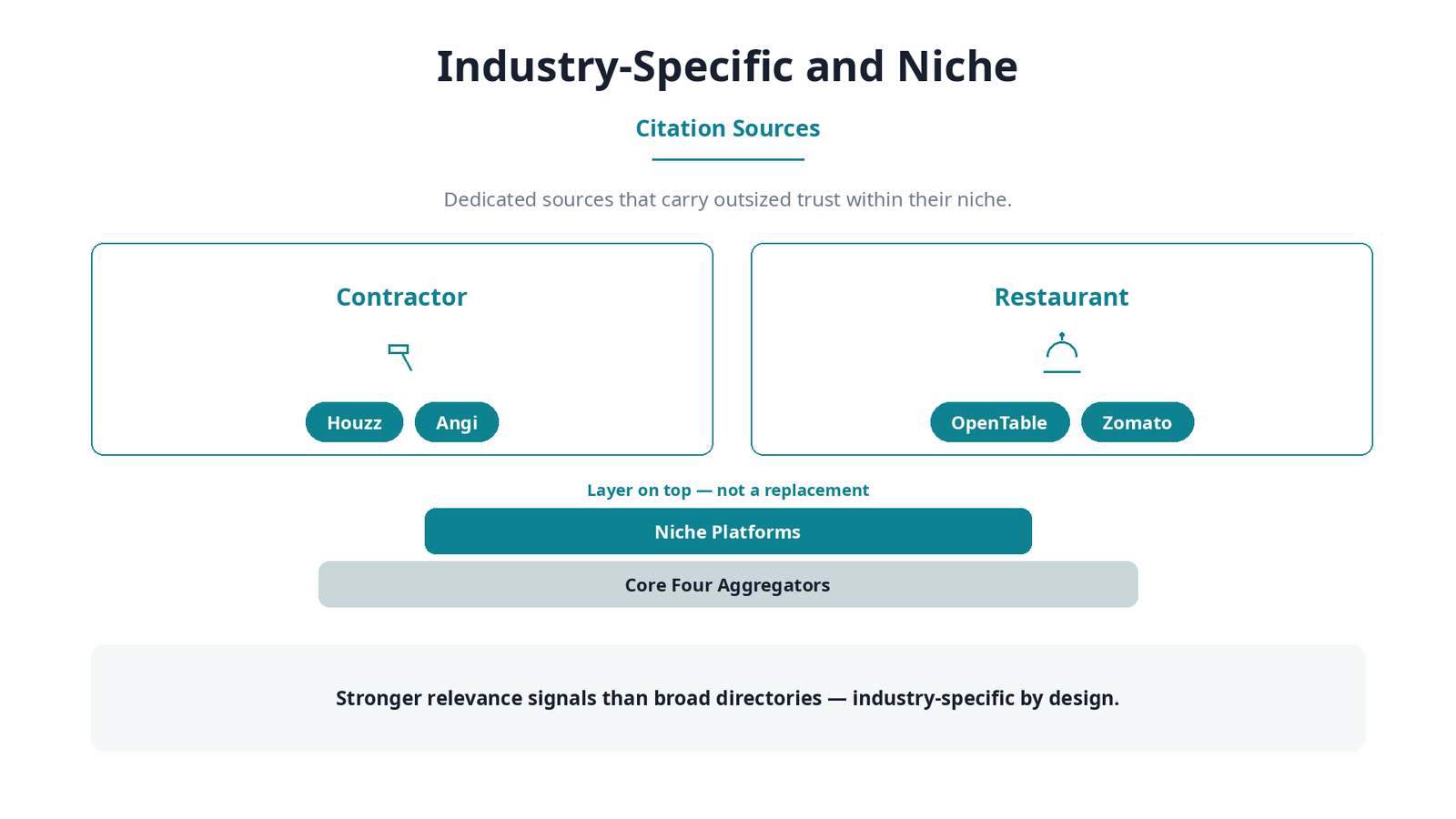
These niche platforms often send stronger relevance signals than broad directories because they’re industry-specific by design. I always layer these on top of the core four aggregators rather than treating them as a replacement.
How Citation Accuracy Affects Local Search Visibility
Citation accuracy directly affects whether Google trusts a business’s location and contact data enough to surface it prominently in local results. Inconsistent data forces Google to work harder to verify legitimacy, which can suppress visibility even when every other ranking factor is strong.
BrightLocal’s Local Search Industry Survey found that a significant share of consumers lose trust in a business after encountering inconsistent online information. That trust gap shows up in rankings just as much as in customer behavior.
Common Citation Inconsistencies and Their Causes
Most citation inconsistencies trace back to business moves, phone number changes, rebrands, or multiple people submitting data to different directories without coordination. I see this most often with businesses that have relocated but never updated their older listings.
Duplicate listings cause a similar problem, since search engines struggle to determine which version is authoritative when two records exist for the same business. Merging or suppressing duplicates is often the first fix in any citation audit.
How Long Citation Propagation Takes Across the Web
Citation propagation to Tier 1 sources typically takes two to four weeks, while full distribution across Tier 2 and Tier 3 directories can take two to six months depending on each aggregator’s sync schedule. I set this expectation with every client upfront, because nothing frustrates a business owner more than expecting overnight results from a citation cleanup.
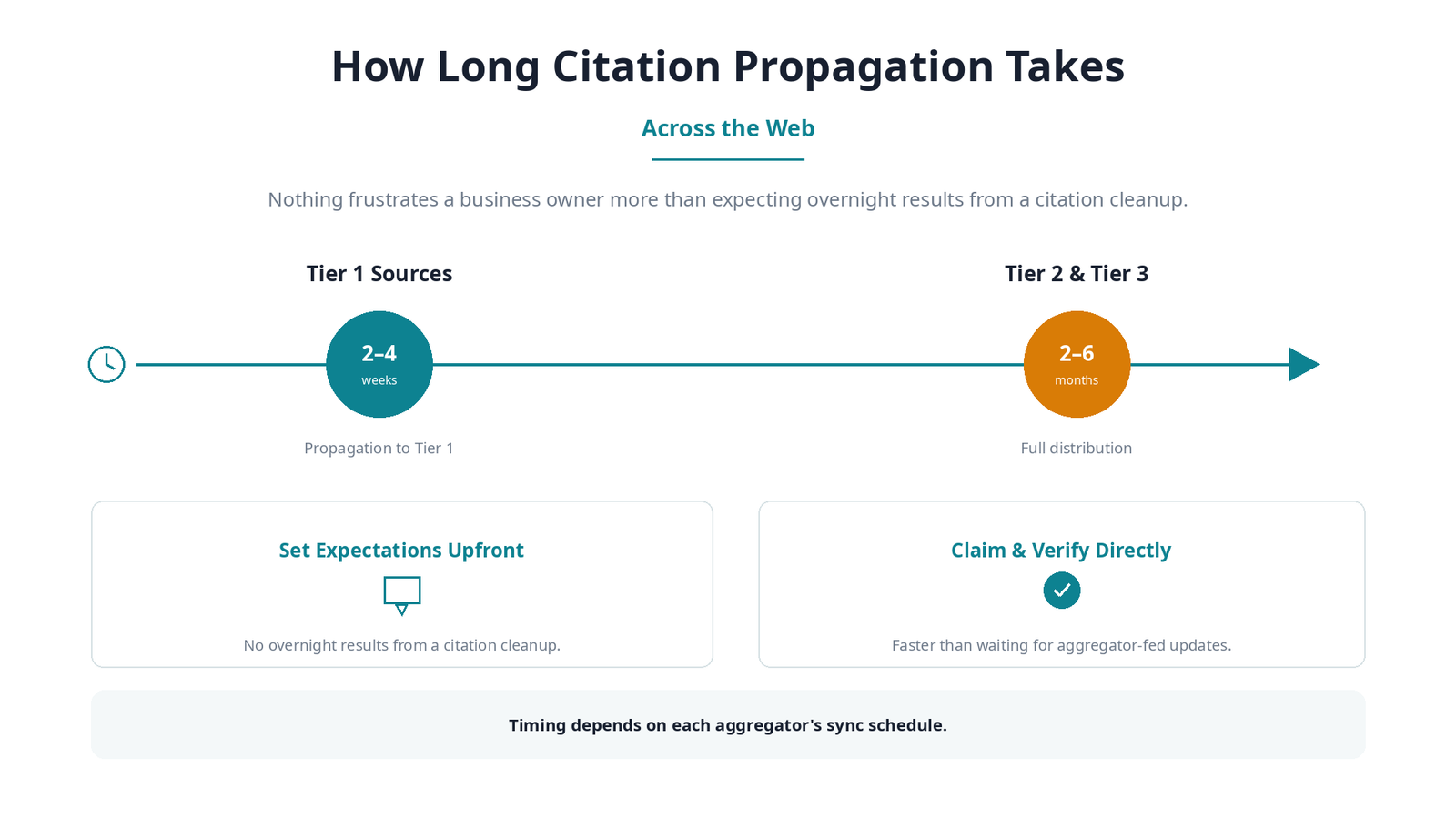
Some directories update faster when a business claims and verifies its own listing directly rather than waiting for aggregator-fed updates to cascade down naturally.
Manual Citations vs. Aggregator-Fed Citations
| Factor | Manual Citations | Aggregator-Fed Citations |
| Submission method | Business claims listing directly | Data flows from aggregator sync |
| Speed of update | Often faster for that specific site | Dependent on aggregator refresh cycle |
| Coverage scale | One directory at a time | Hundreds of directories at once |
| Control over accuracy | High | Moderate, depends on aggregator data quality |
This comparison shows why most effective citation strategies combine both approaches rather than relying on just one. Manual claims fix high-priority Tier 1 listings fast, while aggregator submissions handle long-tail coverage at scale.
How to Audit Your Business’s Existing Citation Footprint
- Search the business name, address, and phone number across major search engines to surface existing listings
- Check the four primary aggregators directly for current data accuracy
- Use a citation tracking tool to identify duplicate or outdated listings
- Document every inconsistency found, including minor formatting differences
- Prioritize corrections starting with Tier 1 sources before moving to Tier 2 and Tier 3
- Resubmit corrected data to aggregators and manually update high-priority directories
- Recheck listings after four to six weeks to confirm propagation
This process gives a business a clear starting baseline before investing further time or budget into citation building.
Citation Building Best Practices for Sustainable Local SEO
Consistent formatting across every listing matters more than sheer volume of citations. I’d rather see a business with fifty perfectly consistent citations than two hundred with scattered formatting errors.
Claiming and verifying listings directly, rather than waiting passively for aggregator data to populate, speeds up accuracy across the board. Industry-specific directories deserve the same attention as general ones, since niche relevance often carries more weight than broad reach alone.
Citations vs. Backlinks: Understanding the Difference
| Factor | Citations | Backlinks |
| Core function | Verify business identity and location | Pass authority and relevance signals |
| Link requirement | Not always required | A link is the entire point |
| Primary ranking impact | Local pack and map visibility | Organic ranking across all search types |
| Typical sources | Directories, aggregators, apps | Blogs, news sites, industry publications |
This table highlights why a complete local SEO strategy needs both elements working together rather than treating one as a replacement for the other. Citations establish trust and location accuracy, while backlinks build broader topical authority.
How Citation Distribution Fits Into a Broader Local SEO Strategy
Citation distribution works alongside on-page optimization, Google Business Profile management, review generation, and link building as one pillar of a complete local SEO strategy. None of these elements functions well in isolation, and I’ve seen businesses waste budget chasing one tactic while ignoring the others entirely.
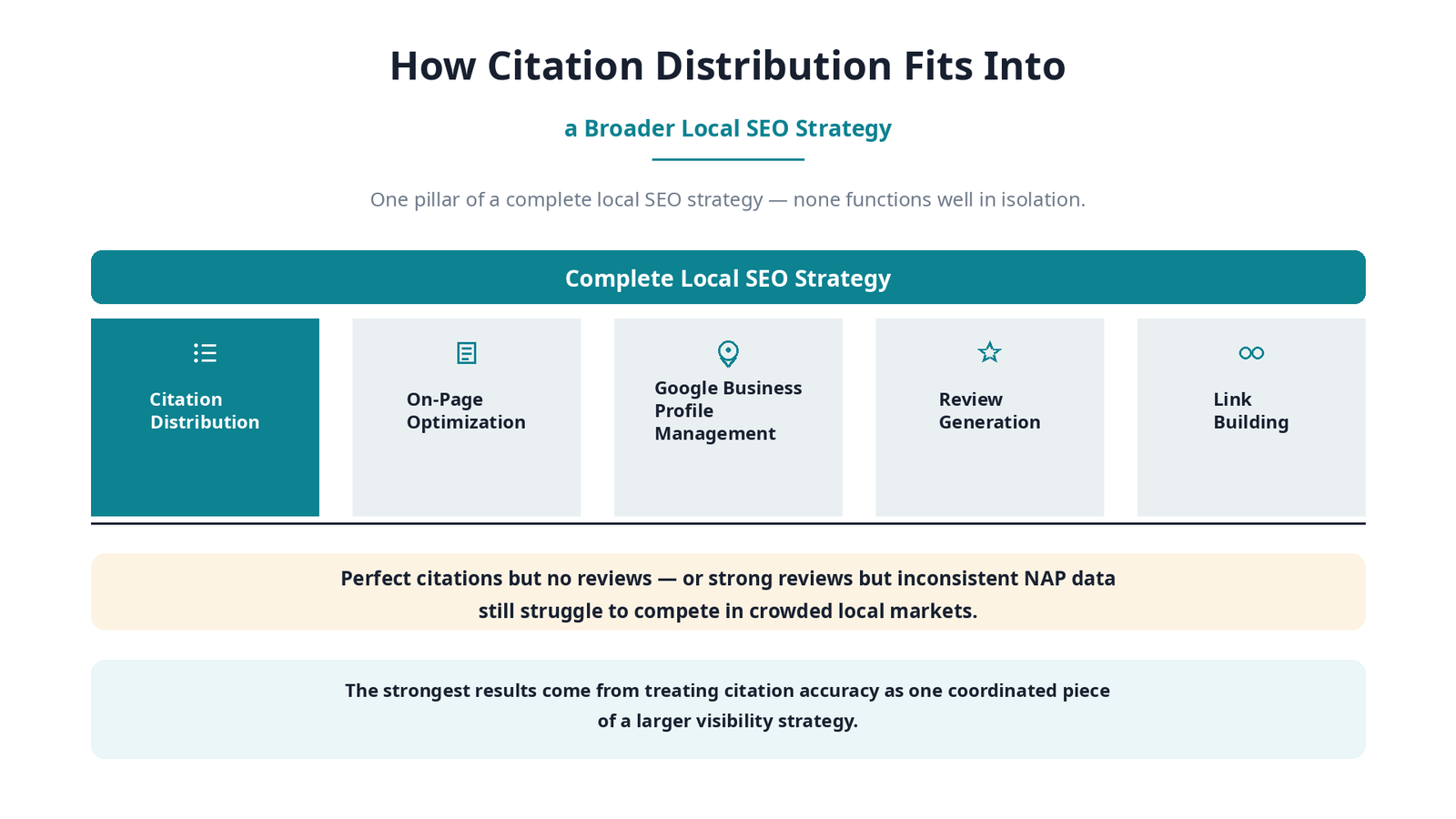
A business with perfect citations but no reviews, or strong reviews but inconsistent NAP data, still struggles to compete in crowded local markets. The strongest results come from treating citation accuracy as one coordinated piece of a larger visibility strategy.
Conclusion
Local citation distribution moves through aggregators, tiers, and sync cycles before reaching full propagation. Accuracy at the source prevents confusion downstream. Consistent NAP data, paired with strategic citation building, strengthens local trust signals search engines rely on.
This fits into a broader local SEO strategy alongside reviews, on-page work, and links. Getting citations right takes patience, since propagation isn’t instant.
We help businesses audit, correct, and build sustainable citation profiles that support long-term local visibility. White Label SEO Service can manage this process for you.
Frequently Asked Questions
What is a local citation in SEO?
A local citation is any online mention of a business’s name, address, and phone number. It can appear with or without a link, and search engines use it to verify legitimacy.
How many citations does a business need?
There’s no fixed number, since quality and consistency matter more than volume. Thirty to fifty accurate, well-distributed citations typically outperform hundreds of inconsistent ones.
What is the difference between a data aggregator and a directory?
A data aggregator collects and redistributes business data to multiple directories at once. A directory is a single platform where that data appears to end users.
How long does it take for citations to update across the web?
Tier 1 sources usually update within two to four weeks. Full propagation across Tier 2 and Tier 3 directories can take two to six months.
Do citations still matter for local SEO rankings?
Yes, citations remain a measurable local ranking factor according to industry studies. They work alongside reviews, proximity, and on-page signals rather than as a standalone factor.
What happens if my business information is inconsistent across directories?
Inconsistent data confuses search engines and can suppress local pack visibility. It also erodes customer trust when they encounter conflicting contact details.
Should I manually submit citations or rely on aggregators?
A combined approach works best for most businesses. Manual submissions fix high-priority Tier 1 listings quickly, while aggregator-fed distribution handles broader long-tail coverage.


