
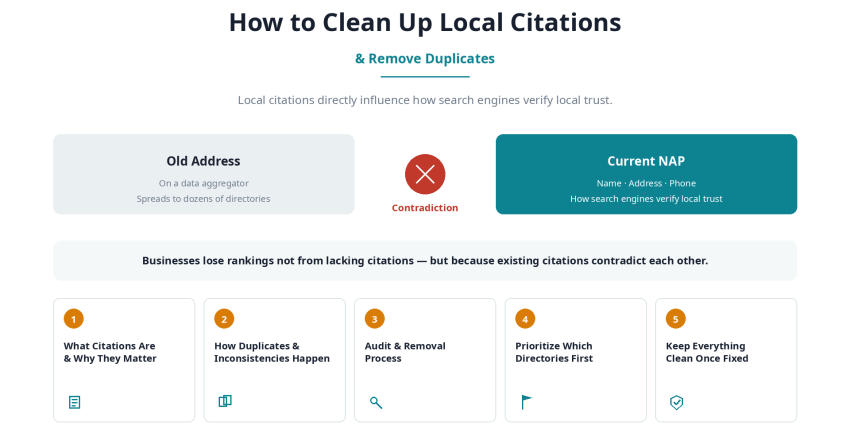
Local citations are online mentions of a business’s name, address, and phone number (NAP) that appear on directories, apps, and data platforms, and they directly influence how search engines verify local trust. I’ve audited hundreds of these profiles, and the pattern is always the same: businesses don’t lose local rankings because they lack citations, they lose them because their existing citations contradict each other.
That contradiction compounds fast. One old address on a data aggregator can quietly spread to dozens of directories within weeks.
This guide covers what citations are and why they matter, how duplicates and inconsistencies happen in the first place, the audit and removal process from manual checks through data aggregators and tools, how to prioritize which directories deserve attention first, and how to keep everything clean once it’s fixed.
What Local Citations Are and Why They Matter for SEO
A local citation is any online listing of a business’s name, address, and phone number, whether or not it includes a link back to the website. I think of citations as a trust layer search engines use to confirm a business is real and operating where it claims to be.
Search engines cross-reference these listings against each other. When the data matches everywhere, that consistency becomes a ranking signal for local pack visibility and map results.
NAP Consistency and Its Role in Local Rankings
NAP consistency means a business’s name, address, and phone number appear identically across every directory and platform where it’s listed. I’ve seen businesses stall in the local pack for months with zero explanation, and the root cause was almost always a mismatched suite number or an old phone line still live on a directory.
Search engines weigh this consistency heavily because it’s one of the few verifiable trust signals available outside the website itself.
How Duplicate Citations Happen
Duplicate citations happen when the same business gets listed more than once under slightly different details, usually without the owner ever realizing it. I’ve traced this back to four recurring triggers: address changes, rebrands, agency turnover, and automated data aggregator syncing.

Each duplicate listing then gets picked up by smaller directories that scrape larger ones, and the problem multiplies on its own.
Common Causes — Data Aggregators, Rebrands, Moves, Agency Errors
Business moves and rebrands are the most common root causes, since the old listing rarely gets updated and a new one gets created instead. An SEO agency turnover often leaves behind orphaned profiles nobody remembers creating.
Automated syncing from data aggregators then pushes the outdated version to dozens of smaller sites before anyone notices.
Why Duplicate and Inconsistent Citations Hurt Rankings
Duplicate and inconsistent citations hurt local rankings because they fracture the trust signal search engines rely on to confirm a business’s true location and identity. I’ve watched well-optimized Google Business Profiles underperform for months purely because conflicting NAP data elsewhere kept diluting confidence in the primary listing.
Google’s own guidance confirms that consistent business information across the web is one of the clearest trust signals it checks before ranking a local result prominently.
Local Pack Visibility and Trust Signal Dilution
Trust signal dilution happens when search engines can’t confidently pick which version of a business’s information is accurate. That uncertainty shows up as reduced local pack visibility, even when every other ranking factor looks strong.
A BrightLocal study found that citation signals remain among the top local ranking factors cited by SEO professionals year over year.
How to Audit Your Existing Citations
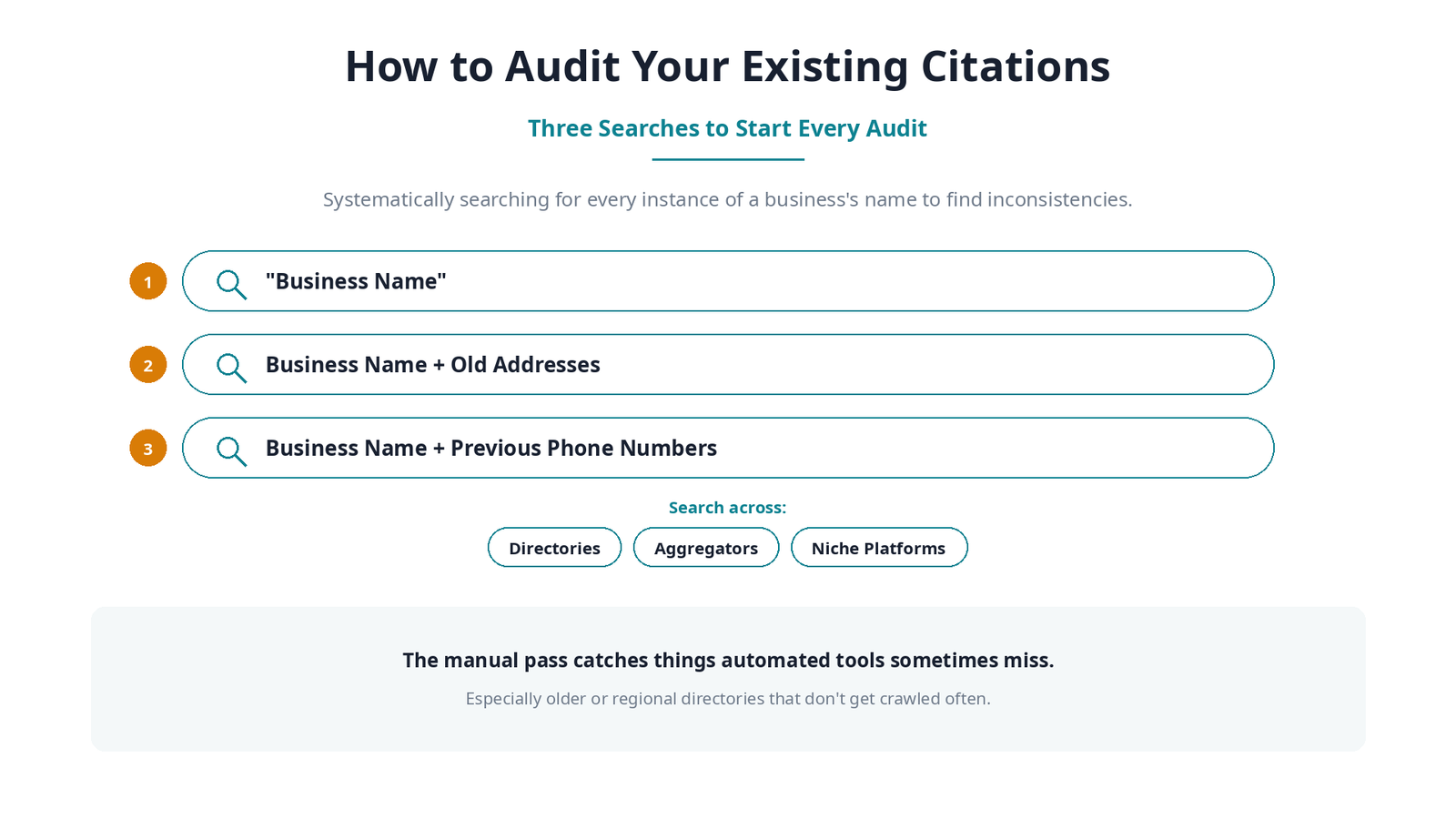
Auditing citations means systematically searching for every instance of a business’s name across directories, aggregators, and niche platforms to find inconsistencies. I start every audit the same way: search the exact business name in quotes, then search name plus old addresses, then search name plus any previous phone numbers.
This manual pass catches things automated tools sometimes miss, especially older or regional directories that don’t get crawled often.
Manual Search Methods
Manual search methods rely on exact-match queries in search engines using the business name alongside variations of past addresses or phone numbers. I also check image search and map results, since citation errors sometimes surface visually before they show up in text listings.
This method is slower, but it surfaces directories that citation tools frequently fail to index.
Citation Audit Tools and Platforms
Citation audit tools scan hundreds of directories simultaneously and flag inconsistencies that would take a person days to find manually. I rely on these tools for the first pass and manual search for the second, since no single platform indexes everything.
Moz Local’s research notes that even comprehensive citation tools typically miss five to ten percent of smaller regional directories.
How to Identify Duplicate Listings
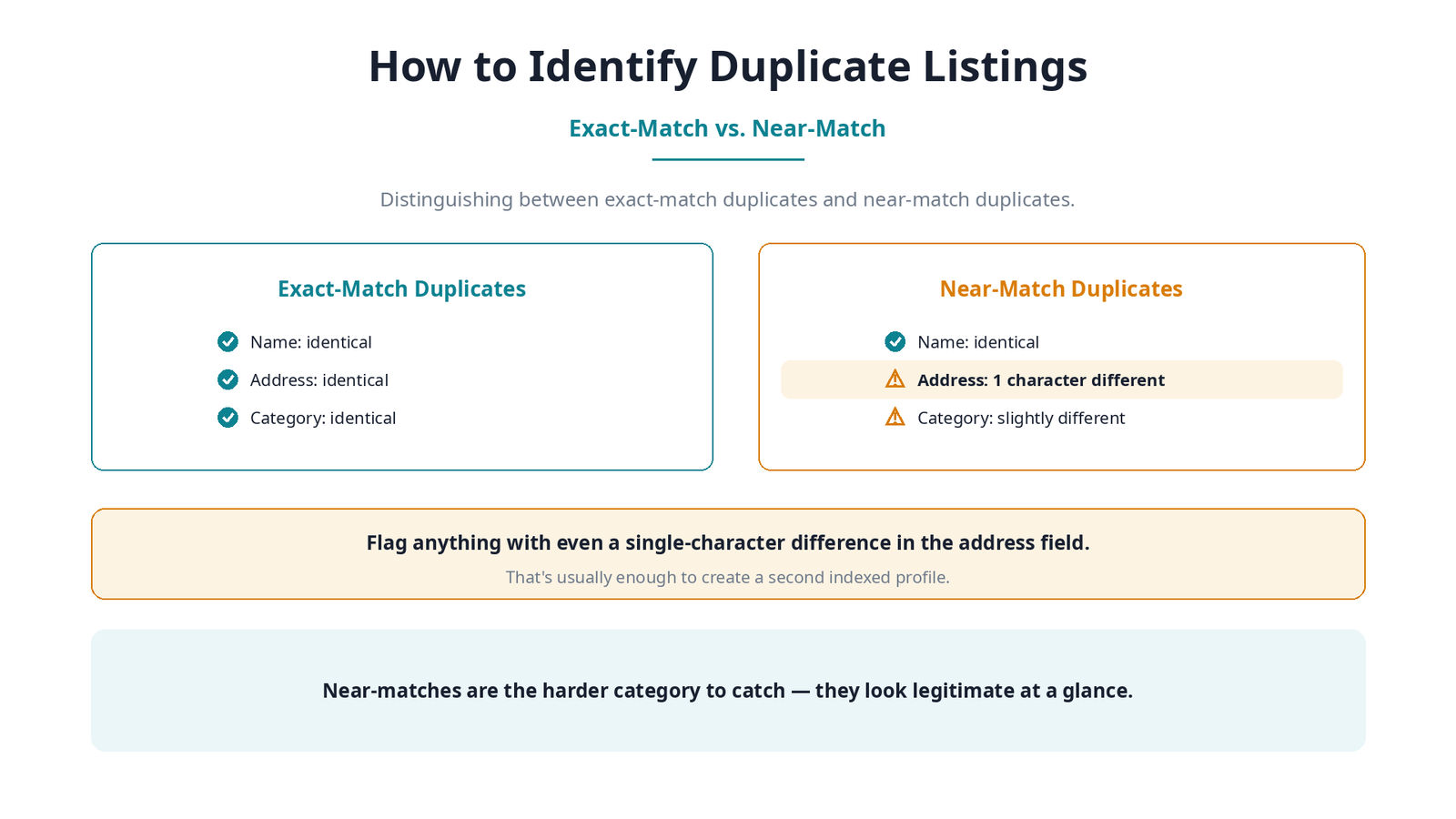
Identifying duplicate listings means distinguishing between exact-match duplicates, where every detail is identical, and near-match duplicates, where small variations exist in the name, address, or category. I flag anything with even a single-character difference in the address field, since that’s usually enough to create a second indexed profile.
Near-matches are the harder category to catch because they look legitimate at a glance.
Exact-Match vs. Near-Match Duplicates
Exact-match duplicates share identical NAP data and almost always stem from accidental resubmission on the same platform. Near-match duplicates carry small variations, like “St.” versus “Street” or a missing suite number, and these are the ones that quietly damage consistency the longest.
I treat near-matches as higher priority to fix, since they’re harder to spot and easier to leave unresolved for years.
Step-by-Step Process to Remove Duplicate Citations
Removing a duplicate citation generally follows four steps: locating the duplicate, determining whether it can be claimed, merging or requesting removal, and verifying the correction propagated. I never skip verification, since platforms sometimes approve a removal request but take weeks to actually update the public listing.
This table shows the general difference in process depending on listing ownership status.
| Listing Status | Action Required | Typical Timeline |
| Claimed by the business | Edit directly or merge duplicate | 1-7 days |
| Unclaimed, business-created | Claim, then edit or delete | 1-3 weeks |
| Unclaimed, aggregator-sourced | Submit removal request to source | 2-8 weeks |
| Claimed by a third party | Dispute through platform support | 4-12 weeks |
Claiming, Merging, and Requesting Removal
Claiming a listing establishes ownership and unlocks the ability to edit or merge it directly. Merging combines two profiles into one when a platform supports that feature, which is faster than requesting a deletion.
Requesting removal becomes necessary when a duplicate sits on a platform where no merge option exists, and that process depends entirely on the platform’s own support workflow.
How to Fix Inconsistent NAP Data Across Directories
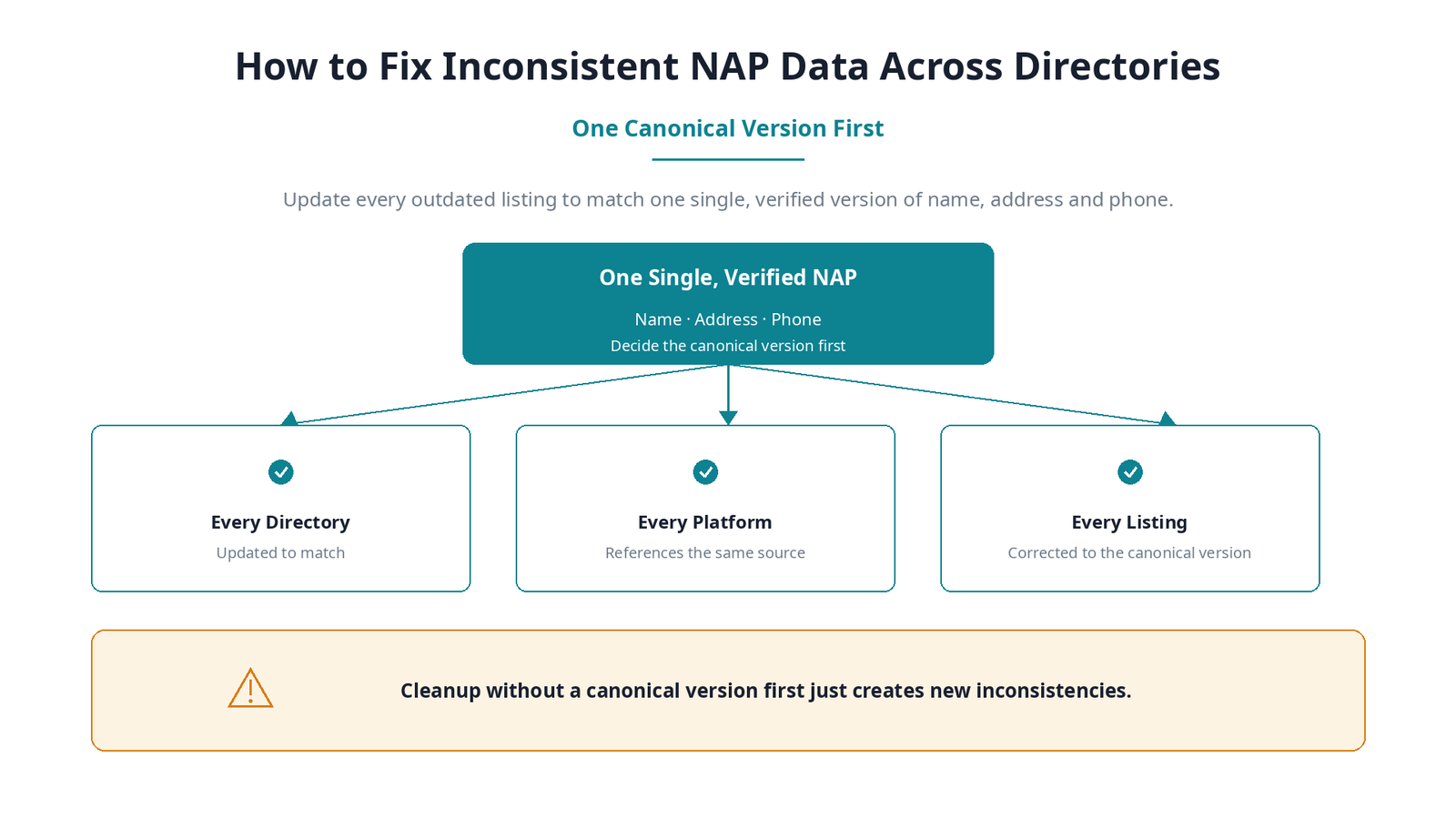
Fixing inconsistent NAP data means updating every outdated listing to match one single, verified version of the business’s name, address, and phone number. I always start by deciding on that single canonical version before touching any directory, otherwise the cleanup just creates new inconsistencies.
Once that canonical NAP is locked in, every correction across every platform references the same source.
Data Aggregators and Their Role in Citation Accuracy
Data aggregators are large databases that collect and distribute business information to hundreds of smaller directories, apps, and GPS systems. I think of them as the root of the citation tree. Fix the data at the aggregator level, and corrections eventually flow downstream to the smaller sites that pull from it.
Skip the aggregators, and a business ends up fixing the same error on fifty individual directories instead of four sources.
The Four Major Data Aggregators in the US
The four major data aggregators in the US are Data Axle, Foursquare, Neustar Localeze, and Acxiom, and together they feed business data to a large share of smaller local directories. Correcting NAP data at this level is one of the highest-leverage steps in any citation cleanup.
I always address these four before touching smaller niche directories, since skipping them means the same error resurfaces later.
Prioritizing Citation Sources (Tier 1, 2, 3 Directories)
Prioritizing citation sources means tackling the directories with the highest trust and traffic value first, since search engines weigh those corrections more heavily. Tier 1 covers the major aggregators and platforms like Google Business Profile and Bing Places.
Tier 2 includes broad, well-known directories, and Tier 3 covers smaller or regional listings that carry lower individual weight but still contribute to overall consistency.
Industry-Specific and Niche Citation Sources
Industry-specific citation sources are directories built around a single profession or sector, such as legal directories, healthcare provider databases, or home service marketplaces. These niche listings often carry more weight within their specific vertical than general directories do.
A local SEO case study from Whitespark found that industry-specific citations correlated more strongly with local pack rankings in competitive niches than generic directory listings.
How Google Business Profile Fits Into Citation Cleanup
Google Business Profile acts as the anchor listing that other citation data gets measured against, making its accuracy the highest priority in any cleanup effort. I treat this profile as the canonical source of truth before correcting anything else, since inconsistencies elsewhere get judged against whatever this listing says.
Duplicate Google Business Profiles create a particularly damaging version of this problem, since Google sometimes can’t determine which listing should rank and ends up suppressing both.
Merging duplicate Google profiles requires requesting ownership of the duplicate, then using Google’s built-in merge request process once both listings are verified under the same account.
Tools and Software for Citation Management
Citation management software automates the detection and correction of NAP inconsistencies across hundreds of directories from a single dashboard. I use these platforms to handle the bulk corrections, then follow up manually on the handful of directories that don’t accept automated submissions.
Most platforms also provide ongoing monitoring, which flags new duplicates the moment they appear instead of waiting for the next manual audit.
How Long Citation Cleanup Takes and What to Expect
A full citation cleanup typically takes two to six months from initial audit to full propagation across directories and aggregators. I set that expectation with every client upfront, since aggregator-level corrections can take eight weeks or longer to filter down to dependent directories.
Smaller, independently-run directories sometimes never respond to removal requests at all, which is a realistic limitation worth planning around rather than chasing indefinitely.

How to Maintain Clean Citations Long-Term
Maintaining clean citations long-term means scheduling recurring audits and locking down who has authority to create or edit listings on behalf of the business. I recommend a quarterly check at minimum, since new duplicates tend to appear whenever a business changes any detail, even something as small as a phone system upgrade.
Assigning one person as the sole listing manager prevents the agency turnover problem from recreating the same mess a year later.
Common Mistakes to Avoid During Citation Cleanup
The most common mistake is deleting a duplicate listing before confirming which version holds more authority, backlinks, or reviews. I’ve seen businesses accidentally delete the stronger profile and keep the weaker one, which sets rankings back further than doing nothing at all.
Rushing the aggregator correction step is the second most common mistake, since skipping it guarantees the same errors resurface on smaller directories within months.
How Citation Cleanup Fits Into a Broader Local SEO Strategy
Citation cleanup works alongside on-page local SEO signals and review management as one of three core pillars supporting local pack visibility. None of these elements compensates fully for weakness in another, which is why citation accuracy needs to be treated as ongoing maintenance rather than a one-time project.

A business with perfect on-page optimization still underperforms locally if its NAP data contradicts itself across twenty directories.
Conclusion
Clean, consistent citations build the trust signal search engines use to confirm a business’s identity and location. Citation work pairs with on-page SEO and review signals inside a complete local visibility strategy, and it rewards the businesses that treat it as ongoing maintenance.
We help businesses audit, correct, and monitor citations as part of a complete local SEO program. White Label SEO Service builds that consistency into lasting local visibility.
Frequently Asked Questions
What is a local citation in SEO?
A local citation is any online mention of a business’s name, address, and phone number. It appears on directories, apps, or aggregators, with or without a link.
How do duplicate citations happen?
Duplicate citations happen when a business is listed more than once under slightly different details. Moves, rebrands, and agency turnover are the most common causes.
How long does it take to clean up citations?
A full citation cleanup typically takes two to six months to complete. Aggregator-level corrections take the longest to propagate downstream.
Can I remove citations myself or do I need a tool?
Citations can be removed manually through each platform’s support process. Tools speed up detection across hundreds of directories but don’t replace manual verification entirely.
What happens if I don’t fix duplicate listings?
Unresolved duplicates dilute the trust signal search engines use for local rankings. This often suppresses local pack visibility even when other SEO factors are strong.
Which citation sources matter most?
The four major US data aggregators carry the most downstream influence. Google Business Profile and Bing Places are equally critical as primary platforms.
How often should citations be audited?
A quarterly audit catches new duplicates before they spread to smaller directories. Any business change, like a move or rebrand, should trigger an immediate re-check.


