I built this guide because I kept hearing the same questions from business owners who felt lost in local SEO jargon. Local SEO is the practice of optimizing a business’s online presence so it ranks higher in geographically relevant search results, including Google’s Local Pack, Maps listings, and localized organic results. It matters because most consumers now search “near me” before making a purchase decision, and businesses without a strong local presence lose that traffic to competitors.
I’ve watched businesses waste budget chasing tactics that don’t move the needle locally. This guide sets the record straight in exactly 30 words right here.
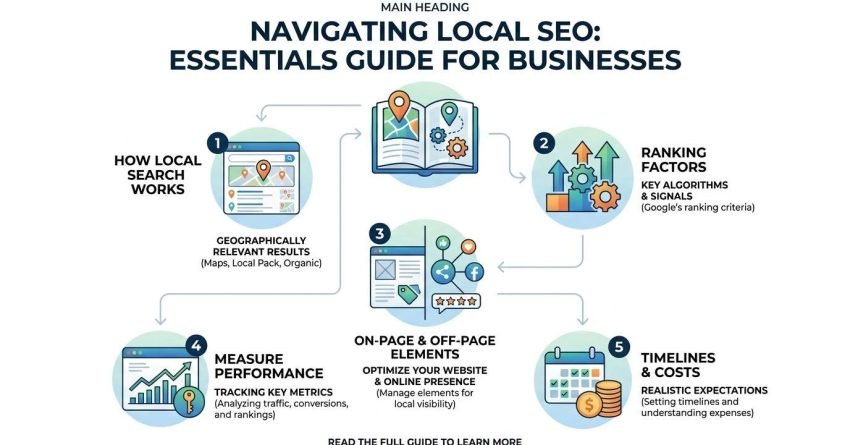
We cover how local search actually works, the ranking factors that matter, the on-page and off-page elements you need to manage, how to measure performance, and what realistic timelines and costs look like. Each section points to a deeper resource where you can go further.
What Is Local SEO and How Does It Work?
Local SEO is a specialized branch of search engine optimization that helps businesses rank in location-based search results tied to a specific city, region, or “near me” query. It exists because Google treats local intent differently than general informational or transactional searches.
I think of local SEO as running on three pillars: relevance, distance, and prominence. These three factors form the backbone of the Google Local Algorithm, which decides which businesses appear in the Local Pack for any given search.
Relevance measures how well a business profile matches what someone searched for. Distance measures physical proximity between the searcher and the business location. Prominence reflects how well-known and well-reviewed a business is across the web.
Traditional SEO optimizes for broad organic visibility across any location, while local SEO narrows that focus to a specific geographic radius. A plumber in Austin doesn’t need to rank in Seattle — they need to dominate their own city and surrounding suburbs.
We built this guide around that distinction because most business owners conflate the two and end up optimizing for the wrong outcome entirely.
What makes local SEO different from traditional SEO?
Local SEO targets geographically-bound search intent, while traditional SEO targets broad topical visibility regardless of location. Local SEO relies heavily on Google Business Profile signals, proximity, and localized citations that traditional SEO doesn’t weight as heavily.
What role does the Google Local Algorithm play?
The Google Local Algorithm determines which businesses appear in the Local Pack based on relevance, distance, and prominence. It pulls signals from Google Business Profile data, review volume, citation consistency, and on-page location signals.
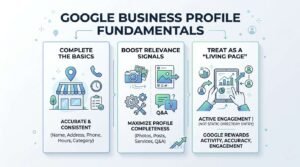
Google Business Profile is the free business listing tool that powers a company’s appearance in Google Maps, the Local Pack, and localized search results. A complete, accurate, and actively managed profile is the single highest-leverage asset in local SEO.
I always start local SEO audits here because a weak or incomplete profile undermines everything else. The basics business name, address, phone number, hours, and category need to be accurate and consistent everywhere they appear online.
Profile completeness directly affects visibility. A Google Business Profile study by Whitespark found that primary category selection is one of the top three ranking factors in the Local Pack algorithm, alongside proximity and review signals.
Photos, posts, services listed, and Q&A sections all contribute additional relevance signals. Businesses that update their profile regularly tend to outperform those that set it up once and never return.
I recommend treating your profile like a living page rather than a static directory entry. Google rewards activity, accuracy, and engagement over profiles that sit dormant for years.
What information belongs on a Google Business Profile?
A Google Business Profile needs an accurate business name, complete address, local phone number, correct business category, hours of operation, website URL, and a detailed business description. Photos and service listings strengthen the profile further.
How does profile completeness affect rankings?
Profile completeness directly influences relevance scoring in Google’s local algorithm. Incomplete profiles miss ranking signals that competitors with fully optimized listings capture, putting incomplete businesses at a competitive disadvantage from the start.
Local Search Ranking Factors
Local search ranking factors are the specific signals Google uses to determine which businesses appear in local search results, grouped broadly into relevance, distance, and prominence categories. Understanding these factors helps businesses prioritize where to focus limited time and budget.
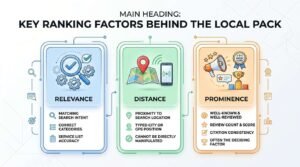
Proximity carries enormous weight in local results, and it’s the one factor businesses can’t fully control since it depends on where the searcher is standing. But prominence signals like review count, review quality, and overall web authority are fully within a business’s control.
| Ranking Factor Category | What It Measures | Business Control Level |
| Relevance | Match between profile and search query | High |
| Distance | Physical proximity to searcher | None |
| Prominence | Reviews, citations, backlinks, authority | High |
This table shows why most local SEO strategy focuses on relevance and prominence; they’re the levers a business can actually pull. Distance is fixed unless a business opens a new location.
A 2024 Whitespark local ranking factors survey found that Google Business Profile signals account for roughly 32% of ranking weight, more than any other category measured.
How much does proximity affect rankings?
Proximity affects rankings by determining which nearby businesses Google considers eligible for a given search, and it can override other ranking signals entirely. A business three miles away often outranks a stronger profile ten miles away.
What is prominence in local search?
Prominence refers to how well-known and well-reviewed a business is, both online and offline. Google measures it through review volume, review scores, backlink authority, and general brand mentions across the web.
On-Page Local SEO Elements
On-page local SEO refers to the optimization of a website’s actual page titles, content, schema markup, and internal structure — to signal geographic relevance to search engines. This work happens directly on the website, separate from the Google Business Profile.
![Infographic titled ON-PAGE LOCAL SEO TERMS illustrating how Local Keywords & Geo-Modifiers (SERVICE TERM + [CITY NAME]) branch into three core on-page elements: Optimized Title Tags (PRIMARY KEYWORD | [GEOGRAPHIC AREA]), Dedicated Location Pages targeting a specific area map, and Local Landing Pages featuring conversion funnels.](https://whitelabelseoservice.com/wp-content/uploads/2026/09/On-Page-Local-SEO-Terms-300x167.jpg)
NAP consistency, meaning the business Name, Address, and Phone number match exactly across the website and every external listing, remains one of the most overlooked on-page factors. Even small discrepancies, like “St.” versus “Street,” can dilute trust signals.
Local business schema markup helps search engines parse address and service-area data programmatically. Title tags and headers that include city or neighborhood names, when done naturally, also reinforce geographic relevance.
What is NAP consistency?
NAP consistency means a business’s Name, Address, and Phone number appear identically across the website, Google Business Profile, and every directory listing. Inconsistent NAP data confuses search engines and can suppress local rankings.
Local Citations and Directory Listings
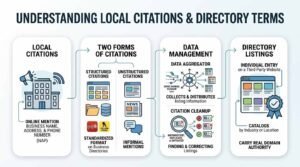
A local citation is any online mention of a business’s name, address, and phone number, typically found on directories, review sites, and industry-specific platforms. Citations reinforce the legitimacy and prominence signals search engines use to rank local businesses.
Data aggregators like Data Axle and Foursquare distribute business information to dozens of smaller directories, which makes cleaning up citation data at the source highly efficient. Industry-specific directories, chambers of commerce, and local business associations round out a strong citation profile.
I prioritize accuracy over volume every time. A handful of clean, consistent citations on high-authority directories outperforms fifty citations scattered across low-quality sites with mismatched information.
Which directories matter most for local citations?
Google Business Profile, Bing Places, Apple Maps, Yelp, and major data aggregators like Data Axle matter most for local citations. Industry-specific directories add additional relevance depending on the business category.
Online Reviews and Reputation Management
Online reviews are customer-generated ratings and feedback posted to platforms like Google, Yelp, and Facebook, and they directly influence both prominence rankings and consumer purchase decisions. Review volume, recency, and average rating all factor into local search visibility.
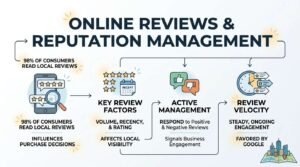
A BrightLocal consumer review survey found that 98% of consumers read online reviews for local businesses in 2024, making review management inseparable from local SEO strategy.
Responding to reviews, both positive and negative, signals active business management to both customers and search algorithms. Businesses that ignore negative reviews often see reputation damage compound over time, while thoughtful responses can rebuild trust with prospective customers reading later.
Review velocity, meaning how consistently new reviews come in over time, matters more than a single burst of reviews. Google favors businesses showing steady, ongoing customer engagement.
How do reviews influence local rankings?
Reviews influence local rankings through volume, average rating, recency, and keyword content within the reviews themselves. Higher review counts and consistent positive sentiment strengthen prominence signals in Google’s local algorithm.
How should businesses respond to negative reviews?
Businesses should respond to negative reviews promptly, acknowledge the customer’s concern, and offer a resolution path without becoming defensive. A calm, professional response often matters more to future customers than the original complaint.
Local Link Building Strategies
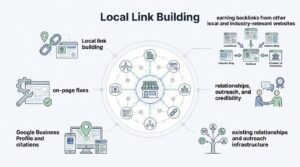
Local link building is the process of earning backlinks from other websites within a specific geographic region or local industry network to strengthen a business’s authority and relevance signals. Local links carry extra weight because they reinforce geographic relevance alongside general domain authority.
Sponsorships of local events, partnerships with complementary local businesses, and mentions from local news outlets all generate the kind of local link building opportunities that generic outreach campaigns miss entirely.
What types of local backlinks carry the most value?
Backlinks from local news outlets, chambers of commerce, and industry-specific local directories carry the most value. These sources combine geographic relevance with topical authority, strengthening both trust and rankings simultaneously.
Local Content Marketing and Landing Pages
Local content marketing involves creating web pages and articles tailored to specific service areas or neighborhoods, designed to capture geographically-targeted search intent. Multi-location businesses depend heavily on this content type to avoid competing against their own pages.
A well-built location landing page includes unique content about that specific service area, not a duplicated template with only the city name swapped out. Google penalizes thin, duplicated location content aggressively.
What makes a location page effective?
An effective location page includes unique, locally-relevant content, embedded maps, local testimonials, and location-specific service details. Duplicating the same template across multiple cities weakens rankings for all of them.
Multi-Location and Franchise Local SEO
Multi-location local SEO addresses the unique challenges franchises and businesses with several physical locations face when trying to rank each location independently in local search. Each location typically needs its own Google Business Profile and dedicated landing page.
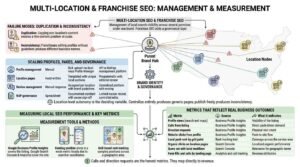
Franchise brands often struggle with duplicate content across location pages and inconsistent NAP data between corporate and franchisee-managed listings. A multi-location SEO strategy needs centralized oversight even when execution happens at the local level.
How many Google Business Profiles does a multi-location business need?
A multi-location business needs one Google Business Profile per physical location, each verified independently. Profiles should never share addresses or attempt to represent multiple locations under one listing.
Local SEO for Mobile and Voice Search
Mobile and voice search optimization ensures local business information is structured and accessible for the growing share of searches conducted through smartphones and voice assistants. Voice queries tend to be longer and more conversational than typed searches.
Structured data and concise, direct answers to common questions improve a business’s odds of being the source a voice assistant reads aloud when someone asks “what’s the best pizza place near me?”
Does voice search require different SEO strategies than text search?
Voice search favors conversational, question-based content and concise, direct answers more than traditional text search does. Structured data and FAQ-style content improve a business’s chances of being selected as the spoken answer.
Measuring Local SEO Performance and ROI
Measuring local SEO performance means tracking specific metrics like Local Pack rankings, Google Business Profile views, and phone calls generated to determine whether local SEO investment is producing business results. Vanity metrics like impressions matter less than conversion-focused data.
| Metric | What It Tells You | Where to Track It |
| Local Pack ranking position | Visibility for target keywords | Rank tracking tools |
| GBP calls and direction requests | Direct conversion actions | Google Business Profile Insights |
| Organic local traffic | Website visibility from local search | Google Analytics |
| Review growth rate | Ongoing prominence signal strength | Review monitoring tools |
This table outlines the core metrics worth tracking monthly. Businesses that only watch keyword rankings miss the calls, direction requests, and website clicks that Google Business Profile Insights tracks directly, and those actions often correlate more closely with revenue than ranking position alone.
What local SEO metrics matter most?
Local Pack ranking position, Google Business Profile actions like calls and direction requests, and organic local traffic matter most. These metrics connect directly to business outcomes rather than vanity visibility numbers.
Local SEO Timelines and Realistic Expectations
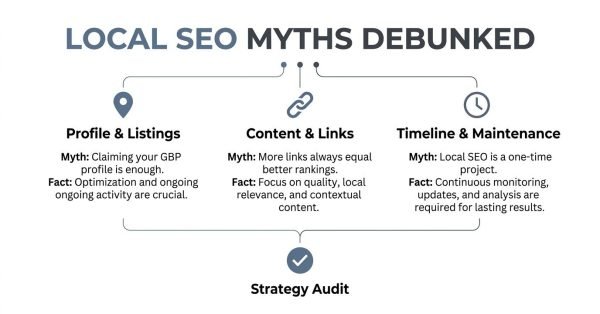
Local SEO typically takes three to six months to show measurable ranking improvements, though competitive markets can extend that timeline to nine months or more. Businesses expecting overnight results usually end up disappointed or vulnerable to short-term tactics that risk penalties.
An Ahrefs study of ranking timelines found that even well-optimized pages rarely crack the top 10 organic results in under three months, and local competitive dynamics add further variability. Newer businesses with no citation history or reviews generally take longer than established businesses simply refreshing their existing presence.
I set expectations early with every client because underestimating timelines leads to premature strategy changes that reset progress. Local SEO compounds: early months focus on foundational fixes, while later months show the visible ranking movement.
How long does local SEO take to show results?
Local SEO typically shows initial ranking movement within three to six months, with more competitive markets taking longer. Foundational work like citation cleanup and profile optimization happens first, and ranking gains follow afterward.
Common Local SEO Mistakes and Penalties
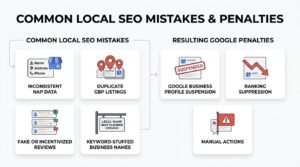
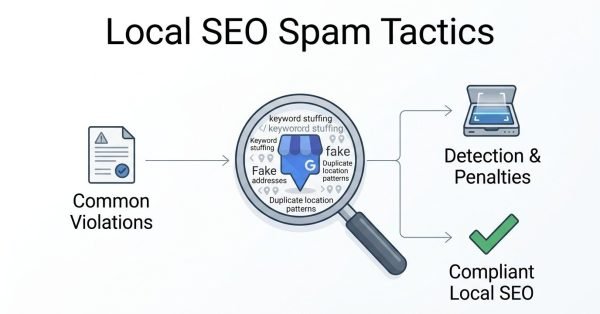
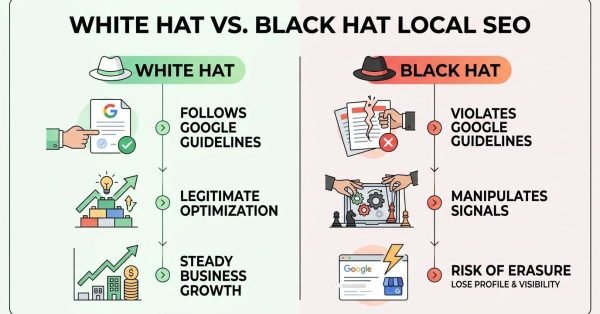
Common local SEO mistakes include inconsistent NAP data, duplicate Google Business Profile listings, fake reviews, and keyword-stuffed business names, all of which risk suppression or penalties from Google. These errors often stem from rushed setup or outdated agency practices.
Keyword stuffing a business name, like adding “Best Plumber Chicago” to a legal business name, violates Google Business Profile guidelines and can result in profile suspension.
What are the most common local SEO penalties?
The most common local SEO penalties include Google Business Profile suspension for guideline violations, ranking suppression from duplicate listings, and manual actions triggered by fake or incentivized reviews.
Choosing a Local SEO Service Provider
Choosing a local SEO service provider means evaluating an agency’s transparency, reporting practices, and track record with businesses in similar industries or markets. The right provider explains their strategy clearly rather than hiding behind vague promises of guaranteed rankings.
I always tell business owners to ask for case studies, request sample reporting dashboards, and confirm whether the agency follows Google’s guidelines rather than using shortcuts that risk penalties.
What questions should I ask a local SEO provider before hiring them?
Ask about reporting frequency, case studies from similar businesses, and whether they follow Google’s Business Profile guidelines. Avoid any provider guaranteeing specific rankings, since no legitimate provider controls Google’s algorithm.
Local SEO Costs and Pricing Models
Local SEO pricing typically ranges from $300 to $2,000 per month depending on business size, competition level, and scope of services included. Larger multi-location businesses or highly competitive markets often exceed this range significantly.
A recent survey of SEO pricing found that most agencies charge between $501 and $1,000 monthly for standard SEO retainers, with local-focused packages often falling at the lower end of that range.
How much does local SEO typically cost?
Local SEO typically costs between $300 and $2,000 per month, depending on business size, market competition, and service scope. Highly competitive metro markets often require higher investment to see comparable results.
Conclusion
Local SEO connects Google Business Profile optimization, on-page signals, citations, reviews, and links into one measurable system. Together, these components determine local visibility.
The broader SEO landscape keeps evolving alongside voice search, AI-driven results, and shifting consumer behavior. Staying current keeps local businesses competitive over time.
We help businesses build this foundation correctly from day one. Partner with White Label SEO Service to turn local visibility into consistent, trackable growth.
Frequently Asked Questions
What is local SEO?
Local SEO is the practice of optimizing a business’s online presence to rank higher in geographically relevant search results. It focuses on Google Business Profile, citations, reviews, and location-based content.
How is local SEO different from regular SEO?
Local SEO targets geographically-bound searches, while regular SEO targets broad topical visibility regardless of location. Local SEO relies more heavily on proximity, citations, and Google Business Profile signals.
Do I need a physical address for local SEO?
Most local SEO strategies require a verifiable physical address to create and verify a Google Business Profile. Service-area businesses without a public address can still qualify using Google’s service-area business settings.
How often should I post on Google Business Profile?
Businesses should post on Google Business Profile at least once or twice monthly to signal active management. More frequent posting during promotions or events can further boost engagement signals.
Can I do local SEO myself without an agency?
Business owners can manage basic local SEO tasks themselves, including profile setup, citation cleanup, and review responses. More competitive markets often benefit from professional expertise to manage technical and link-building components.
Does local SEO work for online-only businesses?
Local SEO primarily benefits businesses with physical locations or defined service areas. Online-only businesses without geographic service boundaries typically see more value from broader national SEO strategies instead.
How do I know if my local SEO strategy is working?
Track Local Pack ranking positions, Google Business Profile actions, and organic local traffic over three- to six-month periods. Consistent upward movement across these metrics indicates an effective strategy.