Local SEO is the practice of optimizing a business’s online presence to rank higher in geographically relevant search results, and it directly determines whether nearby customers find you or a competitor. I’ve watched business owners waste entire marketing budgets chasing tactics that stopped working years ago. Most of what people believe about local SEO today is outdated, oversimplified, or flat-out wrong.
These misconceptions don’t just waste time. They actively push real customers toward competitors who understand what actually works.
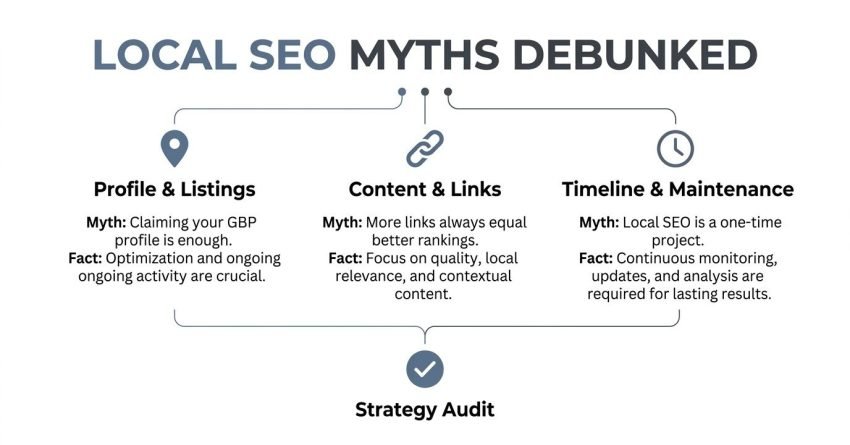
This guide breaks down the most damaging myths in three groups: profile and listing misconceptions, content and link myths, and timeline and maintenance misunderstandings. We’ll also show you how to audit your own strategy against reality.
What Local SEO Actually Is (And Why Myths Spread So Easily)
Local SEO is a specialized branch of search engine optimization that helps businesses rank in location-based searches, such as “near me” queries and map pack results. It relies on three core factors: proximity, relevance, and prominence.
I see the confusion start here because local SEO changes faster than general SEO. Google updates its local algorithm frequently, and tactics that worked in 2019 often backfire now.
Local search results also vary by device, location, and even time of day, which makes it easy for someone to test something once, see it “work,” and turn that anecdote into a rule. That’s how most of these myths get started and spread.
Why Local Search Results Change So Often
Google’s local algorithm weighs real-time signals like business hours, review recency, and mobile user behavior. I’ve seen rankings shift within the same week a competitor updates their profile or earns a batch of new reviews.
This volatility is exactly why static “set it and forget it” advice fails so often in local search.
Myth 1: “Google My Business Is All You Need for Local SEO”
A complete Google Business Profile helps local rankings, but it is only one input among many ranking signals search engines evaluate together. I still meet business owners who filled out their profile once, years ago, and assumed the job was done.
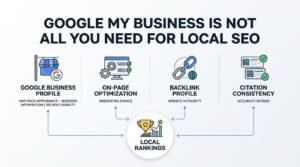
Your website’s on-page optimization, backlink profile, and citation consistency all carry weight too. A Google Business Profile without a properly optimized website behind it rarely sustains top rankings.
Google Business Profile is a free business listing tool that controls how a company appears in Google Maps and local search results. Treating it as the entire strategy ignores everything else search engines evaluate.
What a Google Business Profile Actually Controls
The profile controls your map pack appearance, business information display, and review visibility. It does not control your website’s organic rankings, page-level relevance, or backlink authority.
I always tell clients to think of it as the storefront sign, not the entire store.
Myth 2: “Keyword Stuffing Your City Name Boosts Rankings”
Repeating a city name throughout website content does not improve local rankings and can trigger spam filters that suppress visibility instead. Search engines identify location relevance through structured signals, not keyword repetition.
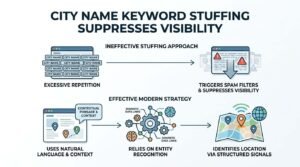
I’ve audited sites where every page title, heading, and paragraph crammed in the city name, and rankings were worse than competitors using natural language once or twice per page.
Modern search engines rely on entity recognition and contextual relevance to understand where a business operates, which makes forced repetition unnecessary and often counterproductive.
How Google Detects Location Relevance Instead
Google cross-references your Google Business Profile address, website schema markup, and citation data across the web to confirm your service area. Consistent, accurate business information across these sources matters far more than keyword density.
A single well-placed local landmark reference or service-area mention does more work than ten repeated city names.
Myth 3: “More Directory Listings Always Mean Better Rankings”
Submitting a business to dozens of low-quality directories does not improve rankings and can actively harm them when listing information is inconsistent. Citation quality outweighs citation quantity in nearly every case I’ve reviewed.
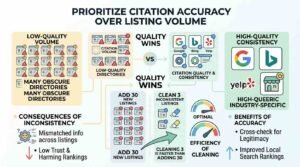
Search engines cross-check your business name, address, and phone number across directories to verify legitimacy. Mismatched information across even a handful of listings creates confusion that search algorithms interpret as a trust signal problem.
Citation Consistency vs. Citation Volume
I prioritize accuracy on 15-20 authoritative directories over submitting to 200 obscure ones. Moz’s local search ranking factors study consistently ranks citation consistency above citation volume as a ranking influence.
Cleaning up three inconsistent listings often moves the needle faster than adding thirty new ones.
Myth 4: “Reviews Don’t Affect Local Rankings, Only Reputation”
Customer reviews directly influence local search rankings and are treated as a core ranking signal by Google’s local algorithm, not just a trust indicator for shoppers. Review count, recency, and rating all factor into how prominently a business appears.
I’ve watched businesses jump several map pack positions after a concentrated review campaign, with no other changes made to their SEO. That correlation is too consistent across clients to dismiss as coincidence.
BrightLocal’s 2024 consumer review survey found that 98% of consumers read online reviews for local businesses, and Google factors that same engagement data into ranking calculations.
How Review Signals Feed Local Ranking Algorithms
Google evaluates review velocity (how often new reviews arrive), review diversity (different reviewers over time), and keyword content within reviews themselves. A business earning steady, detailed reviews signals ongoing legitimacy and customer engagement.
Responding to reviews, both positive and negative, adds another layer of engagement signal that inactive competitors miss entirely.
Myth 5: “You Only Need to Optimize for One Location Page”
Businesses serving multiple areas need dedicated location pages for each service area, because a single page cannot rank for distinct geographic searches. I’ve seen multi-location businesses stall out for years relying on one generic “service area” page.
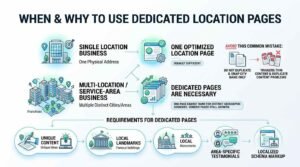
Each location page should include unique content, local landmarks, area-specific testimonials, and localized schema markup. Duplicating the same page with only the city name swapped triggers thin content and duplicate content problems instead of solving them.
When Multi-Location Pages Are Actually Necessary
A single-location business with one physical address rarely needs more than one optimized location page. Multi-location businesses, franchises, and service-area businesses covering several distinct cities are the cases where dedicated pages become necessary.
The threshold I use: if a competitor could realistically outrank you in a specific city because they have a dedicated page and you don’t, you need one too.
Myth 6: “Local SEO Results Happen Within Weeks”
Local SEO typically takes four to six months to produce measurable ranking improvements, and competitive markets can take longer. I set this expectation with every new client because underestimating timelines leads to premature strategy changes that reset progress.
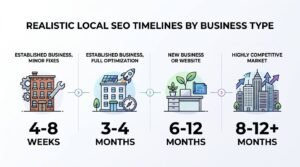
New websites or profiles with no existing authority take longer than established businesses making targeted improvements. Google needs time to crawl changes, gather user engagement data, and reassess your standing against competitors.
Realistic Local SEO Timelines by Business Type
| Business Situation | Typical Timeline to Meaningful Results |
| Established business, minor fixes | 4-8 weeks |
| Established business, full optimization | 3-4 months |
| New business or new website | 6-12 months |
| Highly competitive market (legal, medical) | 8-12+ months |
I’ve found that businesses who understand this table upfront stick with their strategy long enough to see it work.
Myth 7: “Backlinks Don’t Matter for Local Search”
Backlinks remain a significant local ranking factor, and locally relevant links from community organizations, local news sites, and industry partners carry particular weight. I regularly see businesses with strong on-page optimization stall in rankings simply because they have no meaningful backlink profile.
A link from a local chamber of commerce or a regional news feature often outperforms a generic national directory link for local ranking purposes.
The Role of Local and Industry-Relevant Links
Sponsoring a local event, partnering with complementary businesses for cross-promotion, and getting featured in local press all generate the kind of contextually relevant links that strengthen local prominence.
Industry-specific links matter too. A plumbing company earning a link from a trade association signals relevance that a random guest post never will.
Myth 8: “Mobile Optimization Is Optional for Local Businesses”
Mobile optimization is a required ranking factor for local search, since Google uses mobile-first indexing to evaluate and rank virtually all websites. I’ve audited sites losing map pack positions purely because their mobile load times exceeded five seconds.
Most local searches, especially “near me” queries, happen on mobile devices while someone is actively looking for a business to visit or call.
How Mobile Experience Ties to Local Ranking Signals
Slow mobile pages increase bounce rates, and high bounce rates signal poor user experience to search algorithms. Click-to-call buttons, mobile-friendly navigation, and fast load speeds all support the engagement metrics that feed local rankings.
I treat mobile page speed as a non-negotiable baseline, not an optional enhancement, for any local SEO strategy.
Myth 9: “Social Media Activity Directly Improves Local Rankings”
Social media activity does not directly influence local search rankings, since Google has confirmed social signals are not a direct ranking factor. I still hear agencies pitch social posting as a core local SEO tactic, which misrepresents what social media actually contributes.
Social profiles can appear in search results and support brand visibility, but posting frequency itself doesn’t move map pack positions.
What Social Signals Actually Influence
Social media drives brand awareness, website traffic, and occasionally generates the kind of engagement that indirectly leads to reviews or backlinks. Those downstream effects matter, but the mechanism is indirect, not a direct ranking input.
I recommend treating social media as a complementary channel that supports local SEO goals rather than a replacement for on-page and citation work.
Myth 10: “Once You Rank, You Can Stop Optimizing”
Local rankings require continuous maintenance because competitors, algorithm updates, and changing customer behavior constantly shift the ranking landscape. I’ve seen businesses lose top positions within months of abandoning their local SEO efforts entirely.
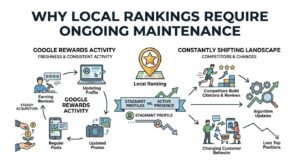
A competitor who starts actively building citations, earning reviews, and updating their profile will eventually overtake a business that stopped maintaining its presence.
Why Local Rankings Require Ongoing Maintenance
Google’s algorithm rewards freshness and consistent activity. Profiles with regular posts, updated photos, and steady review acquisition outperform stagnant ones over time, even if the stagnant profile ranked well previously.
Treating local SEO as a one-time project rather than an ongoing process is one of the most expensive mistakes I see repeated across industries.
The Real Local SEO Ranking Factors That Matter
Google’s local ranking algorithm weighs three primary factors: proximity, relevance, and prominence, according to Google’s own local search documentation. Understanding these three factors makes it much easier to spot which advice is myth and which is grounded in how rankings actually work.
Proximity measures the physical distance between the searcher and the business. Relevance measures how well a business profile and website match what the searcher is looking for.
Proximity, Relevance, and Prominence Explained
Prominence reflects how well-known and well-regarded a business is, based on reviews, backlinks, citations, and overall online presence. A business can’t control proximity, but relevance and prominence are both directly influenced by the strategy choices covered throughout this guide.
Every myth debunked above ultimately traces back to a misunderstanding of one of these three pillars.
How to Audit Your Business for These Local SEO Myths
A local SEO audit starts by checking whether your current strategy relies on any of the ten myths covered in this guide, since eliminating bad practices often matters more than adding new ones. I walk every new client through this same process before building a forward strategy.
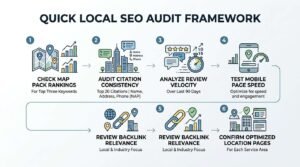
Start with your Google Business Profile completeness, then review citation consistency, review velocity, mobile page speed, and backlink quality in that order.
A Quick Self-Check Framework
- Pull your current map pack rankings for your top three keywords
- Audit your top 20 citations for name, address, and phone number consistency
- Check your review velocity over the last 90 days
- Test your website’s mobile page speed
- Review your backlink profile for local and industry relevance
- Confirm each service area has its own optimized location page
Running through these six steps typically reveals which myths have quietly shaped your existing strategy.
Signs Your Local SEO Strategy Needs Professional Help
A local SEO strategy needs professional intervention when rankings plateau despite consistent effort, or when a business lacks the internal resources to track algorithm changes. I see this most often in businesses juggling day-to-day operations with no time left for ongoing optimization.
Other signs include declining review velocity, inconsistent citations across dozens of directories, or a website that hasn’t been technically audited in over a year.
If your business is showing two or more of these signs, the cost of inaction usually exceeds the cost of getting expert support.
Conclusion
Local SEO succeeds through proximity, relevance, and prominence working together, not through shortcuts or outdated tricks. The ten myths above cost real businesses, real customers every single day.
We’ve covered what actually drives local rankings, and the deeper strategy resources in this cluster expand on each factor. Local search keeps evolving, and staying informed keeps you ahead of competitors who don’t.
We built White Label SEO Service to help businesses cut through this confusion daily. Let’s build a local SEO strategy grounded in what actually works.
Frequently Asked Questions
How long does local SEO take to show results?
Local SEO typically takes four to six months to show measurable ranking improvements. Competitive industries and new websites often take longer to build enough authority.
Does Google Business Profile alone guarantee local rankings?
No, a Google Business Profile alone does not guarantee local rankings. Website optimization, citations, and backlinks all contribute alongside your profile.
Do online reviews really affect local search rankings?
Yes, online reviews directly influence local search rankings as a core Google ranking signal. Review count, recency, and response activity all factor into visibility.
Is keyword stuffing city names still effective for local SEO?
No, keyword stuffing city names is not effective and can trigger spam filters. Search engines identify location relevance through structured data instead.
How many business directory listings do I actually need?
Focus on 15-20 authoritative, consistent directory listings rather than dozens of low-quality ones. Consistency matters more than sheer volume.
Does social media activity improve local search rankings?
No, social media activity does not directly improve local search rankings. It indirectly supports SEO through brand visibility and occasional review or link generation.
Can I stop optimizing once my business ranks locally?
No, local rankings require ongoing maintenance to defend against competitors and algorithm changes. Businesses that stop optimizing typically lose positions within months.