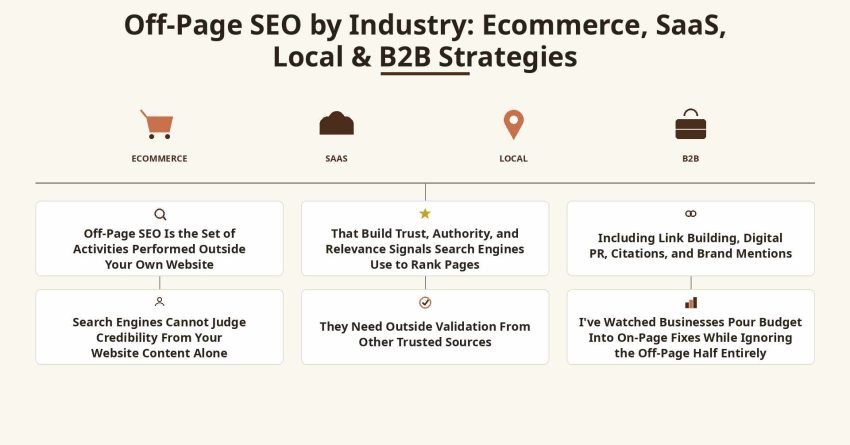
Off-page SEO is the set of activities performed outside your own website that build trust, authority, and relevance signals search engines use to rank pages, including link building, digital PR, citations, and brand mentions. It matters because search engines cannot judge credibility from your website content alone. They need outside validation from other trusted sources.
I’ve watched businesses pour budget into on-page fixes while ignoring the off-page half of the equation entirely. That gap usually shows up as flat rankings despite strong content, and it costs real revenue over time.
This guide covers how off-page SEO ranking factors actually work, what strategy looks like across ecommerce, SaaS, local, and B2B models, the core tactics that span every industry, and how to measure results and set realistic timelines.
What Off-Page SEO Means Beyond Link Building
Off-page SEO is a broader category than link building alone, encompassing brand mentions, digital PR, social proof, and citation consistency across the web. Links remain the strongest individual signal, but they’re one input among several that search engines weigh together.
I think the “off-page equals backlinks” shorthand causes a lot of wasted effort. A brand mentioned repeatedly in industry press without a single link still builds measurable topical trust.
Every industry generates these signals differently. An ecommerce store earns mentions through product reviews, a SaaS company earns them through comparison articles, and a local business earns them through community press.
Links, Mentions, and Digital PR as Trust Signals
A backlink passes direct authority, while a brand mention without a link still signals relevance when it appears near topically related content. Search engines increasingly treat unlinked mentions as a weaker but real trust signal, particularly when the mentioning site has its own established authority.
Digital PR sits above both because it generates mentions and links simultaneously through earned media coverage. A single strong placement in a trade publication can outperform months of manual outreach.
Why Off-Page Signals Vary by Industry Model
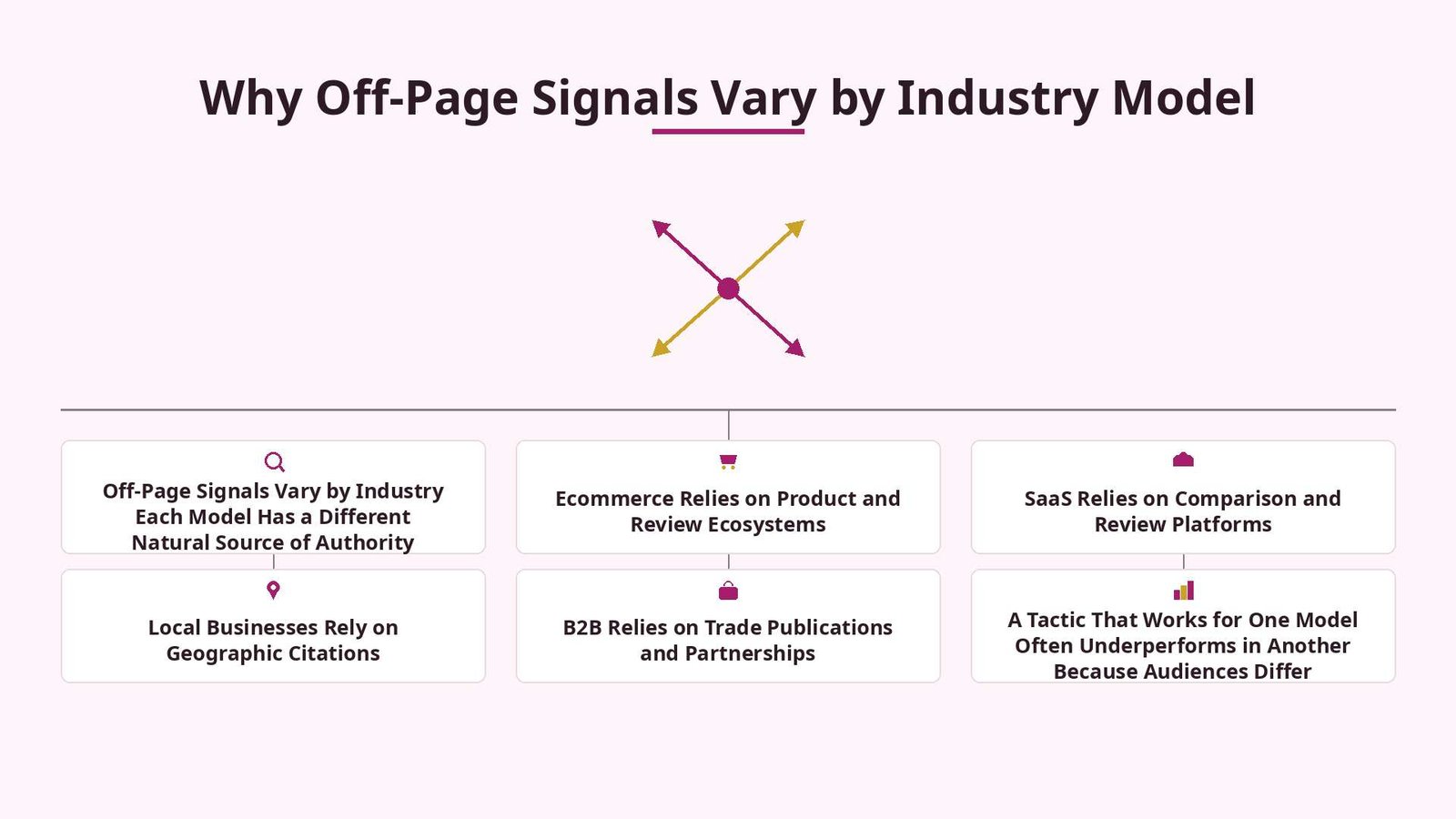
Off-page SEO signals vary by industry because each business model has a different natural source of authority: ecommerce relies on product and review ecosystems, SaaS relies on comparison and review platforms, local businesses rely on geographic citations, and B2B relies on trade publications and partnerships. A tactic that works well for one model often underperforms in another because the audience and content ecosystem differ.
I’ve seen agencies apply the same outreach template across every client regardless of industry, and it shows in the backlink profile, generic, low-relevance, and slow to move rankings.
How Off-Page SEO Ranking Factors Actually Work
Off-page ranking factors work by signaling to search engines that other credible sources on the web vouch for your site’s relevance and trustworthiness on a given topic. The strength of that signal depends on the linking site’s own authority, topical relevance, and how naturally the link fits its context.
Quantity still matters less than most people assume. A single link from a highly relevant, high-authority domain can outweigh dozens of weak, unrelated ones.
Domain Authority, Relevance, and Link Equity
Link equity is the ranking value passed from one page to another through a hyperlink, and it’s influenced by the linking domain’s authority, the topical relevance between the two pages, and the link’s placement within the content. A link buried in a footer passes less equity than one placed naturally within an article’s body.
Relevance often matters more than raw authority scores. A mid-authority site in your exact niche frequently outperforms a high-authority general site with no topical connection.
E-E-A-T and Off-Page Trust Building
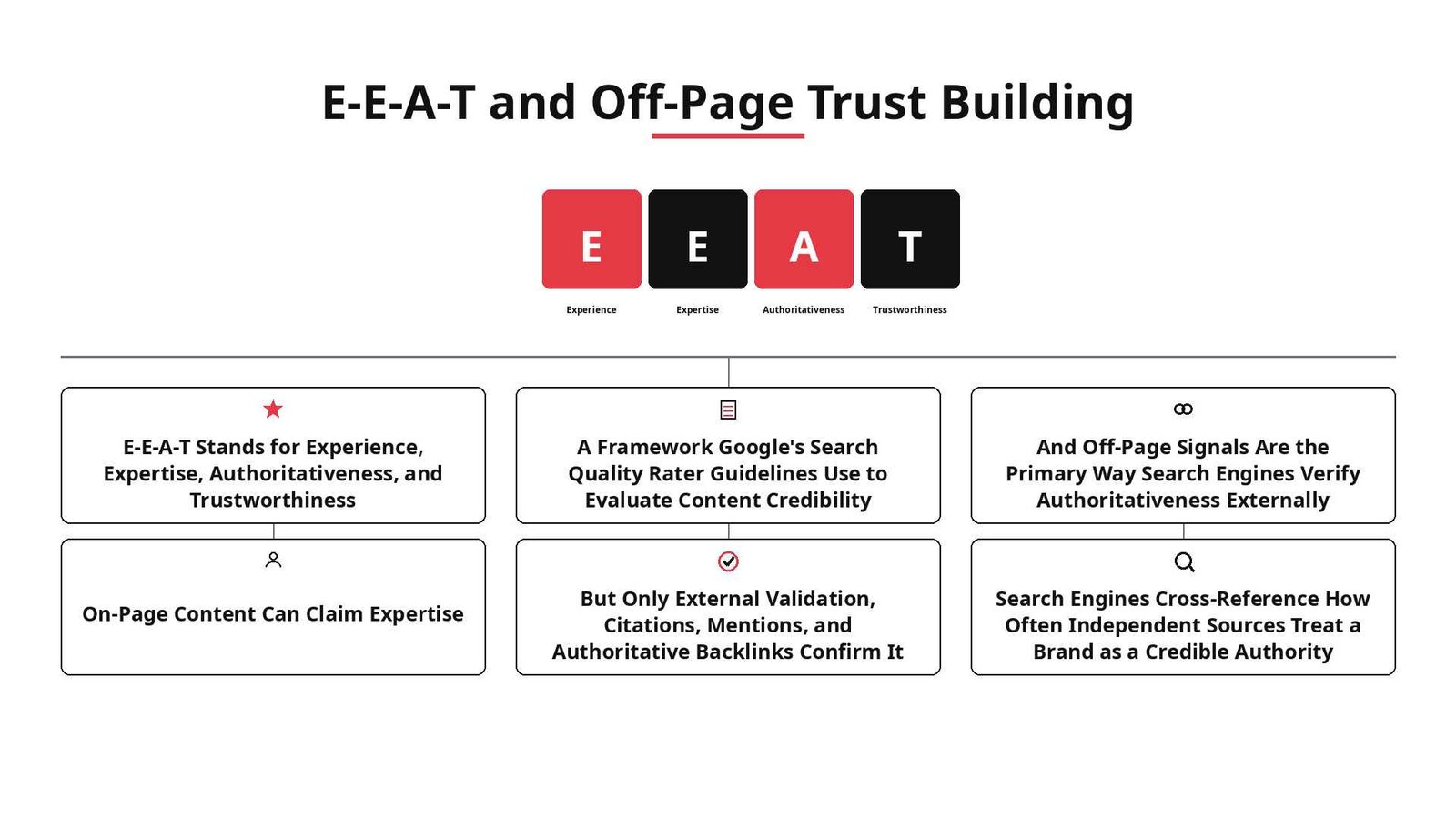
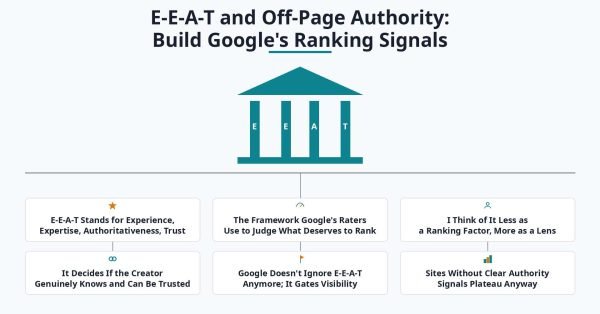
E-E-A-T stands for Experience, Expertise, Authoritativeness, and Trustworthiness, a framework Google’s Search Quality Rater Guidelines use to evaluate content credibility, and off-page signals are the primary way search engines verify authoritativeness externally. On-page content can claim expertise, but only external validation, citations, mentions, authoritative backlinks, confirms it.
This is where E-E-A-T signals become measurable rather than theoretical, since search engines cross-reference how often independent sources treat a brand as a credible authority on its subject.
Off-Page SEO for Ecommerce Brands
Ecommerce off-page SEO centers on product-driven authority signals, reviews, affiliate mentions, and seasonal press coverage, rather than the editorial link building common in content-heavy industries. Product pages rarely earn links organically, which makes structured outreach and partnerships essential.
I’ve found ecommerce clients get the fastest wins from review site placements and affiliate relationships rather than traditional guest posting, simply because the content ecosystem around products is different from the one around ideas.
Product-Led Link Building and Affiliate Partnerships
Affiliate partnerships generate off-page value for ecommerce sites by placing product links on content sites that already rank for commercial, buyer-intent keywords. These partnerships work because the affiliate site has an existing incentive, commission, to maintain and promote the link long-term.
Product-led link building also includes supplying samples to niche reviewers and bloggers in exchange for honest coverage, which tends to produce more durable links than one-off guest posts.
Digital PR for Product Launches and Seasonal Campaigns
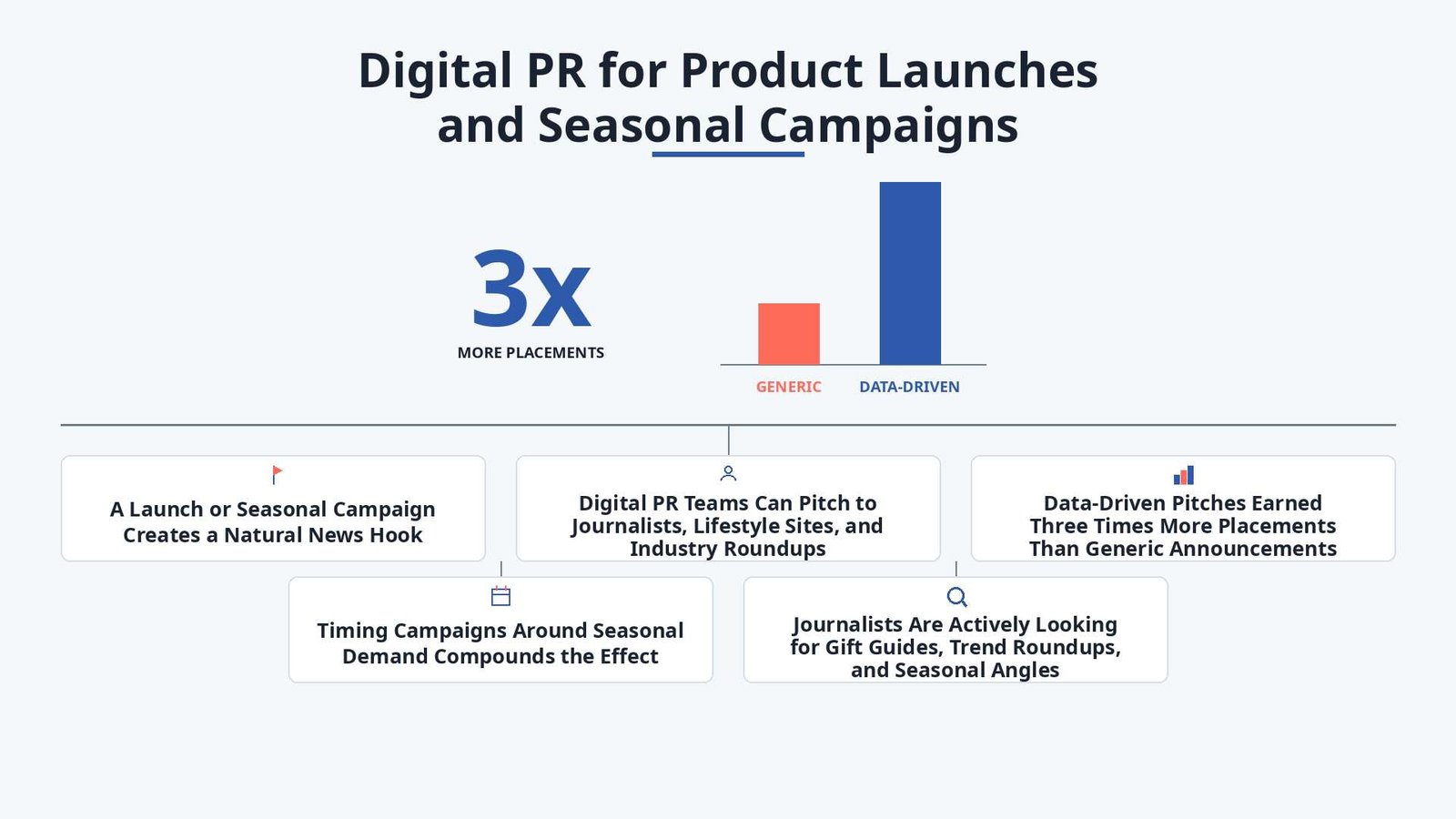
A product launch or seasonal campaign creates a natural news hook that digital PR teams can pitch to journalists, lifestyle sites, and industry roundups seeking timely content. A 2024 Ahrefs study of digital PR campaigns found that newsworthy data-driven pitches earned three times more placements than generic product announcements.
Timing these campaigns around seasonal demand compounds the effect, since journalists are actively looking for gift guides, trend roundups, and seasonal angles during those windows.
Off-Page SEO for SaaS Companies
SaaS off-page SEO depends heavily on comparison sites, review platforms, and founder-led content, because software buyers research extensively before purchasing and trust third-party validation over vendor claims. A strong presence on review platforms often influences purchase decisions as much as the product page itself.
I treat review platform management as a core off-page channel for SaaS clients, not an afterthought, because buyers actively search “[product] vs [competitor]” before ever visiting the vendor’s site.
Earning Links Through Comparison and Review Sites
Review platforms generate off-page authority for SaaS companies when the product earns enough verified reviews to rank within comparison grids and category pages that already attract high-intent search traffic. These placements function similarly to earned backlinks because they sit on high-authority domains and drive referral traffic directly to the product.
Actively requesting reviews from satisfied customers, rather than waiting passively, is what separates SaaS companies with strong review profiles from those with thin, outdated listings.
Guest Content and Founder-Led Thought Leadership
Founder-led thought leadership builds off-page authority when the founder or executive team contributes bylined articles, podcast appearances, and expert commentary that search engines and readers associate with the brand. This works particularly well in SaaS because B2B buyers often research the people behind a product, not just the software itself.
Guest content placed on industry publications also tends to earn more durable backlinks than paid placements, since editorial teams maintain those links as part of their own content integrity standards.
Off-Page SEO for Local Businesses
Local off-page SEO relies on geographic trust signals, citations, Google Business Profile activity, and community press, that confirm a business’s physical presence and relevance to a specific area. Search engines weight these signals heavily for any query with local intent.
I’ve seen local businesses outrank larger competitors purely on citation consistency and review volume, proving that off-page local signals can offset a smaller overall domain profile.
Google Business Profile Signals and Local Citations
A Google Business Profile strengthens local off-page signals when it maintains consistent name, address, and phone information across every listing, paired with regular review activity and accurate category selection. Inconsistent information across directories confuses search engines about which business details are authoritative.
Citation accuracy compounds over time, since each additional consistent listing reinforces the same core business data points search engines use to confirm legitimacy.
Community Partnerships and Local Press Coverage
Local press coverage generates off-page authority through mentions on news sites, chamber of commerce pages, and sponsorship acknowledgments that carry strong geographic relevance. These sources rarely compete for the same keywords as the business itself, which makes the link or mention purely beneficial.
Sponsoring a local event or partnering with a community organization often produces a natural backlink from the organization’s own site, something I’ve found far more sustainable than cold outreach to local bloggers.
Off-Page SEO for B2B Companies
B2B off-page SEO depends on industry publications, trade associations, and partner co-marketing rather than consumer-facing press, because the audience and decision-making process are fundamentally different. B2B buying cycles are longer, which means authority signals need to compound over months, not days.
I find B2B clients underestimate how much their existing partner and vendor relationships could be converted into link opportunities if someone simply asked.
Industry Publications and Trade Association Links
Trade association websites and industry publications carry strong topical relevance for B2B companies because their entire readership overlaps with the target buyer. A single mention in a respected trade publication often carries more ranking weight than several links from unrelated general business sites.
Contributing data, surveys, or original research to these publications tends to earn placements more reliably than pitching generic commentary.
Case Studies and Partner Co-Marketing Links
Co-marketing with implementation partners, resellers, or technology integrations creates natural backlink opportunities because both parties benefit from the shared visibility. A joint case study published on a partner’s site typically links back to both companies involved.
This tactic also strengthens the B2B content marketing strategy layer of a broader growth plan, since co-marketed content tends to have a longer shelf life than single-brand content alone.
Link Building Tactics That Work Across Industries
Certain link building tactics perform consistently across ecommerce, SaaS, local, and B2B contexts because they rely on universal principles, relevance, editorial value, and mutual benefit, rather than industry-specific mechanics. Guest posting, broken link building, and resource page outreach fall into this category.
I rely on these tactics as the baseline for any new client regardless of vertical, then layer industry-specific strategies on top once the foundation is in place.
Guest Posting and Editorial Outreach
Guest posting earns a backlink by contributing original content to another site in exchange for an author bio or in-content link, and it remains effective when the host site has genuine topical relevance and an engaged readership. The tactic loses value when used purely for link volume on low-quality, pay-for-post networks.
Editorial outreach extends this by pitching existing content for inclusion in roundups, resource lists, or citations rather than writing something new for every placement.
Broken Link Building and Resource Page Links
Broken link building works by finding dead links on resource and reference pages, then pitching your own relevant content as a replacement, giving the site owner an incentive to fix their page while you earn the link. This tactic scales well because resource pages are curated lists that site owners actively want to keep accurate.
Resource page link building follows a similar logic, identifying pages that already compile links on a topic and pitching inclusion based on genuine value added.
Digital PR and Earned Media Strategy
Digital PR builds off-page authority by generating original, newsworthy content, data studies, surveys, or expert commentary, that journalists and publishers want to cover organically. Unlike manual outreach, digital PR creates a reason for the link to exist beyond the SEO benefit itself.
I treat digital PR as the highest-leverage off-page channel because one successful campaign can generate dozens of placements that would take months to earn through individual outreach.
Newsjacking and Data-Driven Story Pitching
Newsjacking attaches a brand’s expertise or data to a currently trending news story, giving journalists a timely reason to include a quote or reference. A Muck Rack survey of journalists found that 89% prefer pitches tied to a current trend over generic company news.
Data-driven pitching works similarly by packaging original survey or usage data into a story angle that journalists can build an article around, rather than simply announcing a product update.
HARO and Journalist Outreach Platforms
Journalist outreach platforms connect sources with reporters actively seeking expert quotes for stories already in progress, creating a direct path to earned media mentions and links. Response speed matters heavily here, since reporters typically work on tight deadlines and select from the first relevant, well-written responses.
Consistent participation over months tends to outperform sporadic use, since journalists often return to sources who delivered quality quotes previously.
Brand Mentions and Unlinked Citation Recovery
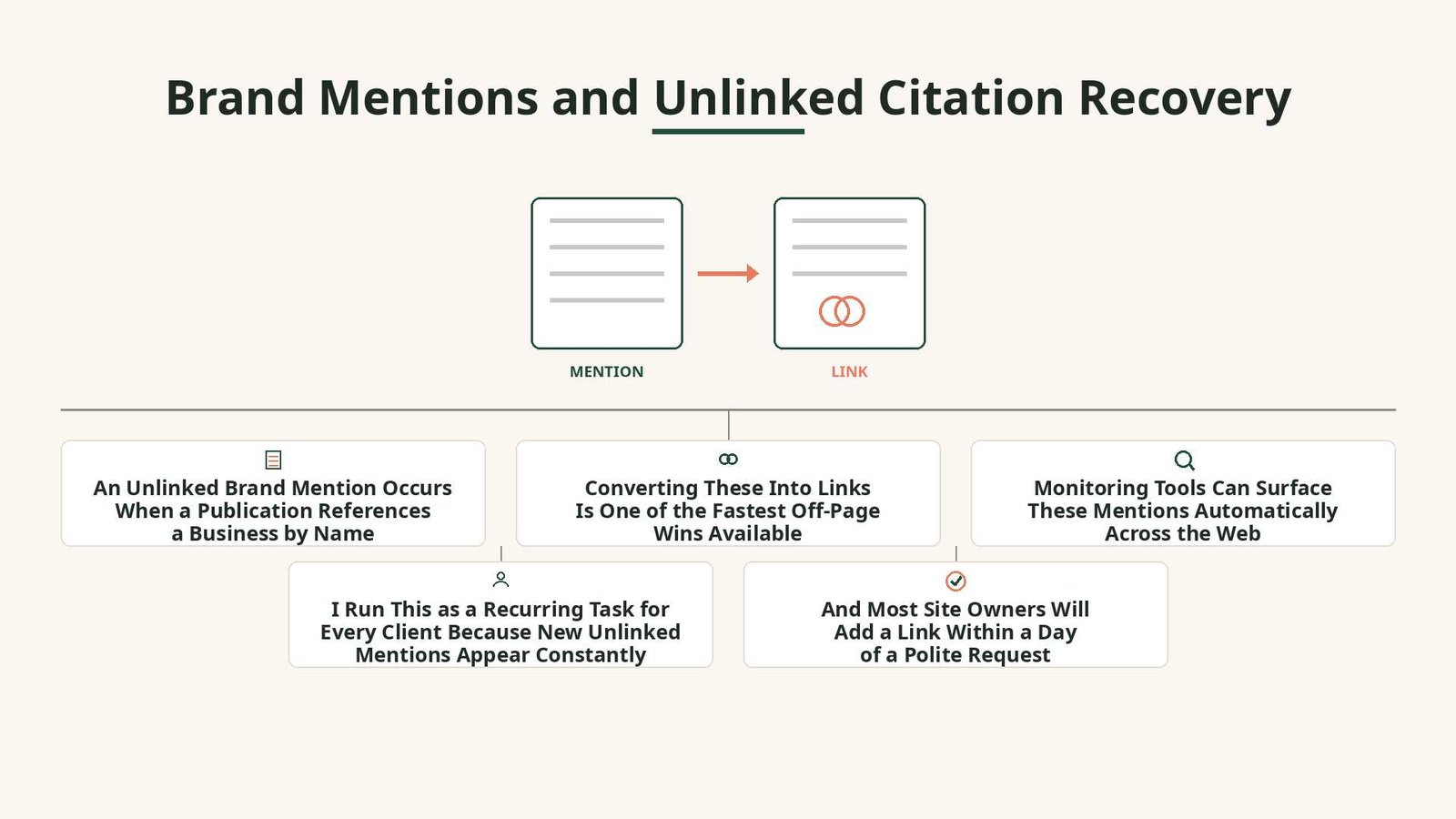
An unlinked brand mention occurs when a publication references a business by name without including a hyperlink, and converting these into links is one of the fastest off-page wins available because the relationship and relevance already exist. Monitoring tools can surface these mentions automatically across the web.
I run this as a recurring task for every client because new unlinked mentions appear constantly, and most site owners will add a link within a day of a polite request.
Social Signals and Off-Page SEO’s Indirect Influence
Social signals do not directly influence search rankings, but they contribute indirectly by increasing content visibility, which raises the likelihood of earning links and mentions from people who discover the content through social sharing. Google has stated publicly that social shares themselves are not a ranking factor.
The indirect pathway still matters in practice, since a widely shared piece of content reaches more potential linkers than one that never circulates beyond the original publish.
Local Citations and NAP Consistency
NAP consistency refers to keeping a business’s name, address, and phone number identical across every directory, map listing, and citation source on the web. Inconsistent NAP data creates confusion that can suppress local ranking performance even when other signals are strong.
Auditing citations quarterly catches the small discrepancies, a missing suite number, an old phone number, that accumulate across dozens of directories over time.
Influencer and Partnership Marketing for Authority Building
Influencer partnerships build off-page authority when the influencer’s own platform carries topical relevance and genuine audience trust, producing mentions and links that function similarly to earned media. This differs from paid advertising because the value comes from perceived authenticity rather than reach alone.
Partnership marketing extends this concept to business-to-business relationships, where co-branded content and shared audiences create natural cross-linking opportunities.
Evaluating Backlink Quality and Avoiding Toxic Links
Backlink quality depends on the linking domain’s relevance, authority, and the naturalness of the link’s placement, while toxic links typically come from spam networks, unrelated foreign-language sites, or paid link schemes flagged by search engines. A single toxic link rarely causes harm, but a pattern of them can trigger manual review.
I audit backlink profiles quarterly for any client running active outreach, since low-quality link vendors sometimes deliver exactly the kind of spam links that create long-term risk.
How to Measure Off-Page SEO Performance
Off-page SEO performance is measured primarily through referring domain growth, domain rating changes, and the resulting organic traffic lift to linked and related pages. These metrics should be tracked together, since referring domains alone don’t confirm whether the links are actually driving ranking improvement.
I pull this data monthly rather than weekly, because off-page signals compound slowly and short-term fluctuations rarely reflect real progress.
Key Metrics: Referring Domains, DR, and Traffic Lift
Referring domains count the number of unique websites linking to a site, and this metric matters more than total backlink count because ten links from ten different domains carry more weight than fifty links from one domain. Domain rating estimates a site’s overall link authority on a logarithmic scale, making it a useful shorthand for tracking authority growth over time.
Traffic lift ties both metrics back to business outcomes by showing whether newly acquired links correlate with increased organic visits to the pages they point to.
Off-Page SEO Timelines and Realistic Expectations
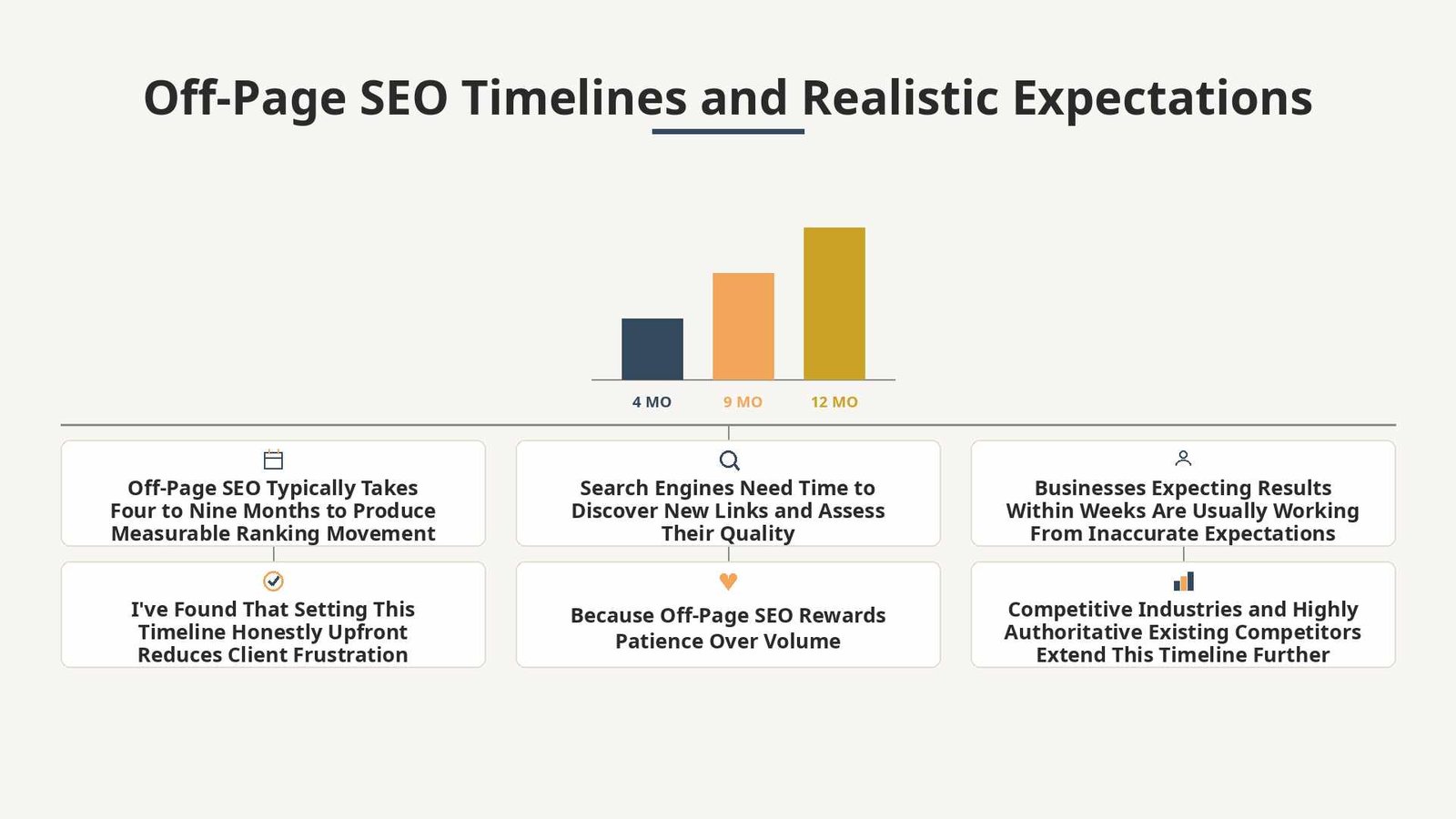
Off-page SEO typically takes four to nine months to produce measurable ranking movement, since search engines need time to discover new links, assess their quality, and factor them into existing rankings. Businesses expecting results within a few weeks are usually working from inaccurate expectations set by low-quality vendors.
I’ve found that setting this timeline honestly upfront reduces client frustration far more than any individual tactic, because off-page SEO rewards patience over volume.
Competitive industries and highly authoritative existing competitors extend this timeline further, sometimes requiring twelve months or more of sustained effort before meaningful ranking shifts appear.
Building an Industry-Specific Off-Page SEO Strategy
An effective off-page SEO strategy combines universal tactics, guest posting, digital PR, citation management, with industry-specific channels matched to where a business’s real audience and authority already exist. Treating every industry the same way wastes budget on tactics that were never going to produce links in that ecosystem.
I build these strategies by first mapping where the industry’s authority naturally lives, then sequencing tactics to target that ecosystem directly rather than starting from a generic outreach template.
Conclusion
Off-page SEO works differently across ecommerce, SaaS, local, and B2B models, but every version depends on the same core signals: relevance, authority, and earned trust from outside sources.
Building this authority takes sustained effort across digital PR, citations, partnerships, and link building matched to your specific industry ecosystem.
We help businesses build that authority with a strategy matched to their industry. Reach out to White Label SEO Service to get started.
Frequently Asked Questions
What is off-page SEO and why does it matter?
Off-page SEO refers to activities outside your website, links, mentions, citations, that signal trust and authority to search engines. It matters because on-page content alone cannot prove credibility without external validation.
How long does off-page SEO take to show results?
Off-page SEO typically takes four to nine months to produce measurable ranking movement. Competitive industries often require closer to twelve months of sustained effort.
Is off-page SEO different for ecommerce vs. SaaS businesses?
Yes, ecommerce relies more on product reviews and affiliate links, while SaaS depends heavily on comparison sites and founder-led content. Each industry’s natural authority ecosystem shapes which tactics work best.
How many backlinks does a website need to rank?
There’s no fixed number of backlinks required to rank a website. Relevance and authority of each linking domain matter far more than total link count.
What is the difference between link building and digital PR?
Link building typically targets links directly through outreach or guest posting. Digital PR creates newsworthy content that earns links and mentions organically through media coverage.
Do social media signals affect SEO rankings?
Social signals don’t directly affect search rankings, according to Google’s own statements. They influence rankings indirectly by increasing content visibility and the chance of earning links.
How do I know if a backlink is harmful to my site?
A harmful backlink usually comes from spam networks, unrelated foreign-language domains, or paid link schemes. A pattern of these links, not a single occurrence, typically creates risk.