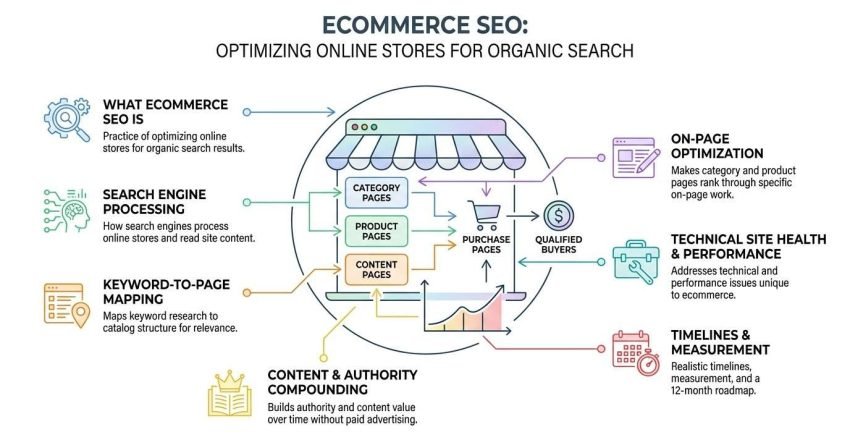
Ecommerce SEO is the practice of optimizing an online store so its category, product, and content pages rank in organic search results. It covers technical site health, keyword-to-page mapping, on-page optimization, structured data, and authority building, all aimed at driving qualified buyers to purchase pages without paid advertising.
I have watched stores double revenue on the same ad spend purely by fixing what search engines could not read. Most owners discover this too late, after years of renting traffic.
This guide covers what ecommerce SEO is and how search engines process online stores, how keyword research maps to your catalog structure, the on-page work that makes category and product pages rank, the technical and performance issues unique to ecommerce, how content and authority compound over time, and finally what realistic timelines, measurement, and a 12-month roadmap actually look like.
What Ecommerce SEO Actually Means
Ecommerce SEO is the discipline of making an online store’s pages eligible to rank for the searches its customers already perform. It is not one task. It is a program that connects your catalog structure, your page content, your site’s technical health, and your domain’s authority into a system search engines can crawl, understand, and trust.
I think of it as three overlapping jobs. Getting found, getting understood, and getting chosen.
Most beginners collapse all of that into “add keywords to product pages.” That is a fraction of the work, and usually the least valuable fraction.
How Ecommerce SEO Differs From Traditional SEO
Ecommerce SEO differs from traditional SEO because online stores publish thousands of near-identical pages, change inventory constantly, and route the highest commercial value through category pages rather than articles. A blog optimizes dozens of pages. A mid-sized store manages tens of thousands.
That scale changes everything. Manual optimization stops working around page 500, and templating plus rules-based logic takes over.
Inventory volatility is the second difference. Products sell out, get discontinued, and get replaced, so a store’s URL set is never stable the way a publisher’s archive is.
The Core Components of an Ecommerce SEO Program
Every functioning ecommerce SEO program runs on six components working together:
- Technical foundation: crawlability, indexation control, and site speed
- Information architecture: how categories, subcategories, and products nest
- Keyword-to-page mapping: which URL owns which search intent
- On-page optimization: titles, copy, headings, images, and structured data
- Content marketing: informational pages that capture demand earlier
- Authority-building: links and brand signals that make rankings possible
Pull any one out and the others underperform. I have seen perfect technical SEO produce nothing because the site had no authority, and I have seen strong brands buried because faceted navigation ate their crawl budget.
How Search Engines Crawl, Index, and Rank Online Stores
Search engines process an online store in four sequential stages: discovery, crawling, indexing, and ranking. A page that fails at any earlier stage cannot succeed at a later one, which is why technical problems outrank content problems in priority.
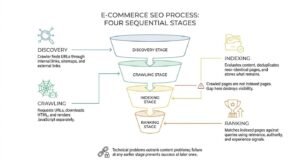
Here is what actually happens when Googlebot meets your store:
- Discovery: the crawler finds URLs through internal links, sitemaps, and external links
- Crawling: it requests those URLs and downloads the HTML, then renders JavaScript separately
- Indexing: it evaluates the content, deduplicates near-identical pages, and stores what remains
- Ranking: it matches indexed pages against queries using relevance, authority, and experience signals
The gap between stage two and stage three destroys more ecommerce visibility than anything else. Crawled pages are not indexed pages.
Crawling and Crawl Budget on Large Catalogs
Crawl budget is the number of URLs a search engine requests from a site within a given period, determined by server capacity and the site’s perceived value. Small stores rarely hit the ceiling. Stores above roughly 10,000 URLs almost always do.
The problem is that filter combinations multiply URLs geometrically. A category with five filters holding four options each generates over a thousand crawlable variations from a single page.
Google’s own crawl budget documentation states that sites under 1,000 unique URLs generally do not need to manage crawl budget at all. Above that, wasted crawls come directly out of your important pages.
Indexing Rules for Product and Category Pages
Not every URL in a store deserves indexing, and treating them equally wastes authority. Category pages and top-selling product pages earn index status. Filtered views, internal search results, sorted variants, and paginated deep pages generally do not.
I set indexation rules before I write a single product description. Deciding what should never be indexed is faster than fixing it after Google has already crawled forty thousand junk URLs.
Canonical tags, robots directives, and sitemap inclusion are the three levers. Used together, they tell search engines exactly which version of a page carries the value.
Why Ecommerce SEO Matters More Than Paid Traffic Alone
Organic search matters for ecommerce because it delivers buyers at zero incremental cost per click, while paid traffic stops the moment the budget stops. Ads rent attention. Search rankings accumulate as an asset on your balance sheet.
I am not anti-paid. Paid search is faster, more controllable, and better for testing offers.
But a store running exclusively on ads has a customer acquisition cost that rises every year as competition bids the auction higher.
Organic Search vs. Paid Search Economics
The economics diverge over time rather than immediately. Paid delivers a predictable cost per acquisition from day one and holds roughly flat. Organic costs more upfront, returns nothing for months, then produces traffic whose marginal cost approaches zero.
BrightEdge research attributes 53% of all trackable website traffic to organic search, compared with 15% from paid search. That ratio holds across most retail verticals.
The right answer for most stores is both channels, with organic funded as an infrastructure investment rather than a monthly performance line item.
Compounding Returns and Customer Acquisition Cost
Ecommerce SEO compounds because each ranking page strengthens the domain, which makes the next page easier to rank. A store with 200 indexed, linked, authoritative pages ranks new products faster than a store with 20.
That compounding is invisible in month three and undeniable in month eighteen. It is also why abandoning SEO at month six is the most expensive decision store owners make.
Customer acquisition cost tells the story cleanly. Paid CAC stays constant or rises. Blended CAC falls every quarter as organic traffic grows.
Keyword Research for Ecommerce Stores
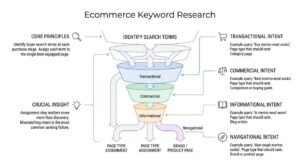
Ecommerce keyword research is the process of identifying the search terms buyers use at each purchase stage and assigning each term to the single page best equipped to satisfy it. The assignment step matters more than the discovery step, and beginners almost always skip it.
Finding keywords is easy now. Deciding which of your 4,000 URLs should own each one is the actual work.
Transactional, Commercial, and Informational Intent
Search intent in ecommerce splits into three practical buckets, and each maps to a different page type on your store:
| Intent type | Example query | Page type that should rank |
| Transactional | “buy merino wool socks” | Category page |
| Commercial | “best merino wool socks” | Comparison or buying guide |
| Informational | “is merino wool warm” | Blog article |
| Navigational | “darn tough merino socks” | Brand or product page |
Mismatching these is the most common cause of a well-written page ranking nowhere. A product page will not beat listicles for “best” queries, and a blog post will not beat category pages for “buy” queries.
Mapping Keywords to Store Page Types
Keyword mapping assigns exactly one primary target term to each URL, with supporting variations grouped underneath it. One page, one job. When two pages chase the same term, keyword cannibalization splits your signals, and both underperform.
I build this as a spreadsheet before any optimization begins. URL, primary keyword, search volume, intent type, current rank, and target rank.
The document becomes the brief for every piece of on-page work that follows.
Site Architecture and URL Structure for Online Stores
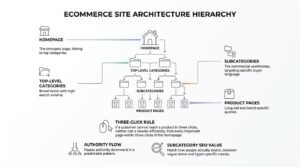
Ecommerce site architecture is the hierarchy that determines how category, subcategory, and product pages nest and link to one another. Good architecture puts every important page within three clicks of the homepage and passes authority downward in a predictable pattern.
The rule I use is simple. If a customer cannot reach a product in three clicks, neither can a crawler efficiently.
Category, Subcategory, and Product Hierarchy
A clean store hierarchy follows a consistent descending pattern:
- Homepage: the strongest page, linking to top categories
- Top-level categories: broad terms with high search volume
- Subcategories: the commercial workhorses, targeting specific buyer language
- Product pages: long-tail and brand-specific queries
Subcategories carry the most underused SEO value in ecommerce. They match how people actually search, sitting between vague top-level terms and hyper-specific product names.
Faceted Navigation and Filter Parameters
Faceted navigation is the filter system letting shoppers narrow results by attributes like size, color, price, or brand. It improves usability and destroys crawl efficiency unless it is explicitly controlled.
Each filter combination generates a unique URL. Left unmanaged, a hundred products can produce a hundred thousand crawlable URLs, nearly all near-duplicates.
The standard controls are canonical tags pointing filtered views back to the parent category, robots directives blocking parameter crawling, and selective indexation of only the filter combinations with genuine search demand.
Optimizing Category Pages (Your Biggest Ranking Asset)
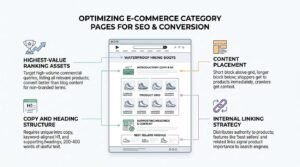
Category pages are the highest-value ranking assets in most online stores because they target high-volume commercial queries while listing every relevant product in one place. They convert better than blog content and rank better than individual product pages for non-branded terms.
Most stores treat them as navigation. That is the mistake.
A category page targeting “waterproof hiking boots” competes for a term with real purchase intent and real volume, while the individual boot pages fight over brand queries almost nobody searches.
Category Page Copy and Heading Structure
Category page optimization requires unique introductory copy above or below the product grid, a keyword-aligned H1, and supporting headings that address buyer questions. Two hundred to four hundred words of genuinely useful text is usually enough.
I put a short block above the grid and a longer block below it. Shoppers get to products immediately, and crawlers get the context they need.
The copy should answer what the category contains, how to choose between options, and what distinguishes the products. Not padded keyword repetition.
Internal Linking From Categories to Products
Internal linking distributes authority from strong category pages to individual products and signals which products matter most. The products you link to most prominently are the products search engines treat as most important.
Featured product blocks, “best sellers” modules, and related-category links all serve this function. They are architecture decisions disguised as merchandising decisions.
Product Page Optimization Fundamentals
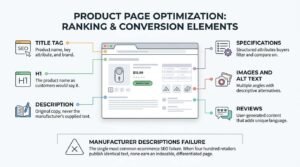
Product page optimization makes an individual item page eligible to rank for branded, model-specific, and long-tail queries while converting the traffic it receives. Six elements do most of the work:
- Title tag: product name, key attribute, and brand
- H1: the product name as customers would say it
- Description: original copy, never the manufacturer’s supplied text
- Specifications: structured attributes buyers filter and compare on
- Images and alt text: multiple angles with descriptive alternatives
- Reviews:s user-generated content that adds unique language
Manufacturer descriptions are the single most common ecommerce SEO failure. When four hundred retailers publish identical text, none of them earn an indexable, differentiated page.
Product Titles, Descriptions, and Specifications
Product titles should follow a consistent template combining brand, model, and primary attribute, because consistency helps both shoppers scanning results and crawlers parsing patterns. “Brand + Product + Key Spec” works for most catalogs.
Descriptions need original copy that answers what the product does, who it suits, and how it compares. Two hundred words of real information beats eight hundred words of adjectives.
Specification tables deserve particular attention since they feed structured data, power on-site filtering, and answer the comparison questions buyers actually have.
Images, Alt Text, and Media Optimization
Product images influence rankings through page speed, image search visibility, and accessibility signals. Alt text describes the image factually, using the product name and visible attributes rather than stuffed keywords.
I compress everything, serve modern formats, and lazy-load anything below the fold. Image weight is the number one cause of slow product pages.
Technical SEO Issues Unique to Ecommerce
Technical ecommerce SEO addresses problems that barely exist on other site types: mass duplication, inventory churn, parameter explosion, and pagination at scale. These issues are structural, not editorial, and they usually require developer involvement.
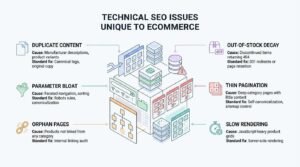
Here are the recurring problems and their standard resolutions:
| Issue | Cause | Standard fix |
| Duplicate content | Manufacturer descriptions, product variants | Canonical tags, original copy |
| Parameter bloat | Faceted navigation, sorting | Robots rules, canonicalization |
| Orphan pages | Products not linked from any category | Internal linking audit |
| Out-of-stock decay | Discontinued items returning 404 | 301 redirects or page retention |
| Thin pagination | Deep category pages with little content | Self-canonicalization, sitemap control |
| Slow rendering | JavaScript-heavy product grids | Server-side rendering |
Duplicate Content and Canonical Tags
A canonical tag is an HTML element that tells search engines which URL is the preferred version of near-identical content. In e-commerce,ce it resolves product variants, filtered category views, and pages reachable through multiple paths.
Colour and size variants are the classic case. Twelve URLs for one shirt should consolidate to one indexable page unless individual variants have their own search demand.
Out-of-Stock and Discontinued Products
Out-of-stock product handling depends on whether the item returns. Temporarily unavailable products keep their URL, keep their content, and add availability schema. Permanently discontinued products redirect to the closest equivalent or the parent category.
Deleting a ranking product page and returning a 404 throws away every link and every ranking signal that page accumulated. I have watched stores lose six figures doing exactly that during a catalog cleanup.
Pagination and Infinite Scroll
Pagination splits large category listings across multiple URLs, and search engines need to crawl those pages to discover the products on them. Infinite scroll implemented purely in JavaScript often hides those products entirely.
The safe pattern is paginated URLs that work without JavaScript, each self-canonical, with the products on every page discoverable through standard links.
Site Speed and Core Web Vitals for Online Stores
Core Web Vitals are Google’s measurable page experience metrics covering loading performance, interactivity, and visual stability. They function as a ranking tiebreaker, and they directly influence conversion rates regardless of ranking impact.
The current thresholds are specific. Google defines a “good” experience as Largest Contentful Paint under 2.5 seconds, Interaction to Next Paint under 200 milliseconds, and Cumulative Layout Shift under 0.1.
Speed matters commercially before it matters algorithmically. Every additional second of load time measurably reduces checkout completion.
What Core Web Vitals Measure
Each metric captures a different failure mode. Largest Contentful Paint measures how long the main content takes to appear. Interaction to Next Paint measures responsiveness when someone taps or clicks. Cumulative Layout Shift measures how much the page jumps around while loading.
Layout shift is the ecommerce killer. Late-loading banner images and lazy-loaded product cards push the “add to cart” button under a shopper’s thumb mid-tap.
Common Speed Killers on Ecommerce Platforms
The usual culprits are consistent across platforms: uncompressed product imagery, excessive third-party scripts, unoptimized apps and plugins, render-blocking CSS, and heavy JavaScript frameworks rendering product grids client-side.
App bloat deserves special mention. Every Shopify app, WooCommerce plugin, and tracking pixel adds requests, and stores accumulate dozens without ever auditing them.
Structured Data and Rich Results for Products
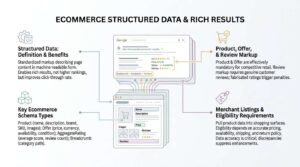
Structured data is standardized markup that describes page content to search engines in machine-readable form, enabling rich results like star ratings, price displays, and availability badges. For ecommerce, it directly affects how listings appear in search results.
Rich results do not guarantee higher rankings. They do improve click-through rate substantially, which is often the more valuable outcome.
Product, Offer, and Review Schema
Ecommerce stores implement four schema types most often:
- Product: name, description, brand, SKU, and images
- Offer: price, currency, availability, and condition
- AggregateRating: average review score and review count
- Breadcrumb: List the category path to the product
Product and Offer are effectively mandatory for competitive retail. Review markup requires genuine customer reviews, since fabricated ratings trigger manual penalties.
Merchant Listings and Eligibility Requirements
Merchant listing experiences pull product data into shopping surfaces, free product listings, and enhanced result formats. Eligibility depends on accurate pricing, valid availability status, shipping details, and return policy information.
The requirement most stores fail is data accuracy. Prices in markup that disagree with prices on the page get the whole store’s enhancements suppressed.
Content Marketing and Blog Strategy for Ecommerce
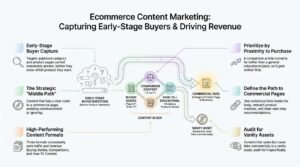
Ecommerce content marketing creates informational pages that capture buyers earlier in the purchase journey, before they know which product they want. It targets the questions your category and product pages cannot reasonably answer.
This is where most stores either overinvest or ignore entirely. The middle path is content that has a clear route to a commercial page.
Buying Guides, Comparisons, and How-To Content
Three content formats consistently earn traffic and revenue for online stores. Buying guides target “best X” and “X for Y” queries. Comparison content targets “X vs Y.” How-to and educational content targets the problems your products solve.
I prioritize by proximity to purchase. A comparison article between two products you stock converts far better than a general educational piece, so it gets written first.
Connecting Content to Commercial Pages
Every content piece needs a defined path to a category or product page;ge, otherwise, it generates traffic that never becomes revenue. Contextual links inside the body, relevant product modules, and clear next-step recommendations all serve this.
Content that ranks but never links commercially is a vanity asset. I audit for it specifically.
Link Building and Authority for Online Stores
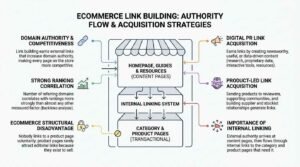
Link building for ecommerce is the process of earning external links that increase domain authority, making every page on the store more competitive. Authority is what separates two technically identical stores where one ranks and one does not.
Backlinko’s analysis of 11.8 million search results found that the number of referring domains correlates with rankings more strongly than almost any other measured factor.
Ecommerce has a structural disadvantage here. Nobody links to a product page voluntarily.
Digital PR and Product-Led Link Acquisition
Digital PR earns links by creating something newsworthy, useful, or data-driven that publications want to reference. For stores, that usually means original research, proprietary data, interactive tools, or genuinely useful free resources.
Product-led acquisition works differently. Sending products to reviewers, supporting relevant communities, and building supplier and stockist relationships all generate links that competitors cannot easily replicate.
Why Product Pages Rarely Earn Links Naturally
Product pages rarely attract editorial links because they exist to sell rather than to inform, and publishers have no reason to reference a transactional page. Links land on homepages, guides, and resources instead.
That is why internal linking matters so much in ecommerce. External authority arrives at content pages, then flows through internal links to the category and product pages that need it.
User Experience, Reviews, and Conversion Signals
User experience signals in ecommerce cover the behavioral and trust factors that influence whether visitors engage with a store, including navigation clarity, mobile usability, review presence, and checkout friction. They shape both rankings and revenue.
Search engines increasingly reward pages that satisfy the searcher. A page that ranks and immediately loses the visitor does not hold its position.
Customer Reviews as Ranking and Conversion Inputs
Customer reviews contribute unique, keyword-rich content to product pages, provide the data for rating rich results, and materially increase conversion rates. They solve the duplicate content problem on product pages almost by accident.
Volume matters, but recency matters more. A product with reviews from last month reads as current in a way that a product with reviews from 2021 does not.
Trust Signals Search Engines and Buyers Both Read
Trust signals include visible contact information, clear returns and shipping policies, secure checkout indicators, business address details, and transparent pricing. These map directly onto experience, expertise, authoritativeness, and trust evaluation.
The overlap is convenient. Everything that reassures a nervous first-time buyer also reassures a quality rater.
Ecommerce Platform Considerations (Shopify, WooCommerce, Magento)
Ecommerce platform choice sets the ceiling on what SEO work is technically possible, since each platform imposes different URL structures, template controls, and performance characteristics. No platform is unrankable, but some make certain fixes harder.
Here is how the major platforms compare on the factors that matter for search:
| Platform | URL control | Technical flexibility | Typical SEO friction |
| Shopify | Limited | Moderate | Forced /collections/ and /products/ paths |
| WooCommerce | Full | High | Performance and plugin bloat |
| Magento | Full | Very high | Complexity and development cost |
| BigCommerce | Good | Moderate | Fewer apps, fewer conflicts |
| Custom build | Full | Total | Nothing works until it is built |
Platform-Level SEO Limitations
Every platform has a fixed constraint list worth knowing before you commit. Shopify locks URL prefixes and limits robots.txt editing on lower plans. WooCommerce inherits WordPress performance issues at scale. Magento demands developer resources most small stores cannot fund.
None of these are dealbreakers. They are just constraints to design around rather than fight.
Migration Risks and Safeguards
Platform migration is the highest-risk event in ecommerce SEO, because URL changes, template changes, and content changes all happen simultaneously. Stores routinely lose 30% to 60% of organic traffic through poorly executed migrations.
The safeguards are non-negotiable: a complete URL inventory before migration, a mapped 301 redirect for every changed URL, preserved metadata and content, and daily monitoring for at least eight weeks after launch.
Local and International Ecommerce SEO
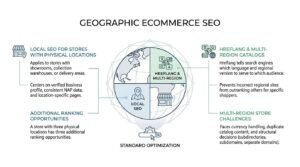
Geographic ecommerce SEO adapts a store’s optimization to the physical or linguistic markets it serves, whether that means a single city with a showroom or twelve countries with separate catalogs. Both cases add a layer on top of standard optimization rather than replacing it.
Local SEO for Stores With Physical Locations
Local SEO applies to ecommerce stores with showrooms, warehouses offering collection, or service areas tied to delivery. It centers on a verified business profile, consistent name-address-phone data, and location-specific pages.
Hybrid retailers underuse this constantly. A store with three physical locations has three additional ranking opportunities it is usually ignoring entirely.
Hreflang and Multi-Region Catalogs
Hreflang is an HTML attribute telling search engines which language and regional version of a page to serve to which audience. It prevents your UK site from outranking your US site for American shoppers.
Multi-region stores also face currency handling, duplicate catalog content across regional domains, and the decision between subdirectories, subdomains, or separate country domains. Get the structure wrong at launch and fixing it later means a full migration.
How long does ecommerce SEO take, and what does it cost?
Ecommerce SEO Timelines and Realistic Expectations
Ecommerce SEO typically produces measurable ranking movement within three to six months and meaningful revenue impact between six and twelve months, with competitive niches extending well beyond that. The variables are domain age, existing authority, catalog size, competition, and execution speed.
Anyone promising rankings in thirty days is selling something else.
Month-by-Month Progression
Here is the pattern I see across most mid-sized store engagements:
| Period | Typical activity | Typical visible result |
| Months 1–2 | Technical audit, fixes, keyword mapping | Indexation improves, little traffic change |
| Months 3–4 | On-page optimization, category rollout | Long-tail rankings appear |
| Months 5–7 | Content production, link acquisition | Traffic climbs, first revenue attribution |
| Months 8–12 | Scale and refine | Compounding growth, competitive terms move |
| Months 12+ | Maintenance and expansion | Organic becomes a primary channel |
Stores with existing authority compress this timeline substantially. New domains extend it.
What Slows Results Down
The recurring blockers are predictable: slow development resources for technical fixes, thin or manufacturer-supplied product content that nobody rewrites, no link acquisition activity, and inconsistent execution after month four.
Internal delay is almost always the real constraint. The strategy is rarely the problem.
Measuring Ecommerce SEO Performance
Ecommerce SEO measurement tracks the metrics that connect organic visibility to revenue rather than reporting rankings in isolation. Position data alone tells you nothing about whether the program is working.
| Metric | What it tells you | Where to find it |
| Organic sessions | Total demand captured | Analytics |
| Organic revenue | Direct commercial return | Analytics ecommerce reports |
| Indexed pages | Technical health | Search Console |
| Non-branded impressions | Genuine visibility growth | Search Console |
| Category page rankings | Commercial term progress | Rank tracking |
| Organic conversion rate | Traffic quality | Analytics |
Metrics That Predict Revenue
Non-branded organic impressions lead revenue by roughly two to three months, making them the earliest reliable signal that the work is landing. Impressions rise before clicks; clicks rise before conversions.
I watch that metric more closely than rankings. It captures everything, including terms nobody thought to track.
Attribution and Assisted Conversions
Last-click attribution systematically undervalues organic search because buyers frequently discover a store through a search result and return later through direct or paid channels. Assisted conversion reporting corrects for this.
Stores that judge SEO on last-click data alone routinely conclude it is not working while it quietly feeds every other channel.
Common Ecommerce SEO Mistakes That Cost Revenue
The most expensive ecommerce SEO mistakes are structural rather than tactical, which is why they persist for years without anyone noticing. Five appear in nearly every audit I run:
- Manufacturer product descriptions duplicated across hundreds of competitors
- Neglected category pages treated as navigation rather than ranking assets
- Unmanaged faceted navigation consuming the entire crawl budget
- Deleted product pages returning 404s and discarding accumulated authority
- No link acquisition leaving a technically perfect site without the authority to rank
Thin and Duplicated Product Content
Duplicate product content prevents individual product pages from ranking because search engines have no reason to prefer your copy over four hundred identical versions. The fix is original description copy on revenue-driving products first, not all products at once.
Prioritize by margin and traffic potential. Rewriting your top 200 products beats rewriting all 5,000 badly.
Ignoring Category Pages Entirely
Category pages get ignored because they look like infrastructure rather than content. They are the pages targeting the highest-volume commercial queries in your entire keyword set.
If I could only optimize one page type on a store, it would be categories. Every time.
Building a 12-Month Ecommerce SEO Roadmap
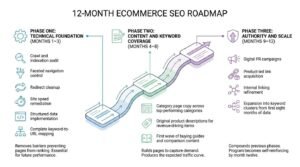
A 12-month ecommerce SEO roadmap sequences technical fixes, content production, and authority building so each phase enables the next rather than competing for the same resources. Sequence matters more than speed.
Phase One: Technical Foundation (Months 1–3)
Phase one removes the barriers preventing pages from ranking at all. Crawl and indexation audit, faceted navigation control, redirect cleanup, site speed remediation, structured data implementation, and complete keyword-to-URL mapping.
Nothing built later performs properly if this phase is skipped. I refuse engagements where clients want to start with content.
Phase Two: Content and Keyword Coverage (Months 4–8)
Phase two builds the pages that capture demand. Category page copy across the top-performing categories, original product descriptions for revenue-driving items, and the first wave of buying guides and comparison content.
This phase produces the traffic curve most stakeholders are waiting for.
Phase Three: Authority and Scale (Months 9–12)
Phase three compounds what phases one and two created. Digital PR campaigns, product-led link acquisition, internal linking refinement, and expansion into the keyword clusters revealed by the first eight months of data.
By month twelve, the program should be self-reinforcing, with new pages ranking faster than the pages published in month four.
Conclusion
Ecommerce SEO connects technical health, catalog architecture, keyword mapping, on-page optimization, structured data, content, and authority into one compounding revenue system.
Every component covered here goes deeper than a single guide allows, and the linked resources throughout expand each area for stores ready to execute.
We build and run programs exactly like this at White Label SEO Service, so book a strategy call, and we will map your first ninety days.
Frequently Asked Questions
What is ecommerce SEO in simple terms?
Ecommerce SEO makes an online store’s pages rank in search results so buyers find products without paid ads. It combines technical fixes, keyword targeting, content, and links.
How long does ecommerce SEO take to work?
Ecommerce SEO usually shows ranking movement in three to six months and revenue impact between six and twelve months. Competitive niches and new domains take longer.
Is SEO or paid advertising better for an online store?
Paid advertising delivers faster results at a constant cost, while SEO costs more upfront and then compounds. Most successful stores run both channels together.
Which pages matter most for ecommerce SEO?
Category and subcategory pages matter most because they target high-volume commercial queries and list every relevant product. Product pages capture branded and long-tail searches.
Do I need to rewrite manufacturer product descriptions?
Yes, original product copy is essential because identical manufacturer text appears on hundreds of competing stores. Start with your highest-margin and highest-traffic products.
Does Shopify handle SEO automatically?
Shopify covers basic SEO like clean templates and sitemaps, but it locks URL structures and limits technical control. Serious optimization still requires deliberate work.
How much should a store budget for ecommerce SEO?
Most mid-sized stores invest between two and eight thousand dollars monthly, depending on catalog size and competition. Cheaper programs rarely include technical work or link acquisition.