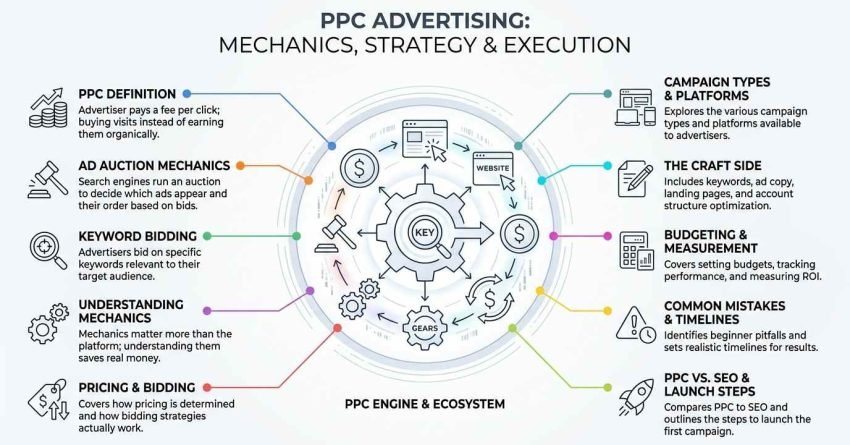
PPC advertising is a digital marketing model in which advertisers pay a fee each time someone clicks their ad, buying visits to a website instead of earning them organically. Advertisers bid on keywords, and search engines run an auction to decide which ads appear and in what order.
I have watched too many business owners burn a month’s budget in nine days because nobody explained the auction to them. The mechanics matter more than the platform. Understanding them saves real money.
This guide covers what PPC is and how the ad auction decides who wins; the campaign types and platforms available to you; how pricing and bidding actually work; the craft side of keywords, ad copy, landing pages, and account structure; budgeting; measurement; common beginner mistakes; realistic timelines; how PPC compares to SEO; and the steps to launch your first campaign.
What Is PPC Advertising?
Pay-per-click advertising is an auction-based advertising model where advertisers pay only when a user clicks their ad, rather than paying for the ad to be displayed. The name describes the billing method, not the ad format.
I like that billing model because it puts risk on the right side of the table. You are not paying for impressions nobody noticed. You pay when someone raises their hand.
PPC covers search ads on Google and Bing, shopping listings, display banners, YouTube video ads, and most paid social formats. The unifying feature across all of them is the auction and the click-based charge.
How PPC Differs From Organic Search
Organic search results are earned through relevance and authority, while PPC results are bought through an auction and disappear the moment you stop paying. Both appear on the same results page, usually with paid listings above the organic ones.
The practical difference is speed against durability. A well-built paid search campaign delivers traffic on day one. An organic ranking takes months but keeps producing after the invoice stops.
Google labels paid results with a small “Sponsored” marker. Most searchers do not consciously register it, which is part of why the format works.
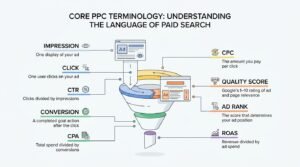
The Core Terms Every Beginner Needs to Know
Nine terms carry most of the weight in PPC, and I use every one of them daily. Learn these and the platform interfaces stop feeling hostile.
| Term | What It Means |
| Impression | One display of your ad |
| Click | One user clicks on your ad |
| CTR | Clicks divided by impressions |
| CPC | The amount you pay per click |
| Conversion | A completed goal action after the click |
| CPA | Total spend divided by conversions |
| ROAS | Revenue divided by ad spend |
| Quality Score | Google’s 1–10 rating of ad and page relevance |
| Ad Rank | The score that determines your ad position |
Impressions tell you reach, clicks tell you appeal, and conversions tell you whether any of it mattered. I judge accounts almost entirely on the third column.
How PPC Advertising Actually Works
PPC works through a real-time auction that runs every single time someone enters a search query, deciding in milliseconds which ads appear and what each advertiser pays. The highest bid does not automatically win.
Here is the sequence, and it repeats billions of times a day:
- A user enters a search query
- The platform identifies every advertiser bidding on matching keywords
- Each eligible ad receives an Ad Rank score based on bid, Quality Score, and expected impact of assets
- Ads are ordered by Ad Rank, and low-scoring ads are filtered out entirely
- The winner pays only the minimum needed to beat the advertiser below them
That fifth point is the one beginners miss. You almost never pay your maximum bid.
The Ad Auction Explained
The ad auction is a second-price-style mechanism that charges the winning advertiser slightly more than the amount required to outrank the next competitor, not the full bid submitted. Your maximum bid is a ceiling, not a price tag.
Say you bid $6.00 and the advertiser below you effectively needs $3.80 to be beaten. You pay roughly $3.81. The gap is yours to keep.
This is why raising bids blindly rarely fixes performance. The auction rewards relevance far more efficiently than it rewards money.
Quality Score and Ad Rank
Quality Score is a 1–10 diagnostic metric Google assigns to each keyword based on expected click-through rate, ad relevance, and landing page experience. It feeds directly into Ad Rank alongside your bid.
A high Quality Score lets you win better positions at lower cost than competitors bidding more. I have taken accounts from position four to position one by fixing landing page relevance alone, with no bid change.
The relationship is multiplicative rather than additive. Poor relevance cannot be bought around at any bid level.
What Happens Between Search and Click
Between the query and the click sits roughly 200 milliseconds of eligibility checks, scoring, and ad serving that the user never perceives. Understanding that window explains why your ad sometimes disappears without warning.
Ads drop out for mundane reasons: budget exhausted for the day, a negative keyword blocked the query, the ad failed a policy check, or your Ad Rank fell below the platform’s minimum threshold. Position zero is not a penalty; it is arithmetic.
The Main Types of PPC Campaigns
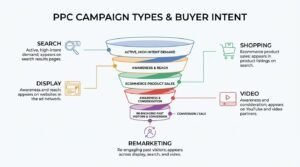
PPC campaigns split into five main types, each serving a different stage of buyer intent and each priced and optimized differently. Choosing the wrong type is the single most common beginner error I see.
This table maps campaign types against the buyer intent they serve best:
| Campaign Type | Where It Appears | Best For |
| Search | Search results pages | Active, high-intent demand |
| Display | Websites in the ad network | Awareness and reach |
| Shopping | Product listings on search | Ecommerce product sales |
| Video | YouTube and video partners | Awareness and consideration |
| Remarketing | Across display, search, and video | Re-engaging past visitors |
Search Campaigns
Search campaigns are text ads triggered by keyword queries on search engine results pages, and they capture demand that already exists. Someone typing “emergency plumber near me” is not browsing.
I start almost every new advertiser here. Intent is highest, measurement is cleanest, and results arrive fastest.
Display and Video Campaigns
Display campaigns place visual banner ads across the millions of websites in a platform’s partner network, while video campaigns run on YouTube and connected video inventory. Both create demand rather than capture it.
Click-through rates on display sit far below search, often under 0.5%. Judge these campaigns on assisted conversions and reach, never on last-click revenue alone.
Shopping Campaigns
Shopping campaigns display product images, prices, and merchant names directly in search results, pulled from a product feed rather than keywords. Retailers frequently see them outperform text search ads on the same products.
The lever here is feed quality, not bidding. Clean titles, accurate attributes, and complete product data drive the results.
Remarketing Campaigns
Remarketing campaigns serve ads specifically to users who have already visited your site or interacted with your brand. Costs per conversion typically run well below cold prospecting because the audience already knows you.
I treat remarketing as the highest-return campaign type in most accounts. It is also the one beginners neglect the longest.
Where PPC Ads Run: The Major Advertising Platforms
PPC advertising runs across search engines, social networks, retail marketplaces, and video platforms, each with distinct audiences, costs, and targeting capabilities. Google holds the largest share of paid search spend by a wide margin.
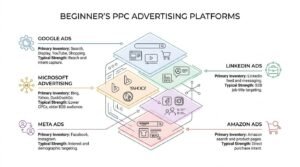
This table compares the platforms most beginners should consider first:
| Platform | Primary Inventory | Typical Strength |
| Google Ads | Search, Display, YouTube, Shopping | Reach and intent capture |
| Microsoft Advertising | Bing, Yahoo, DuckDuckGo | Lower CPCs, older B2B audience |
| Meta Ads | Facebook, Instagram | Interest and demographic targeting |
| LinkedIn Ads | LinkedIn feed and messaging | B2B job-title targeting |
| Amazon Ads | Amazon search and product pages | Direct purchase intent |
Google Ads
Google Ads is the advertising platform that serves ads across Google Search, YouTube, Gmail, Google Shopping, and the Google Display Network. It is where most beginners should start, simply because that is where the search volume is.
The interface is genuinely intimidating on day one. I tell people to ignore ninety percent of it for the first month and focus on keywords, ads, and negatives.
Microsoft Advertising
Microsoft Advertising serves ads on Bing, Yahoo, and DuckDuckGo, reaching an audience that skews older, more affluent, and more desktop-based than Google’s. Cost per click frequently runs noticeably lower for the same keywords.
The volume is smaller, so nobody builds a strategy on it alone. As a second channel with imported Google campaigns, the effort-to-return ratio is excellent.
Social and Retail Media Platforms
Paid social platforms target users by demographics, interests, and behaviors rather than by search query, which means creating demand instead of capturing it. Retail media platforms like Amazon sit at the opposite end, capturing purchase intent at the point of sale.
Match the platform to where your buyer’s attention actually sits. B2B software rarely wins on Instagram, and impulse consumer products rarely win on LinkedIn.
How PPC Pricing and Bidding Work
PPC pricing is determined by competition, keyword commercial value, industry, and your own Quality Score, with average cost per click across Google Search sitting somewhere around $2 to $4 for most industries. Legal, insurance, and finance keywords routinely exceed $50 per click.
I want beginners to internalize one thing here. The number on the invoice is a symptom, and the disease is almost always relevance or targeting.
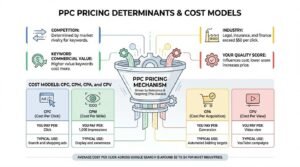
Cost Models: CPC, CPM, CPA, and CPV
Four pricing models cover nearly all PPC buying, and each charges for a different user action. Knowing which one you are on prevents unpleasant surprises.
| Model | You Pay Per | Typical Use |
| CPC | Click | Search and shopping ads |
| CPM | 1,000 impressions | Display and awareness |
| CPA | Conversion | Automated bidding targets |
| CPV | Video view | YouTube campaigns |
CPC dominates search. CPM dominates display and awareness buying.
Manual Versus Automated Bidding Strategies
Manual bidding gives you direct control over the maximum bid for each keyword, while automated bidding hands bid decisions to the platform’s machine learning based on a goal you specify. Automation needs conversion data to function, typically at least 15 to 30 conversions in a 30-day window.
New accounts often lack that data, so I start manually or on Maximize Clicks, gather signal, then move to a smart bidding strategy once the numbers support it. Switching too early produces erratic spend and poor results.
The bidding strategy you choose sets the ceiling on what optimization can achieve. Choose it deliberately.
Keyword Research for PPC Campaigns
PPC keyword research identifies the search terms your buyers use, estimates what each will cost, and separates commercial intent from research intent. Paid keyword research differs from organic because you are buying immediate action, not building long-term relevance.
Volume matters far less here than intent. I would take 90 searches a month for “buy commercial coffee machine” over 12,000 for “coffee.”
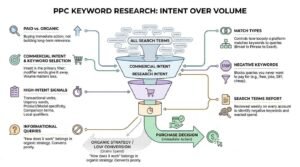
Commercial Intent and Keyword Selection
Commercial intent describes how close a search query sits to a purchase decision, and it is the primary filter for paid keyword selection. Modifier words give it away.
High-intent signals worth bidding on:
- Transactional verbs: buy, hire, order, book
- Urgency words: emergency, same day, near me
- Product or model specificity: exact SKUs, model numbers
- Comparison and decision terms: best, top rated, pricing, cost
- Local qualifiers: your city, “in [location].”
Informational queries like “how does X work” belong in your organic strategy, not your paid budget. They convert poorly and drain spend quickly.
Match Types and Negative Keywords
Keyword match types control how loosely a platform matches your keyword to real user queries, ranging from broad to phrase to exact. Negative keywords do the opposite job, blocking queries you never want to pay for.
Broad match without a strong negative list is the fastest way I know to waste a budget. Add “free,” “jobs,” “DIY,” and “cheap” on day one unless they genuinely fit your offer.
I review the search terms report weekly on every new account. That report is where negative keywords come from, and it is where most wasted spend gets caught.
Writing Ad Copy That Earns the Click
Effective PPC ad copy mirrors the searcher’s query, states a specific benefit, and gives one clear reason to click rather than scrolling past. You have roughly 90 characters of headline space to do it.
The best-performing ad copy I write is rarely clever. It is specific.
What consistently earns clicks:
- The keyword itself in headline one, matching the query language
- A concrete number: price, timeframe, quantity, percentage
- A differentiator competitors cannot copy in a week
- One unambiguous call to action
- A trust signal: years in business, review count, guarantee
Test at least three ads per ad group. Responsive search ads assemble headline and description combinations automatically, so give the system genuinely different angles to work with rather than five variations of one sentence.
Ad Extensions and Assets
Ad assets, formerly called extensions, are additional pieces of information appended to your ad such as sitelinks, callouts, phone numbers, prices, and locations. They increase ad size, improve click-through rate, and feed into Ad Rank.
They are free. Not using them is leaving both real estate and relevance on the table for no reason.
Landing Pages and Post-Click Experience
A PPC landing page is the destination page a user reaches after clicking an ad, and its relevance directly affects both conversion rate and cost per click. Sending paid traffic to a generic homepage is the most expensive mistake in this guide.
The click is where your money stops. Everything after it decides whether that money produced anything.
What a converting landing page needs:
- Message match between the ad headline and the page headline
- A single, obvious conversion action above the fold
- Fast load time, ideally under three seconds on mobile
- Proof: reviews, logos, case results, guarantees
- Removed navigation that lets people wander off
Why Landing Page Relevance Affects Cost
Landing page experience is one of three components in Google’s Quality Score, which means a poor page raises the price you pay for every click. Google does not want to send searchers somewhere disappointing.
Improve the page and your cost per click falls without touching your bid. I have seen 30% CPC reductions from landing page work alone.
Campaign Structure and Account Architecture
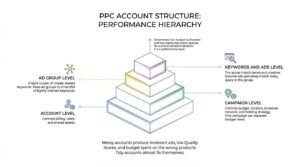
PPC account structure is the hierarchy of campaigns, ad groups, keywords, and ads that determines how budget is allocated and how tightly ads match queries. Structure is not administration; it is a performance lever.
Messy accounts produce irrelevant ads, low Quality Scores, and budget spent on the wrong products. Tidy accounts almost fix themselves.
Campaigns, Ad Groups, and Keyword Grouping
The hierarchy runs in four levels, and each level controls something specific:
- Account: billing, users, and shared assets
- Campaign: budget, location, schedule, network, and bidding strategy
- Ad group: a tight cluster of closely related keywords
- Keywords and ads: the actual match terms and creative
Set budget at campaign level, which means one campaign per product line, service, or geography you want to control spend on separately. Keep ad groups to a handful of tightly themed keywords so the ad can genuinely match every query in the group.
How to Set a PPC Budget
A realistic starting PPC budget for a small business sits between $1,000 and $3,000 per month, enough to generate the click volume and conversion data needed to optimize. Below roughly $500 monthly, most accounts never gather enough signal to improve.
I calculate it backward from the goal, never forward from what feels comfortable. Comfortable numbers produce inconclusive data.
The calculation is simple arithmetic:
| Input | Example |
| Average CPC in your niche | $3.50 |
| Target conversions per month | 20 |
| Realistic landing page conversion rate | 5% |
| Clicks required | 400 |
| Monthly budget needed | $1,400 |
What Beginners Should Expect to Spend
Expect your first 60 to 90 days of PPC spend to function as paid research rather than profitable acquisition. That period buys search term data, conversion rate benchmarks, and the negative keyword list that makes month four efficient.
Budget for it deliberately. Advertisers who quit in week three pay the tuition and never attend the class.
Conversion Tracking and PPC Measurement
Conversion tracking is the system that records what users do after clicking your ad, and without it, PPC is guesswork with an invoice attached. Install it before your first ad goes live, not after.
Every optimization decision downstream depends on this. Automated bidding literally cannot function without conversion data flowing back to the platform.
The Metrics That Actually Matter
Five metrics carry the diagnostic weight in most accounts, and impressions is not one of them:
| Metric | What It Tells You |
| Conversion rate | Whether the post-click experience works |
| Cost per acquisition | Whether the channel is affordable |
| ROAS | Whether the channel is profitable |
| Impression share | How much available demand you are missing |
| Search terms report | Where budget is leaking |
Click-through rate is a useful relevance signal, not a business outcome. I check it to diagnose ad copy, then move on.
Attribution and Reporting Basics
Attribution is the method used to assign conversion credit across the touchpoints in a customer journey, and the model you choose changes what your reports appear to say. Last-click attribution systematically undervalues awareness campaigns.
Data-driven attribution is now the Google Ads default where sufficient data exists. Understanding the difference stops you from cutting a campaign that was actually assisting every sale.
Connect Google Ads to Google Analytics and Search Console early. The cross-channel picture prevents expensive misreads.
Common PPC Mistakes Beginners Make
Most first-time PPC failures trace to six mistakes, and all six are preventable in under an hour of setup work. I see the same list on nearly every audit.
- Launching without conversion tracking installed
- Sending all traffic to the homepage instead of a matched landing page
- Running broad match with no negative keyword list
- Bidding on high-volume informational keywords with no purchase intent
- Changing bids and budgets daily, before the data stabilizes
- Ignoring the search terms report entirely
Number five deserves emphasis. Give changes at least two weeks before judging them, or you are optimizing against noise.
How Long Does PPC Take to Work?
PPC generates traffic within hours of launch, but reaching stable, profitable performance typically takes 60 to 90 days of data collection and optimization. The traffic is instant; the efficiency is not.
Week one produces clicks and a messy search terms report. Weeks two through four produce your negative keyword list and early conversion signal. Months two and three are where cost per acquisition usually drops meaningfully as bidding strategies gain enough data to work.
This is the honest expectation, and I set it before every launch. Advertisers who understand the curve stay long enough to profit from it.
PPC vs SEO: Which One Does Your Business Need?
PPC buys immediate visibility that stops when the budget stops, while SEO earns compounding visibility that takes months to build and persists afterward. The two channels answer different business questions, which is why the comparison is rarely either-or.
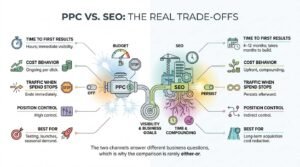
This table sets the real trade-offs side by side:
| Factor | PPC | SEO |
| Time to first results | Hours | 4–12 months |
| Cost behavior | Ongoing per click | Upfront, compounding |
| Traffic when spend stops | Ends immediately | Persists |
| Position control | High | Indirect |
| Best for | Testing, launches, seasonal demand | Long-term acquisition cost reduction |
Businesses needing leads this quarter start with PPC. Businesses building durable acquisition economics need an organic search strategy running alongside it.
Running PPC and SEO Together
Running both channels together produces compounding advantages neither delivers alone, because paid search data directly improves organic decision-making. Your search terms report is real query data with real conversion rates attached.
I use paid keyword performance to prioritize which content to build organically. Keywords that convert at $4 in PPC are worth ranking for at zero marginal cost.
Occupying both a paid slot and an organic listing also increases total click share on the same result page. The channels reinforce each other rather than cannibalize.
Managing PPC In-House Versus Outsourcing
The choice between in-house and outsourced PPC management comes down to available time, monthly spend level, and how quickly you need competence. Neither is universally correct.
| Factor | In-House Works When | Outsourcing Works When |
| Monthly spend | Under $2,000 | Above $5,000 |
| Available time | 5+ hours weekly | Under 2 hours weekly |
| Complexity | Single platform, few products | Multi-platform or ecommerce |
| Speed needed | Learning curve acceptable | Results needed this quarter |
Agency fees typically run 10% to 20% of ad spend or a flat monthly retainer. At low spend levels, that overhead rarely pays back, which is why I tell small advertisers to learn the basics themselves first.
How to Launch Your First PPC Campaign
Launching a first PPC campaign takes eight steps and roughly a day of focused work, assuming your landing page already exists. Follow the order, because several steps depend on the ones before them.
- Define one measurable goal: leads, calls, or sales, with a target cost
- Install conversion tracking and verify it fires correctly
- Build or select a matched landing page for the offer
- Research 15 to 30 high-intent keywords in tight themes
- Build a negative keyword list before launch, not after
- Write three ads per ad group with the keyword in headline one
- Add every relevant ad asset: sitelinks, callouts, calls, locations
- Launch with a controlled daily budget and review search terms weekly
Do not skip step two. Every remaining step depends on knowing which clicks produced something.
Conclusion
You now understand the PPC auction, campaign types, platforms, bidding, keywords, ad copy, landing pages, budgets, measurement, and how paid search compares to organic.
PPC works best inside a wider search strategy where paid data informs organic priorities and organic rankings reduce long-term acquisition costs.
We build both sides of that equation for agencies and brands. Talk to White Label SEO Service about integrating paid and organic search properly.
Frequently Asked Questions
How much does PPC advertising cost for a small business?
Most small businesses spend $1,000 to $3,000 monthly on PPC. Below $500, accounts rarely gather enough conversion data to optimize effectively.
Is PPC advertising worth it for beginners?
Yes, when tracking is installed and keywords carry commercial intent. Beginners without conversion tracking or negative keywords typically lose money for months.
What is a good click-through rate for PPC ads?
Search ads average around 3% to 5% CTR across industries. Display campaigns average under 0.5%, so judge each network against its own benchmark.
Can you do PPC advertising without a website?
Technically yes, using call-only ads or lead forms. Results are far weaker, because conversion tracking and landing page relevance both become severely limited.
How is PPC different from paid social advertising?
PPC search captures existing demand from people actively searching. Paid social creates demand by interrupting people based on interests and demographics.
Do PPC ads help SEO rankings?
No, paid clicks are not a ranking factor. PPC helps indirectly by revealing which keywords convert, which sharpens organic content priorities.
How do I know if my PPC campaign is working?
Compare cost per acquisition against your target and check ROAS. Rising conversions at stable or falling CPA means the campaign is working.