SEO penalty recovery restores lost organic visibility after Google issues a manual action or an algorithmic demotion, and it typically pays for itself within three to nine months when the affected pages previously drove meaningful revenue. I have watched businesses freeze the moment they see a traffic cliff on their analytics dashboard, and that hesitation is usually the most expensive decision in the whole ordeal.
Every month a penalty goes unaddressed, the gap between where a site should rank and where it actually sits gets wider. Competitors absorb that lost visibility, and it does not come back for free.
This guide covers what a penalty actually is and what it costs you, how recovery works and how long it takes, and how to calculate the ROI before you commit budget. I also walk through what recovery services cost, how to build a business case internally, and how to choose a partner and prevent repeat penalties.
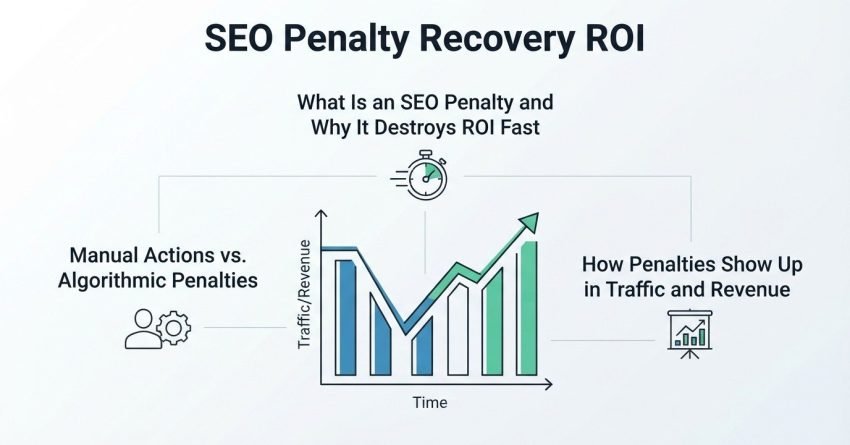
What Is an SEO Penalty and Why It Destroys ROI Fast
An SEO penalty is a ranking demotion applied by Google either through a manual action from a human reviewer or through an algorithmic filter that devalues a site automatically. I have seen both types show up identically in a traffic graph: a sharp drop that looks nothing like normal seasonal variation.
Manual Actions vs. Algorithmic Penalties
A manual action is a penalty applied by a Google search quality reviewer after identifying a violation of Google’s spam policies, and it always appears explicitly inside the Manual Actions report in Google Search Console. Algorithmic penalties, on the other hand, happen automatically when a broad core update or a targeted algorithm (like the link spam update) reassesses a site’s quality signals.
I always check the manual actions report first, because it removes guesswork. If nothing shows there, the drop is almost certainly algorithmic, tied to a named core update.
How Penalties Show Up in Traffic and Revenue Data
Organic sessions dropping alongside a flat or unchanged backlink and content publishing cadence is the clearest early signal of a penalty. I cross-reference the drop date against Google’s documented update rollout windows before assuming it is a penalty rather than a seasonal dip.
Revenue impact almost always lags the traffic drop by two to four weeks, since existing leads in the pipeline take time to dry up. That lag is exactly why waiting to investigate makes the eventual recovery ROI calculation look worse than it needed to.
The True Cost of an Unaddressed SEO Penalty
The true cost of an unaddressed SEO penalty is the compounding revenue lost every month a site sits at reduced visibility, which for most mid-sized businesses runs into five or six figures annually. I built this section around a simple idea: penalties do not just cost you rankings; they cost you the compounding value of rankings you would have earned in the meantime.
Lost Organic Traffic Value Calculation
I calculate lost traffic value by multiplying the drop in organic sessions by the site’s historical conversion rate and average order or lead value. A site losing 10,000 monthly organic sessions with a 2% conversion rate and a $500 average deal size is losing roughly $100,000 in monthly pipeline value.
That number changes everything about how leadership views the urgency of recovery. Once you can show pipeline value in dollars, “we should probably look into this” turns into “we need this fixed now.”
Compounding Revenue Loss Over Time
Search visibility compounds because rankings build trust signals, backlinks, and brand recall over time, and a penalty resets much of that accumulated equity. Ahrefs’ study of ranking recovery patterns found that sites which delayed remediation by more than 90 days took 2.3 times longer to fully recover their pre-penalty traffic levels.
That delay multiplier is the single biggest reason recovery ROI shrinks the longer a business waits. Every quarter of inaction adds recovery time on the back end.
Common Causes of Google Penalties
The most common causes of Google penalties are unnatural link profiles, thin or duplicate content, and cloaking or deceptive redirect practices. I have diagnosed dozens of penalized sites, and roughly seven out of ten trace back to link-related issues rather than content problems.
Link-Based Penalties
A link-based penalty results from a backlink profile containing paid links, link exchanges, or private blog network placements that violate Google’s link spam policies. These links are usually accumulated over years through outdated agency practices or aggressive guest posting campaigns run without oversight.
Content and Technical Penalties
Content-based penalties typically stem from thin, auto-generated, or duplicate pages that provide little original value to users. Technical penalties, including cloaking and sneaky redirects, get flagged when the content Googlebot crawls differs from what a real visitor sees.
| Penalty Type | Primary Trigger | Typical Detection Method |
| Manual – Unnatural Links | Paid or manipulative backlinks | Search Console manual action notice |
| Algorithmic – Link Spam | Toxic link velocity or PBNs | Sudden ranking drop post-update |
| Content Quality | Thin, duplicate, or AI-spun content | Core update correlation |
| Cloaking/Redirects | Content mismatch for bots vs. users | Manual action or crawl anomaly |
How to Diagnose an SEO Penalty Before Investing in Recovery
Diagnosing an SEO penalty starts with checking the Google Search Console Manual Actions report, then cross-referencing any traffic drop against known algorithm update dates. Skipping this step is the fastest way to spend recovery budget on the wrong problem.
Reading Google Search Console Manual Action Reports
Google Search Console’s Manual Actions report lists the exact violation type, the affected URLs or entire site, and instructions for remediation. I treat this report as the single source of truth; if it is empty, I never label the issue a “manual penalty” regardless of how severe the traffic drop looks.
Identifying Algorithmic Traffic Drops
Diagnosing an algorithmic drop follows a repeatable process:
- Export organic sessions by date from Google Analytics
- Overlay the drop date against Google’s confirmed update timeline
- Segment the drop by landing page to find the affected content cluster
- Check whether rankings dropped site-wide or only for specific query types
- Review recent site changes, migrations, template updates, content pruning
- Compare the affected pages against Google’s helpful content guidelines
Following these steps in order prevents the common mistake of blaming the wrong update or the wrong section of the site.
The SEO Penalty Recovery Process Explained
The SEO penalty recovery process involves auditing the backlink profile or content quality issue, remediating the root cause, and submitting a reconsideration request where applicable. I break this into two tracks depending on whether the penalty is link-based or content-based, since the remediation steps differ significantly.
Disavowing Toxic Backlinks
Link-based recovery follows this sequence:
- Export the full backlink profile from Search Console and a third-party tool
- Score every referring domain for spam signals and relevance
- Attempt manual outreach to remove the worst offenders first
- Compile a disavow file for links that cannot be removed
- Submit the disavow file through Google Search Console
- File a reconsideration request explaining the remediation steps taken
I always attempt manual removal before disavowing, since Google’s guidance favors genuine cleanup over blanket disavowal.
Content Remediation and Reconsideration Requests
Content-based recovery requires rewriting or removing thin and duplicate pages, then improving depth and originality across the affected section. A Search Engine Journal analysis of helpful content recoveries found that sites which removed or consolidated more than 30% of thin pages recovered rankings within the following two core updates.
Reconsideration requests only apply to manual actions, not algorithmic penalties, and must document every specific fix made. I write these requests assuming a human reviewer will check each claim against the live site.
How Long SEO Penalty Recovery Actually Takes
SEO penalty recovery typically takes anywhere from four weeks for a resolved manual action to twelve months or more for a severe algorithmic demotion. Timelines depend heavily on penalty type, remediation thoroughness, and how quickly Google reprocesses the site’s signals.
Manual Action Recovery Timelines
Manual action recovery generally resolves within two to six weeks after a reconsideration request is approved, since Google explicitly reviews and lifts the flagged violation. I set client expectations at the higher end of that range, since first reconsideration requests get rejected more often than approved.
Algorithmic Recovery Timelines
Algorithmic recovery depends on the next relevant core update cycle, which historically occurs every three to four months according to Google’s public update history. Full traffic restoration after a helpful content-related demotion often takes two full update cycles rather than one.
Calculating the ROI of SEO Penalty Recovery
The ROI of SEO penalty recovery is calculated by comparing the projected recovered revenue against the total cost of remediation services over a defined recovery period. This is the section that turns a technical fix into a financial decision leadership can approve.
Revenue Recovery Formula
The core formula looks like this: (Projected Recovered Monthly Organic Revenue × Months to Recovery) − Total Recovery Investment = Net Recovery ROI. A site that lost $100,000 in monthly pipeline value, recovers over six months, and spends $25,000 on remediation nets a projected return well above 20 times the initial investment once full recovery lands.
| ROI Component | Example Value | Notes |
| Pre-penalty monthly organic revenue | $120,000 | Baseline before drop |
| Post-penalty monthly organic revenue | $20,000 | Current reduced state |
| Monthly revenue gap | $100,000 | Lost value per month |
| Recovery investment | $25,000 | One-time + ongoing fees |
| Months to full recovery | 6 | Based on penalty type |
| Net ROI at recovery | ~$575,000 | Cumulative gap closed minus cost |
Cost-of-Inaction vs. Cost-of-Recovery Model
The cost-of-inaction model compares what continued monthly losses total over a year against the one-time or phased cost of remediation. I present this side by side with stakeholders because a static recovery cost next to a compounding loss number makes the investment decision obvious almost immediately.
What SEO Penalty Recovery Services Typically Cost
SEO penalty recovery services typically cost between $3,000 and $30,000 depending on site size, penalty severity, and whether the work is handled in-house or outsourced. Pricing scales heavily with how many backlinks need auditing and how much content requires rewriting.
Factors That Influence Recovery Pricing
Recovery pricing shifts based on backlink profile size, content volume affected, and whether multiple reconsideration request cycles are needed. A site with 50,000 referring domains costs significantly more to audit than one with 2,000, purely on analyst hours required.
In-House vs. Agency Recovery Investment
In-house recovery saves on service fees but usually costs more in opportunity cost, since internal teams rarely have handled a penalty before and learn through trial and error. Agency recovery investment typically front-loads cost but compresses the timeline, since specialized recovery teams have repeatable diagnostic frameworks already built.
Building a Business Case for SEO Recovery Investment
A strong business case for SEO recovery investment pairs the projected revenue recovery timeline with a clear comparison against the ongoing cost of doing nothing. I have sat in enough budget approval meetings to know that vague urgency never wins; specific numbers do.
Presenting Recovery ROI to Stakeholders
Presenting recovery ROI works best as a one-page summary showing current monthly loss, projected recovery cost, and projected payback period in months. Stakeholders approve budget faster when the payback period sits under twelve months and is backed by comparable case data.
Framing Recovery as Risk Mitigation
Framing recovery as risk mitigation, not just growth, resonates with finance-minded stakeholders who respond better to loss prevention than to upside projections. I often pair the revenue recovery numbers with a brand risk note, since unresolved penalties can also affect paid channel trust signals and partner perception.
How to Prevent Future SEO Penalties After Recovery
Preventing future SEO penalties after recovery requires ongoing link profile monitoring, strict content quality standards, and regular technical audits. Recovery without prevention just resets the clock until the next violation.
Ongoing Link Profile Monitoring
Monthly backlink audits catch toxic link acquisition early, before it accumulates into another manual action. I set alert thresholds on new referring domains so any suspicious spike gets reviewed within days, not months.
Content Quality Governance
Content quality governance means every new page passes an originality and depth review before publishing, following the same standards Google’s helpful content system evaluates. Sites that formalize this review process rarely see repeat content-based penalties.
Measuring Success After SEO Penalty Recovery
Success after SEO penalty recovery is measured by organic traffic returning to or exceeding pre-penalty levels, alongside restored keyword rankings and conversion volume. I track these metrics weekly during the first three months post-recovery, since early signals predict the full trajectory.
Key Recovery Performance Metrics
| Metric | What It Confirms |
| Organic sessions vs. pre-penalty baseline | Overall visibility restoration |
| Ranking positions for core keywords | Search engine trust rebuilt |
| Indexed page count | Crawl and quality signals normalized |
| Conversion rate on recovered pages | Revenue recovery, not just traffic |
Timeline Benchmarks for Full Traffic Restoration
Most sites reach 80% of pre-penalty traffic within four months of a successful manual action lift, with the remaining 20% recovering over the following two quarters. Algorithmic recoveries follow a slower, steadier curve tied to subsequent core update cycles rather than a single sharp rebound.
Choosing the Right Partner for SEO Penalty Recovery
Choosing the right partner for SEO penalty recovery means verifying documented case studies, transparent audit methodology, and clear communication on realistic timelines. I have taken over recovery projects from providers who promised guaranteed 30-day fixes, and none of those guarantees held up.
Questions to Ask Before Hiring a Recovery Team
Ask any prospective recovery partner for specific before-and-after traffic data from past penalty cases, their exact backlink audit methodology, and how they handle reconsideration request writing. Vague answers to any of these three questions are a reliable warning sign.
Red Flags in Recovery Providers
Red flags include guaranteed recovery timelines, refusal to show past case data, and pricing that seems dramatically lower than the market range for comparable site size. A provider unwilling to explain their audit process in plain language usually cannot execute one either.
Conclusion
SEO penalty recovery ROI comes down to one comparison: the cost of compounding revenue loss against a defined, calculable remediation investment. Understanding penalty types, diagnosis, and recovery timelines turns a scary traffic drop into a manageable business decision.
Recovery is rarely a one-time fix; it connects to ongoing technical SEO, content governance, and ranking monitoring across your broader organic strategy. Sustainable visibility depends on treating recovery as the start of stronger SEO practices, not the end of the problem.
We help businesses calculate real recovery ROI and execute the technical and content fixes penalties demand. Reach out to White Label SEO Service to build your recovery business case today.
Frequently Asked Questions
How much does SEO penalty recovery cost on average?
Most SEO penalty recovery projects cost between $3,000 and $30,000. Pricing depends on site size, backlink profile complexity, and how much content needs remediation.
How long does it take to recover from a Google penalty?
Manual action recovery typically takes four to six weeks after a reconsideration request is approved. Algorithmic recovery can take three to twelve months across multiple update cycles.
Can a website fully recover its rankings after a penalty?
Yes, most sites fully recover rankings once the root cause is properly remediated. Recovery speed depends on penalty severity and how thoroughly the underlying issue was fixed.
What is the ROI of investing in SEO penalty recovery?
ROI is calculated by comparing recovered monthly revenue against total remediation cost. Many businesses see returns exceeding ten times their initial investment within a year.
How do I know if my traffic drop is a penalty or an algorithm update?
Check the Google Search Console Manual Actions report first for an explicit penalty notice. If nothing appears there, cross-reference the drop date against confirmed algorithm update timelines.
Is it worth hiring an agency for SEO penalty recovery?
Agencies bring repeatable diagnostic frameworks that often compress recovery timelines significantly. In-house recovery can work but usually involves a steeper learning curve and slower results.
What happens if I ignore an SEO penalty?
Ignoring a penalty compounds revenue loss and extends the eventual recovery timeline significantly. Delayed remediation has been shown to more than double the time needed for full traffic restoration.