Scaled content abuse is a Google spam classification that targets pages produced in bulk, with little regard for user value, primarily to manipulate search rankings. This penalty affects sites using AI tools, templated content, or automated translation to mass-produce pages without editorial oversight, and it can trigger both manual actions and algorithmic ranking drops. I’ve walked several sites through this exact recovery process, and the pattern is always the same: volume without value gets flagged eventually.
Google tightened its spam policies in March 2024 specifically to catch this behavior at scale. Sites that ignore it risk long-term visibility loss, not just a temporary dip.
This guide covers how Google defines and detects scaled content abuse, the warning signs of a penalty, how to audit and prune affected pages, safe ways to use AI content going forward, and how to file a reconsideration request if you’re hit with a manual action. We’ll also cover realistic recovery timelines and how to build a content strategy that doesn’t put you back in this position.
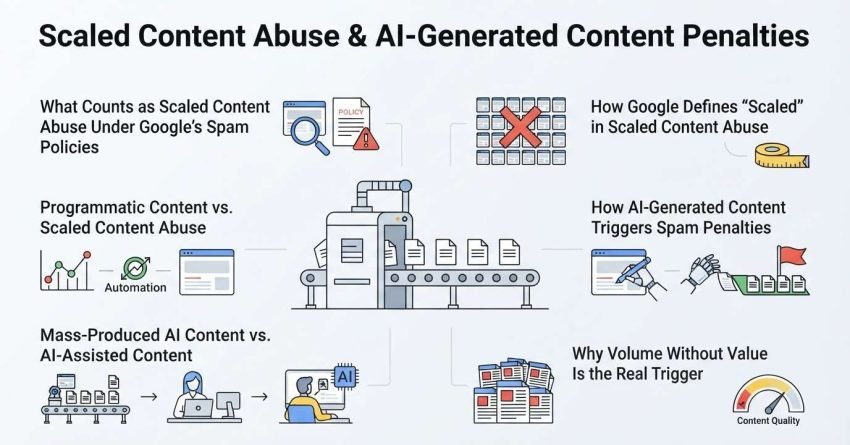
What Counts as Scaled Content Abuse Under Google’s Spam Policies
Scaled content abuse is a spam classification Google applies to content created primarily to manipulate search rankings rather than help users, regardless of whether it’s written by humans, AI, or automated tools. Google’s own spam policy documentation treats the production method as irrelevant. What matters is intent and value.
I’ve seen this catch sites that never touched AI at all. Freelancer-written content, spun across hundreds of near-identical location pages, gets flagged the same way as AI-generated listicles.
How Google Defines “Scaled” in Scaled Content Abuse
“Scaled” refers to the volume and repetition pattern, not a specific tool or word count. Google’s crawlers look for templated structures repeated across dozens or hundreds of URLs with minimal unique value added to each one.
A single AI-assisted article isn’t scaled abuse. Two thousand near-identical city landing pages generated from a spreadsheet template usually is.
Programmatic Content vs. Scaled Content Abuse
Programmatic content generation itself isn’t banned. Legitimate programmatic pages, like real estate listings or product databases, pull unique structured data into each page and provide genuine utility.
The distinction comes down to whether each page offers something a user actually needs. Pages that just swap a city name into an otherwise identical paragraph fail that test immediately.
How AI-Generated Content Triggers Spam Penalties
AI-generated content triggers spam penalties when it’s published at scale without human review, factual verification, or added expertise, not simply because an AI tool was involved in drafting it. Google has repeatedly clarified through its Search Central documentation that AI assistance in content creation isn’t itself a violation.
Mass-Produced AI Content vs. AI-Assisted Content
Mass-produced AI content typically involves generating hundreds or thousands of pages from prompts with little to no editing, fact-checking, or unique insight added. AI-assisted content uses the tool to draft, then a human editor verifies claims, adds expertise, and shapes the piece around genuine reader needs.
The volume-to-oversight ratio is the tell. One editor reviewing 500 AI drafts a week is a different risk profile than one editor reviewing five.
Why Volume Without Value Is the Real Trigger
Publishing speed alone doesn’t cause penalties. A site publishing 50 well-researched, unique pages a week is fine. A site publishing 500 templated pages with swapped keywords is not, and Google’s classifiers are specifically built to catch that pattern.
Signs Your Site Has Been Hit by a Scaled Content Penalty
A scaled content penalty typically shows up as a sudden, sitewide traffic drop rather than a gradual decline, often coinciding with a known Google core update or spam policy enforcement date. I check Search Console first, every time, before assuming anything else.
Sudden Traffic Drops in Search Console
The Performance report shows a sharp cliff, not a slope, usually affecting a large percentage of indexed pages at once rather than isolated URLs. This pattern is different from a typical ranking fluctuation, which tends to hit specific pages or keyword clusters unevenly.
Cross-reference the drop date against Google’s official search status dashboard to confirm whether it lines up with a known update rollout.
Manual Action Messages vs. Algorithmic Suppression
A manual action appears directly in Search Console under the Manual Actions tab, with a specific message like “Scaled content abuse.” Algorithmic suppression shows no such message; pages simply stop ranking as well after an update, which makes it harder to diagnose without traffic pattern analysis.
Manual Actions vs. Algorithmic Demotions for Content Spam
A manual action is a penalty applied by a human reviewer at Google after a specific site is flagged and evaluated, while an algorithmic demotion happens automatically when ranking systems detect spam patterns during a broader update. Manual actions come with a visible notice and a clear path to reconsideration. Algorithmic demotions don’t.
Recovery from a manual action follows a defined process. Recovery from algorithmic suppression requires fixing the underlying pattern and waiting for the next update cycle to reassess the site, which takes considerably longer and offers no direct feedback loop.
The March 2024 Core Update and Its Impact on Scaled Content
Google’s March 2024 core update, combined with new spam policy enforcement, resulted in a stated 45% reduction in low-quality, unoriginal content in search results, according to Google’s own announcement. This update specifically expanded the scaled content abuse policy to explicitly cover AI-generated pages at scale, which previously existed in a grayer enforcement zone.
Sites relying heavily on programmatic AI content saw the sharpest declines in the weeks following rollout. The update rolled out over roughly six weeks, meaning some sites saw delayed impact rather than an immediate hit.
How to Audit Your Site for Scaled Content Abuse
Auditing for scaled content abuse means identifying which pages were produced at scale with minimal unique value, then cross-referencing those pages against your traffic and indexing data. I start this process the same way on every site: export everything before touching anything.
Identifying Low-Value Pages at Scale
Pull a full URL list from your CMS or sitemap, then flag pages built from the same template with only variable data swapped in. Content similarity tools can automate this by scoring pages against each other for near-duplicate structure.
Pages scoring above 80% structural similarity to dozens of other URLs are strong candidates for pruning or substantial rewriting.
Using Search Console to Find Affected URLs
Filter the Performance report by the date range matching the suspected penalty, then sort pages by the steepest click and impression losses. Export this list and match it against your low-value page audit to confirm overlap.
Content Pruning and Deindexing Strategy for Recovery
Content pruning removes or consolidates low-value, templated pages that contributed to a scaled content penalty, and it’s typically the fastest path to recovery when done systematically. I’ve never seen a scaled content recovery succeed without some level of pruning involved.
- Identify pages with near-zero organic traffic and high template similarity.
- Consolidate overlapping pages into one comprehensive page where the topics genuinely overlap.
- Noindex or 410 pages that offer no unique value and can’t be reasonably improved.
- Redirect consolidated URLs to their new destination with 301s.
- Resubmit the updated sitemap through Search Console.
Rewriting vs. Removing: What to Do With Penalized Pages
Whether to rewrite or remove a penalized page depends on whether it has genuine search demand and unique potential, or whether it exists purely because a template made it easy to create. Pages with real search volume behind them are usually worth rewriting with actual expertise and unique data.
Pages that were only created because a spreadsheet had a row for them, with no independent search demand, are better removed entirely. Trying to save every page usually slows the recovery timeline without adding real value.
How to Use AI Content Without Triggering Penalties
AI content avoids triggering penalties when a qualified human editor reviews, fact-checks, and adds unique expertise or data to every piece before publication, rather than publishing raw AI output at volume. This single practice separates sites that recover quickly from sites that get flagged repeatedly.
Human Review and Editorial Oversight Requirements
Every AI-assisted draft needs a human editor verifying factual claims, checking for hallucinated statistics, and confirming the content matches genuine user intent rather than just keyword targets. The editor’s role isn’t cosmetic; it’s the actual compliance mechanism Google is checking for indirectly.
E-E-A-T Signals AI Content Still Needs
AI-drafted content still needs demonstrated experience, expertise, authoritativeness, and trust signals, meaning author bylines, credentials, original data, or first-hand examples woven into the piece. Content that reads as generic, regardless of who or what wrote it, struggles to rank even without a formal penalty.
Submitting a Reconsideration Request After a Manual Action
A reconsideration request is a formal appeal submitted through Search Console after fixing the underlying issue, asking Google to re-review the site and lift a manual action. I never submit one until every flagged page has actually been fixed or removed.
- Complete the full content audit and pruning process first.
- Document exactly what was changed, removed, or rewritten.
- Go to the Manual Actions report in Search Console and select “Request Review.”
- Write a specific, honest explanation of what caused the issue and what was fixed.
- Submit and monitor Search Console for the review outcome.
How Long Scaled Content Abuse Recovery Takes
Recovery from a manual action for scaled content abuse typically takes 2 to 4 weeks after submitting a successful reconsideration request, while algorithmic recovery can take 3 to 6 months or longer until the next relevant core update. This is one of the most common questions I get, and the honest answer disappoints most people.
Algorithmic recovery has no formal appeal process, which is what makes it slower and less predictable than a manual action. Sites that fix the underlying pattern thoroughly tend to recover faster once an update does reassess them.
Building a Sustainable Content Strategy Post-Recovery
A sustainable post-recovery content strategy prioritizes editorial review, genuine search demand research, and a publishing pace that oversight can actually keep up with. I tell every client the same thing after recovery: the pace that got you penalized isn’t coming back.
Set a realistic publishing cadence tied to your actual editorial capacity, not your content tool’s output speed. Build topic clusters around genuine user questions rather than scaling a template across every possible keyword variation.
Monitoring and Preventing Future Scaled Content Penalties
Preventing future scaled content penalties requires ongoing monitoring of publishing patterns, regular Search Console checks, and clear editorial standards applied consistently across every contributor. Set calendar reminders to review Search Console monthly, not just when traffic drops.
Track the ratio of new pages published to editor hours available, and flag it internally if that ratio starts climbing. Review Google’s spam policy updates page quarterly since enforcement details shift over time.
Conclusion
Scaled content abuse penalties come down to volume without value, whether AI or humans created the pages. Recovery requires honest auditing, pruning, and editorial oversight going forward.
The cluster of issues here connects directly to broader content quality and E-E-A-T standards Google continues to refine. Sustainable growth depends on treating content as a long-term asset, not a shortcut.
We help sites recover from penalties and rebuild sustainable visibility. Reach out to White Label SEO Service to start your recovery plan today.
Frequently Asked Questions
What is scaled content abuse in Google’s spam policy?
Scaled content abuse is content created primarily to manipulate search rankings rather than help users, produced in bulk with minimal unique value. It applies regardless of whether AI, humans, or automation created it.
Can AI-generated content rank well on Google?
Yes, AI-generated content can rank well when a human editor reviews, fact-checks, and adds genuine expertise before publishing. Google penalizes low-value volume, not the use of AI itself.
How do I know if my site has a manual action penalty?
Check the Manual Actions report inside Google Search Console for a specific notice. A sitewide traffic cliff without a manual action notice usually points to algorithmic suppression instead.
How long does it take to recover from a scaled content penalty?
Manual action recovery typically takes 2 to 4 weeks after a successful reconsideration request. Algorithmic recovery can take 3 to 6 months, tied to the next relevant core update.
Should I delete or rewrite AI-generated pages after a penalty?
Pages with genuine search demand are worth rewriting with real expertise and unique data. Pages created only because a template made it easy should be removed entirely.
Does Google penalize all AI content automatically?
No, Google does not automatically penalize AI content. Penalties target scaled, low-value publishing patterns, regardless of whether the content was written by AI or humans.
What is the difference between a manual action and an algorithmic update?
A manual action is a penalty applied by a human reviewer with a visible Search Console notice and an appeal path. An algorithmic update happens automatically with no notice and no formal appeal process.