I’ve watched multilingual sites lose 40-60% of organic traffic overnight, and hreflang errors are usually the hidden cause. An international SEO penalty is a ranking or visibility loss that happens when search engines misinterpret language, region, or duplicate content signals across a multilingual or multi-regional website. It shows up as wrong-language pages ranking in the wrong country, sudden indexing drops, or entire language folders disappearing from search results.
Multilingual sites carry structural risk that single-language sites never face. One broken hreflang tag can quietly cannibalize rankings across five country versions of the same page, and most site owners never trace the drop back to its actual source.
This guide covers how hreflang tags work and where they typically break, the difference between algorithmic filtering and manual penalties, how to diagnose international targeting errors using Search Console, the exact recovery sequence once damage has occurred, and the structural decisions URL formats, geotargeting, localization that prevent penalties from happening again.
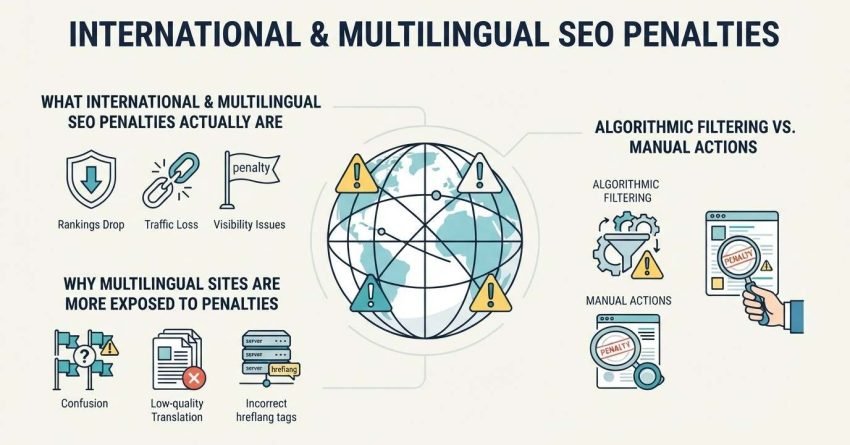
What International & Multilingual SEO Penalties Actually Are
An international SEO penalty is a drop in rankings or visibility caused by search engines misreading language, region, or duplication signals across a multi-language site, rather than by a direct violation of guidelines. Most of what site owners call a “hreflang penalty” is actually algorithmic filtering, not a manual action from Google’s spam team.
I treat these as two separate problems because the fixes are different. Filtering resolves once the underlying signal confusion is corrected. A manual action requires a formal reconsideration request after the fix.
Algorithmic Filtering vs. Manual Actions
Algorithmic filtering happens automatically when Google’s systems detect duplicate or conflicting content across regional versions and choose to demote or consolidate them. A manual action, by contrast, involves a human reviewer at Google flagging the site directly, and it always appears as a message in Google Search Console’s manual actions report.
Manual actions for pure hreflang misconfiguration are rare. Far more often, a multilingual site experiencing a traffic collapse is dealing with duplicate content filtering, not a penalty in the strict sense.
Why Multilingual Sites Are More Exposed to Penalties
Multilingual sites multiply every technical error across every language version, so a single mistake in the templating system can affect ten country pages instead of one. Translation workflows also introduce duplicate or near-duplicate content risk that single-language sites never encounter.
I’ve seen agencies roll out five new country folders in a week and only discover the hreflang mismatch three months later, once rankings had already dropped.
How Google Handles International and Multilingual Websites
Google handles international and multilingual websites by evaluating language, geographic targeting, and duplicate content signals separately, then choosing the single best-matching version to show each searcher. This means a French page in France might outrank an identical French page targeted at Canada, even if the Canadian one is technically superior.
Google’s own international targeting documentation confirms that hreflang is a signal, not a directive, meaning the algorithm can still override it when other quality signals point elsewhere.
Language vs. Country Targeting
Language targeting tells search engines what language a page is written in, while country targeting tells them which geographic audience the page serves, and these are configured independently in hreflang syntax. A page can target Spanish speakers in Mexico specifically, or Spanish speakers everywhere, depending on how the tag is written.
Confusing these two settings is one of the most common structural mistakes on multilingual sites. Getting the language-region pairing wrong sends the right content to the wrong audience.
How Google Selects Which Page Version to Rank
Google selects which version of a page to rank by combining the searcher’s location, language settings, and the hreflang signals present on the page, then serving whichever version best satisfies all three. When those signals conflict, Google tends to default to whichever version has stronger overall authority signals, even if it isn’t the intended regional match.
This is why a poorly optimized US page can sometimes outrank a well-optimized UK page in UK search results when the hreflang implementation is broken.
What Hreflang Tags Are and Why They Matter
Hreflang is an HTML attribute that tells search engines which language and regional version of a page to serve to a specific audience, preventing duplicate-content confusion across international sites. Without it, search engines are left to guess which version US English, UK English, or Australian English belongs in front of which searcher.
I consider hreflang the single highest-leverage technical fix on any multilingual site, because it directly controls indexing behavior across every regional variant at once.
The Hreflang Attribute Explained
The hreflang attribute uses a language code, optionally paired with a region code, written in the format lang-region, such as en-us or en-gb. Each page in a multilingual set needs to declare hreflang tags pointing to every other version, including itself.
A page that forgets to reference itself in its own hreflang set is a common error that breaks the entire cluster’s signal.
Hreflang and Canonical Tag Interaction
Hreflang tags and canonical tags serve different purposes and can actively conflict when canonical tags point to a single “master” version instead of self-referencing each language variant. A Google Search Central guidance page confirms each localized page should carry a self-referencing canonical, not one pointing to a different language version.
I’ve fixed dozens of international SEO issues that traced back to exactly this: canonical tags silently telling Google to ignore three out of four language versions.
Common Hreflang Implementation Methods
Hreflang can be implemented through HTML link tags in the page head, HTTP headers for non-HTML files, or entries inside an XML sitemap, and each method serves a different technical scenario. Most content-managed websites use the HTML link tag method because it’s the easiest to maintain at scale.
HTML Link Tags
HTML link tags place hreflang declarations directly inside the <head> section of each page, using a rel=”alternate” attribute paired with the hreflang value. This method works well for smaller sites but becomes error-prone past a few dozen pages, since every page needs matching, accurate tags.
HTTP Headers
HTTP header implementation declares hreflang values in the server response rather than the HTML itself, making it the required method for non-HTML content like PDFs. Very few CMS platforms support this natively, so it’s usually reserved for specific technical use cases.
XML Sitemap Hreflang
XML sitemap implementation centralizes all hreflang declarations in one file instead of scattering them across every page’s HTML, which significantly reduces maintenance overhead on large sites. Sites with hundreds or thousands of URLs across multiple languages benefit most from this centralized approach.
Duplicate Content Penalties in Multilingual SEO
Duplicate content filtering in multilingual SEO occurs when search engines detect that two or more regional pages carry substantially identical text without clear signals distinguishing their intended audiences. This isn’t usually a manual penalty; it’s Google choosing to rank only one version and suppressing the others.
Machine-Translated Content Risks
Machine-translated content that hasn’t been reviewed by a human carries a measurably higher risk of being flagged as low-quality, since Google’s spam policies explicitly name auto-generated content as a violation type when it’s published without human oversight or added value.
I always tell clients that raw machine translation across ten country pages isn’t ten pages of content. It’s one page of content copy-pasted ten times with different vocabulary.
Common Hreflang Errors That Trigger Ranking Loss
The most common hreflang errors are missing return tags, incorrect language or region codes, and conflicts with canonical tag declarations, and any one of these can cause entire language sections to drop from search results. These errors compound because hreflang is a reciprocal system that fails silently.
Missing Return Tags (No Confirmation Links)
A missing return tag happens when Page A references Page B in its hreflang set, but Page B doesn’t reference Page A back, breaking the required reciprocal confirmation. Google explicitly ignores hreflang annotations that aren’t confirmed by a matching return tag on the destination page.
Incorrect Language/Region Codes
Incorrect language or region codes occur when a site uses a country code where a language code belongs, such as writing en-eu instead of a valid ISO code, causing search engines to silently discard the tag. The ISO 639-1 language code standard and ISO 3166-1 country codes are the only valid inputs hreflang accepts.
Conflicting Signals With Canonical Tags
Conflicting canonical signals happen when a page’s canonical tag points to a different language version than the one hreflang is declaring, telling search engines two contradictory things about which page is authoritative. This single conflict is responsible for a large share of the “my hreflang isn’t working” cases I’ve diagnosed.
URL Structures for International SEO (ccTLD vs. Subdomain vs. Subfolder)
International URL structure falls into three main categories: country-code top-level domains like .de or .fr, subdomains like de.example.com, and subfolders like example.com/de/, each carrying different authority-consolidation tradeoffs. ccTLDs send the strongest geographic signal but split domain authority across separate properties entirely.
Subfolders consolidate all authority under one domain, which is why I default most mid-sized international sites toward that structure unless there’s a strong local-market reason to use a ccTLD.
Geotargeting Settings and Their Impact on Visibility
Geotargeting settings tell search engines which country a section of a website is intended to serve, independent of the language the content is written in. This setting matters most for generic top-level domains like .com, since ccTLDs already carry an implicit geographic signal on their own.
Misconfigured geotargeting can suppress a page from ranking in its intended country even when every other SEO element is technically correct.
Signs Your Multilingual Site Has Been Penalized or Filtered
The clearest signs of international SEO filtering are sudden traffic drops isolated to specific language folders, wrong-country pages ranking in search results, and a mismatch between indexed page count and published page count in Search Console. These symptoms typically appear together rather than in isolation.
Traffic Drop Patterns Specific to International Sites
International traffic drops often show a distinctive pattern where one language folder collapses while others remain stable, pointing directly at a localized hreflang or canonical error rather than a site-wide algorithm update. A site-wide update tends to affect all language versions proportionally, while a technical hreflang break isolates itself to specific folders.
How to Diagnose Hreflang and International SEO Errors
Diagnosing hreflang errors starts with Google Search Console’s International Targeting report, followed by a manual audit of return tags, language codes, and canonical alignment across every regional URL set. Most diagnostic work can be done without paid tools, though scale changes that calculation quickly.
Using Google Search Console International Targeting Reports
The International Targeting report inside Search Console flags specific hreflang errors including missing return tags and invalid language codes, directly at the URL level. This report is the first place I check whenever a multilingual client reports an unexplained ranking drop.
Hreflang Auditing Tools
Dedicated hreflang auditing tools crawl an entire site and cross-reference every declared hreflang tag against its target, flagging broken reciprocal links across thousands of URLs simultaneously. This becomes essential once a site exceeds roughly 500 URLs, where manual checking stops being realistic.
Recovery Process for Hreflang and International SEO Penalties
Recovery from an international SEO penalty starts with fixing the underlying hreflang and canonical errors, then monitoring reindexing through Search Console before considering a reconsideration request. Most cases resolve through algorithmic re-evaluation once the technical signals are corrected, without needing a formal request at all.
Fixing Hreflang Tag Errors
Fixing hreflang errors means correcting every broken return tag, replacing invalid language and region codes, and aligning canonical declarations so each page self-references correctly. I always fix all instances across the entire tag set at once, since a partial fix just shifts which pages get suppressed.
Requesting Reconsideration (When Applicable)
A reconsideration request through Google Search Console is only necessary when a manual action appears in the Security & Manual Actions report, not for algorithmic filtering. Submitting one without an actual manual action flag wastes review time and won’t resolve algorithmic suppression.
Content Localization vs. Direct Translation
Localization adapts content to a target market’s cultural context, currency, idioms, and search behavior, while direct translation simply converts words from one language to another without adjusting meaning or relevance. Search engines increasingly reward localized content because it better matches actual local search intent.
I’ve seen directly translated pages underperform localized versions by wide margins, even when the translation quality itself was excellent.
Structured Data and Multilingual Markup Considerations
Structured data on multilingual sites needs to be translated and localized in the same language as its corresponding page, since mismatched structured data language can confuse how search engines interpret the page’s content. A German page carrying English-language schema markup sends a contradictory signal about the page’s actual language.
Best Practices to Prevent Future International SEO Penalties
Preventing international SEO penalties means auditing hreflang implementation on a recurring schedule, using self-referencing canonicals consistently, and requiring human review on any translated or localized content before publishing. Building this into a standing technical checklist prevents the slow accumulation of errors that typically causes these penalties in the first place.
Treating international SEO as an ongoing maintenance discipline, rather than a one-time setup task, is what separates multilingual sites that stay stable from ones that quietly lose rankings every few months.
How International SEO Penalties Affect Timelines and ROI
International SEO penalties extend recovery timelines significantly beyond a typical single-market SEO timeline, since fixes need to propagate and be re-crawled across every affected language version before rankings stabilize. Recovery can take anywhere from a few weeks for straightforward tag fixes to several months when duplicate content filtering has taken hold.
Budgeting for this reality upfront changes how a business plans its international expansion timeline and its expected return on that investment.
Conclusion
International SEO penalties trace back to hreflang errors, canonical conflicts, and duplicate content across language versions. Understanding these mechanics protects rankings across every regional market you operate in.
Multilingual SEO keeps evolving as more markets and languages get added to a site’s footprint. Staying ahead of it requires ongoing technical monitoring and correction.
We help businesses diagnose and recover from international SEO penalties fast. Talk to White Label SEO Service today to protect your global rankings.
Frequently Asked Questions
What is an hreflang penalty?
An hreflang penalty isn’t typically a formal penalty at all, but algorithmic filtering caused by broken or conflicting hreflang tags. It results in wrong-language pages ranking or entire regional sections losing visibility.
How do I know if hreflang is causing duplicate content issues?
Check Google Search Console’s International Targeting report for flagged errors first. A sudden drop isolated to one language folder strongly suggests hreflang-related duplicate content filtering.
Can Google penalize a site for having multiple language versions?
Google doesn’t penalize multiple language versions by default; the risk comes from duplicate, untranslated, or poorly configured content between them. Proper hreflang implementation prevents this from becoming a duplication problem.
How long does hreflang recovery take?
Simple tag fixes often show improvement within two to four weeks after recrawling. Deeper duplicate content filtering can take two to three months to fully resolve.
Do I need hreflang if I only translate part of my site?
Yes, hreflang should be applied to every translated page set, even partial ones. Skipping it on partial translations still creates duplicate content ambiguity for search engines.
What is the difference between geotargeting and hreflang?
Geotargeting tells search engines which country a section serves, while hreflang tells them which language and regional audience a specific page matches. They work together but control different signals.
Should I use subdirectories or ccTLDs for international SEO?
Subdirectories consolidate domain authority under one property, making them the more scalable default. ccTLDs send a stronger local signal but require building authority separately for each domain.