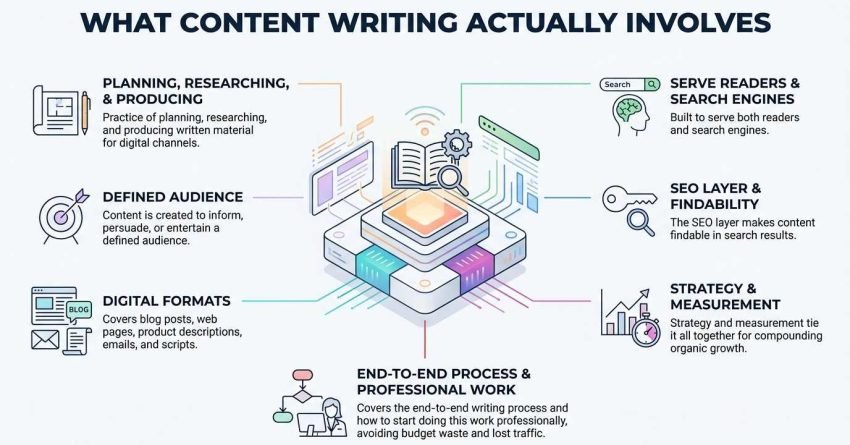
Content writing is the practice of planning, researching, and producing written material for digital channels that informs, persuades, or entertains a defined audience. It covers blog posts, web pages, product descriptions, emails, and scripts, and it is built to serve both readers and search engines.
I have watched businesses pour budget into content without knowing what content writing actually involves. That gap costs them traffic, leads, and years of compounding organic growth.
This guide covers what content writing means and how it differs from adjacent disciplines, the main formats and the skills behind them, the end-to-end writing process, the SEO layer that makes content findable, how strategy and measurement tie it all together, and how to start doing this work professionally.
What Content Writing Actually Means
Content writing is the discipline of creating written material for digital publication with a defined audience, purpose, and distribution channel. It sits between journalism, marketing, and technical documentation, and it borrows from all three.
I get asked constantly whether content writing is just blogging. It is not. Blogging is one output format inside a much wider practice.
The Core Definition of Content Writing
The work has three non-negotiable parts. You research a subject, you structure the information, and you write it in language your reader understands.
Everything else sits on top of that foundation. SEO, tone, formatting, and distribution are layers, not substitutes.
What separates content writing from general writing is the commercial intent behind it. Every piece exists to move someone toward an outcome, whether that outcome is understanding, trust, a subscription, or a purchase.
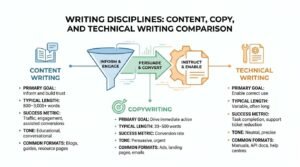
Content Writing vs. Copywriting vs. Technical Writing
Copywriting is a form of persuasive writing built to drive an immediate action, such as a click, a signup, or a purchase. Content writing informs first and converts second.
Technical writing is a form of instructional writing that documents how a product, system, or process works with precision and repeatability. It optimises for accuracy over engagement.
Here is how the three disciplines compare across the attributes that matter most:
| Attribute | Content Writing | Copywriting | Technical Writing |
| Primary goal | Inform and build trust | Drive immediate action | Enable correct use |
| Typical length | 800–3,000+ words | 20–500 words | Variable, often long |
| Success metric | Traffic, engagement, assisted conversions | Conversion rate | Task completion, support ticket reduction |
| Tone | Educational, conversational | Persuasive, urgent | Neutral, precise |
| Common formats | Blogs, guides, resource pages | Ads, landing pages, emails | Manuals, API docs, help centres |
Most working writers move between all three. The difference between content writing and copywriting shows up in how each one measures success, not in the sentence-level craft.
Why Content Writing Matters for Business Growth
Content writing matters because organic search is the largest and most durable traffic source most businesses have access to. A well-researched article keeps earning visits years after publication, while paid traffic stops the moment the budget does.
I have seen single guides generate more qualified leads over three years than an entire quarter of ad spend.
Content as an Organic Traffic Engine
Search engines need something to rank, and that something is content. Every page you publish is an entry point that can capture demand you did not create.
HubSpot’s State of Marketing research found that companies publishing consistently see substantially higher lead volume than those publishing sporadically. Consistency compounds because search engines reward sites that demonstrate sustained topical coverage.
The compounding effect is the part beginners underestimate. Content published in year one still contributes traffic in year four.
How Content Supports Leads and Revenue
Content works across the whole buying journey, not just the top of it. Awareness pieces bring people in, comparison pieces help them evaluate, and decision pieces help them choose.
The link between reading and revenue runs through trust. Someone who has read three of your articles arrives at a sales conversation already convinced you know the subject.
Attribution is where this gets difficult, and understanding content marketing ROI requires tracking assisted conversions rather than last-click alone. Most content contributes to revenue; it never gets credit for it in a default analytics report.
The Main Types of Content Writing
Content writing splits into distinct formats, each with its own conventions, length, and success metric. Most professional writers specialise in two or three rather than attempting all of them.
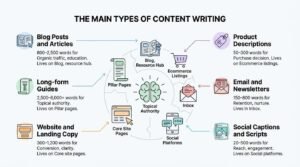
The table below shows the main formats and what each one is built to achieve:
| Format | Typical length | Primary goal | Where it lives |
| Blog posts and articles | 800–2,500 words | Organic traffic, education | Blog, resource hub |
| Long-form guides | 2,500–6,000+ words | Topical authority | Pillar pages |
| Website and landing copy | 300–1,200 words | Conversion, clarity | Core site pages |
| Product descriptions | 50–300 words | Purchase decision | Ecommerce listings |
| Email and newsletters | 150–800 words | Retention, nurture | Inbox |
| Social captions and scripts | 20–500 words | Reach, engagement | Social platforms |
Blog and Article Writing
Blog writing is the highest-volume format in the industry and the usual entry point for beginners. Articles target specific questions or topics that an audience already searches for.
Blog posts differ from long-form guides mainly in scope. An article answers one question thoroughly, while a guide maps an entire subject area.
Website and Landing Page Content
Website content explains who a business is, what it does, and why someone should care, usually in far fewer words than a blog post. Landing pages narrow that further to a single offer and a single action.
The constraint here is space. You get one screen to establish relevance before someone leaves.
Product and Ecommerce Descriptions
Product descriptions translate specifications into reasons to buy. The best ones answer the objection the shopper has not voiced yet.
Writing effective product descriptions means balancing search terms that shoppers use with the sensory and practical detail that closes the sale.
Email and Newsletter Writing
Email writing targets an audience that has already opted in, which changes the tone completely. You are writing to people who know you, so the persuasion burden drops and the value burden rises.
Subject lines carry disproportionate weight. Nothing else in the email matters if the open never happens.
Social, Script, and Long-Form Formats
Social captions, video scripts, whitepapers, and case studies all fall under content writing. Each has its own rhythm, but the underlying research and structural discipline stays constant.
Video scripts in particular reward writers who can think in spoken rather than written sentences.
The Core Skills Every Content Writer Needs
The core skills of content writing are research, structural thinking, clear prose, and disciplined self-editing. Grammar matters, but it ranks below all four of those.
I hire on research ability before writing flair. A writer who researches properly can be taught structure, but a stylish writer who invents facts is unusable.
Research and Source Evaluation
Research means finding primary sources, not summarising the top three Google results. A content writer who only reads competitors produces content that adds nothing to the conversation.
Source evaluation is the paired skill. You need to distinguish an original study from a blog post that misquoted it three hops later.
Structure and Clarity
Structure is the skeleton beneath every good piece. Readers scan before they read, so the heading hierarchy has to communicate the argument on its own.
Clarity means writing sentences a distracted reader understands on the first pass. Short sentences, concrete nouns, active verbs.
Editing and Self-Review
Editing is where average drafts become publishable. The rule I follow is that the first draft gets everything down and the second draft cuts twenty percent of it.
Self-review requires distance. Reading a draft aloud catches problems your eye skips over entirely.
The Content Writing Process, Step by Step
The content writing process runs through five stages: briefing, research, outlining, drafting, and editing. Skipping any stage shows up in the finished piece.
Beginners tend to start drafting immediately. That habit costs more time than it saves, because unstructured drafts get rewritten rather than edited.
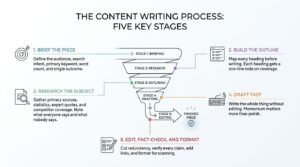
Here is the sequence I work through on every piece:
- Brief the piece. Define the audience, the search intent, the primary keyword, the word count, and the single outcome the piece must achieve.
- Research the subject. Gather primary sources, statistics, expert quotes, and competitor coverage. Note what everyone says and what nobody says.
- Build the outline. Map every heading before writing a sentence. Each heading gets a one-line note on what it will cover.
- Draft fast. Write the whole thing without editing. Momentum matters more than polish at this stage.
- Edit, fact-check, and format. Cut redundancy, verify every claim, add links, and format for scanning.
Briefing and Intent Definition
The brief is the contract between the writer and the outcome. A weak brief produces a piece that reads fine but ranks for nothing.
Writing a strong content brief means specifying the target query, the format, the competing pages, and the angle before any writing begins.
Research and Outlining
Research feeds the outline, and the outline controls the draft. I spend roughly a third of total project time here.
The test of a good outline is that someone else could write the piece from it.
Drafting
Drafting is the fastest stage when the outline is solid. Write badly on purpose if it keeps you moving.
The draft exists to be edited, not admired.
Editing, Fact-Checking, and Publishing
Editing runs in passes rather than all at once. One pass for structure, one for sentence-level clarity, one for facts, one for formatting.
Fact-checking is non-negotiable on anything with a number in it. Every statistic gets traced back to its original source before publication.
How Search Intent Shapes What You Write
Search intent is the underlying goal behind a search query, and it determines the format your content must take to rank. Writing a listicle for a query that demands a tutorial fails regardless of quality.
I check intent before I check keyword volume. Volume tells you how many people search; intent tells you what to actually write.
The four intent types map to distinct content formats:
| Intent type | What the searcher wants | Content format that ranks |
| Informational | To learn or understand | Guides, explainers, how-tos |
| Navigational | To reach a specific site or page | Brand pages, login pages |
| Commercial | To compare before buying | Comparisons, reviews, best-of lists |
| Transactional | To buy or sign up now | Product pages, pricing pages |
The Four Intent Types
Informational queries dominate content writing work because they carry the highest volume and the lowest competition per query. Commercial queries convert better but attract more aggressive competitors.
Understanding search intent properly means reading the current search results rather than guessing, because the ranking pages reveal what the engine has decided the query means.
Matching Format to Intent
Format matching is mechanical once intent is clear. A “how to” query gets steps, a “best” query gets a ranked list, a “vs” query gets a comparison table.
Mismatched format is the single most common reason well-written content fails to rank.
Keyword Research for Content Writers
Keyword research is the process of identifying the terms an audience actually types into search engines, then choosing which ones a piece of content will target. It is a demand-discovery exercise, not a word-stuffing exercise.
Writers who skip this stage write about what interests them rather than what anyone searches for.
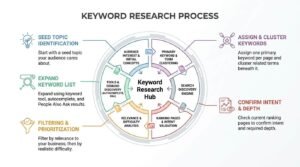
The practical workflow looks like this:
- Start with a seed topic your audience cares about.
- Expand it using a keyword tool, autocomplete, and People Also Ask results.
- Filter by relevance to your business, then by realistic difficulty.
- Assign one primary keyword per page and cluster related terms beneath it.
- Check the current ranking pages to confirm intent and required depth.
Finding Topics People Actually Search
Autocomplete and People Also Ask are free and underused. They show real query phrasing rather than the tidy terms marketers assume people use.
Effective keyword research also means checking whether you can realistically compete, because targeting a term dominated by national publishers wastes months.
Primary, Secondary, and Semantic Terms
The primary keyword defines the page. Secondary keywords are close variations that belong in headings and subheadings.
Semantic terms are the related vocabulary that naturally appears when a subject is covered properly. You do not force these in; they arrive when the research is thorough.
On-Page SEO Fundamentals for Writers
On-page SEO is the set of optimisations applied directly to a page’s content and HTML to help search engines understand and rank it. Writers control most of these elements directly.
You do not need to be a technical SEO to handle the writer’s share of on-page work.
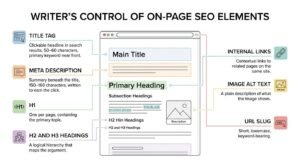
The elements that sit inside a writer’s control:
- Title tag: the clickable headline in search results, 50–60 characters, primary keyword near the front
- Meta description: the summary beneath the title, 150–160 characters, written to earn the click
- H1: one per page, containing the primary topic
- H2 and H3 headings: a logical hierarchy that maps the argument
- Internal links: contextual links to related pages on the same site
- Image alt text: a plain description of what the image shows
- URL slug: short, lowercase, keyword-bearing
Titles, Headings, and Meta Descriptions
Titles do two jobs at once. They tell the search engine what the page is about and tell the human whether to click.
Writing title tags and meta descriptions that perform means front-loading the topic and leaving a reason to click at the end.
Internal Linking Basics
Internal links pass authority between pages and help readers find related material. The anchor text should describe the destination in plain language.
Effective internal linking connects new content to established pages in the same topic area, which helps search engines understand how a site’s subjects relate.
Readability and Formatting Signals
Short paragraphs, clear subheadings, and generous white space keep readers on the page. Time on page and scroll depth are behavioural signals worth protecting.
Formatting is not decoration. It is comprehension architecture.
Content Structure and Formatting That Works
Content structure is the arrangement of headings, paragraphs, and visual elements that makes a page scannable and logically ordered. Structure determines whether a reader stays past the first screen.
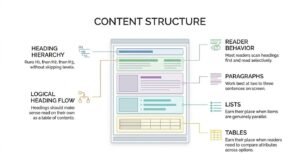
Most readers scan headings first and read selectively. Write for that behaviour rather than against it.
Heading Hierarchy
Heading hierarchy runs H1, then H2, then H3, without skipping levels. Each H2 covers a distinct dimension of the topic, and each H3 covers a component of its parent H2.
Headings should make sense read on their own as a table of contents. If they do not, the structure is wrong.
Paragraphs, Lists, and Tables
Paragraphs work best at two to three sentences on screen. Longer blocks lose mobile readers immediately.
Lists earn their place when items are genuinely parallel. Tables earn their place when readers need to compare attributes across options, which is why they perform so well in search result snippets.
Writing for Humans and Search Engines at the Same Time
Writing for both audiences means producing genuinely useful prose that also happens to be structured for machine extraction. These goals conflict far less often than beginners assume.
The conflict only appears when writers treat SEO as something applied to content rather than built into it.
The Extractability Principle
Extractability is the property of a sentence that lets it be lifted out of a page and quoted accurately on its own. AI Overviews and featured snippets cite sentences, not pages.
A sentence that starts with “it” or “this” and depends on the previous paragraph cannot be extracted. Name the subject in every sentence that carries a claim.
Content written for featured snippets opens each section with a direct answer before adding context, because the answer is what gets lifted.
Avoiding Keyword Stuffing
Keyword stuffing is the repeated, unnatural insertion of target terms into content in an attempt to influence rankings. Search engines have penalised it for well over a decade.
Write the topic properly, and the keywords appear on their own. If you have to force a phrase in, the phrasing is wrong.
E-E-A-T and Content Quality Standards
E-E-A-T stands for Experience, Expertise, Authoritativeness, and Trust, and it is the framework Google’s Search Quality Rater Guidelines use to assess content quality. It is not a direct ranking factor, but it describes what the ranking systems are built to reward.
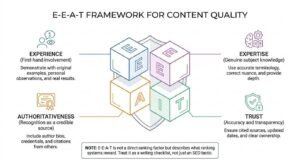
I treat E-E-A-T as a writing checklist rather than an SEO tactic.
| Signal | What it means | How writers demonstrate it |
| Experience | First-hand involvement with the subject | Original examples, personal observations, real results |
| Expertise | Genuine subject knowledge | Accurate terminology, correct nuance, depth |
| Authoritativeness | Recognition as a credible source | Author bios, credentials, citations from others |
| Trust | Accuracy and transparency | Cited sources, updated dates, clear ownership |
Experience, Expertise, Authoritativeness, and Trust
Experience became the newest addition to the framework, and it is the hardest to fake. Content that shows someone actually did the thing reads differently from content that summarises people who did.
Trust sits at the centre of the four. Inaccurate content undermines every other signal.
Sourcing and Citation Practices
Every statistic gets a link to its original source in the same sentence as the number. Aggregator sites that restate other people’s data are not sources.
Building topical authority requires this discipline across an entire site, not on a single page, because the signal is measured at the domain level.
Content Strategy: Where Individual Pieces Fit
Content strategy is the plan that determines what content gets created, for whom, in what order, and to what end. Without it, publishing becomes activity rather than progress.
Individual articles rarely move a business on their own. Coordinated sets of articles do.
Topic Clusters and Pillar Pages
A topic cluster is a group of related pages covering one subject area, organised around a central pillar page that links to each of them. The structure signals to search engines that a site covers a subject comprehensively.
The pillar page sits at the centre and covers the whole subject at an overview depth, while cluster pages handle each subtopic in full. This guide is itself a pillar page.
Editorial Calendars and Publishing Cadence
An editorial calendar assigns topics, owners, and dates so publishing survives busy weeks. Consistency beats volume for search engines and audiences alike.
Cadence matters more than frequency. Two pieces a month for two years outperforms twenty pieces in one month followed by silence.
AI Writing Tools and the Modern Content Workflow
AI writing tools are language models that generate drafts, outlines, and variations from prompts. They accelerate parts of the content process without replacing the judgement that makes content worth publishing.
Adoption has been rapid. Semrush’s AI content research reports that a substantial majority of marketers now use AI somewhere in their content workflow.
Where AI Helps and Where It Fails
AI is strong at outlining, rephrasing, summarising research, and generating format variations. It is weak at original insight, verified facts, and anything requiring first-hand experience.
The failure mode is confident invention. Models produce plausible statistics and citations that do not exist.
Human Review Requirements
Every AI-assisted draft needs a human pass for accuracy, voice, and originality. Fact-checking is mandatory, not optional.
Search engines do not penalise AI use directly, but they do penalise unhelpful content, and unreviewed AI output is reliably unhelpful.
How to Measure Content Performance
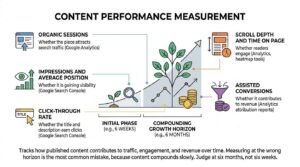
Content performance measurement tracks how published content contributes to traffic, engagement, and revenue over time. Measuring at the wrong horizon is the most common mistake, because content compounds slowly.
I judge a piece at six months, not six weeks.
| Metric | What it tells you | Where to find it |
| Organic sessions | Whether the piece attracts search traffic | Google Analytics |
| Impressions and average position | Whether it is gaining visibility | Google Search Console |
| Click-through rate | Whether the title and description earn clicks | Google Search Console |
| Scroll depth and time on page | Whether readers engage | Analytics, heatmap tools |
| Assisted conversions | Whether it contributes to revenue | Analytics attribution reports |
Traffic, Rankings, and Engagement Metrics
Impressions rise before clicks do, and clicks rise before conversions. Reading those signals in sequence tells you whether a piece is working or stalling.
Using Google Search Console properly shows which queries a page already surfaces for, which often reveals opportunities the original brief missed.
Conversion and Revenue Attribution
Last-click attribution systematically undervalues informational content. Assisted conversion reports show the pages people read on their way to converting.
The honest answer is that content attribution is imperfect everywhere. Track directionally and make decisions on trends rather than single numbers.
Common Content Writing Mistakes Beginners Make
The most common beginner mistakes are writing before researching, ignoring search intent, burying the answer, and publishing without editing. Each one is fixable with process rather than talent.
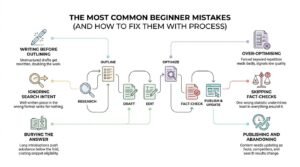
I made every one of these in my first year.
- Writing before outlining. Unstructured drafts get rewritten rather than edited, which doubles the work.
- Ignoring search intent. A well-written piece in the wrong format ranks for nothing.
- Burying the answer. Long introductions push the substance below the fold and cost you snippet eligibility.
- Over-optimising. Forced keyword repetition reads badly and signals low quality.
- Skipping fact-checks. One wrong statistic undermines trust in everything around it.
- Publishing and abandoning. Content needs updating as facts, competitors, and search results change.
How to Start a Content Writing Career
Starting a content writing career requires a portfolio of published work, a demonstrable niche, and a working understanding of SEO. Formal qualifications matter far less than evidence you can do the job.
Most people overestimate the barrier and underestimate the consistency required.
Building a Portfolio
A portfolio needs three to five strong pieces, not thirty average ones. Self-published work counts if it is genuinely good.
Choose a niche early. Specialists earn more than generalists in almost every content market.
Rates, Clients, and In-House Roles
Freelance rates vary enormously by niche, market, and experience. Technical, financial, and medical writing pay well above general lifestyle content.
In-house roles offer stability and deeper subject knowledge, while freelancing offers rate control and variety. Building a freelance writing business means treating client acquisition as seriously as the writing itself.
Conclusion
Content writing combines research, structure, clear prose, and search understanding into published work that serves a defined audience and a defined business outcome.
The discipline connects to keyword research, on-page SEO, content strategy, and performance measurement, each of which rewards deeper study on its own terms.
We help brands turn this understanding into consistent organic growth. Talk to White Label SEO Service about building a content programme that compounds.
Frequently Asked Questions
What does a content writer actually do?
A content writer researches subjects, plans structure, and produces written material for websites, blogs, emails, and marketing channels. The role includes editing and basic SEO application.
Do I need a degree to become a content writer?
No degree is required to become a content writer. Clients and employers hire based on portfolio quality, subject knowledge, and reliability rather than formal qualifications.
How long should a piece of content be?
Content length should match what the topic and the ranking competitors require, typically 800–2,500 words for articles. Length is an outcome of coverage, not a target.
Is content writing the same as SEO writing?
Content writing and SEO writing overlap but differ in emphasis. SEO writing prioritises search visibility, while content writing prioritises reader value with search as a layer.
How much do content writers earn?
Content writer earnings vary widely by niche, market, and experience level. Technical, financial, and B2B specialists consistently earn more than general lifestyle writers.
Can AI replace content writers?
AI cannot replace content writers because it lacks first-hand experience, verified accuracy, and original insight. It accelerates drafting while humans handle judgment and fact-checking.
How long does content take to rank?
Content typically takes four to twelve months to reach meaningful rankings. New sites with limited authority sit at the longer end of that range.