I’ve watched agencies hit a ceiling around the same point every time. White label SEO partnerships let agencies scale service delivery by outsourcing technical execution to a specialized provider while retaining the client relationship and brand. It solves the exact problem that stalls most growing agencies: too many clients, not enough hands, and no time to hire and train an internal team fast enough.
Agencies that ignore this bottleneck lose clients to slower turnaround. We’ve seen churn spike the moment delivery capacity falls behind sales.
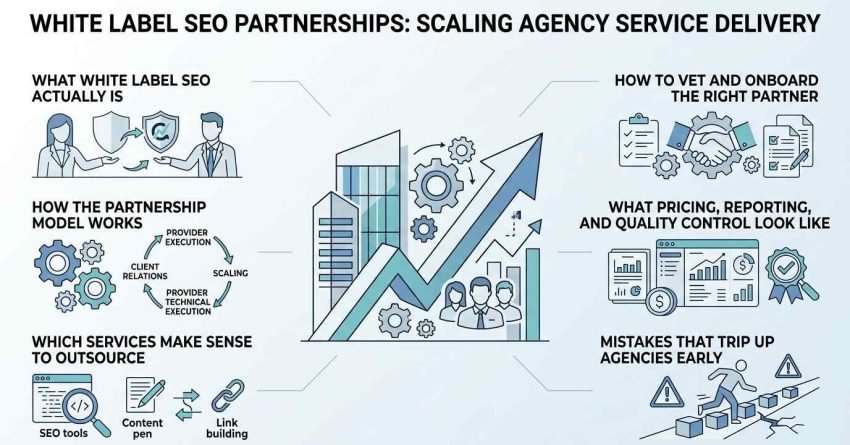
This guide covers what white label SEO actually is and how the partnership model works, which services make sense to outsource, how to vet and onboard the right partner, and what pricing, reporting, and quality control look like once you’re running campaigns at scale. I’ll also flag the mistakes that trip up agencies early.
What Is White Label SEO and How Does It Work?
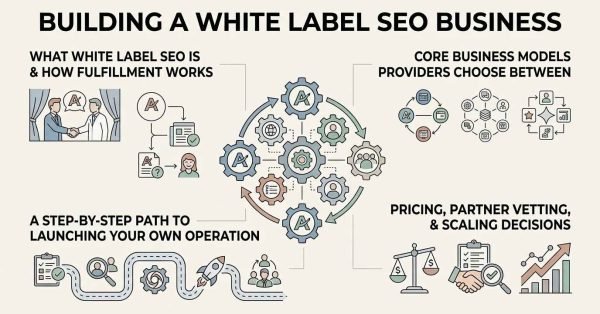
White label SEO is a service arrangement where one company performs SEO work that another company sells and delivers to its own clients under its own brand. The end client never sees the provider’s name; they only see your agency.
I think of it as renting expertise and capacity rather than building it from scratch. The provider handles execution, audits, content, link building, and technical fixes, while you manage the client relationship, strategy conversations, and invoicing.
This differs from a typical subcontracting arrangement because the branding stays yours entirely. Reports, dashboards, and even login portals often carry your agency’s logo instead of the provider’s.
Key Players in a White Label SEO Partnership
Three parties sit inside every white label arrangement: the agency (you), the white label provider, and the end client. The client only interacts with the agency, never the provider.
Your agency owns the strategy conversation and the client relationship. The provider owns execution: the actual audits, the content production, the outreach for links.
White Label vs. In-House SEO Delivery
In-house delivery means your own employees do the SEO work under your direct supervision. White label delivery shifts execution to an external specialized team while your agency retains client ownership and billing.
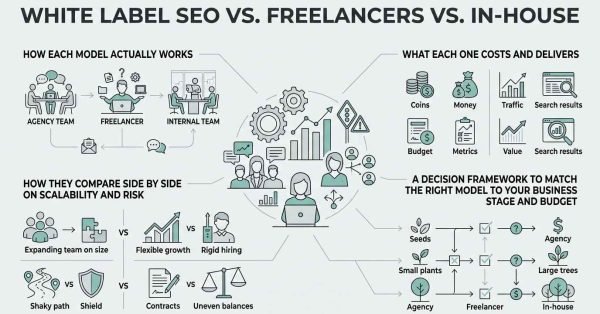
In-house gives you tighter quality control but requires salaries, training, and tools regardless of workload. White label flexes with demand: you pay per project or per client, not per employee, which matters most when client volume fluctuates seasonally, and staffing up and down isn’t realistic.
Why Agencies Turn to White Label Partnerships to Scale
Agencies turn to white label partnerships because scaling an in-house SEO team is slow, expensive, and risky against unpredictable client demand. Hiring a full technical SEO specialist, content writer, and link builder can take months and tens of thousands in salary before the first client sees results.
I’ve seen agencies land three new clients in a month and have no way to service them without white-labeling the overflow. The partnership model closes that gap in weeks, not quarters.
Common Growth Bottlenecks White Labeling Solves
Capacity constraints, skill gaps, and slow hiring cycles are the three bottlenecks white labeling addresses most directly. Agencies often sell SEO services they can’t fully execute in-house, especially technical work like site architecture audits that require specialized skill sets.
Cash flow is another factor. Paying a provider only when you have billable work avoids the fixed cost of full-time hires sitting idle between contracts.
Core Services You Can White Label
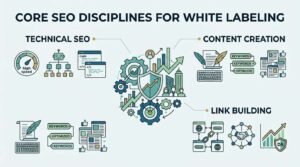
Nearly every core SEO discipline can be white-labeled, including technical SEO, content creation, link building, local SEO, and reporting. Agencies typically start with the service that’s hardest to staff internally.
I recommend agencies white label their weakest internal skill first rather than trying to outsource everything at once. That keeps quality control manageable while you learn how a new partner operates.
Technical SEO
Technical SEO covers the backend elements that determine whether search engines can crawl, index, and rank a site properly, things like site speed, crawlability, and structured data. This work requires developer-level skills that most content-focused agencies don’t have in-house.
A white label technical SEO provider typically runs the audit, prioritizes fixes, and either implements changes directly or hands your team a prioritized punch list. Crawl budget optimization alone can require hours of specialized diagnostic work most agencies don’t have time for.
Content Creation
Content creation for SEO means producing keyword-targeted, search-optimized pages and articles designed to rank and convert. Volume is usually the constraint here; agencies managing ten clients might need forty articles a month, which no small internal team can sustainably produce.
White label content partners scale output without agencies hiring a full editorial staff. Quality control matters most here since content is client-facing and directly shapes their perception of your agency’s work.
Link Building
Link building is the process of earning backlinks from other websites to build a domain’s authority and improve its rankings. It’s one of the most time-intensive and relationship-dependent parts of SEO, which makes it a common first choice for white labeling.
A Backlinko study found that pages ranking in the top 10 results had significantly more referring domains than lower-ranked pages, reinforcing why consistent link acquisition matters for long-term ranking gains. Outreach, relationship building, and content placement take specialized skills most agencies don’t want to build internally.
How to Choose the Right White Label SEO Partner
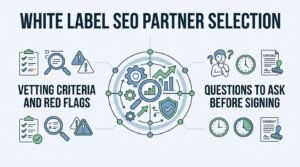
The right white label SEO partner has proven case studies, transparent reporting, clear communication timelines, and pricing that supports your margin structure. I always start by asking a prospective partner for three client results, not just testimonials.
A provider who can’t show measurable outcomes, even anonymized, isn’t a partner worth the risk. Your agency’s reputation is on the line every time they touch a client account.
Vetting Criteria and Red Flags
Vetting criteria should include client retention rates, communication responsiveness, reporting transparency, and whether the provider has experience in your client’s industry. Red flags include vague reporting, no direct point of contact, and reluctance to share sample deliverables.
I walk away from any provider that won’t explain their process step by step. If they can’t explain it to me, they definitely can’t explain it well enough for me to explain it to a client.
Questions to Ask Before Signing
Before signing, agencies should ask about turnaround times, escalation processes, white label report customization, and what happens if a campaign underperforms. These questions surface problems before they become client-facing disasters.
I also ask how many other agencies share the same account manager. Overloaded account managers are the number one reason communication breaks down mid-partnership.
Pricing Models and Profit Margins in White Label SEO
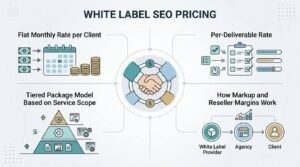
White label SEO pricing typically follows either a flat monthly rate per client, a per-deliverable rate, or a tiered package model based on service scope. Flat monthly rates are most common because they’re predictable for both the agency and the provider.
An Ahrefs survey of SEO professionals found that most agencies charge clients between $1,500 and $5,000 per month for SEO retainers, giving agencies substantial room to mark up white label costs and still deliver value.
How Markup and Reseller Margins Work
Markup is the difference between what you pay the white label provider and what you charge your client, and it’s where your profit lives. Agencies typically mark up white label services by 50% to 150%, depending on service complexity and their own overhead.
I’ve seen agencies undercharge because they’re nervous about markup optics. Clients pay for the relationship and outcomes you manage, not just the raw execution cost.
Building Your White Label SEO Workflow and Onboarding Process
A solid white label workflow starts with a standardized onboarding checklist covering client goals, access credentials, and reporting cadence before any work begins. Skipping this step is the fastest way to create confusion between your team, the provider, and the client.
I map out exactly who owns which task at each stage: kickoff call, keyword research handoff, first draft review, and client delivery. Clear ownership prevents dropped balls during handoffs between your team and the white label provider.
Reporting and Client Communication Under a White Label Model
Reporting under a white label model should look and feel entirely like it comes from your agency, with your branding, your voice, and your explanations layered over the provider’s raw data. Clients should never see a mention of the underlying provider anywhere in the deliverables.
I always review reports before they go out, even when the provider builds them well. It’s my agency’s name on that document, and errors reflect on us, not them.
White Labeled Dashboards and Branded Reports
White labeled dashboards pull live ranking, traffic, and conversion data into a branded interface clients can access directly. Most white label providers offer this as a built-in feature rather than a custom build.
I push clients toward scheduled report reviews rather than raw dashboard access alone. Numbers without context create more client anxiety than confidence.
Setting Realistic SEO Timelines for Client Expectations

Realistic SEO timelines typically show measurable ranking movement within three to six months, with significant traffic and lead growth appearing between six and twelve months. Agencies that promise faster results set themselves up for client churn when reality doesn’t match the pitch.
An Ahrefs study of two million keywords found that only 5.7% of newly published pages reach the top 10 search results within a year. I set that expectation with clients on day one, before any contract is signed.
Common Mistakes Agencies Make When Scaling with White Label SEO
The most common mistake agencies make is scaling client acquisition faster than their white label partner can handle delivery capacity. This creates a backlog that damages client trust before the partnership even proves its value.
Another frequent error is failing to audit deliverables before sending them to clients. I’ve seen agencies pass along a report with the provider’s branding still visible, an embarrassing and entirely avoidable mistake.
How to Maintain Quality Control Across White Labeled Campaigns
Quality control requires a documented review process where every deliverable passes through your team before it reaches the client. Skipping this step is how agencies lose control over the quality bar they’ve promised.
I run spot checks on a rotating basis rather than reviewing everything line by line once volume increases. Full review works fine at five clients; it breaks down completely at fifty.
Scaling Strategy: When and How Fast to Expand Your Partnership
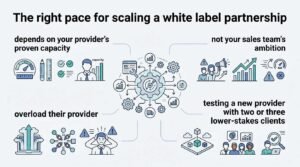
The right pace for scaling a white label partnership depends on your provider’s proven capacity, not your sales team’s ambition. Agencies that ignore this and scale too fast overload their provider and damage every client relationship simultaneously.
I recommend testing a new provider with two or three lower-stakes clients before shifting your entire book of business. That gives you real performance data before the risk gets bigger.
Contract, Compliance, and Ethical Considerations
Contracts with white label providers should explicitly define ownership of deliverables, confidentiality terms, and what happens if either party exits the agreement. Vague contracts create disputes exactly when agencies can least afford them.
I never sign a white label agreement without a clear data ownership clause. Client rankings, backlink profiles, and content assets need to transfer cleanly if you ever switch providers.
Non-Disclosure and Non-Compete Clauses
Non-disclosure clauses prevent the provider from revealing they’re doing the work behind your agency’s brand, protecting your client relationships. Non-compete clauses stop the provider from approaching your clients directly, which matters more than most agencies realize until it happens.
I treat these clauses as non-negotiable in any contract draft. A provider unwilling to sign either one isn’t a partner I’m willing to risk client trust with.
Conclusion
White label partnerships let agencies scale technical execution, content output, and link building without the overhead of full-time hires. Choosing the right partner, structuring fair pricing, and maintaining quality control determine whether that growth sticks.
The broader SEO landscape keeps shifting, and agencies that pair strong partnerships with realistic timelines position clients for sustainable results. Cluster resources throughout this guide go deeper into each piece.
We built White Label SEO Service to help agencies scale delivery without sacrificing quality or client trust. Reach out and let’s talk about how we fit into your growth plan.
Frequently Asked Questions
Is white label SEO worth it for small agencies?
Yes, white label SEO is worth it for small agencies that lack the staff or budget to hire specialized in-house talent. It lets small teams compete for larger contracts without the overhead of full-time hires.
How much does white label SEO cost?
White label SEO typically costs between $300 and $2,000 per client per month, depending on service scope and provider expertise. Pricing scales with the complexity of technical work, content volume, and link building involved.
Can I rebrand white label SEO reports as my own?
Yes, rebranding white label reports as your own is standard practice and expected in these partnerships. Most providers build reports specifically to carry your agency’s branding, not theirs.
What’s the difference between white label and private label SEO?
White label SEO involves fully rebranding a provider’s work as your own with no client awareness of the arrangement. Private label SEO sometimes allows more customization but follows a similar branding structure overall.
How do I explain white label SEO to my clients?
Most agencies don’t explain white label arrangements to clients at all, since the work is presented entirely under the agency’s own brand. Clients typically only need to know their results, not who executed the work.
How long does it take to see results from white label SEO campaigns?
Most white label SEO campaigns show measurable ranking improvements within three to six months. Full traffic and lead generation gains typically appear between six and twelve months of consistent execution.
What happens if a white label SEO partner underperforms?
Agencies should have an exit clause allowing them to pause or terminate the partnership if agreed performance benchmarks aren’t met. Reviewing contracts for this protection before signing prevents client relationships from absorbing the damage.