White label SEO lets agencies resell search engine optimization services under their own brand while a third-party provider does the actual work. I’ve watched agencies scale fast this way, and I’ve also watched a handful of them lose major clients because they never built a system for catching problems before they reached the client’s inbox. The arrangement works well when both sides understand what’s actually being handed over.
The real cost of an unmanaged white label partnership shows up months later, in a canceled contract or a damaged domain. I’ve seen both.
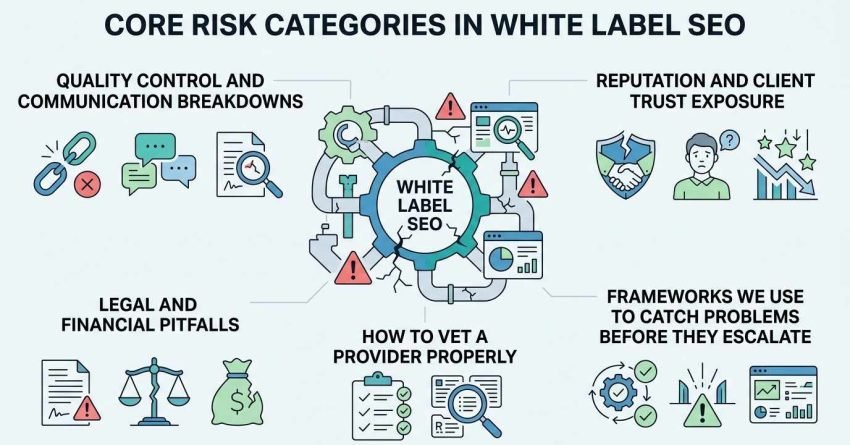
This guide covers the core risk categories in white label SEO, including quality control and communication breakdowns, reputation and client trust exposure, legal and financial pitfalls, and the frameworks we use to catch problems before they escalate. We’ll also cover how to vet a provider properly.
What Is White Label SEO and Why Does Risk Management Matter?
White label SEO is a service arrangement where one company performs SEO work that another company sells and presents as its own. The agency owns the client relationship; the provider owns the execution. I’ve run both sides of this arrangement, and the risk always concentrates at the handoff points: reporting, quality checks, and communication.
How White Label SEO Partnerships Are Structured
Most white label partnerships follow one of three structures: fully outsourced execution, hybrid teams where the agency manages strategy and the provider executes, or white-labeled reporting on work the provider fully controls. Ahrefs’ 2024 agency survey found that agencies using hybrid white label models report 23% higher client retention than those using fully outsourced models.
Each structure shifts risk differently. Full outsourcing concentrates risk in vendor quality. Hybrid models concentrate risk in coordination and handoffs. Neither structure removes risk; it just relocates it, and I’ve found the agencies that succeed are the ones that know exactly where their risk sits.
Quality Control Risks in White Label SEO
Quality control risk in white label SEO means the finished work content, links, technical fixes doesn’t match the standard your agency’s brand promises to clients. This is the single biggest driver of client churn in outsourced SEO arrangements.
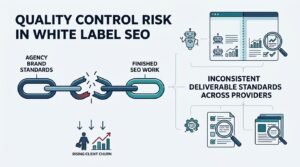
Every provider has an internal quality bar, and it rarely matches what the reselling agency assumes going in. I’ve reviewed white label content that read like it was written to hit a word count, not to rank or convert. Content quality inconsistency becomes visible to clients fast when deliverables vary from month to month. Inconsistent Deliverable Standards Across Providers.
Deliverable standards vary wildly across white label vendors because there’s no industry-wide certification for SEO quality. One provider’s “comprehensive technical audit” might be a 200-point automated scan; another’s might involve genuine manual review. Requesting sample deliverables before signing catches most of this mismatch early.
Communication and Transparency Risks
Communication risk in white label SEO happens when the agency loses visibility into what the provider is actually doing month to month. This gap grows quietly until a client asks a question the agency can’t answer.
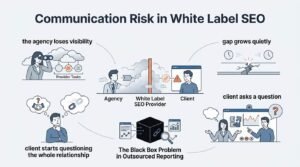
I’ve sat in client calls where I couldn’t explain a ranking drop because the provider hadn’t flagged it. That’s not a small failure; it’s the moment a client starts questioning the whole relationship.
The Black Box Problem in Outsourced Reporting
The black box problem describes a provider relationship where raw data comes through, but the reasoning behind decisions doesn’t. Agencies see rankings move and links get built, but never learn why a particular keyword was prioritized or why a specific page got optimized first. Requiring documented strategy notes alongside monthly reports closes most of this gap.
Reputation Risks When Outsourcing SEO Under Your Brand
Reputation risk means your agency’s name absorbs the consequences of a provider’s mistakes, since the client believes your team did the work. A penalized site, a botched migration, or a spammy backlink profile all land on your brand, not the vendor’s.
This risk compounds because clients rarely separate “the agency I hired” from “the work that got done.” Search Engine Journal’s 2024 industry report found that 41% of agencies have lost a client due to a white label vendor’s underperformance. I’ve had to have that exact conversation, and it’s not one you want to repeat.
What Happens When a White Label Provider Underperforms
Underperformance typically surfaces as stalled rankings, declining organic traffic, or a Google penalty traced back to manipulative link building. The agency usually finds out from the client before the provider raises a flag, which is precisely backward from how the relationship should function. Building your own independent tracking dashboard, separate from the provider’s reports, catches this before the client does.
Client Relationship and Trust Risks

Client relationship risk in white label SEO stems from managing expectations for work your team didn’t directly perform. The agency has to translate provider updates into client-facing language without losing accuracy or overpromising results.
Trust erodes fastest when a client sees a discrepancy between what they were told and what actually happened on their site. I’ve learned that over-communicating uncertainty builds more trust than confidently promising a timeline that isn’t guaranteed.
Managing Client Expectations With a Hidden Vendor
Most clients don’t know a white label vendor exists, and most contracts are written that way on purpose. The challenge is setting timeline and outcome expectations that hold up even when the agency has limited direct control over execution speed. Building in a buffer beyond the provider’s stated timelines protects the agency from vendor delays becoming client-facing failures.
Data Security and Confidentiality Risks
Data security risk in white label SEO involves client credentials, analytics access, and proprietary business data being shared with a third party the client never approved directly. Search Console, Analytics, and CMS logins routinely change hands between agency and provider.
A vendor with weak internal access controls creates exposure the agency’s own security policy can’t cover. This matters more with every client added to a shared vendor relationship.
Access Control Across Multiple Client Accounts
Providers managing dozens of white label clients often use shared logins or loosely governed permission systems, which raises the odds of a credential leak or accidental cross-client data exposure. Requiring individual, revocable access credentials per client account limits the blast radius of any single security failure.
Black Hat and Penalty Risks From Low-Quality Vendors
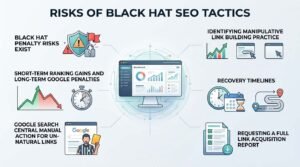
Black hat penalty risk exists because some white label providers use manipulative tactics like link schemes or cloaking to produce fast results that impress agencies during the sales process. These tactics generate short-term ranking gains and long-term Google penalties. The agency’s name is on the site when the penalty hits, not the vendor’s.
A Google Search Central manual action for unnatural links can take months to recover from even after the offending links are disavowed. I’ve walked clients through recovery timelines, and it’s never a fast conversation.
Identifying Manipulative Link Building Practices
Manipulative link building shows up as sudden spikes in referring domains, links from clearly unrelated or low-quality sites, or exact-match anchor text repeated across dozens of placements. Requesting a full link acquisition report before signing, not after, is the only reliable way to catch this pattern in advance.
Legal and Contractual Risks in White Label Agreements
Legal risk in white label SEO centers on unclear ownership terms, liability gaps, and non-compete restrictions that weren’t fully understood at signing. A poorly drafted white label contract can leave an agency owning none of the work product it’s reselling.
I always read the ownership clause twice before anything else. It determines who actually controls the content, links, and technical assets once the relationship ends.
Ownership, Liability, and Non-Compete Clauses
Ownership clauses determine whether the agency retains rights to content and strategy documents after termination, while liability clauses determine who pays if the provider’s work triggers a Google penalty. Non-compete clauses can also restrict which clients or industries the agency is allowed to serve independently. Every one of these terms should be negotiated before any work begins, not after a dispute starts.
Financial and Pricing Risks
Financial risk in white label SEO comes from pricing structures that look affordable upfront but erode margins once add-on fees, scope changes, and minimum commitments are factored in. Many providers advertise a low base rate specifically designed to win the initial sale.
The real cost only becomes clear a few months in, once the agency has already built client pricing around the provider’s initial quote.
Hidden Costs and Margin Erosion
Hidden costs typically show up as charges for “priority” link placements, extra content revisions, or expedited technical fixes that weren’t included in the base package. Moz’s 2024 agency pricing survey found that agencies using white label SEO underestimate actual vendor costs by an average of 18% in their first year. Requesting a complete, itemized fee schedule before signing prevents most of this margin erosion.
Scalability and Capacity Risks
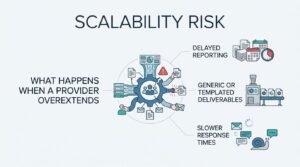
Scalability risk happens when a white label provider takes on more clients than its team can properly service, and quality drops across every account simultaneously. This risk is invisible until it isn’t; everything looks fine until a provider suddenly misses deadlines across multiple accounts at once.
Growth-stage providers are particularly prone to this, since sales often outpaces hiring and process development.
What Happens When a Provider Overextends
An overextended provider typically shows delayed reporting, generic or templated deliverables, and slower response times to agency questions. Capacity strain signals tend to appear in communication speed before they show up in the actual deliverable quality. Watching response time trends month over month gives an early warning before deliverable quality drops.
How to Vet a White Label SEO Provider
Vetting a white label SEO provider means verifying their process, deliverable quality, and client history before signing a contract, not after problems surface. A thorough vetting process is the single most effective risk mitigation step available to an agency.
I never sign with a provider without seeing real, unredacted work samples from an existing client relationship, ideally in a similar industry to the one I’m about to hand them.
Key Questions to Ask Before Signing a Contract
The strongest vetting questions cover process transparency, escalation procedures, and exit terms: How is link building sourced and vetted? What’s the average client tenure? What happens to deliverables and data if the relationship ends? Reference checks with current agency clients reveal far more than any sales call or case study. A provider unwilling to provide references is itself a signal worth taking seriously.
Building a Risk Management Framework for White Label SEO
A risk management framework for white label SEO is a documented system of checkpoints, reporting requirements, and escalation triggers that catches problems before clients notice them. Without this structure, risk management becomes reactive instead of preventive.
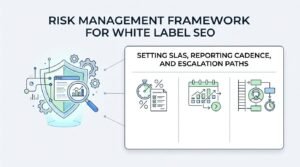
The strongest frameworks I’ve built treat the provider relationship the way I’d treat an internal hire, with clear accountability and regular performance reviews.
Setting SLAs, Reporting Cadence, and Escalation Paths
Service level agreements should specify exact turnaround times, reporting formats, and quality benchmarks tied to measurable outcomes, not vague language like “high quality” or “best effort.” Escalation paths need a named contact and a defined response window for anything from a ranking drop to a security concern. Reviewing these terms quarterly keeps the framework aligned as the relationship and client base grow.
Red Flags That Signal a High-Risk White Label Partner
Red flags in a white label SEO partnership include vague reporting, reluctance to share process details, and pricing that seems too low relative to the promised scope of work. These signals often appear during onboarding, well before any actual damage occurs.
I treat a provider’s transparency during the sales process as a preview of how they’ll behave once the contract is signed.
Warning Signs During the Onboarding Process
Common onboarding red flags include refusal to provide sample reports, pressure to sign before reviewing full contract terms, and inability to clearly explain their link building or content process. A provider that can’t answer specific process questions during onboarding is unlikely to become more transparent once the relationship is underway.
Conclusion
Managing white label SEO means understanding quality, reputation, legal, and financial risk before they surface. Every partnership carries exposure across vendor performance, communication gaps, and contractual terms.
Strong risk frameworks, careful vetting, and clear SLAs turn outsourced SEO into a sustainable growth channel rather than a liability.
We help agencies build exactly this kind of accountable partnership. Reach out to White Label SEO Service to see how we manage risk at every step.
Frequently Asked Questions
What is the biggest risk in white label SEO?
Quality control is the biggest risk in white label SEO, since inconsistent deliverables directly damage client trust in the reselling agency. Reputation and financial risks typically follow close behind.
Can a white label SEO provider get my client’s site penalized?
Yes, a white label provider using manipulative link building or content practices can trigger a Google manual action on a client’s site. The reselling agency’s name is usually attached to the fallout, not the vendor’s.
How do I know if my white label SEO provider is reliable?
Reliable providers offer transparent reporting, verifiable client references, and clear documentation of their process. Requesting sample deliverables and speaking directly with current clients confirms reliability before signing.
Who owns the content in a white label SEO agreement?
Content ownership depends entirely on the contract terms negotiated before work begins. Many agreements default to provider ownership unless the agency specifically negotiates full rights transfer.
What happens if a white label SEO relationship ends abruptly?
Data, login access, and deliverable ownership become immediate concerns when a white label relationship ends abruptly. Contracts should specify a transition period and data handoff process in advance to avoid service gaps.
How much does white label SEO typically cost?
White label SEO pricing varies widely based on scope, ranging from a few hundred to several thousand dollars monthly per client. Hidden fees for add-ons often make the effective cost higher than the advertised base rate.
Should agencies disclose white label partnerships to clients?
Disclosure isn’t legally required in most jurisdictions, but many agencies choose transparency to build long-term trust. The decision typically depends on client relationship dynamics and the agency’s positioning strategy.