White label SEO is a fulfillment arrangement where one company performs SEO work on behalf of another company, which then presents that work to its own clients under its own brand. I’ve watched this model shift from a niche workaround into a standard operating structure across the industry. It matters because agencies of every size face the same core problem: SEO demands specialized, ongoing labor that most client-facing teams can’t fully staff in-house.
Getting this wrong costs agencies client trust, retention, and revenue. The right fulfillment structure protects margins while client expectations stay met.
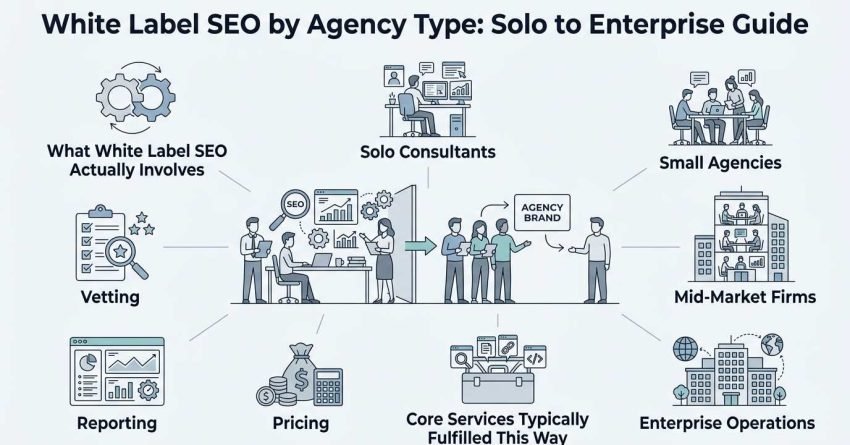
This guide covers what white label SEO actually involves, how the model changes across solo consultants, small agencies, mid-market firms, and enterprise operations, the core services typically fulfilled this way, and how pricing, reporting, and vetting work in practice.
What White Label SEO Actually Means
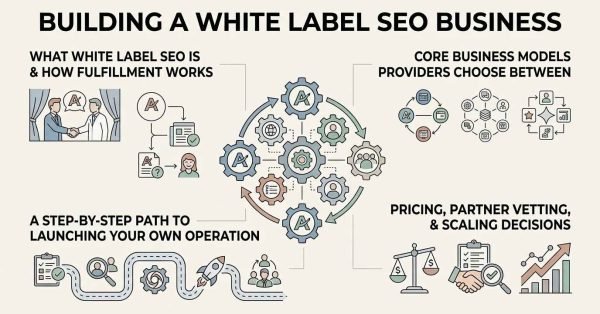
White label SEO is a service arrangement in which a specialized provider performs SEO work technical audits, content, link building, and reporting that gets delivered to the end client under the reselling agency’s own branding. I think of it less as outsourcing and more as invisible staffing. The client never sees the provider’s name anywhere in the deliverables.
This structure exists because SEO requires several distinct skill sets at once: technical auditing, content strategy, and outreach-based link building. Few agencies, especially smaller ones, keep all three fully staffed year-round.
The provider typically works from the reselling agency’s brand guidelines, communicates through the agency (not directly with the end client), and delivers white-labeled reports the agency can present as its own. Ahrefs’ 2024 agency survey found that a majority of digital marketing agencies outsource at least one core SEO function rather than fully staffing it internally.
Who the White Label Provider Serves Behind the Scenes
The provider’s actual client is the agency, not the end business receiving the SEO work. I’ve found this distinction shapes everything about how communication and reporting get structured. The provider answers to the agency’s account manager, not the agency’s client directly.
This behind-the-scenes role means the provider’s success is measured by whether the agency’s client stays happy and retained, not by direct client satisfaction scores. It’s an indirect accountability model that changes how disputes and quality issues get resolved.
Why Agency Size Changes the White Label SEO Equation
Agency size determines how much white label SEO an agency needs, which services it outsources, and how much control it keeps in-house. A solo consultant with one client needs something entirely different from an enterprise firm managing fifty accounts across multiple markets. I see this misunderstood constantly; agencies assume a “one-size” white label package exists when it doesn’t.

Smaller operations tend to outsource nearly everything because they lack the headcount to specialize internally. Larger firms usually keep strategy and client relationships in-house while outsourcing narrower, labor-intensive execution tasks like link building or content production at volume.
Budget structures also shift with size. A solo consultant often pays per-project rates, while enterprise agencies negotiate volume-based contracts with dedicated account teams and custom SLAs.
White Label SEO for Solo Consultants and Freelancers
Solo consultants use white label SEO to offer a full-service package without hiring additional staff, letting one person manage client relationships while a provider handles execution. This lets a single operator compete against agencies with dedicated departments. The margin gets split with the provider, but the alternative of turning down SEO work entirely costs more in lost revenue.
The core constraint for a solo operator isn’t skill; it’s hours in the day. Technical audits, content calendars, and outreach campaigns each demand focused blocks of time that a one-person shop can’t dedicate to every client simultaneously.
Capacity Gaps a Solo Consultant Faces
A solo consultant typically hits capacity limits around three to five active SEO clients before quality starts slipping. I’ve seen this threshold play out repeatedly: the same person managing strategy calls, content reviews, and technical fixes runs out of bandwidth fast.
Outsourcing execution to a white label partner removes the highest-effort, lowest-differentiation tasks (technical implementation, bulk content writing) so the consultant’s time goes toward strategy and client communication instead.
What Solo Operators Should Outsource First
Technical SEO implementation is usually the first function solo consultants hand off, since it requires specialized tooling knowledge and ongoing monitoring that’s hard to maintain part-time. Content production follows closely behind, since consistent output at scale eats disproportionate hours.
Link building tends to stay outsourced longest for solo operators because outreach campaigns require dedicated relationship-building time that rarely fits around client meetings.
White Label SEO for Small Agencies (2–10 People)
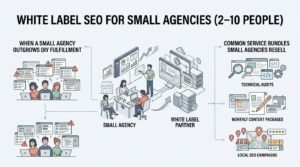
Small agencies between two and ten people use white label SEO to fill specific skill gaps, usually technical SEO or link building, while keeping strategy, reporting, and client relationships managed internally. This hybrid model lets a small team punch above its actual headcount. The agency retains the client relationship and margin control while the provider absorbs the execution workload.
Small agencies at this size often reach a point where founder-led sales bring in more SEO clients than the existing team can fulfill without dropping quality on current accounts.
When a Small Agency Outgrows DIY Fulfillment
A small agency typically outgrows fully in-house fulfillment once it holds more than six or seven active SEO retainers with a team of three or fewer specialists. I’ve watched this transition happen almost overnight after a single new client signs during a busy month.
At that point, the agency either hires additional in-house staff a slower, costlier path or brings in a white label partner to absorb overflow without the fixed cost of a new salary.
Common Service Bundles Small Agencies Resell
Small agencies commonly resell technical audits, monthly content packages, and local SEO campaigns as their most frequently white-labeled service bundles. These three services tend to have the most standardized deliverables, making them easier to outsource consistently across multiple clients.
Local SEO campaigns specifically get outsourced often because citation building and Google Business Profile management require repetitive, time-intensive work that’s straightforward to hand off.
White Label SEO for Mid-Market Agencies
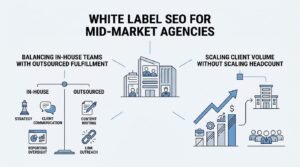
Mid-market agencies use white label SEO to scale client volume beyond what their in-house team can handle without the overhead of proportional hiring, while maintaining strategic oversight internally. These agencies typically have dedicated account managers and some in-house specialists, but outsource execution during growth spurts or seasonal spikes.
This tier faces a different challenge than smaller agencies: they’ve already built internal processes and brand standards, so any white label partner needs to match existing quality benchmarks rather than just fill a skill gap.
Balancing In-House Teams With Outsourced Fulfillment
Mid-market agencies typically keep strategy, client communication, and reporting oversight in-house while outsourcing high-volume execution tasks like content writing and link outreach. This split protects the client relationship the thing that actually drives retention while offloading repetitive production work.
The friction point here is quality consistency. An in-house content writer who understands brand voice deeply differs from a white label writer working from a style guide, so onboarding and feedback loops need real structure.
Scaling Client Volume Without Scaling Headcount
A mid-market agency can typically double its active SEO client count without doubling staff by routing execution-heavy tasks to a white label partner while keeping account management flat. This keeps fixed payroll costs from rising in lockstep with revenue.
The tradeoff shows up in margin per client rather than in capacity, since the provider takes a cut that a fully in-house model wouldn’t require.
White Label SEO for Enterprise Agencies and Large Firms

Enterprise agencies use white label SEO to manage fulfillment complexity across dozens or hundreds of client accounts, often across multiple markets, brands, or languages, where full in-house staffing isn’t cost-efficient at every skill level. At this scale, white label partnerships typically function more like managed vendor relationships than simple outsourcing.
Enterprise contracts usually involve formal service level agreements, dedicated account teams on the provider side, and integration with the agency’s existing project management and reporting systems.
Multi-Location and Multi-Brand Fulfillment Complexity
Enterprise agencies managing multi-location or multi-brand clients need white label partners capable of maintaining separate SEO strategies, local citations, and content voices for each brand or location simultaneously. A single franchise client with fifty locations, for example, needs location-specific technical and content work that doesn’t just copy-paste across markets.
This complexity is why enterprise-level white label providers usually run larger internal teams with role specialization, rather than generalist fulfillment staff.
Compliance, Reporting, and SLA Expectations at Scale
Enterprise agencies typically require formal service level agreements covering turnaround times, quality benchmarks, and escalation procedures before signing a white label contract. Clutch’s 2024 B2B services report found that enterprise buyers cite SLA clarity as a top vendor evaluation criterion, ahead of price in many cases.
Reporting demands also scale up considerably, often requiring custom dashboards, API integrations, and dedicated account check-ins rather than standard monthly PDF reports.
Core Services Covered Under White Label SEO
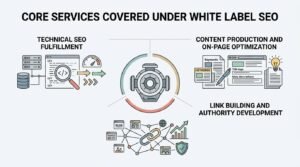
White label SEO typically covers three core service categories: technical SEO fulfillment, content production, and link building, each requiring distinct expertise that agencies commonly outsource independently. Some agencies outsource all three to a single provider; others split them across specialized vendors.
Technical SEO Fulfillment
Technical SEO fulfillment covers site audits, crawlability fixes, page speed optimization, schema markup, and structural issues that affect how search engines index a site. This work requires specialized tooling and ongoing monitoring, which makes it one of the most commonly outsourced functions across agency sizes.
Content Production and On-Page Optimization
Content production covers keyword-mapped articles, landing pages, and on-page elements like title tags and meta descriptions, written to satisfy both search intent and ranking factors. Volume is the main constraint here; a single writer can only produce so many well-researched pieces per month.
Link Building and Authority Development
Link building and authority development involve outreach campaigns, guest content placements, and digital PR efforts designed to earn backlinks that signal site authority to search engines. This function requires ongoing relationship management with external publishers, which is why it’s frequently the first service agencies hand off entirely.
How White Label SEO Pricing Models Differ by Agency Size
White label SEO pricing typically follows three structures: per-project rates for solo consultants, tiered monthly packages for small and mid-market agencies, and custom volume contracts for enterprise firms. Per-project pricing suits sporadic, one-off needs, while ongoing retainer work usually gets discounted at higher monthly volumes.
Solo consultants and small agencies often pay list-rate or lightly discounted pricing since their order volume doesn’t justify custom contracts. Mid-market and enterprise agencies typically negotiate volume discounts once monthly spend crosses a meaningful threshold, sometimes with dedicated account management bundled in.
Choosing Between a White Label Partner and an In-House Hire
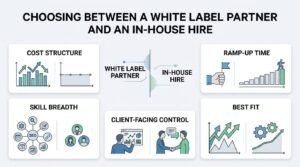
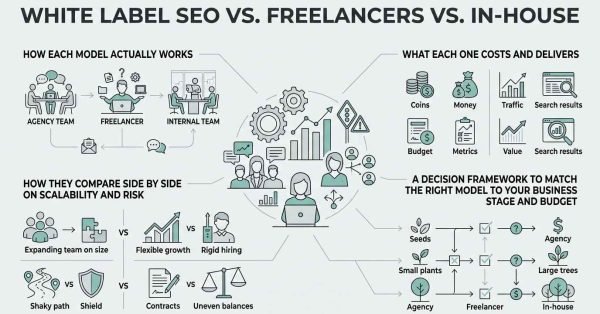
The choice between a white label partner and an in-house hire usually comes down to volume consistency: predictable, ongoing high-volume work favors in-house hiring, while variable or growing demand favors outsourcing. A single full-time SEO specialist costs an agency salary, benefits, and management overhead regardless of how much client work exists in a given month.
| Factor | White Label Partner | In-House Hire |
| Cost structure | Variable, scales with work volume | Fixed, regardless of volume |
| Ramp-up time | Immediate (existing team) | Weeks to months (hiring + training) |
| Skill breadth | Multiple specialists available | Limited to hire’s specific skills |
| Client-facing control | Indirect, through agency | Direct, full oversight |
| Best fit | Fluctuating or growing demand | Stable, high, predictable volume |
How Client Reporting Works in a White Label Arrangement
Client reporting in a white label arrangement typically involves the provider generating branded reports using the agency’s logo and formatting, which the agency reviews before sending to its own client. This keeps the provider’s involvement invisible to the end client throughout the relationship.
Most white label providers offer either fully white-labeled dashboards the agency can access directly, or raw data the agency’s team compiles into its own report templates. The choice usually depends on how much the agency wants to control the final presentation versus save time on formatting.
Common Risks and Red Flags When Vetting a White Label Provider
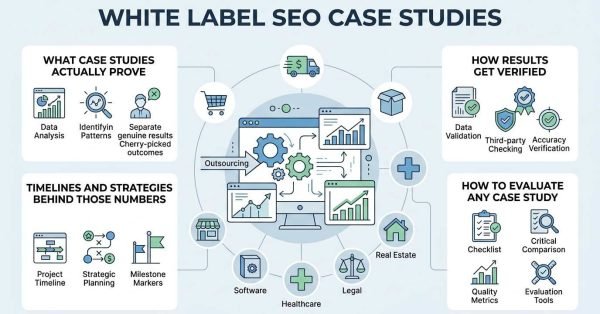
Common red flags when vetting a white label SEO provider include vague reporting, reluctance to share sample work, inconsistent communication turnaround, and pricing that seems too low relative to the scope promised. A provider unwilling to show anonymized case studies or sample deliverables is usually hiding inconsistent quality.
Communication delays are another major warning sign, since the agency itself will get blamed by its end client for any missed deadline, regardless of where the actual delay originated. Unrealistic ranking guarantees are one of the clearest red flags, since no legitimate provider can promise specific rankings on a timeline given how many variables affect search results.
Realistic SEO Timelines Agencies Should Set With Their Clients
SEO typically takes four to six months to show measurable ranking improvement and closer to twelve months for significant traffic and lead growth on competitive terms. Ahrefs’ study of two million keywords found that only 5.7% of pages reach the top 10 search results within a year of publishing, underscoring how gradual organic growth actually is.
Agencies that set accurate timeline expectations upfront retain clients longer than those promising fast results, since clients who understand the gradual nature of organic growth are less likely to churn during the early months.
How to Onboard a White Label SEO Partner Successfully

Successful onboarding with a white label SEO partner typically follows five steps: sharing brand guidelines, defining reporting formats, setting communication cadences, establishing quality benchmarks, and running a trial period before full rollout.
- Share brand voice guidelines and existing client documentation upfront.
- Define exactly what the branded report should look like before the first deliverable.
- Set a fixed communication cadence; weekly check-ins work for most arrangements.
- Establish measurable quality benchmarks tied to actual deliverable specs.
- Run a trial period with one or two accounts before shifting full client volume over.
Skipping the trial period is the most common onboarding mistake, since problems with communication style or quality standards rarely surface until real client work is underway.
Conclusion
White label SEO connects agency capacity with specialized execution, technical fulfillment, content production, and link building scaled to fit solo consultants, mid-market teams, and enterprise operations alike.
As agencies grow, this model shifts from full outsourcing toward hybrid fulfillment, with deeper resources available across the broader SEO service landscape.
We help agencies of every size build dependable, scalable fulfillment. Partner with White Label SEO Service to grow client results without growing overhead.
Frequently Asked Questions
What does white label SEO mean for an agency?
White label SEO means an agency resells SEO work performed by a separate provider under its own brand name. The end client never interacts with or knows about the fulfillment provider.
Is white label SEO worth it for a solo consultant?
Yes, white label SEO lets a solo consultant offer full-service SEO without hiring staff. It’s typically worth it once a consultant handles more clients than they can personally fulfill.
How much does white label SEO typically cost?
Pricing typically ranges from per-project rates for occasional work to tiered monthly packages for ongoing retainers. Enterprise volume contracts usually bring the lowest per-unit cost.
Can enterprise agencies use white label SEO providers?
Yes, enterprise agencies commonly use white label providers for high-volume execution across multiple brands or locations. These arrangements typically involve formal SLAs and dedicated account teams.
How do agencies maintain quality control with white label fulfillment?
Agencies maintain quality control through clear brand guidelines, defined reporting formats, and trial periods before full rollout. Regular check-ins during onboarding catch most quality issues early.
Do clients know the SEO work is outsourced?
No, in a properly structured white label arrangement, the end client believes the reselling agency performed all the work directly. Reports and communication carry the agency’s branding exclusively.
How long does it take to see results from white label SEO?
Results typically take four to six months for initial ranking movement and up to twelve months for significant traffic growth. Timelines depend on competition level and starting site authority.