Offshore white label SEO is a service model where an agency or business outsources SEO execution to a provider based in another country, who works under the client-facing brand’s name. I’ve watched agencies lean on this model to scale delivery without hiring locally, and it works when the provider is vetted properly. It fails just as often when it’s treated as a shortcut instead of a partnership.
Getting this decision wrong costs more than money. It costs client trust, campaign momentum, and months of recoverable rankings.
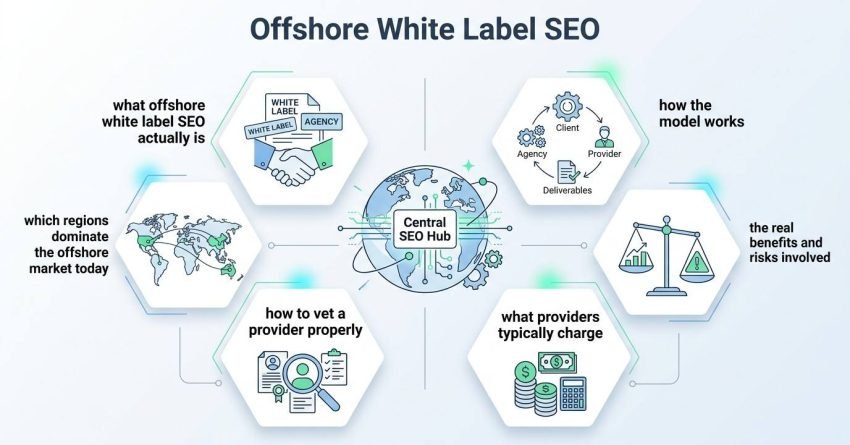
This guide covers what offshore white label SEO actually is and how the model works, the real benefits and risks involved, what providers typically charge, how to vet a provider properly, and which regions dominate the offshore market today.
What Is Offshore White Label SEO?
Offshore white label SEO is a service delivery model in which an SEO provider located in a different country performs SEO work that gets rebranded and resold under another company’s name. The end client never knows a third party is involved. I think of it as outsourcing with a mask on the strategy, execution, and reporting; all happen behind the scenes.
This model exists because building an in-house SEO team is expensive and slow. Agencies get access to skilled labor at a fraction of domestic rates, and they can take on more clients without expanding headcount immediately.
How Offshore White Label Differs From Domestic White Label
Domestic white label SEO keeps the entire relationship within one country, which usually means similar time zones, shared regulatory standards, and easier in-person communication. Offshore white label SEO introduces a geographic and often cultural gap between the reseller and the provider.
That gap isn’t automatically a dealbreaker. I’ve seen offshore partnerships outperform domestic ones purely because the offshore team had deeper technical SEO specialization.
Who Actually Uses Offshore White Label SEO
Digital marketing agencies use offshore white label SEO most heavily, particularly agencies managing more than 15-20 client accounts where hiring in-house isn’t cost-effective yet. Web design firms, PR agencies, and even in-house marketing teams at SMEs also use this model to add SEO services without building internal expertise.
How the Offshore White Label SEO Model Works
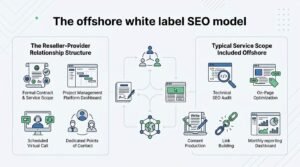
The offshore white label SEO model works through a three-party structure: the end client pays the reseller, the reseller pays the offshore provider, and the offshore provider executes the actual SEO work invisibly. I always tell people to picture it as a relay, where the baton (client communication) never actually leaves the reseller’s hand.
This structure lets the reseller focus entirely on client relationships and sales while outsourcing production work.
The Reseller-Provider Relationship Structure
The reseller signs a contract with the offshore provider that typically includes service scope, reporting cadence, and confidentiality terms. Communication happens through project management platforms, shared reporting dashboards, and scheduled calls rather than in-person meetings.
Strong reseller-provider relationships tend to have one dedicated point of contact on each side rather than a rotating cast of account managers.
Typical Service Scope Included Offshore
Offshore providers commonly deliver technical SEO audits, on-page optimization, content production, link building, and monthly reporting under the reseller’s brand. Higher-end providers also offer local SEO management and structured data implementation.
Not every offshore provider covers strategy, though many execute tasks assigned by the reseller rather than setting direction themselves.
Key Benefits of Offshore White Label SEO

Offshore white label SEO’s primary benefit is cost reduction, since labor rates in common offshore regions run 40-70% lower than equivalent US-based talent. That gap is what makes the entire business model financially viable for agencies operating on thin margins.
Beyond cost, offshore partnerships give agencies access to specialized skill sets they couldn’t otherwise afford to hire full-time.
Cost Efficiency and Margin Advantages
Cost efficiency comes from the wage gap between offshore labor markets and domestic ones, which lets agencies mark up services while still underpricing competitors who staff domestically. An agency paying $800/month offshore for work it resells at $2,500/month keeps a healthy margin most domestic-only shops can’t match.
This margin cushion also gives agencies room to invest in sales and account management instead of production labor.
Scalability for Agencies and In-House Teams
Scalability means an agency can onboard new clients without a corresponding hiring cycle, since offshore providers usually have bench capacity built in. I’ve seen agencies go from 10 to 40 clients in under a year purely because their offshore partner could absorb the volume.
This flexibility matters most for agencies in growth mode, where hiring lag time directly costs revenue opportunities.
Cost Structures and Pricing Models Explained
Offshore white label SEO pricing typically falls into three structures: flat monthly retainers, per-project pricing, and hourly rates, with monthly retainers being the most common for ongoing campaigns. Retainers usually range from $300 to $2,000 per client depending on scope and region.
Providers in South Asia tend to price lowest, while Eastern European providers often charge 20-40% more for comparable deliverables.
Common Pricing Models Offshore Providers Use
Flat monthly retainers dominate the offshore market because they simplify budgeting for both the reseller and the provider, while per-project pricing suits one-off technical audits or content sprints. Hourly pricing is less common and usually reserved for highly specialized technical work like site migrations.
| Pricing Model | Typical Range (USD) | Best Fit For |
| Monthly retainer | $300–$2,000/client | Ongoing SEO campaigns |
| Per-project | $500–$5,000 | Audits, migrations, one-time fixes |
| Hourly | $15–$60/hour | Specialized technical work |
Hidden Costs to Watch For
Hidden costs in offshore SEO contracts often include charges for revisions beyond an agreed limit, premium tool access fees, and rush-delivery surcharges that aren’t disclosed upfront. I’ve seen resellers get blindsided by a “content tool fee” line item that wasn’t mentioned during the sales call.
Reading the full contract before signing avoids most of these surprises entirely.
Risks and Challenges of Offshore White Label SEO
The biggest risk in offshore white label SEO is inconsistent quality control, since the reseller’s brand takes the reputational hit for any subpar work delivered by the offshore team. A missed deadline or a poorly written blog post reflects on the agency, not the offshore provider hiding behind the scenes.
Language barriers, time zone mismatches, and inconsistent reporting standards compound this risk further.
Quality Control and Communication Risks
Quality control risk stems from the reseller’s limited visibility into daily execution, since most offshore work happens without direct oversight until a monthly report arrives. By the time a problem surfaces in reporting, weeks of flawed execution may already have happened.
Communication risk adds another layer, particularly when technical SEO terminology gets lost in translation between non-native English speakers and end clients.
Compliance, Data, and Reputational Risks
Compliance risk arises when offshore providers handle client data without adhering to regulations like GDPR or CCPA, exposing the reseller to legal liability even though the provider caused the breach. Reputational risk follows a similar pattern: the end client blames the agency they hired, not the invisible offshore subcontractor.
Vetting a provider’s data handling practices before onboarding matters as much as vetting their SEO skill.
Quality Control Standards for Offshore Providers
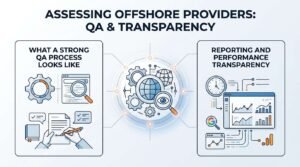
Strong offshore providers maintain quality control through documented SOPs, multi-tier review processes, and native-language proofreading before any content reaches the client. Providers without a written QA process tend to produce inconsistent output as their team scales.
Asking a provider to walk through their QA workflow during the vetting call reveals more than any sales pitch will.
What a Strong QA Process Looks Like
A strong QA process includes at least two review layers: one technical (checking SEO accuracy) and one editorial (checking language and tone), before deliverables reach the reseller. Providers who skip the editorial layer tend to produce technically correct but awkwardly written content.
I look for providers who can show me a sample QA checklist, not just describe one verbally.
Reporting and Performance Transparency
Transparent reporting means the offshore provider gives the reseller real-time or weekly access to performance data through tools like Google Search Console and Google Analytics, rather than a single end-of-month PDF. Monthly-only reporting hides problems for far too long.
Providers offering live dashboard access tend to be more confident in their own execution quality.
Communication and Time Zone Management
Effective communication with an offshore SEO team requires establishing overlapping working hours, using asynchronous project management tools, and setting clear escalation paths for urgent issues. A 10-12 hour time difference, common with South Asian providers, means same-day responses require deliberate scheduling.
Providers who staff a few team members on shifted hours to overlap with US business hours tend to resolve issues faster than those operating entirely in their local time zone.
Written documentation becomes more important than verbal communication when time zones don’t overlap much, since a missed real-time conversation can cost a full 24-hour delay.
Top Offshore Regions for White Label SEO Providers
The three dominant offshore regions for white label SEO are South Asia, Southeast Asia, and Eastern Europe, each offering different trade-offs between cost, English proficiency, and time zone overlap with the US. Selecting a region is as much a strategic decision as selecting an individual provider.
South Asia (India, Pakistan, Bangladesh)
South Asia offers the lowest-cost offshore SEO talent globally, with India remaining the largest hub due to its large English-speaking, technically trained workforce. The trade-off is a significant time zone gap with the US, typically 10-13 hours, which limits real-time collaboration.
Quality varies widely across South Asian providers, making vetting especially critical in this region.
Southeast Asia (Philippines, Vietnam)
The Philippines has built a strong reputation in white label SEO due to widespread English fluency and cultural familiarity with US business norms from decades of BPO industry growth. Vietnam offers lower costs than the Philippines with a growing technical SEO talent pool.
Time zone gaps here are similar to South Asia, though English communication quality tends to be smoother, particularly from Filipino teams.
Eastern Europe (Ukraine, Poland, Romania)
Eastern European providers, particularly in Ukraine and Poland, offer strong technical SEO expertise with only a 5-8 hour time difference from the US East Coast, making same-day communication far more realistic. Pricing runs higher than South or Southeast Asia but often closer to the value delivered.
Agencies prioritizing overlap hours and technical depth over rock-bottom pricing tend to gravitate toward this region.
How to Vet an Offshore White Label SEO Provider
Vetting an offshore white label SEO provider requires reviewing case studies, requesting a trial project, checking client references, and confirming their reporting and communication processes before signing a long-term contract. Skipping this step is the single most common cause of failed offshore partnerships.
A rushed vetting process almost always costs more time later in damage control.
Questions to Ask Before Signing a Contract
Key vetting questions include asking about team size and turnover rate, requesting sample reports from existing clients, and clarifying what happens if a deliverable misses quality standards. Providers who hesitate on turnover questions often have unstable teams behind the scenes.
Asking for a paid trial project, rather than committing to a full retainer immediately, reveals actual working quality without long-term risk.
Red Flags That Signal a Poor Provider
Red flags include vague pricing structures, an unwillingness to share client references, generic proposal templates that ignore the reseller’s specific niche, and promises of guaranteed rankings within an unrealistic timeframe. Any provider guaranteeing “page one in 30 days” is not being honest about how search engines work.
I treat overly aggressive sales pitches as a warning sign rather than a selling point.
Offshore vs. Domestic vs. Hybrid White Label SEO Models
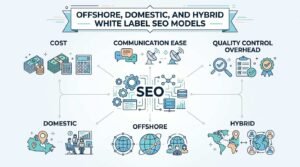
Offshore, domestic, and hybrid white label SEO models differ primarily in cost, communication ease, and quality control overhead, with hybrid models attempting to combine offshore cost savings with domestic oversight. A hybrid setup often keeps strategy and client communication domestic while outsourcing production tasks like content writing and link building offshore.
| Model | Cost | Communication Ease | Quality Control Overhead |
| Domestic | High | Easiest | Low |
| Offshore | Lowest | Hardest | Highest |
| Hybrid | Moderate | Moderate | Moderate |
Agencies scaling quickly often start fully offshore, then shift toward a hybrid model as client volume and revenue justify domestic strategic hires.
Data Security and Client Confidentiality Considerations
Data security in offshore SEO partnerships depends on contractual non-disclosure agreements, restricted access to client analytics accounts, and clear data handling policies aligned with regulations like GDPR. Granting an offshore provider full admin access to a client’s Google Analytics or CMS without restriction creates unnecessary exposure.
Limiting access to only what’s needed for the assigned task reduces risk without slowing down execution.
Contract, SLA, and Legal Considerations
A solid offshore SEO contract includes defined service level agreements covering turnaround times, revision limits, confidentiality terms, and clear termination clauses that protect the reseller if quality drops. Missing SLA terms around reporting deadlines is one of the most common contract gaps I see.
Legal review before signing matters more here than in domestic contracts, since enforcement across international jurisdictions is far more complicated.
How Offshore White Label SEO Fits Into an Agency’s Growth Strategy
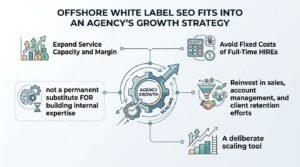
Offshore white label SEO fits into an agency’s growth strategy as a way to expand service capacity and margin without the fixed costs of full-time hires during uncertain growth phases. Agencies use the cost savings to reinvest in sales, account management, and client retention efforts instead.
This approach works best as a deliberate scaling tool rather than a permanent substitute for building internal expertise.
Signs It’s Time to Bring SEO In-House vs. Stay Offshore
Signs it’s time to bring SEO in-house include consistent client growth that justifies fixed salary costs, recurring quality control issues with an offshore partner, and clients requesting more strategic involvement than an offshore execution model can provide. Agencies crossing roughly 30-40 SEO clients often find the economics of in-house hiring start to match or beat offshore costs.
Staying offshore still makes sense for agencies with unpredictable client volume or tight margins that can’t absorb fixed salary risk.
Conclusion
Offshore white label SEO connects cost-efficient execution with agency-branded delivery, spanning provider models, pricing structures, and regional talent pools. Understanding these mechanics helps agencies scale responsibly.
The offshore SEO landscape keeps shifting as regions specialize, and standards rise. Vetting quality matters more than ever.
We help agencies and businesses build SEO partnerships that actually perform. Reach out to White Label SEO Service to talk strategy.
Frequently Asked Questions
Is offshore white label SEO safe for client campaigns?
Offshore white label SEO can be safe when the provider follows documented quality control processes and data security standards. Risk increases significantly with unvetted providers lacking transparent reporting.
How much does offshore white label SEO typically cost?
Offshore white label SEO typically costs $300 to $2,000 per client monthly, depending on region and service scope. South Asian providers generally price lowest, while Eastern European providers charge more.
What’s the difference between white label and offshore SEO?
White label SEO refers to rebranded service delivery under another company’s name, while offshore specifically means that the provider operates in a different country. Offshore white label SEO combines both elements.
Can offshore white label SEO hurt my agency’s reputation?
Poor quality control from an offshore provider can hurt an agency’s reputation since the reseller’s brand takes responsibility for the work. Thorough vetting and ongoing QA reduce this risk substantially.
How do I communicate effectively with an offshore SEO team?
Effective communication with an offshore SEO team requires overlapping working hours, clear written documentation, and defined escalation paths for urgent issues. Asynchronous project management tools help bridge time zone gaps.
Which countries are best for offshore white label SEO?
India, the Philippines, Vietnam, Ukraine, and Poland rank among the best countries for offshore white label SEO. Each offers different trade-offs between cost, English proficiency, and time zone overlap.
Should a growing agency use offshore or domestic white label SEO?
Growing agencies often benefit most from offshore white label SEO during early scaling phases due to lower costs. Domestic or hybrid models become more viable once client volume justifies fixed salary investments.