AI in white label SEO refers to the use of machine learning tools and automation systems to support keyword research, content drafting, technical audits, and reporting inside outsourced SEO delivery. I’ve watched this shift happen fast across agency partnerships, and it’s changing how work gets produced behind the scenes. Agencies reselling SEO need to understand exactly where AI helps and where it introduces risk.
Automation without oversight creates real exposure for resold work. Quality and transparency gaps compound quickly across client accounts.
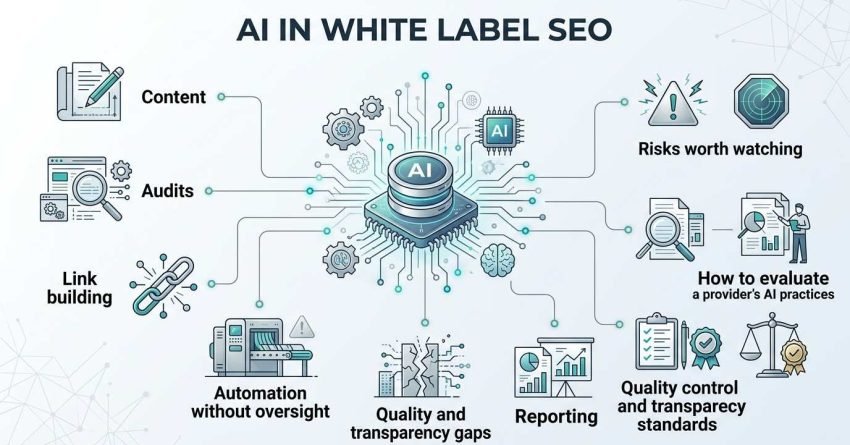
This guide covers what AI actually does inside white label SEO delivery, the specific areas where automation shows up content, audits, link building, and reporting plus the quality control and transparency standards agencies should demand, the risks worth watching, and how to evaluate a provider’s AI practices before signing on.
What AI in White Label SEO Actually Means
AI in white label SEO means using machine learning tools to automate parts of research, content production, technical diagnostics, and reporting that a provider then delivers under an agency’s own brand. It sits inside the existing white label model rather than replacing it. The provider still does the work; AI just changes how much of that work is machine-assisted before a human reviews it.
Traditional white label workflows relied on manual keyword research, hand-written briefs, and analyst-led audits. Traditional white label workflows depended almost entirely on human hours, which capped how many accounts a provider could service well.
How AI Differs From Traditional White Label Workflows
The core difference is speed of first-draft production, not necessarily final quality. AI compresses hours of research and drafting into minutes, but the finished deliverable still depends on the humans reviewing and refining what AI produced.
Where AI Fits in the Agency-to-Client Chain
AI usually sits at the provider level, invisible to the end client unless disclosed. The agency reselling the service often doesn’t know how much of the deliverable was AI-assisted unless the provider is transparent about it.
Why Agencies Are Adopting AI-Driven White Label SEO
Agencies are adopting AI-driven white label SEO because it lets a small delivery team service far more client accounts without proportionally increasing headcount. I’ve seen agencies double their client load with the same analyst team once AI-assisted research and audits entered the workflow.
Scalability Pressure on Agency Delivery Teams
Agencies selling SEO under their own brand face constant margin pressure. Manual research and reporting don’t scale linearly with new clients, and agency scalability pressure pushes many providers toward automation just to keep delivery times competitive.
Client Demand for Faster Turnaround
Clients increasingly expect faster audits, quicker content turnaround, and near-instant reporting. This demand for speed is a major driver behind AI adoption across resold SEO services, even when quality controls haven’t caught up yet.
Core Areas Where AI Is Used in White Label SEO
AI shows up in four core areas of white label SEO delivery: keyword research and clustering, content drafting, technical audits, and client reporting. Each area uses AI differently, and the risk level varies quite a bit between them.
| AI Application Area | What AI Does | Human Oversight Needed |
| Keyword Research & Clustering | Groups keywords by intent and topic at scale | Validating search intent accuracy |
| Content Drafting | Produces first-draft briefs or full articles | Editing for voice, accuracy, E-E-A-T |
| Technical Audits | Crawls sites and flags common issues | Prioritizing fixes by business impact |
| Reporting & Dashboards | Aggregates metrics into client-facing reports | Interpreting results and context |
AI in Keyword Research and Clustering
AI tools can process thousands of keywords and group them by semantic similarity in a fraction of the time manual clustering takes. Semantic keyword clustering has become one of the most reliable AI applications because the output is easy to verify against actual search intent.
AI in Content Drafting and Briefs
AI-generated content briefs speed up the research phase, but the drafting itself still needs a human pass for accuracy and tone. This is one of the highest-risk areas covered in more depth further down.
AI in Technical Audits
Automated crawlers flag broken links, duplicate content, and indexation issues far faster than manual review. The output still needs a strategist to decide which issues actually matter for that specific site.
AI in Reporting and Dashboards
AI-assisted reporting tools pull data from Google Search Console and Google Analytics into pre-built templates automatically. This saves hours per client but can produce generic insights if no one adds real strategic interpretation.
AI-Powered Content Creation in White Label SEO
AI-powered content creation uses language models to draft articles, meta descriptions, and briefs that a human editor then reviews before publishing. An AI Overview study by Ahrefs found that pages with heavy unedited AI content saw inconsistent ranking performance compared to human-edited equivalents.
Where AI Content Generation Helps
AI content generation is genuinely useful for first drafts, outlines, and scaling content volume across multiple client accounts at once. It handles repetitive structural work headers, meta tags, boilerplate sections far faster than a writer starting from a blank page.
Where Human Editing Remains Essential
Human editing remains essential for brand voice, factual accuracy, and any claim that needs real expertise behind it. Content that skips this step tends to read as generic and can undermine the trust the agency built with its client.
AI in Technical SEO Audits and Site Diagnostics
AI-assisted technical audits use automated crawlers to scan a site’s structure, speed, and indexation status and flag issues without manual review. Automated crawl diagnostics can process a 10,000-page site in minutes, something that would take a human analyst days to complete manually.
Automated Crawl Analysis vs. Manual Review
Automated crawls catch volume-based issues like broken links and duplicate meta tags reliably. Manual review still matters for judgment calls deciding which of 200 flagged issues actually deserve engineering time first.
AI in Link Building and Outreach Automation
AI in link building automates prospect research and personalizes outreach emails at a scale manual outreach can’t match. This has made link building faster to execute, but it has also made low-quality mass outreach far more common across the industry.
Risks of Over-Automating Outreach
Fully automated outreach campaigns tend to produce generic messaging that gets flagged as spam more often. Personalized link outreach still outperforms fully automated sequences because real relationship context is hard for AI to replicate convincingly.
Quality Control Challenges With AI-Generated SEO Work
Quality control challenges with AI-generated SEO work center on factual accuracy, generic phrasing, and inconsistent brand voice across client accounts. These issues often don’t surface until a client notices the content sounds nothing like their brand.
Common AI Quality Failures Agencies Encounter
AI-generated content sometimes fabricates statistics, misstates technical details, or produces surface-level analysis that reads well but says little. I’ve caught AI drafts citing outdated ranking factors that hadn’t been relevant for years.
Building a Human-in-the-Loop QA Process
A human-in-the-loop QA process means every AI-assisted deliverable passes through a reviewer before it reaches the client. This single step catches most of the quality failures that damage agency-client trust.
Maintaining E-E-A-T When Using AI in White Label SEO
E-E-A-T is a Google quality framework standing for Experience, Expertise, Authoritativeness, and Trustworthiness that search engines use to assess content quality. Maintaining these signals matters more, not less, when AI is involved in production, because unedited AI content often lacks genuine first-hand experience markers.
Why Search Engines Scrutinize AI-Assisted Content
Search engines don’t penalize AI use directly, but they do penalize the generic, low-value patterns that unedited AI content tends to produce. Google’s own guidance states that content quality matters more than how it was produced.
Transparency Standards for AI Use in Agency-Client Relationships
Transparency standards for AI use mean the reselling agency discloses to its own clients how much of the delivered work involved automation. This disclosure builds trust and protects the agency from surprises when a client asks direct questions later.
What Clients Have a Right to Know
Clients have a reasonable right to know whether their content, audits, or reports were AI-assisted, human-produced, or a mix of both. Clear AI disclosure practices prevent the awkward conversations that happen when a client discovers automation after the fact.
Disclosure Practices That Build Trust
Simple disclosure practices include a short statement in onboarding materials or contracts explaining the role AI plays in deliverable production. Agencies that get ahead of this conversation tend to retain clients longer than those who avoid it.
AI Tools Commonly Used in White Label SEO Operations
AI tools commonly used in white label SEO span four functional categories: content generation, technical auditing, keyword research, and reporting automation. Most providers combine several tools rather than relying on a single platform for every task.
Categorizing Tools by Function
Content tools draft copy and briefs. Audit tools crawl and diagnose technical issues. Research tools cluster keywords and map intent. Reporting tools aggregate performance data into client dashboards automatically.
Risks and Limitations of AI in White Label SEO
The main risks of AI in white label SEO are algorithmic detection of low-quality patterns, loss of brand voice consistency, and over-reliance on automation without strategic judgment. These risks compound when a provider skips human review to save time.
Algorithmic Detection and Ranking Risk
Search engines increasingly recognize thin, formulaic content patterns regardless of whether a human or AI produced them. A Search Engine Journal analysis found that sites publishing bulk unedited AI content saw ranking volatility increase noticeably compared to edited content.
Loss of Brand Voice and Nuance
AI-generated content tends toward generic phrasing unless heavily edited for a specific brand’s voice and terminology. This is a particular risk in white label work, where the same base AI output sometimes gets reused with minimal client-specific customization.
How to Evaluate a White Label SEO Partner’s AI Practices
Evaluating a white label SEO partner’s AI practices means asking directly what percentage of deliverables are AI-assisted and what the review process looks like before delivery. A provider that can’t answer this clearly is a warning sign worth taking seriously.
Questions Agencies Should Ask Before Reselling
Agencies should ask what tools are used, who reviews AI output before delivery, and whether clients will be told AI was involved. These questions reveal whether a provider has real quality control or is simply automating everything to cut costs.
The Future of AI in White Label SEO
The future of AI in white label SEO points toward deeper integration into research and diagnostics while human strategy stays central to execution decisions. I expect the gap between providers who use AI well and those who use it carelessly to widen over the next few years.
Where Human Strategy Will Remain Irreplaceable
Human strategists will remain essential for interpreting business context, setting priorities, and making judgment calls AI tools simply aren’t built to make. No automation replaces understanding a specific client’s market position.
Building an AI Governance Framework for Agency Delivery
An AI governance framework is a set of internal rules an agency or provider follows to control how, when, and where AI gets used in client deliverables. Having this framework in writing protects consistency across every account the team touches.
Setting Internal Standards for AI Use
Internal standards typically cover which tasks AI can touch, mandatory human review steps, and disclosure requirements for client contracts. Providers with documented standards tend to produce more consistent quality across their entire client roster.
Conclusion
AI now touches research, content, audits, and reporting across white label SEO delivery. Quality depends entirely on human oversight layered on top of automation.
Agencies that demand transparency and strong QA processes protect their client relationships. The providers who get this balance right will define the next stage of resold SEO.
We build AI-assisted delivery on disciplined human review at every step. Partner with White Label SEO Service for automation you can actually stand behind.
Frequently Asked Questions
Is AI-generated SEO content safe from Google penalties?
Google doesn’t penalize AI use directly but does penalize low-quality, formulaic patterns AI can produce. Content edited for accuracy and originality typically performs fine regardless of how it started.
Do white label SEO providers disclose AI use to agencies?
Disclosure varies widely across providers, with many not volunteering details unless asked directly. Agencies should request this information explicitly before signing any contract.
Can AI fully replace human SEO strategists?
No, AI cannot fully replace human strategists because it lacks judgment about business context and client priorities. It handles repetitive tasks well, but strategy still requires human decision-making.
How much of white label SEO work is automated today?
Automation levels vary by provider, but research, first drafts, and basic audits are commonly AI-assisted today. Final review, strategy, and client communication typically remain human-led.
What quality checks should agencies require for AI-assisted deliverables?
Agencies should require a documented human review step before any AI-assisted deliverable reaches a client. This should include fact-checking, brand voice alignment, and technical accuracy checks.
Does AI content rank as well as human-written content?
Edited AI content can rank comparably to human-written content when quality and originality are maintained. Unedited bulk AI content tends to underperform and shows more ranking volatility.
How do agencies maintain brand voice when reselling AI-assisted SEO?
Agencies maintain brand voice by having editors review every AI-assisted deliverable against brand guidelines before delivery. This step prevents generic-sounding content from reaching the client’s audience.