White label SEO lets agencies and consultants sell SEO services under their own brand while a specialized partner handles the actual fulfillment work. I’ve watched this model reshape how small agencies compete with much larger firms without hiring a full technical team. It works because the client only ever sees the reseller’s name on the report.
Building this kind of business right now matters because client demand for SEO keeps climbing every year. Agencies that skip white label options often stall at a low headcount ceiling.
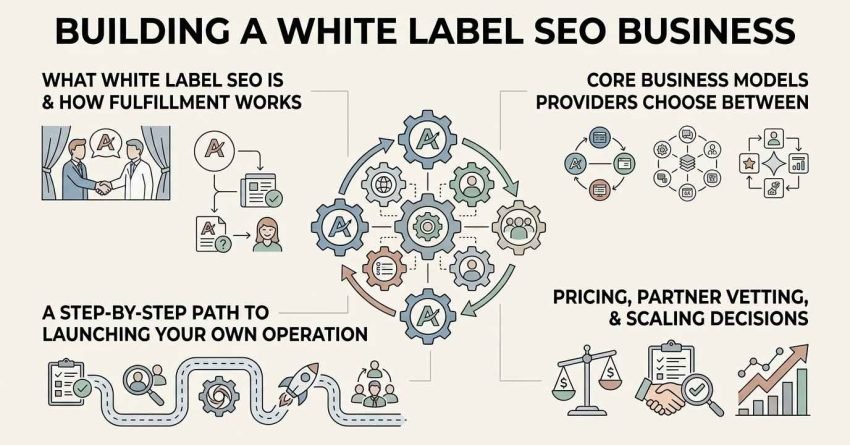
This guide covers what white label SEO actually is and how the fulfillment process works, the core business models providers choose between, a step-by-step path to launching your own operation, and the pricing, partner vetting, and scaling decisions that determine whether the business survives past year one.
What Is White Label SEO?
White label SEO is an arrangement where one company performs SEO work that gets delivered to the end client under a different company’s branding. I use this definition with every new agency owner I talk to because it strips away the confusion around who actually “owns” the work.
The provider doing the fulfillment stays invisible to the end client. Reports, emails, and even the dashboard often carry the reselling agency’s logo and colors instead.
This matters for anyone running or starting an agency because it separates two skills that rarely live in the same person: selling SEO and executing SEO. I’ve met plenty of great salespeople who have zero interest in reading a crawl report, and white labeling lets them focus where they’re strongest.
How White Label SEO Differs From In-House SEO Teams
An in-house SEO team works exclusively for one company and builds knowledge specific to that single brand over time. A white label arrangement instead uses a third-party fulfillment partner serving many agencies at once.
I think the biggest practical difference shows up in ramp-up time. Hiring and training an in-house specialist can take months, while a white label partner can usually start delivering within a week or two of onboarding.
Cost structure changes too. In-house hiring means salary, benefits, software licenses, and management overhead, whereas white labeling converts most of that into a variable, per-client cost.
Who Uses White Label SEO Services
Digital marketing agencies represent the largest group of white label SEO buyers, followed closely by web design firms and independent consultants. I’ve also worked with PR firms and social media agencies who added SEO purely through a white label partner rather than building a department.
Freelancers benefit in a slightly different way. A single consultant managing ten client relationships physically cannot also run technical audits and link campaigns for all ten, so white labeling becomes the only way to scale past their own hours in the day.
How Does White Label SEO Actually Work?
White label SEO works through a structured handoff where the reseller manages the client relationship while the fulfillment partner executes the technical and content work behind the scenes. I think of it as a relay race with a branding wall in the middle: the baton passes, but the client never sees the exchange happen.
The Fulfillment Process From Order to Delivery
The reseller collects client requirements, site access, and goals, then passes that information to the fulfillment partner through a shared onboarding form or portal. I always tell new resellers to over-document this step because miscommunication here creates almost every downstream problem.
The fulfillment partner then audits the site, builds a strategy, and begins execution of technical fixes, content production, or link building depending on the scope. Work moves through the reseller for approval before anything goes live on the client’s site or gets sent as a report.
Most partnerships run on a monthly cycle: strategy and execution happen continuously, while reporting and check-ins happen on a fixed schedule the reseller sets with their own client.
Where the Provider’s Branding Appears (and Doesn’t)
The fulfillment partner’s name is stripped from reports, project management tools, and any client-facing communication. I’ve seen agencies white label everything down to the sender email address and the color scheme on a PDF report.
Behind the scenes, the fulfillment partner’s team, tools, and internal processes stay completely separate from what the client ever sees or asks about.
Why Build a White Label SEO Business Instead of Hiring In-House?
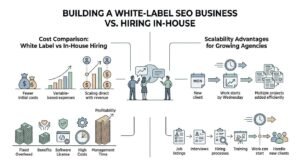
Building a white-label SEO business instead of hiring in-house lets an agency add a full-service capability without the fixed cost, training time, or management burden of a permanent SEO team. I’ve watched agencies triple their SEO client count in a year using this exact structure.
Cost Comparison: White Label vs In-House Hiring
A single in-house SEO hire in the US typically costs a base salary plus benefits, software, and management time, often the equivalent of managing three to five client accounts before that hire even turns a profit. White label fulfillment instead charges per client or per project, so cost scales directly with revenue instead of running ahead of it.
I find this comparison convinces most skeptical agency owners faster than any other argument, because it’s simple math rather than a sales pitch.
Scalability Advantages for Growing Agencies
An agency using white label fulfillment can accept a new SEO client on Monday and have work started by Wednesday, without posting a job listing or running interviews. This kind of scalability lets a two-person agency service fifty SEO clients if the sales pipeline supports it.
Core Business Models for White Label SEO Providers
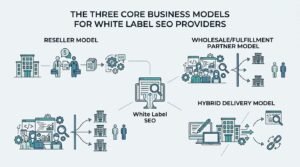
The three core business models for white label SEO providers are the reseller model, the wholesale fulfillment model, and a hybrid delivery model that blends the two. Choosing between them shapes almost every other decision in the business.
Reseller Model
In the reseller model, the agency owns the entire client relationship, sets its own pricing, and simply passes the execution work to a fulfillment partner. I consider this the lowest-risk entry point for someone testing whether an SEO offering fits their existing client base.
The reseller takes on sales and account management responsibility while contributing none of the technical labor themselves.
Wholesale/Fulfillment Partner Model
The wholesale model flips the arrangement: the provider builds and delivers the actual SEO work at scale for many resellers, without ever speaking to the end client directly. I see this model chosen by teams with strong technical skills but no interest in sales or client management.
Hybrid Delivery Model
A hybrid model mixes in-house capability with white label support; an agency might keep content writing internal while outsourcing technical audits and link building. This gives a growing agency more control over quality on the parts of the service they consider core to their brand.
Step-by-Step: How to Start a White Label SEO Business
Starting a white label SEO business follows three sequential steps: defining your service scope, vetting a fulfillment partner, and formalizing the relationship through contracts and branding guidelines. Skipping any one of these three tends to surface as a costly problem within the first ninety days.
Defining Your Niche and Service Scope
I always push new providers to pick a niche before anything else local service businesses, e-commerce, or SaaS, for example because a defined niche makes both sales messaging and fulfillment strategy far more consistent.
Service scope needs the same clarity. Deciding upfront whether the business sells technical SEO, content, link building, or all three prevents scope creep once clients start asking for extras.
Vetting and Selecting a White Label Partner
A trustworthy fulfillment partner should provide sample reports, case studies, and a clear explanation of their process before any contract gets signed. I never recommend signing with a partner who won’t share a sample audit or walk through their reporting dashboard live.
Communication speed during the sales process is usually a reliable preview of communication speed once you’re an active client, so I pay close attention to response times during vetting itself.
Setting Up Contracts, SLAs, and Branding Guidelines
A solid contract spells out turnaround times, revision limits, ownership of deliverables, and what happens if a client cancels mid-project. Branding guidelines need to cover exactly how reports, emails, and any client-facing materials should look before the first client ever gets onboarded.
What Services Can Be White Labeled in SEO?
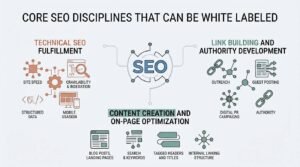
Nearly every core SEO discipline can be white labeled, including technical SEO, content creation and on-page optimization, and link building and authority development. I’ve seen providers specialize in just one of these three or offer all of them as a bundled package.
Technical SEO Fulfillment
Technical SEO fulfillment covers site speed, crawlability, indexation, structured data, and mobile usability fixes. This category tends to require the deepest specialized expertise, which is exactly why it gets white labeled more often than any other SEO discipline.
Content Creation and On-Page Optimization
Content fulfillment includes keyword-mapped blog posts, landing page copy, and on-page elements like title tags, headers, and internal linking structure. A strong content fulfillment partner should be producing material that reads naturally rather than obviously keyword-stuffed.
Link Building and Authority Development
Link building fulfillment involves outreach, guest posting, and digital PR campaigns designed to earn backlinks from relevant, authoritative sites. This service carries the highest reputational risk of the three since low-quality link tactics can actively damage a client’s site.
How to Price White Label SEO Services for Profit
White label SEO services get priced profitably by adding a markup of roughly 30 to 50 percent on top of the fulfillment partner’s base cost, adjusted for the reseller’s own sales and account management overhead. Pricing too thin is the single fastest way I’ve seen new resellers go out of business.
Common Pricing Models (Flat-Fee, Hourly, Retainer)

Flat-fee pricing charges a set monthly rate regardless of hours worked, which simplifies client conversations but requires accurate cost estimation upfront. Retainer pricing works similarly but often scales with the client’s site size or competitive difficulty.
Hourly pricing is far less common in SEO specifically because clients tend to distrust paying for effort rather than results.
Calculating Markup and Margin
Markup gets calculated by taking the fulfillment partner’s wholesale cost and adding the percentage needed to cover sales commissions, account management time, and target profit. I recommend resellers model at least three different client sizes before setting a single standard price point.
How to Choose the Right White Label SEO Partner
The right white label SEO partner is chosen by evaluating reporting transparency, communication speed, proven track record, and how well their process fits your specific client niche. Getting this decision wrong early tends to cost far more than switching partners does later.
Key Vetting Criteria (Reporting, Transparency, Track Record)
Reporting quality should be evaluated by asking for a live sample report, not just a template screenshot. Transparency shows up in whether a partner will explain exactly what work gets done each month, in plain language, without hiding behind jargon.
Track record matters too, and case studies with real, verifiable results carry more weight than testimonials alone.
Red Flags to Avoid in a White Label Partner
Vague reporting, guaranteed rankings, and reluctance to share client references are the three clearest red flags in this vetting process. A partner promising a specific ranking position within a fixed timeframe is making a claim the algorithm itself doesn’t support.
What Reporting and Transparency Should Clients Expect?
Clients working with a white label SEO reseller should expect monthly reports covering keyword rankings, organic traffic trends, and a summary of completed work. I think the reports matter almost as much as the SEO work itself, since they’re often the only tangible proof of progress a client sees.
Standard KPIs Tracked in White Label SEO Reports
Standard KPIs include organic traffic growth, keyword ranking position changes, backlinks acquired, and technical issues resolved during the reporting period. A well-built report ties each of these metrics back to a business outcome like leads or conversions rather than presenting them in isolation.
How to Sell White Label SEO to Your Clients
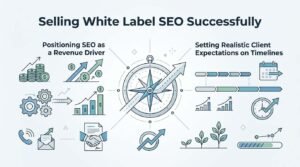
Selling white label SEO successfully means positioning it as a revenue-driving investment rather than a technical service, while setting realistic expectations about how long results take to appear. I’ve found agencies that lead with ROI language close deals far faster than ones that lead with technical jargon.
Positioning SEO as a Revenue Driver
Framing SEO around leads, conversions, and revenue rather than rankings and traffic alone gives non-technical clients a much easier way to judge success. I always tell resellers to translate every ranking improvement into what it means for the client’s actual business.
Setting Realistic Client Expectations on Timelines
Most SEO campaigns take four to twelve months to show meaningful traffic growth, and setting this expectation upfront prevents the most common source of client churn. Clients who hear “results in thirty days” during the sales process almost always cancel by month three when that promise doesn’t hold.
Common Challenges When Running a White Label SEO Business
The most common challenges in running a white label SEO business are communication breakdowns with the fulfillment partner, managing client expectations around timelines, and maintaining consistent quality across multiple client accounts. I’ve seen even well-run agencies stumble on the communication piece specifically.
Managing Communication Gaps Between Client and Fulfillment Partner
A communication gap happens when the reseller can’t answer a client question because information hasn’t been relayed clearly from the fulfillment partner. Setting a fixed weekly sync between the reseller’s account manager and the fulfillment team tends to close this gap quickly.
Essential Tools for Managing a White Label SEO Operation
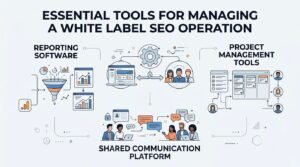
Running a white label SEO operation efficiently requires reporting software, project management tools, and a shared communication platform connecting the reseller and fulfillment partner. Choosing the wrong stack early tends to create friction that compounds as the client list grows.
Reporting, Project Management, and Communication Tools
Reporting tools should pull data directly from Google Search Console and Google Analytics into a branded, automated dashboard rather than a manually built spreadsheet. Project management tools need to track task status across both the reseller and fulfillment sides so nothing falls into a communication gap.
How to Scale a White Label SEO Business Long-Term
Scaling a white label SEO business long-term depends on building repeatable onboarding systems and prioritizing client retention over constant new client acquisition. I’ve seen agencies grow fastest not by adding more clients, but by keeping the ones they already have for years instead of months.
Building Repeatable Systems and Client Retention
A repeatable onboarding system turns a chaotic first thirty days into a predictable checklist that any team member can execute. Client retention improves dramatically once reporting, communication, and results all become consistent instead of ad hoc.
Conclusion
White label SEO connects reseller agencies, fulfillment partners, and end clients into one working system built on branding, pricing, and trust. This model keeps evolving as agencies scale past what any single in-house team could deliver alone.
We built White Label SEO Service to help providers launch and scale exactly this kind of partnership with confidence.
Frequently Asked Questions
What is white label SEO in simple terms?
White label SEO is when one company performs SEO work that gets delivered to a client under a different company’s brand. The end client never interacts with the actual fulfillment team.
Is white label SEO profitable for agencies?
Yes, white label SEO is profitable when priced with a 30 to 50 percent markup over fulfillment costs. Profitability depends on maintaining low overhead since execution work is outsourced.
How much does white label SEO cost?
White label SEO costs typically range based on service scope, client site size, and competitive difficulty. Fulfillment partners usually charge wholesale rates that resellers then mark up for their own clients.
Do I need SEO experience to start a white label SEO business?
No, extensive SEO experience isn’t required to start a white label SEO business since a fulfillment partner handles execution. Sales and client management skills matter more for this specific business model.
How long does it take to see results from white label SEO?
Most white label SEO campaigns take four to twelve months to produce meaningful organic traffic growth. Timelines depend on site history, competition, and the scope of work being executed.
What’s the difference between reseller and wholesale SEO models?
A reseller owns the client relationship and outsources execution, while a wholesale partner delivers the execution work itself, often without direct client contact. Some providers blend both into a hybrid model.
How do I find a reliable white label SEO partner?
A reliable white label SEO partner provides sample reports, clear process documentation, and verifiable case studies before signing any contract. Communication speed during vetting is usually a preview of ongoing service quality.